
❌

Normal view

NASA’s New X-59 Test Pilot Gets Behind Controls for Ground Test
16 September 2026 at 00:37
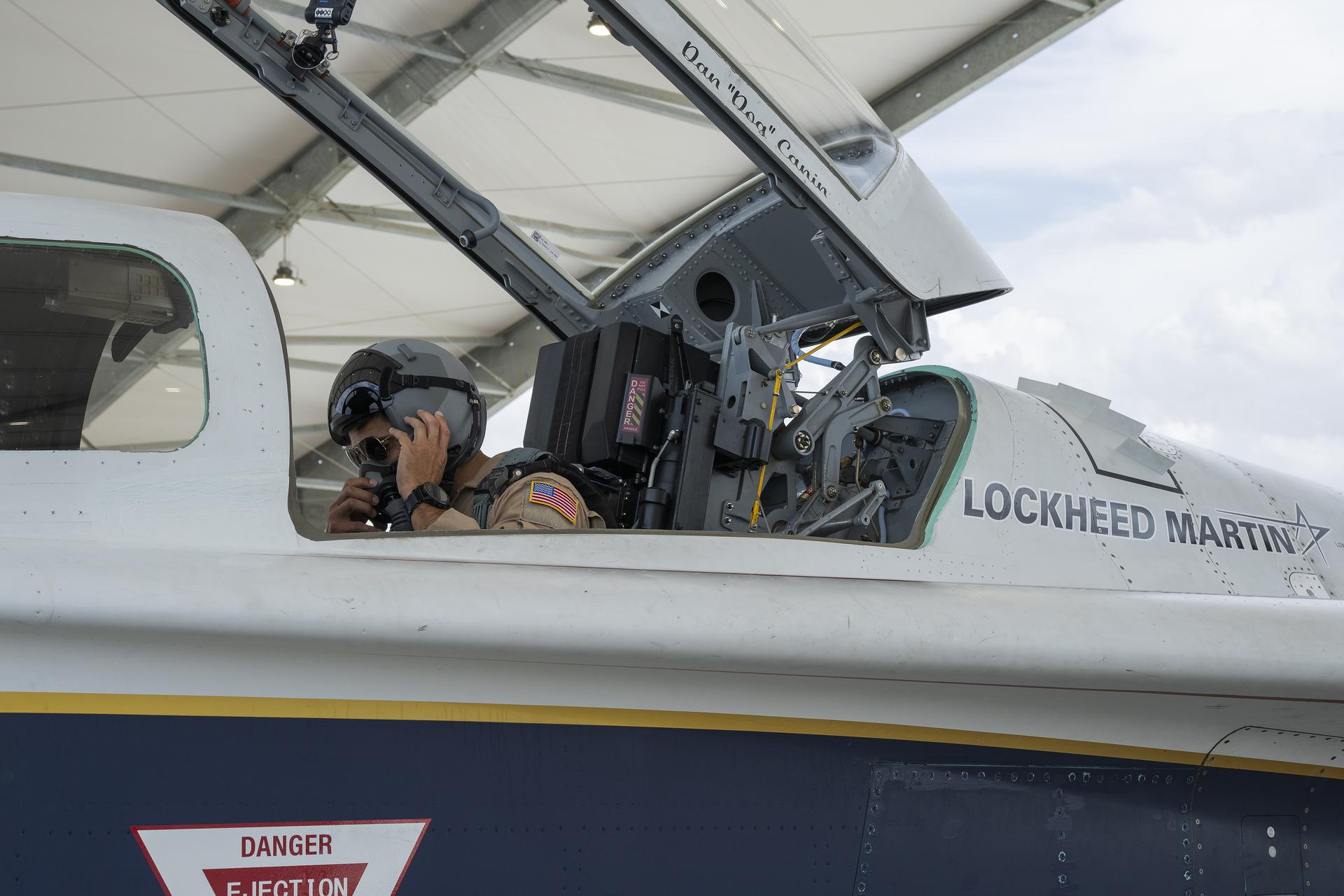
A man seated inside an aircraft cockpit adjusts a helmet, with the open canopy above him.
Mike Lippert, one of NASA’s X‑59 test pilots, sits in the cockpit of the agency’s X‑59 quiet supersonic research aircraft for the first time during an engine run at NASA’s Armstrong Flight Research Center in Edwards, California, on Thursday, Aug. 27, 2026. Lippert is the third X‑59 pilot supporting NASA’s Quesst mission, which will demonstrate quiet supersonic flight over U.S. communities and gather public feedback on the aircraft’s quieter sonic “thump.”
NASA/Carla Escamilla

This summer, NASA test pilot Mike Lippert powered up the X‑59 cockpit for the first time, running the aircraft’s engines on the ground during a key step in his months of preparation and training to fly the experimental aircraft. 

“Getting into the cockpit of the X‑59 felt very comfortable,” said Lippert, the newest X-59 test pilot for NASA’s Quesst mission. “The whole team has done a tremendous job of making sure I am trained and prepared.”

Lippert’s first powered interaction with the aircraft demonstrated how mentorship works in NASA’s test pilot community. The X‑59’s two established pilots, Nils Larson and Jim “Clue” Less, guided him throughout the test. Larson monitored Lippert’s coordination with the control room, while Less answered questions and provided coaching. 

Their feedback, along with insights from experienced engineers, turned the startup sequence into a detailed training exercise to strengthen Lippert’s understanding of the X‑59’s systems and the pace of test operations. 

The X-59 is a revolutionary design, shaped to create a quiet thump instead of a sonic boom when flying faster than the speed of sound. The test pilots’ experience and skill will allow NASA to safely test the aircraft, then eventually fly it over U.S. communities to gather data on how the public perceives the sounds it makes. 

The engine run also introduced Lippert to the X‑59’s maintenance crew. As the test progressed, Lippert saw how the cockpit and control room work together during critical operations. Watching the real-time rhythm, he said, provided a better understanding of how NASA’s flight test teams align to ensure safety and precision. 

Lippert credited the test team’s operating practices and leadership for helping him prepare for flight. He spent extensive time in the X-59’s high-fidelity simulator — designed to match the aircraft’s cockpit — for training, aircraft familiarization, and mission rehearsal. The simulation team’s members are absolute experts on the aircraft and have been key contributors to his training and the program as a whole, Lippert said. 

Lippert said he felt energized after powering on the aircraft’s systems for the first time, adding the milestone left him feeling ready for upcoming test flights. The X-59 will continue to progress through envelope expansion and test its performance under various flight conditions. In the coming months, it will advance toward acoustic validation flight tests to study the sonic thumps it is designed to make.

Learn more about the Quesst mission on NASA’s site.  

The post NASA’s New X-59 Test Pilot Gets Behind Controls for Ground Test appeared first on NASA Science.

Promoções na App Store: Planet of Lana, Little Nightmares, Smart Calculator: All In One e mais!

15 September 2026 at 17:55

Nesta terça-feira, confira, aproveite e economize com a nossa seleção de promoções na App Store!

Planet of Lana é uma bela aventura, desenvolvida pelo Wishfully Studios e publicada nas plataformas móveis pela Playdigious, e nosso destaque do dia.

O jogo nos conquista primeiro pelos olhos: cada cenário parece uma pintura em movimento, com cores vibrantes, que transforma o planeta alienígena em algo ao mesmo tempo acolhedor e misterioso.

A jornada de Lana e seu companheiro Mui se destaca pela atmosfera contemplativa, criando uma experiência com um tom esperançoso. O design dos puzzles é intuitivo e nos incentiva a observar o ambiente e experimentar soluções criativas.

Confira um vídeo:

Um jogo cuja história passeia pelo equilíbrio, natureza e conexão. Uma oferta imperdível! 🥹


Abaixo outros jogos/apps que, juntos, somam quase R$130 em descontos:

Jogos

Jogo de aventura.

Jogo de cartas.

Diversão matemática.

Aplicativos

Calculadora.

Utilitário para códigos QR.

Fotos panorâmicas.


Aproveite as ofertas e até amanhã! Lembrando que elas são sempre por tempo limitado, então é bom correr. ✈️

Developing for iPhone Duo

11 September 2026 at 18:58

Craig Hockenberry:

It looks like Xcode 27.1 is needed to test the iPhone Duo resizability - and that hasn’t been uploaded yet.

Jordan Morgan:

Cupertino and Friends™️ dropped six new videos over developing, designing, and crafting great apps for the nascent device:

  1. Design for iPhone Duo
  2. Prepare your app for iPhone Duo
  3. Raise the bar with iPhone Duo
  4. Strike a pose with adaptive layouts on iPhone Duo
  5. Leverage multiple displays and scenes on iPhone Duo
  6. Build a great camera experience for iPhone Duo

Nathan Manceaux-Panot:

In the Duo dev video, they describe how text buttons can’t be moved to the new vertical sidebar, as opposed to icon buttons.

I wonder if that’s one of the reasons Liquid Glass pushed hard for icon buttons, even though these are harder to understand; they make the vertical layout possible at all.

Nico Reese:

Totally confusing to me how the toolbar is ordered completely different between both modes here.

Dennis Oberhoff:

I think the problem with the iPhone Duo for developers is mostly that it does not create any new opportunities in the form of a new market or a new audience.

Previously:

Update (2026-09-17): See also: Accidental Tech Podcast.

Previously:

Update (2026-09-18): Xcode 27.1 Beta (Hacker News) adds support for iPhone Duo, but:

StandBy is unavailable in the iPhone Duo Simulator runtime.

Running and debugging most app extensions is unavailable in the iPhone Duo Simulator runtime.

Update (2026-09-21): Léo Natan:

Apple writing example code in Objective C, in 2026. They are REALLY desperate for developers to support this device.

Natalia Panferova:

On iPhone Duo, navigation controls, toolbar actions, and tabs can move into a shared vertical bar along the edge of the display, leaving more vertical space for content. Apps built with the iOS 27.1 SDK get this adaptation through standard containers such as NavigationStack, NavigationSplitView, and TabView. We continue to declare toolbar actions in their usual placements, and SwiftUI determines how to present them in the current context.

Imthaz Ahamed:

I was going through the iPhone Duo specs and realised the inner screen has a different pixel density to the outer screen. The inner 7.6-inch folding display runs at 1878×2670 and 430 ppi, while the outer 5.4-inch display runs at 1398×2034 and 460 ppi.

Jesper:

The iPhone Duo remains interesting, and is clearly a technical tour-de-force that is the outcome of deep thinking about what a foldable phone can be. But the things that sparkle in my mind when I consider it is just the details. They are very important details that yield a noticeably different product, but they are sprinkles on top of a downward slope in user interface design at Apple that does not care any longer about what users or developers want. All that's important is for this year's device to uproot fundamentals and demand that everyone conform to an arbitrary new intuition.

Update (2026-09-29): Craig Hockenberry:

I don’t remember seeing this mentioned anywhere, but you have to be careful about where you place your safe area constraints.

My first pass moved the constraints on scroll/collection views from the superview leading/trailing to the safe area leading/trailing.

[…]

But if you look at Settings and Safari - our only two examples of “what’s right”, you’ll see the scroll indicators are “outside” the navigation bar and hug the edge of the device bezel.

❌