Researchers have identified a new plant species in western Thailand whose unusual appearance inspired the dramatic name Thismia daemona, or the “devil flower.” A nearly black flower with horn-like projections and flashes of reddish orange has been discovered beneath leaf litter in a mountain forest in western Thailand. The plant cannot photosynthesize, spends most of [...]
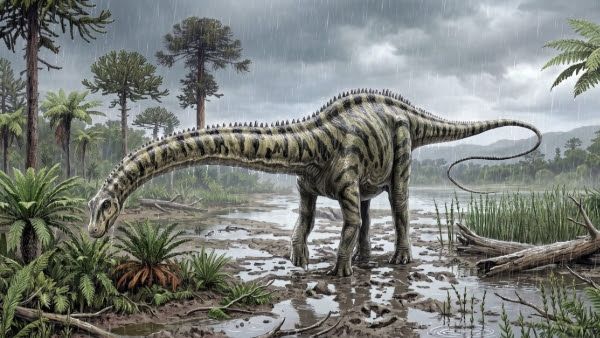
Paleontologists have identified the first confirmed remains of Diplodocus — "Dippy," for short — outside the western U.S., revealing that the iconic long-necked dinosaur reached what is now Spain roughly 150 million years ago.
The findings show that the enormous sauropod didn't live only in North America, as was long thought. Instead, it may have rambled across a land bridge all the way to Europe, the new study suggests.
The discovery, made at the La Tejería site near the small village of El Castellar in eastern Spain, provides some of the strongest fossil evidence yet that dinosaurs could move between North America and Europe during the Late Jurassic, when the Atlantic Ocean was still in its early stages of opening after the breakup of the supercontinent Pangaea. The researchers published their findings Tuesday (Sept. 15) in the Journal of Vertebrate Paleontology.
"Paleontological studies like this one help us better understand the history of life on Earth, reconstruct ancient ecosystems, and understand how they changed through time," study first author Sergio Sánchez Fenollosa, a doctoral student who studies biodiversity and evolutionary biology at the Joint Paleontology Foundation Teruel-Dinópolis (Dinópolis Foundation), a paleontological research institution, told Live Science via email.
A sauropod in Spain
Dippy is one of the best-known dinosaurs. After its fossils made their grand debut at the Carnegie Museum of Natural History in Pittsburgh in the early 1900s, life-size fossil replicas of the towering herbivore were sent around the world, including to England, France, Spain, Argentina and Russia.
But until now, Diplodocus' Late Jurassicfossils were known only from the Morrison Formation in the western United States — and the latest discovery shows that Dippy wasn't a homebody.
The newly unearthed Diplodocus specimen consists of 14 well-preserved tail vertebrae and several chevrons — bones that helped support blood vessels and muscles within the dinosaur's tail.
Study co-author and managing director of the Dinópolis Foundation, Alberto Cobos, said it was a friend who "thought he had spotted some bones on a mountainside," Cobos told Live Science via email. "That very day, I went to the site near El Castellar (a village in the province of Teruel). Sure enough, we saw a couple of sauropod vertebral centers."
Although only part of the skeleton has been recovered, the bones show a series of characteristics associated with Diplodocus, including large cavities corresponding to where air sacs would have been, along with deep grooves running alongside the underside of the tailbones.
The 14 vertebrate and several chevrons found in Spain correspond to the Dipolodocus' anatomy. (Image credit: Carmelo López)
"It was an exciting and continuous process of seeing the pieces of the puzzle gradually fall into place," Sánchez Fenollosa said in a statement. "From the early stages of the osteological study, we noticed strong similarities with several diplodocine sauropods … With each new result, the picture became clearer: we were looking at a Diplodocus."
It's unclear which species of Diplodocus the new specimen is, but like others of its genus, it was a huge dinosaur with an extremely long neck and whip-like tail.
"The Diplodocus from El Castellar was approximately 25 meters [82 feet] long (comparable in size to its North American relatives), making it another of the giant sauropods of the Spanish Jurassic," Cobos said in the statement.
An ancient bridge
Between 195 million and 170 million years ago, the supercontinent Pangaea broke apart as the Atlantic Ocean opened. But the ocean was much narrower than it is today, and the continents were not necessarily as isolated as their modern geography is now.
Evidence indicates that temporary land bridges may have allowed some animals to move between the two regions. The most famous prehistoric land bridge is the Bering Land Bridge that humans used to move between Asia and what is now Alaska. Previous research showed the Bering Land Bridge also existed around 68 million years ago, and it may have allowed an Asian ancestor of Tyrannosaurus rex to trek into North America.
Geological conditions may have allowed dinosaurs like Diplodocus to move between continents, Sánchez Fenollosa told Live Science in an email. "This interpretation is supported not only by the fossil record but also by geological evidence," he said.
The newfound Diplodocus fossils also suggest that the distribution of giant sauropods was more complicated than the fossil record previously indicated.
"More complete specimens will be essential to understand this story in greater detail, particularly to determine which Diplodocus species inhabited Europe: whether it was one already known from North America or a previously unknown species," Sánchez Fenollosa said. "This discovery reminds us that even for such iconic dinosaurs, there are still many unanswered questions about their evolutionary history and biogeography."
Staff at St. Louis Zoo in St. Louis, Missouri recently opened up a very special delivery in the mail: an overnight shipment of 500 adult Partula snails.
Their journey began at the Detroit Zoo in Royal Oak, Michigan, and it’s not quite over yet. The small invertebrates’ final destination is Tahiti, where they will be released into the wild as part of an international effort to reestablish wild populations of Partula snails.
“The snails are sent ‘priority overnight’ via either FedEx or UPS. The snails are carefully packed using insulating materials and special ‘phase change’ packs to stabilize the temperature inside,” Mark Vassallo, Curator of Amphibians at the Detroit Zoological Society, tells Popular Science. “Currently the Detroit Zoological Society bred snails are taking a pit-stop at St. Louis Zoo where they will be fed a special diet in order to prepare them for the wild.”
Partula snails are small, tree-dwelling native to islands in French Polynesia. In Polynesian cultural heritage, each unique Partula snail shell represents an island. When humans introduced the predatory rosy wolf snail to the region to manage another invasive snail species, it wrecked Partula snail populations.
A Partula snail is weighed and measured by keeper Tom Maunders, during the annual weigh-in at Whipsnade Zoo in England. Image: Joe Giddens/PA Images via Getty Images.
For decades, the Detroit Zoo has been breeding and raising Partulasnails and helping return them to their native habitat by the thousands in Tahiti. In fact, the 500 en route right now were all bred at the zoo. Each of their shells features an orange dot of animal-safe paint that glows in UV light, which identifies them as one of the snails released in 2026. Each year has a different color, and the dots also allow conservationists to easily monitor them in their natural habitat.
This upcoming release is part of an international recovery program that has returned 11 different Partula species formerly deemed extinct in the wild to their native environments, consisting of over 17,000 individual snails. The Audubon Nature Institute in New Orleans, Louisiana, also recently sent 200 Partula snails to Tahiti.
Orange markings on Partula nodosa snails bred at the Detroit Zoo glow under ultraviolet light. The markings will help researchers identify and monitor the 2026 release group after the snails are returned to the wild in Tahiti. Image: Detroit Zoo.
When asked what “success” looks like, Vassallo explains that, “Success for a conservation project can be defined in stages but ultimately, a self-sustaining population with consistent reproduction and very importantly, proper habitat that is protected to sustain that species to allow long term recovery and stabilization of that population.”
Some species of Partula snails are already extinct in the wild, such as Partula nodosa. In the wake of reintroductions of the species, however, experts were excited to observe offspring born in the wild.
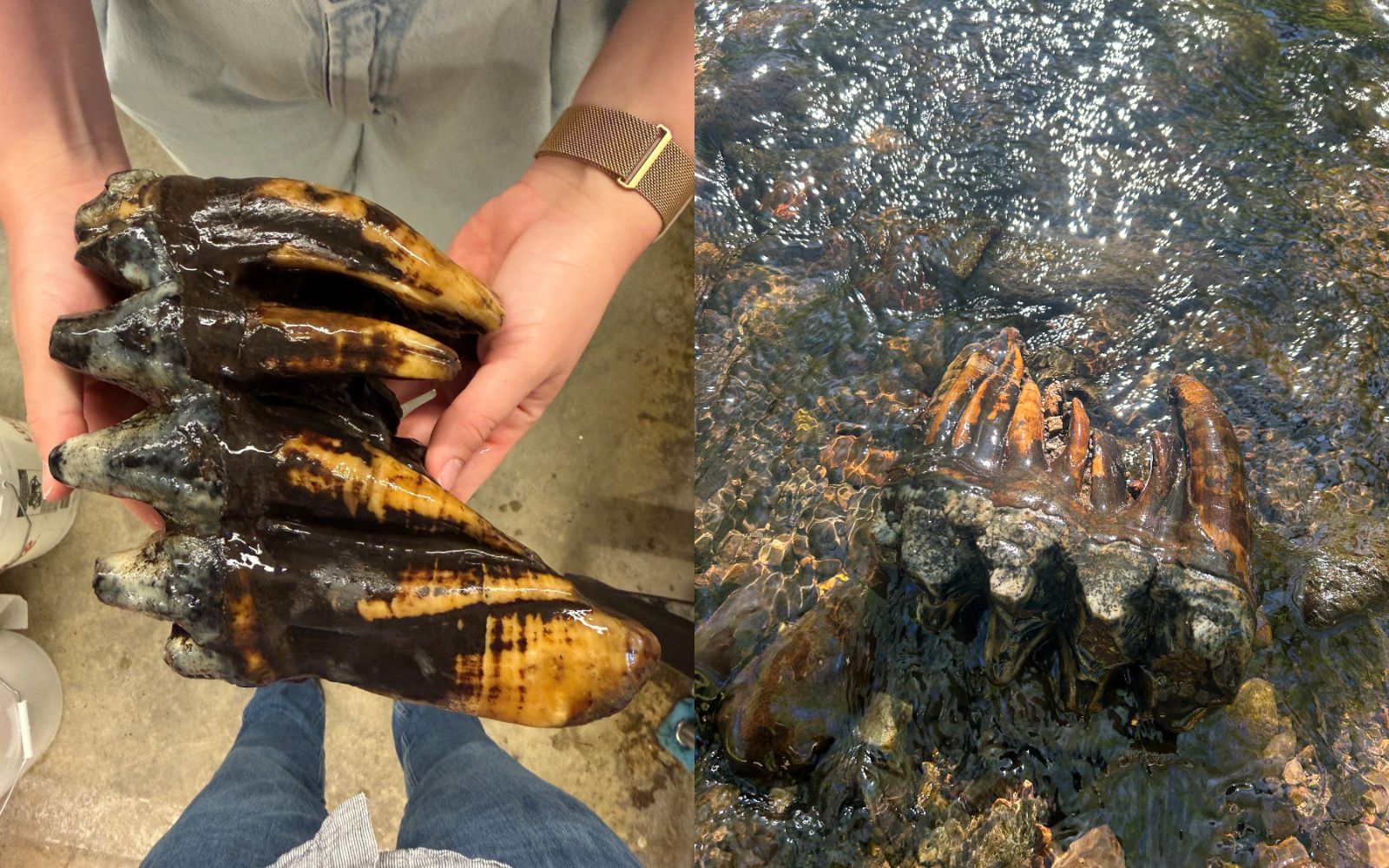
An exceptionally well-preserved fossilized molar belonging to an adult Pacific mastodon has surfaced in a nature preserve near San Francisco.
Upon first glance, the ancient tooth looked like an "oddly shaped rock" to geologists who were conducting fieldwork in the area, according to a statement from the Midpeninsula Regional Open Space (Midpen), which runs the preserve. But the find was quickly unmasked as a valuable fossil from the last ice age and was sent to scientists at Stanford University for carbon dating.
"The tooth itself is in immaculate condition," Wayne Thompson, a paleontologist and the CEO of Pacific Paleontology, a consulting firm that carried out a preliminary analysis, said in the statement. "It's the most complete mastodon molar from our area, and the most spectacular mastodon molar that I've ever seen. I had chills and shivers up and down my spine."
Brigid Lynch, a geomorphologist with the California-based hydrology consulting firm Balance Hydrologics, found the molar this summer while surveying a creek bed. "As a geologist, I've gone out and seen stuff in the field, but definitely nothing as exciting as this," Lynch said in the statement.
Lynch's team was working on a habitat enhancement project to support the threatened California red-legged frog (Rana draytonii) inside the preserve, which is located on the San Francisco Peninsula in San Mateo County. The fossil was a complete surprise and dates to at least 10,000 years ago, when the Pacific mastodon (Mammut pacificus) is thought to have gone extinct.
Mastodons are extinct, elephant-like creatures that lived during the last ice age. (Image credit: Midpen (left); Balance Hydrologics (right))
The Pacific mastodon was first recognized as a species in 2019. It was closely related to the American mastodon (Mammut americanum). Both elephant-like creatures lived in North America during the Pleistocene epoch (2.6 million to 11,700 years ago), but the Pacific mastodon inhabited regions farther west than its cousin, roaming parts of present-day Mexico, California, Oregon and the northern Rocky Mountains of the western U.S., according to the statement.
Pacific and American mastodon fossils reveal slight differences between the species, including a narrower third molar, thicker hind-leg bones and occasionally absent lower-jaw tusks in the Pacific mastodon, according to the Royal Alberta Museum.
The newfound tooth is "another puzzle in the Ice Age saga that we can put into place," Thompson said. To get a precise date for the fossil, Midpen donated it to Stanford University's Doerr School of Sustainability in July, the Los Angeles Times reported.
Researchers will produce a 3D copy of the molar that Midpen plans to use for public outreach and education, according to the statement.

 Login

 Researchers have identified a new plant species in western Thailand whose unusual appearance inspired the dramatic name Thismia daemona, or the “devil flower.” A nearly black flower with horn-like projections and flashes of reddish orange has been discovered beneath leaf litter in a mountain forest in western Thailand. The plant cannot photosynthesize, spends most of [...]