❌

Normal view

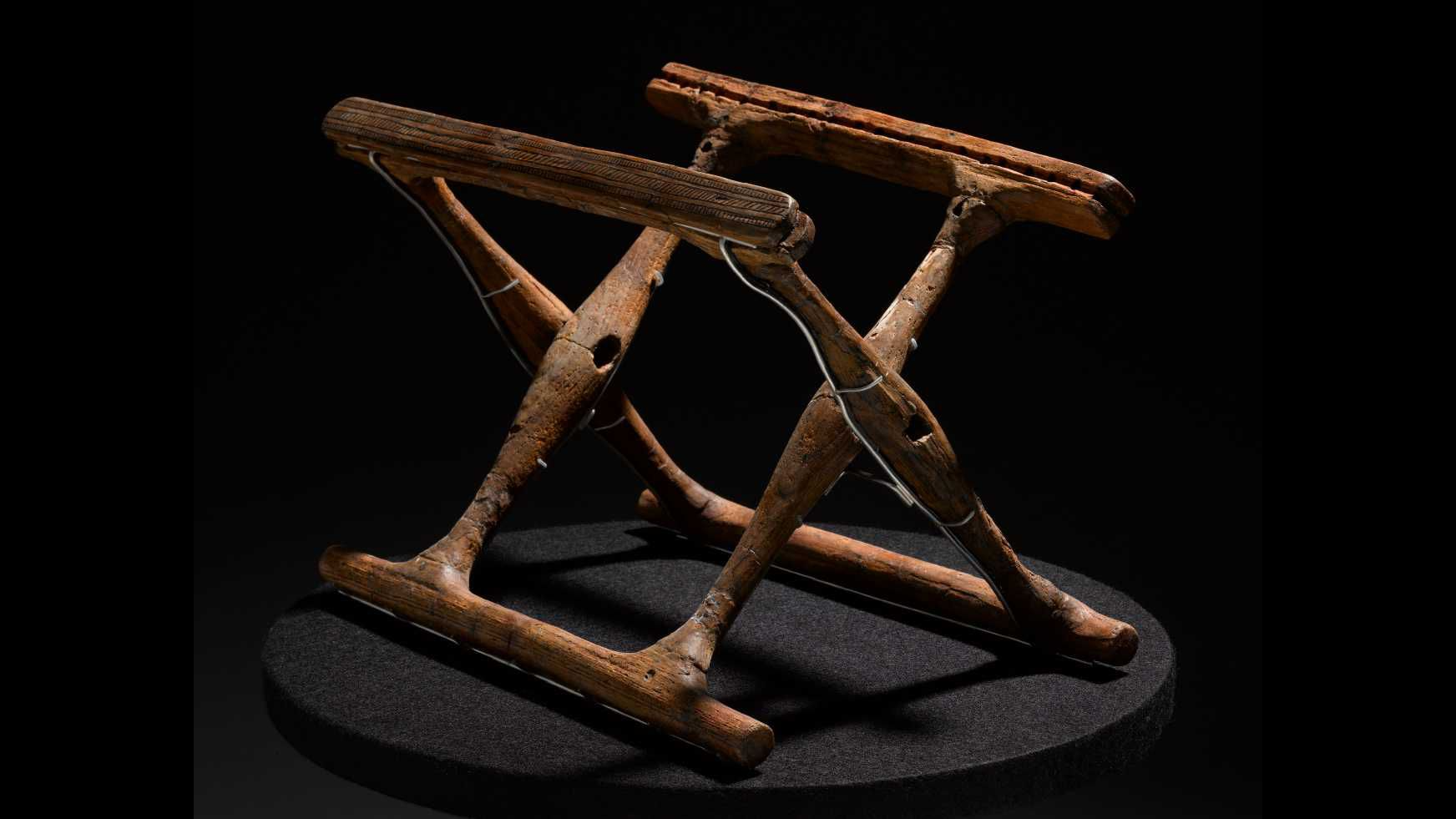
Guldhøj folding chair: The only completely preserved chair from Bronze Age Europe

a folding chair base of two wooden squares hitched together at a 45-degree angle against a black background

Remains of a Bronze Age folding chair were found in a chieftain's grave in Denmark. (Image credit: National Museum of Denmark (CC-BY-SA))
QUICK FACTS

Name: Guldhøj folding chair

What it is: A wooden chair with an otter-skin seat

Where it is from: Guldhøj, southern Denmark

When it was made: Circa 1400 B.C.

When archaeologists with the National Museum of Denmark excavated a burial mound called Guldhøj (Gold Hill) in southern Jutland in 1891, they were surprised to find a well-preserved wooden folding chair similar to those known from ancient Egypt and Greece. But the Guldhøj folding chair was made in Denmark around 3,400 years ago and is the only completely preserved chair from the Bronze Age in Europe, according to the National Museum of Denmark.

The chair was discovered in the grave of a chieftain, who was buried in a hollowed-out oak tree trunk and wrapped in a cowhide. The man had been dressed in a wool cloak secured with a bronze brooch, two wool hats, woolen mittens and leather shoes. Among the offerings his loved ones left in the grave were a bronze ax and a bronze dagger, along with two ornate wooden bowls and a wooden box. But the folding chair was an unusual addition to the grave and was likely a marker of the man's extremely high status.

The frame of the Guldhøj folding chair was crafted from ash wood, while the seat was made from otter skin, only a fragment of which was preserved over the millennia. Patterns incised into the top of the wooden frame were inlaid with a black, tar-like substance to create a band of geometric decoration.

In a 1999 study led by archaeologist Kirsten Prangsgaard, researchers who examined the chair determined that it was made from two frames of wood, each about 13 inches (33 centimeters) tall. When the frames were put together at a 45-degree angle, the low chair or stool would have been around 9.5 inches (24 cm) off the ground. Originally, the chair frame was likely held together with bronze nails, which may have been removed before the seat was placed in the grave, according to the researchers.

Folding chairs may seem simple, but they were important pieces of furniture that signified the seated person was of high rank, and they were likely used in rituals or ceremonies, according to the National Museum of Denmark.

Archaeologists have found ancient folding chairs in this style in Bronze Age Egypt and Greece, where weather conditions are better for preserving organic material such as wood. The Guldhøj folding chair is not unique in Nordic countries; pieces of chairs have been found in other chieftain graves in Denmark and northern Germany, and a rare metal folding chair was even found in an early medieval woman's grave in Germany. However, it is the only completely preserved wooden folding chair from Bronze Age Europe, Prangsgaard and colleagues noted in the study. "The folding chairs thus seem to belong to the warrior graves of the Early Bronze Age," they wrote.

The similarity of the Guldhøj chair, which was made in Denmark, to chairs found in far-flung civilizations means that Bronze Age people were exchanging ideas through trade and gift giving, the researchers wrote. The chairs show a clear artistic connection between Bronze Age Nordic and Mediterranean groups. Another connection is the four-spoked wheel on the famous Sun Chariot from Trundholm, which mimics designs seen in the Aegean region.

Both the unusual folding chair and the wooden bowls buried with the Bronze Age chieftain in the Guldhøj mound "can only be described as rare objects of high prestige," according to the National Museum of Denmark.

For more stunning archaeological discoveries, check out our Astonishing Artifacts archives.

Can you put together last week's Astonishing Artifact?

Stunning Roman-era mosaic discovered in Turkey features 'Emerald' the cat and 'Ocean' the dog

Nearly two millennia ago, a wealthy Roman commissioned an intricate, multicolored floor mosaic that depicted two beloved household animals: a cat named Emerald and a dog named Ocean. The mosaic was a key feature of a villa, which archaeologists recently unearthed from beneath the ancient city of Adramytteion on Turkey's Aegean coast.

Within the Roman villa, which has been dated to the late second to third centuries A.D., archaeologists discovered three halls surrounding a central atrium. In one room, which likely functioned as the villa's main reception hall, archaeologists found a colorful mosaic with 15 separate panels depicting living and mythological creatures.

In a study forthcoming in the Journal of Mosaic Research, archaeologist Hüseyin Özgen, head of the Adramytteion research team at Mimar Sinan Fine Arts University, wrote that the 15 panels are centered around what appears to be a depiction of Medusa, while the named cat and dog may preserve the memory of household creatures.

a panel of a multicolored Roman floor mosaic that depicts a dog named Ocean

Another panel of the mosaic depicts a dog named Ocean. (Image credit: H. M. Özgen/Adramytteion Research Archive)

Özgen began excavating at Adramytteion in 2012, but he and his team discovered the Roman villa only recently and excavated it in 2025 and early 2026. In the Roman period, Adramytteion was a provincial capital within Asia Minor and a prime trading spot due to its location at the head of a gulf on the Aegean Sea. The impressive villa included three mosaic-paved halls, a number of secondary rooms, and a network of pipes and drains that may have connected to a latrine.

Visitors approaching from the courtyard of the villa would have been greeted by the largest, most elaborate mosaic in the residence, according to Özgen. Located in the middle of the room, the mosaic measures about 16.4 by 11.8 feet (5 by 3.6 meters) and contains 15 panels arranged in three rows. Most of the panels depict birds, fish and felines, but two mythologically inspired panels include a gorgon (possibly Medusa) and a winged horse (possibly Pegasus). Ancient artists used white, black, red, orange, yellow, pink, burgundy, blue, turquoise and green tiles to create the intricate design.

overview image of a 15-panel multicolored Roman mosaic

Archaeologists discovered the colorful floor mosaic in a Roman-era residence at Adramytteion, an archaeological site in Turkey. (Image credit: H. M. Özgen/Adramytteion Research Archive)

Only two of the animals depicted in the mosaic are named. As someone entered the room, the first mosaic panel they would have seen to their left was a pale cat seated on a blue-green cushion, Özgen wrote in the study. Above the cat are the Greek letters ΖΜΑΡΑΓΔΙΝ (Zmaragdin), meaning emerald. The relaxed cat sitting on a cushion suggests that Emerald may have been a pet rather than a stray.

One possible explanation for Emerald's name may be a link to the desert of Roman Egypt, where emeralds were mined in antiquity; the villa owner may have been a merchant with North African connections.

On the right side as someone entered the room was a mosaic panel depicting a running or leaping dog. This animal is labeled with the Greek letters ΩΚΕΑΝΟΣ (Okeanos), meaning ocean. Adramytteion was a harbor city, so Ocean's name may have been bestowed due to his surroundings, according to Özgen.

Emerald and Ocean were likely familiar to the villa's residents, even if they weren't specifically pets, Özgen wrote, and their depictions in the mosaic may have functioned as familiar signs of ownership and household identity.

Research at Adramytteion by Özgen and the project team is ongoing.

From Augustus to Nero, see how much you know about ancient Rome's famous leaders with our Roman emperor quiz!

Excavation in Poland reveals Stone Age man buried with decapitated heads and a tooth necklace

Archaeologists were excavating in a Roman-period cemetery in Poland when they came across something extremely unusual: the grave of a man who was buried with two decapitated human heads, a necklace made from 42 mammal teeth, and a battle ax. That ax provided an important clue: He was actually from the Stone Age, three millennia older than the Roman cemetery.

"We were practically packing up, and then we discovered a circular shape in the ground and began digging," Paweł Dąbrowski, a biological anthropologist at Wrocław Medical University, said in a Sept. 2 translated statement. "We found fairly well-preserved animal teeth arranged in a necklace."

The grave, which was found near Wrocław in southwest Poland, included the nearly complete skeleton of an adult male who was buried with amber beads, a flint blade and a battle ax made of serpentinite, a greenish metamorphic rock. The style of the stone ax suggests the burial was made around 2900 B.C., during the Middle Neolithic period (New Stone Age), according to the statement.

But a handful of teeth and bones that were also deposited in the grave as funeral offerings made the burial stand out as particularly unusual.

partial remains of a human skeleton being excavated from the dirt with a stone ax and measurement tool

Archaeologists found an ax under the skeleton's right elbow, as well as teeth from another human skull. (Image credit: Wrocław Medical University)

"The arrangement of the 42 teeth was precise," Dąbrowski said, "and upon further inspection, it turned out that all of them had holes drilled through their roots. They must have formed a kind of necklace."

The teeth that made up the necklace were incisors and canines that belonged to large mammals, such as wolves, deer, bears and potentially humans, Dąbrowski said in a Sept. 4 translated statement.

"It's possible we've discovered the grave of a warrior or hunter, but because of this necklace, we can assume it was someone important, for example, the leader of a family clan," Dąbrowski said.

The burial also contained the remains of two human skulls, which the archaeologists think may be from decapitated heads that were buried with the man as gifts or funeral offerings. However, further analysis of the skulls is needed to confirm or rule out decapitation, according to the first statement.

A similar elite person's burial filled with axes, flint tools and amber beads was previously discovered nearby, the researchers noted in the statements. In that case, the bones of a calf suggested that the animal had been sacrificed at the grave. But to date, these are the only two burials of their kind in the area. According to the statements, they might be from members of the Corded Ware culture, which likely spread Indo-European languages around Europe and Asia.

According to Dąbrowski, the next step is to analyze the remains from both Stone Age burials to figure out if the people were related and what their lives were like nearly 5,000 years ago. He expects the first results of the analyses to be available later this year.

What do you know about the Paleolithic, Mesolithic and Neolithic eras? Find out with our Stone Age quiz.

Lavish private bath used by Roman emperor and 'high-status residents' discovered at imperial palace in Serbia

Archaeologists excavating in eastern Serbia have discovered the remains of a lavish and uniquely constructed Roman bath that once belonged to an emperor. The suite of rooms ‪—‬ which included heated floors, three bathing pools and a sauna ‪—‬ was uncovered at the bottom of a tower within an imperial palace, a design archaeologists had never seen before in the Roman Empire.

The bath complex, known in Latin as a balneum, was found at the archaeological site of Vrelo-Šarkamen, a monumental fortified residential complex that was built in the early fourth century and was occupied by Maximinus Daza (or Daia), who was Roman emperor from 310 to 313. Archaeologists have been excavating at Vrelo-Šarkamen on and off for decades, and the latest discovery was made by a research team from the Institute of Archaeology, an independent research institution in Serbia, according to a Sept. 3 statement.

Galerius Valerius Maximinus, born in what is now Serbia and originally named Daza, was one of the four Roman "tetrarchs." In A.D. 293, Emperor Diocletian essentially split the Roman Empire into two halves — Eastern and Western — and each was administered by a senior emperor and a junior ruler. By 305, the rulers of the Roman Empire were Constantius and Galerius as senior emperors and Severus and Maximinus Daza as junior rulers, but the tetrarchy had begun to fall apart. Maximinus claimed the title of senior emperor in 301 but lasted only three years. He died in 313 after losing a civil war against his rival, Licinius.

The new excavations at Maximinus Daza's imperial residence have revealed that the palace was even more complex and luxurious than previously thought, according to the statement.

aerial image of an excavated ancient roman bath showing low pillars that supported the floor

Archaeologists identified this part of the bath as the "sudatorium," or steam room. (Image credit: Vrelo-Šarkamen research team/Institute of Archaeology)

Maximinus' palace had a monumental tower in the southwest corner. But archaeologists were surprised to find a circular bath complex on the lowest level of the tower, as most ancient balnea were oriented linearly, with rooms in a row. This bath area had a domed ceiling with six windows, which shows a high level of engineering knowledge, according to the statement.

The balneum was split into two sections: one for equipment needed to run the baths and one for bathing and relaxing. Within the equipment room, archaeologists found the furnace that heated the bath's floors. They also discovered the base for a copper boiler that would have been used to heat up bath water. However, the copper boiler itself is now missing.

Within the suite of rooms that the emperor used, archaeologists found three bathing pools or tubs, along with a sudatorium, the Latin word for a steam bath or sauna.

According to the statement, "the complex was not simply a space intended for personal hygiene, but a carefully designed private bath intended for high-status residents of the palace, in which architecture, technical infrastructure and comfort formed a single functional whole."

Researchers will continue to explore the bath complex to better understand how the rooms were structured and how Emperor Maximinus and his family accessed it.

From Augustus to Nero, see how much you know about ancient Rome's famous leaders with our Roman emperor quiz!

Crown of Kerch: A 1,600-year-old gold, gem-studded diadem found in the grave of a Hun noblewoman

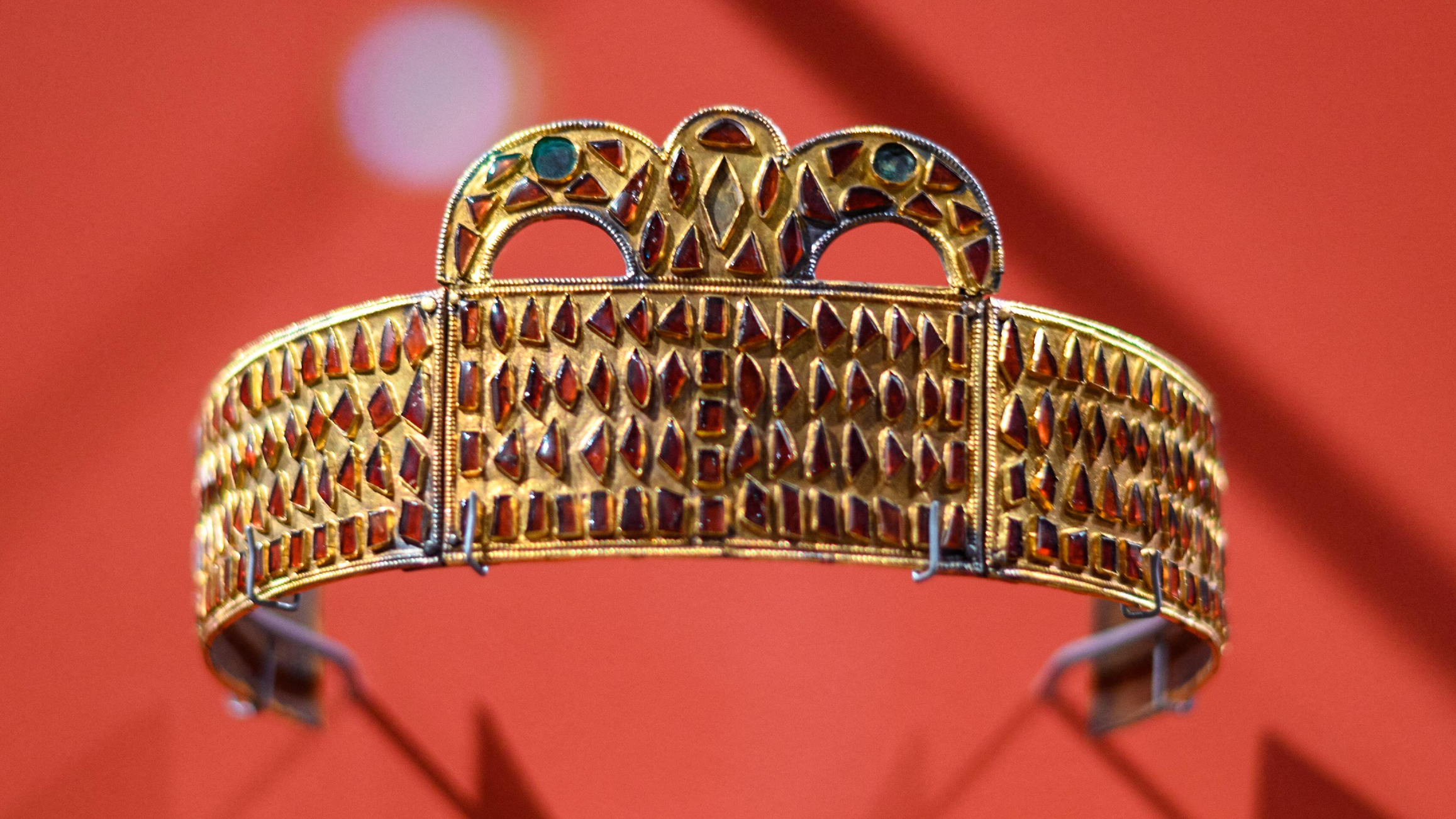
a garnet-studded gold crown against a red background

The Crown of Kerch was discovered in a high-status woman's grave in Crimea more than a century ago. (Image credit: Mirko Kuzmanovic/Alamy)
QUICK FACTS

Name: Crown of Kerch

What it is: A gold-and-garnet diadem

Where it is from: Kerch, Crimea

When it was made: Late fourth to early fifth centuries

At the beginning of the 20th century, a German art collector acquired dozens of artifacts from a Russian-led excavation of an ancient Hun settlement in Crimea. The most spectacular piece of the collection was the Crown of Kerch ‪—‬ a garnet-studded, gold diadem featuring stylized birds of prey.

The artifact, which is now on display at the Neues Museum in Berlin, is made up of three gold-covered, bronze plaques and more than 250 gem-studded cells. According to the museum, the crown was discovered in the grave of a high-status woman buried in the ancient city of Pantikapaion on what is now the Kerch Peninsula of Crimea.

The band of the rare gold diadem is roughly 1.7 inches (4.4 centimeters) tall and is associated with the fearsome nomadic warriors known as the Huns, who moved west from the Don River in what is now Russia in the late fourth century A.D.

Pantikapaion was founded as a Greek colony in the sixth century B.C. but was conquered by the Huns in the late fourth century A.D. A large necropolis with as many as 2,000 burials was excavated at Pantikapaion in the early 20th century, but only a handful of artifacts and skulls were saved from the excavation. Pantikapaion was incorporated into the Byzantine Empire in the sixth century by Emperor Justinian I.

The Crown of Kerch features two stylized heads of birds of prey, likely eagles, flanking a central floral motif. Round, green gems mark the birds' eyes. These birds likely represented power and authority among the Huns and other groups, according to the museum, and they were a popular symbol on jewelry and accessories of the time. Similar birds of prey have been found on Visigoth women's jewelry in Spain from the sixth century, for example.

German archaeologist Joachim Werner wrote in a 1956 study that the Crown of Kerch was found in a burial chamber near the skeleton of a woman with an artificially modified skull. Although the woman was buried with the diadem, Werner believed that these items were not just used for grave goods, and that high-status Hun women regularly wore the accessory during life, possibly with a cloth cap or veil attached.

Around two dozen examples of similar gold diadems have been discovered to date. This suggests that the Crown of Kerch is not technically the royal insignia of a queen but rather a diadem worn 1,600 years ago by a member of the ruling Hun elite.

For more stunning archaeological discoveries, check out our Astonishing Artifacts archives.

Can you put together last week's Astonishing Artifact?

❌