❌

Normal view

Hubble confirms mysterious, 10-sided cloud is growing over Saturn's south pole

3 September 2026 at 22:27

New Hubble observations have revealed a dramatic, 10-sided jet surrounding Saturn's south pole, and it appears to be evolving before our eyes.

The Hubble Space Telescope recently snapped a high-resolution view of the striking "atmospheric wave," which appears to have begun forming in 2023, archival Hubble images show. Scientists are curious about how this "decagon" popped up so quickly, given that Saturn's other famous multisided wave — a hexagon at the north pole — has been observed on the planet for 40-plus years.

"The question is, why did it suddenly form now when we haven't seen one before?" Amy Simon, a senior scientist at NASA's Goddard Space Flight Center and co-author of a new study describing the observations, said in a statement.

"The northern hexagon has been there every time we've looked for more than 40 years," Simon added. "This feature is different — it appears to be strengthening, giving us the rare opportunity to watch a giant atmospheric pattern develop."

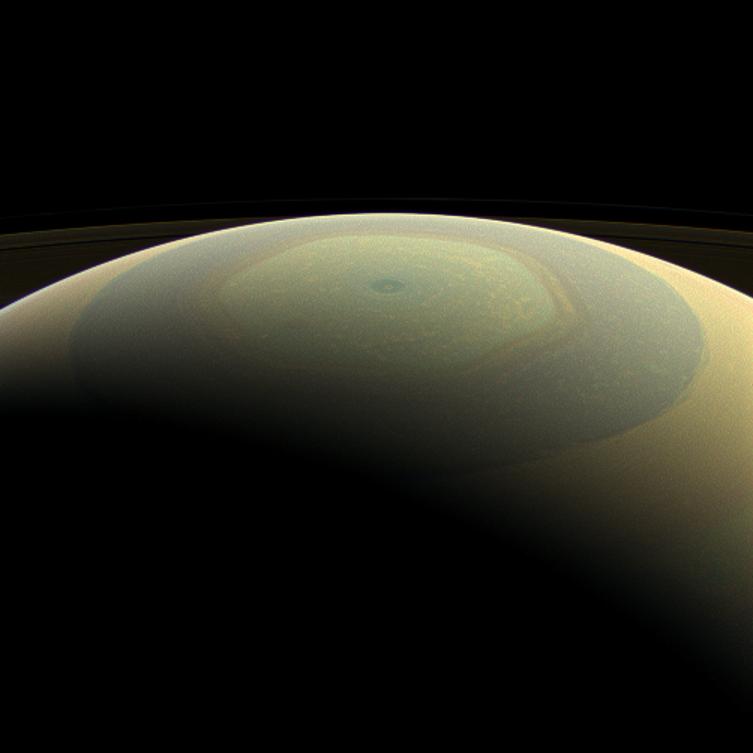
The globe of Saturn, seen here in natural color, is reminiscent of a holiday ornament in this wide-angle view from NASA's Cassini spacecraft.

The famous hexagon at Saturn’s north pole. (Image credit: NASA/JPL-Caltech/Space Science Institute)

Scientists can see the wave persisting through several atmospheric layers, which means it extends beyond the cloud tops. The wave is also found in a large jet stream at Saturn. More observations with Hubble and the James Webb Space Telescope (JWST) will be required to see how the wave is generated and what the decagon illustrates about atmospheres in large gas giants like Saturn.

The images were obtained as part of Hubble's Outer Planet Atmospheres Legacy program, which uses some of the telescope's time to image the solar system's outer planets — Jupiter, Saturn, Uranus and Neptune — once a year. The goal is to obtain long-term observations of these worlds, to supplement spacecraft orbiting or flying by.

From Earth's perspective, Saturn is slowly orbiting in its roughly 29-year journey of the sun so that its south pole is visible from our planet, allowing for a good view of the changing decagon. Hubble, in fact, was not the first to see signs of this decagonal shape; it was ground-based observatories that spotted a mysterious undulating band around Saturn’s south pole in 2024.

Agustín Sánchez-Lavega, first author of the study and a researcher in the Department of Applied Physics at the University of the Basque Country, and amateur astronomers Trevor Barry and Jean-Paul Oger first spotted the forming wave. The trio used the university's Planetary Virtual Observatory Laboratory, which brings in observations from around the world, to make the Saturnian discovery.

While more images in 2025 showed the wave starting to move into a decagon structure, Hubble was able to obtain high-resolution images without Earth's atmosphere in the way.

The Cassini spacecraft, which orbited Saturn between 2004 and 2017, didn't see the feature, hinting that it hadn’t started forming yet, according to NASA. "Given Saturn's symmetry in its north-south jet stream system, we have been searching for a counterpart to Saturn's northern hexagon on the south pole in Hubble images since 1990," Sánchez-Lavega said.

Both Hubble and JWST are expected to provide more opportunities to look at the ringed planet's developing decagon in the near future. In the meantime, Saturn isn’t the only solar system planet with perplexing polar features; 2017 images from NASA’s Juno spacecraft showed that Jupiter’s south pole is studded with gigantic, oval-shaped cyclones that echo the chaos of the planet’s famous Great Red Spot.

Astronomers Discover Decagonal Wave circling Saturn’s South Pole

3 September 2026 at 00:26
These Hubble images show Saturn and the gas giant’s southern pole with its 10-sided atmospheric wave. Image credit: NASA / ESA / STScI / Agustin Sánchez-Lavega, UPV / Amy Simon, NASA’s Goddard Space Flight Center / Michael Wong, UC Berkeley / Alyssa Pagan.

For almost five decades, Saturn’s north pole has been famous for hosting a bizarre, six-sided jet stream known as the hexagon, a feature first spotted by NASA’s Voyager spacecraft in the 1980s and still churning today.

The post Astronomers Discover Decagonal Wave circling Saturn’s South Pole appeared first on Sci.News: Breaking Science News.

The Massive Asteroid Apophis Will Pass Closer to Earth Than Some Satellites in 2029—Planetary Defense Researchers are Getting Ready

22 August 2026 at 13:24

One of planetary defense‘s biggest opportunities will come as the asteroid Apophis makes its tight flyby of our planet on April 13, 2029, allowing international space missions to interact with the near-Earth object. Asteroids this size only approach this close to Earth about once every 7,500 years, making the event a rare opportunity for real-world planetary defense research.

In a new paper published in the journal Space: Science & Technology, a team of researchers analyzes the many opportunities the Apophis flyby will offer for science and planetary defense.

The closest distance between Earth and Apophis during the flyby will be a mere 38,000 kilometers, about one-tenth of the distance from the Earth to the Moon. Coordinating these planetary defense efforts among the Earth’s nations may be one of the biggest challenges as the object comes uncomfortably close.

Apophis Explained

As soon as astronomers first discovered Apophis in 2004, the asteroid’s 340-meter-wide diameter and close pass by Earth immediately made it a concern for scientists. Fortunately, it is expected that on April 13, 2029, it will safely pass our planet at a distance of close to 20,000 miles—closer than some of our weather and communication satellites, but still with no risk of an impact.

Yet the near-Earth asteroid still holds mysteries for scientists. Models of the object depend heavily on assumptions, not hard data, to predict not just its tidal effects but also its composition, size, internal structure, and spin state.

Apophis
A series of images of the asteroid Apophis captured in March 2021 (Image Credit: NASA/JPL-Caltech and NSF/AUI/GBO)

With so many open questions about the asteroid and the unique opportunity to collect data and test processes for future planetary defense operations, many countries are planning missions to Apophis, but in this new paper, the researchers note that some of these activities require increased international coordination to avoid interference.

Part of the paper synthesizes known data on Apophis, including radar observations, light-curve, and spectral data. From this data, the team then developed new predictions for the asteroid’s dust ejection, orbital and spin changes, internal structural response, and surface material displacement. These projections were crucial in the researchers’ evaluations of the feasibility of various currently proposed or authorized missions and their likely scientific value.

Apophis Missions are Gearing Up

Future Apophis missions fit into four primary categories: rendezvous, flyby sample return, and impactor experiments.

In the recent research, the team found that flyby missions should capture data at very fine scales, down to the centimeter or decimeter for surface changes and hours for changes in spin period. Additionally, these space-borne instruments should be able to measure dust ejection phenomena. Together, this data stream alone could provide important direct evidence for how such rubble-pile asteroids evolve structurally. Relatively low-cost sample return missions could push this even further.

The activities coordinated under the International Asteroid Warning Network constitute the largest multinational asteroid detection and observation effort ever assembled and are its first global joint exercise. The network will build experience responding to potentially deadly space threats in the future.

Earth Interactions

On the other hand, the asteroid’s close approach to Earth will affect Apophis as well. Our planet’s gravity is expected to alter Apophis’s orbit from an Aten-type to an Apollo-type, changing the object’s spin period and orbital uncertainty. 

Additionally, roughly 1% of Apophis may experience a surface material disruption, potentially altering the object’s spectral properties by exposing fresh material.

The asteroid’s extremely low gravity may also cause it to lose surface dust to Earth’s magnetosphere, posing an electromagnetic disturbance hazard to spacecraft. Space agencies will need to monitor the situation to protect our increasingly essential space-based communications infrastructure during the event.

While there is no immediate danger to our planet, the researchers say this event is shaping up to be a pivotal moment in international space cooperation and a turning point for organized space defense.

The paper, “The Apophis Encounter in 2029: A Rare Opportunity for Planetary Science and Defense,” appeared in Space: Science & Technology on August 22, 2026.

Ryan Whalen covers science and technology for The Debrief. He holds an MA in History and a Master of Library and Information Science with a certificate in Data Science. He can be contacted at ryan@thedebrief.org.

❌