❌

Normal view

The combat demo for Free Stars: Children of Infinity is out, and it's free

8 September 2026 at 17:05

After five years in development, Free Stars: Children of Infinity—the official sequel to The Ur-Quan Masters by the old game's original creators—has released a free public demo. It's a "combat demo" in the style of UQM’s melee mode, where players can assemble a fleet from the game's roster of nearly 40 ships, then match those ships up in head-to-head arcade SpaceWar-style action. The demo can be found on Steam and GOG, and it's available for Windows, Mac, and Linux. (Console versions are coming, but they're not yet out.)

Title image for the Free Stars: Children of Infinity combat demo Pew pew! Credit: Pistol Shrimp Games

I have to present this news with a big disclaimer, though, because I've been part of the Children of Infinity writing team since 2021, working as a volunteer with the Pistol Shrimp Games crew and contributing NPC dialogue and some story bits. As a huge fan of the original games, it's been a dream opportunity. (Because I've been volunteering my time, I'm not financially involved and receive no compensation if you download the demo or, when it's eventually released, buy the full game.)

What's in the demo

Children of Infinity is a space adventure RPG, just like The Ur-Quan Masters (and its direct spiritual predecessors, Starflight and Starflight 2). What's been released today is just one part of the game—the arcade-style "melee" portion, which lets players jump into one-versus-one combat against another player or against a computer-controlled opponent. Each of the ships you can pick has its own maneuvering characteristics, weapons, and special abilities.

Read full article

Comments

© Pistol Shrimp Games

Objects at the border between planets and stars

7 September 2026 at 12:00

Beyond the solar system, the line between planet and star can get blurry. Astronomers call objects that fall between the size ranges of planets and stars substellar objects. One type of substellar object, called a brown dwarf, forms from collapsing gas clouds like a star, but is not quite massive enough to fuse hydrogen in its core. Some can briefly fuse a heavier form of hydrogen, known as deuterium, in their cores, though never enough to produce starlight. Others are small and cold enough to develop complex atmospheres.

Recently, astronomers discovered a new type of substellar object in a star-forming region of the Milky Way Galaxy called IC 348. Using observational data from the JWST’s Near InfraRed Spectrograph (JWST NIRSpec), they found objects 0.2% to 1.2% the mass of the Sun that float freely like stars but have carbon-containing molecules called hydrocarbons in their atmospheres. Because these objects are smaller than known brown dwarfs and have evidence of hydrocarbons, scientists refer to them as H-type objects.

To investigate what H-type objects are and where they fit within the spectrum of substellar objects, researchers Richard J. Parker and Catarina Alves de Oliveira analyzed survey data on stars and substellar objects in IC 348, then conducted follow-up simulations to uncover how H-type objects formed. The main question they asked was whether H-type objects form from collapsing gas clouds, like brown dwarfs and stars, or develop around host stars before being ejected and drifting freely through space, like planets.

First, they reviewed the observational records of IC 348 obtained with the JWST NIRSpec and the near-IR spectrograph SpeX at the NASA Infrared Telescope Facility. IC 348 has 495 stars and brown dwarfs combined, as well as 9 H-type objects. Estimates for the age of this star-forming region range from either 1 to 3 million years or 5 to 6 million years, depending on how different teams calculated it. From there, Parker and Alves de Oliveira compared where the stars, brown dwarfs, and H-type objects were located within the cluster. They found no unique spatial distribution among the 3 types of objects.

Then, the team simulated the evolution of IC 348 over 10 million years to determine which initial conditions would result in a spatial distribution closest to the survey data. They simulated an initial giant gas cloud and used a mathematical function to distribute its mass among the 495 constituent objects. The researchers then placed a Jupiter-sized planet around each simulated star that was approximately the Sun’s mass to determine whether they could grow and escape their home star and become H-type objects. They also repeated the simulations by placing the Jupiter-sized planets at distances from the Sun similar to those of Earth, Jupiter, and Neptune, and varied the sizes and star densities of the simulated IC 348 regions.

They found that if Jupiter-sized planets orbited their stars at roughly Jupiter’s distance from the Sun, then 5 to 15 of them could escape their stars in a region like IC 348, which would roughly match the number of known H-type objects. However, the escaped planets were distinctly more spread-out than the observed H-type objects, which share a similar spatial distribution with the cluster’s stars and brown dwarfs. Since the simulations did not match the observed distribution, the researchers suggested that these H-type objects are likely a new sub-category of very small brown dwarfs rather than escaped planets.

Although this study favors a brown dwarf origin for H-type objects, the exact details of how they formed remain up for debate. Astronomers still have multiple competing theories about how ordinary brown dwarfs form. Perhaps they are ejected from their gas cloud before fully forming, have their outer layers stripped by radiation from a nearby massive star, or simply form like stars on a slightly smaller scale. Regardless, future researchers will continue to explore this murky area of substellar astronomy.

The post Objects at the border between planets and stars appeared first on Sciworthy.

What Is a Neutron Star? The City-Sized Remnant of a Stellar Explosion

7 September 2026 at 10:00

A neutron star is what remains after the core of a massive star collapses. It is not a small ordinary star. It is the crushed core of a dead one, compressed until protons and electrons are forced together and most of the material becomes neutrons. The result is one of the strangest objects in the […]

The post What Is a Neutron Star? The City-Sized Remnant of a Stellar Explosion appeared first on Curiosmos.

Stars forge and deliver the elements that make up your body — and scientists may finally know how

4 September 2026 at 17:00

Scientists are closer than ever before to understanding how stars forge the elements that comprise our planet, bodies and pretty much everything else around us — and they're gaining a clearer picture of where star explosions fit into the story.

New research reported in two different papers looks at how stars forge elements as they explode and how these supernova explosions spread those elements — and other elements stars have forged during their lifetimes — throughout the cosmos.

Astronomers have been studying the bright supernova deaths of massive stars for centuries, but they still don't quite understand how these explosions proceed.

The first paper looked at one way to investigate supernovas. It uses a radioactive element produced by these explosions called titanium-44, which lingers long after supernovas fade. Researchers have now collected experimental evidence that determines how much titanium-44 is created in a supernova, finding that these cosmic explosions produce 35% more of this element than expected.

With this knowledge in hand, scientists can now develop robust computer models of supernovas and compare these models with astronomical observations. This could bring them much closer to understanding how these explosions progress.

"It's exciting to see just how far the field has come," Christopher Cousins, a postdoctoral researcher in the University of Surrey's Nuclear Physics Group, said in a statement. "A measurement like this would have been considered out of reach only a couple of decades ago, but it now gives us new insight into one of the biggest unanswered questions in astrophysics."

An illustration shows a

An illustration shows a "vampire" neutron star feeding on a close companion star. (Image credit: Robert Lea (created with Canva))

The second paper honed in on a particular brand of stellar explosion called a Type I supernova. These occur when a dense stellar remnant called a neutron star drags material from a companion stellar body. The intense gravitational influence of the neutron star — a stellar corpse that has one to two times the mass of the sun crammed into a body about 12 miles (20 kilometers) wide — means that, when this stolen stellar matter hits their surfaces, a thermonuclear explosion is triggered.

These blasts forge heavy elements and release incredible amounts of energy, some in the form of X-ray bursts.

The authors of this paper, hailing from the Facility for Rare Isotope Beams (FRIB) in Michigan, studied the nuclear reaction that triggers X-ray bursts in greater detail than has been possible before.

This revealed the long-debated role of the so-called nickel-copper cycle, the temporary trapping of nuclear material during supernovas. Scientists previously didn't know if material was trapped in the nickel-copper cycle during X-ray bursts.

This research reveals that this does happen, but only in small proportions. It gives scientists a clearer picture of how Type I supernovas proceed.

An illustration shows a supernova explosion bombarding Earth with neutrinos

An illustration shows a supernova explosion bombarding Earth. (Image credit: Super-Kamiokande Collaboration)

"Despite decades of research, we still don't fully understand the nuclear reactions that power some of the universe's most spectacular stellar explosions," said Gavin Lotay of the University of Surrey.

"These two studies give us a much clearer picture of how these explosions happen, allowing us to compare our models more closely with astronomical observations and bringing us closer to understanding how the chemical elements are created and spread throughout the universe," he added.

The two papers were published in the July edition of the journal Physical Review Letters.

Primordial Planetesimals from the Guts of Population III Stars

2 September 2026 at 21:45

Protoplanetary Disk

While previous investigations of planet formation across the universe’s history suggest that planets trickled into the picture, a recent study has found that primordial planetesimals could have formed much earlier from the insides of the first stars in the universe.

First Stars, First Planets?

When the first stars flickered on, the universe was filled with pristine gas, containing only hydrogen, helium, and a little lithium. This gas, though great at making massive stars known as Population III (Pop III) stars, was not yet enriched with the heavy elements necessary for planet formation and, of course, life. Past studies have suggested that planet formation in the universe was gradual, taking several billion years to peak after billions of stars created and spilled the needed metals into the universe. However, local pockets of enriched gas from Pop III stars could have created the right conditions for planet formation earlier in the universe’s history.

Pop III stars burned bright and fast, exploding violently in pair-instability supernovae that completely shredded the progenitor, ejecting over 100 solar masses of metals into their previously pristine surroundings. Cosmological simulations suggest that oxygen from these supernovae could have produced significant water fractions within the dense cores of the supernova remnant. This may have set the stage for planet formation in water-rich disks around subsequent generations of stars as early as 150–200 million years after the Big Bang — does numerical modeling support this planet formation hypothesis?

Protoplanetary disk growth

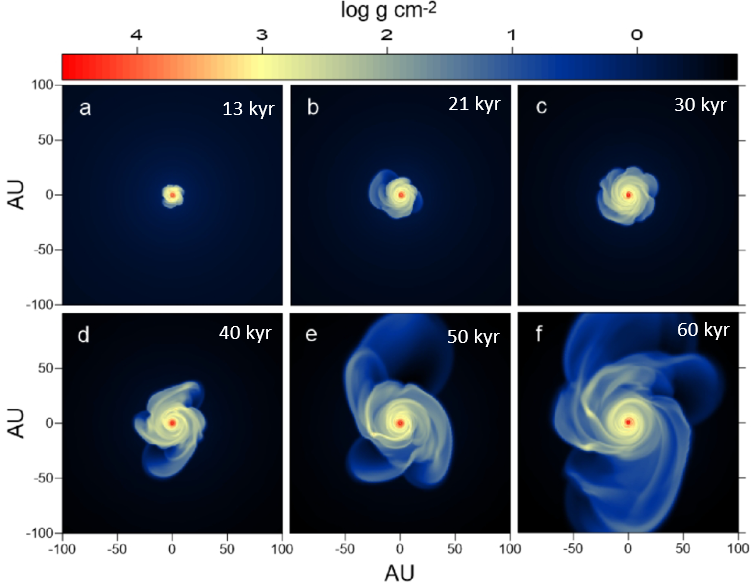
Simulation snapshots showing the formation and evolution of the protoplanetary disk for 13, 21, 30, 40, 50, and 60 thousands of years after protostellar birth. Click to enlarge. [Modified from Vorobyov et al 2026]

Primordial Planetesimals in Simulated Water-Rich Disks

To test if these water-rich dense cores within Pop III supernova remnants could form planetesimals, the building blocks of terrestrial planets, Eduard I. Vorobyov (University of Innsbruck; Southern Federal University) and collaborators performed numerical simulations tracing the collapse of one such gas core into a protoplanetary disk around a protostar. The simulations begin from the gravitational collapse of a 1-solar-mass gas cloud core, with a protostar emerging 24 thousand years after the initial cloud collapse. As the protostar’s gravity pulled in material from its surroundings, a rotating disk formed around the growing star.

Protoplanetary disk evolution and planetesimal growth

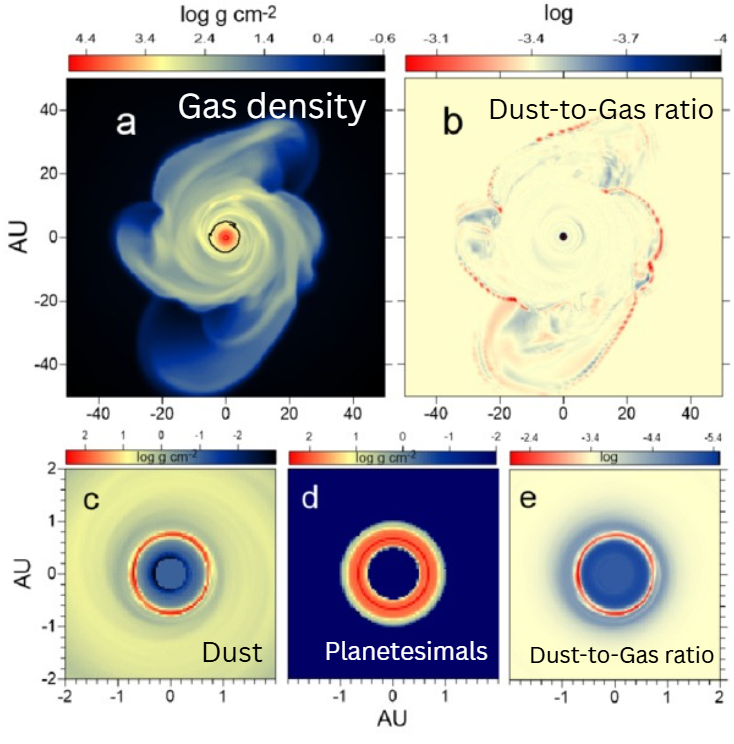
Simulation snapshot 40 thousand years after the formation of the protostar showing the gas, dust, and planetesimal surface densities and the dust-to-gas ratio. Click to enlarge. [Modified from Vorobyov et al 2026]

Tracking the gas and dust evolution in the disk, the authors found that several Earth masses of planetesimals formed within 0.5–1.0 au of the 0.4-solar-mass protostar. While the simulations did not trace the disk all the way to planet formation (this requires complex multi-body modeling and lots of computing power), enough planetesimals formed to create a Mars- or Earth-mass planet in the future. Luckily, unlike their live-fast and die-young predecessors, low-mass stars born from Pop III supernova remnants would still be burning hydrogen in their cores today, and ancient metal-poor stars in the Milky Way’s halo may be home to the universe’s first planets that could be detected in future exoplanet surveys. This study showed, for the first time, that water-rich protoplanetary disks with planetesimals could pop up billions of years earlier than previously thought, changing our understanding of planet formation in the universe.

Citation

“Planet Formation at Cosmic Dawn: Planetesimals in H2O-rich Disks around Low-mass Stars,” Eduard I. Vorobyov et al 2026 ApJL 1007 L51. doi:10.3847/2041-8213/ae907c

The post Primordial Planetesimals from the Guts of Population III Stars appeared first on AAS Nova.

The Search for a Second Earth Begins: NASA’s Nancy Grace Roman Space Telescope is Poised to Make History

1 September 2026 at 13:13

Now that NASA’s Nancy Grace Roman Space Telescope is on its way toward its Lagrange Point 2 (L2) destination, more of its mission goals are coming into focus, including the possibility that it could detect an Earth-like planet orbiting a star like our own Sun using gravitational microlensing.

The Roman team said such a detection could identify targets for the proposed Habitable Worlds Observatory project, including scanning their atmospheres for signs of extraterrestrial life.

Searching for Another Earth with the Nancy Grace Roman Space Telescope

In NASA’s mission fact sheet, Roman’s planners pose several questions. These include: 

  • How common are solar systems like our own?
  • What kinds of planets exist in the cold, outer regions of planetary systems?
  • What determines the habitability of Earth-like worlds?

Although scientists have used several methods to detect exoplanets, including Earth-like planets, Roman will employ three. These include the transit method, microlensing, and direct imaging. NASA said the combination of approaches will allow mission scientists to conduct a “sweeping search expected to uncover around 100,000 new exoplanets — a staggering leap compared to the nearly 6,200 currently known.”

“It is hoped that Roman will discover thousands of new exoplanets and significantly expand our knowledge of the diversity of planetary systems in our Galaxy,” explained Associate Professor Edita Stonkutė, an astrophysicist at Vilnius University unconnected to the Roman team, in a statement emailed to The Debrief.

Microlensing Can Reveal Earthlike Planets Orbiting Sunlike Stars

Most exoplanets have been detected by the dimming of their host star when they transit between it and Earth, giving the transit method its name. Roman plans to use that same method for most of its larger planetary detections. However, among the expected tens of thousands of transit-method detections, mission planners expect a small but sizeable percentage to come from microlensing.

NASA said the “light-bending” microlensing phenomenon occurs when two distant stars “align closely from our vantage point.” Due to the strength of the nearer star’s gravity, the light from the more distant one is “warped” around the nearer one, essentially focusing it very briefly for a distant observer.

“If the alignment is especially close, the nearer star acts like a cosmic lens, focusing and magnifying light from the background star.” Professor Stonkutė explained. “By analysing these changes, astronomers can determine that the planet exists and estimate its mass and orbital characteristics.”

Critically, Professor Stonkutė also noted that microlensing can occur with objects other than stars, including exoplanets.

“This is Precisely Where Roman Has the Edge”

Using its Wide-Field Array, Roman will monitor hundreds of millions of stars. NASA said the observatory will monitor these target stars for “tiny surges in starlight” that typically signal a microlensing event.

Although the transit method is employed to detect larger exoplanets, NASA noted that microlensing “specializes in finding planets like those in our solar system.” The space agency added that this includes “worlds as lightweight as Mars in their star’s habitable zone or farther out.”

A star’s habitable zone is typically defined as the orbital plane where an exoplanet could sustain liquid water on its surface, a key ingredient for life as we know it.

Professor Stonkutė described microlensing as “particularly valuable” since it can detect planets that are difficult to spot with other planet-hunting methods. The professor said this includes “small Earth-like planets located far from their star.” The Roman team hopes to find “more than 1,000 microlensing planets.”

The professor warned that “most microlensing events cannot be predicted in advance.” As a result, telescopes need to actively scan large areas of the sky to increase the chances of a microlensing detection

“This is precisely where Roman has the edge over other telescopes that have searched for exoplanets using different methods,” the professor added.

A “Stepping Stone” Toward NASA’s Habitable Worlds Observatory Concept

While Roman is tasked with directly imaging exoplanets, finding another Earth around a Sun-like star will still require an indirect detection, most likely from a microlensing event. However, the Roman team notes that their observatory “will provide a crucial stepping stone for NASA’s Habitable Worlds Observatory concept.”

According to the space agency, that “flagship” telescope, still awaiting final approval, “would be designed to photograph Earth-like planets for the first time ever.”

Roman may also be able to scan the atmospheres of planets detected with the transit method. The space agency said Roman “would also look for signs of life called biosignatures by measuring atmospheric gases like oxygen and ozone that could signal the presence of living things.” 

Christopher Plain is a Science Fiction and Fantasy novelist and has spent the last six years as Associate News Editor and Head Science Writer at The Debrief. Follow and connect with him on X, learn about his books at plainfiction.com, or email him at christopher@thedebrief.org.

❌