
❌

Normal view

Stunning Roman-era mosaic discovered in Turkey features 'Emerald' the cat and 'Ocean' the dog

Nearly two millennia ago, a wealthy Roman commissioned an intricate, multicolored floor mosaic that depicted two beloved household animals: a cat named Emerald and a dog named Ocean. The mosaic was a key feature of a villa, which archaeologists recently unearthed from beneath the ancient city of Adramytteion on Turkey's Aegean coast.

Within the Roman villa, which has been dated to the late second to third centuries A.D., archaeologists discovered three halls surrounding a central atrium. In one room, which likely functioned as the villa's main reception hall, archaeologists found a colorful mosaic with 15 separate panels depicting living and mythological creatures.

In a study forthcoming in the Journal of Mosaic Research, archaeologist HΓΌseyin Γ–zgen, head of the Adramytteion research team at Mimar Sinan Fine Arts University, wrote that the 15 panels are centered around what appears to be a depiction of Medusa, while the named cat and dog may preserve the memory of household creatures.

a panel of a multicolored Roman floor mosaic that depicts a dog named Ocean

Another panel of the mosaic depicts a dog named Ocean. (Image credit: H. M. Γ–zgen/Adramytteion Research Archive)

Γ–zgen began excavating at Adramytteion in 2012, but he and his team discovered the Roman villa only recently and excavated it in 2025 and early 2026. In the Roman period, Adramytteion was a provincial capital within Asia Minor and a prime trading spot due to its location at the head of a gulf on the Aegean Sea. The impressive villa included three mosaic-paved halls, a number of secondary rooms, and a network of pipes and drains that may have connected to a latrine.

Visitors approaching from the courtyard of the villa would have been greeted by the largest, most elaborate mosaic in the residence, according to Γ–zgen. Located in the middle of the room, the mosaic measures about 16.4 by 11.8 feet (5 by 3.6 meters) and contains 15 panels arranged in three rows. Most of the panels depict birds, fish and felines, but two mythologically inspired panels include a gorgon (possibly Medusa) and a winged horse (possibly Pegasus). Ancient artists used white, black, red, orange, yellow, pink, burgundy, blue, turquoise and green tiles to create the intricate design.

overview image of a 15-panel multicolored Roman mosaic

Archaeologists discovered the colorful floor mosaic in a Roman-era residence at Adramytteion, an archaeological site in Turkey. (Image credit: H. M. Γ–zgen/Adramytteion Research Archive)

Only two of the animals depicted in the mosaic are named. As someone entered the room, the first mosaic panel they would have seen to their left was a pale cat seated on a blue-green cushion, Γ–zgen wrote in the study. Above the cat are the Greek letters Ξ–ΞœΞ‘Ξ‘Ξ‘Ξ“Ξ”Ξ™Ξ (Zmaragdin), meaning emerald. The relaxed cat sitting on a cushion suggests that Emerald may have been a pet rather than a stray.

One possible explanation for Emerald's name may be a link to the desert of Roman Egypt, where emeralds were mined in antiquity; the villa owner may have been a merchant with North African connections.

On the right side as someone entered the room was a mosaic panel depicting a running or leaping dog. This animal is labeled with the Greek letters Ξ©ΞšΞ•Ξ‘ΞΞŸΞ£ (Okeanos), meaning ocean. Adramytteion was a harbor city, so Ocean's name may have been bestowed due to his surroundings, according to Γ–zgen.

Emerald and Ocean were likely familiar to the villa's residents, even if they weren't specifically pets, Γ–zgen wrote, and their depictions in the mosaic may have functioned as familiar signs of ownership and household identity.

Research at Adramytteion by Γ–zgen and the project team is ongoing.

From Augustus to Nero, see how much you know about ancient Rome's famous leaders with our Roman emperor quiz!

How did the Romans build their towering aqueducts?

5 September 2026 at 10:00

The Romans are well known for their aqueducts, which brought water to their cities and settlements.

These aqueducts sometimes ran for very long distances. For instance, the aqueduct of Valens, which brought water to the city of Constantinople (modern-day Istanbul), was 250 miles (400 kilometers) long, according to a statement from Johannes Gutenberg University Mainz.

The aqueducts also lasted a long time; their remains are some of the most prominent Roman architectural finds visible today. All of this demonstrates the Romans' engineering prowess. So how did the Romans build such large and long-lasting aqueducts?

Preparing the route

Sign up for our newsletter

Life's Little Mysteries logo with a question mark in a magnifying glass

(Image credit: Marilyn Perkins / Future)

Sign up for our weekly Life's Little Mysteries newsletter to get the latest mysteries before they appear online.

First, the Romans would select a source of water for the aqueduct, with springs being a popular choice. The aqueducts had to be designed so water would flow toward the city or settlement. The successful building of the aqueducts "was accomplished by an ever slight incline downwards from the spring to its end source," such as Rome, Ann Olga Koloski-Ostrow, a classics professor and chair emerita at Brandeis University in Massachusetts, told Live Science in an email.

Roman surveyors had to design a route carefully. "To choose a route with the necessary gradient, Roman surveyors would have either used the libra or the dioptra," Joseph Lewis, an archaeologist at the University of Cambridge, told Live Science in an email.

The dioptra was shaped like a disc with a sighting bar in the middle. It could be suspended from a stand, and the surveyor could look through the sighting bar at rods in the ground to help determine their elevations. "Surveyors would sight through the sighting bar toward surveying staves to measure differences to elevation," Lewis said.

The exact design of the libra is unclear, but we know that it had a plumb bob that was suspended in the air and the surveyor could compare it to rods in the ground to help determine differences in ground height. "Surveyors would set the libra up along proposed routes for the aqueduct and look forward and backward against calibrated staves," Lewis explained, noting that this allowed them to determine differences in ground height.

Building a long-lasting aqueduct

The Romans used a form of concrete that tended to last much longer than modern-day concrete. Roman concrete used pozzolan, an ashy substance, that was combined with lime and water to form a durable concrete that hardened when exposed to water.

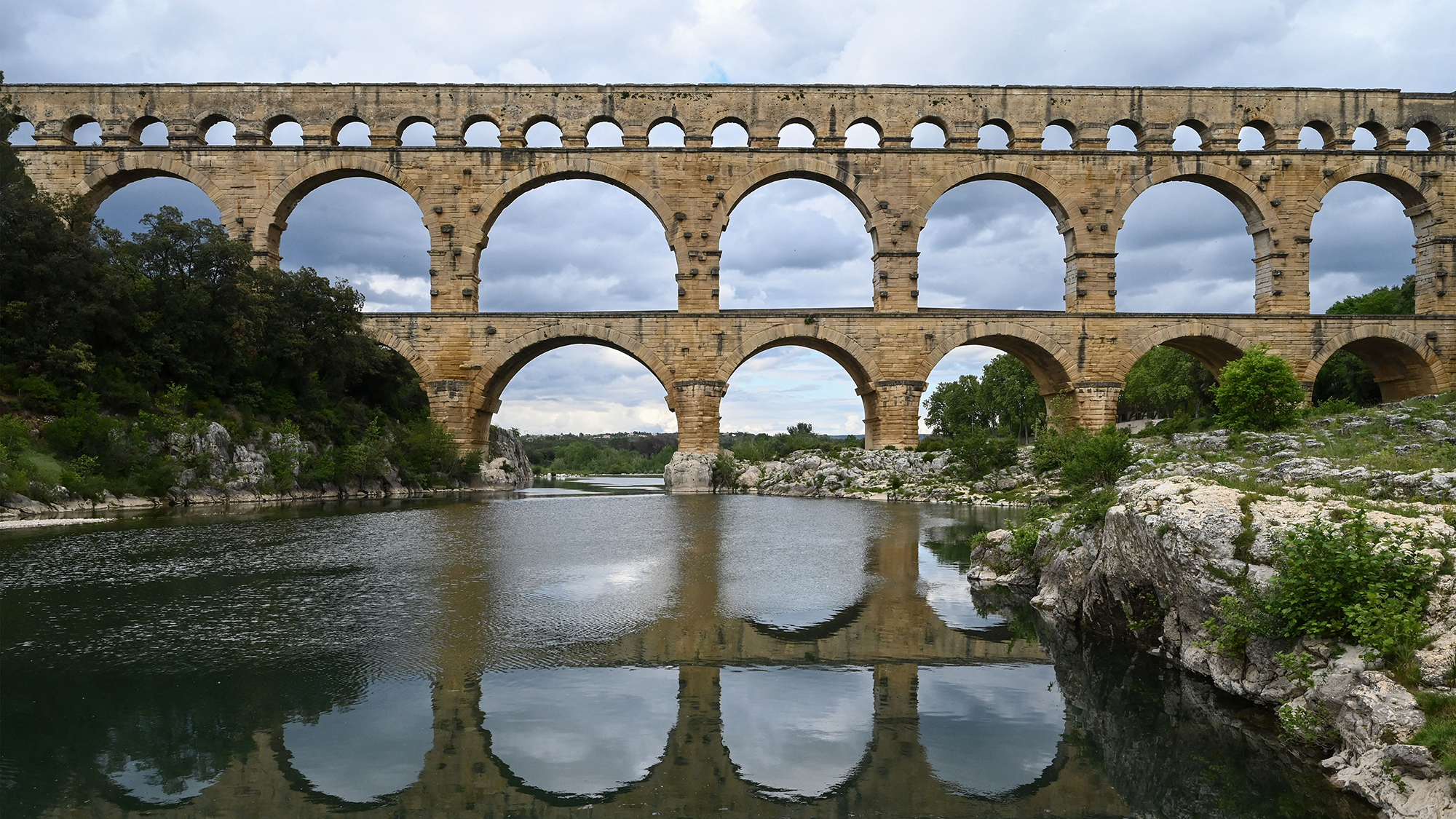
A large stone aqueduct is seen over a river.

A Roman aqueduct crossing a river at Pont du Gard in France. (Image credit: PASCAL GUYOT via Getty Images)

"Roman concrete certainly played an important role, especially in bridges, arcades, and other structural elements," Giovanni De Feo, a professor of industrial engineering at the University of Salerno in Italy, said in an email.

But this wasn't the only factor that allowed Roman aqueducts to last such a long time.

"I believe their remarkable preservation results from a combination of factors," De Feo said. For example, the Romans were careful to select routes that followed stable geological formations.

Regular maintenance that, in many cases, continued into the Middle Ages also helped Roman aqueducts survive the test of time, De Feo noted. This means that they tried to avoid volcanoes and other landscapes that were unstable.

Aqueducts did not always run aboveground; sometimes, they had lengthy underground portions in areas where the landscapes made it difficult to place it aboveground. Some "aqueducts had hardly any stretches above ground outside the city, while others ran on arches for a considerable distance," Gerda de Kleijn, a researcher at Radboud University in the Netherlands, wrote in her book "The Water Supply of Ancient Rome" (J.C. Gieben, 2001).

As the water neared the city, it would sometimes go into pools that helped remove dirt and other visible pollutants. "Water would pool into the basin, sediment would sink to the bottom, then the water would continue from there on its course to the distribution tank," Harry Evans, a professor emeritus of classics at Fordham University, said in an email.

The number of workers required to build an aqueduct depended on its size and timeline for completion. The Hadrianic aqueduct at Athens, which runs for about 12.4 miles (20 km), could have been completed in 15 years by a team of around 500 workers, researchers estimated in a 2022 paper.

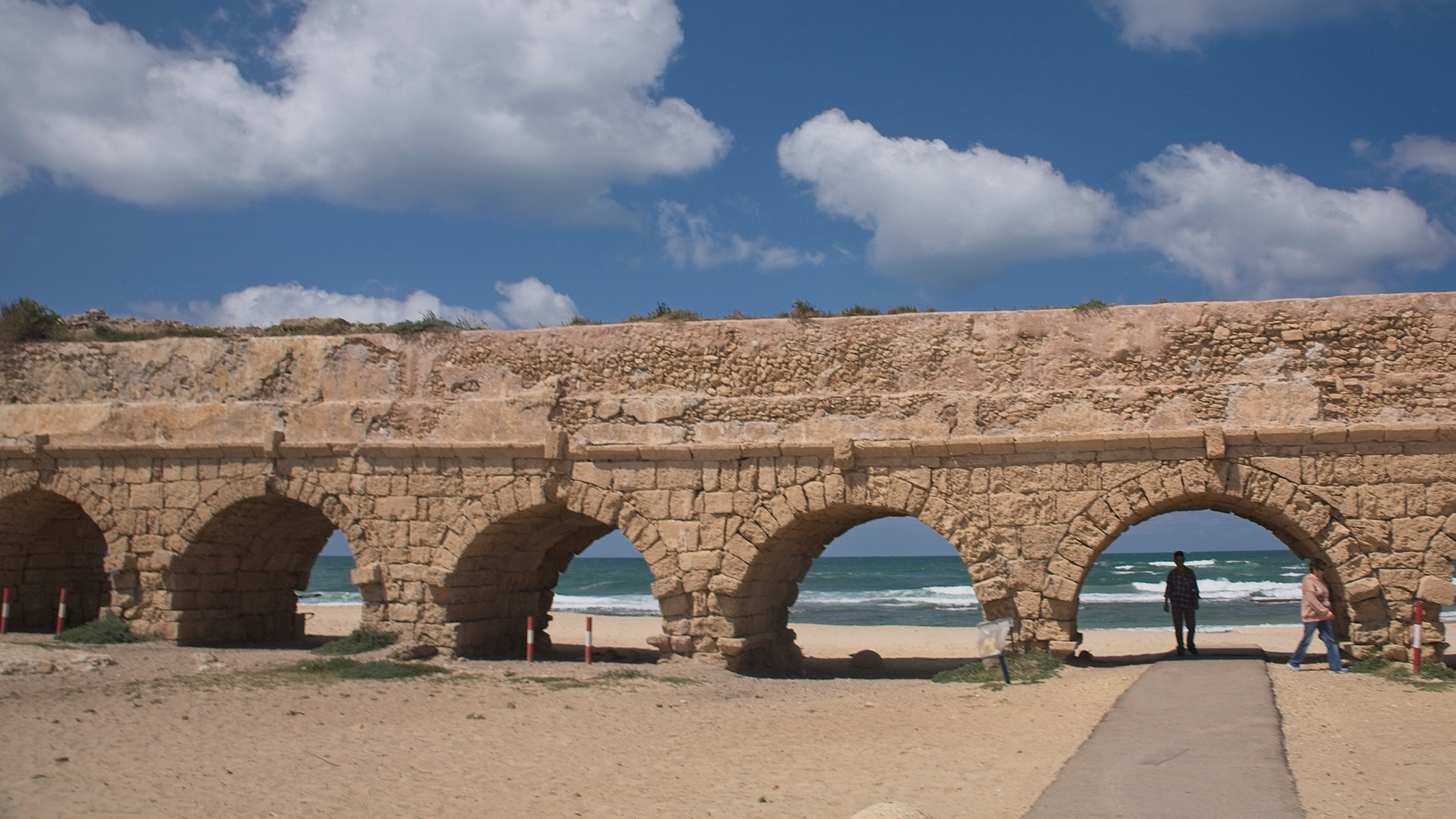
A series of stone archways

Part of a Roman aqueduct in Caesarea, on the Mediterranean coast. (Image credit: Richard Nowitz Photography via Getty Images)

Maintaining the aqueduct

After an aqueduct was built, regular maintenance kept it in good shape. Cees Passchier, head of tectonophysics at Johannes Gutenberg University Mainz in Germany, has studied a Roman aqueduct at Divona in France. In a 2023 study, Passchier and colleagues found that carbonate would have built up on the aqueduct over time. Maintenance workers "partly scraped away" the carbonate before replastering the aqueduct, Passchier told Live Science in an email. At some other aqueducts, they wouldn't bother scraping but would "simply plaster over the carbonate without ever cleaning anything," he said.

A sizable number of workers would have been needed to keep aqueducts functional, but it varied based on the aqueduct's size. For "a small place like Divona, a workforce of a dozen people would probably have been enough," Passchier said. "We know that in Rome, there was a staff of a few hundred people to keep the aqueducts working."

Even after the Roman Empire collapsed, many of its aqueducts survived, as some were used and maintained into the Middle Ages and even into modern times. One of the aqueducts, the Aqua Virgo, built in 19 B.C., is still bringing water to Rome today.

From Augustus to Nero, see how much you know about ancient Rome's famous leaders with our Roman emperor quiz!
Lavish private bath used by Roman emperor and 'high-status residents' discovered at imperial palace in Serbia

Archaeologists excavating in eastern Serbia have discovered the remains of a lavish and uniquely constructed Roman bath that once belonged to an emperor. The suite of rooms β€ͺ—‬ which included heated floors, three bathing pools and a sauna β€ͺ—‬ was uncovered at the bottom of a tower within an imperial palace, a design archaeologists had never seen before in the Roman Empire.

The bath complex, known in Latin as a balneum, was found at the archaeological site of Vrelo-Ε arkamen, a monumental fortified residential complex that was built in the early fourth century and was occupied by Maximinus Daza (or Daia), who was Roman emperor from 310 to 313. Archaeologists have been excavating at Vrelo-Ε arkamen on and off for decades, and the latest discovery was made by a research team from the Institute of Archaeology, an independent research institution in Serbia, according to a Sept. 3 statement.

Galerius Valerius Maximinus, born in what is now Serbia and originally named Daza, was one of the four Roman "tetrarchs." In A.D. 293, Emperor Diocletian essentially split the Roman Empire into two halves β€” Eastern and Western β€” and each was administered by a senior emperor and a junior ruler. By 305, the rulers of the Roman Empire were Constantius and Galerius as senior emperors and Severus and Maximinus Daza as junior rulers, but the tetrarchy had begun to fall apart. Maximinus claimed the title of senior emperor in 301 but lasted only three years. He died in 313 after losing a civil war against his rival, Licinius.

The new excavations at Maximinus Daza's imperial residence have revealed that the palace was even more complex and luxurious than previously thought, according to the statement.

aerial image of an excavated ancient roman bath showing low pillars that supported the floor

Archaeologists identified this part of the bath as the "sudatorium," or steam room. (Image credit: Vrelo-Ε arkamen research team/Institute of Archaeology)

Maximinus' palace had a monumental tower in the southwest corner. But archaeologists were surprised to find a circular bath complex on the lowest level of the tower, as most ancient balnea were oriented linearly, with rooms in a row. This bath area had a domed ceiling with six windows, which shows a high level of engineering knowledge, according to the statement.

The balneum was split into two sections: one for equipment needed to run the baths and one for bathing and relaxing. Within the equipment room, archaeologists found the furnace that heated the bath's floors. They also discovered the base for a copper boiler that would have been used to heat up bath water. However, the copper boiler itself is now missing.

Within the suite of rooms that the emperor used, archaeologists found three bathing pools or tubs, along with a sudatorium, the Latin word for a steam bath or sauna.

According to the statement, "the complex was not simply a space intended for personal hygiene, but a carefully designed private bath intended for high-status residents of the palace, in which architecture, technical infrastructure and comfort formed a single functional whole."

Researchers will continue to explore the bath complex to better understand how the rooms were structured and how Emperor Maximinus and his family accessed it.

From Augustus to Nero, see how much you know about ancient Rome's famous leaders with our Roman emperor quiz!
1,600-year-old skeleton found in a giant jar in Bulgaria may belong to Roman who hid there to escape enemy attack

2 September 2026 at 12:00

Archaeologists in Bulgaria have discovered a human skeleton inside a giant Roman jar. It's likely that the individual sought shelter in the vessel during an enemy attack over 1,600 years ago but died as a fire swept through the area.

The team unearthed the gigantic jar in a Late Roman turret, or small tower, in the Roman colony of Deultum on Aug. 10. It's unclear which battle led to the individual's death, but Deultum faced many attacks from East Germanic tribes and Huns in the fourth and fifth centuries, lead excavator Lyudmil Vagalinski, an archaeologist at the Bulgarian Academy of Sciences, told Live Science in an email.

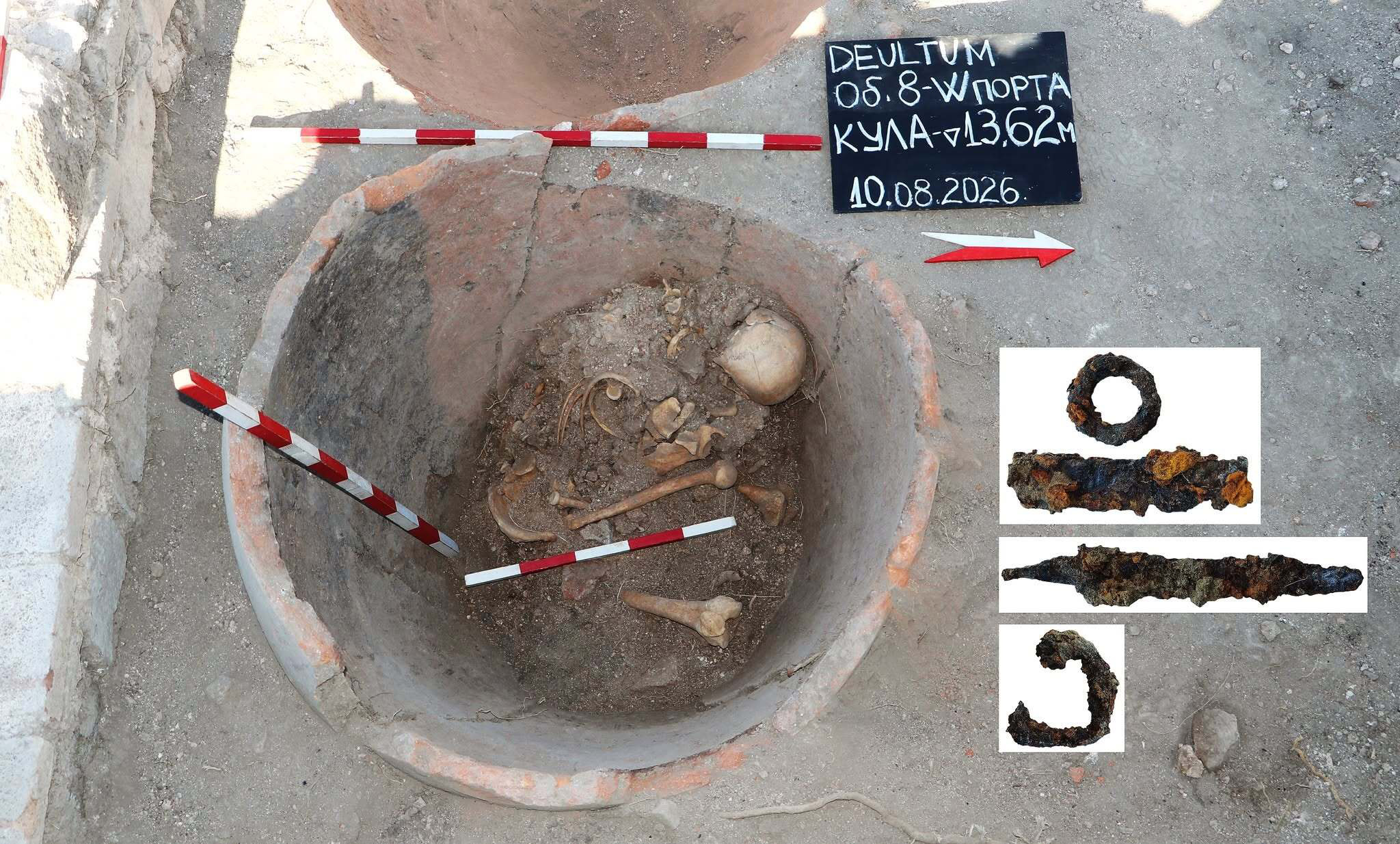
The individual's remains were found with two iron knives and a belt inside the container, a type of jar known as a dolium. These huge vessels were the largest type of pottery in antiquity (from roughly the eighth century B.C. to the fifth century A.D.) and were used to store goods such as olive oil and wine. The largest dolia could hold more than 260 gallons (1,000 liters), although the surviving lower part of the newfound dolium was smaller, measuring approximately 3 feet (1 meter) in diameter, Vagalinski said.

Even though Vagalinski and his colleagues had been excavating the turret, which is the northern turret of Deultum's western Roman gate, they weren't expecting to find human remains there, according to Standart News, the Bulgarian outlet that first covered the finding.

"We were surprised," Vagalinski said in an email. It's very rare for archaeologists to discover human remains inside the cities of antiquity except in the case of "extraordinary circumstances" β€ͺ—‬ like earthquakes, enemy attacks or volcanic eruptions, he said. Even in these cases, survivors would search for their dead to bury them beyond the city walls, but they often didn't know that there were dead bodies under the ruins.

The recent discovery seems to represent one of those "extraordinary circumstances," Vagalinski said. The team found a significant amount of burned materials around the dolium, including ashes and coals; broken bricks, tiles and shards; blackened walls; melted glass fragments; and bones from domestic animals. The likely scenario is that, upon hearing of an imminent attack, people brought their livestock into the fortress. The archaeologists also found many bronze coins that were probably lost in the chaos.

The individual, presumably a young man, was likely part of this tumult and climbed into the dolium to hide or seek shelter, Vagalinski said. And while it's unknown how the fire started, the presence of ashes under the skeleton in the dolium indicates that the individual went inside after the fire had already begun, Vagalinski said.

A skeleton half unearth sits at the bottom of a giant vessel. There are three inset images of the corroded metal knives.

The individual climbed inside the giant vessel with two knives around 1,600 years ago. (Image credit: Archaeologia Bulgarica)

The team's preliminary analysis dates the event to approximately A.D. 400, though they'll have a more precise date after they process the rest of their field data, according to Vagalinski.

The young man was likely hiding from the raging fire in the empty dolium and held an iron knife between his legs to defend himself in case the attackers found him, Vagalinski explained. He had a second knife in his belt.

"In any case, he made no attempt to get out of the ceramic vessel," Vagalinski said. The team determined this based on the individual’s position, similar to that of a sleeping man. "After the attack, the inhabitants of the city leveled the ruins of the tower and covered them with a new, higher floor." They did not know that a fellow citizen was lying at the bottom of the dolium.

The skeletal remains have been moved to Sofia, the capital of Bulgaria, where they will be analyzed by a physical anthropologist, according to Vagalinski. Next summer, the team will head back to Deultum to try to unearth the entire western Late Roman gate, which dates to approximately A.D. 300. The researchers are "eager to reveal its whole plan and proper chronology," Vagalinski said. They also aim to complete the investigation of the gate's northern turret, where they found the dolium.

Earlier this year, the team discovered an older latrina, the Latin word for toilet, dating to between the second and third centuries, near the gate.

From Augustus to Nero, see how much you know about ancient Rome's famous leaders with our Roman emperor quiz!

❌