
❌

Normal view

After 24 years, Return to Castle Wolfenstein is finally distributed uncut in Germany — game was censored due to strict laws regarding Nazi symbolism

9 August 2026 at 11:40

Some announcements arrive with fireworks, while others show up as a single easily missed tweet during a flurry of QuakeCon announcements to quietly close one of the longest-running oddities in PC gaming. After roughly 25 years, Return to Castle Wolfenstein (RTCW) is finally available in Germany in its original, uncut form. Bethesda Deutschland dropped the news amidst its QuakeCon announcements, bringing an end to a censorship saga regarding Nazi symbolism that stretches all the way back to the game's original 2001 release.

A Return to Castle Wolfenstein screenshot showing the Norway level and the submarine you board at the end.

The game's environments are surprisingly varied despite the relatively primitive technology in use. This level is set in Norway. (Image credit: Bethesda Softworks)

If you weren't around for PC gaming in 2001, it's hard to overstate how different the landscape looked. NVIDIA's GeForce 3 had only recently introduced programmable shaders to consumer graphics cards, the ATI Radeon 8500 was fresh competition, Windows XP was brand new, and legendary pioneers 3dfx had just disappeared after being acquired by NVIDIA. Broadband internet was becoming more common, but plenty of multiplayer sessions still happened over LANs, and a Pentium III or Athlon paired with 256 MB of RAM was enough to run one of the latest engine technology showcases.

Built on id Tech 3, perhaps better known as the tech that powered the incredible Quake III Arena, Grey Matter's Return to Castle Wolfenstein looked fantastic for its day, and it also inherited the series' unmistakable identity. See, ever since Castle Wolfenstein in 1981, and even more so after Wolfenstein 3D essentially invented the first-person shooter as we know it a decade later, the games have been about one thing above all else: shooting Nazis.

That identity created a problem in Germany. For decades, games depicting Nazi symbolism faced legal and regulatory hurdles that films did not, resulting in a heavily modified German version. In RTCW, swastikas disappeared, Nazi organizations were renamed, Heinrich Himmler became the fictional "Heinrich Höller," and references to the Third Reich gave way to the equally fictional "Wolf Clan."

At first glance, that sounds like the sort of censorship that simply strips away context, yet RTCW was already a strange game. The opening hours suggest a relatively grounded World War II action title. You wake up in a prison with a knife, you fight Nazis in a castle, and things seem normal for about a whole hour before rapidly veering into supernatural pulp. Within a few missions, you're fighting zombies, exploring haunted crypts, and watching the SS dabble in increasingly implausible occult experiments.

An RTCW screenshot showing the final boss, Heinrich I, flanked by several undead enemies.

The final boss Heinrich is barely mentioned before the end of the game, making him quite a surprise if you aren't paying close attention to the story. (Image credit: Alan Chan/MobyGames)

By the end, the final boss isn't Hitler (mech suit or no) or a secret superweapon, but Heinrich I, historically known as Henry the Fowler. He was a real 10th-century German king, supposedly resurrected in the game through dark ritual. He's also somewhat infamously a surprisingly manageable final boss, making for a finish both absurd and anticlimactic after the game's escalating parade of undead knights and bizarre experiments.

Seen through that lens, the censored version accidentally became a different story. Instead of Nazis attempting to exploit medieval occult power, it played more like an ancient secret society preserving itself across the centuries before trying to resurrect its long-dead founder. It's arguably a cleaner fantasy premise. The "Wolf Clan" makes more narrative sense once the game fully commits to gothic horror. However, it does make the opening chapters, where an OSS Ranger is somehow investigating a shadowy organization seemingly unrelated to the wider war, a bit awkward.

The catch, of course, is that it stops feeling much like Wolfenstein. The series' DNA is inseparable from infiltrating Nazi strongholds and sabotaging increasingly desperate attempts to turn the tide of World War II. Remove that element, and the title itself starts to feel like an artifact from another game series altogether.

A screenshot of a briefing screen from Return to Castle Wolfenstein, showing how detailed the mission briefings were.

These surprisingly detailed mission briefings had to be fully reworked for the German version of the game. (Image credit: Bethesda Softworks)

It's a curious example of something that occasionally happens with censorship across entertainment. More often than not, edits simply leave a work feeling diminished. Every so often, though, these constraints produce something unexpectedly memorable. The Texas Chain Saw Massacre owes much of its enduring reputation to how much horror it leaves to implication rather than explicit gore, and that decision was made due to the ratings board. Similarly, action film edits for TV often cut gory death scenes, which can ironically improve the pacing of the film.

Return to Castle Wolfenstein belongs in that same conversation, albeit for different reasons. The German version wasn't a better version of the game in any objective sense, but it accidentally shifted the genre. Instead of occult Nazis, it became a story about an ancient cult whose descendants had survived into the modern era. That's a premise that I personally find more appealing and even internally consistent, even if it comes at the expense of the series' defining theme.

A RealRTCW mod screenshot showing improved texturing and lighting over the base game.

The RealRTCW mod offers widescreen support and improved texturing and lighting over the base game. (Image credit: RealRTCW Team)

So, after a quarter of a century, German players can finally buy the same uncensored game that much of the rest of the world has had since 2001. It's ironic, and it's about time, too. While Germany relaxed its gaming rules in 2018, allowing modern entries like The New Order to go uncut in 2019, Grey Matter's 2001 classic remained stuck in censorship limbo until now. For game preservation, historical authenticity, and simple consumer choice, that's unquestionably the right outcome. Yet it also marks the quiet retirement of one of gaming's strangest alternate versions; a release that, through a combination of legal necessity and narrative coincidence, accidentally stumbled into telling a very different and potentially more compelling story.

Folks in Germany should now be able to pick up the uncensored version of the classic game on sale for just two dollars at Steam and GOG, or you can get a bundle that includes the original Wolfenstein 3D for just a dollar more. If you grab it, make sure to check out the RealRTCW overhaul mod that radically improves the game with modern features like proper widescreen support and cleaner OpenAL audio.

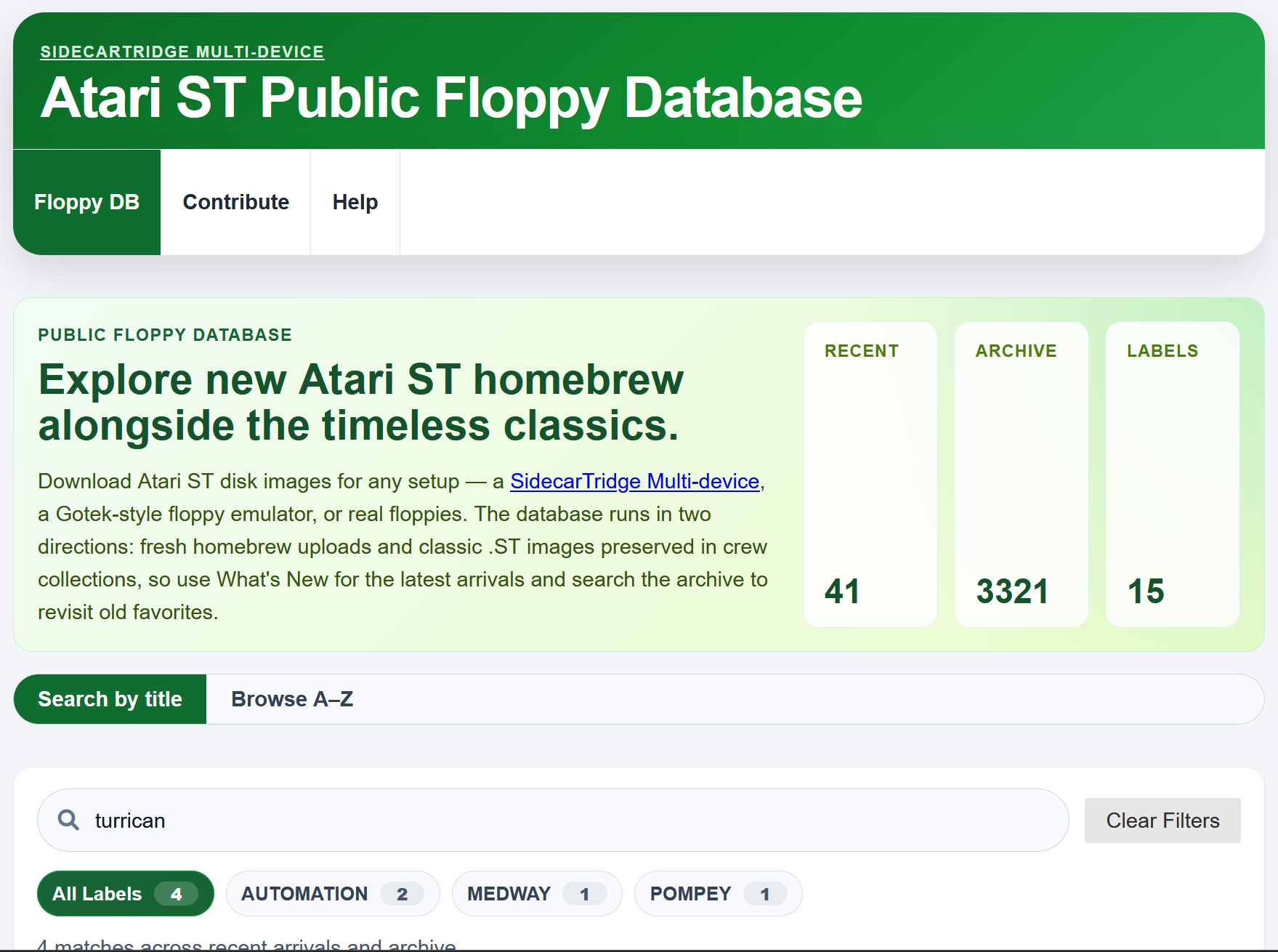
Atari ST Public Floppy Database now open for everyone — online archive originally designed for ST flash cart packed with classics and homebrew

8 August 2026 at 13:15

An extensive Atari ST floppy disk database can now easily be accessed by all netizens. Originally created to serve floppy images to the owners of the SidecarTridge multi‑function hardware add‑on for the Atari ST family (ST, STE, Mega ST, TT, Falcon), anyone can now browse, search, and download the .ST files to use with other hardware, emulators, or even to rewrite the disk images to actual floppies.

The Atari ST Public Floppy Database browser from the SidecarTridge Multi-device is now open on the web to everyone.Until now, searching that community-curated archive of floppy images meant firing up your Atari ST with a SidecarTridge Multi-device. The search lived inside the…July 21, 2026

After reading the announcement, I decided to check out the online repository. My favorite old platformer series was there, with more than one disk featuring the legendary Turrican and Turrican II releases. I also checked and confirmed public domain/shareware favorites like Gravity Force were available, as was Llamatron, and the mono high-resolution Bolo. Some things I looked for, like the Stupendous Demo, seemed to be missing, as were serious art and DTP tools I used to dabble with in the 90s.

Atari ST screenshots

(Image credit: Tom's Hardware)

The database is pleasingly new and regularly maintained, though. For example, it has 41 Atari ST disks flagged as recent arrivals. These are a mix of old releases being added, and some extremely new titles like new homebrew games, and a collection of demos released at Sommerhack 2026 just last month.

As indicated in the intro, this disk database was originally collated for direct access via hardware designed to bring several modern conveniences to those who still cling to original Atari ST-family computers. The SidecarTridge slots into the computer’s cartridge port, hence the name. It is much more than a ‘Gotek-style’ flash card floppy loader, though. This Raspberry Pi Pico W RP2040 microcontroller-powered device can also load different ROMs (the Atari ST’s entire OS and GEM desktop were loaded from ROM for super-fast,t no-disk-needed booting) via its microSD card slot. It also provides hard disk emulation, networking features (Wi-Fi for downloading Atari ST Public Floppy Database disks), access to RTC, and modern keyboards, mice, and other peripherals.

Play Any Apple II or Apple IIgs Game in Your Browser

7 August 2026 at 22:34

If you’ve been using computers for a long time, you might recall the Apple II and Apple IIgs, two of Apple’s early computers that were before they had fully committed to the Macintosh platform. While there were plenty of productivity apps and programming tools for Apple II and Apple IIgs, there were also a whole ... Read More

The post Play Any Apple II or Apple IIgs Game in Your Browser appeared first on OS X Daily.

Take-Two despreocupa com polêmica sindical e mira sucesso do GTA 6

7 August 2026 at 20:29

Descubra como a Take-Two encara a controvérsia sindical e segue confiante no lançamento do GTA 6.

O post Take-Two despreocupa com polêmica sindical e mira sucesso do GTA 6 apareceu primeiro em Blog do Edivaldo - Informações e Notícias sobre Linux.

💾

Aproveite vídeos e músicas que você ama, envie e compartilhe conteúdo original com amigos, parentes e o mundo no YouTube.

New official 30th anniversary Quake mission pack adds new maps and mechanics

7 August 2026 at 19:00

This year is the 30th anniversary of the launch of the original Quake by id Software, if you could believe it. To commemorate that, publisher Bethesda has released a new campaign chapter for the game, titled "Dawn of the Machine."

This is part of a series of new campaign chapters, all developed by MachineGames "in collaboration with id Software." MachineGames is best known for making the games in the relatively recent Wolfenstein reboot series, as well as Indiana Jones and the Great Circle. The Quake maps are made by a team dubbed "Quake Club," which includes several MachineGames employees who work on Quake maps in their spare time.

The ambition and scope of some of these maps is beyond what was typical for Quake maps back in the late '90s, thanks in part to the team's use of TrenchBroom, a newer map editor that works well on modern systems and is easier to work with and more capable than what folks were using in those days.

Read full article

Comments

© Bethesda

EA Sports FC 27: what does the next instalment of the world’s biggest football game have in store?

7 August 2026 at 14:00

The all-conquering franchise’s revamps are technically impressive, its transfers more true to life – and its new grassroots social hub is surprising fun

As if the world wasn’t sufficiently football-obsessed, it’s time to prepare for the arrival of its biggest football video game. EA Sports FC 27 (the franchise that used to be Fifa – what better time to no longer be Fifa-branded?) is due to be released on 25 September. I just spent two intense days in Vancouver, where the EA FC games are made, playing FC 27 and talking to its developers.

With an annual franchise such as EA FC, it helps to have something fresh to entice regular fans, and FC 27 has a whole new element, entitled the Grounds. It’s a physical hub-type area, similar to the City as seen in 2K’s recent NBA 2K basketball games, but much more pleasant to frequent, split as it is into areas inspired by British, French and Argentinian street-football culture.

Continue reading...

© Photograph: Electronic Arts

© Photograph: Electronic Arts

© Photograph: Electronic Arts

Pony Island 2 Panda Circus: gallop out of hell in this phantasmagorical follow-up to 2016’s indie hit

7 August 2026 at 10:00

Daniel Mullins explains how he plans to follow up his quirky classic without losing what made it stand out in the first place

Glitchy aesthetics. Literally collapsing menu boxes. The game taunting you by “possessing” your Steam friends. Technical tricks of this nature may sound gimmicky in 2026, but they felt excitingly unorthodox a decade ago, when Pony Island came out to critical acclaim.

Fans of Daniel Mullins, the celebrated indie developer of Inscryption, will be forgiven for forgetting that Pony Island 2: Panda Circus is in active development. After all, it’s been almost three years since the announcement – and a full decade since it was first teased as an Easter egg in Pony Island’s ARG (Alternate Reality Game) – with only a single trailer and a bunch of tunes from the soundtrack released to the public.

Continue reading...

© Photograph: Daniel Mullins Games

© Photograph: Daniel Mullins Games

© Photograph: Daniel Mullins Games

EA Sports Tailors Madden NFL 27 for Apple Arcade

6 August 2026 at 19:00

EA Sports has released Madden NFL 27 Arcade Edition, a version of the popular football simulation franchise that Apple Arcade subscribers can play on the iPhone, iPad, Mac, and Apple TV. It’s a big release built specifically to take advantage of Apple hardware, allowing players to play the game on a wide variety of hardware.

I was struck by how easy it is to pick up and play the game whether you’re a diehard NFL fan or not. I don’t follow football closely, but I was able to get the hang of the game and have fun right away, knocking out a Quick Play match when I had a few minutes to spare.

Quick Play tightly limits the overall time it takes to complete a matchup, but it doesn’t sacrifice depth in the process. There are long lists of plays you can run, including suggested plays, play types, formations, and recents, as well as a wide variety of statistics. And after a big play, you can replay it with total control over the camera angle, too.

However, if you want to go really deep, the game’s Franchise Mode lets you play a full NFL season, managing your team all the way through the playoffs. You can also draft your dream team from the game’s huge catalog of real-world NFL stars. Plus, during the real-world NFL season, player attributes shift based on their actual performance.

Madden NFL 27 also looks terrific. The 120Hz playback is smooth on the iPhone, where I spent most of my time with the game, and even nicer on a bigger screen like my 14” M4 Max MacBook Pro, making for an immersive experience.

What impresses me most about Madden NFL 27, though, is how well it makes use of the Apple hardware and technologies at its disposal. Too often, those sorts of details get left behind when a big release is published on Apple platforms.

To its credit, EA has done an excellent job adapting Madden NFL 27 for Apple Arcade subscribers. You can play across every device mentioned above, leaving off on one device and picking up on another seamlessly because saves sync across devices. Every device supports game controllers and touch where applicable, and those devices with 120Hz displays support that, too.

Madden NFL 27 Arcade Edition is available now on the App Store as part of an Apple Arcade subscription. The game is debuting on other platforms next week.

Nazis and Happy Feet collide in Penguin Colony, a psychological horror game set at the world’s end

6 August 2026 at 15:00

Explore Antarctica as a flightless bird – and dodge some earthly monsters – in this surreal adaptation of HP Lovecraft

While watching the 2006 animated film Happy Feet with his daughter, Origame Digital founder Naphtali Faulkner noticed something interesting. “[In the movie], they see the digger fall into the ocean, and it has an almost eldritch quality,” he says. Over time, and with plenty of iteration, Faulkner’s inspirations coalesced, from HP Lovecraft to the 1982 version of The Thing and the works of David Lynch. “I’m a big fan of horror that sits in your head rather than in your stomach,” says Faulkner.

In Penguin Colony, players body-switch between species of flightless birds, piecing together cryptic cosmic clues as they tail a Nazi expedition to Antarctica. In the process, Origame Digital draws on Lovecraft’s novella At the Mountains of Madness. “I’d always wanted to do a creature that’s a manifestation of colonial thought, energy and power, and the idea of it resting and then regrowing,” says Faulkner. “I was looking through the history of Lovecraft and him being a gigantic racist, and this idea of the Nazis sort of came out,” he adds.

Continue reading...

© Photograph: Fellow Traveller

© Photograph: Fellow Traveller

© Photograph: Fellow Traveller

‘Mamma mia!’: Trump tariffs refund ignites 53% profit spike at Nintendo

Profit jump fuelled largely by unknown US refund amount as Japanese video game firm records quarterly sales drop

Nintendo has reported a jump in profits, as the Japanese game maker’s earnings were buoyed up by a long-awaited refund on Donald Trump’s tariffs.

The company said profits surged 53.5% to ¥147.4bn (£694m) over the three months to June, substantially beating expert forecasts for ¥77.8bn.

Continue reading...

© Photograph: Richard A Brooks/AFP/Getty Images

© Photograph: Richard A Brooks/AFP/Getty Images

© Photograph: Richard A Brooks/AFP/Getty Images

Metroid at 40: happy birthday to Samus Aran, gaming’s greatest badass and my personal heroine

6 August 2026 at 08:00

Being a woman who loves video games has often felt lonely, like being on a hostile planet – but Metroid’s female space hunter has been with me all the way

It’s 1986, and you’re playing a brand-new game. (You’re in Japan in this scenario, by the way; the game in question, Metroid, won’t come to North America and Europe until later.) Anyway, this new game has you in its grip. You are a lone astronaut exploring a hostile alien planet full of ancient, mysterious structures. This astronaut looks human enough – but this distinctly alien place is full of objects that power up their spacesuit’s capabilities. Each new ability allows you to explore a new area, and as you do, you realise that the entirety of the planetary base you’re exploring is one, massive, interconnected maze. Whoa.

Hours later, you finally defeat Mother Brain and set off a timed self-destruct sequence. Upon your escape, you’re treated to an endgame screen: the little astronaut faces you as text on screen implores you to “pray for peace in space”.

Continue reading...

© Photograph: Nintendo

© Photograph: Nintendo

© Photograph: Nintendo

❌