❌

Normal view

NASA is sending 2 probes to the moon to test complex 'three-body orbits'

NASA is planning to send two maneuverable probes to lunar orbit in order to learn how spacecraft are affected by the complex gravitational environment near the moon.

The mission, known as CAPSTONE 02, is currently aiming to launch in 2027. It will see the two probes maneuver in close proximity to one another and fly in "formation" so mission operators can better understand the gravitational effects spacecraft experience in cislunar space. This area of space is under the influence of both Earth's gravity and the moon's, meaning spacecraft operating there will have to navigate what are known as "three-body orbits."

While testing spacecraft maneuverability in these complex orbits, CAPSTONE 02 will also study communication and navigation systems that will be used in NASA's planned Artemis missions of lunar exploration and moon base construction. "This mission represents an important step in the maturation of cislunar capabilities," said NASA's Sean Fuller, Moon Base CAPSTONE manager, in an agency statement. "CAPSTONE 02 lays the foundation for lunar infrastructure and commercial services that support Artemis, Moon Base, and future missions to deep space."

The two CAPSTONE 02 probes are being built by Terran Orbital Systems, Inc. Once in space, they will alternate jobs while flying in formation, switching between what NASA calls "chaser" and "target" roles.

The spacecraft pair will use celestial navigation, optical sensors and data collected by telescopes on the ground during these maneuvers. This is similar to how NASA will use a variety of data to help its Orion spacecraft meet up with a lunar lander en route to the moon.

On the upcoming Artemis III mission, currently scheduled for 2027, NASA will test some of these techniques as Orion will rendezvous with both Blue Origin's Blue Moon lander and SpaceX's Starship, if all goes according to plan.

"Transporting crew to the lunar surface from cislunar orbit depends on knowing how well navigation systems will perform during these operations. Since these conditions can't be fully recreated on Earth, they must be tested in space," NASA wrote in its statement outlining the CAPSTONE 02 mission.

A giant chrome rocket and a small space capsule dock in low Earth orbit.

An artist's rendering of NASA's Orion spacecraft meeting up with SpaceX's Starship on the planned Artemis III mission. (Image credit: SpaceX)

As its name implies, this will be the second mission under NASA's CAPSTONE program, or Cislunar Autonomous Positioning System Technology Operations and Navigation Experiment. The first CAPSTONE probe launched in 2022 and operated for four years before NASA officially concluded its mission in June 2026.

That microwave-oven-sized CAPSTONE spacecraft tested communications tech and became the first spacecraft to test three-body orbits around the moon, according to a NASA statement.

CAPSTONE was tested in what is known as a near rectilinear halo orbit. This is a fairly gravitationally stable orbit, thanks to the nearly equal pulls of both Earth's gravity and the moon's.


Artemis moonsuits take a dive | Space photo of the day for July 31, 2026

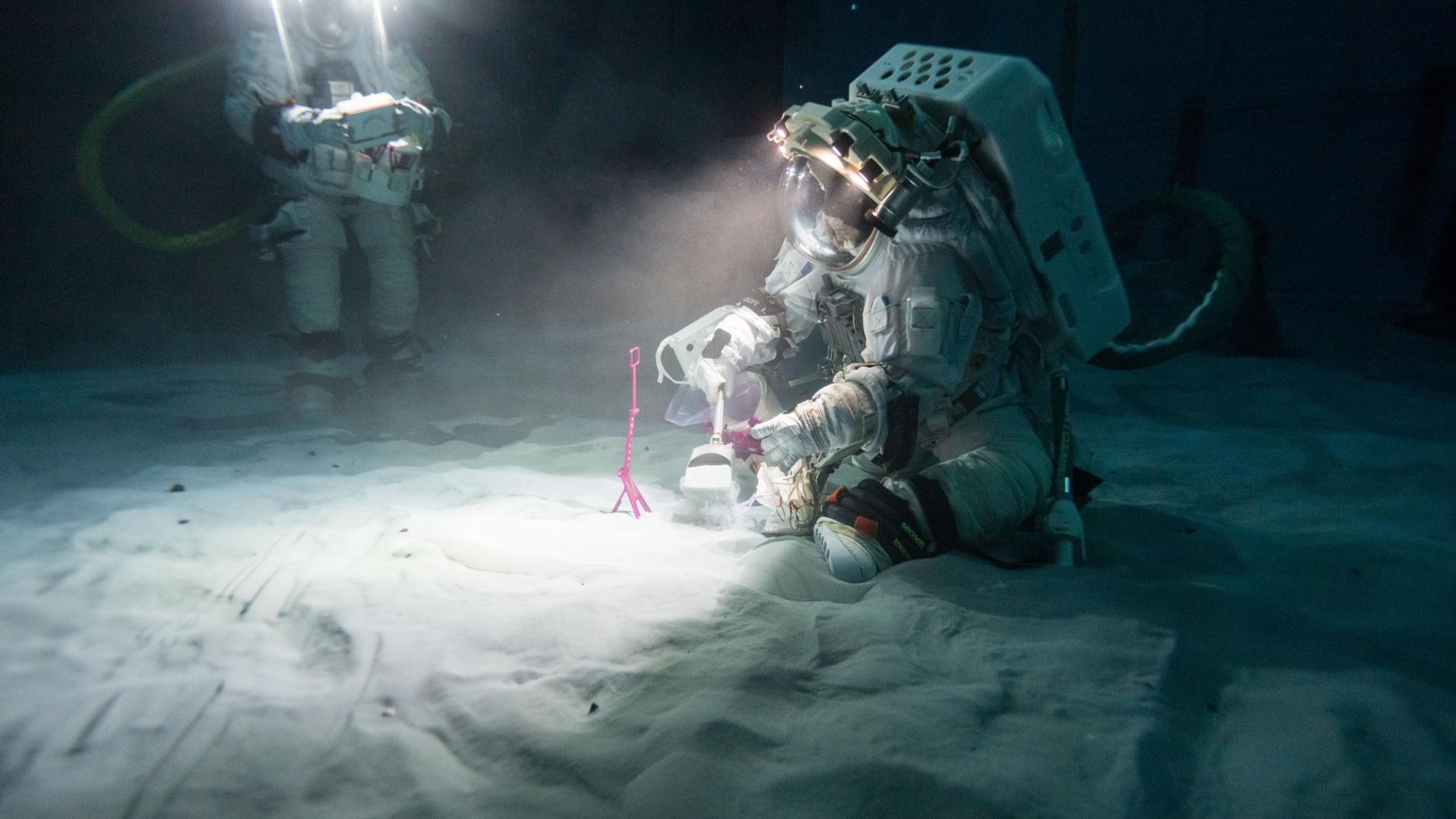
a person in a bulky white spacesuit attached to an umbilical digs in sand with a shovel underwater

Exploration geologists and Artemis science officers Trevor Graff, left, and Angela Garcia carry out a lunar training development run at NASA's Neutral Buoyancy Laboratory (NBL) in Houston. (Image credit: NASA)

Sometimes to go to the moon, you first have to go underwater.

NASA is currently developing the training program for NASA's Artemis astronauts, some of whom could set foot on the moon during the agency's planned Artemis IV mission. As part of that development, two agency scientists recently donned Artemis moonsuits and took to NASA's underwater training facility.

What is it?

These photos show two NASA exploration geologists and Artemis science officers practicing using the same types of geology tools that astronauts might use when they explore the moon.

The scientists also "deployed a mock lunar payload under low-angle lighting conditions," according to a NASA statement accompanying the photo. NASA is currently aiming to place astronauts at the lunar south pole, where many areas remain in permanent shadow. As such, future lunar explorers may have to operate in near-total darkness and learn how to carry out their missions with very little light.

people in bulky spacesuits walk across a sandy surface underwater in a dark pool-like laboratory

Exploration geologists and Artemis science officers Trevor Graff, left, and Angela Garcia carry out a lunar training development run at NASA's Neutral Buoyancy Laboratory (NBL) in Houston. (Image credit: NASA)

Why is it incredible?

The fact that NASA is preparing to send humans back to the moon is incredible in itself. Humanity hasn't set foot on our natural satellite since 1972. While NASA still has many technical hurdles to cross when it comes to developing and selecting a moon lander, the agency is pushing ahead with developing the training it will use to prepare its astronauts to explore the lunar surface.

For this particular part of Artemis training development, NASA placed two scientists in its Neutral Buoyancy Laboratory (NBL), a 40-foot-deep (12-meter) pool at NASA's Johnson Space Center in Houston. The particular test in these photos was "the first time that two geologists were suited up simultaneously for lunar geology training in the NBL," according to NASA's statement.

For these tests, a portion of the underwater laboratory was outfitted with soil and rocks that simulate the surface of the moon. The buoyancy of the pool can be manipulated in order to simulate different levels of gravity, helping astronauts train for spacewalks or for exploring other worlds like the moon.

Satellites spy penguin poop on Danger Islands | Space photo of the day for July 30, 2026

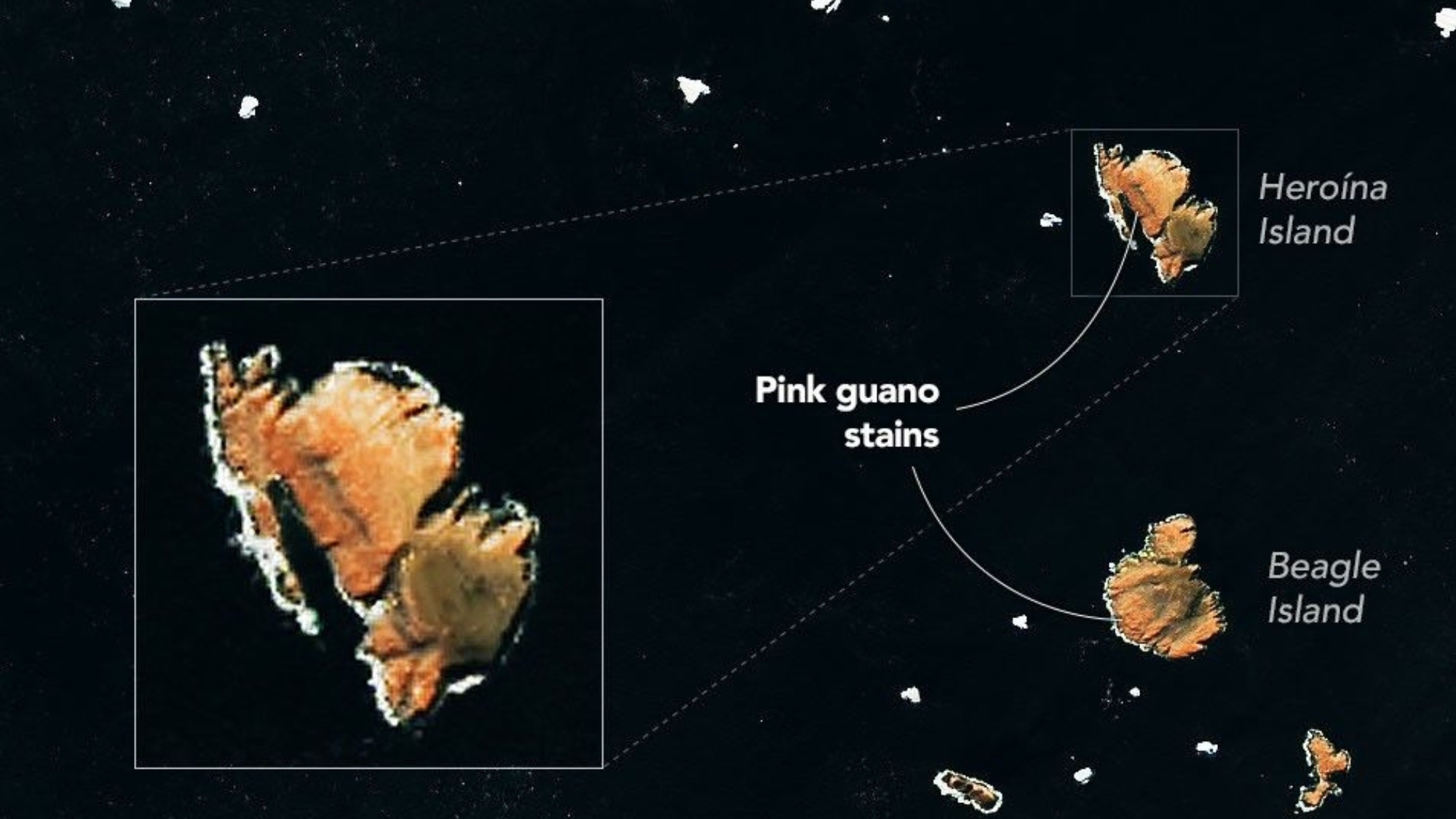
a satellite view of two long islands

Pieces of sea ice drift near Antarctica's Danger Islands in this image, acquired on Jan. 22, 2023, by theΒ Landsat 8 satellite. Several of the islands are stained pink by guano from AdΓ©lie penguins with a krill-rich diet. (Image credit: NASA Earth Observatory/Michala Garrison)

The diets of penguins on Antarctica's Danger Islands can be seen from space. At least indirectly.

Using satellite images captured by the Landsat 8 spacecraft operated by NASA and the United States Geological Survey, scientists can track changes in AdΓ©lie penguins' diets based on the color of their guano, or droppings.

What is it?

The image above shows pinkish-orange guano staining large sections of some of the Danger Islands, HeroΓ­na Island and Beagle Island. The penguins that live there eat a diet rich in krill, small marine crustaceans that are bright pink in color due to a specific type of algae upon which they feed.

a group of penguins jump from one ice floe to another in the sea

A group of Adelie penguins jumping from ice pebble to ice pebble on a beach of Paulet Island on the tip of the Antarctic Peninsula. (Image credit: Wolfgang Kaehler/LightRocket via Getty Images)

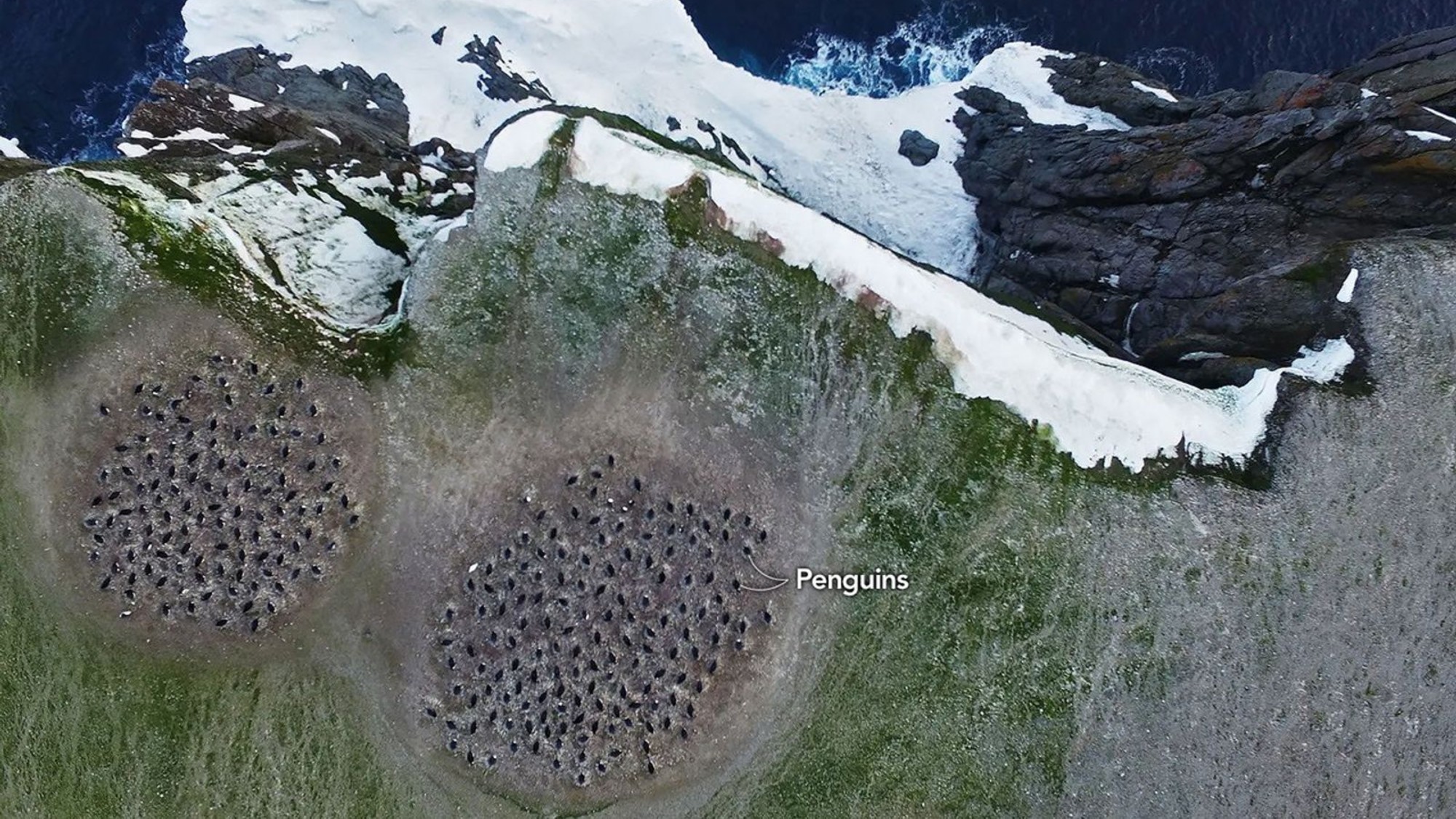
The bright pink color of the penguins' droppings stands out in satellite imagery, allowing researchers to monitor the birds' populations from space. But scientists wanted a closer look, and collected drone imagery as well, as seen in the image below.

two large clumps of dots can be seen on a grassy hill lined with snow and ice from an overhead perspective

A colony of AdΓ©lie penguins is visible in this image captured by a drone during a research expedition to the Danger Islands. (Image credit: Thomas Sayre-McCord/WHOI/MIT)

Why is it incredible?

It's pretty amazing that the diet of a specific population of birds can be monitored from 438 miles (705 kilometers) above Earth's surface. The imagery collected by Landsat-8 helped scientists locate where the penguin colonies might be, allowing them to find them in-person and collect guano samples. Those samples contained evidence of what the penguins were eating over time.

Researchers are using those satellite images and samples to track how the penguins' diet might be affected by changes in sea ice conditions, according to a NASA statement.

"Sea ice is such a hugely important factor in the Antarctic marine environment," said Clemson University biologist Casey Youngflesh who led a study comparing the penguins' diet and sea ice conditions. "The structure of the region's food web is changing in response."

NASA launched this spacecraft to save a space telescope. Now, it needs saving too

Things aren't going so well for NASA's latest satellite rescue mission.

NASA launched the Swift Boost mission on July 3, sending a specialized spacecraft to low Earth orbit on a Northrop Grumman air-launched Pegasus XL rocket. The spacecraft is called LINK and was built by Arizona-based Katalyst Space Technologies. LINK was sent to orbit to try and link up with NASA's Swift observatory, a highly successful scientific satellite designed to search for gamma-ray bursts, some of the most energetic events in the universe.

But it looks like just a few weeks after launch, LINK is experiencing some issues. "Katalyst's LINK servicing spacecraft experienced issues with attitude control, causing the spacecraft to spin and resulting in sporadic communications," NASA wrote in an update on Tuesday (July 28). Despite the malfunction, however, the space agency says the rest of the spacecraft is functioning normally and remains in otherwise good health.

According to preliminary analysis of the issue, two of the LINK spacecraft's three reaction wheels are not operating. In addition, there is "some loss of functionality" in LINK's cold gas thruster system.

The failure with the LINK spacecraft's reaction wheel is slightly ironic, given that the Swift observatory itself once had issues with its own reaction wheels. In 2022, NASA placed the observatory in safe mode when one of its reaction wheels caused minor issues with the spacecraft's movements.

a cylindrical spacecraft floats above earth

NASA's Neil Gehrels Swift Observatory, shown in this artist's concept, orbits Earth as it studies the ever-changing universe. (Image credit: NASA’s Goddard Space Flight Center Conceptual Image Lab)

Mission teams will now try to use the spacecraft's electric propulsion system to stop the spinning and regain control. If that can be done, NASA and Katalyst will then have to evaluate if the mission can proceed as planned.

Swift's orbit has been decaying for years, and the observatory is unable to boost its orbit on its own. Thus, LINK was designed to meet up with Swift in low Earth orbit and spend some time studying the observatory to determine how best to grab onto it with three robotic arms. Once it has linked up with Swift, LINK should be able to use its own thrusters to boost the observatory to a higher orbit and extend Swift's life.

a three-panel illustration showing two spacecraft meeting up above earth

Artist's illustration of Katalyst Space Technologies' Link servicing spacecraft approaching and capturing NASA's Swift space observatory on an orbit-boosting mission. (Image credit: Katalyst Space Technologies)

The Swift observatory, officially known as the Neil Gehrels Swift Observatory, was launched in 2004 at a cost of $250 million. The Swift Boost mission only cost NASA $30 million.

Over the last 22 years, Swift has been searching the sky for gamma-ray bursts and other high-energy astrophysics phenomena in the cosmos. In 2022, the observatory spotted a gamma-ray burst nicknamed the "BOAT," short for Brightest of All Time. At the time of discovery, it was the most powerful space explosion ever seen.

SpaceX Starship still floating 5 days after flight | Space photo of the day for July 29, 2026

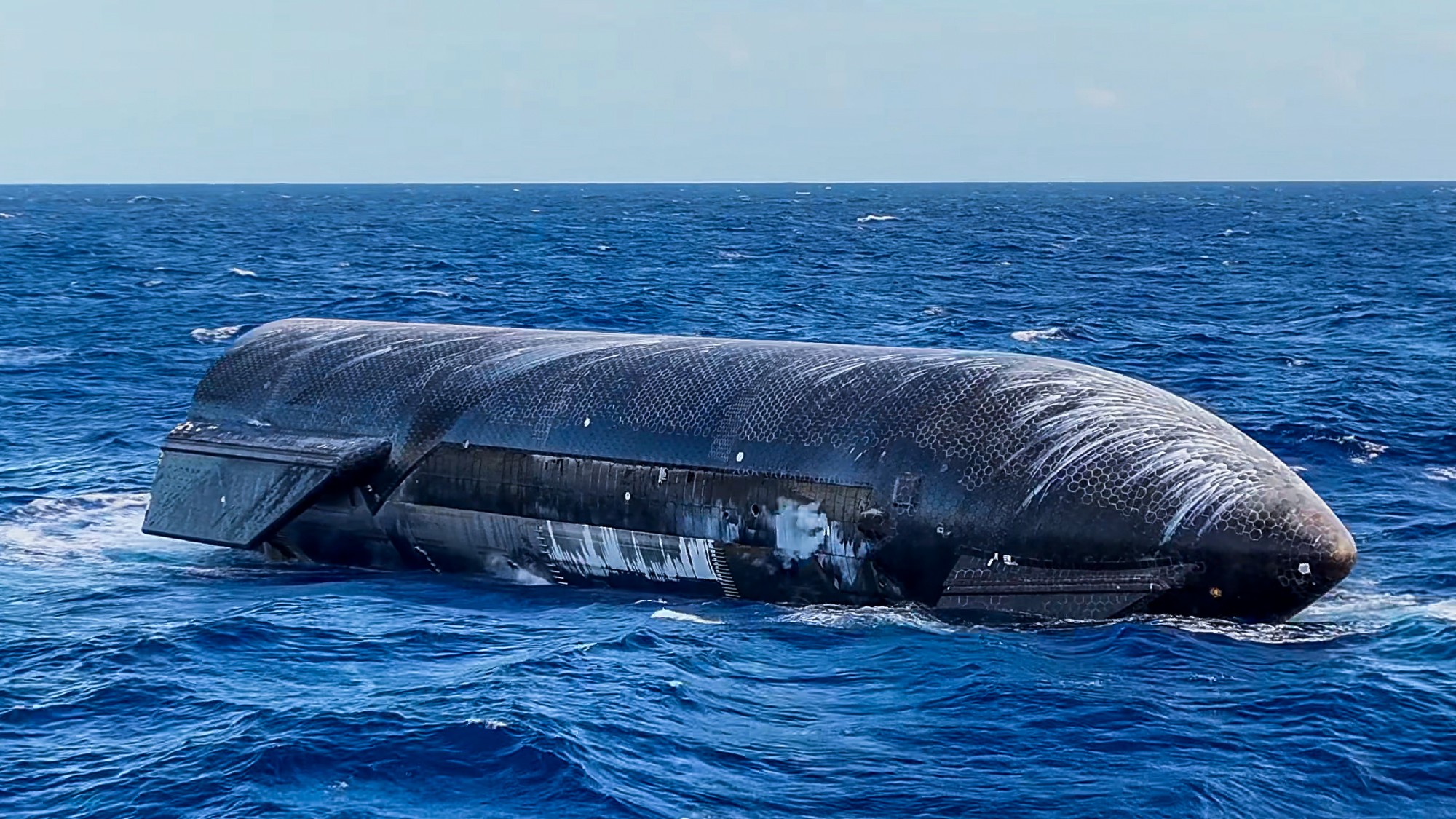
a large black cylinder with wing-like canards floats on top of a choppy blue sea

SpaceX's Starship Version 3 floats on the Indian Ocean on July 28, 2026, days after splashing down on the vehicle's Flight Test 13 on July 24. (Image credit: SpaceX via X)

SpaceX's Starship V3 looks absolutely seaworthy in this new photo taken days after its most recent flight test.

What is it?

SpaceX launched its Starship vehicle on July 24, sending the 408-foot-tall (124-meter) Starship Version 3 (V3) rocket on a suborbital trajectory that saw the rocket's upper stage make its softest splashdown yet.

In fact, the landing was so smooth that Starship is still floating off the coast of Western Australia. SpaceX shared the photo of Starship on Tuesday (July 28), posting on X that the vehicle is "still afloat in the Indian Ocean."

The scorch-streaked 171-foot (52-meter) Starship upper stage resembles an orca or a submarine in the photo, resting mostly out of the water.

Why is it incredible?

It wasn't just the splashdown that was so stunning. Video taken from aboard Starship and from the Starlink satellites that were deployed alongside the upper stage during Flight Test 13 truly looks like the stuff of sci-fi.

Starship, which consists of SpaceX's Super Heavy booster and the somewhat-confusingly-named upper stage known as Starship (or Ship), is designed to be rapidly reusable. That means, if all goes according to plan, SpaceX will eventually be able to land both stages and have them refueled, inspected and ready for flight again in a matter of days.

But there are still major hurdles to cross before that goal is ever reached. SpaceX will have to figure out how to make Starship's heatshield more durable and reusable, a feat some experts call a "dead-end for all missions that require full and rapid reusability," according to Ars Technica.

Nevertheless, having a fully intact second stage rocket floating on the ocean four days after a flight test is quite a feat.

ISS meets Venus in incredible daylight photo | Space photo of the day for July 28, 2026

a T-shaped space station beside a half-orb on a blue sky

Venus beside the International Space Station as captured by photographer A.J. Smadi from Edmonds, Washington on July 18, 2026. (Image credit: AJ Smadi)

An astrophotographer captured a breathtaking scene as the International Space Station zoomed by Venus in the daytime sky.

What is it?

Photographer AJ Smadi set up the scene on July 18 in a park near Seattle, Washington. Smadi used a 9.25" (23.5 cm) Celestron Schmidt-Cassegrain Telescope and a ZWO ASI662MC camera equipped with an ultraviolet and infrared filter to capture the incredible image.

But this isn't the first time Smadi has pulled off such a feat. Just over a year ago, the photographer captured the ISS beside Venus in a photo that was selected by NASA as one of its Astronomy Photos of the Day.

"The thing that inspired me to capture Venus with the ISS is the fact that nobody has done it before," Smadi told Space.com by email. "After having realized this in April 2025 following my first time capturing the pair together, I was determined to best my own achievement," Smadi said.

Smadi regularly photographs the ISS but says the clarity differs greatly depending on the stability of the air and its distance.

a t-shaped space station next to a white half-orb in a blue sky

A timelapse photo of Venus passing beside the International Space Station as captured by photographer A.J. Smadi from Edmonds, Washington on July 25, 2026. (Image credit: AJ Smadi)

Why is it incredible?

Capturing Venus, the ISS, or any other object in space (other than the moon) during the daylight hours takes careful planning and a deep understanding of astrophotography techniques and filters.

The ISS travels at a mind-boggling 4.6 miles per second (7.5 km per second) and is 84 million miles (135 million kilometers) away from Venus, so lining up a photograph of the two seemingly side-by-side is no easy feat and takes painstaking planning.

For more of AJ Smadi's work, including photos of the ISS transiting the sun, the moon, and passing by Saturn, visit his Instagram.

❌