 Login

Quiz of the week: what type of radiation travels on a photonic highway?
31 July 2026 at 16:00
The post Quiz of the week: what type of radiation travels on a photonic highway? appeared first on Physics World.

To play, click or drag one or more tiles to move them into the empty space. Repeat until you have reconstructed the image.
Image courtesy: iStock/Muhammed Zeynel Ozturk
Fancy some more? Check out our puzzles page.
The post Identifying maximum viscosity: a slide puzzle appeared first on Physics World.
Quantum theory is one of humanity’s great intellectual achievements, radically transforming our understanding of nature at the deepest level while delivering unprecedented technological advances. We have thus always felt it a great pity that most young people never get the opportunity to engage with the theory at a substantive level.
The solid-state physicist David Mermin, who has studied the fundamentals of quantum mechanics, once memorably wrote of quantum theory: “We now know that the Moon is demonstrably not there when nobody looks”. It was a comment that certainly captures the imagination, but it is difficult to appreciate what he meant meant without engaging with the mathematics that lies behind it.
In an attempt to see if we could change that, we ran our first Quantum in Pictures programme at the University of Hertfordshire earlier this month. A five-day, in-person course, it was attended by about 45 students aged 16–18 and was built around Quantum Pictorialism – a diagrammatic approach to quantum theory pioneered by Bob Coecke from the University of Oxford and collaborators.
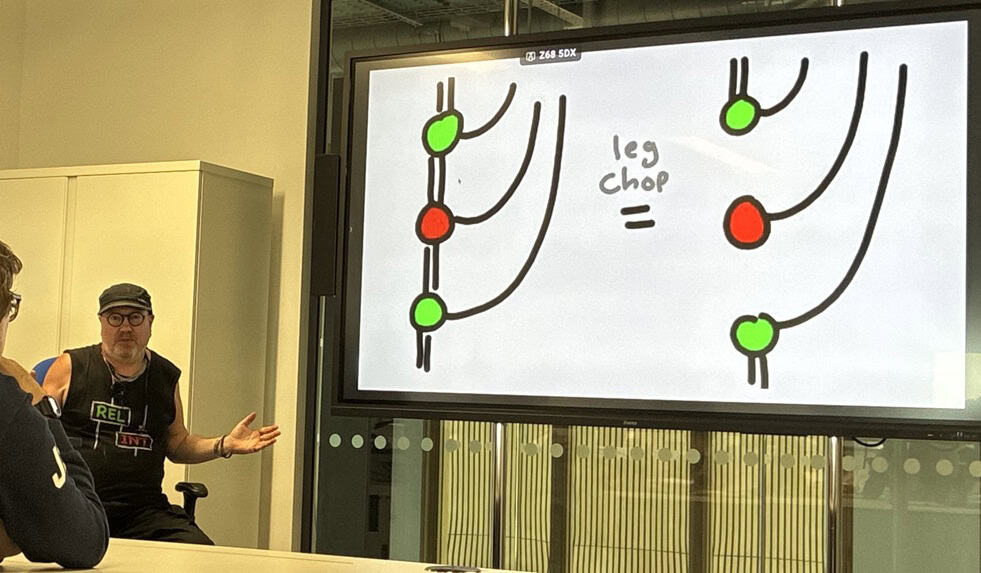
The crucial point is that the pictures aren’t illustrations of some more fundamental mathematics hidden underneath. The pictures are the mathematics. A rigorous graphical calculus built from spider diagrams enables students to reason directly about quantum processes. Since this diagrammatic formulation is fully equivalent to the usual Hilbert space formalism, the students were doing quantum mechanics for real.
We felt truly privileged to share the mysteries of quantum mechanics with a fantastically friendly, interested and diverse cohort from schools across south-east England. What struck me was how readily they engaged with the material: asking excellent (and sometimes rather challenging) questions, debating ideas and working collaboratively through the problem-solving sessions.
The graphical problems proved particularly popular, with repeated cries for “more spider diagrams!”. The course was deliberately ambitious, but by the end, they were able to work through the complete quantum teleportation protocol. Indeed, one student was confident enough to get up and reason through it for the whole class (something we certainly would not have dared to do at their age).
As Maya, a year-12 student from Highams Park Sixth Form in London, put it: “I really enjoyed seeing how ideas in quantum physics could be explained through simple pictures and diagrams. I was surprised that concepts like quantum teleportation, which seemed very complicated at first, could become much easier to understand through this approach. The programme has made me even more interested in studying physics and exploring quantum theory in the future.”
The approach also worked for students without a traditional mathematics or physics background, such as Andrew, a year-12 student from Sir John Lawes School in Harpenden.
“The programme was captivating,” he said. “The concept of using diagrams was innovative and explained things in a logical manner to help me understand topics such as quantum teleportation. The programme showed the stark differences between classical and quantum physics through real-world examples, enriched by talks from industry experts and pioneers with different backgrounds.”
Muhammad Hamza Waseem, who helped develop the programme and joined us on the final day, captured the atmosphere perfectly. “I found the enthusiasm, curiosity, and irreverence of the students very inspiring,” he said, “and I hope that they take the same spirit into their university education and beyond.”
That sense of joy and excitement was, for me, the lesson of the week. We’ve been thoroughly convinced that quantum theory isn’t intrinsically beyond the reach of curious 16-year-olds. We just need to give them the right mathematical language. The next step is an optional graduate-level exam, which will put that claim to the test. Watch this space.
The post Can a 16-year-old really understand quantum teleportation? appeared first on Physics World.
A new method of stabilizing radioactive molecules could open the door to sensitive searches for physics beyond the Standard Model. The approach, which involves cooling radium-bearing molecules to just above absolute zero, offers a tabletop alternative to experiments that use particle accelerators to look for violations of fundamental symmetries. According to lead researcher Nick Hutzler, a physicist at the California Institute of Technology (Caltech), US, it also shows that university laboratories can safely handle these radioactive materials, paving the way for similar studies at other institutions.
One of the greatest puzzles in physics is the fact that the early universe created more matter than antimatter. For decades, physicists have tried to solve this mystery (and others) by using particle accelerators to search for violations of nuclear symmetry at ever-higher energies. However, molecules that contain heavy radioactive nuclei could also act as super-sensitive sensors for symmetry violations – with the advantage that the equipment required to manipulate them generally fits in a single room, rather than an entire building.
The basic idea is this: when electron orbitals overlap with a nucleus, the system’s atomic or molecular energy levels shift by tiny amounts that depend on the nucleus’ size and shape. Variations in nuclear structure due to symmetry-violating effects would therefore produce changes in the electron orbitals, and these changes could be measured with high-precision spectroscopy.
Asymmetric nuclei are ideal for this purpose because their lopsided shape makes small changes easier to detect. Radium, for example, has a pear-shaped nucleus, and radium-containing molecules offer additional advantages because the repulsion and attraction of neighbouring atoms further distorts the electron orbitals.
The downside is that radium is both radioactive and highly reactive, making it dangerous to handle without specialized equipment that is not present in standard university laboratories. It is also only available in extremely small quantities.
In the latest study, which is published in Science, physicists at Caltech and chemists at Johns Hopkins University and Michigan State University (all in the US) found a possible way around these obstacles. Their first step was to make radium stable and transportable. For this, they developed a process that resembles candy-making, though they do not recommend eating the results. By “caramelizing” small amounts of radium-226 in a solution of xylitol sweetener, they created a material they could transport in small quantities, keeping radioactivity levels low enough to comply with standard radiation-safety frameworks.
Next, they added their sticky radium “goo” to gold foil; installed it in a copper cryogenic cell; and cooled it to 4K using helium gas. They then used a laser to excite the radium into a chemically reactive state, allowing it to bond with targets such as hydroxide, deuteroxide and fluoride. Collisions with surrounding helium atoms further cooled these radium-bearing molecules into a mixture of only a few rotational and vibrational states. At this point, the team was finally able to perform the first-ever high-precision spectroscopic analysis of such molecules.
Hutzler acknowledges that several challenges remain before precision searches for symmetry violation can begin in earnest. Though theory predicts that these radium-bearing molecular species will be amenable to standard laser cooling and trapping techniques, no one has yet cooled them to ultracold temperatures. Another challenge will be to extend the process to other isotopes. Radium-225, for example, has a better nuclear shape for high-precision searches for symmetry violation, but it is also much more radioactive than radium-226, with a half-life of 15 days rather than 1600 years.
The team is also interested in studying the spectra of other radioactive species, with the aim of better understanding nuclear structure and chemistry at the extremes of the periodic table. A final possibility, Hutzler adds, would be to study other radium-containing molecules, as this would enable different precision measurements.
David DeMille, a physicist at Johns Hopkins who studies symmetry violations in atomic and molecular systems but was not involved in this research, calls it an “extremely promising way” to search for interactions that violate charge-parity (CP) symmetry. The efficiency with which the team converts solid-phase radium atoms into gas-phase molecules is a good sign, he adds, and extending the process to other radioactive molecules could help scientists understand species that have been observed astronomically.
However, DeMille points out that achieving ultracold temperatures poses additional challenges, including finding a way to release the confined molecules into a larger, much more complex experimental setup, without helium, while maintaining safe conditions. That said, he notes that the spectroscopic results are, in themselves, an important step towards reaching this ultracold regime.
The post Cold radioactive molecules offer a tabletop route to new physics appeared first on Physics World.
A new type of “photonic multi-lane highway” that can carry multiple topologically-protected optical signals at once – without the need for a bulky insulator – has been demonstrated by researchers in China. The technology, which relies on a new type of material called a photonic valley half-semimetal to achieve topological protection, is currently at the prototype stage. However, the researchers believe that, if fabrication challenges can be addressed, the combination of spatial efficiency and topological robustness could be promising for future photonic technologies.
In the past 20 years, photonic topological insulators have become widespread for connections in devices such as on-chip photonic circuits because their edge modes can only conduct light in one direction and are therefore are inherently immune from scattering off imperfections. However, the protected edge mode of a topological insulator comes at a cost: the bulk must have an optical band gap, which means it must be opaque to the relevant frequency. Meanwhile, the photonic analogue of another concept from electronics has also become popular in optical waveguides. Gapless photonic semimetals – analogous to graphene – can be placed between topologically distinct optical insulators to broaden the guided modes, but non-guiding insulating claddings are still required.
To address the fundamental trade-off between spatial efficiency and topological protection in conventional topological waveguides, researchers in the group of Che Ting Chan at the Hong Kong University of Science and Technology in China and their collaborators introduced a novel photonic structure called a photonic valley half-semimetal. Here, the valley degree of freedom refers to inequivalent local energy extrema in momentum space, which can be used as independent degrees of freedom for transport. Crucially, a single photonic valley half-semimetal plays a dual role via its two valley channels: one valley acts as a gapless semimetal that enables waveguiding, while the other functions as a topological insulator that provides a topological barrier for the corresponding valley mode in adjacent regions.
The researchers designed a waveguide comprising four stacked layers of a honeycomb structure made from interconnected rods of the magnetic material yttrium iron garnet, which interfered with the propagating photons. By altering the diameters of the rods or the magnetic field, the researchers constructed four inequivalent photonic valley half-semimetal domains and arranged them in a specific periodic sequence. This creates adjacent domains that mutually insulate each other.
Xiaohan Cui is lead author on a paper in Nature that describes the research. She explains that the underlying topological physics is similar to that in a traditional photonic topological insulator.
“The important difference lies in how the mode is spatially implemented,” she says, “In a conventional photonic topological-insulator waveguide, two gapped bulk domains meet at an interface, and the propagating mode is tightly localized to that interface. Most of the surrounding insulating material remains inert, serving only as cladding.”
In the present configuration, however, the researchers were able to use the blocked valley as topological protection for unidirectional propagation in the neighbouring domain, and utilize this to create a four-lane highway, with two lanes in each direction, that could guide signals around sharp bends and through constrictions without backscattering or inter-lane crosstalk:
“The architecture transforms the usual narrow interface state into a set of directly adjacent, large-area waveguiding lanes. Consequently, no region of the device is ‘wasted’ as inert cladding,” explains Cui.
The team’s current device works for microwave radiation but the team says that the design could be adapted and extended to operate at higher frequencies.
“The present experiment is a proof of principle demonstration at microwave frequencies, so one clear next step is to move the concept towards higher-frequency, chip-scale integrated photonics platforms, thereby paving the way toward ultra-compact topological photonic circuitry,” says Cui.
The researchers believe application in the terahertz regime should be possible using magnetized semiconductors such as indium antimonide. However, non-reciprocal applications at higher frequencies could be challenging owing to the weakness of magnetic effects.
“The major experimental challenges will be to realize these higher-frequency designs while managing geometric complexity, fabrication tolerances, and propagation loss, and ensuring efficient coupling with practical sources, detectors and other photonic components,” she explains.
Quantum optician Mahmoud Jalali Mehrabad of Massachusetts Institute of Technology believes the work brings an important issue into focus. “A paper doesn’t always have to have the perfect solution as long as it highlights and really streamlines a key problem…To me this paper does that,” he says. “Spatial efficiency has been a problem in topological physics and the question is why? Is there any other way to destroy this trade-off? It shouldn’t be a side problem in the supplementary material of a paper – this is a big problem.” Whether or not the researchers can make their own solution viable, he says, “time will tell”.
The post ‘Photonic multi-lane highway’ enjoys insulator-free topological protection appeared first on Physics World.
