The Moon’s far side is overturning a long-held theory, revealing that the early Solar System’s asteroid assault may have faded slowly instead of exploding in one catastrophic burst. For decades, scientists have debated whether the early Solar System endured one sudden, catastrophic wave of asteroid strikes or a much longer period of gradually fading violence. [...]
Scientists once suspected that a brutal, years-long winter starved the dinosaurs following an asteroid impact 66 million years ago. New evidence suggests a more violent end: widespread firestorms that may have burned even thick-skinned dinosaurs to a crisp within hours.
The roughly six-mile-wide (10-kilometer-wide) asteroid struck Mexico's Yucatán Peninsula, excavating the Chicxulub crater and vaporizing enormous quantities of rock. Some of that material condensed into tiny droplets called spherules, which spread around the planet before falling back through Earth's atmosphere at several miles per second.
As the spherules slowed, their kinetic energy became heat, producing an intense pulse of thermal radiation. Earlier models suggested the effect would have resembled a worldwide broiler that was potentially deadly to exposed, thin-skinned animals, but not powerful enough to ignite vegetation across the globe.
A new study argues that those calculations overlooked a crucial ingredient: a thick layer of fine silicate dust formed from rock vapor that did not initially condense into spherules. Evidence for that dust emerged in 2023 from the Tanis fossil site in North Dakota, where researchers identified a layer of extremely fine, impact-derived material deposited above the spherules. A similar dust layer has since been documented at the K–Pg boundary (which divides the "age of reptiles" and the "age of mammals") in Raton Basin across the Colorado–New Mexico border.
"It reinvigorated my interest in what happened to the leftover vapor — that's where this work started," lead author Brandon Johnson, a planetary scientist at Purdue University, said in a statement.
The dust would have acted like an insulating blanket, preventing thermal radiation from escaping into space and redirecting more heat toward Earth’s surface. The researchers estimated that the surface heat pulse could have been about 3.5 times more intense than what was suggested by models considering the falling spherules alone. "We're in the realm where we might be essentially killing off everything within that first hour or two," Johnson said.
The radiation may not have directly ignited thick pieces of wood, but it exceeded ignition thresholds for grass, lichen, and pine needles, which could have fueled larger fires. The study also found that exposed terrestrial animals may have received about 17 times the thermal dose considered lethal to humans.
Animals sheltering underground or in water would have had a better chance of surviving the initial heat pulse. Afterward, the same dust may have blocked sunlight for years, triggering the prolonged "impact winter" more typically blamed for the dinosaurs' extinction.
There is, however, a missing element: the wildfire evidence that supports this dust-caused inferno theory has only been found in North America. "It could be that we will eventually find the record of completely global wildfires," said Alfio Alessandro Chiarenza, a paleontologist at University College London who was not involved in the study. "We just don't have it so far."
The study was published on July 28 in the journal JGR Biogeosciences.
A solar eclipse, the Perseids, bright Venus after sunset, and a deep partial lunar eclipse highlight August’s skywatching.
Skywatching Highlights
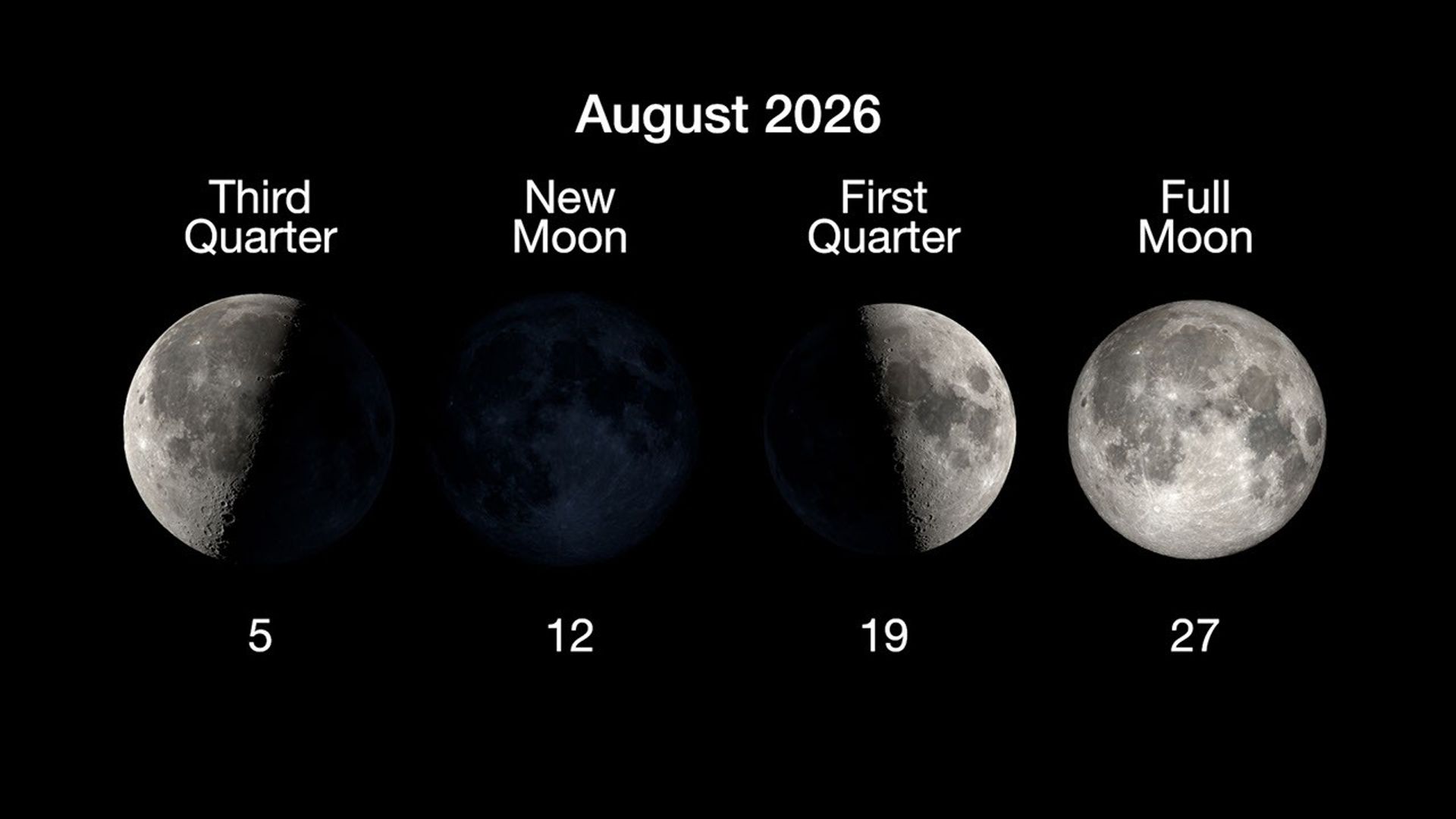
Aug. 5: Last Quarter Moon
Aug. 12: Total solar eclipse across northern Russia, Greenland, Iceland, northern Spain, and part of Portugal; partial eclipse in parts of the U.S.; New Moon
Aug. 12-13: Perseid meteor shower peak under dark skies
Aug. 14-16: Venus reaches greatest eastern elongation and shines low in the west after sunset
Aug. 27-28: Partial lunar eclipse visible from much of North and South America and parts of Europe and Africa
Transcript
A solar eclipse, one of the year’s best meteor showers, Venus at its brightest in the evening sky, and a lunar eclipse to close out the month.
That’s “What’s Up” for August.
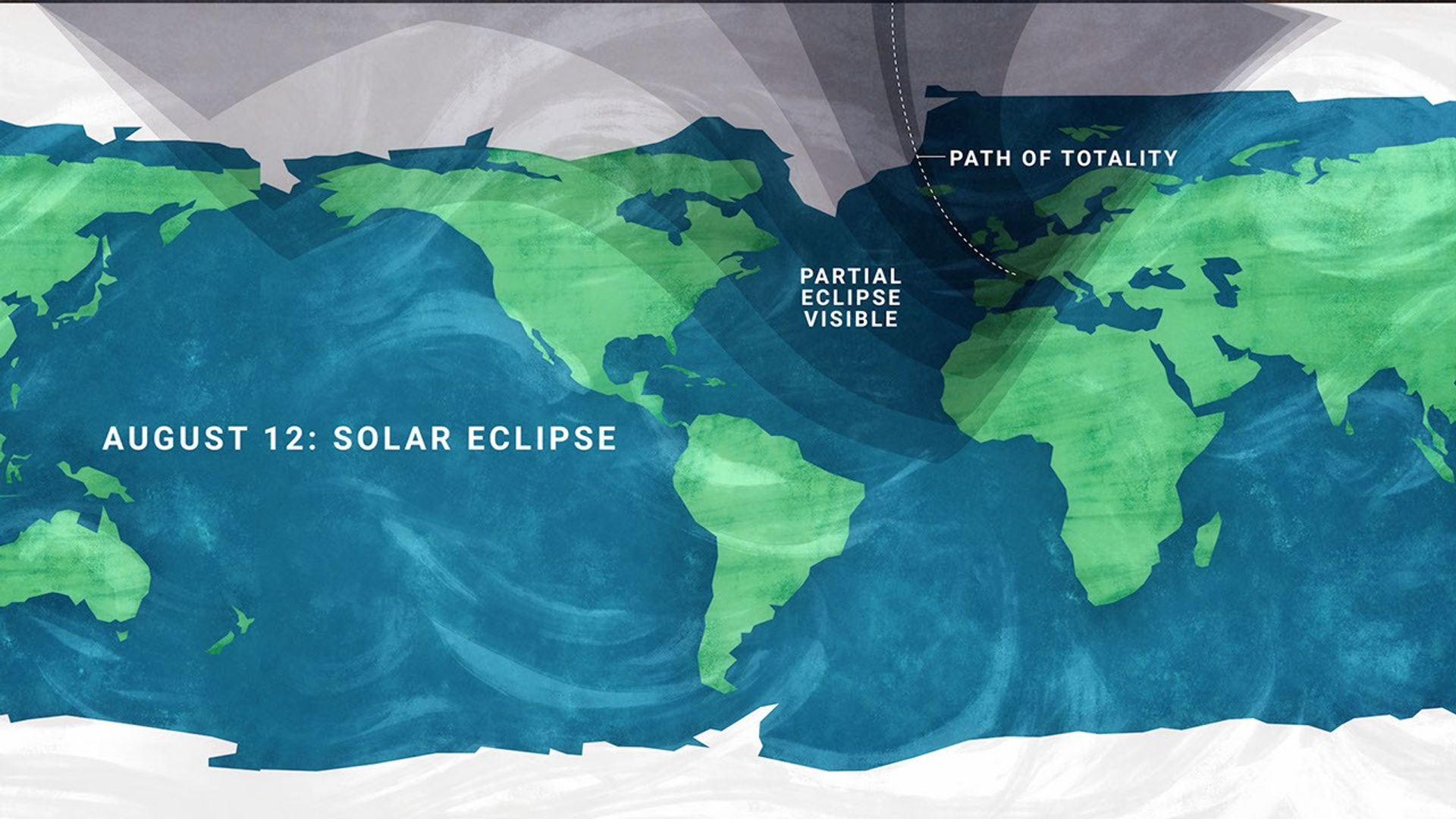
On Aug. 12, a total solar eclipse crosses northern Russia, Greenland, Iceland, and northern Spain, with a small corner of Portugal inside the path of totality.
In parts of the United States, from Alaska to North Carolina, the eclipse is partial. The Moon will take only a small bite out of the Sun, and the amount of coverage will vary with location.
A map showing viewing areas of the August 2026 total solar eclipse.
NASA/JPL-Caltech
Remember to watch safely. Use certified eclipse glasses or a safe solar viewer any time any part of the Sun is visible. Regular sunglasses are not safe. And never use binoculars, a telescope, or a camera without a solar filter made for the front of the optics.
Later that same night, the Perseid meteor shower will light up the sky, peaking the evening of Aug. 12 into the early morning hours of the 13th. And with a New Moon arriving on the 12th, the skies will be ideally dark.
The Perseids happen every year when Earth passes through a debris stream left behind by Comet Swift-Tuttle. As those tiny bits of comet dust hit our atmosphere at high speed, they burn up as bright streaks of light.
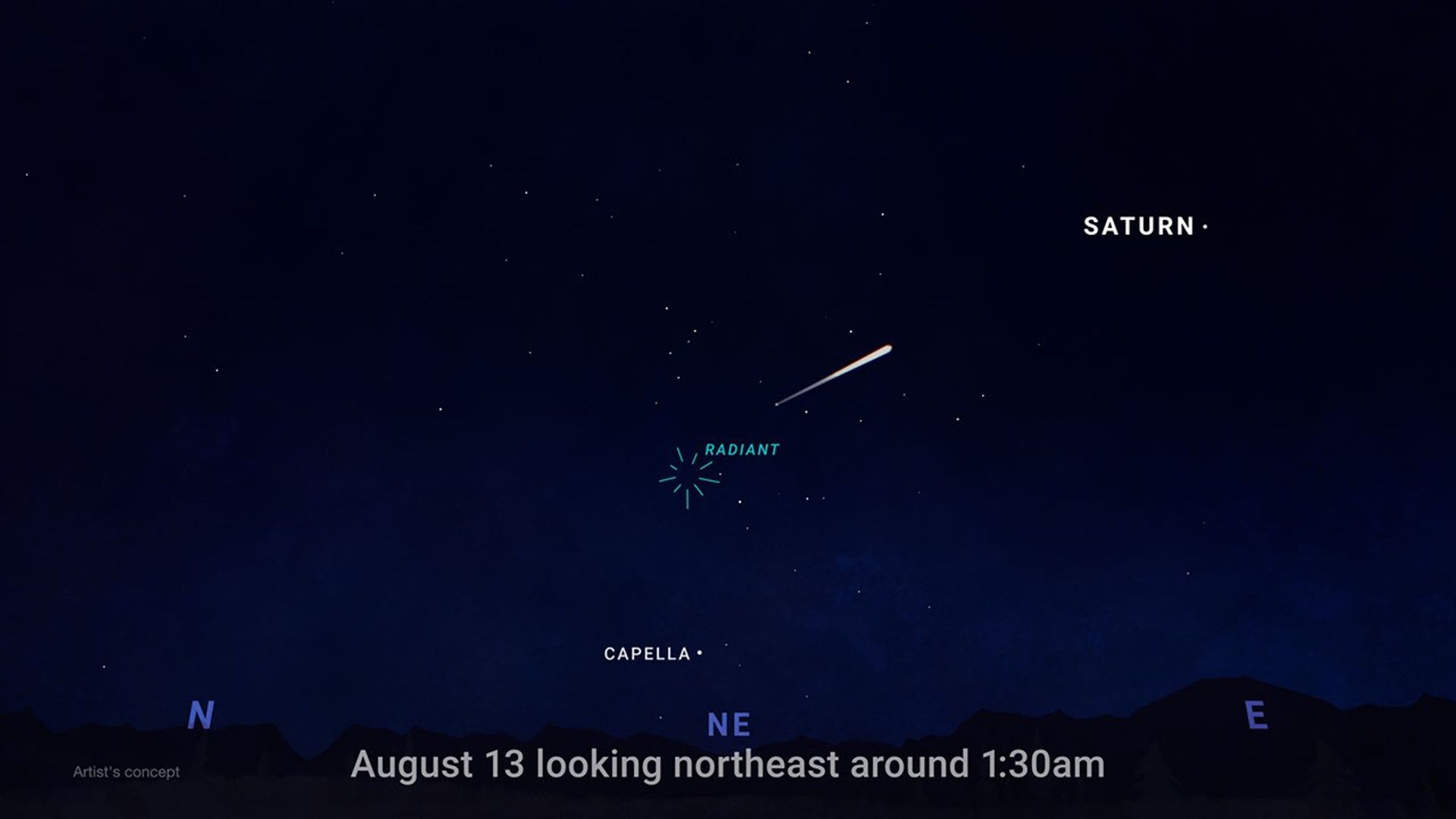
To view this meteor shower, look toward the northeast once it’s fully dark and watch for the constellation Perseus to clear the horizon. This is where the meteors originate, but let your eyes wander, because they can flash across any part of the sky.
For the best view, stay out late as the stars climb higher, find a dark open spot, and give your eyes 30 minutes to adjust.
This illustration shows where in the night sky to look for the Perseid meteor shower.
NASA/JPL-Caltech
Aug. 14-16, Venus reaches its greatest eastern elongation, which is its widest apparent separation from the Sun during this evening appearance.
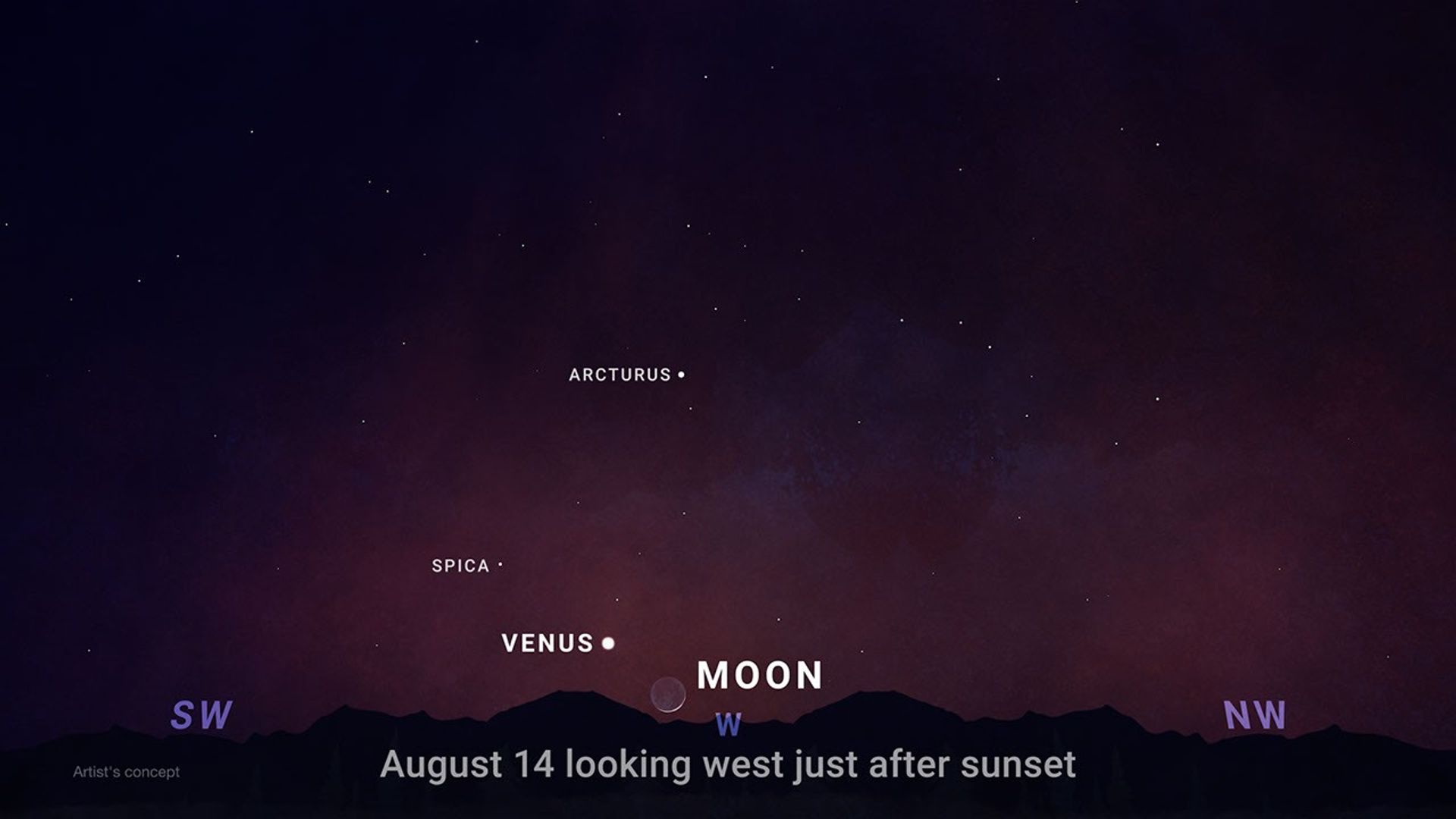
Look low in the western sky shortly after sunset for the bright object that will outshine every star around it. Through a telescope after sunset, Venus will look close to half lit, like a tiny lunar phase.
This illustration shows where to observe Venus after sunset in August.
NASA/JPL-Caltech
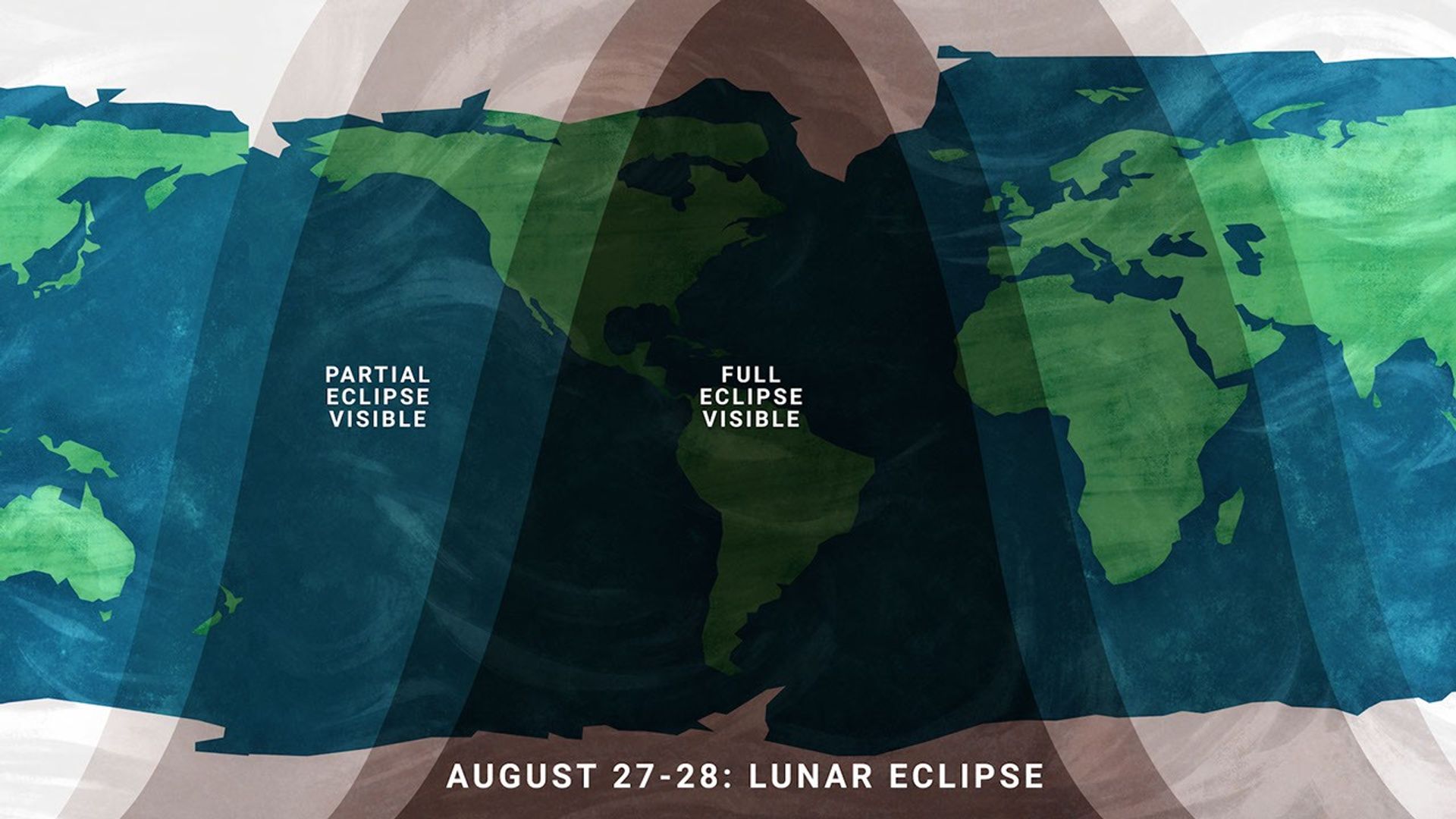
On the night of Aug. 27, continuing into Aug. 28 for some time zones, the Full Moon slips through Earth’s shadow, resulting in a partial lunar eclipse. It will be visible from much of North and South America and parts of Europe and Africa.
Viewing areas for the August 2026 lunar eclipse.
NASA/JPL-Caltech
At maximum eclipse, about 93% of the Moon’s diameter will be inside Earth’s dark central shadow, called the umbra. The Moon will not be completely covered, but it can look dramatically darkened, with a rusty, coppery tint along the covered edge.
Unlike a solar eclipse, a lunar eclipse is safe to watch with just your eyes. Binoculars or a small telescope can give you a closer view of Earth’s curved shadow moving across the Moon.
Here are the phases of the Moon for August.
NASA/JPL-Caltech
You can stay up to date on all of NASA’s missions exploring the solar system and beyond at science.nasa.gov. I’m Raquel Villanueva from NASA’s Jet Propulsion Laboratory, and that’s What’s Up for this month.
A solar eclipse, one of the year's best meteor showers, Venus at its brightest in the evening sky, and a partial lunar eclipse to close out the month.On Augu...
A solar eclipse, the Perseids, bright Venus after sunset, and a deep partial lunar eclipse highlight August’s skywatching.
Skywatching Highlights
Aug. 5: Last Quarter Moon
Aug. 12: Total solar eclipse across northern Russia, Greenland, Iceland, northern Spain, and part of Portugal; partial eclipse in parts of the U.S.; New Moon
Aug. 12-13: Perseid meteor shower peak under dark skies
Aug. 14-16: Venus reaches greatest eastern elongation and shines low in the west after sunset
Aug. 27-28: Partial lunar eclipse visible from much of North and South America and parts of Europe and Africa
Transcript
A solar eclipse, one of the year’s best meteor showers, Venus at its brightest in the evening sky, and a lunar eclipse to close out the month.
That’s “What’s Up” for August.
On Aug. 12, a total solar eclipse crosses northern Russia, Greenland, Iceland, and northern Spain, with a small corner of Portugal inside the path of totality.
In parts of the United States, from Alaska to North Carolina, the eclipse is partial. The Moon will take only a small bite out of the Sun, and the amount of coverage will vary with location.
A map showing viewing areas of the August 2026 total solar eclipse.
NASA/JPL-Caltech
Remember to watch safely. Use certified eclipse glasses or a safe solar viewer any time any part of the Sun is visible. Regular sunglasses are not safe. And never use binoculars, a telescope, or a camera without a solar filter made for the front of the optics.
Later that same night, the Perseid meteor shower will light up the sky, peaking the evening of Aug. 12 into the early morning hours of the 13th. And with a New Moon arriving on the 12th, the skies will be ideally dark.
The Perseids happen every year when Earth passes through a debris stream left behind by Comet Swift-Tuttle. As those tiny bits of comet dust hit our atmosphere at high speed, they burn up as bright streaks of light.
To view this meteor shower, look toward the northeast once it’s fully dark and watch for the constellation Perseus to clear the horizon. This is where the meteors originate, but let your eyes wander, because they can flash across any part of the sky.
For the best view, stay out late as the stars climb higher, find a dark open spot, and give your eyes 30 minutes to adjust.
This illustration shows where in the night sky to look for the Perseid meteor shower.
NASA/JPL-Caltech
Aug. 14-16, Venus reaches its greatest eastern elongation, which is its widest apparent separation from the Sun during this evening appearance.
Look low in the western sky shortly after sunset for the bright object that will outshine every star around it. Through a telescope after sunset, Venus will look close to half lit, like a tiny lunar phase.
This illustration shows where to observe Venus after sunset in August.
NASA/JPL-Caltech
On the night of Aug. 27, continuing into Aug. 28 for some time zones, the Full Moon slips through Earth’s shadow, resulting in a partial lunar eclipse. It will be visible from much of North and South America and parts of Europe and Africa.
Viewing areas for the August 2026 lunar eclipse.
NASA/JPL-Caltech
At maximum eclipse, about 93% of the Moon’s diameter will be inside Earth’s dark central shadow, called the umbra. The Moon will not be completely covered, but it can look dramatically darkened, with a rusty, coppery tint along the covered edge.
Unlike a solar eclipse, a lunar eclipse is safe to watch with just your eyes. Binoculars or a small telescope can give you a closer view of Earth’s curved shadow moving across the Moon.
Here are the phases of the Moon for August.
NASA/JPL-Caltech
You can stay up to date on all of NASA’s missions exploring the solar system and beyond at science.nasa.gov. I’m Raquel Villanueva from NASA’s Jet Propulsion Laboratory, and that’s What’s Up for this month.
Traversing through the solar system, a comet split in two, and a recent study used six months of observations to investigate when and why.
A Split Comet
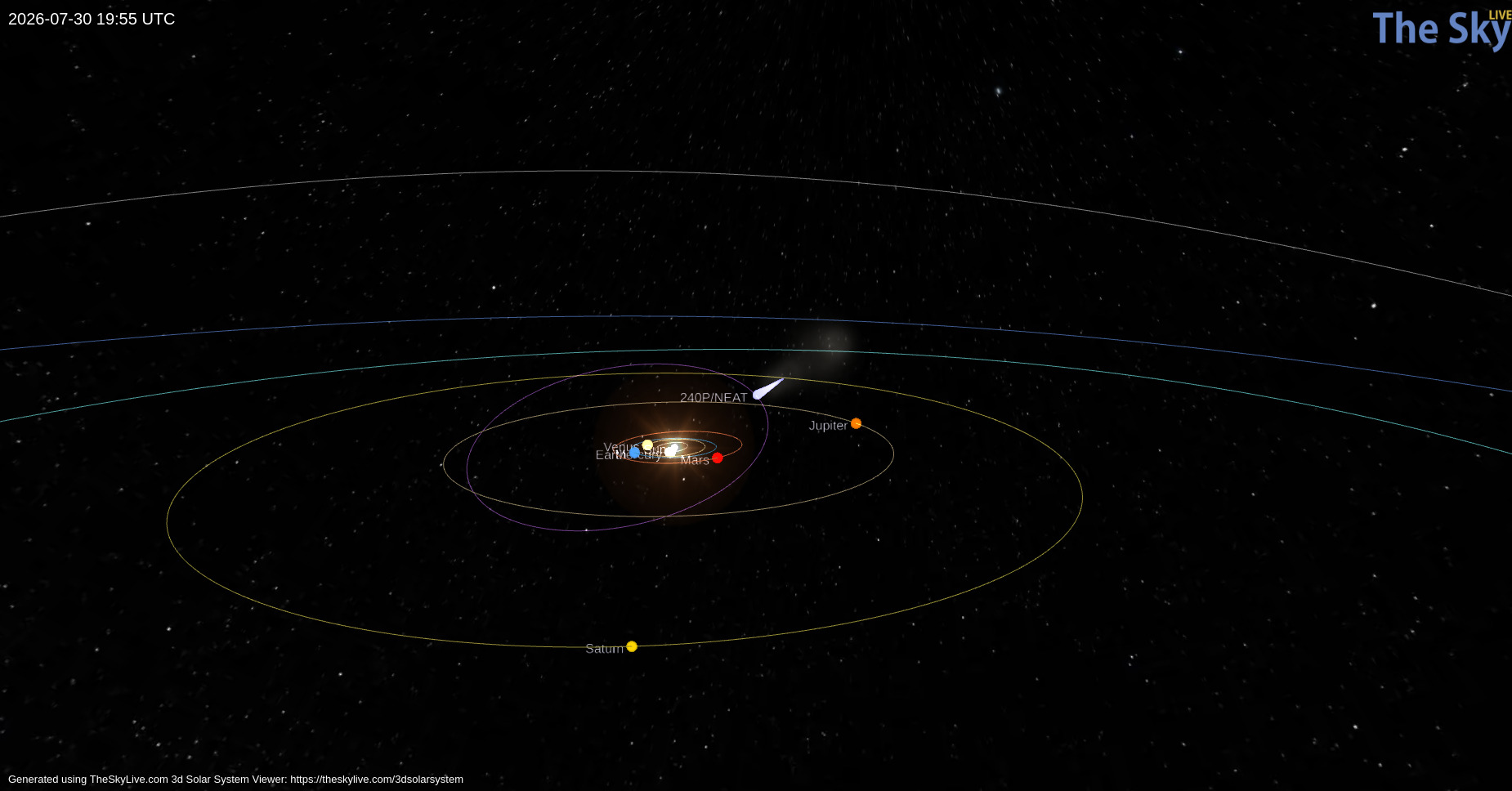
Orbital path of 240P/NEAT (purple) and the position of the comet on 30 July 2026 (light blue teardrop). Click to enlarge. [TheSkyLive]
While we often think of comets as icy remnants of the solar system’s formation that populate the Kuiper Belt and Oort Cloud, some comets make their homes closer to the Sun. One such class, known as Jupiter-family comets, traveled from the Kuiper Belt to short orbital periods (less than 20 years) whose paths through the solar system are shaped by Jupiter’s gravity. Discovered in 2002, 240P/NEAT is a Jupiter-family comet that loops between Jupiter and Mars on a 7.6-year orbit. Making close approaches to Jupiter, 240P experiences frequent, strong interactions with the gas giant that can alter the comet’s orbit and cause sudden bursts in brightness as ice and dust are heated and outgassed from the comet’s surface.
Most recently, 240P swept closest to Jupiter in July 2007, shifting the comet’s perihelion distance (closest approach to the Sun) from 2.5 to 2.1 au, and several long-lived bursts in brightness in 2018/2019 could have been spurred by this orbital shift. Excitingly, a fainter comoving object, 240P-B, was first reported in June 2025 as the comet headed toward perihelion — at some point recently, 240P had split in two!
Over the last century, numerous split comets have been recorded, but detailed physical studies of these objects are rare. With growing evidence suggesting splitting and disintegration are the primary mechanisms of comet destruction, understanding the properties and cause of 240P’s split is imperative.
Observing 240P
With 240P on the move to perihelion, David Jewitt (University of California, Los Angeles) and collaborators monitored the comet from October 2025 to April 2026 to establish the likely cause of its split. Employing the Alhambra Faint Object Spectrograph and Camera on the 2.56-meter Nordic Optical Telescope, the authors obtained detailed imaging of the comet from two months before to four months after perihelion to characterize both components.
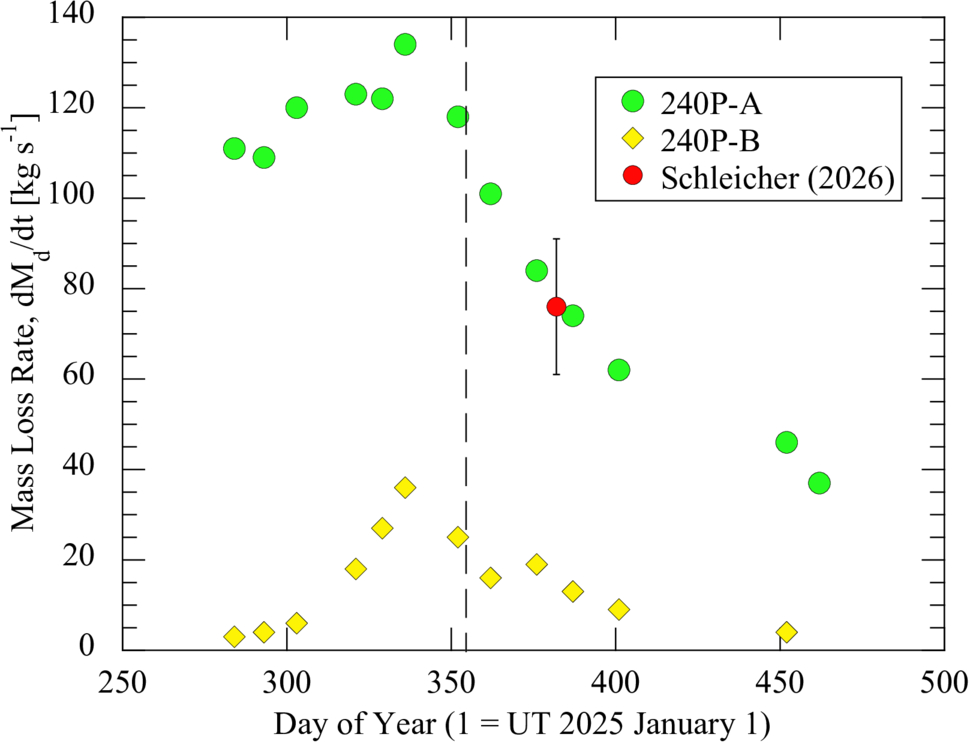
Tracking both photometric and morphological changes across their observations, the authors estimated the dust-loss rates, physical sizes, and separation speed of 240P-A and 240P-B. The brighter component, 240P-A, has an estimated radius between 400 and 600 meters and a dust-loss rate almost four times higher than 240P-B. Because 240P-B is fainter, its radius is harder to constrain observationally. From its lower dust-loss rate and lower brightness, the authors estimated a radius around 300 meters (and no smaller than 50). Based on how the separation of the two comet pieces changes over time, the authors determined that the split of 240P occurred at least three years before their observations.
Dust mass-loss rates for 240P-A (green circles) and 240P-B (yellow diamonds) over the course of the observations. Both components peak shortly before perihelion (dashed vertical line). Click to enlarge. [Jewitt et al 2026]
Source of the Split
How exactly did this fragmented comet get this way? The authors considered a number of comet-splitting mechanisms: tidal forces, asteroid impact, pressure buildup below the comet’s surface, thermal stresses, and rotational instability. Given the comet’s orbit, it has not had close enough encounters with the Sun or other planets for tidal forces to be the culprit, and it traverses well above the asteroid belt, avoiding collisions. Pressure buildup and thermal stresses can fracture comets, but both are unlikely to launch such a large fragment as seen in this system.
This leaves rotational instability as the likely source of 240P’s split. Outgassing torques lead to rotational instability, especially in subkilometer comets like 240P, and 240P has exhibited recent outgassing. In addition, the separation speed between the 240P components is comparable to the escape speed of the primary comet, which is expected for rotational breakup. To confirm this hypothesis, future observations measuring the rotation period of 240P are necessary, but this study adds to the small number of split-comet observations that aid in understanding comet destruction.
Scientists have found the first triple-lobed asteroid in the asteroid belt between Mars and Jupiter — and it has a small moon to boot.
The asteroid in question is 44 Nysa, which was discovered all the way back in 1857. Of course, back then it was just a pinprick of light in the sky, and subsequent observations — including some from the Hubble Space Telescope — had failed to tell us much about Nysa. Those previous observations suggested Nysa might be bi-lobed, like many asteroids and comets such as asteroid 52246 Donaldjohanson, which NASA's Lucy mission flew past in 2025.
However, new joint observations by the Large Binocular Telescope (LBT) on Mount Graham in Arizona and the Very Large Telescope (VT) on Paranal mountain in Chile have revealed that this asteroid actually seems to have three lobes, the first such object ever seen.
"The images reveal a remarkably unusual object," said lead researcher Kate Minker of Arizona's Lowell Observatory in a statement. "The most likely explanation is that Nysa is either a contact trinary, consisting of three connected components, or an extremely irregular coherent body unlike anything we've previously observed."
Obtaining the detailed images of Nysa was not easy. Key to the success were two high contrast imaging devices, the Italian-built SHARK-VIS on the LBT and SPHERE and its ZIMPOL polarimeter on the VLT, used in conjunction with adaptive optics that counteract the blurring effect of the atmosphere.
"These observations had to be combined with specially developed image-processing techniques to further sharpen the images and remove the bright halo surrounding the asteroid, potentially hiding faint companions," said Anthony Berdeu of the European Southern Observatory.
The images showed an irregular-shaped body 47 miles (75 kilometers) at its widest point, with two notable valleys or "colli" that wrap around the asteroid's circumference and which Minker's team interprets as being the necks of the different lobes. Furthermore, the images revealed a 0.6-mile-wide (1-km-wide) moon orbiting Nysa at a distance of at least 106 miles (170 km). The moon has been designated S/2026 (44) 1 for now. And, because it was seen independently during two different observing campaigns, it was possible to observe its motion around Nysa.
An animation showing the rotation of Nysa and its orbiting moon. (Image credit: Kate Minker et al.)
"We borrowed a specialized technique from another field of astronomy, known as high-contrast imaging, to detect the small moon whose faint light was overwhelmed by the intense brightness of the primary asteroid," said Gianluca Li Causi of the SHARK-VIS team at the Italian National Institute for Astrophysics (INAF).
Nysa is named after the mythical land where the ancient Greek god Dionysus was raised by nymphs. Al Conrad of the Large Binocular Telescope Observatory finds the name fitting because Dionysus was the Greek god of theater, which for the ancient Greeks often involved wearing masks and hiding one's true identity.
"We're finally unmasking the asteroid's true nature, long after it was discovered," said Conrad.
How such a bizarre object formed remains uncertain, but Minker's team does have a couple of ideas.
The team's preferred explanation is that Nysa is a contact trinary — three asteroid bodies being held together loosely by gravity. The best alternative, the researchers say, is that Nysa once upon a time had a close encounter with a much larger asteroid that slammed into it, thereby deforming it. In these situations, modeling suggests that gravitational tidal forces could have deformed Nysa's mantle, creating Nysa's odd shape and even ripping it apart into a bunch of fragments in a string-of-peals configuration. If this is the case, then where did the other fragments go? Such events usually produce a family of asteroids all sharing the same composition, but Nysa seems to be alone (barring its moon, of course).
There could be a way to distinguish between the two possible origins. By tracking the moon's orbital velocity and period, astronomers will be able to pin down the exact mass and density of Nysa and then see which model matches it best.
Nysa has been a subject of study because it can also tell us about the birth of our own planet Earth. Nysa is more reflective than many other asteroids thanks to its surface composition that is abundant in a silicate mineral called enstatite, which lacks iron. Asteroids like this are generally called E-types, and Nysa is the largest and brightest of all of them. E-type asteroids are thought to have formed close to the sun and therefore have been identified as potential building blocks of the inner planets. If Nysa is a relic of that time, it could tell us a great deal about conditions in the inner solar system 4.5 billion years ago.
The findings can be read on the arXiv archive, and have been submitted to the journal Astronomy & Astrophysics.
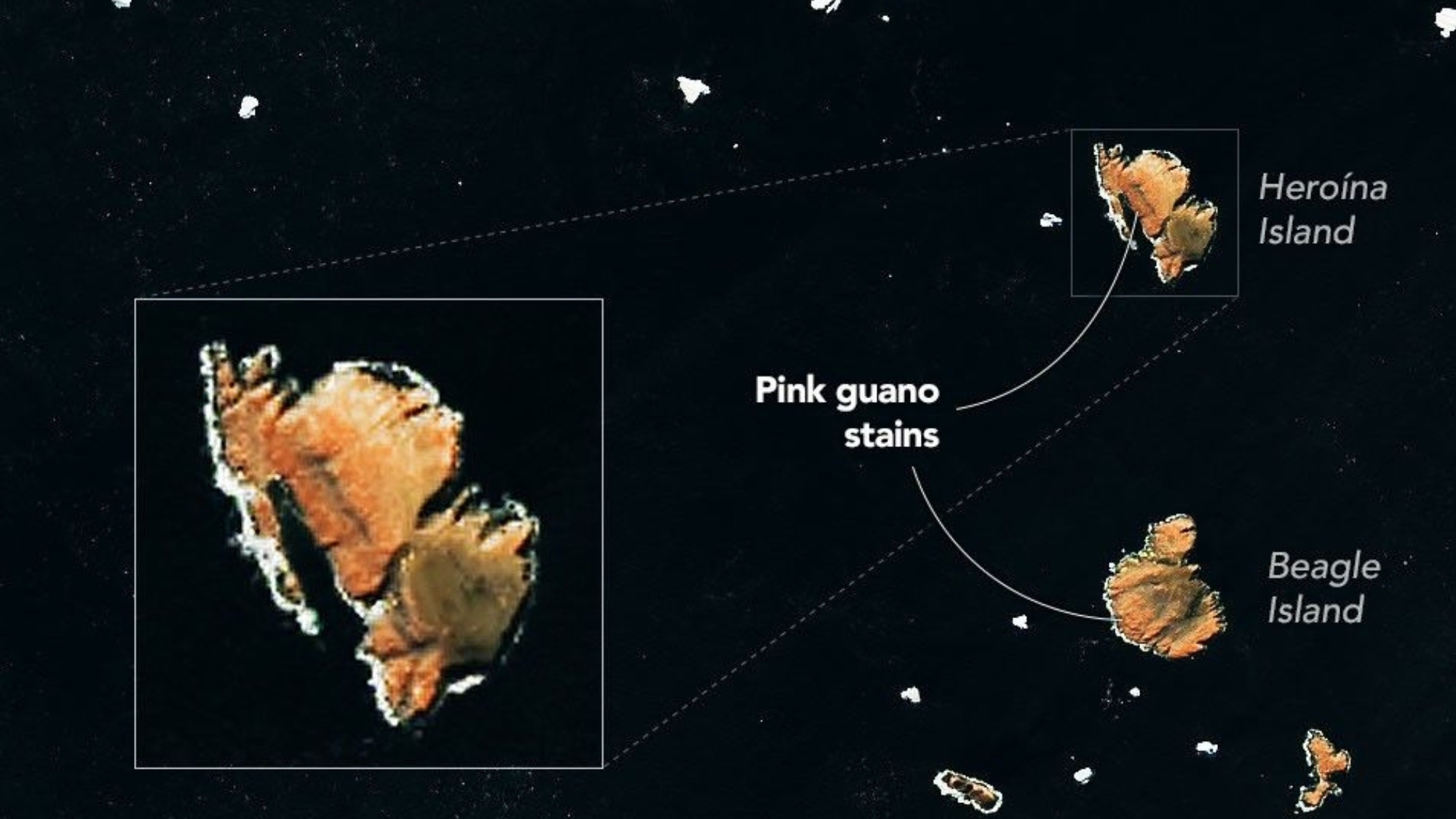
Pieces of sea ice drift near Antarctica's Danger Islands in this image, acquired on Jan. 22, 2023, by the Landsat 8 satellite. Several of the islands are stained pink by guano from Adélie penguins with a krill-rich diet. (Image credit: NASA Earth Observatory/Michala Garrison)
The diets of penguins on Antarctica's Danger Islands can be seen from space. At least indirectly.
Using satellite images captured by the Landsat 8 spacecraft operated by NASA and the United States Geological Survey, scientists can track changes in Adélie penguins' diets based on the color of their guano, or droppings.
What is it?
The image above shows pinkish-orange guano staining large sections of some of the Danger Islands, Heroína Island and Beagle Island. The penguins that live there eat a diet rich in krill, small marine crustaceans that are bright pink in color due to a specific type of algae upon which they feed.
A group of Adelie penguins jumping from ice pebble to ice pebble on a beach of Paulet Island on the tip of the Antarctic Peninsula. (Image credit: Wolfgang Kaehler/LightRocket via Getty Images)
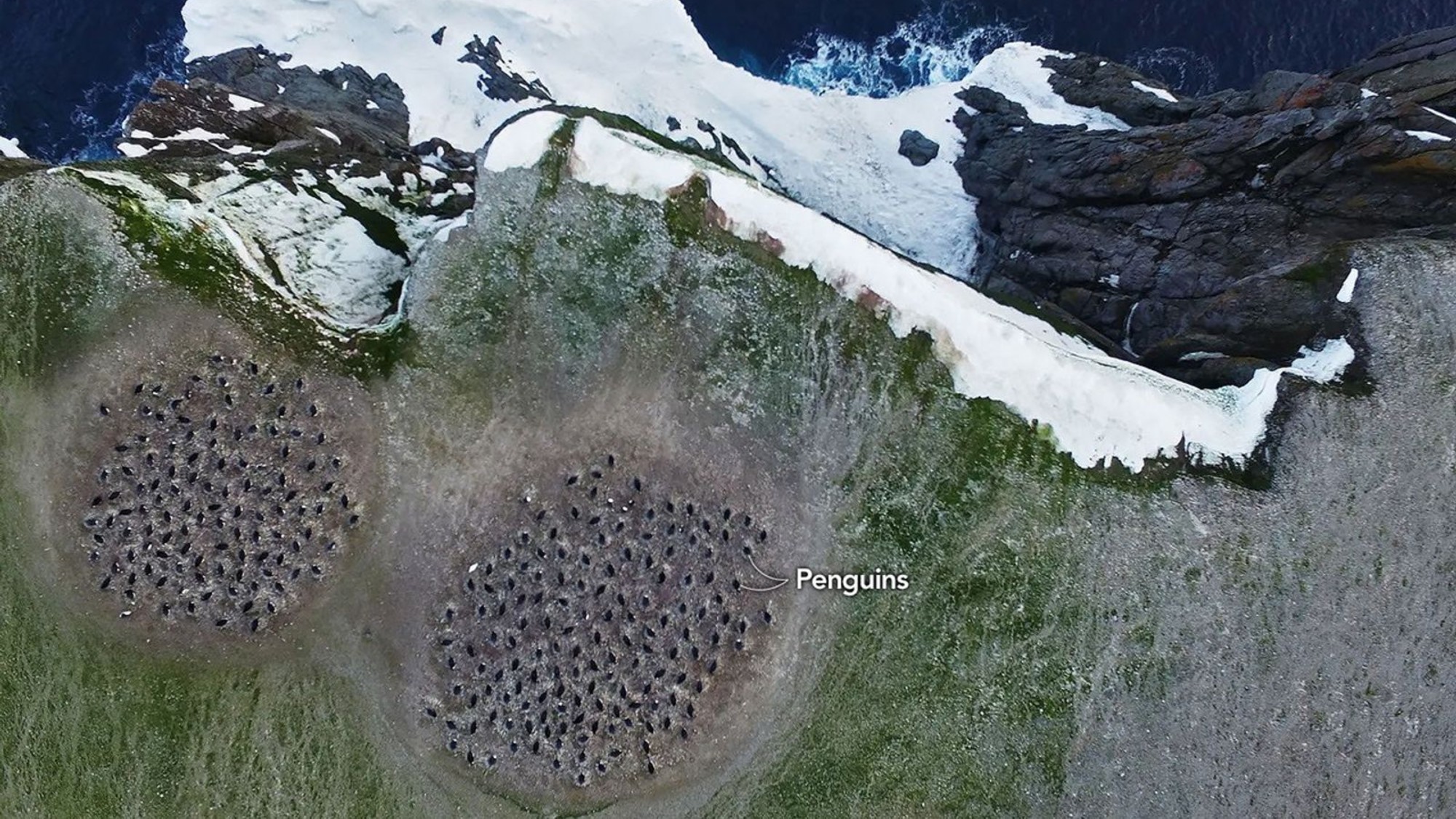
The bright pink color of the penguins' droppings stands out in satellite imagery, allowing researchers to monitor the birds' populations from space. But scientists wanted a closer look, and collected drone imagery as well, as seen in the image below.
A colony of Adélie penguins is visible in this image captured by a drone during a research expedition to the Danger Islands. (Image credit: Thomas Sayre-McCord/WHOI/MIT)
Why is it incredible?
It's pretty amazing that the diet of a specific population of birds can be monitored from 438 miles (705 kilometers) above Earth's surface. The imagery collected by Landsat-8 helped scientists locate where the penguin colonies might be, allowing them to find them in-person and collect guano samples. Those samples contained evidence of what the penguins were eating over time.
Researchers are using those satellite images and samples to track how the penguins' diet might be affected by changes in sea ice conditions, according to a NASA statement.
"Sea ice is such a hugely important factor in the Antarctic marine environment," said Clemson University biologist Casey Youngflesh who led a study comparing the penguins' diet and sea ice conditions. "The structure of the region's food web is changing in response."
On Aug. 5, Earth's moon is due for a human-made, high-speed impact from an identified flying object: a spent SpaceX Falcon 9 upper stage. The event will lead to a literal "dust up" on the lunar landscape.
That Falcon 9 upper stage is a leftover from the launch that sent Firefly's Blue Ghost-1 lander to the moon on Jan. 15, 2025. Onboard the same flight was the Hakuto-R Mission 2, called Resilience, a robotic lunar lander developed by the Japanese company ispace.
And according to a new study by an international team published on the open-source arXiv server, the resulting impact plume may briefly be bright enough to see against the dark sky near the moon's edge. That means it might be visible to moongazers with sufficiently sensitive telescopes.
This head-on collision of the errant stage is expected to occur near the Einstein and Bell craters near the western lunar limb. It may well be visible to ground and space-based assets. Indeed, putting aside all the unknowns and modeling uncertainties, some specialists suggest if you've got the time and observational prowess, it might be worth a look.
Visible ejecta spike
Using special physics simulations to model the impact, William Jo, a graduate research assistant at the University of Texas, Austin and colleagues predict the debris plume from the impact will have the central ejecta spike reaching roughly 47 miles to over 60 miles (75 kilometers to 100 kilometers) altitude.
"Our calculations suggest the plume should be several orders of magnitude brighter than the dark-sky background for the first few minutes after impact," Jo told Space.com. "So the plume should be visible, though I'd stress this is a single nominal case. The real one will look different, and the numbers are on the optimistic side. But the point worth making is that the flash isn't really the story here."
Jo emphasized that there's great slam-dunk science to be had. "Watching this one gives us a rare chance to open up ejecta-plume science and calibrate those models against a real event, which matters for every future thing we deliver to the moon," Jo said.
An animation predicting the evolution of the target ejecta column density, rendered on the lunar surface at the predicted impact site near Einstein crater by William Jo et al. (Image credit: William Jo/UT Austin)
Implications for future moon missions
According to new research led by Benjamin Fernando of the Los Alamos National Laboratory in New Mexico, the impact flash and resultant ejecta plume are "potentially observable" from ground- and space-based observational facilities.
"This event provides an opportunity to attempt the recording of an artificial impact in real-time; although many of the properties of the event (such as visual magnitude) are imprecisely predicted at present," Fernando and colleagues report.
Moreover, this rocket stage meets moon occasion yields an opportunity to test a pipeline for localizing impacts on the lunar surface for future seismic experiments, investigating the dust and plume dynamics from impact events on the moon, and considering hazards from artificial space debris impacts that future astronauts on the lunar surface might have to avoid, Fernando and team members point out.
"The maximum ballistic range of resolved particles is found to be slightly under 1,000 km, which is far enough to be significant from the perspective of presenting a hazard to future astronauts or infrastructure across much of the lunar surface," Fernando et al wrote in the study.
A SpaceX photo of one of the company's Falcon 9 second stages, taken in 2022. A similar second stage is expected to impact the moon in August 2026. (Image credit: SpaceX)
Before and after
Brent Garry is a project scientist for NASA's Lunar Reconnaissance Orbiter (LRO) at Goddard Space Flight Center in Greenbelt, Maryland. LRO will be passing over the projected rocket stage crash site about seven days prior to the impact and about seven days after the impact, Garry explains.
"After the impact we might have a little bit more knowledge of where it is. We can do some additional targeting about a week after the impact and get some targeting over where the site is," said Garry, as noted in earlier Space.com reporting.
Meanwhile, Jo at the University of Texas, Austin underscores the fact that a spent rocket stage is a hollow, spacecraft-like body, and there are very few impact models for human-made objects like it. They seem to produce very different plumes than natural impactors, like asteroids or comets do. But Jo stresses that the real scientific contributions will come by studying the moments after the impact.
"My concern is that most observers will stop at the sub-second flash and never track down the ejecta, which is the part that should actually be visible, and where the science is."
The end of July brings the Alpha Capricornids and the Southern Delta Aquarids, both of which will be most active on Thursday night into Friday morning.
A new look at more than two decades’ worth of archival data from NASA’s Spirit mission suggests that the Martian soil may hold iron-bearing minerals -- hematite and altered magnetite -- that were too faint for scientists to detect in real time during the mission.

 Login

 The Moon’s far side is overturning a long-held theory, revealing that the early Solar System’s asteroid assault may have faded slowly instead of exploding in one catastrophic burst. For decades, scientists have debated whether the early Solar System endured one sudden, catastrophic wave of asteroid strikes or a much longer period of gradually fading violence. [...]