Age-related remodeling of the immune system leaves older adults increasingly susceptible to sudden infections and cancer, while also promoting chronic, misdirected inflammation and impaired wound repair. These effects help drive a wide spectrum of long-term diseases. Yet despite rapid progress in immunology and gerontology, key mechanistic links—how specific immune-cell programs degrade over time and how that degradation shapes early response decisions—remain incompletely understood.
A major obstacle has been the limited availability of immune-aging models that are both predictive and experimentally tractable. Conventional in vitro systems often fail to capture the tissue context, cellular crosstalk, and microenvironmental cues that govern when and how immune responses ignite. As a result, “aging phenotypes” can be difficult to reproduce across laboratories and difficult to connect to causal pathways.
In a 2026 Nature Aging discussion, Nikolich and colleagues argue that the field needs a shift from descriptive comparisons toward engineered, mechanistically grounded platforms. They propose multidisciplinary strategies spanning immunology, gerontology, and engineering to interrogate immune aging at the point of initiation—when innate sensors, tissue barriers, and early signaling networks collectively determine the trajectory of downstream immunity.
The authors highlight drug delivery technologies as a route to more precise interventions. By tuning where, when, and at what dose immunomodulatory agents act, researchers could better test how age-altered signaling thresholds change the balance between protective responses and harmful inflammation.
They also emphasize extracellular matrix (ECM) and biomaterials, noting that aging reshapes the physical and biochemical scaffold surrounding immune cells. Biomaterials that recapitulate age-associated stiffness, ligand density, and degradation dynamics could reveal how microenvironmental cues reprogram immune recruitment, activation, and effector function.
Microphysiological systems and organoid-like models are presented as complementary engines for causality. These platforms can integrate multiple cell types, enable controlled perturbations, and better mimic tissue architecture than traditional culture formats.
Together, these approaches aim to deliver validated in vitro tools for immune-aging research—tools designed not only to measure differences, but to reproduce them reliably and connect them to specific upstream drivers.
The ultimate ambition is precision diagnostics and therapies that can “reprogram and rejuvenate” immune function in older adults, extending both lifespan and healthspan. By targeting immune-response initiation with engineered models, the field may finally bridge the gap between observational aging biology and interventions that work.
Subject of Research: Aging immune system; immune response initiation models and modulation
Article Title: Bioengineering strategies to interrogate and modulate the aging immune system
Article References: Nikolich, J.Ž., Wolf, M.T., Pompano, R.R. et al. Bioengineering strategies to interrogate and modulate the aging immune system. Nat Aging (2026). https://doi.org/10.1038/s43587-026-01187-y
Glenview, Illinois—CHEST, the American College of Chest Physicians’ flagship journal portfolio, has reported a major milestone for its open-access publication CHEST® Critical Care: the journal has earned its first Journal Impact Factor of 2.7. Released annually by Clarivate through the Journal Citation Reports, the metric reflects the average number of citations received by articles published in a journal, serving as a widely used proxy for scholarly influence.
In practical terms, an Impact Factor offers more than prestige. It functions as a signal to authors, clinicians, and research teams that the work circulating in a journal is being engaged by the wider scientific and medical community—particularly important in time-sensitive domains like intensive care medicine, where findings can influence protocols and bedside decision-making.
Hayley Gershengorn, MD, FCCP, Editor in Chief of CHEST Critical Care, emphasized that the achievement is rooted in the ecosystem around the journal. Authors contribute original and reproducible studies; reviewers help refine rigor and clarity; editorial leadership maintains standards; and readers ensure the research travels beyond publication.
The journal was designed to accelerate dissemination of high-quality critical care research while keeping access frictionless. Because CHEST Critical Care is fully open access, its content can be read by practitioners, investigators, and policymakers worldwide without subscription barriers—an element that can broaden citation pathways and facilitate adoption of evidence-based practices.
Beyond original studies, the journal publishes a range of formats, including reviews and case reports, as well as “How I Do It” clinical education articles. This blend supports both scientific discovery and translational learning, which can be critical for managing complex syndromes such as sepsis, respiratory failure, and septic shock.
For biomedical audiences, open-access visibility plus peer-reviewed credibility creates a compelling combination: findings are discoverable, accessible, and citable. That coupling helps explain why emerging journals can gain momentum quickly when their content resonates with urgent clinical needs.
To follow updates across the CHEST journal ecosystem, readers can visit the CHEST website and track news via the journal’s social channels. The organization frames the Impact Factor as a validation of community effort—and as motivation to keep publishing research that improves outcomes in critical care.
Subject of Research: Critical care medicine; scholarly publishing metrics Article Title: CHEST Critical Care Achieves First Journal Impact Factor of 2.7 News Publication Date: Not provided Web References:https://www.chestnet.org/guidelines-and-topic-collections/publications ; https://www.twitter.com/journal_chest References: Clarivate Journal Citation Reports (Journal Impact Factor methodology) Image Credits: Not provided Keywords: CHEST Critical Care, Journal Impact Factor, Clarivate, open access publishing, critical care medicine, citations, peer review, intensive care research
Daniel Blumstein, a professor of ecology and evolutionary biology at U.C.L.A., faced a funding issue amid federal cuts to scientific research. To raise money for its marmot research, his team started “OnlyMarms,” a free, G-rated account of cute videos that collects money through tips.
More light at the day’s end comes at a price: much later winter sunrises across much of the U.S. Scientists have documented consequences for public health and the economy.
Scientists managed to confirm pregnancies in three giant mantas with underwater ultrasound scans, offering clues to the animals’ elusive reproductive habits.
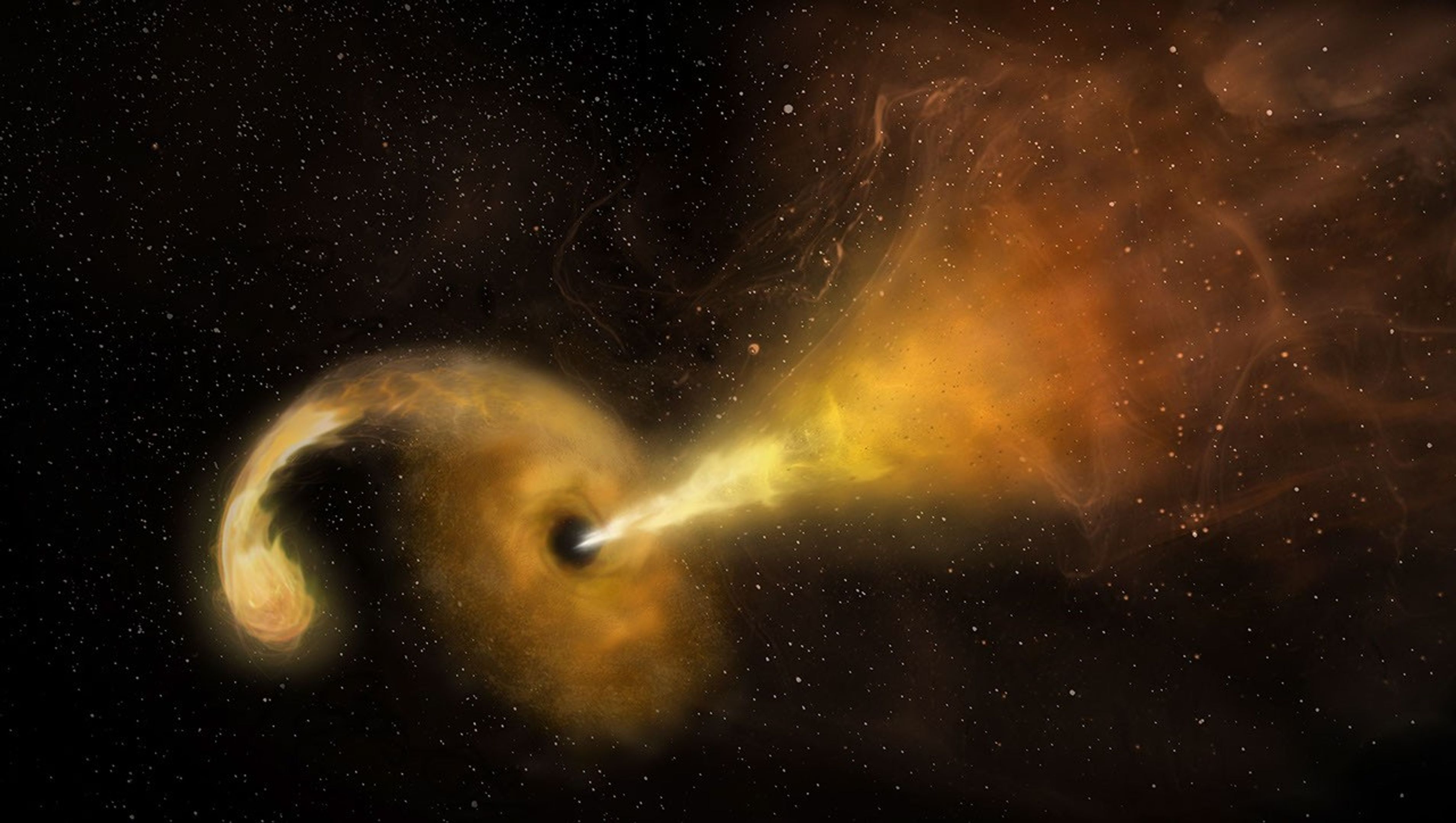
This artist’s concept depicts a tidal disruption event, which occurs when a star passes fatally close to a supermassive black hole. Crumbs of the splintering star heat up as they swirl around the black hole, creating a glow astronomers can see from far across the cosmos, and the black hole launches a relativistic jet into space.
NRAO/AUI/NSF/NASA
NASA’s Neil Gehrels Swift Observatory captured an “orphan” black hole lighting up as it devoured a star on the outskirts of a faraway galaxy. These phenomena are rare to begin with, and none had ever before been seen so far outside of a galaxy’s core.
“We were looking for these star-shredding events as a way to find otherwise invisible supermassive black holes wandering away from the galactic cores where they usually reside,” said Robert Stein, a research fellow at The University of Maryland, College Park and NASA’s Goddard Space Flight Center in Greenbelt, Maryland. “With this discovery, which is one of just a couple that have been confirmed so far, we’ve validated a new technique and can use it to hunt for more.”
A paper describing the results, led by Stein, was published Monday in The Astrophysical Journal Letters.
Researchers saw an ultrabright flare unleashed by a star being torn apart by extreme gravitational forces after drifting too close to a monster black hole — a phenomenon called a tidal disruption event. The black hole behind the blast weighs in at about a million times the Sun’s mass. Its existence was first flagged in November 2025 as an unusual brightening in a galaxy about 750 million light-years away by ZTF (Zwicky Transient Facility), a survey conducted by the Palomar Observatory in Southern California.
“Out of the half million flashes ZTF detects each night, our new artificial intelligence algorithm automatically recognized a flare that looked a lot like a tidal disruption event, despite its unusual location in the outskirts of a galaxy,” Stein said. For a few months, the tidal disruption event outshone its entire host galaxy in ultraviolet wavelengths, temporarily radiating with the light of about 10 billion suns.
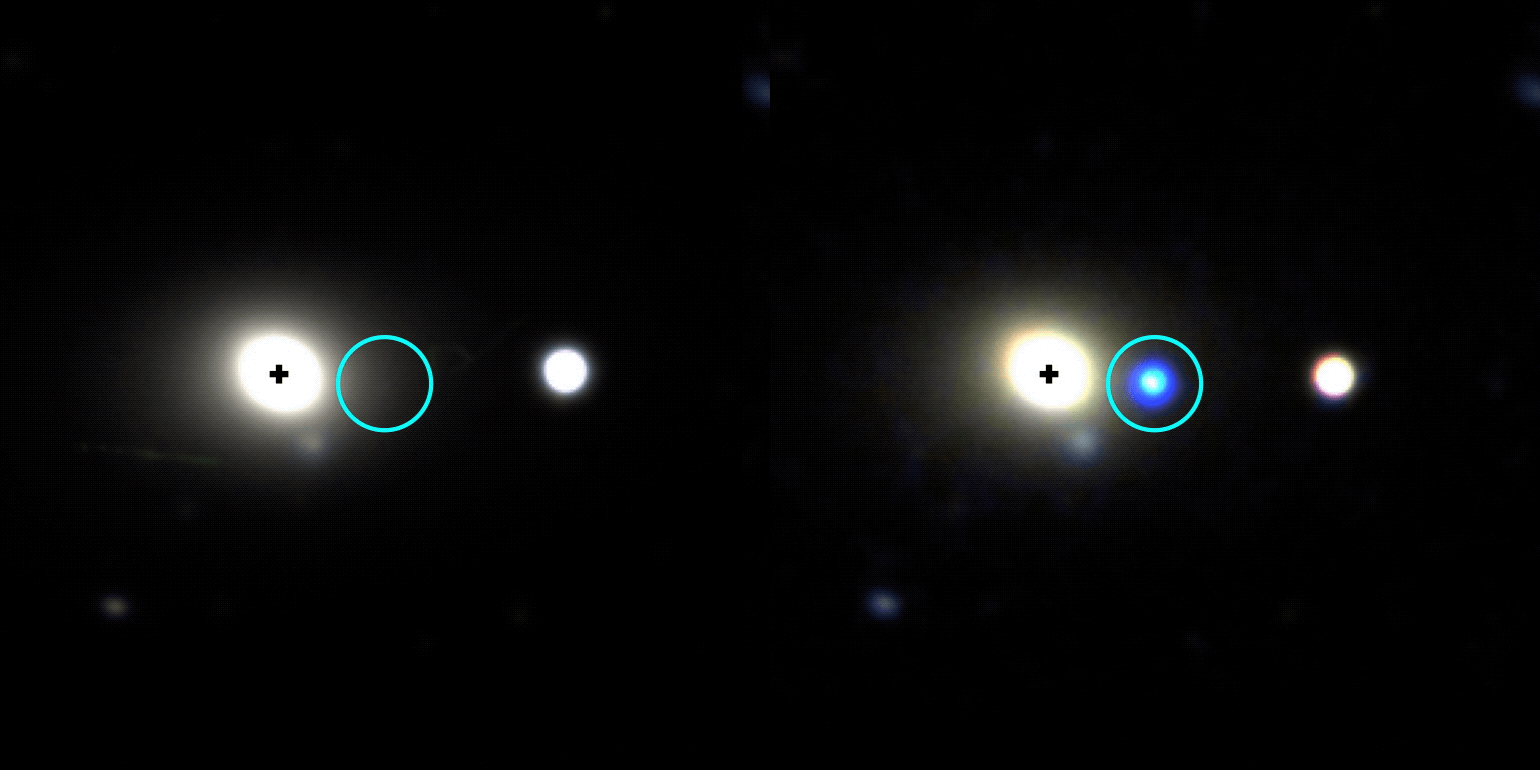
This gif shows the galaxy WISEA J014656.04-152214.7, located about 750 million light-years away in the constellation Cetus, before and after a tidal disruption event was spotted on its outer edge in November 2025. The image at left was taken by the DESI (Dark Energy Spectroscopic Instrument) Legacy Survey and the one at right is from the Lowell Discovery Telescope.
Other telescopes, including the SOAR (Southern Astrophysical Research) telescope in Chile, followed up on the ZTF source to look at the event’s spectrum, which revealed features supporting that it was likely a tidal disruption event. Astronomers then used NASA’s Swift to look at wavelengths they can’t detect with ground-based telescopes to uncover new information. For example, Swift’s UVOT (Ultraviolet/Optical Telescope) took the blip’s temperature and found that it had quite a fever at about 54,000 degrees Fahrenheit (30,000 degrees Celsius).
“The combination of all this data helped us rule out other explanations and confidently say it’s a tidal disruption event, despite its strange location,” said Jonathan Carney, a doctoral student at the University of North Carolina at Chapel Hill, who took the first spectra that supported the flare’s interpretation as a tidal disruption event.
Hidden heavyweights
Nearly every galaxy in the universe is anchored by a supermassive black hole sitting right in the center. About once every 100,000 years, a star will drift too close to this invisible heavyweight and trigger a tidal disruption event.
While they’re rather rare in any given galaxy, scientists scour millions of galaxies for them. Each year, astronomical surveys typically spot about 30 tidal disruption events occurring somewhere in the universe.
Prior to 2024, they’d only been seen in galaxy cores. That’s partly because astronomers mainly looked for them there; after all, it’s where all the known supermassive black holes were, and you can’t get a tidal disruption event without one (the gravitational pull of lighter black holes isn’t strong enough).
Then scientists saw the telltale signs of a star being shredded 2,600 light-years from the center of its host galaxy. That inspired more astronomers to look beyond galaxy cores for similar events, and now a team has identified one more than 30,000 light-years away from a galaxy’s center.
This video visualizes a star approaching a supermassive black hole so closely that it’s stretched to a breaking point by the black hole’s strong gravity. Intense tidal forces crack the star open and hurl its gaseous guts outward. Stellar debris forms a spinning accretion disk as it continues to spiral into the black hole.
NASA, ESA, STScI, Ralf Crawford (STScI)
Oddball origin story
So how did the newfound black hole become so off-kilter?
“It must have originated in a galaxy’s center, but not the one it’s in the outskirts of now,” Stein said. “We think the host galaxy’s supermassive black hole is still at its core, but the one eating the star could have started off in a small galaxy that merged with the big one we see today.”
The researchers have outlined two possibilities. Three or more galaxies may have merged together, and the gravitational tug-of-war between their central supermassive black holes may have flung the lightest black hole out to the galaxy’s edge.
Or a dwarf galaxy could be midway through a merger. As the dwarf’s stars fell into the larger galaxy, one may have passed too close to the dwarf’s supermassive black hole.
“Further discoveries could reveal the origin of this apparent ‘orphan’ black hole,” Stein said. “The key science question we want to answer is: How common are wandering black holes?”
The answer may soon be within reach. “Pointed science observations with Swift’s UVOT and XRT (X-Ray Telescope) instruments are temporarily suspended as the mission awaits an orbit boost, which is planned for this summer,” said co-author S. Bradley Cenko, Swift’s principal investigator at NASA Goddard. The spacecraft, whose primary mission ran from 2004 to 2006, is slowly sinking toward Earth due to atmospheric drag after more than 20 years of observations of the changing universe. Nudging it to a higher orbit could extend its lifetime even longer. “Once it resumes normal operations, Swift could continue searching for more examples of out-of-place black holes.”
In the coming years, scientists will use the new technique to search for disintegrating stars in observations from the newly operational Vera C. Rubin Observatory, jointly funded by the U.S. Department of Energy and National Science Foundation, in Chile and NASA’s upcoming Nancy Grace Roman Space Telescope.
“Rubin’s wide, deep surveys will reveal a much larger sample of tidal disruption events than current observatories are capable of collecting, including ones that are off-center,” Carney said. “And Roman’s space-based surveys will extend the current search zone by seeing ones that are farther away, looking back through 9 billion years of cosmic history.” Adding their observations to Swift’s and those from ground-based observatories will bring astronomers closer than ever before to completing a census of the universe’s behemoth black holes.

 Login