Static electricity is one of those everyday phenomena that turns out to be much more complicated than you might expect. Indeed, our guest in this episode of the Physics World Weekly podcast has devoted much of his career to understanding how objects exchange electrical charge – a process that he says scientists are mostly “clueless” about.
Based at the Institute of Science and Technology Austria, Scott Waitukaitis is in conversation with Physics World’s Margaret Harris. He explains how his early work in granular physics opened his eyes to the many unsolved problems related to static electricity. They also chat about some of Waitukaitis’s current research projects including his quest to understand the role that adsorbed molecules play in how an object is charged.
Like a two-lane highway with one lane empty and the other clogged with traffic, superconducting diodes allow electrons to flow without resistance in one direction while encountering normal, resistive conditions in the other. First demonstrated experimentally in 2020, these devices have considerable potential as platforms for fundamental studies of quantum materials and as building blocks for superconducting electronics.
For many applications, being able to control the flow of electricity through the diode – or even reverse its polarity – is essential. In principle, there are several ways of doing this because the efficiency of the superconducting diode effect (SDE) depends on many factors. Examples include magnetic field, temperature and diode design as well as intrinsic properties such as the momentum of the Cooper-paired superconducting electrons and their spin-orbit coupling.
In practice, though, some of these properties are more easily changed than others. To return to the highway analogy, it’s much more straightforward to alter the flow of traffic by posting new road signs, rather than by rebuilding the road or redesigning the cars.
In a recent paper in Chinese Physics Letters, Yanwu Xie, Yishuai Wang, Wenze Pan and Meng Zhang of Zhejiang University in Hangzhou, China describe a new superconducting diode platform that makes it far easier to change the device’s configuration, and thus to control the flow of superconducting electrons through it. Physics World spoke to them about their research and its possible applications.
How did you get the idea for this new type of superconducting diode?
This work started with an unexpected experimental observation. While we were making routine current-voltage measurements on a conventional strip-shaped superconducting device constructed at the interface between two materials, LaAlO3 and KTaO3 (LAO/KTO), we noticed a pronounced difference between the critical currents in opposite directions. Given the growing interest in the SDE, this surprising result immediately caught our attention and prompted us to investigate its origin.
What is special about these two materials?
The properties of conventional superconducting diodes are typically locked into their fixed physical structures, such as Josephson junctions or patterned vortex pinning sites. This inflexibility makes post-fabrication tuning or reconfiguration of the diode characteristics extremely challenging.
Two-dimensional oxide interface superconductors such as LAO/KTO and LaAlO3/SrTiO3 are good candidates for overcoming this problem. The strong spin-orbit coupling near the interface enables possible finite-momentum Cooper pairing, while the extremely low superfluid density and intrinsic two-dimensional nature of the materials create ideal conditions for studying vortex dynamics and magnetic flux behaviour.
In addition, these systems have exceptional tuneability. Their superconducting states can be well controlled through both global substrate gating and local conductive atomic force microscope (cAFM) lithography, which opens new possibilities for post-fabrication SDE engineering.
What was the most challenging aspect of this research?
The most challenging part was unravelling the frustrating sample-to-sample variability we encountered early on. We now know that the SDE in conventional LAO/KTO devices stems from asymmetric vortex entry conditions caused by random, fabrication-induced edge imperfections. At the time, however, even devices with nominally identical geometries exhibited wildly different SDE efficiencies and polarities, showing no discernible systematic trend.
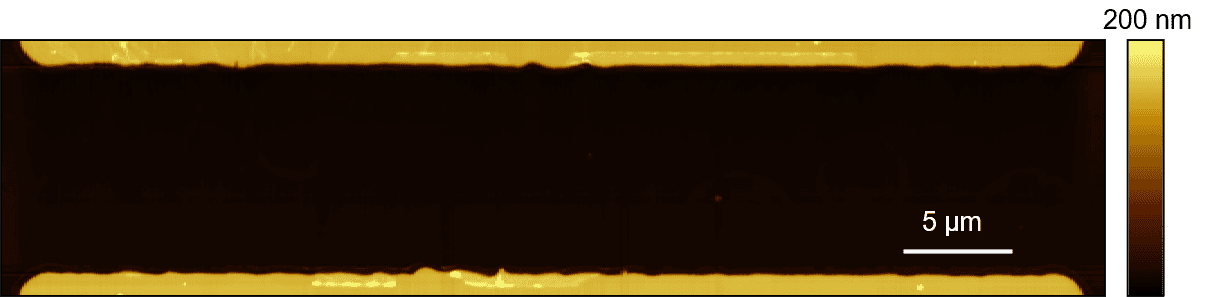
The breakthrough came when AFM imaging revealed random edge defects on the superconducting channels. To test whether these random imperfections were indeed the root cause, we used cAFM lithography to “straighten” the originally photolithography-produced rough channel boundaries. This atomic-scale trimming strongly suppressed the SDE, providing unambiguous evidence for the vortex edge asymmetry mechanism.
Channel edges: An atomic force microscopy (AFM) image of the LAO/KTO channel in the diode, showing the roughened edges. (Courtesy: Yanwu Xie)
We then turned this challenge into an opportunity. By using cAFM to re-shape the channel edges repeatedly and in a non-volatile way, we transformed a source of random sample variability into a tool for deterministic, on-demand quantum device control.
What are some possible applications for this editable superconducting diode?
The nonreciprocal transport of charge carriers – exemplified by p-n junctions in semiconductor diodes – is a cornerstone of modern electronics. Similarly, superconducting diodes are emerging as pivotal components for superconducting electronics. What distinguishes our approach is our ability to reversibly modify the diode polarity and efficiency within the same device through nanoscale control of the superconducting channel geometry. This editability may enable reconfigurable superconducting circuit elements and adaptive circuit architectures, while also providing a versatile platform for investigating the role of geometry-associated vortex dynamics in nonreciprocal superconducting transport.
What will you do next?
We plan to fully exploit the unique cAFM lithography capability of our oxide interface platform to systematically investigate how tailored vortex-boundary configurations shape the SDE. The diode performance can be further optimized by mapping out the precise relationship between channel geometry, vortex entry barriers and rectification efficiency.
In parallel, we plan to introduce artificial pinning centres (such as nanoscale insulating dot arrays) directly into the superconducting channel. This will allow us to engineer asymmetric vortex-pinning landscapes within the bulk of the channel. Combining this engineered flux pinning with the asymmetric vortex-boundary mechanism demonstrated in the current work offers a promising route toward achieving a robust, deterministic and highly controllable superconducting diode.
Nature is always more complicated than the models we use to describe it. Ocean waves, for example, are constantly evolving. They grow when wind transfers kinetic energy to the water’s surface. They interact with each other in highly nonlinear ways. And once the wind dies down, their internal viscosity makes them dissipate away to nothing, leaving behind a surface as flat as glass.
This process is familiar to anyone who’s ever been to the seaside, yet physicists’ go-to models of water moving through the ocean essentially ignore it. Instead, the standard theory of wave transport, known as classical Stokes drift theory, concentrates on describing the flow of steady waves with finite amplitude. And while extensions of the theory incorporate complications such as nonlinear wave shapes, uneven seabeds and the inertia of particles carried along by the waves, they don’t account for waves that grow and fade over time.
For Marco Edoardo Rosti, a physicist at Japan’s Okinawa Institute of Science and Technology (OIST), this shortcoming has real-world consequences. “There is increasing interest in understanding near-surface transport processes because they are directly connected to problems such as pollutant dispersion, microplastic accumulation, sediment transport, and air-sea exchange,” he explains. “Since these processes depend sensitively on particle trajectories, even subtle modifications of the drift mechanism may become important over long times.”
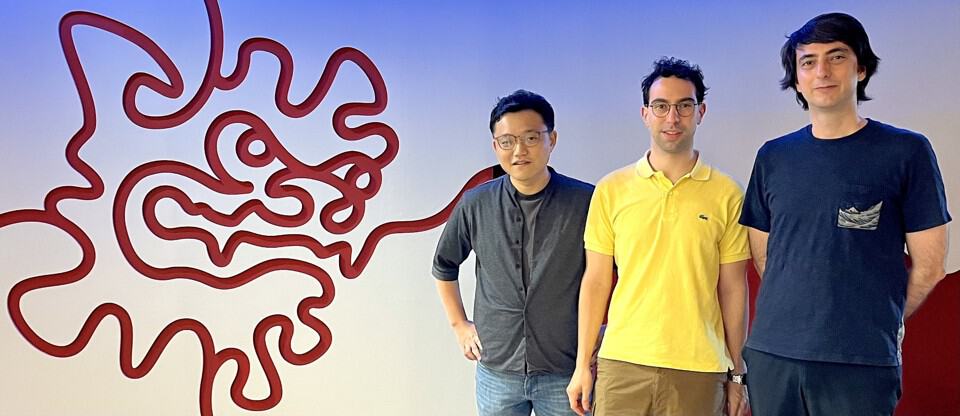
Wave mechanics Team members (l-r) Tatsuo Izawa, Giulio Foggi Rota and Marco Edoardo Rosti. (Courtesy: Marco Edoardo Rosti/OIST)
In a study published in the journal EPL, Rosti and his colleagues Alessandro Chiarini, Tatsuo Izawa and Giulio Foggi Rota explored ways of remedying this deficiency. They focused on the simplest type of wave evolution: a freely decaying, single-frequency gravity wave, one where the force of gravity acts to restore equilibrium and smooth out the surface of the water. Physics World spoke with the team about the findings.
What is the most important advance in this work?
Classical Stokes drift theory predicts that on average, particles will get transported through the water horizontally, in the direction of the wave. But by combining fully nonlinear two-phase simulations with a perturbative analytical model, we demonstrate that when you allow those waves to decay, additional transport mechanisms appear.
Specifically, we identified a net vertical particle migration that arises solely from the temporal decay of the wave field, due to the interplay between fluid inertia and viscous dissipation. This migration persists even for fluids with relatively weak viscosity. Also, because the drift velocity depends on depth, even small vertical displacements alter particle trajectories and mixing properties.
International collaboration: Team member Alessandro Chiarini. (Courtesy: Alessandro Chiarini)
More broadly, our results show that unsteadiness in the wave amplitude is not a minor correction to classical Stokes drift. It’s something that can qualitatively change how an individual parcel of fluid moves through space and time – what we call Lagrangian transport. This has important implications for understanding how floating and suspended materials, including sediments, aerosols and microplastics, get redistributed near the ocean surface.
Can you say more about those implications?
Because gravity waves at the ocean surface span a broad range of wavelengths, from centimetres to hundreds of meters, even a modest fractional vertical displacement per wave cycle can significantly change the depth of a drifting particle. And because the drift velocity beneath a wave decays exponentially with depth, these small vertical excursions can substantially alter how much horizontal drift a particle accumulates. That could influence whether microplastics remain near the surface (where they are most bioavailable), or whether they instead migrate to greater depths, where different biological and physical processes govern their fate.
Why have previous studies not seen this vertical drift?
The drift mechanism we identify accumulates gradually as the wave field decays. That means it only becomes apparent when “tracer” particles in the water are exposed to the same wave as its amplitude decreases over many periods. Most wave-tank experiments and field measurements instead follow tracers as they are swept through a passing wave packet, which is a fundamentally different configuration.
In open-sea conditions, similar arguments apply, and the presence of currents, wind forcing and turbulence all complicate the picture. These effects mask a signal that only shows up unambiguously in clean, unforced conditions.
What was the most challenging aspect of this work?
The most challenging part was to bridge the limits of classical wave theories with the fully nonlinear, two-phase simulations of an air-water interface. The classical Landau wave-decay theory, for example, assumes an isolated, weakly viscous fluid (water). However, our high-resolution simulations demonstrate (as previously reported in other studies) a deviation from these idealized assumptions. In fact, the dominant viscous energy dissipation occurs in a thin layer of air just above the water surface, rather than in the bulk.
To investigate how continuous wave energy decay affects Lagrangian particle transport, we developed a perturbative analytical model based on the classical Landau framework. This was a difficult step because the framework is inherently blind to the two-phase dissipative system. As a result, its asymptotic predictions progressively diverged from simulated flow fields at long times, likely due to intrinsic limitations of the Landau decay-wave model.
What do you plan to do next?
The drift mechanism we discuss in this study applies to a very idealized form of wave decay. In the future, we would like to test whether and how this mechanism propagates in more complex but realistic wave conditions. In particular, we want to work out how to measure such mechanisms in wave-tank experiments. To do so, we will study a different setup, one in which waves decay spatially instead of temporally, since this is closer to what observed in wave tanks. We would also like to study how our mechanism affects drift in waves that vary over time, with controlled unsteadiness, rather than simply decaying.

 Login