
❌

Normal view

Machine vision begins to work like the human eye

8 July 2026 at 09:15

Artificial vision is employed in applications ranging from self-driving cars to advanced robotics. However, most “artificial eyes” do not work well in complex real-world conditions, such as sudden strong glare, dimness or uneven light levels. Such devices also rely on complex and rigid electronic circuitry to adjust their sensitivity to light and on post-algorithmic processing for accurate image recognition. A research team headed up at the University of Electronic Science and Technology of China and Penn State in the US has now developed a new adaptive photomemristor structure that does not suffer from any of these problems, allowing for machine vision that truly adapts to natural and complex light fluctuations, just like human eyes.

Sight is one of our most important senses: we acquire over 80% of the information from our environment through our eyes. Indeed, the human eye is so sensitive that it can process visual information under varied lighting levels with a photodetection dynamic range of more than 160 dB. This allows us to watch a film in a dark room or drive in the glare of oncoming headlights. Until now, however, artificial eyes have lacked this so-called dynamic self-adaptation.

Memristors for improving light adaptation

In recent years, researchers have been looking into neuromorphic devices that mimic the way biological structures work. These devices can be engineered to behave very much like neurons in the human brain, which learn by reconfiguring the strengths of the connections (synapses) between neurons. Memristors (or memory resistors) are excellent in this respect because they can bring this learning functionality to the connections in electronic circuits.

Rather than being fixed, the resistance of memristors changes depending on the current or voltage previously applied to them. This means that specific resistances can be programmed into the devices and subsequently stored. Importantly, the “remembered” value of the resistive state persists even when the power is switched off, making it a non-volatile form of electronic memory.

Photomemristors are a type of memristor that can change their resistance in response to both voltage/current and light and could therefore be used in advanced optical systems.

Reversible water absorption and desorption

In the new work, reported in Nature Communications, a team led by materials scientist Jia Zhu made a highly adaptive optoelectronic synapse from the composite material TiO₂/PEDOT:PSS. The TiO2 absorbs light, converting it into a photocurrent that then passes through the conductive surface of the PEDOT:PSS polymer. This intrinsic photothermal effect, explains Zhu, triggers reversible water absorption and desorption on the polymer surface, which in turn impacts the device’s conductivity.

“This process allows the device to automatically suppress the photoresponse under intense bright light and amplify its sensitivity under dim weak light,” he says. “In extreme strong-light conditions, its photocurrent can even drop below the dark current level, allowing for an ultralow-sensitivity state similar to human eye pupil constriction.”

A high image recognition accuracy

Zhu tells Physics World that when integrated with artificial neural networks, the new adaptive vision system achieves a high image recognition accuracy of 91.3% in dynamically changing mixed-light scenarios, including glare, dim shadow and alternating brightness. It also eliminates the need for bulky auxiliary circuits and complex real-time computing algorithms,  reducing power consumption and hardware volume.

The new work is a first step towards making next-generation neuromorphic vision systems that could be used in practical applications. “Our adaptive photomemristor vision system can effectively resist strong glare from oncoming vehicle headlights, accurately identify pedestrians, lane lines and traffic signals in complex day–night alternating light environments, so greatly improving the safety of autonomous driving,” Zhu explains.

The technology could also be widely applied to humanoid robots, outdoor intelligent monitoring equipment, aerial reconnaissance and portable intelligent vision terminals, he adds.

Looking ahead, the researchers will now focus on optimizing the material formula of the compound studied in this work and improve its fabrication. They will also be working on complete system-level integration, including array device packaging, signal readout modules and adaptive control units, with the aim of constructing a fully functional bionic artificial eye prototype. “We will then verify whether this biomimetic dynamic regulation strategy can be extended to other oxide/polymer composite memristor systems to develop a universal design principle for high-performance light-adaptive neuromorphic devices,” says Zhu.

The post Machine vision begins to work like the human eye appeared first on Physics World.
New superconducting diode gives greater control over the flow of electrons

2 July 2026 at 15:00

Like a two-lane highway with one lane empty and the other clogged with traffic, superconducting diodes allow electrons to flow without resistance in one direction while encountering normal, resistive conditions in the other. First demonstrated experimentally in 2020, these devices have considerable potential as platforms for fundamental studies of quantum materials and as building blocks for superconducting electronics.

For many applications, being able to control the flow of electricity through the diode – or even reverse its polarity – is essential. In principle, there are several ways of doing this because the efficiency of the superconducting diode effect (SDE) depends on many factors. Examples include magnetic field, temperature and diode design as well as intrinsic properties such as the momentum of the Cooper-paired superconducting electrons and their spin-orbit coupling.

In practice, though, some of these properties are more easily changed than others. To return to the highway analogy, it’s much more straightforward to alter the flow of traffic by posting new road signs, rather than by rebuilding the road or redesigning the cars.

In a recent paper in Chinese Physics Letters, Yanwu Xie, Yishuai Wang, Wenze Pan and Meng Zhang of Zhejiang University in Hangzhou, China describe a new superconducting diode platform that makes it far easier to change the device’s configuration, and thus to control the flow of superconducting electrons through it. Physics World spoke to them about their research and its possible applications.

How did you get the idea for this new type of superconducting diode?

This work started with an unexpected experimental observation. While we were making routine current-voltage measurements on a conventional strip-shaped superconducting device constructed at the interface between two materials, LaAlO3 and KTaO3 (LAO/KTO), we noticed a pronounced difference between the critical currents in opposite directions. Given the growing interest in the SDE, this surprising result immediately caught our attention and prompted us to investigate its origin.

What is special about these two materials?

The properties of conventional superconducting diodes are typically locked into their fixed physical structures, such as Josephson junctions or patterned vortex pinning sites. This inflexibility makes post-fabrication tuning or reconfiguration of the diode characteristics extremely challenging.

Two-dimensional oxide interface superconductors such as LAO/KTO and LaAlO3/SrTiO3 are good candidates for overcoming this problem. The strong spin-orbit coupling near the interface enables possible finite-momentum Cooper pairing, while the extremely low superfluid density and intrinsic two-dimensional nature of the materials create ideal conditions for studying vortex dynamics and magnetic flux behaviour.

In addition, these systems have exceptional tuneability. Their superconducting states can be well controlled through both global substrate gating and local conductive atomic force microscope (cAFM) lithography, which opens new possibilities for post-fabrication SDE engineering.

What was the most challenging aspect of this research?

The most challenging part was unravelling the frustrating sample-to-sample variability we encountered early on. We now know that the SDE in conventional LAO/KTO devices stems from asymmetric vortex entry conditions caused by random, fabrication-induced edge imperfections. At the time, however, even devices with nominally identical geometries exhibited wildly different SDE efficiencies and polarities, showing no discernible systematic trend.

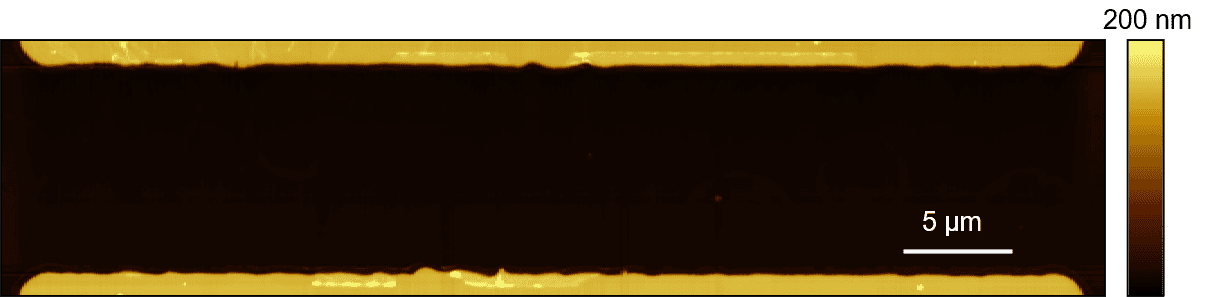
The breakthrough came when AFM imaging revealed random edge defects on the superconducting channels. To test whether these random imperfections were indeed the root cause, we used cAFM lithography to “straighten” the originally photolithography-produced rough channel boundaries. This atomic-scale trimming strongly suppressed the SDE, providing unambiguous evidence for the vortex edge asymmetry mechanism.

AFM image showing two horizontal yellow-orange surfaces separated by a larger black gap. The inner edges of the surfaces are visibly bumpy.
Channel edges: An atomic force microscopy (AFM) image of the LAO/KTO channel in the diode, showing the roughened edges. (Courtesy: Yanwu Xie)

We then turned this challenge into an opportunity. By using cAFM to re-shape the channel edges repeatedly and in a non-volatile way, we transformed a source of random sample variability into a tool for deterministic, on-demand quantum device control.

What are some possible applications for this editable superconducting diode?

The nonreciprocal transport of charge carriers – exemplified by p-n junctions in semiconductor diodes – is a cornerstone of modern electronics. Similarly, superconducting diodes are emerging as pivotal components for superconducting electronics. What distinguishes our approach is our ability to reversibly modify the diode polarity and efficiency within the same device through nanoscale control of the superconducting channel geometry. This editability may enable reconfigurable superconducting circuit elements and adaptive circuit architectures, while also providing a versatile platform for investigating the role of geometry-associated vortex dynamics in nonreciprocal superconducting transport.

What will you do next?

We plan to fully exploit the unique cAFM lithography capability of our oxide interface platform to systematically investigate how tailored vortex-boundary configurations shape the SDE. The diode performance can be further optimized by mapping out the precise relationship between channel geometry, vortex entry barriers and rectification efficiency.

In parallel, we plan to introduce artificial pinning centres (such as nanoscale insulating dot arrays) directly into the superconducting channel. This will allow us to engineer asymmetric vortex-pinning landscapes within the bulk of the channel. Combining this engineered flux pinning with the asymmetric vortex-boundary mechanism demonstrated in the current work offers a promising route toward achieving a robust, deterministic and highly controllable superconducting diode.

The post New superconducting diode gives greater control over the flow of electrons appeared first on Physics World.

“It Was a Mix of Excitement and Disbelief”: When Scientists Sent Deep-Sea Rovers to Confirm a 1960s Theory, They Made a Surprising Discovery

20 July 2026 at 13:05

A team of scientists exploring a possible deep-sea coral reef off the coast of Benin that 1960s researchers had deemed likely dead found a living, thriving reef supporting a complex underwater ecosystem, including several coral and fish species.

Led by scientists from the Institut de Recherches Halieutiques et Océanologiques du Bénin, the discovery is the first known mesophotic coral reef in the region and offers scientists a tantalizing target for future deep-sea marine-life expeditions.

Deep-Sea Coral Reef Spotted in the 1960s was Considered Dead

According to a statement announcing the unexpected discovery, previous historical surveys of the area had indicated a possible reef more than 50 meters below the water’s surface. When a 1960s survey detected the unusual feature, they suspected it was a coral reef that was likely dead.

When team leader Gérard Zinzindohoué and colleagues studied the features, they suspected that the team from the 60s may have provided them with a golden scientific opportunity. Although the feature’s depth ruled out a typical shallow-water coral reef, the researchers note that it could be an entirely different kind of reef structure, known as a mesophotic coral ecosystem, that can inhabit such depths.

“A mesophotic coral ecosystem lives deeper than the usual shallow coral reefs, in zones where light is much more limited,” Zinzindohoué explained. “Unlike typical shallow reefs, it does not always form a single continuous reef structure. Instead, it can appear as patchy or scattered coral communities spread across the seafloor.”

Instead of using mid-twentieth-century technology to settle the debate, the team turned to the National Geographic Exploration Technology Lab, which provided access to its Deep-Sea Camera System.

“We Could Actually See the Sea Floor”

Following the path set out by the 1960s survey, the team used the underwater camera to map the seafloor with sonar. After several passes, the team covered a total of 11.5 kilometers. Zinzindohoué highlighted the difficulty of the effort, noting that it was “not an easy field campaign.”

“It was a mix of long days at sea, technical problems, and a lot of uncertainty,” the researcher explained. “But then we saw structures on the sonar that looked like they could be reef signatures, which gave us hope that we were close.”

The closer the team drove the Deep-Sea Explorer’s cameras, the more the shockingly unexpected scene began to unfold.

deep-sea life
Image Credit: Gérard Zinzindohoué

“That was a big moment for us, because suddenly we could actually see the seafloor,” Zinzindohoué said.

Instead of the dark, lifeless structure anticipated by the original survey team, the new team found a healthy reef containing eight distinct types of coral. The system was also actively supporting eight fish species, with the camera capturing them feeding and sheltering among the corals. The species identified by the team include golden African snappers, blackbar soldierfish, Guinean angelfish, West African goatfish, the Monrovia doctorfish, three-banded butterflyfish, and two distinct species of damselfish.

deep-sea life forms found on a coral reef assumed dead.
Image Credit: Gérard Zinzindohoué

“I still remember seeing those first images,” Zinzindohoué recalled of the vibrant ecosystem lying directly in front of the cameras. “It was a mix of excitement and disbelief, because after all this time thinking about this reef, suddenly there was something real in front of us.”

More Research Needed to Determine if the Coral Reef Was Ever Dead

When discussing the discovery’s significance, Zinzindohoué said that to the team’s knowledge, “this is the first confirmed record of a living mesophotic coral ecosystem on the Gulf of Guinea continental shelf.”

Although the cameras captured a complex ecosystem, the researchers said that the reef does not appear to be a continuous barrier. Instead, the deep-sea environment consists of several patches of coral that occupy rocky seabed areas most suitable for their survival. Still, they add that further surveys may identify more reefs in the same area.

“I think what we found is probably not an exception,” Zinzindohoué said. “It is more likely a reflection of how little we still know about coastal regions in West Africa and elsewhere. If we were able to find this reef again after 60 years, how many others are still undocumented or simply forgotten?”

Since the team was unable to sample the corals directly, they were unable to confirm the species identification with genetic analysis. The team was also hesitant to condemn the original 1960s survey, noting that it is impossible to tell, without more data, whether the corals were dead at the time and have since rebounded.

“This is still an initial exploration,” Zinzindohoué said. “The historical reports suggested that this could be a continuous coral reef barrier extending roughly 40 kilometers parallel to the coast. We only surveyed a small section of this area, and we had a limited number of visual transects.”

Although there are no immediate plans for a return expedition, the research leader said the only thing holding them back from learning more about these ecosystems, which are “still poorly known in this part of the world,” is adequate financial support.

“If I had all the grant money in the world, the first thing I would do is return to the site with a proper scientific diving and sampling program,” he said, before adding that “every additional piece of information matters.”

“I do believe there are more coral systems out there that we have not yet documented,” he said. “But we should not assume they are everywhere. Each discovery needs to be confirmed. Without going back into the field, we are really just guessing.”

On a personal note, the team leader said the most exciting part is understanding the reef’s history and the lessons that can be gleaned from this underexplored region.

“It feels like we have only just started to read an archive that has been there for a very long time.”

The study “First evidence of live mesophotic coral reefs on the Benin continental shelf” was published in Frontiers in Marine Science.

Christopher Plain is a Science Fiction and Fantasy novelist and has spent the last six years as Associate News Editor and Head Science Writer at The Debrief. Follow and connect with him on X, learn about his books at plainfiction.com, or email him at christopher@thedebrief.org

Astronomers May Have Been Looking for Alien Megastructures Around the Wrong Stars

20 July 2026 at 12:58

Some of the most promising locations to search for possible alien megastructures, known as Dyson spheres, may not be stars like the Sun, but rather the galaxy’s smallest and dimmest stars.

Physicist Freeman Dyson introduced the idea of a Dyson sphere in 1960, describing it as a shell or, more realistically, a swarm of orbiting collectors that could capture most of a star’s energy. This concept has interested scientists searching for signs of advanced technology, but the question of how such a structure would appear in astronomical observations remained unknown.

Now, a new study, available on the arXiv preprint server, suggests that one of the coldest objects in a stellar system could, in principle, be an artificial megastructure rather than a natural astronomical object.

Amirnezam Amiri, a physicist at the University of Arkansas, explored the question of Dyson spheres by modeling these hypothetical megastructures around two often-overlooked types of stars: red M-dwarfs and white dwarfs. Amiri credits discussions with Harvard astronomer and founder of the Galileo Project, Avi Loeb, with helping shape the study.

Small, Dim, and Built to Last

Red dwarfs make up about 70% of the stars in the Milky Way. These stars burn slowly and can remain stable for trillions of years, much longer than the universe has even existed so far. White dwarfs offer a different benefit. As the dense remnants of stars like the Sun, they shrink to about 1% of their original size. This means a Dyson swarm could orbit much closer, requiring less material and a smaller structure than one built around a star like the Sun.

Amiri’s study explores how astronomers could detect such structures. Both red dwarfs and white dwarfs are dim enough that the infrared heat emitted by a Dyson swarm would stand out more clearly against the star’s own light.

Reading the Wreckage on a Star Chart

Astronomers use the Hertzsprung-Russell diagram to classify stars by temperature and brightness, and this tool is central to Amiri’s analysis. A Dyson swarm would not destroy a star’s energy, but would capture its light and re-emit it as heat at much longer wavelengths. 

In the new model, a star with a Dyson swarm would appear on the H-R diagram at the same luminosity but shifted dramatically toward the cool end. For instance, a red dwarf at about 3,000 K could appear surrounded by a shell as cold as 50 K, a difference of about two orders of magnitude. No known stars naturally occupy this region of the H-R diagram.

Identifying Factors

Dust and distant galaxies can also produce strong infrared emissions, so astronomers cannot identify a Dyson swarm using temperature alone. Amiri’s model points to a more complex set of clues. A true Dyson swarm would not show the silicate dust features seen in normal dusty disks, so its spectrum would be unusually smooth for an object with strong infrared emission.

Additionally, if the swarm consists of many separate collectors rather than a solid shell, there would be gaps that cause irregular, non-stellar flickering as the pieces move. Each of these signs can have natural causes, but finding them together is rare and hard to explain without considering artificial structures.

Future Observations

Astronomers can carry out this search using existing telescopes. The James Webb Space Telescope’s infrared instruments are already designed to detect faint, cold signals like these. The Vera C. Rubin Observatory’s new sky survey and the Nancy Grace Roman Space Telescope, which is expected to launch later this year, will add to these efforts. Together, they will generate the kinds of observations needed to search for the signatures described in the study.

Possible candidates for these future observations have already been identified. In 2024, Project Hephaistos identified seven potential Dyson sphere candidates among about 5 million cataloged stars, all linked to red dwarfs. One was ruled out after it was shown that a background black hole caused the observed signal. Several candidate Dyson sphere systems still remain under investigation. Amiri does not claim that any of these are actual Dyson spheres, and the paper makes this clear. Instead, the study offers a better way to tell true anomalies apart from dusty disks before using valuable telescope time. If a Dyson swarm surrounds a star and reradiates its energy at temperatures unlike those of natural stars, upcoming infrared surveys may finally be able to detect one.

Austin Burgess is a writer and researcher with a background in sales, marketing, and data analytics. He holds an MBA, a Bachelor of Science in Business Administration, and a data analytics certification. His work focuses on breaking scientific developments, with an emphasis on emerging biology, cognitive neuroscience, and archaeological discoveries.

❌