A team of scientists uploaded videos of the squirrel-like rodents in the wild on the adult-content site OnlyFans to raise money amid government budget cuts.
In the final weeks before Romania’s presidential vote in November 2024, TikTok accounts that had previously spent years posting about manicures or fashion suddenly started promoting a little-known politician named Calin Georgescu.
His posts, espousing hard-line views on immigration and anti-Semitic tropes, were viewed 120 million times before the vote. Georgescu, who had previously been polling in the single digits, stunned observers by winning the election’s first round with 23 percent of the vote.
In the Netherlands, Adriana Iamnitchi was watching closely. As chair of computational social sciences at Maastricht University, she leads the research into disinformation campaigns. She wanted to know how pro-Georgescu content was being monetized on TikTok through hidden influencer marketing and livestreamed political content.
In addition to model development, the Mars Climate Modeling Center (MCMC) conducts cutting-edge scientific research on the past and present atmosphere and climate of Mars.
The Mars Climate Modeling Center (MCMC) conducts atmospheric and climate science research using the NASA Ames Mars Global Climate Models (MGCMs), advancing our understanding of Mars’ climate today, in its ancient past, and as a target for future exploration.
Mars’ climate is governed by three interacting cycles — dust, water, and carbon dioxide (CO₂) — that vary across seasons and from year to year. MCMC scientists use the MGCMs to study these cycles and the processes that drive them, including:
Dust storms and dust transport – Investigating the mechanisms that lift, transport, and remove dust in the Martian atmosphere, including the onset and evolution of regional and global-scale dust storms.
Water and CO₂ cycles – Studying the seasonal exchange of water and CO₂ between the atmosphere, polar caps, and surface, and the clouds that form as a result.
Atmospheric dynamics – Examining circulation patterns, wave-mean flow interactions, and the extension of the MGCM into the middle atmosphere to better connect the lower and upper atmosphere.
Ancient Mars and habitability – Reconstructing past climate states, including the role of asteroid and comet impacts, to assess when and where conditions may have supported liquid water and habitability.
Mission support – Applying model results to landing site selection and characterization, atmospheric entry planning, and interpretation of data from current and past Mars missions.
This research is carried out by a team of civil servant and contractor scientists, postdoctoral researchers, and students, often in collaboration with universities and other NASA centers. You can read more about individual MCMC team members and their science on the Group Members page. A full list of MCMC research papers, conference presentations, and technical reports is available on the Publications page.
3D render claiming to depict Apple’s first foldable iPhone (image: Jon Prosser)
Apple is poised to make one of the most impressive debuts in recent smartphone history. According to Counterpoint Research’s latest forecast, the company’s first foldable iPhone is expected to capture a remarkable 25% share of global foldable smartphone shipments in 2026 — its very first year (really, quarter) in the category — while helping propel the overall market to robust 21% year-over-year growth.
This is no ordinary product launch. In a segment long dominated by a handful of Android players, Apple is projected to debut in a clear second place, ahead of Huawei (24%) and closing the gap dramatically on market leader Samsung, whose share is forecast to decline from 40% in 2025 to 32%. Motorola and HONOR are expected to see further erosion of their positions, underscoring how Apple’s entry is poised to reshape the competitive landscape overnight.
Global Foldable Smartphone Shipment Share by OEM, 2025 vs 2026F Source: Counterpoint Foldable Smartphone Market Forecast
What makes this projection especially powerful is the nature of the demand Apple is expected to unlock. Counterpoint notes that Apple’s arrival will intensify competition specifically in the premium book-type foldable segment—the form factor that prioritizes productivity, multitasking, and expansive screen real estate over pure novelty. As AI features evolve beyond simple chat into everyday workflows such as document summarization, content editing, schedule management, and seamless cross-app information movement, a wider, more flexible canvas becomes essential. Apple’s anticipated design approach aligns perfectly with this shift, positioning the foldable iPhone as a natural extension of the company’s longstanding focus on refined user experience, seamless ecosystem integration, and premium craftsmanship.
Samsung is set to retain the overall lead for now, but the narrowing of its advantage to just seven percentage points over Apple highlights the disruptive force of Cupertino’s entry. Other brands that once held meaningful shares are projected to lose ground, illustrating how a single, highly anticipated Apple product can redefine market dynamics and accelerate category maturation.
The 21% growth forecast for the global foldable market in 2026 is itself a vote of confidence in the category’s future, and Counterpoint explicitly ties much of that expansion to Apple’s influence. By bringing its massive, loyal customer base, rigorous attention to durability and software optimization, and unmatched brand prestige into the foldable arena, Apple is expected to expand the total addressable market rather than merely redistribute existing demand. Premium book-style devices stand to benefit most, moving foldables further from experimental gadgets toward mainstream productivity tools.
For years, observers have waited for Apple’s carefully timed move into foldables. The Counterpoint numbers suggest that timing was deliberate and strategic. Rather than rushing to market, Apple appears positioned to enter with a product that not only claims a quarter of all foldable shipments in its first quarter, but also elevates the entire segment—raising expectations for design excellence, software polish, and real-world utility.
In short, 2026 is shaping up as the year the foldable smartphone market comes of age, and Apple is set to be one of its primary architects. Capturing 25% share on debut is more than a strong start; it is a clear signal that when Apple decides a category is ready, the industry—and consumers — take notice.
MacDailyNews Take: And, in 2027, if they don’t actually exceed Counterpoint’s projection and claim the crown straight off in Q226, after a mere three months on the market, Apple’s iPhone will be No.1 in foldable smartphones. Apple’s well-heeled customer base guarantees it.
As with fingerprint and facial recognition, when Apple debuts a foldable iPhone, then foldable smartphones will have been done right. – MacDailyNews, January 17, 2019
Please help support MacDailyNews — and enjoy subscriber-only articles, comments, chat, and more — by subscribing to our Substack: macdailynews.substack.com. Thank you!
The Mars Climate Modeling Center (MCMC) presents the webserver, a website for interactive plotting and downloading Mars Global Climate Model (MGCM) output.
The model visualization tool offers the most accessible introduction to Mars Global Climate Model (MGCM) data. It is an online dashboard that allows users to interactively plot, explore, and download model output stored on the NAS Data Portal (see the MGCM Output tab for more information).
GCM analysis tools
MGCM Webserver
You can explore, plot, and download the MGCM output through our user-friendly web interface.
A Cambridge professor has transcribed a handwritten story that the famous mathematician wrote in the year before his death, presenting a different side of him.
The European Commission has fined Google a total of €890 million ($1 billion) for its breaches of the Digital Market Act (DMA).
Just over half the fine — €460 million — was because Google illegally gave preference to its own services in Google Search results.
The remainder was because in the Google Play store for Android apps, the company prevented app developers from leading consumers to alternative, often cheaper, purchase channels. Under the DMA, app developers who distribute their apps via Google Play or Apple’s App Store should be able to inform customers of alternative offers.
Now Google must give third-party services featuring in its results the same treatment as its own services, and allow developers of apps in the Play Store to communicate about offers both in and outside the Play Store, or face further fines.
In our experiment, we deployed A.I. “agents” to act as office workers, and found that they were capable of performing some of the tasks we assigned, but not all of them.
Google was today fined €890 million ($1 billion) by the European Union for breaching antitrust rules with regard to its search and Google Play store services.
The European Commission found that Google had broken the Digital Markets Act (DMA) by using its dominant position in the search market to favour its own services, like shopping and hotel deals, over those of rivals.
The Commission also said that the company had abused its position by preventing developers from directing users to cheaper ways to buy apps and app subscriptions on websites and alternative app stores.
The Commission noted that Google has begun testing changes to how its own services are placed in search results and rolled out changes to its steering terms, which the EU’s main executive body described as substantial progress towards compliance.
“Google has fallen short of effective compliance with the Digital Markets Act, and today we have taken decisive yet balanced enforcement action sanctioning these breaches,” said Teresa Ribera, Executive Vice-President for Clean, Just and Competitive Transition.
“The best products should succeed because they’re better, not because they’re owned by the company running the search engine. And European consumers have a right to be told by app developers where to sign up to the best offers, even when the app store owner does not get a cut.”
With search, Google is required to share with competitors — search engines and AI chatbots alike — a massive amount of user data from Google Search user interactions. What terms people search for, what they click on in results, what languages and devices they use. It’s all ostensibly anonymized but that’s tricky when it comes to search terms. A lot of the terms people type into web search fields are to some degree personally identifying. The EC seems to be saying it’s Google’s problem to filter out things like passwords and usernames and omit them from the shared datasets. Google can charge money for this access, but only under “fair, reasonable, and non-discriminatory (FRAND)” prices, based on a Commission-defined methodology.
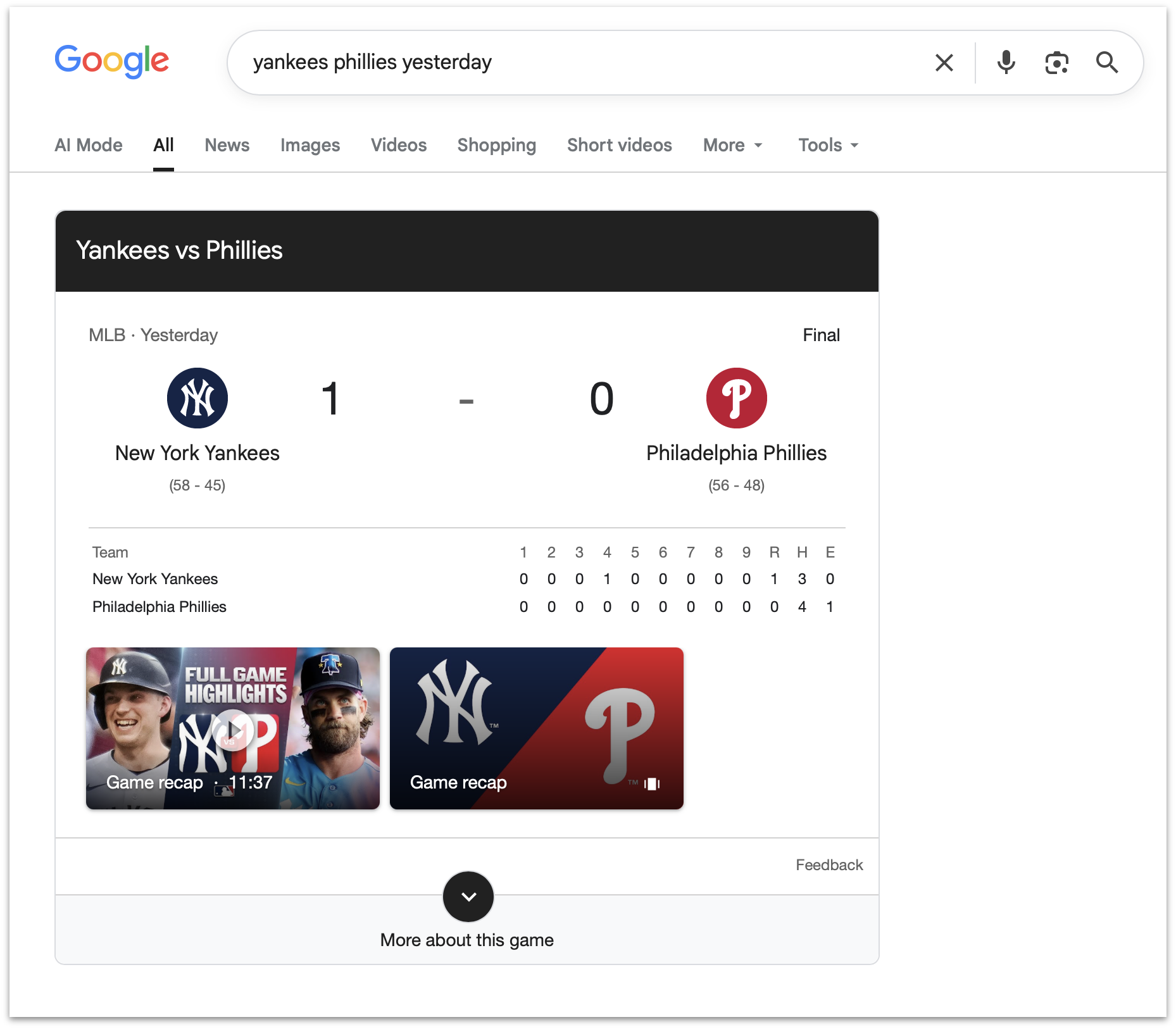
So if you search for the score of a sporting event, it’s illegal in the EU for Google to show you the score, like this search I just tried. What the EC is saying is that because Google Search is so popular, it’s no longer allowed to improve.
It drives me insane when in Europe the link between Google Search and Google Maps is broken and I often have to copy paste an address between the two. Thanks EU, what if I like Google’s integrations?
They could have simply added a selector when a user first clicks on the maps preview in the search result, and then remembered it on device or across that user’s account.
But of course, then the user could choose a competitor’s product and Google would have to honor it. That would be horrible, so instead they just made the user experience worse for everyone and elegantly made people blame the EU.
Back in 2018, Google was handed a record-setting 4.34 billion-euro ($4.9 billion) fine in Europe for abusing its monopoly on Android. The company has spent the intervening years challenging that decision, but the continent’s highest court has put a stop to that. The Court of Justice of the European Union has affirmed the penalty, meaning Google is out of options.
[…]
The EU took issue with Google search and Chrome being the default options on Android. Even devices made by other companies, such as Samsung and Xiaomi, include Google apps as the default per the Android licensing agreement, giving Google an unfair advantage, according to European antitrust regulators. This is not to be confused with a 2.95 billion euro ($3.45 billion) fine against Google’s advertising monopoly issued by the European Union last year.
There’s never a reason not to string the appeal process out, but it’s especially true when your profits are growing at an exceptional rate. By growing their profits around 5×, they’ve reduced the relative sting of this fine by 5×
I ceppi batterici resistenti hanno progressivamente reso inefficaci molti antibiotici di ultima istanza, modificando le proprie pareti cellulari per impedire l'azione dei farmaci. Un team di ricerca guidato dal chimico John Moses del Cold Spring Harbor Laboratory, in collaborazione con Howard Hang di Scripps Research, ha sviluppato una strategia alternativa: anziché progettare nuove molecole antibiotiche, i ricercatori hanno mirato a disattivare i meccanismi di difesa dei patogeni. Il bersaglio dello studio è l'enzima secreted antigen A (SagA), un'idrolasi utilizzata dal batterio Enterococcus faecium per modellare la propria parete cellulare e nascondere i punti d'attacco del farmaco. Sfruttando la tecnica di sintesi chimica Diversity Oriented Clicking, il gruppo ha identificato la molecola pghi-4, capace di inibire l'enzima SagA. La somministrazione combinata di pghi-4 e vancomicina ha permesso di ridurre fino a otto volte la dose di antibiotico necessaria per eliminare i ceppi resistenti nei test di laboratorio, dimostrando un'efficacia confermata anche su modelli animali. L'approccio apre la strada al recupero di molecole farmacologiche storiche per contrastare le infezioni ospedaliere e altre patologie complesse.

 Login