Humans Can Learn To Echolocate In Just 10 Weeks, and It Rewires the Brain
Read more of this story at Slashdot.
A possible “exosatellite” has been discovered 73 light years away. Bizarrely, it is roughly the size of Jupiter and orbiting a failed star called a brown dwarf, which in turn is orbiting the red dwarf star CD-35 2722.
This huge alien “moon” was found by the Very Large Telescope’s CRIRES+ spectroscopic instrument, which measured the Doppler shift in the brown dwarf’s light as the exosatellite gravitationally tugged on it. This is the same method used to discover the first known exoplanet around a Sun-like star, namely 51 Pegasi b, in 1995.
Only a handful of exosatellite candidates have been discovered thus far, with none being particularly convincing. This newly detected satellite, reported in Nature, is possibly the best of the bunch. The brown dwarf, known as CD-35 2722b, has a mass about 37 times greater than Jupiter and its exosatellite has a minimum mass of 90% that of Jupiter.
Planetary mass objects around brown dwarfs have been discovered before. Take the example of 2M1207b, which is an object up to six times more massive than Jupiter orbiting a brown dwarf, discovered in 2005 by the Very Large Telescope. Such objects have not been referred to previously as moons or satellites, so why now?
“This system is meaningfully different from 2M1207 because of the mass ratios and separations involved in CD-35 2722,” says Kevin Hoy, a PhD candidate at the European Southern Observatory and the Instituto de Estudios Astrofísicos in Chile, who led the discovery.
Whereas 2M1207b is approximately a quarter of the mass of its host brown dwarf and on a very wide orbit, possibly as long as 20,000 years, CD-35 2722b’s satellite has about 2.5% of the mass of its host brown dwarf and is on a much closer 170-day orbit.
There’s also the hierarchy of the system to consider. In the 2M1207 system, the brown dwarf doesn’t orbit anything, but in CD-35 2722 the brown dwarf is on a 5000-year-long orbit around its companion star. The candidate exosatellite therefore orbits something that orbits a star, just as a given moon in our Solar System orbits a planet that orbits a star. Since our Solar System has nothing like this brown dwarf–satellite combination, the language that we use to describe such objects is seemingly inadequate.
Mary Anne Limbach of the University of Michigan, who was not involved in this study, agrees that our nomenclature is increasingly ill-suited to the bizarre objects that we are discovering beyond our Solar System.
“Most people in the astronomical community would probably hesitate to call this an exomoon,” she tells Physics World. “But I think ‘exosatellite’ is appropriate. The field needs language for companions that do not neatly fit into the traditional categories of planets and moons, and ‘satellite’ seems to be the broader term that the field is gravitating towards.”
Definitions are important, adds Limbach, because they allow us to distinguish between how otherwise similar objects formed.
The moons in our Solar System formed from debris discs encircling their parent planets. Material in the discs clumped together, forming cores that were then able to sweep up the remainder of the material. Astronomers refer to this as core accretion formation.
“If I had to put money on it, I would doubt that the CD-35 2722b satellite formed via core accretion for several reasons,” says Hoy. These reasons include the size of the disc required to build such a massive satellite, the speed with which it would have done so (it is only 150 million years old) and its eccentric orbit. Moons born in situ around their parent typically adopt a more circular orbit.
Instead, Hoy suspects that the brown dwarf and its satellite collapsed directly out of a gas cloud in much the same way that stars do. “That would be my best guess,” he says.
The formation mechanism makes all the difference to Limbach, who opines that, “an object can reasonably be called a moon if it formed through a process analogous to the formation of the moons around the Solar System’s planets.”
Limbach cautions that since we only know the satellite’s minimum mass, we cannot yet rule out this being a binary system of two brown dwarfs. Either way, Limbach sees the system as being close to that of a binary giant planet. Our understanding of how giant planetary bodies and low-mass brown dwarfs form tells us that binary giant planets should be rare, “but the first emerging examples hint that they may not be,” says Limbach. These include about 40 pairs of rogue binary giant planets, called Jupiter Mass Binary Objects (JuMBOs), found by the James Webb Space Telescope in the Orion Nebula’s Trapezium star cluster.
Another unanswered question is how far down does CD-35 2722’s hierarchy go? Could the exosatellite have moons of its own?
“I think it’s definitely possible,” says Hoy, so long as they are on tight orbits so that gravitational tides cannot destabilize them. “Unfortunately such an object is likely impossible to detect with our current methods.”
However, our current methods could soon learn that CD-35 2722 is just the tip of the iceberg.
“Looking at directly imaged planets and brown dwarfs is the most likely way to yield more exosatellites,” says Hoy, while also citing astrometry (looking for deviations in the motion of a star through space) and microlensing (where the gravity of an otherwise unseen exosatellite creates a temporary gravitational lens) as key techniques that could bring dividends.
Meanwhile, it is hoped that the European Space Agency’s PLATO mission, which will discover exoplanets via transits, will detect significantly large terrestrial moons once the mission launches at the beginning of 2027. All in all, we could be on the cusp of a new era of exomoon and exosatellite discovery.
The post Discovery of giant ‘exosatellite’ challenges our notion of what makes a moon appeared first on Physics World.

Sugars are a vital ingredient in the recipe for life, responsible for a range of biological processes and a key component of nucleic acids such as DNA and RNA. The question of how these essential biomolecules were produced on primitive Earth is a pressing concern for origin-of-life researchers, with laboratory experiments suggesting that primordial conditions would not yield sufficient quantities.
In a study led by Izaskun Jiménez-Serra at the Centro de Astrobiología (CAB, CSIC-INTA) in Spain, researchers have observed a four-carbon sugar, erythrulose, in the interstellar medium for the first time. Such sugar could have contributed to the resources available for early biological processes, providing insight into how life began on Earth.
Based on studies of asteroid samples, researchers suggest that key building blocks for life may have had an extraterrestrial origin. Previous analysis of samples from the asteroid Bennu has demonstrated the presence of the sugar glucose, a primary energy source for biological processes, and ribose, a sugar that contributes to the development of nucleic acids.
The idea is that meteorites and comets containing these important chemical components impacted Earth and contributed to the resources available to develop life. This latest research looks backwards in this process to question whether these molecules may have formed in the clouds of dust and gas that parent these astronomical bodies.
Detailed in Nature Astronomy, this first observation of sugar in the interstellar medium suggests that the ingredients for life may indeed form in dust clouds as previously proposed.
To detect these molecules, Jiménez-Serra and colleagues used the Yebes 40 m and IRAM 30 m telescopes in Spain. Ultrasensitive, broadband spectral surveys allowed them to identify the signature of erythrulose inside G+0.693−0.027, a cloud of gas close to the centre of the Milky Way.
The team had to overcome various challenges, including the spectral signatures of different molecules overlapping and blending into one another. To ensure the validity of their observations, they identified over 180 molecular species to better understand any possible interference with the emission of erythrulose. This extensive characterization allowed the researchers to obtain very high levels of confidence in their observations, they say.
The team also analysed how the erythrulose may have been formed in the extreme low temperatures and vacuum conditions of interstellar space. The abundance of erythrulose is eight times that of three-carbon sugars which are currently undetected by these incredibly sensitive observations. This led the team to model the formation of erythrulose from simpler and more readily available two-carbon aldehydes and alcohols – a process that occurs on the surface of grains of dust in space, with the potential to then contribute to chemical systems on Earth.
On Earth, erythrulose is found in fruits such as melons and raspberries. In aqueous environments, such as bodies of water on Earth, erythrulose easily changes its configuration into the sugar threose. Similar to ribose in RNA, threose appears in threose nucleic acid (TNA). One of the simplest nucleic acids, TNA may be one of the first involved in the early development of life.
According to Jiménez-Serra: “The discovery of erythrulose in the interstellar medium opens up the possibility for these key organic compounds to form in other molecular clouds in the Galaxy where stars and planets are forming”.
The team’s future plans include searching for larger sugars such as the five-carbon ribose found in RNA. “By combining astronomical observations with laboratory experiments and theoretical calculations, we will explore the chemistry of these sugars and of their related compounds, which could have played a key role in the origin of life,” shared Jiménez-Serra.
The work is being completed as part of the ERC consolidator grant OPENS. This highly interdisciplinary project draws from a range of research methods and scientific fields to approach the question of how life begun on earth. By continuing this research, the team hopes to learn more about the very earliest stage of our journey on this planet.
The post Scientists discover sugar in interstellar space appeared first on Physics World.
Fancy some more? Check out our puzzles page.
The post Quiz of the week: what makes strange metals so strange? appeared first on Physics World.
How did you get on?
9 words Warming up nicely
13 words Getting hot, hot, hot
17 words Top dog!
Fancy some more? Check out our puzzles page.
The post Word flower puzzle no. 6 appeared first on Physics World.
Fancy some more? Check out our puzzles page.
The post Quiz of the week: what techniques can be combined to predict the frequency of extreme weather events? appeared first on Physics World.
Fancy some more? Check out our puzzles page.
The post Quiz of the week: what are researchers using to detect the motion of silent whales? appeared first on Physics World.
“The most beautiful thing we can experience is the mysterious,” wrote Albert Einstein. “It is the source of all true art and science.” It is a reminder that wonder – particularly in the natural world – lies at the heart of both disciplines. When it comes to an issue as multifaceted and emotive as climate change, it feels only natural to turn to art as well as science to make sense of what is happening around us.
The latest episode of Physics World Stories brings together two artists doing exactly that. Host Andrew Glester speaks first with Tom Bailey, a performance and environmental artist from Bristol-based creative company Mechanimal. Bailey has recently returned from an extraordinary 600 kilometre journey through the Arctic borderlands — spanning Norway, Finland and Sweden — travelling by ski, sledge, foot and boat, and occasionally dressed as a reindeer.

Travelling between festival performances, Bailey immersed himself in a region undergoing dramatic change: shifting weather patterns, transforming landscapes, and growing international interest in its mineral resources, raising urgent questions about governance and access. Central to his vision is a “more-than-human” perspective, advocating for nature to have formal representation in international decision-making, not merely as a resource to be managed, but as a presence with its own legitimate interests.
Composer Naomi Hart approaches the crisis from a different angle. After a conversation with her daughter about fears for the future left her saddened but resolute, she channelled that emotion into Save Progress – a short video game exploring how human connection can help us to think about the world and the choices ahead. In the podcast, Hart talks about her creative choices; the game combines an intentionally old-school design with specially composed synthesizer music. Save Progress takes around 10 minutes to play: give it a try.
The post Beyond the data: art meets climate at the edge of the world appeared first on Physics World.
Fancy some more? Check out our puzzles page.
The post Quiz of the week: how do scientists hope to protect Earth from dangerous solar storms? appeared first on Physics World.
If you enjoyed this demon crossword, why not discover more about the use of demons to help us understand scientific concepts.
The post A demon of a puzzle: interactive cryptic crossword appeared first on Physics World.
Fancy some more? Check out our puzzles page.
The post Quiz of the week: what’s the secret to the Venus flytrap’s swift closure? appeared first on Physics World.
Here’s how the game works:
If you want the answer, read the article here.
Fancy some more? Check out our puzzles page.
The post Word wave puzzle no.5 appeared first on Physics World.
Soviet Scientific Institutes
By Eric Lusito
Photos of research facilities in the former Soviet Union and its satellite nations might not seem the most promising subject matter for a coffee-table book. But French photographer Eric Lusito has done just that with Soviet Scientific Institutes, which contains more than 150 pictures from his travels across the former Soviet bloc. Unable to travel to Russia, Azerbaijan and Belarus, images from what Lusito calls the “authoritarian remnants” of the Soviet Union are absent. However, his photos across eight other countries depict the downfall of many once vibrant labs, from a rusty cosmic-ray telescope in Armenia to a defunct nuclear reactor in Georgia. The grim reality stands in contrast to the colourful 1970s mosaics in a Ukrainian cybernetics institute that seemed to herald a utopian future. Matin Durrani
Meet the Neighbours: Life on Mars and How to Find It
By Steven A Benner
In 1976 Viking 1 achieved two remarkable things: it performed the first successful landing on Mars and it sent home evidence for life on the red planet. Yet shortly after, Mars was again declared dead and for decades any scientist who suggested otherwise was ostracized. What happened? This is the story that astrobiochemist Steven Benner traces in his book Meet the Neighbours. He clearly explains the science and history, but most of all the machinations and philosophy of how science works. The work is a little polemical and very US-focused, but also extremely enlightening. Kate Gardner
Amazing Worlds of Science Fiction and Science Fact
By Keith Cooper
Fans of the British TV show Doctor Who might recall the 10th Doctor visiting the stunning and terrifying planet “Midnight” – a diamond-encrusted place, bathed in extreme radiation, replete with a “sapphire waterfall”. While some aspects of this fictional world will remain in the realms of fantasy, as of 2011 astronomers believe that the supermassive exoplanet 55 Cancri Ae orbits so close to its parent star that it is indeed bathed in extreme radiation. And it is mainly made up of carbon, in the form of diamond and graphite. This is a perfect example of the symbiotic relationship that science fiction and fact can have with one another, as Keith Cooper outlines in his fascinating book Amazing Worlds of Science Fiction and Science Fact. From the many “strange new worlds” of Star Trek to the Dyson spheres of Ringworld and beyond, this book is a must for “hard sci-fi” aficionados and astronomers alike. Tushna Commissariat
An Anthology of Stargazing: a Collection of Constellations and Other Wonders in the Sky
By Abigail Beall, illustrated by Angela Rizza and Dilbag Singh
While the target audience of children will likely be immediately attracted to its beautiful cover and gold-edged pages, what makes An Anthology of Stargazing special is journalist Abigail Beall’s clear explanations alongside the artistic talents of Angela Rizza and Dilbag Singh. Despite covering everything from the history of stargazing and careers in the field, to the life of a star and the celestial sphere, Beall manages to tread that fine line of being informative while not losing the attention of young readers. There is a page devoted to each of the 88 recognized constellations, providing details on when and where you can see them, and a diagram of their configurations. These are accompanied by illustrations of the animals, people and objects astronomers saw in the patterns, and snippets of their myths and legends, helping the next generation of stargazers see the stories in the sky. Sarah Tesh
Hum
By Helen Phillips
A mother loses her job to AI, so to make some cash she agrees to have her appearance altered to fool face-recognition technology. With this money she takes her family on a trip of a lifetime to the Botanical Garden – the only place to glimpse nature in their arid, dirty city. A treat only for the well-off, the children are amazed to see trees, swim in waterfalls and encounter wildlife. Hum by Helen Phillips has just won the Climate Fiction Prize 2026 for its view of a harsh world where nature is something you have to pay to see – but perhaps its real power is in Phillips’ portrayal of the future of day-to-day technology. This fabulous book will leave you with a lot to think about. It will likely make you put down your phone, too. Kyla Rushman
The post Soviet institutes, Martian neighbours, Whovian science, stellar patterns and dystopian predictions: micro reviews of recent books appeared first on Physics World.
Thanks to new “transit” observations of the hot Jupiter exoplanet WASP-94A b using the James Webb Space Telescope (JWST), researchers at Johns Hopkins University in the US have discovered a striking weather pattern on this distant world. Their work could help provide a clearer picture of the atmospheres on exoplanets, which has been very limited until now.
When an exoplanet passes in front of (or transits) its host star, some of the light from that star passes through the planet’s atmosphere. By detecting this light using telescopes, either ground-based or in space, astronomers are able to obtain the exoplanet’s atmospheric light spectrum.
A team led by Sagnick Mukherjee and David Sing has now analysed data on WASP-94A b from the space-based JWST and have found that the mornings on this exoplanet are extremely cloudy – with water absorption features in the spectrum – while its evenings are very clear. Clouds likely form on the planet’s colder, permanent nightside where temperatures are low enough for minerals to condense. Winds then carry those clouds towards the morning limb (the leading edge of the atmosphere), explains Mukherjee.
“As these cloud particles are dragged farther toward the hotter dayside, the clouds evaporate or sink deeper, leaving the evening side much clearer,” he says. “This is a clear discovery of a planet-wide cloud cycle in action on a distant exoplanet.”
The researchers, who detail their findings in Science, decided to study WASP-94A b as part of a broader survey of exoplanet atmospheres with the JWST called the “Grand Tour Program”. The goal of this project, says Mukherjee, is to better understand the composition of these exoplanets and the physical processes at play in their atmospheres.
One of the main difficulties encountered during such observations is how small the signals that we are trying to look at are, he explains. However, in this case, the asymmetry between the morning and evening side of the planet was rather dramatic, which made it possible to separately probe the two.
Until now, researchers only had access to a single averaged spectrum of WASP-94A b – and indeed most other exoplanets studied over the last decade –from observations made by the Hubble telescope, for example. The chemical composition of the exoplanet’s atmosphere was therefore highly biased, says Mukherjee, and it was thought that the levels of oxygen and carbon there were hundreds of times higher than on the Sun. “This finding baffled us because this result could not be explained by planet formation theories. The new data show that WASP-94A b only contains only about five times as much oxygen and carbon.”
“Being able to resolve the cloudy morning and clear evening separately therefore gives us a much cleaner view of what the atmosphere is actually made of,” Mukherjee tells Physics World. “And this is not just relevant to hot-Jupiters like WASP-94A b, but might be extended to all exoplanet atmospheres that we are trying to understand using the transit method.”
For Mukherjee, this is one of the most exciting aspects of the JWST era. “We are taking a step beyond simply detecting the atmospheres of distant planets and are now beginning to map their weather, chemistry, and three-dimensional structure in extraordinary detail.”
Indeed, using WASP-94A b as a benchmark, the Johns Hopkins team has already studied eight other hot gas giants and discovered the same distinctive cloud cycle on two other worlds: WASP-39 b and WASP-17 b. “Inspired by these observations, our collaboration, co-led by David Sing, myself and our colleague Guangwei Fu, is about to receive more than 180 hours of new JWST data to understand weather on diverse exoplanets and measure how their weather and cloud-coverage vary with planet temperature and gravity,” reveals Mukherjee.
The post Asymmetric weather pattern reveals exoplanet’s true atmosphere appeared first on Physics World.
Fancy some more? Check out our puzzles page.
The post Quiz of the week: the last major galactic merger of the Milky Way created what feature? appeared first on Physics World.
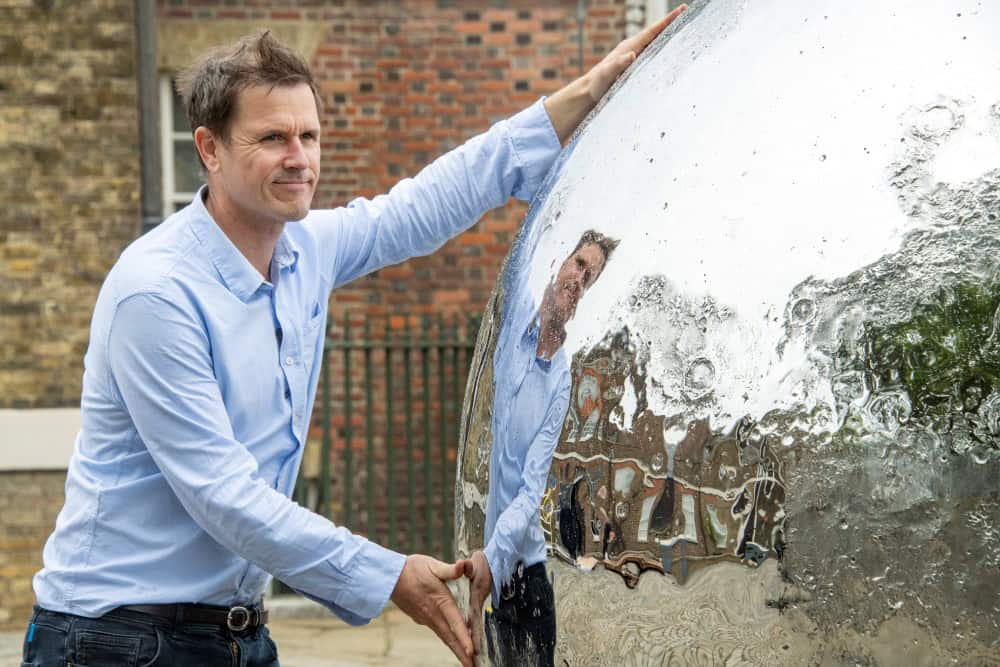
A spectacular new lunar art installation has been installed at the Royal Observatory Greenwich.
Dubbed Mirror Moon it has been created by British artist Luke Jerram and is open for public display today at the observatory.
The artwork is 2 m in diameter and is made of stainless steel. It uses accurate topographic data collected from NASA missions to map the features of the Moon onto the mirrored steel surface.
This includes craters, valleys, mountains and smooth lava fields as well as details from the heavily cratered far side of the Moon.
The installation opens as the NASA Artemis crewed missions foster a renewed interest in the Moon. A crewed lunar landing – Artemis IV – is currently set for 2028.
The Royal Observatory Greenwich is the home of Greenwich Mean Time and the Prime Meridian, and since its founding in 1675 astronomers have used the observatory to study the Moon.

Jerram is best known for his large-scale public engagement artworks including Museum of the Moon and the Earth artwork Gaia, both of which have been displayed internationally.
Jerram says that the observatory has been an “inspiration” for his work as an artist.
“I hope Mirror Moon will inspire generations of visitors to have an interest in contemporary science, art and the wonder of the night’s sky,” he adds.
To mark the installation, Royal Museums Greenwich are selling 20 limited-edition mini versions of the artwork for £2000 each.
Each one is hand signed and numbered by Jerram and includes a presentation box, bespoke display stand and certificate of authenticity.
The post Stunning Moon sculpture unveiled at Royal Observatory Greenwich appeared first on Physics World.
Researchers at the Polytechnic University of Hauts-de-France have used fractal mathematics to create a new non-invasive method that can distinguish genuine artworks from forgeries (Surf. Topogr.: Metrol. Prop. 14 025016).
Art forgery is a growing problem worldwide and traditional authentication of an artwork relies on expert opinion, historical research, pigment analysis and digital techniques.
While these approaches can be effective, they are also resource‑intensive and can sometimes still be inconclusive.
The new technique works by capturing the subtle patterns created by an artist’s brushwork – patterns so consistent that they act like a morphological signature unique to that particular artist.
By converting high-resolution images of the artwork into 3D‑like topological maps the researchers created a microscopic “texture” of a painting, measuring how rough or detailed the surface is using fractal dimensions – a mathematical ratio that measures how densely a fractal shape occupies space as it scales.
The fractal dimensions are calculated for the whole artwork as well as for selected homogeneous areas that are representative of brushwork.
“Fractal analysis gives us a measurable fingerprint of an artist’s brushwork without needing to sample or disturb the painting,” notes lead researcher Francois Berkmans.
The researchers tested the fractal method on works attributed to the Dutch painter Vincent van Gogh finding that the well‑documented fake The Plowmen was a strong outlier compared to other works while the recently authenticated Sunset at Montmajour aligned closely with Van Gogh’s known painting.
Using eight works for each artist, the approach also successfully separated the stylistic signatures of Van Gogh with that of the 17th‑century painter David Klöcker Ehrenstrah.
The researchers say that the technology can improve authentication, especially when combined with other techniques such as chemical analysis.
“This approach won’t replace traditional expertise, but it significantly strengthens it,” adds Berkmans. “Our results show that our technique can clearly point out genuine artists and reliable detect known forgeries.”
The post Fractal maths helps distinguish genuine artworks from forgeries appeared first on Physics World.
There are 10 questions in total: blue is your current question and white means unanswered, with green and red being right and wrong.
How well did you do?
0–3 Shambolic performance, didn’t even get past the group stage
4–6 Solid effort, but crumbled in the knock-out rounds
7–9 Great showing, just bottled it when the game went to extra time
10 Congratulations, you’re a World Cup winner!
The post It’s all kicking off: how much do you know about the science of football? appeared first on Physics World.
Fancy some more? Check out our puzzles page.
The post Quiz of the week: new SKA boss Jessica Dempsey did what before becoming an astronomer? appeared first on Physics World.
How did you get on?
12 words Warming up nicely
17 words Getting hot, hot, hot
22 words Top dog!
Fancy some more? Check out our puzzles page.
The post Word flower puzzle no. 5 appeared first on Physics World.