❌

Normal view

'Extremely rare' Roman military camp found in Slovakia holds hastily buried remains of Marcus Aurelius' soldiers — with some dumped in wells

Archaeologists in Slovakia have uncovered a large Roman military camp likely used by Marcus Aurelius' troops during conflicts with Germanic tribes in the late second century. The "extremely rare" camp came as a surprise to archaeologists, as it holds the hastily buried remains of numerous soldiers in unusual graves, including wells.

Remains of the 18.2-acre (7.4 hectare) camp were found near the town of Šurany in southwestern Slovakia, according to a translated July 17 statement from MH Invest, which excavated the area along with the Institute of Archaeology at the Slovak Academy of Sciences (SAS).

"We have a unique opportunity to explore practically an entire Roman marching camp, which is extremely rare in the European context," Matej Ruttkay, director of the SAS Institute of Archaeology, said in the statement. "We are clearly investigating a place that disappeared immediately after the military conflict between the Romans and the Germans."

Between A.D. 166 and 180, the Romans fought a series of battles against a Germanic people called the Marcomanni, who lived north of the Danube River along the border of the Roman Empire in what are now Slovakia and the Czech Republic. Marcus Aurelius, who reigned as Roman emperor from 161 to 180, commanded troops in the Marcomannic Wars with the goal of defending and securing Rome's border against barbarian invasions. But the wars ended upon Marcus Aurelius' death, when his son Commodus negotiated a peace with the Marcomanni, according to third-century Roman historian Cassius Dio.

The newly discovered Roman military camp had clear defensive characteristics, including five entrance gates, fortifications, and a curved ditch-and-rampart system typical of marching or legionary camps, according to the statement. The Šurany camp is only the second Roman military installation ever found in western Slovakia; the first camp, discovered in 2024 by SAS archaeologists, is thought to be where Marcus Aurelius wrote part of his Meditations.

The Šurany camp surprised archaeologists with a large number of skeletons — and parts of skeletons — buried in ditches, wells and hastily dug shallow graves, according to the statement.

"Our preliminary findings indicate that in most cases these are Roman soldiers," Marek Vojteček, an archaeologist at the SAS Institute of Archaeology, said in the statement. "Numerous components of Roman military equipment and weaponry were also found with the skeletal remains, such as spears, arrowheads, parts of helmets, segmented and scale armor, legionary brooches, coins, and the characteristic 'caligae' military sandals, from which iron nails on the soles have been preserved," he said.

X-ray analysis of blocks of clay revealed the intact sandal nails, which are now stored at the SAS Institute of Archaeology's specialized laboratory for further analysis. "It is literally a miracle to see the original footwear of a Roman soldier and even to be able to determine its size," Michal Cheben, an archaeologist at the SAS Institute of Archaeology, said in the statement.

The unusual burials raise important questions about the use and abandonment of this Roman military camp, according to Cheben, including whether the soldiers died from combat injuries or disease and why the bodies weren't looted before being thrown into storage pits and wells. "Laboratory analyses and further genetic and anthropological research may provide answers," Cheben said.

Because the camp was so large and the artifacts so numerous, a comprehensive analysis of the site will take several years and will involve international experts in carbon dating, soil analysis, isotopic analysis and ancient DNA, according to the statement.

"This is a long-term process, so many results will only become known in the coming years," Ruttkay said.

From Augustus to Nero, see how much you know about ancient Rome's famous leaders with our Roman emperor quiz!

'Once we were like you': Striking reconstructions reveal the faces of 16 people from Roman-era Hungary

23 July 2026 at 00:17

The face of a young woman crowned with a laurel wreath, buried in elaborate clothing and unusual cork sandals, has appeared nearly 1,700 years after her death.

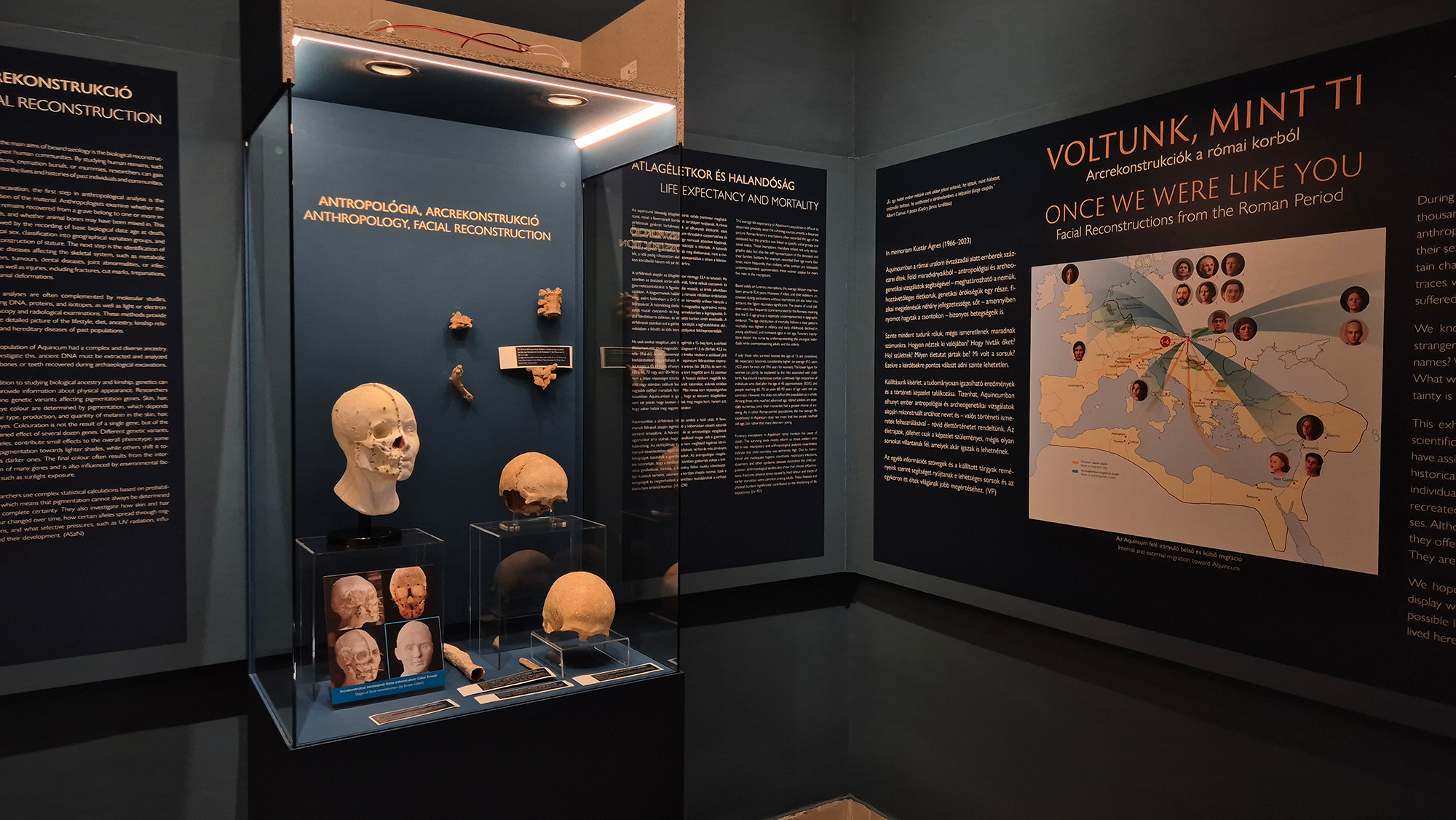
She is one of 16 people from Aquincum, a Roman-era city in present-day Hungary, whose faces have been reconstructed for "Once We Were Like You," a new exhibition at the Aquincum Museum in Budapest. The display pairs skulls excavated in and around the ancient city with scientifically informed approximations of how their owners may have looked in life.

Six of the reconstructions are hyperrealistic silicone models, complete with artificial eyes, human hair, eyebrows, eyelashes and, in some cases, beards. The exhibition, which runs through Oct. 31, includes men, women and a child who lived during the region's period of Roman rule.

"The face is the most important feature for recognizing a person," Emese Gábor, a forensic facial reconstruction specialist who sculpted the silicone faces, told Live Science in an email. Although a skull cannot reveal every detail of a person's appearance, reconstruction lets museum visitors encounter the faces as those of "a real human being rather than as skeletal remains," she said.

A glass display case is seen holding several skulls

The entrance to the "Once We Were Like You" exhibit at the Aquincum Museum in Budapest. (Image credit: Gábor Lakos Aquincum Museum Budapest)

Rebuilding a Roman face

Aquincum stood on the Danube frontier of the Roman Empire in what is now Budapest. The city was home to a diverse population in the first through fourth centuries, and genetic and archaeological analyses of the individuals in the exhibition point to connections with regions including present-day Italy, Scotland and Syria, as well as Sarmatian groups from the Eurasian steppe and Celtic communities that lived in the region before Roman rule.

The remains of those who lived here have also been unearthed, and continue to be discovered today during the excavation of cemeteries," according to a statement from the museum.

Creating a reconstructed face begins with a high-resolution 3D CT scan of the original skull. Specialists then produce an exact 3D-printed replica, allowing experts like Gábor to work without repeatedly handling or disturbing the ancient remains.

"The latest scientific advances — including 3D scanning, CT imaging, archaeogenetic (ancient DNA) analysis and facial approximation research — are incorporated whenever possible," she said.

"If a hyper-realistic reconstruction is required, I create a mould and cast the face in coloured silicone, finishing it with real human hair, eyebrows, eyelashes and, where appropriate, a beard," she said.

A series of images from the exhibit
ARC-heo art-REKO Studio
A series of images from the exhibit
ARC-heo art-REKO Studio
A series of images from the exhibit
ARC-heo art-REKO Studio
A series of images from the exhibit
ARC-heo art-REKO Studio
A series of images from the exhibit
ARC-heo art-REKO Studio

Ancient DNA can sometimes provide additional clues about pigmentation, including probable eye, hair and skin color. But the results are still approximations, not portraits. For instance, hairstyle, expression and many details of the person’s appearance are usually more speculative.

The woman with the laurel wreath

Of all the people she reconstructed, Gábor said she found it especially difficult to forget the woman known as the Jablonka Road mummy.

The woman's skeleton was relatively well preserved, but the soft tissue on her face had decayed, leaving only the skull. A laurel wreath still rested on her head, and, according to Gábor, her burial contained fine clothing, a spindle for weaving, bird-shaped cork sandals and a painted male portrait that had been placed near her feet. Archaeologists have suggested that the portrait may have represented her husband or father, although his identity is unknown.

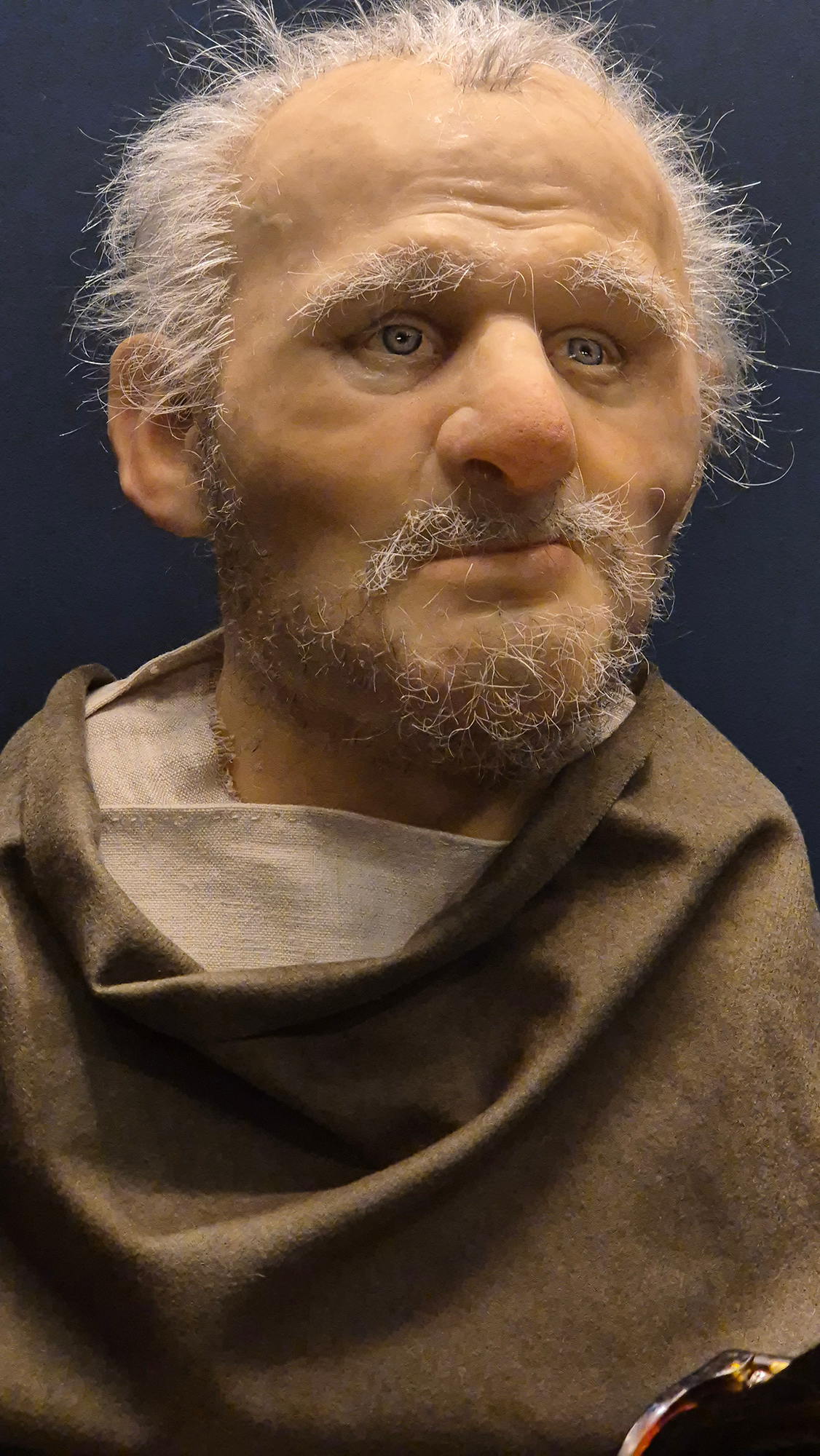
A facial reconstruction of a man with gray hair and a beard wearing brown clothes

The silicon reconstruction of an ancient construction worker. (Image credit: Gábor Lakos Aquincum Museum Budapest)

"Based on these details, the archaeological context and the anthropological data, it was the archaeologists who pieced together her story while I reconstructed her face," Gábor said. "That was very moving."

Other individuals selected for the exhibition include those of a young girl who died in childhood and a woman interpreted as a nurse or healer who was buried in a children's cemetery. Some of the other reconstructions include a construction worker, a military officer and a blacksmith.

Two women appear to have met particularly violent or punitive ends. They were buried face down with their legs bound together, Gábor said. The exhibition's interpretation associates one woman with an accusation of witchcraft and the other with poisons, although such details are historical interpretations rather than evidence-based findings from the burials.

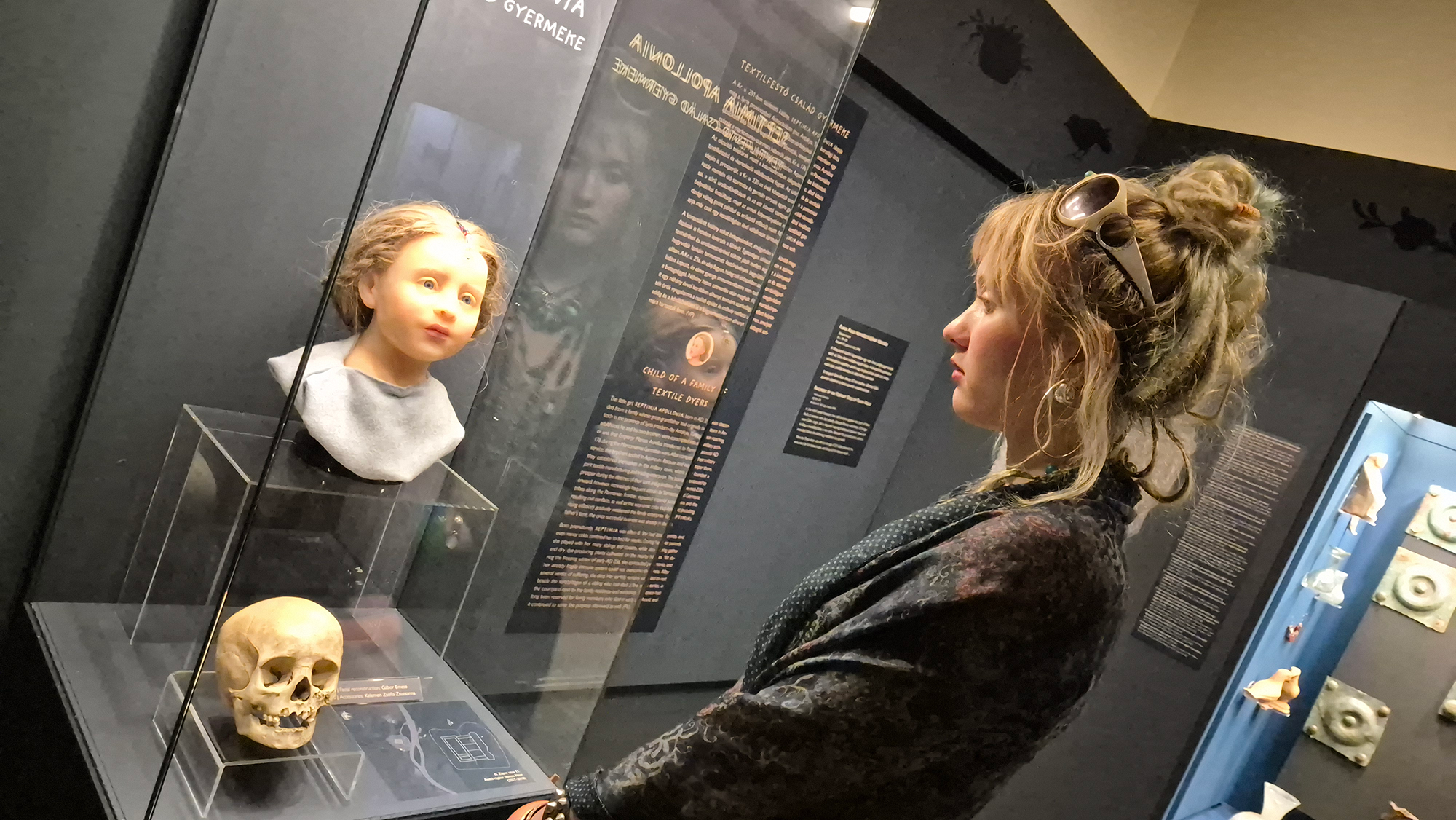
A woman stands in front of a glass display case showing a young face and a skull in front of it

Gábor stands in front of a display showing the reconstructed face of a child from Aquincum. (Image credit: Gábor Lakos Aquincum Museum Budapest)

"Every reconstruction is a journey," Gábor said. "As I shape each face, I find myself reflecting on that person's life again and again, and by the end, they no longer feel like anonymous remains, but like real people."

Analyses of the skeletons suggest that many of the individuals endured strenuous physical labor, periods of hunger and chronic inflammation. This evidence led museum curators to conclude that many represented the less wealthy inhabitants of Roman society — people whose names and experiences were unlikely to appear in surviving written histories.

For Gábor, the physical reconstructions offer something that a digital image cannot: Visitors can stand face-to-face with a life-size person, walk around the model and study it from different angles. Her hope is that this encounter encourages visitors to think beyond the scientific data and imagine the full lives that once surrounded the excavated bones.

"When you see a face, you don't just see bones in a display," Gábor said. "You see a person — someone who was born, who grew up, who worked, who loved, who laughed, who struggled, who fought with challenges, who raised children. Some were sick. Not everyone died of illness. Some died in accidents. Some through violence. And eventually, all of them died. That sense of shared humanity helps spark empathy."

Can you match these historical maps to the empires that ruled them? Test your geography skills with our ancient empires quiz!

❌