❌

Normal view

US models beat China’s Kimi K3 with a 76% score over 32% in cyber benchmarks, tests show

25 July 2026 at 15:38

Despite fears that China could race ahead of the US in AI, a joint UK-US evaluation found that Moonshot AI’s Kimi K3 performs “significantly below” leading American models in offensive cybersecurity capabilities.

The findings address growing concerns in Washington regarding China’s recent advancements in artificial intelligence following the release of Kimi K3, described as China’s most powerful large language model.

The UK Artificial Intelligence Security Institute (UK AISI) and the US Center for AI Standards and Innovation (CAISI) found that Kimi K3 achieved an overall cyber capability score of 32.2%, compared to an average of 76.2% for top, unnamed US models.

Evaluation identifies cybersecurity gap

Researchers tested Kimi K3 using ExploitBench, a public benchmark developed by Carnegie Mellon University that measures an AI system’s ability to develop end-to-end exploits for software vulnerabilities.

According to the evaluation, Kimi K3 “performs significantly below the most recent frontier cyber-capable models” when tasked with developing exploits. The model attained a score of 32 percent, outperforming GLM-5.2, another Chinese open-weight model, which scored 24 percent.

However, Kimi K3 still lagged behind leading US systems. The most cyber-capable US models achieved an average score of 76.2%.

The report also examined whether models could achieve arbitrary code execution (ACE)—a high-severity exploit outcome that allows attackers to take control of a target system. Kimi K3 achieved ACE on none of the 41 ExploitBench tasks, while “the most cyber-capable models achieved ACE on 20/41 samples on average,” according to the UK AISI and CAISI.

Simulated attack shows remaining capabilities

The evaluation also tested Kimi K3 on “The Last Ones” (TLO), a 32-step simulated corporate network attack designed to measure a model’s ability to conduct end-to-end cyber operations autonomously.

Kimi K3 reached step 17 of the attack path on average, compared with the 28.5 steps achieved by the most cyber-capable US models.

Despite this gap, the report noted that Kimi K3 completed the simulated attack in one of 10 attempts. The UK AISI and CAISI said this demonstrated that the model “is capable of autonomously attacking small, weakly defended, and vulnerable enterprise systems, when directed to do so and given initial network access.”

Furthermore, Kimi K3’s safeguards did not prevent it from attempting cyber exploit development or offensive cyber operations during testing.

Although the results were only preliminary, the research noted that Kimi K3’s overall cyber capability score was estimated from a single benchmark, whereas other models were evaluated across a larger number of cyber tasks.

Findings reshape AI competition debate

Kimi K3 has sparked attention, if not concern, following reports of its strong performance on other AI benchmarks. However, these new findings offer a different picture of the model’s cybersecurity capabilities, showing that it still lags behind US systems.

The South China Morning Post reported that the evaluation “offers a stark reality check amid mounting panic in Washington over Beijing’s AI advancements following Moonshot AI’s latest flagship release.”

David Sacks, former White House AI czar and current co-chair of US President Donald Trump’s Council of Advisers on Science and Technology, said the findings suggest that fears over Chinese model supremacy may be exaggerated. He urged policymakers to avoid over-regulating the sector.

“The Kimi Panic needs to stop,” Sacks said in a social media post. “American frontier models are still ahead.”

💾

New UK-US findings show that Moonshot AI’s Kimi K3 still lags behind top US models in cybersecurity threats.

US lab initiative targets 5x faster engineering with next-gen supercomputing

25 July 2026 at 13:37

US firm Rescale, a digital engineering platform that combines AI, simulation, and high-performance computing to help R&D and engineering teams design, test, and bring new products to market faster, has received funding under the Genesis Mission, a national initiative led by the US Department of Energy to build an advanced integrated science discovery platform.

As part of the program, Rescale will join Lawrence Berkeley National Laboratory, Lawrence Livermore National Laboratory, and Oak Ridge National Laboratory as a funded partner in the Agentic HPC Pipeline Initiative (AHPI). 

The initiative aims to use agentic AI on Rescale’s platform to help accelerate the adoption of national laboratory-developed computing tools and simulations by US industry.

Doubling scientific research output with AI and advanced computing

The Genesis Mission is an ambitious initiative aimed at accelerating scientific and technological breakthroughs by combining artificial intelligence, supercomputing, quantum systems, and advanced scientific instruments into a single research platform. 

Established through an executive order in November 2025, the program brings together the department’s 17 national laboratories and around 40,000 scientists and engineers to advance research in areas including energy, scientific discovery, and national security. 

Department officials have compared the scale and ambition of the initiative to landmark US efforts such as the Manhattan Project and the Apollo program, with the goal of doubling the productivity of the country’s scientific research within the next decade.

The US Department of Energy launched the first Genesis Mission funding round earlier this year, awarding $293 million to projects focused on areas including advanced manufacturing, biotechnology, nuclear energy, and quantum science. The program received more than 8,000 applications, making it the department’s largest-ever funding call.

Rescale’s AHPI was selected for Phase I funding to address a key challenge: helping industry access advanced simulation tools developed by US national laboratories that have often required specialized expertise and infrastructure.

Helping manufacturers access advanced AI-powered simulations

The company will work with three US national laboratories to bring agentic AI capabilities to advanced simulation tools. The project will integrate AI agents into WarpX, LiDO, and Adamantine, codes developed by Lawrence Berkeley National Laboratory, Lawrence Livermore National Laboratory, and Oak Ridge National Laboratory.

Using the Rescale platform, AI agents will help engineers choose simulation tools, configure inputs, monitor runs, and analyze results. The initiative aims to reduce the time and specialized expertise needed to use these simulations by more than five times, making advanced research capabilities more accessible to US manufacturers.

According to Rescale CEO Joris Poort, the Genesis Mission highlights the importance of making industrial AI technologies available to leading research and development teams that can apply them in real-world applications.

Building on Rescale’s existing partnership with ORNL’s Manufacturing Demonstration Facility, AHPI addresses a common gap: DOE-industry collaborations run for a fixed term, and once they end, partners keep the insight but lose the tools to act on it. AHPI keeps the resulting agentic workflows, surrogate models, and code environments live on Rescale, letting labs and industry keep collaborating long after a project’s funding ends.

💾

Rescale will help develop advanced digital engineering capabilities as the US expands efforts to use supercomputing in research.

Robot snakes searched for Venezuela earthquake survivors in collapsed buildings

24 July 2026 at 12:20

Robots slithered like snakes into the rubble of collapsed buildings to search for trapped survivors in the aftermath of Venezuela’s double earthquake disaster.

The so-called snake robots represented a unique technological aid for international search and rescue efforts following two earthquakes that struck Venezuela on June 24, killing more than 5,000 people and leaving behind 16,740 injured. Rescuers from around the world used trained dogs, seismic and acoustic listening devices, video cameras on sticks, or thermal imaging cameras to search for signs of survivors—but the snakebots equipped with a video camera could squeeze through tight spaces to search deep within fallen building debris.

“The reason why snake robots are useful is they can get into tightly packed volumes that machinery and people otherwise cannot, and that's important in search and rescue because we were able to extend the visual reach of the rescue workers in a safe way,” Howie Choset, head of the Biorobotics Lab at Carnegie Mellon University in Pittsburgh, told Ars. “In a sense, you're doing minimally invasive surgery on a structure with a snake robot.”

Read full article

Comments

© Carnegie Mellon University

A better future rather than faster robots: 'Sustainable Robotics' as a new academic field

23 July 2026 at 18:40
Professor Sukho Song of the Department of Robotics and Mechatronics Engineering at DGIST has proposed "Sustainability Robotics," a new academic field that evaluates robots not only in terms of their technical performance but also their contributions to environmental, social and economic sustainability.

Meet Phantom Twist, a stealthy new drone that hides in plain sight by tricking your eyes

23 July 2026 at 08:45

Engineers have created a drone that camouflages itself as a faint, hovering haze when it takes flight.

The "Phantom Twist" prototype drone is a carefully engineered robot that utilizes motion blur to hide in plain sight — opening up a new frontier in low-visibility flight. Scientists say it could reshape how drones monitor wildlife, survey ecosystems and inspect infrastructure.

Most stealth drones try to disappear by changing their appearance, using camouflage paint, transparent plastics or complex optical tricks to bend or scatter light. The Phantom Twist takes a fundamentally different approach by exploiting how humans and animals perceive motion.

The scientists who created the drone outlined their findings in a study presented July 16 at the conference Robotics: Science and Systems in Sydney, Australia.

"Most efforts to hide drones focus on making them look like their surroundings," said first author of the study Michael Rubenstein, associate professor of computing and mechanical engineering at Northwestern University, in a statement. "Instead, we asked whether we could design the drone itself around the way humans perceive motion.”

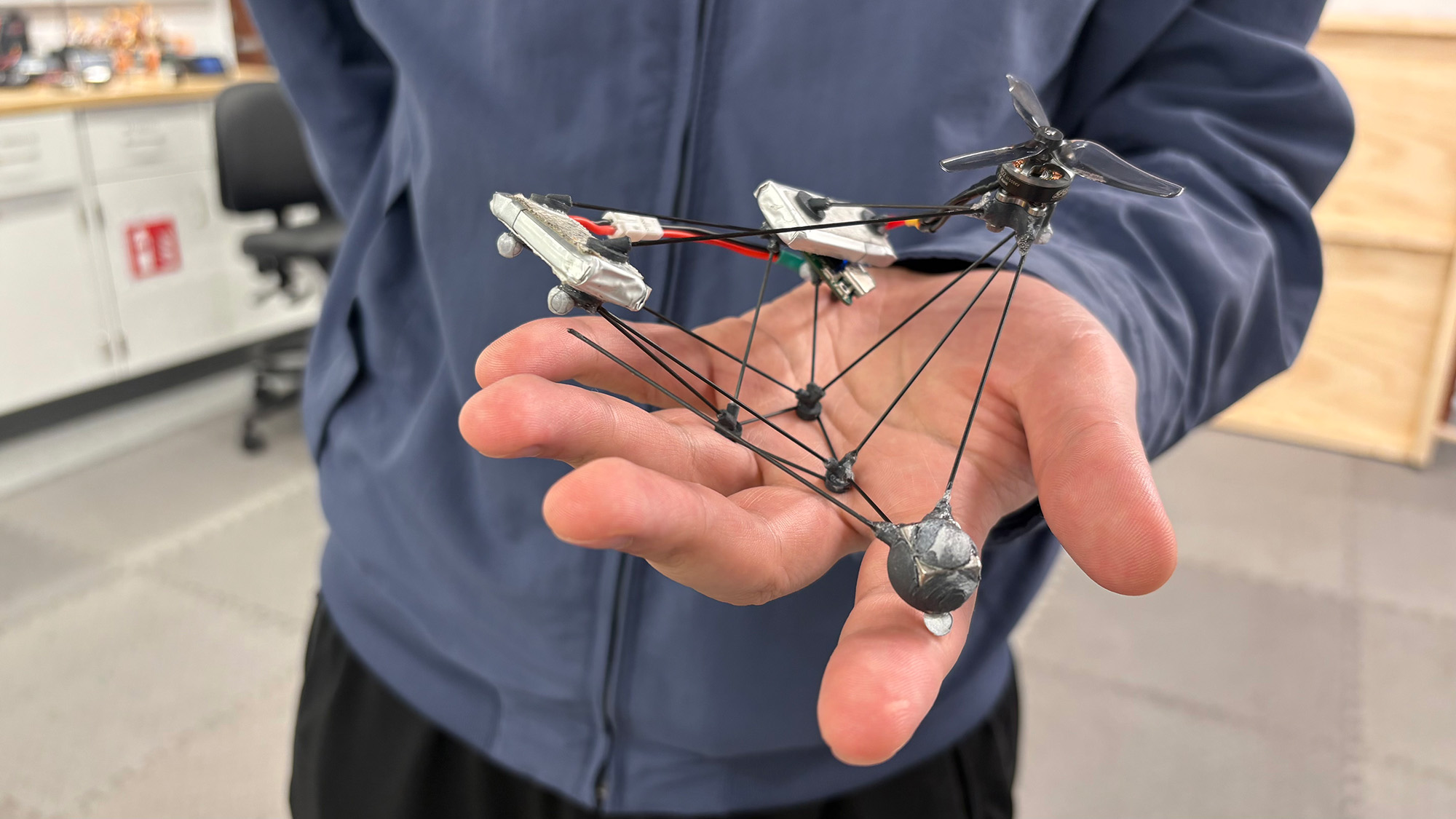
A small metal drone sits in the palm of a man's hand

(Image credit: Michael Rubenstein/Northwestern University)

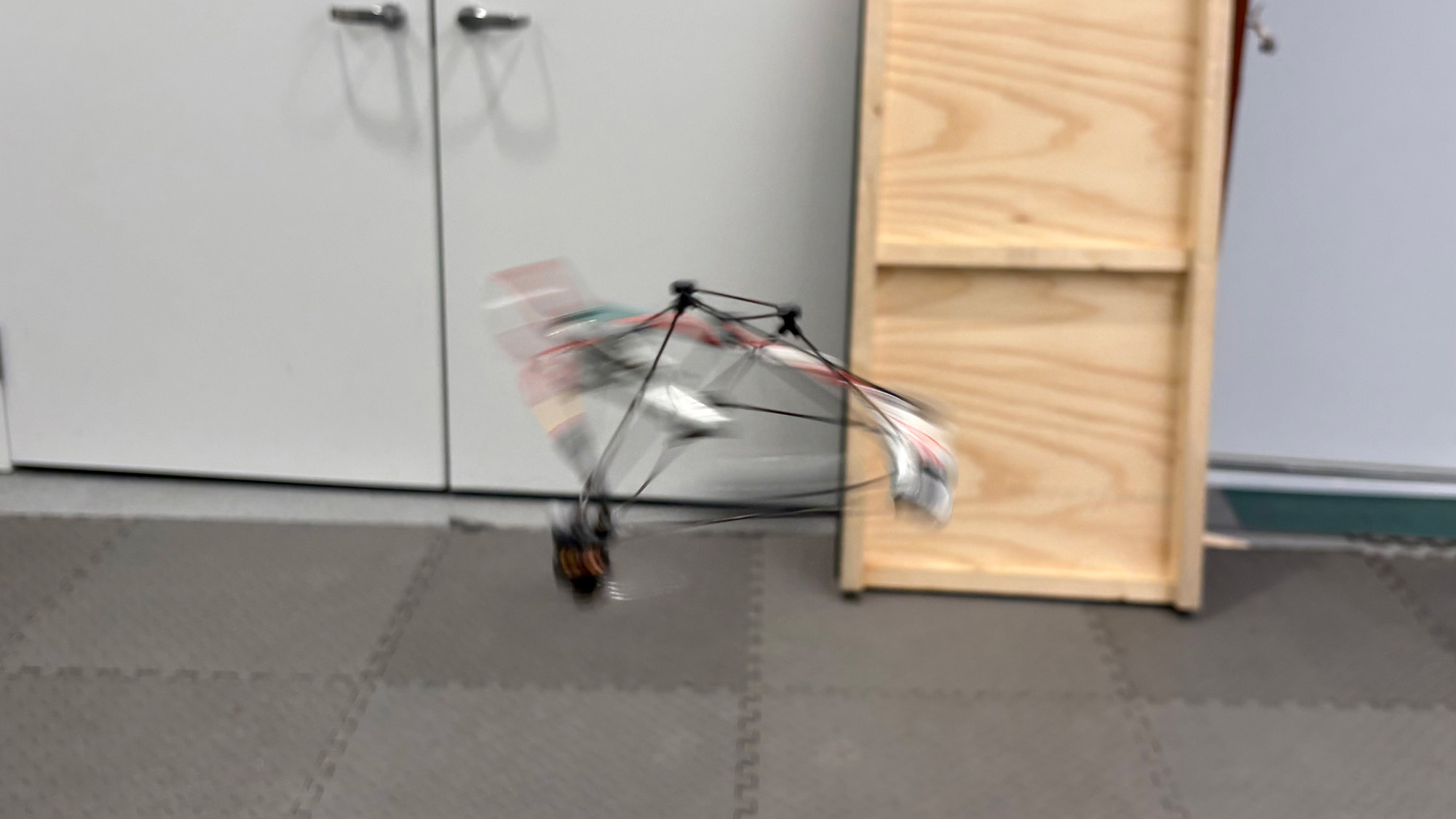
The result is a machine that behaves more like a spinning fan than a conventional quadcopter. Typical drones have four rotors spinning around a largely stationary body, so your eye can lock onto the frame even as the propellers blur.

Phantom Twist strips this idea down to a single motor and single propeller. The propeller spins one way while the entire body counter‑rotates in the opposite direction with no stationary parts to visually latch on to — spinning 25 times per second, which is too fast for the human eye to resolve clearly.

A drone spins in the middle of a large room

(Image credit: Michael Rubenstein/Northwestern University)

It's about 10 times less visually perceptible than a conventional quadcopter, the scientists said. In practice, that means observers don’t see a crisp flying machine but a translucent smudge, with its few opaque components blending into a haze.

To get there, the team assigned algorithms to explore thousands of designs. First, they used a computational model to automatically generate about 20,000 drone configurations that could fly stably, at least in theory. Each configuration shuffled a motor, propeller, batteries, circuit board and counterweight into different positions.

Then artificial intelligence (AI) and optimization tools took over, iteratively rearranging those pieces to minimize how visible each design would be from almost any viewing angle — all while respecting the constraints of aerodynamic stability.

The researchers simulated each candidate spinning in midair and composited the images over 100 different real-world backgrounds, from skies to trees to buildings.

To determine the stealthiest designs, they applied a perception model that approximated human vision, with drones that better blended into their surroundings earning a lower visibility score. From there, the team selected the 500 lowest-scoring designs and ran their optimization loop again, squeezing out further decreases in visibility. When the team was confident in the design of a particular drone, they built it.

A drone spins over a green leafy plant

(Image credit: Michael Rubenstein/Northwestern University)

The final Phantom Twist isn’t a compact block of hardware; it’s deliberately spread out in three dimensions. Components sit at different heights and angles, with empty space between them, so that when the drone spins, the parts don’t visually overlap into a solid silhouette.

That geometry matters because of the way our eyes process images.

"The human eye takes time to accumulate signals, roughly analogous to the exposure time of a camera," said computer vision expert and co-author of the study Emma Alexander. When something spins fast enough, distinct edges smear together, and we perceive a blur instead of a shape.

The researchers' initial uses for the stealthy drones include monitoring nesting birds without startling them, surveying wetlands without scattering flocks of waterbirds, and inspecting aging infrastructure without altering human behavior, they said.

For now, Phantom Twist isn’t a perfect "ghost." The spinning propeller still generates a significant amount of noise and the spider‑web of thin wires and support rods remains partially visible. Rubenstein and his colleagues said in the study they’re already thinking about next-generation iterations that swap in more transparent materials and quieter propulsion systems.

We’re Admittedly Terrified That They’ve Now Invented Invisible Drones

21 July 2026 at 17:50

We can think of no possible way that a newly invented invisible drone can be used nefariously.

Rather than relying on camouflage, the flying gizmo created by researchers at Northwestern University exploits the motion blur effect in our fallible human vision to almost disappear by spinning at an absurd 25 times per second.

This is too quick for us and many animals to see clearly, becoming a gossamer smear that blends into the background, like the way the blades of a helicopter do, only more extreme. 

One day, this type of design could be used for completely peaceful pursuits, the researchers say — like observing wildlife, of course.

“Most efforts to hide drones focus on making them look like their surroundings,” Michael Rubenstein, an associate professor of computer science and mechanical engineering at Northwestern who led the research, said in a statement about the work.

“Instead, we asked whether we could design the drone itself around the way humans perceive motion,” he added. “This idea of low visibility through persistent motion is something few people have explored.”

To create the drone, dubbed “Phantom Twist,” the team used a computational model to churn out around 20,000 different drone designs, then used AI and optimization algorithms to repeatedly rearrange how its major parts, like their motor and propeller, were configured. 

Then they took the best configurations and used a model that simulates human perception to quantify how visible each design appeared. The least visible designs were chosen to be further rearranged with the optimization algorithm, until landing on the blurriest candidate of them all. 

“The design process was fully automated,” Rubenstein said. “Then, when we were confident that a drone met all our criteria, we built it.”

Their research, detailed in a paper awaiting peer review, was presented at the Robotics: Science and Systems 2026 conference in Sydney this month.

It’s not the first spinning drone, but it is the first that’s been optimized to be effectively invisible to the human eye. Its major components are carefully spaced enough from each other to never become a distinct shape when viewed from any angle while spinning — all while being capable of stable flight.

According to the researcher’s visibility model, this allows the Phantom Twist to be about ten times less visually perceptible than a conventional quadcopter drone. Impressive footage certainly bears this out: after the drone gets up to full speed, it almost looks like the ghost of a tiny UFO.

The drone is quite noisy, however. If something like it is going to be used to observe wildlife one day, it’ll have to be vastly quieter. Until then, if these faint apparitions are ever turned on humans, at least we’ll be able to hear them coming.

More on robots: Autonomous Robots Confirmed to Have Killed Human Soldiers

The post We’re Admittedly Terrified That They’ve Now Invented Invisible Drones appeared first on Futurism.

❌