Torna in promo, con uno sconto al check-out, il Google Pixel 10 Pro XL. Il modello è ora disponibile con un prezzo ridotto a 899 euro e con anche la possibilità di pagare in 12 rate mensili senza interessi, per tutti gli utenti abilitati a questo tipo di acquisti.
Si tratta di un'opportunità da cogliere al volo: i nuovi Pixel 11 stanno arrivando e potrebbero registrare un rincaro nel prezzo di listino. Il futuro 11 Pro XL, quindi, sarà disponibile con un prezzo sensibilmente superiore a quello dell'attuale 10 Pro XL.
Per sfruttare la promo basta premere sul box qui di sotto.
Un internaute a découvert qu’un satellite de télécommunication Starlink de SpaceX est passé devant un satellite d’imagerie de la surface Terre pendant qu’il survolait le Texas. L’image a été retrouvée sur Google Earth. Que nous dit cet événement pas si anodin que cela ?
Na declaração, Trump prometeu reverter as penalidades financeiras aplicadas às empresas estadunidenses sancionando tarifas contra a UE. Ele também aproveitou a oportunidade para alfinetar o ex-presidente do país, Joe Biden:
A União Europeia atacou de novo e, como de costume, mirou diretamente nas GRANDES empresas americanas! Depois de multar a Apple, sem motivo aparente, em US$15 bilhões, a Meta em US$3 bilhões, a Amazon em US$2,5 bilhões, e muitas outras, nós acabamos de ser informados que o Google, um grupo fantástico e realmente avançado, acabou de receber outra multa de US$1 bilhão, sem explicação. Isso leva o total do Google para mais de US$18 bilhões!
Essa prática ilegal e altamente discriminatória começou nesses níveis elevados durante o primeiro ano da administração do dorminhoco Joe Biden, mas não continuará durante a administração Trump.
Os Estados Unidos da América não são um “COFRINHO” da Europa, e nós não vamos permitir que sejam!
Que esta VERDADE sirva para representar que vamos iniciar imediatamente uma investigação da Seção 301 1Lei americana de comércio que investiga práticas tributárias ou sanções injustas de outros países contra os EUA. sobre essa prática de “ROUBAR” empresas americanas e, por consequência, o contribuinte americano.
A União Europeia vai pagar caro por essa conduta ilegal e altamente antiética, sobre a qual venho alertando-os de maneira consistente. As penalidades serão inteiramente revertidas e, como esperamos, TARIFAS substanciais serão aplicadas contra eles assim que possível. Fiquem ligados!
Presidente DONALD J. TRUMP
Não é a primeira vez que o mandatário dos EUA critica a maneira como a UE penaliza as empresas americanas: em 2025, ainda recém-empossado, ele não apenas criticou essas práticas, como alegou que as multas eram, na verdade, pretextos para uma retaliação tributária e “injusta”.
Vale lembrar que o segundo mandato de Trump foi endossado de maneira reputacional e monetária por praticamente todas as empresas citadas na declaração — especialmente o CEO 2Chief executive officer, ou diretor executivo. da Apple, Tim Cook, que ajudou a financiar a cerimônia de inauguração do seu governo.
As fears of a bursting AI bubble reach new heights, Google has emerged as arguably one of the best yard sticks available to measure investor sentiment around AI.
Google’s parent company, Alphabet, released its quarterly earnings report on Wednesday. On the surface, there were plenty of reasons to pop the champagne: as the New York Times reported, the company’s profits rose to a staggering $112 billion, four times higher than the nearly $25 billion in profit over the same period last year.
Yet underlying that banner profit is a familiar beast: the same circular financial motions that gave rise to the AI bubble narrative in the first place.
As the NYT observes, the vast majority of Google’s windfall — $99 billion, to be exact — wasn’t due to actual revenue from AI or any other services the company offers; instead, it was due to Alphabet’s mammoth investments in other tech companies. In particular, Alphabet attributed the massive profits to investments in corporations also chasing the AI payday, like Elon Musk’s SpaceX, as well as Anthropic, the company behind the popular chatbot Claude.
In other words, it’s great financial news — until the instant the AI market crashes, in which case it would all come crashing down. (In an earnings statement, Alphabet CEO Sundar Pichai enthused that Google’s “AI investments are redefining what’s possible across every part of our business.”)
Under that green surface froth is a churning sea of red. In addition to those starry revenue numbers, Google upped its anticipated 2026 capital expenditures from $180 to $190 billion — already staggering numbers — to an eye-watering $195 to $205 billion. The argument, in a nutshell, is that it needs to spend much more to break out of the computing bottleneck, which will unlock even higher profits next year.
As Gizmodo observed, Alphabet’s chief financial officer Anat Ashkenazi told investors to expect that figure to “increase significantly in 2027.”
At the same time, Alphabet posted a negative free cash flow for the first time as a publicly traded company, meaning the actual cash it generated after covering operating expenses and capital expenditures is worse than nil.
That revised forecast, coupled with the bone-dry cash flow, left investors shellshocked. On Thursday, the day after the company’s earnings report hit newsrooms, Alphabet’s stock fell by 6.89 percent — evidence, perhaps, that massive profits on paper are no longer enough to keep investors hooked at this stage of the AI bubble.
A court has dismissed Google’s case against SerpApi over that company’s scraping of search results to train AI models.
The US District Court for the Northern District of California found that there was no indication that any copyright had been breached.
Google announced in December that it was suing SerpApI for its alleged web scraping, claiming that it was protecting copyright holders. In February, SerpApI fought back and asked the court to dismiss Google’s case. And this week, Judge Yvonne Gonzalez Rogers agreed with SerpApi that Google’s case has no merit.
Google’s argument was that SerpApi’s actions breached the US Digital Millennium Copyright Act (DCMA). It made two claims: first, that no person shall circumvent a technological measure that effectively controls access to a work protected under this title, and second that no person shall manufacture, import, offer to the public, provide, or otherwise traffic in any technology, product, service, device, or component protected by the Act.
SerpApi claimed that the URLs and other links that were being served by Google did not in themselves entail copyright and the judge agreed. In her judgment, she said that there was no indication that the copyright holders had authorized Google to take action against SerpApi.
The case is not completely over as the judge has given Google 21 days to amend its complaint to demonstrate that it was acting on behalf of the copyright owners. It remains to be seen whether its war against the web scrapers is finally over.
The European Commission has fined Google a total of €890 million ($1 billion) for its breaches of the Digital Market Act (DMA).
Just over half the fine — €460 million — was because Google illegally gave preference to its own services in Google Search results.
The remainder was because in the Google Play store for Android apps, the company prevented app developers from leading consumers to alternative, often cheaper, purchase channels. Under the DMA, app developers who distribute their apps via Google Play or Apple’s App Store should be able to inform customers of alternative offers.
Now Google must give third-party services featuring in its results the same treatment as its own services, and allow developers of apps in the Play Store to communicate about offers both in and outside the Play Store, or face further fines.
Publishers have watched in horror as Google continues to double down on AI features that discourage users from actually clicking on links — a once-steady source of readership that’s causing a crisis in the media now that the search engine is cutting it off.
The situation has become so dire that some publications are now debating whether to cut Google off entirely, as the Wall Street Journal reports, illustrating an increasingly fraught relationship between the tech giant and the publishers that are creating content its AI models are regurgitating.
According to the newspaper, prominent outlets including USA Today, Politico, the Economist, People, and Reuters are all reexamining their relationship with Google. Some are debating whether to continue to work with the tech giant at all.
“This is existential for some categories of publishers,” media consulting firm media consulting firm DJB Strategies CEO David Buttle told the WSJ. “They are looking at more radical things.”
Even Reddit executives are reevaluating the company’s $60 million-a-year contract that allows Google to train its AI models on user-submitted content on the platform. They’ve similarly watched as Google’s AI features discourage users from navigating to Reddit.
Last month, Cloudflare CEO Matthew Prince noticed that automated bot traffic had overtaken human traffic for the first time in the internet’s history, a sobering turning point and concerning inflection point for anyone in the attention economy.
USA Today has seen its traffic from US users drop by almost half over the last year, leading executives to ponder whether to cut off Google’s access entirely.
“It’s time to take a stand and say enough is enough,” USA Today CEO Mike Reed told the WSJ.
Naturally, Google doesn’t see itself as the one to blame, arguing that it’s still sending “billions of clicks to the web every week” and helping “creators and publishers grow their audiences” with the help of AI, as a spokesperson told the newspaper.
Those reassurances, however, are seemingly falling on deaf ears. Beyond pondering whether to cut Google off, other publishers have resorted to suing the company, accusing it of illegally rehashing their intellectual property via AI summaries.
It’s an extremely undesirable position for publishers. By severing ties with the search giant, they could face even steeper declines in traffic. At the same time, there’s seemingly little to gain from having Google’s AIs crawl their content — and in the long term, it could guarantee their destruction.
In some ways, Google is biting the hand that feeds it. AI companies are desperately trying to find new training data that doesn’t include AI-generated slop. By actively discouraging users from visiting websites that source new information, the company is cutting off a fresh supply of the data it so desperately needs.
Google was today fined €890 million ($1 billion) by the European Union for breaching antitrust rules with regard to its search and Google Play store services.
The European Commission found that Google had broken the Digital Markets Act (DMA) by using its dominant position in the search market to favour its own services, like shopping and hotel deals, over those of rivals.
The Commission also said that the company had abused its position by preventing developers from directing users to cheaper ways to buy apps and app subscriptions on websites and alternative app stores.
The Commission noted that Google has begun testing changes to how its own services are placed in search results and rolled out changes to its steering terms, which the EU’s main executive body described as substantial progress towards compliance.
“Google has fallen short of effective compliance with the Digital Markets Act, and today we have taken decisive yet balanced enforcement action sanctioning these breaches,” said Teresa Ribera, Executive Vice-President for Clean, Just and Competitive Transition.
“The best products should succeed because they’re better, not because they’re owned by the company running the search engine. And European consumers have a right to be told by app developers where to sign up to the best offers, even when the app store owner does not get a cut.”
With search, Google is required to share with competitors — search engines and AI chatbots alike — a massive amount of user data from Google Search user interactions. What terms people search for, what they click on in results, what languages and devices they use. It’s all ostensibly anonymized but that’s tricky when it comes to search terms. A lot of the terms people type into web search fields are to some degree personally identifying. The EC seems to be saying it’s Google’s problem to filter out things like passwords and usernames and omit them from the shared datasets. Google can charge money for this access, but only under “fair, reasonable, and non-discriminatory (FRAND)” prices, based on a Commission-defined methodology.
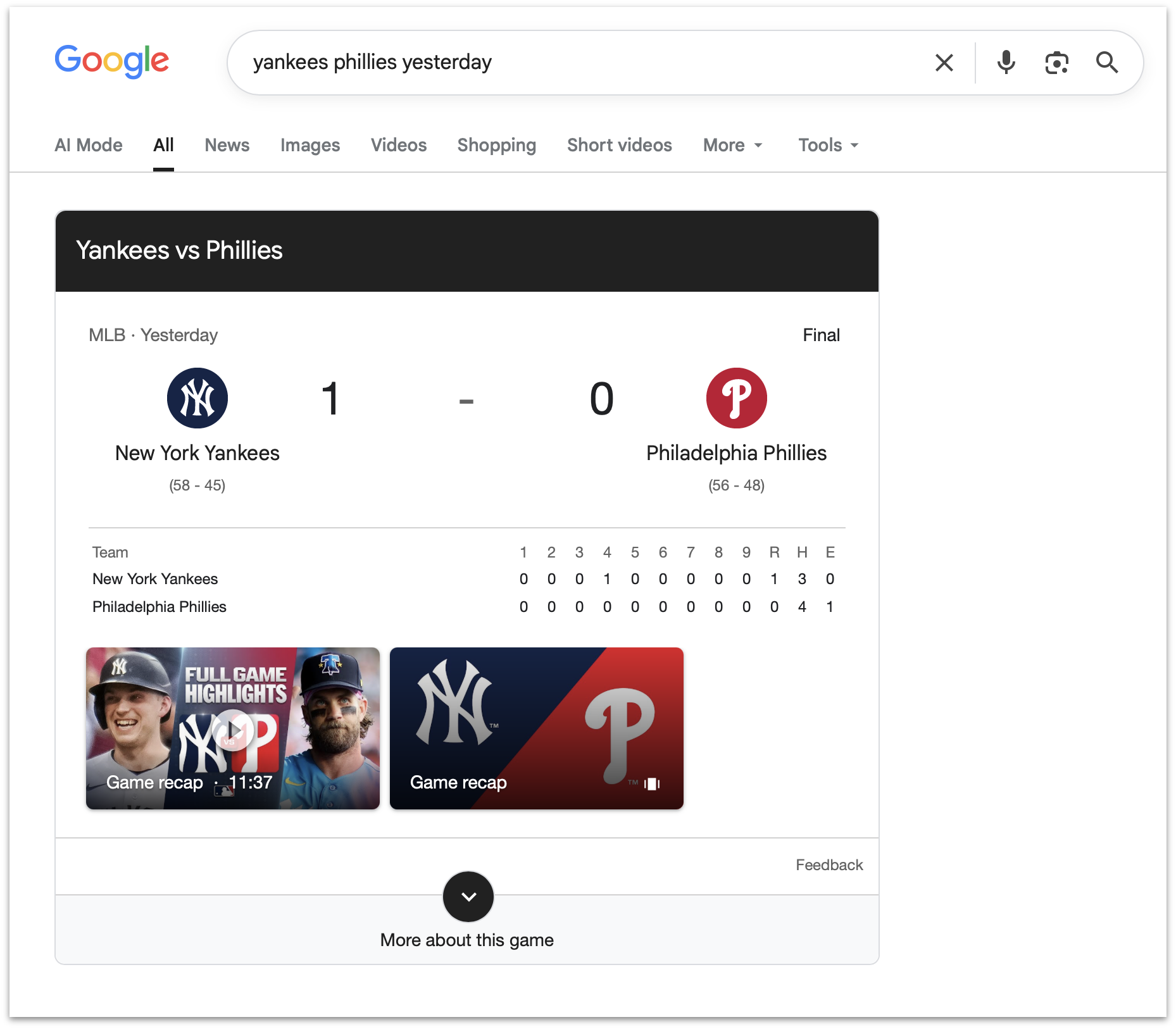
So if you search for the score of a sporting event, it’s illegal in the EU for Google to show you the score, like this search I just tried. What the EC is saying is that because Google Search is so popular, it’s no longer allowed to improve.
It drives me insane when in Europe the link between Google Search and Google Maps is broken and I often have to copy paste an address between the two. Thanks EU, what if I like Google’s integrations?
They could have simply added a selector when a user first clicks on the maps preview in the search result, and then remembered it on device or across that user’s account.
But of course, then the user could choose a competitor’s product and Google would have to honor it. That would be horrible, so instead they just made the user experience worse for everyone and elegantly made people blame the EU.
Back in 2018, Google was handed a record-setting 4.34 billion-euro ($4.9 billion) fine in Europe for abusing its monopoly on Android. The company has spent the intervening years challenging that decision, but the continent’s highest court has put a stop to that. The Court of Justice of the European Union has affirmed the penalty, meaning Google is out of options.
[…]
The EU took issue with Google search and Chrome being the default options on Android. Even devices made by other companies, such as Samsung and Xiaomi, include Google apps as the default per the Android licensing agreement, giving Google an unfair advantage, according to European antitrust regulators. This is not to be confused with a 2.95 billion euro ($3.45 billion) fine against Google’s advertising monopoly issued by the European Union last year.
There’s never a reason not to string the appeal process out, but it’s especially true when your profits are growing at an exceptional rate. By growing their profits around 5×, they’ve reduced the relative sting of this fine by 5×
Getting locked out of an account is no fun. Google has a few ways to help you regain access if you happen to forget your password or lose an authenticator, including recovery contacts and backup codes. Now, Google has a completely new option: your face. You can now give Google a video record of your face and sign into your account with a selfie, which sounds like something people are going to just love.
You will have to set this feature up ahead of time if you want the option of regaining account access with a selfie later on. To get started, verify your account type is supported. You won't be able to configure selfie sign-ins for Workspace accounts, child accounts, or any account enrolled in Google's Advanced Protection Program.
Configuring selfie sign-in requires you to record a video, which Google will store on its servers. Google's selfie sign-in landing page includes the typical disclaimers about privacy and data access, promising that the company will keep the video encrypted and won't use it for any other purposes unless you opt in.
A corrida da IA está a sair cara à casa-mãe da Google e o "peso" dos gastos com infraestruturas já se faz sentir nas contas da gigante tecnológica, levantando preocupação junto dos investidores.
Google CEO Sundar Pichai has sought to allay concerns over the delayed release of the Gemini 3.5 Pro large language model. He dodged questions about it in Google’s quarterly earnings call on Wednesday by focusing on the company’s next frontier AI model, Gemini 4, and plans to release subsequent LLMs at an almost monthly cadence.
His comments came a day after Google unveiled Gemini 3.6 Flash and 3.5 Flash Cyber but offered no update on the release of Gemini 3.5 Pro, the company’s delayed flagship reasoning model that many developers had expected to arrive weeks earlier.
Google introduced the Gemini 3.5 family at its annual I/O conference, promising to release the Pro model in June. That timeline has since slipped, with Bloomberg suggesting Gemini 3.5 Pro is months late because the model’s coding performance is falling short of internal expectations, especially when compared to better performance by similar models from OpenAI and Anthropic.
Instead of revisiting the Gemini 3.5 Pro timeline, Pichai used the earnings call to shift the discussion toward Gemini 4, when asked about how his company planned to navigate an increasingly competitive race to release frontier AI models by to Barclays Investment Bank analyst Ross Sandler.
“We are creating a baseline on top of which you will see us rapidly iterate on subsequent model releases. And so picking up pace and releasing models almost at a monthly cadence is part of our road map as we are building Gemini 4 as well,” Pichai said during the call.
Sandler’s question followed one from JPMorgan Chase & Co analyst Douglas Anmuth, who asked Pichai if Google was releasing frontier AI models frequently enough to keep pace with rivals OpenAI and Anthropic.
Pichai had responded to Anmuth’s question that Google remained confident of competing at the frontier and was investing heavily in a larger Gemini 4 base model.
Analysts, though, aren’t as confident as Pichai.
While delays to Google’s frontier model roadmap have not triggered an exodus of existing customers, either because of high switching costs or because many enterprises already running multi-model architectures, they have made CIOs evaluating AI platforms more cautious about making new commitments, said Bhupendra Chopra, chief revenue officer at IT consulting firm Kanerika.
A monthly model release cadence could prove to be a double-edged sword for enterprises and their CIOs.
While a monthly release cadence could help enterprises gain faster access to improvements in model performance, cost and capabilities, it will also require CIOs to invest more heavily in testing, governance and version management to safely adopt those updates, said Sanchit Vir Gogia, chief analyst at Greyhound Research.
Similarly, Pareekh Jain, principal analyst at Pareekh Consulting, said enterprises will embrace a faster release cadence only if each successive model delivers measurable improvements in performance, cost or safety, rather than simply changing version number.
The challenge for CIOs, Jain said, is not just keeping up with model releases; it’s deciding whether each new version is worth the cost of validating it.
Alphabet CEO Sundar Pichai (pictured) rejected concerns Google is losing ground in the AI race after delays to the Gemini 3.5 Pro model, as the company posted a strong second quarter on booming demand for AI and cloud services.
Speaking on the company’s Q2 earnings call, Pichai acknowledged Google needed to improve in areas including AI coding, but said it remained “very committed and very confident of being at the frontier”.
The chief faced repeated questions over whether Gemini could keep pace with rivals in the AI race after Google delayed the launch of its next advanced model in June. He said Google is “committed to being at the full parade of frontier,” offering models at multiple price points including its more affordable Flash models.
Pichai argued “the frontier is an incredibly dynamic space, and it’s fiercely moving forward”, stressing “there are many attributes on which we are still at the frontier”.
He pointed to Gemini 3.6 Flash, released this week, explaining it improved by more than 10 points on a coding benchmark over its predecessor while using fewer tokens. He also revealed the company has begun training Gemini 4, describing it as its “most ambitious pre-training run yet”.
Once Gemini 4 lands, he added the company plans on “picking up pace and releasing models almost at a monthly cadence”.
Strong demand In Q2 2026, Alphabet pinpointed Google Cloud, which continued to benefit from enterprise demand for AI infrastructure and services.
Revenue from the unit soared 82% to $24.8 billion and operating income more than tripled to $8.8 billion. Google Services revenue increased 15% to $94.5 billion, driven by a 17% spike in Search, 15% in Google subscriptions, platforms and devices, and a 13% rise in YouTube advertising.
Total revenue rose 24% year-on-year to $119.8 billion, Alphabet’s 12th consecutive quarter of double-digit growth.
Net income surged 298% to $112.1 billion, as it benefitted from a net gain of $98 billion on equity securities. It did not disclose further information, but the company is known to have a sizeable stake in SpaceX and has investment in Anthropic.
“Our AI investments are redefining what’s possible across every part of our business,” Pichai explained, adding ballooning demand for AI infrastructure and enterprise AI solutions helped drive the results.
The search giant also continued ramping AI investment, expecting to spend between $195 billion and $205 billion in capital expenditure this year, up from its previous forecast of $180 billion to $190 billion.
“We have increased our capacity quite significantly over the past three years. The demand still outpaces that investment,” explained Alphabet CFO Anat Ashkenazi, adding that although “we’re still in a supply constraint environment”, the company is “seeing very strong demand, both from external cloud customers as well as across the business”.
Looking ahead, the company added it expects capex to “increase significantly” in 2027 as AI demand swells.
Para quem deseja mudar do ecossistema iPhone para Android, a Google facilita o processo com uma nova ferramenta nativa disponível na mais recente versão do sistema operativo.
Firm told to treat third-party services that appear in its results in ‘fair and non-discriminatory manner’
Google has been fined a total of €890m (£760m) by the EU for breaches of online competition laws by its search and app store services.
The European Commission, the EU’s executive arm, said Google had broken the Digital Markets Act by giving priority to its own services, such as shopping and hotel deals, in search results over those of its rivals.
Google upgraded iPhone migration options with a service built directly into Android 17 aimed at simplifying the switch, a release timed to coincide with the unveiling of Samsung’s Z Series at its Galaxy Unpacked event.
The search giant expanded the range of data which can be wirelessly transferred from an iPhone without downloading a separate migration app.
In addition to “photos, videos, contacts, messages and calendar”, the latest method covers a user’s “Google Account, passwords, Wi-Fi credentials” and eSIM profile.
By simplifying onboarding and broadening the compatible data types, Google aims to lower the barriers to switching smartphone ecosystems to attract more iPhone users to Android.
Google commenced deployment of the feature on select Pixel devices and it is also available on the Samsung Galaxy Z Flip8 and Z Fold8 ranges unveiled at Galaxy Unpacked.
The company plans to expand the migration method to more Android devices in future.
Here in this high-tech era of 2026, keeping important info backed up and synced should be effortless and something that just happens on its own, automatically, without any actual thought or ongoing human effort.
In many areas of our digital life, that mercifully does Just Work™ in exactly that way. Fire up an email in most modern mail services, and you can stop at any point and find your in-progress draft in that same app on any other device. The same applies to any file you’re finessing within Google Drive or other cloud storage services or document you’re dawdling over in Docs.
One area where seamless syncing somehow still doesn’t occur, though, is in the domain of downloaded documents on Android. If someone sends you a PDF or a Word file and you save it to your phone, that file exists in an archaic-seeming silo — only locally, on that one gadget. And that, of course, means (a) you can’t access it from any other device, and (b) if you misplace your phone or move into a new one at some point along the way, the file will be left behind in time and entirely unavailable.
Well, take a moment to join me in celebration: Amidst all the Gemini gobbledegook that no one asked for (and that often falls somewhere between “pointless” and “actively counterproductive”), Google’s giving us a major upgrade to Android’s backup capabilities right now. It’s a simple-seeming switch buried in your system settings, and it’s up to you to find and activate it.
Once you do, though, those once-orphaned documents on your Android device’s local storage will be perpetually synced and protected, automatically, without any ongoing thought or effort.
All you’ve gotta do is find and flip that one new switch.
So, for a quick bit of pertinent context on this: Android’s backup systems have actually come a really long way over the years.
‘Twas a time, y’see, when little to nothing about you would sync and carry over automatically from one Android device to another. Years ago — back in the ancient-seeming prehistoric era of the early 2010s — Android enthusiasts in the know would rely on community-created third-party apps for everything from remembering and resyncing downloaded apps to restoring data from within those apps and onward. And reconfiguring your system preferences would be a whole time-consuming song and dance every single time you reset a device or moved into a new one, as little to nothing would automatically carry over.
Most of that stuff is now effortless and automatic. And, thanks to apps like Google Messages, Calendar, Drive, and Docs, many other areas of important data are also synced on their own at the app level — outside of any system mechanisms.
Locally stored files, however, have remained an awkward omission. To this day, anything you download on any Android device exists only on thatone device and isn’t synced or backed up anywhere. The only way that happens is — in a blast-from-the-past twist — if you go out of your way to find and set up a third-party app to handle the heavy lifting.
That brings us to today. Right now, as we speak, Google’s in the midst of sending out a quiet under-the-hood update that (brace yourself…) adds in the option to automatically sync and back up any documents on your device as a native part of Android’s backup setup.
See?
The easily overlooked new option for backing up documents on Android.
JR Raphael, Foundry
The option is on its way to all devices running 2018’s Android 9 release and higher. (If you’re still using a phone with an Android version older than that, you’re now a whopping eight years out of date, and you have much bigger problems.)
Once the added option is present and available for you, you’re literally lookin’ at 10 seconds to find and activate it.
Lemme show ya how.
Android’s document backup addition
I promise: This couldn’t be much simpler.
No matter what kind of Android device is in front of you, just head into your system settings and open the section called “Accounts and backup,” “Back up or copy data,” or something along those same lines. (The exact wording can vary based on who made your device and when it was released or last updated.)
Either tap the line labeled “Google Backup” or look for an option to “Back up data” via Google Drive. You should then either see a series of options for different areas of available backup right then and there — or, depending on your device, you might have to tap a line labeled “Other device data” (or something similar) to find the full list of possibilities.
However you get there, once you’re lookin’ at that list, you’ll see a newly added line for “Documents” if this latest under-the-hood update has reached you.
Android’s expanded list of backup options — now including documents alongside other forms of on-device data.
JR Raphael, Foundry
And from there, all that’s left is to tap it and enable the switch to include that in your automated backups from that moment forward.
If you aren’t seeing the option yet, don’t panic. Google always sends these under-the-hood updates out bit by bit over time, so the change probably just hasn’t reached your device quite yet. As long as you’re running Android 9 or higher, it’ll get there. Set yourself a reminder to check back once a week or so. Odds are, you’ll see it pretty soon.
Notably, all documents synced in this way are always encrypted for security, and they’re kept in your personal (or, depending on the nature of your account, perhaps company-connected) Google Drive storage. That does mean they’ll count against your overall Google storage total, so keep an eye on your Drive storage total to make sure you’re in solid shape and look to the Google One storage hub if you ever want some simple suggestions for freeing up space.
Speaking of other Google services: If you ever want to keep other types of locally stored non-document files from an Android device synced and available elsewhere, you can easily rely on Google Photos for syncing screenshots and other images — after enabling sync in general, be sure to look in the app’s “Collections” areas to find the “On this device” folder and then flip the toggle to “Backup all device folders” (or get more nuanced and open specific individual on-device folders if you want to sync some but not all of those areas) — and you can still turn to those aforementioned third-party apps for broader syncing of anything else imaginable.
But with documents now being handled automatically and natively, that’s one big worry now out of your hair. Just note that the onus will fall on you to find and flip the switch and actively opt in to the feature on each and every Android device you’re using.
Take 10 seconds to do that, though, and you’ll have one less void in your Android data arena. And you don’t need Gemini to tell you that that can only be a good thing.
Get practical Android knowledge in your inbox every Friday with my free Android Intelligence newsletter— one new thing to try each week, straight from me to you.
As smoke from hundreds of burning wildfires spread across Canada and the United States, the first three operational satellites in the Google-backed FireSat program successfully launched into orbit. The satellites will begin providing wildfire detection capable of spotting even small fires in the United States, Australia, and Europe before the end of the year.
The launch of the microsatellites aboard a SpaceX Falcon 9 rocket from Vandenberg Space Force Base in California on July 7, 2026 marks a transition to “initial operational capability” for the FireSat constellation managed by the nonprofit Earth Fire Alliance. After a three-month testing period, the three satellites will begin actively providing data to fire agencies while covering every fire-prone region on Earth at least twice per day.
FireSat represents the first satellite constellation purpose-built for detecting wildfires, including spotting smaller fires that other satellites may miss. The satellites were designed by California-based satellite manufacturer Muon Space and have received over $15 million from Google to support initial deployment. Other notable financial supporters include the Bezos Earth Fund that committed $26 million.

 Login