❌

Normal view

The Wackers’ Decades-Long Harassment Was One of Unsolved Mysteries’ Strangest Cases—New Information Has Finally Come to Light

25 July 2026 at 13:01

For the last 22 years, one of the most bizarre true crime stories ever to grace the program Unsolved Mysteries has confounded amateur investigators and spawned hundreds of pages of online speculation. Who was behind the decade-long torment of Bill and Dorthy Wacker in the 80s and 90s, which included allegations of stalking, robberies, and even assaults?

While any internet true crime enthusiast knows Unsolved Mysteries frequently left out interesting details that can create a rabbit hole of alternative explanations, in this case, the show has been the sole source of information, with no other known period news coverage of the harassment.

That is, until recently, when this author acquired the original police records, spanning almost 100 pages of material, while researching for my podcast, Cease to Exist. The records reveal a wealth of new information, including potential leads on suspects, and answers to questions true crime fans have speculated about for years.

Wackers
The Wackers claimed to be victims of a long-term harassment campaign. Credit: Film Rise/Unsolved Mysteries

Unsolved Mysteries

In the Unsolved Mysteries season 6 two-hour finale, airing in the spring of 1994, the public met Bill and Dorthy Wacker, an elderly couple from Massillon, Ohio, who claimed to be victims of a bizarre string of harassment stretching back years. Since then, their story has been the subject of considerable speculation, with some believing the whole affair was so unbelievable that the Wackers must have been making it up. On the other hand, Dorothy herself did seem to bear injuries consistent with the couple’s claims. Without any further information, true crime fans dissected every available scrap of evidence, including the accuracy of the reenactments, for possible clues.

“The Wackers are quiet, unassuming people who tend to mind their own business. Hardly the type to draw the wrath of an unseen enemy,” Unsolved Mysteries host Robert Stack said at the beginning of the segment.

The scene then opens with the couple returning to find their home ransacked on January 16, 1985. This was the third claimed incident, but according to the program, the first that was reported.

“After nearly 10 years, Dorothy and Bill Wacker still wonder who and why,” Stock intoned.

The Wacker’s Story

In interview footage with the couple, Bill speculates that someone may be attempting to force the couple to move, although why that would be was unclear, and refers to the perpetrator as “a kook,” which becomes a bit of a meme in online discourse about the case.

Six months after the previous break-in, Dorothy was home alone recovering from heart surgery when she heard a knock at the door. She found a young man who claimed his car had broken down and that he needed to use her telephone. Although she didn’t see a car anywhere, she let the polite stranger in. He made a call, thanked her, and appeared to leave.

Before she knew what had happened, Dorothy awoke tied up on her kitchen floor after having been struck in the head. A neighbor heard her cries through an open window and came to her aid. Although Dorothy’s injury was not serious, there were two strange elements to the crime. First was the graffiti “cheaper, but will do,” shown in the reenactment as having been left on the kitchen wall. Second was the variety of items stolen from the home, including a gun and radio receiver, which were later returned to the Wackers’ porch. Police were baffled by the return of a stolen gun and distributed fliers featuring a sketch of the suspect, but no identification was ever made.

Harassment continued with a series of threatening phone calls that persisted even after the family changed their number, according to Dorothy and her daughter Peggy Hoover. Additionally, nocturnal banging on the outside of the house began, which led the couple to install lights. The only result was a strange note on the front porch reading “your lights are a laugh,” and subsequent notes such as “you scum I’ll get even,” with a backside reading “this time ha ha.” The police never found any fingerprints on the notes and suggested they may have been made by someone using their opposite hand to disguise their handwriting.

Unsolved Mysteries Segment Wackers
The graffiti written on the Wackers’ wall in the Unsolved Mysteries Reenactment (Credit: Filme Rise/Unsolved Mysteries)

Second Attack and Stake Out

The most dramatic events yet occurred in the fall of 1993. Dorothy was walking her dog outside of their home on October 27th when she was attacked again. The segment claimed she suffered “skull lacerations” and was taken to the hospital, but there were no witnesses to the event. 

Notably, Sheriff Bruce W Umpleby says that after interviewing neighbors, no one had any information that led them to believe there was a person there. He continued that most crimes have simple motives and there has never been one identified for the strange periodic flurries of activity around the Wackers.

Things reached a climax when the family conducted a stakeout, hoping to finally capture the stalker one November evening. Bill hid inside a trailer in the driveway, while Dorothy and their daughter Cathy stayed inside the home. Across the street, their sons-in-law Dan and Clay sat in a vehicle in a neighbor’s driveway. After almost four hours, they decided to end the stakeout around 10:30 p.m., when they heard a loud bump on the porch. Incredibly, the stalker had apparently evaded the surveillance and thrown a rock onto the Wackers’ front porch with a note reading “get the message.”

At the conclusion of the segment, Bill says he hopes whoever is responsible is caught soon because, if the Wackers were no longer the targets, he feared the individual would simply target someone else.

Unsolved Mysteries Online Speculation

Besides noting that the sheriff’s department had asked Dorothy after the second attack whether Bill could have been the attacker, the series plays the events fairly straight, without directly questioning the couple’s story. The eerie music and Stack’s gravelly voice convey a feeling of serious menace. True crime fans are more divided, with some arguing that the events were too implausible to be real, while others find it unlikely that an elderly couple would fabricate such a wild tale. Notably, another popular Unsolved Mysteries segment, involving the stalking of Cindy James, is also widely believed to have involved a hoax.

Unfortunately, Newspapers.com’s archive of the local paper, The Massillon Independent, has a large gap between the early 1970s and the 2020s. The only other known media appearance by Bill Wacker before his death was in an unrelated citizen-reaction piece about Connie Chung interviewing Newt Gingrich’s mother in the Akron Beacon Journal, although he is wearing an Unsolved Mysteries hat in the picture. The only other items recovered were obituaries stating that Bill had died in 1999 at age 79 and Dorothy in 2020 at age 83. This left armchair sleuths to rely primarily on what appeared in the episode itself, which does raise questions.

One notable detail is that, in the reenactment, Dorothy’s dog doesn’t bark to alert her to the intruder, which seemed uncharacteristic of a small dog. People debated whether this was merely a quirk of the reenactment or reflected how the event actually occurred, with some questioning whether this provided evidence that Bill was behind the assault. Additionally, some found it odd that the stakeout was called off at the relatively early hour of 10:30 p.m. and found the return of stolen items completely unbelievable. Another oddity was the wording of the letters, with phrases like “you scum” and “no junk,” which sounded to some like older adults attempting to mimic the speech of teenagers while using outdated phraseology.

Among those who believe the Wackers, suspicion has frequently fallen on the daughters, who would presumably inherit the home and were not mentioned as suspects in the episode. Particular suspicion has fallen on Peggy, who was not present for the stakeout. Some have also pointed to the phone calls continuing after the Wackers changed their number as possible evidence of an inside job.

One Redditor, sovietbabyy, claimed to be a relative of the Wackers who stumbled upon the case, although they were too young to have ever met Bill and Dorothy themselves. They claimed Bill and his siblings were all dead but asked other family members for more information and were told that the extended family believed the story and that Bill was usually secluded but would help anyone in need. Five years later, a poster using the screen name goawaycommies followed up, claiming to be the same person. In these new posts, the author claimed that Stark County was a high-crime area and that the police were known to be ineffective; therefore, it shouldn’t be surprising that no one was caught.

While it could be debated whether these two posters are actually the same person, the goawaycommies post provided one essential detail that led to a major breakthrough: the Wackers’ address.

Finding the Wackers

In late December, I wrote to the Massillon County Sheriff requesting any files they had on the Wackers. They granted my request in early January, providing 94 pages of documents. Follow-up requests to the North Lawrence Fire Department, who responded to the assaults, as well as inquiries to two of the responding officers and Ricky Lee Pegido, were fruitless. The Sheriff’s office maintains that these documents are all that were found in the file, despite some appearing to be missing, such as a cover sheet without a report and references to a “phone trap” that is not followed up on.

While the officers may not have wanted to talk about these events, what was contained inside was fascinating, providing the names of suspects, neighbors’ opinions on the Wackers, incidents that were not included in the Unsolved Mysteries segment, and another 90s-era “classic” addition: records involving consultation with a psychic about the crimes.

The Wacker Home
The Wacker home today. Credit: Google Street View

The Reports

Right from the beginning, the documents tell a slightly different story from the television segment. Instead of waiting until the third event, in January 1985, to call police, there was a report concerning the initial August 1984 break-in. This one was different from the others, with gold and diamond jewelry stolen that was not returned and police noting that a credit card may have been used to force the lock.

The police report for the January 1985 break-in contained two notable details: the method of entry and the first-named suspect. Despite having their locked home broken into previously, the Wackers had left a side door unlocked, allowing the burglar to gain entry. Additionally, the report lists a “Randy” as a possible suspect, a young man whose aunt had previously cared for Mrs. Wacker’s elderly mother in the home.

Next, the first assault report appears, which is similar to what was shown in the episode, except that “CHEAPER, BUT WILL DO” was written in a bathroom instead of the kitchen. Additionally, a basement window was cut, through which the perpetrator may have escaped. The man who came to her aid is named here as Jim Pedigo, who says he and his brother had been working in their backyard all morning without seeing or hearing a thing until Dorothy’s cries became evident. In this report, the name is given as “Pedigl,” and it switches back and forth between that and “Pedigo” in the reports (the name “Pedigo” appears in print as a family name in the area in obituaries). When Bill returned, he found items that appeared to have been staged to be taken later from the robbery around the perimeter of the house.

Following this, there is a series of minor reports of items being stolen and returned—oddly, with the Wackers still not locking their doors, despite the first report indicating that had been their former habit.

The Second Assault

The report of the second assault does closely match the program, even down to the controversial dog not barking when the assailant came after Dorothy. Although the Wackers claimed the dog normally ignored its surroundings as it relieved itself, the officer noted on a follow-up visit to the residence that the dog barked when he arrived, which he found suspicious. In the report, Dorothy claimed she had to crawl to the back door to get help from Bill after the attacker fled, which was supported by dirt and scratch marks on her forearms noted by the officer. The officer gave Bill some suggestions, such as installing a light on that side of the house and trimming some trees to remove hiding places.

A lengthy segment of the report regarding the Sheriff’s canvassing of the neighborhood provides some interesting insight into the Wackers’ relationship with their neighbors. This portion notes that:

The neighbors collectively agreed that none of them have had any type of problems. Nor, have they seen or heard any form of disturbance in the area. In fact, several of the neighbors stated that they don’t even lock their doors. Further stated by the neighboring community, most of the neighbors stay to themselves, however, ‘the Wackers bring most of their problems on themselves.’ Apparently the Wackers aren’t the most congenial of persons in the neighborhood, especially with the Shillings and Maddox’s.

The Maddox family is the same household as the Pedigo family, a notable change of relations since Jim Pedigo aided Dorothy. On the other hand, another couple in the neighborhood stated that they regularly played cards with the Wackers, providing a nuanced image of them as people who got along with some but not others.

Suspects Not Named on Unsolved Mysteries

Following this event, both of the daughters began continually contacting the Stark County Sheriff’s office, demanding more attention be paid to their parents’ harassment. One of the items introduced here, but oddly never followed up on, is a “phone trap” put on the Wackers’ phone by their telephone company, Ameritech, to monitor all incoming calls. Although the reports say this is activated, there is no information on whether any claims of harassing calls were ever compared against the phone trap.

There appears to be a missing report explaining where the tip originates from, but officers speak with the son residing at the Maddox/Pedigo residence, Ricky Lee Pedigo, about whether he is aware of an individual by the name of “Shriner” on his mother’s side of the family, which he was not. When they later return to speak with his mother, Barbara Maddox, she claims she is not related to anyone by that name and flippantly remarks that the composite of the suspect in the first attack on Dorothy looks like a young dick Van Dyke, but no one she’s ever seen before.

Next, officers follow up on a tip from daughter Peggy Hoover that a woman named Debbie Shriver’s (not Shriner) ex-husband may be the suspect. After tracing this woman through a former landlord and then her own father, Debbie, now going by Debbie Pedigo, agrees to speak with the Stark County Sheriff’s. She says the composite bears no resemblance to her ex-husband, James Shriver.

Peggy then returns with another tip that a psychic told her the suspect lives within a twelve-mile radius of the Wacker home.

Finally, Peggy provides one last suspect: Barbara Maddox’s stepson, Johnny Lee, whom she says may be because her parents didn’t pay enough attention to him as a boy. At this point, Barbara Maddox has had enough, saying that her stepson hasn’t been to visit in years, and she is going to put up a privacy fence to keep away from the Wackers.

Suspect Sketch Dorothy Wacker Assault
The suspect sketch from the Dorothy Wacker assault. Credit: Film Rise /Unsolved Mysteries

Final Events

From this point on, the banging and rocks being thrown at the home continued. At one point, the Wackers claimed someone had tried to gain entrance to their locked home, but the police report casts suspicion on this. The appraisal was that it appeared as though someone was attempting to make it look like the house was being broken into without causing too much damage, and it was inconsistent with typical burglary techniques.

The final report is from October 1997, when Dorothy heard a loud banging on the house while seated in the living room. An officer responded but could find no damage.

All the reports are bizarre. The daughters appear to be very invested in the case, yet Peggy ultimately seems to be throwing around claims that don’t add up to anything. Was she letting her imagination run away with her, using the events as a cover to harass people she had personal grievances against, or was she really on to something? The “Shriner/Shriver” discrepancy speaks to a minor issue prevalent in the police’s investigations: not confirming the spelling of names, which also occurs with “Pedigl/Pedigo.” Does this indicate the sheriff’s department is generally performing sloppy work, as the Reddit poster implied? While there is room to speculate here, the constantly changing accusations may have undermined Peggy’s credibility with law enforcement.

One possible conclusion is that the very earliest break-in was real, since the stolen items were not returned and the report is consistent with a typical forced entry. Perhaps after that, the Wackers developed a taste for the excitement and attention and hoaxed the rest of it. This would explain the incongruities of items being returned, no one ever seeing anything, their continuing to leave their doors unlocked, and the strange attempt to create the appearance of a forced entry without damaging the home.

But then again, officers reported witnessing injuries to Dorothy after both assaults. Could she have been willing to take things that far? Could the couple have truly been victims? Could one of the children be behind it? Was Bill assaulting her?

None of these questions can clearly be answered from the available evidence; and so, decades after the strange story of the Wackers first came to public attention, the case rests—and another relic of the 1990s remains an unsolved mystery.

Ryan Whalen covers science and technology for The Debrief. He holds an MA in History and a Master of Library and Information Science with a certificate in Data Science. He can be contacted at ryan@thedebrief.org, and follow him on Twitter @mdntwvlf.

With help from data, art museums are reframing the visitor experience

Giovanni Kanter goes to at least one art museum whenever he visits a new city. That’s on top of his regular exploration of galleries in New York, where the 25-year-old ICU nurse lives and studies. He typically discovers new artists and gallery openings through word of mouth, though he has recently started curating his social media feed to serve relevant content (he’s currently in what he terms a “surrealism phase”).

He was raised on visual art; he's the son of painter Marianne Gargour and nephew of mixed-media artist Heather Hutchison and painter-printmaker Mark Thomas Kanter. His “exposure-oriented education” featured childhood visits to galleries and shows in and around Dallas, where he grew up, and in France, where he spent time with his grandparents.

But Kanter is an exception. Many other young people have a less immersive artistic education, perhaps shaped by occasional school trips or family visits to museums. If they haven’t internalized an instinct for what Kanter calls “moving through the art and absorbing it,” the museum experience is central to how they learn about and understand art.

Read full article

Comments

With help from data, art museums are reframing the visitor experience

25 July 2026 at 12:00

Giovanni Kanter goes to at least one art museum whenever he visits a new city. That’s on top of his regular exploration of galleries in New York, where the 25-year-old ICU nurse lives and studies. He typically discovers new artists and gallery openings through word of mouth, though he has recently started curating his social media feed to serve relevant content (he’s currently in what he terms a “surrealism phase”).

He was raised on visual art; he's the son of painter Marianne Gargour and nephew of mixed-media artist Heather Hutchison and painter-printmaker Mark Thomas Kanter. His “exposure-oriented education” featured childhood visits to galleries and shows in and around Dallas, where he grew up, and in France, where he spent time with his grandparents.

But Kanter is an exception. Many other young people have a less immersive artistic education, perhaps shaped by occasional school trips or family visits to museums. If they haven’t internalized an instinct for what Kanter calls “moving through the art and absorbing it,” the museum experience is central to how they learn about and understand art.

Read full article

Comments

Emergency SOS via Satellite Expands to Andorra and Iceland

24 July 2026 at 19:28

Emergency SOS via satellite is now available in Andorra and Iceland, allowing supported iPhone and Apple Watch users to contact emergency services when cellular and Wi-Fi coverage are unavailable.

Apple added both countries to an updated support document, expanding the feature to 20 supported markets. Users in Andorra and Iceland can call or text 112 before choosing the satellite option when an ordinary emergency connection cannot be completed.

The expansion covers every iPhone 14 or later model running iOS 26.4 or newer. Apple Watch access requires Apple Watch Ultra 3 with watchOS 26.4 or later.

Emergency SOS does not turn the devices into conventional satellite phones. The system is designed for short emergency exchanges in locations where normal communication networks cannot be reached. Users must remain outdoors with a sufficiently clear view of the sky and follow onscreen directions while the device establishes and maintains a connection.

Emergency SOS via Satellite Reaches 20 Markets

Emergency SOS via satellite first launched in the United States and Canada in November 2022 with the iPhone 14 lineup. Apple gradually added European countries, Australia, New Zealand, Japan and Mexico as regulatory approval and emergency-service support became available.

Andorra and Iceland now join Australia, Austria, Belgium, Canada, France, Germany, Ireland, Italy, Japan, Luxembourg, Mexico, the Netherlands, New Zealand, Portugal, Spain, Switzerland, the United Kingdom and the United States.

The addition is particularly relevant for travelers and residents exploring mountainous or remote terrain.

Andorra contains extensive hiking, cycling and skiing areas across the Pyrenees, where cellular coverage can become unreliable beyond populated valleys and resorts. Iceland presents a different but equally demanding environment, with large rural areas, volcanic landscapes, glaciers and routes far from conventional infrastructure.

Satellite availability does not guarantee a connection everywhere. Mountains, deep valleys, dense tree cover and tall structures can obstruct the line between the device and a passing satellite. Apple also warns that satellite connectivity may not function in locations above 62 degrees latitude, which can affect some northern regions.

Most of Iceland lies below that threshold, although environmental conditions and the position of surrounding terrain can still influence performance.

International travelers can generally use Emergency SOS while visiting a supported country, even when the feature is not offered in their home market. Exceptions apply to devices purchased in certain countries or regions where Apple satellite connectivity is restricted.

Three smartphones display various screens: left shows a satellite connection with instructions, center shows a crash detection alert for Emergency SOS, and right displays a map with a location marked for emergency notification.

iPhone 14 and Newer Models Gain the Expansion

Every version of iPhone 14 and later contains the hardware required for Apple satellite features. Users in Andorra and Iceland must install iOS 26.4 or a newer release before relying on Emergency SOS.

The system appears only when the iPhone cannot reach cellular service or Wi-Fi. Apple recommends trying the local emergency number first because another carrier network may still be able to complete the call even when the user own provider shows no coverage.

When the call fails, the iPhone offers Emergency Text via Satellite. The user answers a short series of questions describing the emergency, including the type of assistance needed and whether anyone is injured.

The compressed questionnaire reduces the amount of information that must be transmitted through the limited-bandwidth satellite connection. Once connected, the iPhone sends the responses and location to an emergency dispatcher or an Apple-supported relay center capable of contacting local responders.

In Andorra and Iceland, the applicable emergency number is 112.

Users can also choose to notify emergency contacts. When Medical ID and emergency contacts have been configured in the Health app, selected details can be shared during the incident.

The conversation does not operate at the speed of an ordinary text exchange. Under ideal conditions, a message may require approximately 30 seconds to send. Light or moderate foliage can extend that delay beyond one minute, while heavier obstructions may prevent a connection entirely.

The iPhone displays guidance showing which direction to turn or move as satellites pass overhead. The phone can remain connected while the screen is locked, but it should not be placed inside a pocket or backpack during the exchange.

Apple Watch Ultra 3 Works Without an iPhone Nearby

Apple Watch Ultra 3 brings similar protection directly to the wrist, allowing users to contact emergency services even when an iPhone is not available.

Emergency SOS via satellite on Apple Watch Ultra 3 does not require an active carrier plan. Apple includes the service at no additional charge for two years following activation of the watch.

When cellular and Wi-Fi connections are unavailable, users can attempt an emergency call or open Messages and text 112. If the message cannot be delivered through an ordinary network, the watch presents the satellite emergency option.

Apple Watch Ultra 3 also guides the wearer toward the satellite connection. The device can remain in its normal position on the wrist rather than being held above the head, although the user may be instructed to turn or move away from an obstruction.

A wet watch may have more difficulty maintaining satellite communication, an important limitation for swimmers, boaters and users caught in severe weather.

The watch can send the emergency questionnaire, location, elevation, Medical ID information and battery level. Emergency contacts can also receive information about the incident when the user has enabled that option beforehand.

Crash Detection and Fall Detection add another layer. If iPhone 14 or later or Apple Watch Ultra 3 detects a severe crash or hard fall and the user remains unresponsive, the emergency notification may be transmitted over satellite when cellular and Wi-Fi networks are unavailable.

A smartwatch with an orange band displays an Emergency Apple Alerts screen, showing "Calling... Emergency Services 911" and a green button labeled "Emergency Text via Satellite." The time on the watch is 10:09.
Image Credit: Apple Inc.

Preparation Matters Before Going Off-Grid

Apple provides a connection demonstration that allows users to practice finding a satellite without contacting emergency services.

On iPhone, the demonstration can be opened through the Satellite controls or the Emergency SOS section in Settings. Apple Watch Ultra 3 users can add the Satellite control to Control Center or place a satellite complication on the watch face.

Testing the process before a remote trip helps users understand how quickly conditions can affect the connection. A clear field may establish contact rapidly, while a canyon or heavily wooded trail may require movement toward more open terrain.

Medical ID and emergency contacts should also be completed before leaving network coverage:

Health > Profile > Medical ID

A Medical ID can provide responders with information such as allergies, medical conditions, medications and emergency contacts. Users remain responsible for deciding which personal details they want stored and shared.

Emergency SOS via satellite is included free for two years after activating an iPhone 14 or newer model. Apple provides the same two-year period with Apple Watch Ultra 3, although the company has not established the long-term price that may apply after promotional access ends.

The arrival in Andorra and Iceland gives hikers, drivers, skiers and other travelers another route to help, but the safest preparation still includes checking weather conditions, sharing an itinerary and carrying adequate power before moving beyond ordinary network coverage.

The post Emergency SOS via Satellite Expands to Andorra and Iceland appeared first on AppleMagazine.

Noble Gases Along for the Ride

24 July 2026 at 17:00

A rendering of an orange and grey planet against a dark background.

What can some neon trapped in a chunk of rock tell us about Earth’s formation and the protosolar nebula? Quite a lot, as detailed in a recent study in The Planetary Science Journal.

Noble Mysteries

By analyzing rocks pulled from mid-ocean ridges, geologists have concluded that there are tiny amounts of noble gases in the deep interior of Earth. That’s a strange statement upon reflection: how did these gases, which are famously apathetic to essentially all other elements, end up embedded within rocks thousands of kilometers underground? Since their passivity rules out the potential of a chemical reaction that formed them in place, they must have been in the mantle since the very beginning of Earth’s history.

A map of Earth with the continents shown normally but the sea colored according to age.

A map illustrating the age of the seafloor. Mid-ocean ridges stand out clearly in red. By sampling material from these ridges, planetary scientists can infer the composition of Earth’s deep interior. Click to enlarge. [Mr. Elliot Lim, CIRES and NOAA/NCEI]

There are a few scenarios for how this could have happened. Though it’s possible that these inert species were delivered to the early Earth encapsulated within primitive meteorites or in solids contaminated by ions from the solar wind, at least some fraction of these elements likely came directly from the gaseous nebula that surrounded the earliest protoplanets.

That last option is especially exciting to present-day planetary scientists interested in constraining Earth’s formation history because it requires some very specific conditions. Since light noble gases like neon don’t dissolve well in seawater, they must have dissolved into a magma ocean — meaning the nebula was still around when Earth was large enough to have a molten surface. That already restricts us to a very specific time in the solar system’s history, but it doesn’t say much about the specific size of the proto-Earth other than “big,” and it doesn’t say much about the state of the nebula other than “it existed.” Recently, Vincent Savignac and Eve Lee (University of California, San Diego; McGill University) successfully refined these constraints to pin down information about both the early Earth and the nebula that surrounded it.

Infant Earths

Savignac and Lee began by growing a grid of infant Earths on their computers via models of gas accretion and atmosphere–magma interactions. Each simulation started with a different proto-Earth mass and nebular density, and each one yielded a different amount of neon in Earth’s deep interior. Excitingly, only a small handful of the scenarios tested ended up with values similar to those observed.

A cartoon of small cores surrounded by gaseous envelopes eventually merging into the Earth.

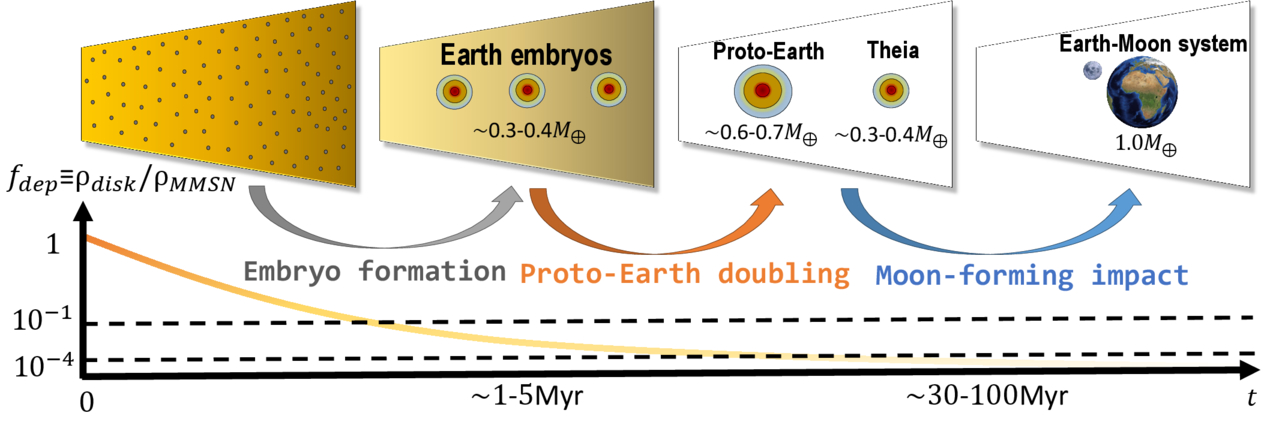
A schematic of Earth’s formation via embryo formation (when the noble gases enter the mantle) followed by mergers. Click to enlarge. [Savignac & Lee 2026]

On the mass axis, the team found a narrow range of acceptable conditions. If a proto-Earth was less than about 20% of Earth’s present-day mass, it couldn’t accrete much gas. This let it cool rapidly, freezing the magma ocean and shutting down neon dissolution before too much could be trapped inside. On the other hand, if a proto-Earth was more than about 40% of Earth’s present-day mass, it would accrete too much gas, stay molten for too long, and be left with too much neon. On the density axis, the researchers found that when the nebula accreted on to the proto-Earth, it must have been fairly depleted compared to its initial density. This implies that the whole process happened at the end of the nebula’s life, just before it was completely blown away by the proto-Sun.

Savignac and Lee demonstrated that these constraints are robust against the later stages of Earth’s evolution. In its later years, Earth either suffered or benefited from a giant impact, depending on your feelings about the Moon, but the researchers showed that this event doesn’t pose a problem for their models. Overall, this study builds a delightful link between rocks from our deep oceans and the particulars of Earth’s formation, demonstrating the unique power of planetary science to tie together different scientific fields.

Citation

“Constructing the Earth’s Formation History Using Deep Mantle Noble Gas Reservoirs,” Vincent Savignac and Eve J. Lee 2026 Planet Sci. J. 7 135. doi:10.3847/PSJ/ae64f7

The post Noble Gases Along for the Ride appeared first on AAS Nova.

Emergency SOS via Satellite Expands to Two More Countries

23 July 2026 at 18:50
Emergency SOS via satellite is now available in Andorra and Iceland, according to an updated Apple support document.

Available on the iPhone 14 and newer and the Apple Watch Ultra 3, Emergency SOS via satellite allows you to text emergency services when you are in a supported area without Wi-Fi or cellular connectivity. The feature requires iOS 26.4 and watchOS 26.4 or later in Andorra and Iceland.
This article, "Emergency SOS via Satellite Expands to Two More Countries" first appeared on MacRumors.com

Discuss this article in our forums

I wanted a clock that never needed setting. Things escalated.

23 July 2026 at 12:00

I wanted a clock that, annoyingly, didn't seem to exist.

Since childhood, my bedside clocks have been a series of red, seven-segment LED clock-radio specials from Walmart or Target. They are invariably cheap, simple, and long-lived—but they require manual intervention at the start and end of Daylight Saving Time and whenever the power flickers. After a recent power flicker, as I found myself standing by the sideboard holding down "TIME" and mashing the "HOUR" button, frustration boiled over, and I thought to myself, "We're a quarter of the way through the 21st century. There has to be a better way!"

My perfect clock would be self-setting. It would offer auto-DST adjustment (or not, depending on how this bill fares!). It would manage drift and always show the exact sub-second time. It would show that time on a red seven-segment display—not blue, not green, not yellow, and absolutely not white. And I shouldn't have to install any privacy-destroying garbage apps to make it work.

Read full article

Comments

© Lee Hutchinson

Researchers Spot Hydrocarbons Surprisingly Close to a Quasar Pair

22 July 2026 at 17:00

J0749+2255

Researchers have detected molecules containing rings and chains of carbon atoms in the vicinity of a rare pair of quasars. The trends in the distribution of these molecules are unexpected, suggesting that more work is needed to understand the conditions surrounding active supermassive black holes.

Infrared Eyes on Molecules in Space

skeletal formulae of aromatic and aliphatic molecules

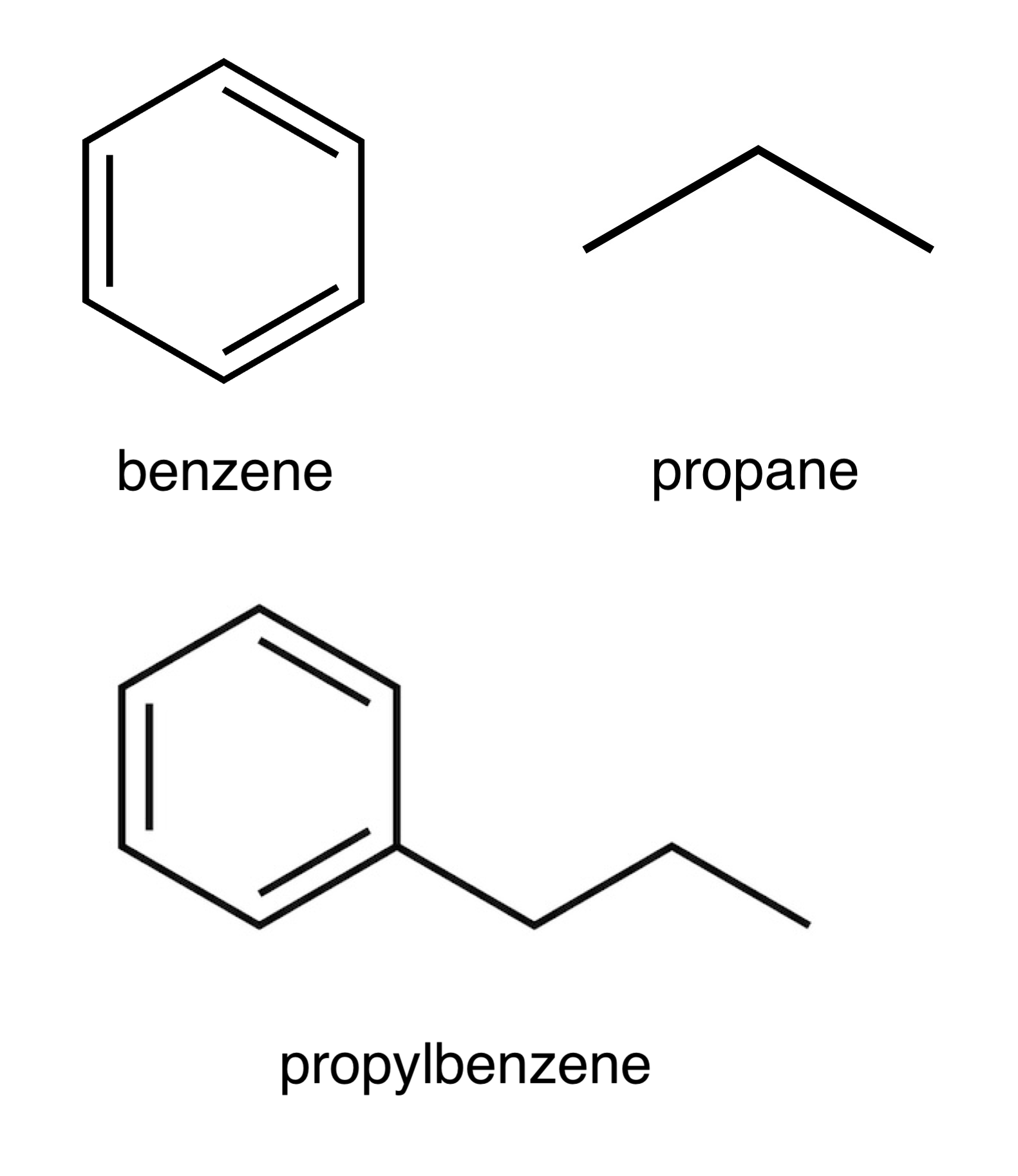
Examples of aromatic and aliphatic hydrocarbons. Benzene (top left) is the simplest aromatic molecule. Propane (top right) is a simple aliphatic molecule. Propylbenzene (bottom) is an aromatic molecule with an aliphatic chain branching off of it. In these “skeletal” formulae, there is a carbon atom at each vertex, and the remaining atoms (not depicted) are all hydrogens. Single lines indicate single chemical bonds, and double lines indicate double bonds. [Wikipedia; Public Domain]

Across the universe, atoms are combining to form molecules, and our ability to study molecules in distant realms has never been better. JWST is particularly attuned to emissions from molecules engaged in a kind of chemical yoga, stretching their bonds and flexing the angles between their atoms.

JWST’s sensitive infrared eyes have allowed researchers to study the distribution, creation, and destruction of both aromatic (containing one or more rings of carbon atoms in which certain electrons spread out within the ring) and aliphatic (containing chains of carbon atoms) hydrocarbons. These molecules have been spotted in a wide array of environments, and now, astronomers are finding them in more distant and more extreme environments than ever before.

Distant Discovery

SDSS J074922.96+225511.7, or J0749+2255 for short, is a quasar pair seen 3 billion years after the Big Bang. The two feasting supermassive black holes are roughly 12,000 light-years apart, giving researchers a glimpse into the late stages of a galaxy merger and a harsh environment in which to study the survival and destruction of molecules.

Researchers studying J0749+2255 with JWST have previously reported the detection of a 3.3-μm emission feature from aromatic molecules. Now, C. E. Mentzer (University of Missouri), Aigen Li (University of Missouri), and Xuejuan Yang (Xiangtan University) have analyzed JWST spectra of J0749+2255 and found not just widespread aromatic emission at a rest-frame wavelength of 3.3 μm, but also aliphatic emission at 3.4 μm, which they attribute to carbon chains branching off from the aromatic molecules. This likely makes J0749+2255 the most distant galaxy in which both aromatic and aliphatic emission has been detected.

analysis results showing the aliphatic fraction across the quasars and the surrounding region

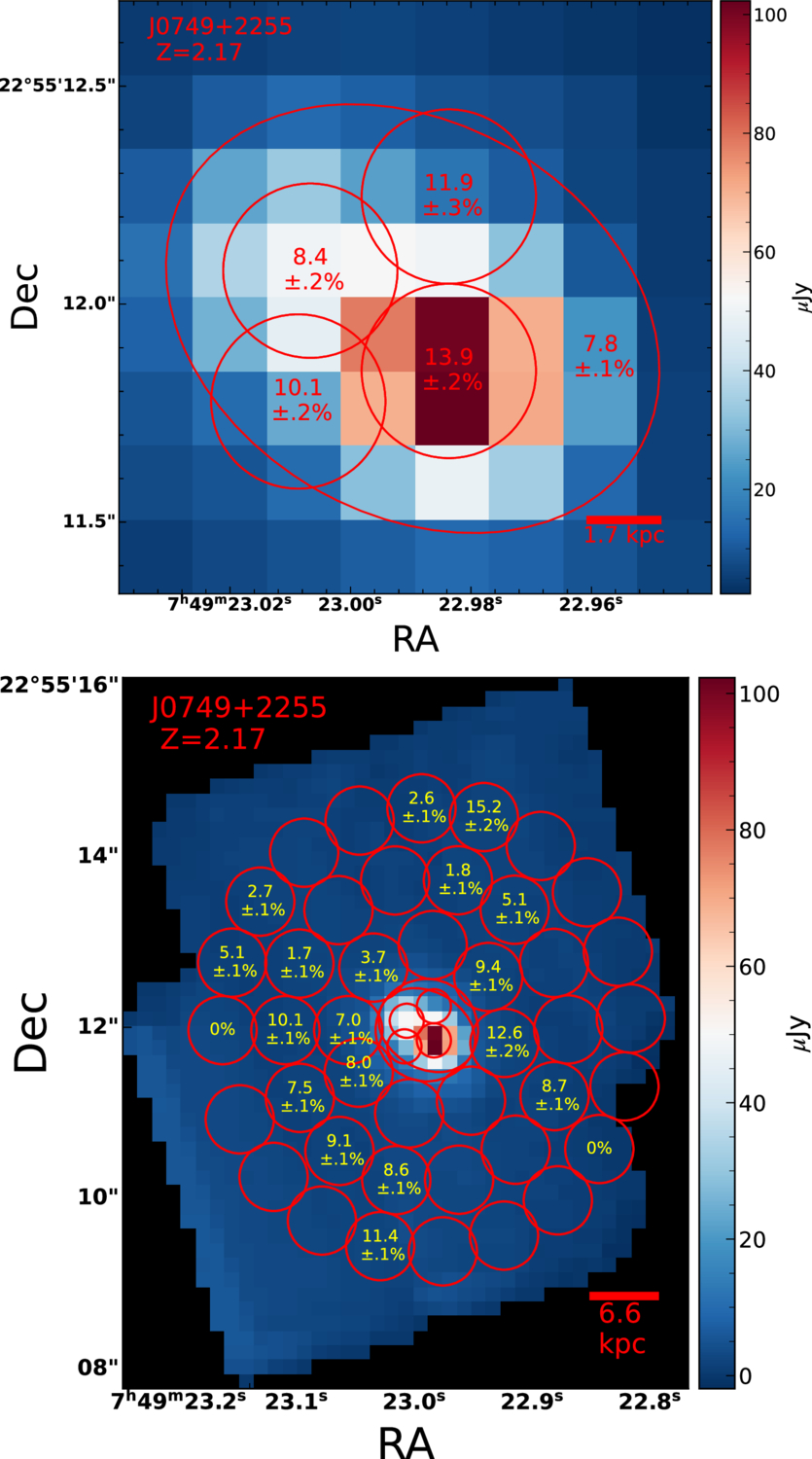
Aliphatic fractions in the bright central region surrounding the two quasars (top) and in the outer regions (bottom). [Mentzer et al. 2026]

Unexpected Trends

Mentzer, Li, and Yang subdivided the observations into 47 regions and measured the strength of the 3.3- and 3.4-μm features in each region. This analysis found strong aromatic emission nearest the quasars and showed that the fraction of carbon atoms bound up in aliphatic chains is highest close to the quasars.

Both of these findings are unexpected: the harsh radiation environment near the two active black holes is thought to break apart chains of carbon atoms attached to aromatic rings (which should decrease the 3.4-μm emission) and possibly destroy small aromatic molecules (which should decrease the 3.3-μm emission) — yet both of these features are strongest near the quasar cores where the radiation should be most capable of molecular destruction.

The authors speculated that the analysis regions centered on the quasars are large enough that they contain gas that hasn’t been pummeled by the quasars’ intense radiation and outflows, leaving molecules intact and able to produce the observed emission. However, this doesn’t explain the trend of stronger 3.3- and 3.4-μm emission closer to the quasars — necessitating further research into the emitting behavior of aromatic and aliphatic molecules under the extreme conditions of a dual quasar’s neighborhood.

Citation

“Widespread Detection of Aromatic and Aliphatic Emission in the Dual Quasar J0749+2255 at Cosmic Noon,” C. E. Mentzer et al 2026 ApJL 1005 L38. doi:10.3847/2041-8213/ae7e86

The post Researchers Spot Hydrocarbons Surprisingly Close to a Quasar Pair appeared first on AAS Nova.

❌