❌

Normal view

Safari Notify Me Makes Online Shopping Easier

By: Hannah
18 July 2026 at 22:31

Safari Notify Me gives Apple’s browser a useful new role in online shopping: watching a product page after the shopper has closed it. Instead of repeatedly returning to check whether an item is available or whether its price has changed, users can ask Safari to monitor the page and send an alert when the requested update appears.

The feature arrives as online shopping becomes increasingly fragmented. Prices can change several times during a promotion, popular items disappear within minutes and retailers often require shoppers to join separate mailing lists for availability alerts. Dedicated tracking apps can help, but each adds another account, extension or subscription.

Safari Notify Me places the monitoring tool inside the browser already being used to view the product. It is simple enough for occasional purchases while potentially useful for expensive electronics, limited releases, event registrations and products that move in and out of stock.

Safari Notify Me Watches the Page for You

Safari Notify Me is designed to monitor changes on a specific webpage. The user identifies what should be watched, such as a lower price, a product returning to stock or registration becoming available. Safari then checks the page and sends a notification after detecting the relevant change.

Apple has presented price changes and product restocks as central examples, though the feature is not restricted to shopping. It may also help with reservations, ticket availability, enrollment openings or other pages where one detail changes over time.

For shopping, the advantage is immediate. A customer can leave the product page without relying on memory, leaving dozens of tabs open or refreshing the site throughout the day.

The browser becomes temporarily responsible for the follow-up.

This differs from a retailer’s own email alert. Store notifications usually depend on the business offering the feature, and they may focus only on inventory. Safari can monitor the page according to the user’s request, potentially covering price and availability without requiring another marketing subscription.

Safari Notify Me - Close-up of a Mac computer screen showing the dock with app icons. The cursor hovers over the macOS Tahoe Launchpad icon, displaying a popup label that says "Launchpad.” Other visible icons include Safari, Chrome, and Calculator.
Image Credit: Pond5

How Safari Price Alerts Help

Online prices are rarely as stable as the label suggests. Retailers adjust discounts, respond to competitors, launch short promotions and change prices according to stock levels.

A shopper interested in a Mac accessory, appliance or expensive display may not want to purchase immediately at the listed price. Checking the page every day is inefficient, while joining a store mailing list can produce far more promotional email than useful information.

Safari price alerts create a quieter alternative. The user can identify the product and wait for the browser to report a meaningful change.

The feature does not replace price history. Safari may detect that the amount has dropped, but that does not necessarily prove the new price is the lowest offered during the year. Dedicated price-tracking services may still provide charts, comparisons and retailer-specific history.

Safari Notify Me is better understood as a page-change assistant. It tells the shopper that something requested has happened. The decision to purchase remains with the user.

Restock Alerts May Be Even More Useful

Restock monitoring may become the feature’s strongest shopping use. Limited products can return without warning and sell out before a retailer’s email reaches every subscriber.

This often happens with game consoles, graphics hardware, collectibles, seasonal products, concert merchandise and popular configurations of newly released devices. Size and color variations can also return separately, making a general product alert less useful.

Safari restock alerts can focus on the page the user is already viewing. A notification provides a reason to return without requiring the tab to remain open.

The browser cannot reserve the item or guarantee that inventory will remain available. A notification may also arrive after other buyers have begun ordering. Safari removes the repeated checking, but it does not control the retailer’s inventory system.

That limitation is reasonable. Notify Me helps users notice the opportunity; it does not turn Safari into an automated purchasing bot.

Using Safari Notify Me

The feature is intended to require little setup. Users begin on the relevant product or registration page and tell Safari which change they want it to watch.

To create a Safari Notify Me alert:

Open the webpage in Safari > Select Notify Me > Describe the price, availability or page change to monitor > Allow Safari notifications when requested

The exact options shown may depend on the device, webpage and software version. Apple is introducing the feature with its new operating-system releases, and availability may vary by language or region.

A useful request should be specific. Asking Safari to report when the item returns to stock is more actionable than asking for any page change. For price monitoring, the user may request a reduction or watch for a particular target when the page supports enough information.

Once the alert is active, there is no need to keep the product page open. Safari sends a notification after detecting the requested update, allowing the user to return directly to the page.

A Better Use for Apple Intelligence

Safari Notify Me is a practical example of Apple Intelligence operating as an assistant rather than a writing tool. It interprets what the user wants, watches for a future condition and reports back when that condition appears.

The feature does not need to generate a long answer or place a chatbot beside every shopping page. Its value comes from removing a repetitive task.

That restrained approach fits Safari. The browser already manages passwords, private browsing, tab organization, Reader and tracking protections. Monitoring a page extends that utility without turning Safari into a retailer or shopping marketplace.

It may also reduce the need for third-party extensions among casual users. Someone who occasionally watches one product does not necessarily need a dedicated deal platform with wish lists, affiliate links and account registration.

Specialized services will remain useful for serious bargain hunting. Safari covers the simpler request: tell me when this exact page changes in the way I care about.

A glowing, abstract metallic shape with six curved, interconnected loops forms a symmetrical pattern against a black background, illuminated with blue and white light—evoking the futuristic vibe of WWDC26 developer betas.
Image Credit: Apple Inc.

Notifications Need Restraint

Any feature built around alerts can become noisy when used too freely. Monitoring every product considered during casual browsing could fill Notification Center with price changes and restocks that no longer feel relevant.

Safari Notify Me works better when reserved for purchases with genuine intent. A few focused alerts are easier to understand and act upon than dozens of loosely defined page watches.

Users should also remove alerts after buying the item or losing interest. A notification for a product purchased weeks earlier adds clutter without saving time.

Safari notifications can be managed through the device’s normal notification settings. Disabling all Safari alerts may also silence other useful browser notifications, so reviewing individual watches inside Safari is preferable when available.

Price Is Not the Only Shopping Decision

A lower price can encourage a quick purchase, but shoppers should still review the seller, return policy, warranty and delivery estimate. Notify Me reports a page change; it does not evaluate whether the store is reliable or whether the offer has hidden conditions.

A product may return through a third-party marketplace seller at a higher price. A discount may apply only after a membership, coupon or trade-in. Limited inventory can also create pressure to buy before reading the terms.

Safari’s privacy protections and fraud warnings remain relevant, but users should confirm that the page belongs to the intended retailer before entering payment information.

The alert is a starting signal, not an endorsement.

Safari Becomes More Useful After the Tab Closes

Browsers traditionally stop being helpful once users leave a page. Safari Notify Me changes that relationship by allowing selected pages to remain useful without remaining visible.

For shoppers, that means fewer repeated searches, fewer forgotten products and less dependence on promotional email. Price and restock alerts can operate quietly until there is a reason to return.

The feature will not replace advanced shopping trackers, and it cannot guarantee inventory. Its appeal is that most users do not need those larger systems for every purchase.

Sometimes the entire shopping problem is waiting for one price to fall or one button to change from unavailable to buy. Safari Notify Me allows the browser to handle that wait.

The post Safari Notify Me Makes Online Shopping Easier appeared first on AppleMagazine.

EU Tech Regulation Creates a Costly Split for Apple

18 July 2026 at 15:34

EU tech regulation, Digital Markets Act, Apple Europe sales, Apple regulation, European Union, Siri AI, iPhone features, device interoperability, App Store changes, alternative marketplaces, iPhone Mirroring, AirPods translation, Apple privacy, iPhone security, app sideloading, platform competition, DMA compliance, Apple Intelligence, European technology, government control

EU tech regulation is no longer limited to App Store payment rules or competition disputes hidden from ordinary consumers. It is beginning to determine which features reach European devices, how quickly they arrive and how deeply third-party companies can interact with the iPhone, iPad and Mac.

The Digital Markets Act was designed to reduce the control of large technology platforms over software distribution, payments, browsers, digital assistants and connected hardware. For Apple, compliance has already produced alternative app marketplaces, web distribution, third-party payment options, additional default-app controls and expanded access to iPhone technologies.

The next phase reaches much deeper into the operating system. European regulators want competing accessories, cloud services and AI assistants to receive access to capabilities traditionally reserved for Apple’s own products.

Apple argues that some of those demands could weaken privacy and security. The European Commission says the company is responsible for creating compliant systems that preserve both competition and user protection.

Between those positions sits a large and commercially significant group of customers. Europe generated $28.06 billion in Apple sales during the quarter ending March 28, 2026, up from $24.45 billion one year earlier. Six-month European sales reached $66.20 billion, compared with $58.32 billion during the same period of fiscal 2025.

Europe therefore represented more than one-quarter of Apple’s latest quarterly revenue. It is too valuable to leave behind, but increasingly difficult to serve with the same software experience available elsewhere.

EU Tech Regulation Is Splitting Feature Availability

Regional differences once centered mainly on language support, licensing agreements or local services. EU tech regulation is creating a more structural divide.

Apple has blamed Digital Markets Act requirements for delaying Siri AI across the European Union. The company says regulators expect competing AI assistants to receive extensive access to personal information, apps and device actions before Apple can reserve those capabilities for its own assistant.

The disagreement concerns more than answering questions. Siri AI is designed to read personal context, understand onscreen information and complete actions across apps. That may include finding messages, accessing files, making purchases or sending information on the user’s behalf.

Opening those capabilities to outside AI systems requires new permission structures, technical interfaces and safeguards. Apple says it cannot release its assistant first and add competing access later without risking regulatory action. The Commission says Apple had sufficient time to design an interoperable solution.

Other delayed European features have included iPhone Mirroring on Mac, Live Translation through AirPods and certain location-based Maps capabilities. Each feature touches a different part of the ecosystem, but all depend on privileged communication between Apple devices, software and services.

The consequence is becoming visible at purchase. Two customers can buy the same iPhone model at similar prices and receive different capabilities because one lives inside the European Union.

A black background with a glowing sphere in the center, featuring colorful light waves—red, orange, blue, and green—swirling horizontally inside the sphere, evoking a futuristic Siri AI interface.
Image Credit: Apple Inc.

Feature Adoption Becomes Slower and Less Predictable

Delayed availability can weaken the adoption of new hardware features even when the devices themselves continue selling well.

Siri AI is intended to become a central part of newer iPhones, iPads and Macs. Buyers who cannot access it lose part of the justification for newer chips, additional memory and on-device AI processing. Developers also face a smaller addressable audience for apps built around the new assistant.

AirPods Live Translation presents a similar problem. A feature designed to demonstrate the combination of iPhone processing, microphones and wearable audio becomes unavailable in a region built around dozens of languages and frequent cross-border travel.

iPhone Mirroring affects the relationship between iPhone and Mac. Users outside the EU can interact with the phone from macOS, while European users may receive notifications without gaining the complete experience.

These differences do not necessarily stop hardware sales. Apple’s newest results show strong European demand despite years of regulatory conflict. They can, however, reduce the speed at which customers use the ecosystem’s newest capabilities.

The effect may grow as software becomes a larger part of hardware differentiation. A faster processor has limited emotional value when the feature designed to demonstrate it is unavailable.

Apple Sales Show Why Europe Cannot Be Ignored

Apple does not report European Union revenue separately. Its Europe segment also includes countries outside the bloc, along with India, the Middle East and Africa. The official segment remains the best regularly published measure of the region’s commercial weight.

European sales rose approximately 15% year over year in Apple’s latest reported quarter. During the first six months of fiscal 2026, the segment expanded by roughly 14%.

Those figures weaken the argument that regulation is already driving customers away from Apple hardware. Demand remains strong, supported by the iPhone 17 family, Mac sales, services and the company’s installed base.

The financial risk is more gradual. Regional software fragmentation can raise engineering costs, delay launches and make European devices less competitive against products able to offer complete feature sets.

Apple must maintain separate distribution rules, payment systems, browser options and eligibility checks. Developers must decide whether alternative stores, external payments or EU-specific business terms justify additional work. Support teams must explain why features differ between countries using the same operating-system version.

A market responsible for more than $28 billion in one quarter can absorb considerable compliance expense. It can also influence Apple’s global product decisions when regulators demand interfaces that cannot be restricted to Europe easily.

A Slow Transfer of Ecosystem Control

The escalating regulatory environment also creates a more fundamental concern: control over complex technology ecosystems can gradually move away from the companies that designed them and toward government committees, regulatory bodies and administrative processes.

That transfer rarely happens through one dramatic order. It develops through repeated obligations covering app distribution, payment systems, browser engines, digital assistants, hardware access, data portability and interoperability. Each requirement may appear narrow when considered alone. Together, they can redefine who determines how the ecosystem operates.

Apple built its platform around tight integration between hardware, software, services and security. Regulators increasingly treat parts of that integration as market power that must be opened to competitors. The danger is that an ecosystem designed as one coordinated environment becomes subject to decisions made by committees that do not carry direct responsibility for product quality, reliability or long-term maintenance.

This can become a slow trap. Once a platform is required to expose one layer, regulators may use that access as the basis for demanding another. A payment exception can be followed by alternative app stores. Alternative stores can lead to broader installation rights. Device interoperability can expand into access for AI assistants, personal data and system actions.

The boundaries of the platform are then set less by engineering judgment and more by regulatory negotiation.

Government agencies have legitimate authority to address competition and consumer harm. The concern appears when regulation shifts from preventing abusive conduct to directing product architecture. At that point, public authorities begin influencing feature design, release timing, software permissions and the relationship between first-party and third-party services.

That creates consequences beyond Apple. Any company considering a tightly integrated product may decide that deep integration invites intervention. Businesses could avoid building ambitious ecosystems if successful coordination later becomes grounds for forced access.

Innovation then becomes shaped by what regulators are likely to permit rather than by what engineers believe will produce the safest or most coherent experience.

A large black Apple logo on a white background, with the shadow of a hand holding a padlock to the right side, symbolizing security or privacy in an era of AI and strict App Store rules around personal data sharing.
Image Credit: Ink Drop / Alamy Stock Photo

Competition Gains Come With Real Consumer Choices

EU policy has produced benefits that Apple rarely emphasizes. Users can install apps through alternative marketplaces or directly from authorized developers. Developers can offer external payment methods, promote different prices and avoid relying entirely on Apple’s distribution system.

Alternative browser engines can compete with WebKit, while users have more control over default apps. Contactless payment access has expanded beyond Apple Pay, allowing competing wallet providers to use the iPhone’s NFC technology under approved conditions.

Interoperability requirements could also improve third-party accessories. Smartwatches, headphones and other devices may gain better notification access, background connectivity and proximity pairing with the iPhone.

These changes can increase competition and reduce the advantage Apple gives its own services and accessories. A third-party smartwatch should not become artificially less useful simply because it was not made in Cupertino.

The difficulty is separating legitimate platform access from unlimited access. A notification interface is one thing. An autonomous AI assistant capable of reading messages, accessing files and acting across apps introduces a different level of sensitivity.

Privacy and Security Risks Are Not Theoretical

Alternative app distribution increases user choice, but it also moves some responsibility away from the App Store. Apple continues to notarize apps distributed through approved alternative channels, checking for known malware and severe fraud. That process is narrower than a complete App Store review.

Purchases made outside Apple’s payment system also fall outside its normal refund and billing support. Users may need to resolve disputes directly with the developer or payment provider.

A malicious marketplace, deceptive payment page or compromised developer account can create opportunities for fraud. Enterprise users face additional concerns when employees install software from sources their organization has not approved.

The AI question reaches further. A third-party assistant may need permission to access messages, photos, calendars, documents and app controls. Even a reputable provider can collect more information than the user expects or introduce vulnerabilities through poorly designed integrations.

Apple can build permission prompts, app isolation and revocation controls, but technical access always creates some exposure. Security depends on how narrowly permissions are defined, how visibly they are used and whether the operating system can stop unauthorized actions.

The Commission maintains that interoperability and privacy can coexist. Apple maintains that regulators are demanding access before adequate protections are ready. Both positions contain a legitimate concern: dominant platforms should not block competition, and competition should not require users to surrender control of personal data.

Elegant, historic Parisian building on a street corner at dusk, with warm lights glowing from large windows and ornate balconies—blending classic charm with Apple Store architecture. Pedestrians stroll nearby, passing a white flag with a gold emblem by the entrance.
Image Credit: Apple Inc.

Government-Controlled Architecture Creates Accountability Gaps

When regulators require a company to alter its architecture, responsibility can become blurred.

Apple remains the company customers blame when an iPhone feature fails, a third-party marketplace distributes a harmful app or an outside assistant misuses personal data. Regulators may have required the access, but they do not operate the device, provide technical support or repair the damage to the platform’s reputation.

This creates an accountability gap. Government committees can mandate openness without assuming the commercial and security consequences of that openness. Apple must comply, maintain the system and explain the outcome to users.

The same problem applies to delayed features. Regulators may argue that Apple chose not to release a service, while Apple may argue that the required conditions made the launch unsafe or technically impractical. Customers are left with less functionality and no simple way to determine who caused the delay.

Over time, the ecosystem can become a negotiated compromise rather than a product with one coherent direction. That may satisfy formal compliance while producing a weaker experience for everyone involved.

The risk is not that governments will literally operate Apple’s software. It is that committees increasingly define the conditions under which Apple can design, connect and release its own features. Control shifts through constraints.

The Industry Will Follow Europe’s Experiment

The consequences extend beyond one company. Google, Meta, Microsoft, Amazon and other platform operators face related European obligations. Hardware makers must consider whether ecosystem advantages can survive when core services are required to support rivals.

Smaller developers may gain new distribution and payment choices, but they may also inherit more compliance, customer-service and security responsibilities. Accessory companies could compete more effectively while becoming accountable for handling sensitive device data.

Other governments are watching. Rules introduced in Europe can influence legislation elsewhere, particularly when companies decide that maintaining one global technical framework is easier than operating several regional versions.

Apple is unlikely to abandon Europe or stop adapting its products. Its sales provide too much evidence of the region’s importance. The company will continue negotiating, appealing decisions and building compliance systems while withholding features it considers unsafe under current demands.

European customers may receive more app stores, payment choices and accessory compatibility. They may also wait longer for headline features included with the same hardware elsewhere.

The deeper consequence may be a technology industry that becomes more cautious about building tightly integrated products. Companies may design around anticipated regulatory demands from the beginning, limiting exclusive features, reducing private-system integration or avoiding innovations that depend on controlled access.

EU tech regulation began as an effort to constrain dominant platforms. Its long-term effect may be to transfer part of the power to shape those platforms from companies and users to regulatory institutions.

That shift deserves scrutiny equal to the market power it is intended to correct. Competition rules can restrain abuse. They can also become a slow mechanism for placing product design, security choices and ecosystem evolution under government supervision.

Shady Control and Bureaucracy

The danger grows when regulatory discretion becomes buried beneath permits, approvals, negotiations and technical committees that operate beyond meaningful public scrutiny.

The more power officials hold over which features, contracts or technologies may proceed—and when—the greater the opportunity for lobbying, favoritism and selective enforcement to influence outcomes. What begins as oversight can gradually become a system in which delay itself is leverage, while responsibility disappears inside layers of administration.

For the technology industry, that risks replacing transparent product decisions with political access, negotiated exceptions and regulatory influence exercised far from the consumers expected to live with the consequences.

The post EU Tech Regulation Creates a Costly Split for Apple appeared first on AppleMagazine.

Dating the Dawn of the Milky Way Disk

17 July 2026 at 18:56

Messier 64

The iconic disks of spiral galaxies are well known across the local universe and now far beyond. A recent study looks at the Milky Way to determine when its own disk emerged.

Spinning into Spirals

The Milky Way, a grand spiral galaxy with stars and gas rotating in a disk, did not always look this way. Galaxies begin as chaotic clumps of gas and stars inside a knot of dark matter, and at some point in time, spiral galaxies must transform into the flat rotating disks we observe them as today. Recent JWST observations have uncovered disk galaxies emerging much earlier in the universe than previously thought, shifting our understanding of how quickly spiral galaxies come together and settle into disks. While we cannot study the detailed assembly history of these very distant galaxies, we can dissect galaxies in the local universe to build a better timeline of galaxy evolution.

disk galaxies

JWST images of distant edge-on galaxy disks [NASA, ESA, CSA, STScI, Takafumi Tsukui (ANU)]

Looking as close to home as possible, astronomers have used the kinematics and chemical makeup of stars in our own Milky Way to trace the moment when the galaxy started to host a rotating stellar disk. This period, known as the “spin-up,” marks when the bulk kinematic signature of the galaxy transitioned from one dominated by random motions to one dominated by a rotating disk.

Stars hold on to the kinematic and chemical information they are born with, so stars of different ages and metallicities across the galaxy should trace the development of the disk. Because stellar ages have been difficult to constrain observationally, studies of galactic spin-up have typically relied on readily available metallicity measurements as a proxy for age; however, metallicity is not a clear-cut age indicator, making it difficult to truly distinguish different stellar populations across the Milky Way’s disk. Luckily, new major surveys have recently provided stellar databases adding the stellar age measurements necessary to pin down when the Milky Way spun up.

Dawn of the Galactic Disk

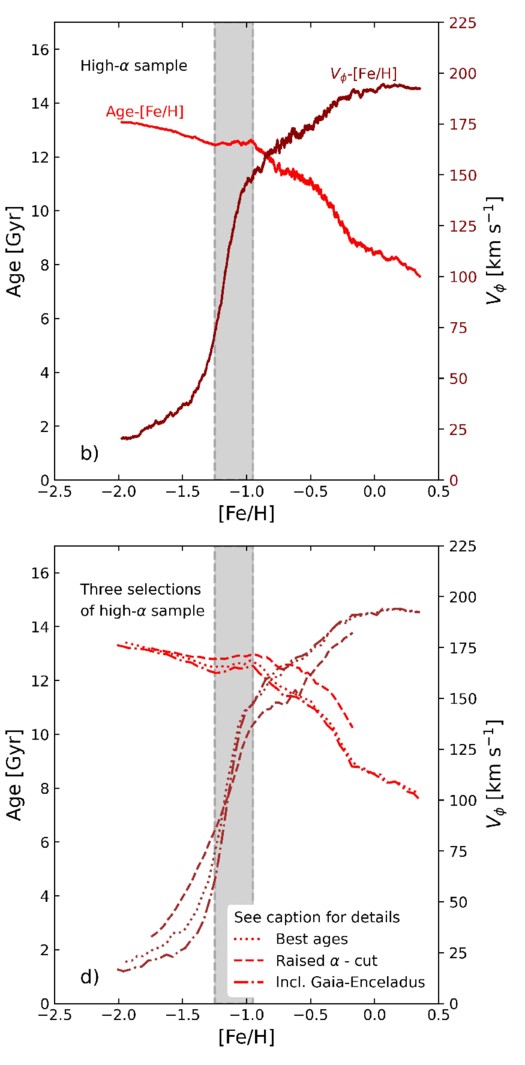
Plots showing stellar age and rotational velocity versus metallicity, [Fe/H].

Plots showing stellar age and rotational velocity (Vϕ) versus metallicity, [Fe/H]. The metallicity range where the age–[Fe/H] relation stalls coincides with the point when the Vϕ–[Fe/H] relation rapidly increases, indicating the age of the spin-up in the Milky Way. Click to enlarge. [Modified from Feltzing et al 2026]

Sofia Feltzing (Lund Observatory) and collaborators used a catalog of over 300,000 subgiant stars from the Large Sky Area Multi-Object Fiber Spectroscopic Telescope with metallicities, kinematics, and crucial stellar ages to determine when the Milky Way began to host a stellar disk. After making quality cuts to ensure they included only the most robustly measured stars, the authors divided the sample into two distinct stellar populations that settled into the Milky Way’s disk differently: older stars with a high abundance of α elements (like oxygen, magnesium, and silicon) relative to iron and younger stars with low α-element abundances.

With these star samples, Feltzing and team analyzed how both stellar rotational velocity and age varied with metallicity to determine when the Milky Way spun up. They found that high-α stars clearly move from having random motions to being rotationally supported over a short range of metallicities about 12.5 billion years ago, while the low-α stars seem to begin in a rotating disk and stay there. When varying their selection criteria and looking at the full sample, the authors determined that the Milky Way spin-up happened between 12.1 to 12.5 billion years ago — the first time Milky Way spin-up has been age-dated in this way.

These results imply a rapid chemical evolution and change in kinematic properties as stars went from randomly orbiting to rotating in an ordered disk in the Milky Way. The authors suggest that future studies should focus on lower-metallicity stars to better disentangle stars in the disk from stars in the halo, which will lead to a more precise determination of the Milky Way’s spin-up. Upcoming large-scale surveys will make this possible and allow astronomers to build a better picture of galaxy formation in the early universe.

Citation

“Dawn of the Milky Way Disk: Determination of When a Rotationally Supported Disk Appears and Dating the Spin-up of the Disk,” Sofia Feltzing et al 2026 ApJL 1004 L28. doi:10.3847/2041-8213/ae6f14

The post Dating the Dawn of the Milky Way Disk appeared first on AAS Nova.

2026 Lucid Gravity Touring review: A strong act 2

17 July 2026 at 12:00

When Lucid introduced the Air electric sedan in late 2021, the first Air Dream Edition I tested packed over 1,100 hp (820 kW) and carried a $180,000-plus window sticker. It's easily the most powerful street car I've tested; the only vehicle I've driven with more power was a purebred race car with a third the mass, and it was on a proper track. Its combustion engine was also about 1,000 times louder than the Air, helping to remind us that "combustion" really does mean explosion after explosion.

For Lucid's second act, the company debuted the Gravity electric SUV last year, and I've just tested the 2026 Gravity Touring, which starts at about $82,000 in the US, including the required destination charge.

My test model carried a bevy of options, including a 22-speaker audio system, the Comfort and Convenience package, third-row seating, a Dynamic Handling package (combining rear-wheel steering and three-chamber air suspension), a luxury seating package (bundling Nappa leather and massaging and ventilated front seats), and special metallic paint.

Read full article

Comments

© Jim Resnick

❌