A dried-out felt-tip marker and a snapped-off piece of molded black plastic sold for $857,600 at a Sotheby's auction on Wednesday.
What otherwise might have been worthless bits of trash commanded the highest bids due to where the two items were 57 years ago—lifting off aboard NASA's Apollo 11 spacecraft on humanity's first mission to land astronauts on the Moon. More than flown odds and ends, one was the problem that almost stranded Neil Armstrong and Buzz Aldrin on the lunar surface, and the other was the simple solution to saving the mission.
"Houston, Tranquility. Do you have a way of showing the configuration of the engine arm circuit breaker?" radioed Aldrin to Mission Control after realizing he or Armstrong had inadvertently broken off the top of the circuit breaker switch that would enable their ascent engine to ignite, beginning their trip back to Earth. "The reason I'm asking is because the end of it appears to be broken off. I think we can push it back in again. I'm not sure we could pull it out if we pushed it in, though."
As Christopher Nolan’s The Odyssey arrives in theaters, archaeologists working off the western coast of Greece say a real-life cult site devoted to the legendary story’s hero has been uncovered.
Local traditions had long told of a stony hilltop on the Greek island of Ithaca that had once been home to a shrine to Odysseus, the legendary Greek king of the isle and main protagonist in Homer’s famous poem.
Now, after close to two decades of archaeological work on the island that served as home to the fictional king in Homer’s epic literature, archaeologists say they have uncovered the most compelling evidence yet that a genuine historical cult site had existed there, dedicated to the famed hero of The Odyssey.
An Ancient Cult Site Devoted to Odysseus
Researchers with the University of Ioannina recently revealed the discovery of new inscriptions and artifacts supporting the existence of a cult element devoted to Odysseus, uncovered at the ancient complex at Agios Athanasios, which had been a public sanctuary devoted to the worship of Homer’s famous hero during the Hellenistic and early Roman periods.
According to a statement released by the Greek Ministry of Culture, the building complex is characterized by a series of robust structures located on terraces, which involve several monumental elements featuring carved architecture and niches for what appear to have been votive offerings or inscriptions, all of which point to its use as a cult site.
Yannos Lolos, one of the project’s lead archaeologists, recently told ArtNet that the site’s role was revealed partially through a reexamination of existing materials found there, which helped reveal what he calls “new and strong inscriptional evidence” linking the site to Odysseus.
Bronze Bust and Inscription Discoveries
Among the most important discoveries at the site were a small bronze bust of Odysseus dating to the first or second century C.E., as well as a roof tile fragment which bore an inscription that reads, “to Odysseus.”
However, an even more compelling discovery involved a second stamped roof tile inscribed with the hero’s name but appearing in the Greek genitive case; this is significant, since it indicates ownership, thereby identifying the sanctuary as “belonging” to Odysseus.
A close-up image depicting the tile recovered from the site, bearing an inscription that references Homer’s Odysseus (Image Credit: Greek Ministry of Culture).
Based on current evidence, organized cult worship is believed to have begun at the site by around the late fourth century B.C.E., which places its use at around 500 years after Homer composed his famous epic poem, and almost a full millennium after the legendary events the epic describes.
The physical sanctuary itself was built onto a massive natural rock formation, and remnants of the ancient structure include a primary tower, a large oblong building, and terraces which were carved directly into the underlying bedrock.
Excavations over the last several years have also revealed the site’s deeper history, which points to evidence of earlier Mycenaean occupation during the 13th and 14th centuries B.C.E., at which time the site had likely served as a strategic center overseeing nearby harbors and local water resources.
A Discovery with Legendary Significance
In a statement, the Greek Ministry of Culture said the two new engravings arrives “in combination with the other available data, to document the development of a prominent public complex at the site,” which it said help to establish the “major role in the religious, social and possibly political life of the Ithacians of the Hellenistic-early Roman periods, but also with a broader pilgrimage character.”
The recognition of this ancient cult site only adds to the existing evidence that already supported worship of Odysseus on Ithaca. Past discoveries have revealed ancient coins depicting the hero, found near ritual offerings at Ithaca, which were also linked to cult activities. However, the identification of the sanctuary offers the most conclusive archaeological evidence to date that Homer’s legendary hero had been the cult’s focus.
Of course, these discoveries fall short of establishing Odysseus as a true historical figure, and most scholars agree that Odysseus was a fictional character born out of traditions that incorporated real places and events into their broader mythos.
However, in at least a few instances, the lines between myth and ancient history have been blurred—a famous example being Heinrich Schliemann’s identification of a site (originally discovered by British amateur archaeologist Frank Calvert, with his identification of the mound of Hisarlik) which helped reveal the archaeological reality behind the city of Troy, which had previously been considered a mythical location.
It was also reported last year that an archaeological discovery resembling the “labyrinth” from Greek mythology had been uncovered on Crete, in a discovery some have called “one of the most important archaeological finds” of the century.
Although the discoveries at Ithaca don’t establish Homer’s Odysseus as a historical figure in this way, they do confirm that centuries after The Odyssey was composed, inhabitants of Ithaca engaged in cult activities to honor the legendary king at a sanctuary on the island, which, according to legend, he once ruled.
Micah Hanks is the Editor-in-Chief and Co-Founder of The Debrief. A longtime reporter on science, defense, and technology with a focus on space and astronomy, he can be reached atmicah@thedebrief.org. Follow him on X @MicahHanks, and at micahhanks.com.
There is no such thing as Judeo-Christian. And never was. Both Old and New Testaments are entirely and only about Jesus Christ. Only He is the Messiah who is called Christ.
Back in 2024, we reported on the discovery of the Quest shipwreck, the polar exploration vessel that served Arctic explorer Sir Ernest Shackleton on his last voyage. Shackleton died before reaching their destination, and the ship sank in 1962. The Royal Canadian Geographic Society (RCGS) has now released the first images of the wreck more than 60 years after it sank, published in Canadian Geographic magazine.
Shackleton, of course, is most famous for his ill-fated voyage on the Endurance, which became trapped in sea ice in 1914 and sank. Shackleton and his crew defied the odds and survived. (The Endurance shipwreck was finally found in 2022.) By the time Shackleton returned to England, the country was embroiled in World War I, and many of his men enlisted. Shackleton was considered too old for active service. He was also deeply in debt from the Endurance expedition, earning a living on the lecture circuit. But he still dreamed of making another expedition to the Arctic Ocean north of Alaska to explore the Beaufort Sea. He got funding from an old school chum, John Quillier Rowett.
Shackleton purchased a wooden Norwegian whaler, Foca I, which his wife Emily renamed Quest. When the Canadian government withdrew its support, the mission shifted back to the Antarctic, and the Quest received an extensive retrofit. The improvements included a new deckhouse, a heated crow’s nest, a wireless set, and an odograph for tracing and charting the route automatically, as well as a Lucas deep-sea sounding machine, a large and pricey collection of cameras and photographic equipment, and even a small airplane.
Wally Funk, who in 2021 became the oldest woman to fly into space—60 years after she and 12 other women sought the same opportunity as NASA's original astronauts—died on Wednesday at 87 years old.
Funk was the last living member of the First Lady Astronaut Trainees (FLATs, or as they were later dubbed by the media, the Mercury 13), a group of women pilots who volunteered to go through the same physical and psychological tests as the United States' first spacemen.
Despite performing as well or better than their male counterparts, though, the Lovelace Woman in Space Program was conducted separately from NASA, and the space agency required that its astronauts be test pilots with jet time. The US military, however, did not accept women into its flight programs.
The findings, reported by Jean-Baptiste Camps and colleagues, relied on a novel approach to uncovering evidence for these long-lost texts: a complexity science approach that allowed them to estimate the volumes of lost ancient literature that once existed, by inferring references to such texts from existing chivalric narratives beginning in the 12th century.
The team’s findings also bring to attention a new concern for historians, since according to their simulations, as much as 60% of all ancient texts from this period, and more than 95% of manuscripts once believed to have existed, may have been lost to time. The findings were recently reported in PNAS Nexus.
Evidence of “Lost” Medieval Manuscripts?
The names we commonly associate with epic tales passed down to us from ancient literature are not the only heroes of yore that existed—they are merely the ones whose stories survived.
For every Gilgamesh, Thor, and King Arthur, it is possible that several more heroic characters from undiscovered ancient epics also exist. However, based on Camps and his team’s findings, they are probably unrecoverable stories, lost to time apart from scant references that occasionally appear in the few surviving manuscripts that have made their way down to us throughout time.
Some of the problems that have contributed to this concerning loss of ancient knowledge are technological. In the days before the invention of the printing press, texts had to be copied manually—a process that led to both innovations, but also errors and inconsistencies as these early copies were made.
From existing copies of surviving ancient texts, scholars can often infer a significant amount of information based on subtle (or in some cases, not-so-subtle) changes that appear from one version to the next. Philologists, researchers who study the structure, historical development, and relationships between languages, refer to the evolutionary “trees” encompassing such texts and their evolution through time as stemmata.
What’s ‘Stemmata’ With You?
Since modern stemmata are based only on existing copies, they lack the full evolutionary history of texts and fail to account for versions that have been forever lost, which may have contained significant differences or additional information.
Jean-Baptiste Camps and his colleagues’ new model has revealed a key discovery: that the early years of a text’s creation, and the number of copies that were made during that time, are of crucial importance to their survival.
As one might guess, the fewer copies that are made, the more endangered the text becomes. However, another implication based on the team’s modeling is that if no copies of the original work are made, all the surviving derivatives generally form what scholars recognize as a subsidiary branch of that manuscript’s family tree.
And therein lies the issue: one that has sobering implications for the preservation of knowledge from ancient times.
Roland’s Unknown Song
As an example, the researchers point to the Song of Roland, an 11th-century account of the Frankish military leader Roland’s deeds at the Battle of Roncevaux Pass. The events in question took place in AD 778, during the reign of Charlemagne, and the account remains the oldest single surviving major work of French literature.
However, the version of the tale we know today comes to us from several different manuscript copies that were made over time. While this speaks to the tale’s popularity in the Medieval world of the 12th to the 16th centuries, it also underscores the fact that its oldest, original versions are probably unknowable to us today.
But how is such knowledge lost to time? Arguably, one of history’s most famous examples involves the famous burning of the library at Alexandria—a story which is itself somewhat contested by modern scholars, in that rather than one catastrophic loss of information resulting from the destruction of a single building, a range of factors over an extended period are more likely to have resulted in the loss of this wealth of knowledge from the ancient world.
This is merely one example; a range of other instances involving random occurrences, accidents, and cataclysmic events point to additional reasons for the fragility of knowledge. One that Camps and his colleagues point to is obvious: the Black Death, which, in addition to raging through Europe and decimating human populations, also likely contributed significantly to the destruction of ancient manuscripts.
Knowledge must be protected, in other words, and the team’s recent findings only underscore how fragile it is—and also how easily it can be lost.
The team’s study, “On the transmission of texts: Written cultures as complex systems,” appeared in PNAS Nexus on July 7, 2026.
Micah Hanks is the Editor-in-Chief and Co-Founder of The Debrief. A longtime reporter on science, defense, and technology with a focus on space and astronomy, he can be reached atmicah@thedebrief.org. Follow him on X @MicahHanks, and at micahhanks.com.
Editor’s Note:Astrobites is a graduate-student-run organization that digests astrophysical literature for undergraduate students. As part of the partnership between the AAS and astrobites, we occasionally repost astrobites content here at AAS Nova. We hope you enjoy this post from astrobites; the original can be viewed at astrobites.org.
Distant galaxies offer a unique window into how stars, gas, and dust evolve over cosmic time. Tracing this evolution requires understanding not only how galaxies form, but also how and when they stop forming stars, a process known as quenching. Understanding how, when, and why galaxies quench is a fundamental question in astrophysics, and one that requires observations of star-forming, quenching, and fully quenched galaxies alike. Unfortunately, one complication is that identifying truly quenched galaxies is challenging: galaxies that appear “dead” may instead be actively forming stars, hidden behind a thick veil of dust.
In today’s article, the authors use observations from the Atacama Large Millimetre/submillimetre Array (ALMA) to investigate five ultramassive galaxies at redshifts, z, between 3 and 4, and ask a deceptively simple question: are these massive red galaxies genuinely quenched, or are they secretly forming stars behind the scenes?
Meet the Suspects: Ultramassive Galaxies at the Edge of Cosmic Noon
The five galaxies in this study are drawn from the Massive Ancient Galaxies at z > 3 NEar-infrared (MAGAZ3NE) survey, which targets some of the most massive galaxies known at early cosmic times. All five have stellar masses exceeding 100 billion solar masses and have been confirmed at z > 3. At these redshifts, we are observing the galaxies as they were when the universe was less than 2 billion years old. This is just before an epoch known as cosmic noon, when star formation across the universe reached its peak.
These galaxies also benefit from extensive multiwavelength observations from a range of observatories, including the ground-based Visible and Infrared Survey Telescope for Astronomy and the Spitzer Space Telescope. By combining imaging across wavelengths from the ultraviolet to the near-infrared, astronomers can measure the “colours” of galaxies and use these colours to infer the galaxies’ star-forming activity.
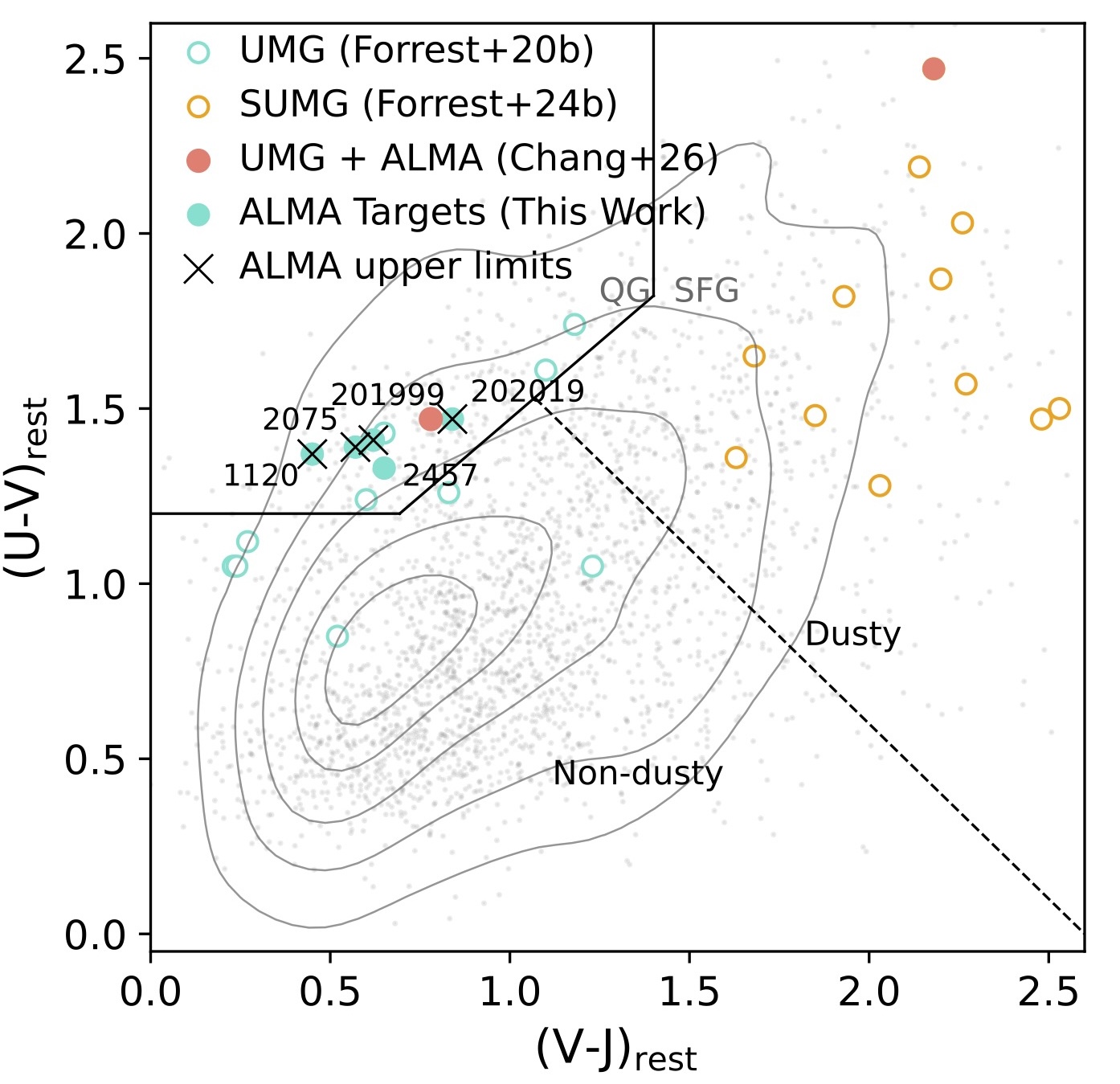
Galaxies that have quenched their star formation are dominated by older stellar populations, which makes them appear red (hence why they are often referred to as “red and dead” galaxies). However, dust can redden galaxies in a similar way by absorbing blue light and re-emitting it at longer wavelengths — meaning that a dusty, star-forming galaxy can easily masquerade as a quenched one. To uncover any hidden star formation, the authors turn to ALMA to search for far-infrared dust emission. The sample of galaxies investigated with ALMA is shown in Figure 1.
Figure 1: UVJ colour–colour diagram, which uses galaxy colours in the ultraviolet (U), visible (V), and near-infrared (J) to identify quenched galaxies. The five ultramassive galaxies (UMGs) studied here (filled cyan circles) lie firmly in the quenched region (QG), consistent with a lack of ongoing star formation. Crosses indicate galaxies undetected in ALMA dust emission, while other massive galaxies at similar redshifts are shown in grey for comparison. [Chang et al. 2026]
ALMA on the Scene
ALMA observes light at sub-millimetre wavelengths, which at these redshifts traces emission from star-forming regions that are obscured by dust. Of the five ultramassive galaxies in this sample, only one is detected with ALMA. Even when the remaining four galaxies are stacked together, no dust emission is recovered, indicating that if any dust is present, it must be extremely faint.
To better quantify what these ALMA non-detections imply, the authors perform spectral energy distribution fitting (see a recent overview bite on spectral energy distribution fitting) using the Code Investigating GALaxy Emission, or CIGALE, a code that enforces energy balance between absorbed starlight and dust emission to estimate physical properties such as a galaxy’s star formation rate and dust content. With the ALMA constraints included, all five galaxies are found to lie more than 10 times below the star-forming main sequence. Even the single ALMA-detected galaxy remains formally quenched, showing only weak residual star formation.
In other words, these galaxies really are dead (or at least extremely dormant).
Extremely Dust-Poor Galaxies
The spectral energy distribution fitting also allows the authors to measure how much dust these galaxies contain relative to their stellar mass. This ratio provides a simple but powerful way to assess how much interstellar material remains in a galaxy — and therefore how much fuel is left for future star formation.
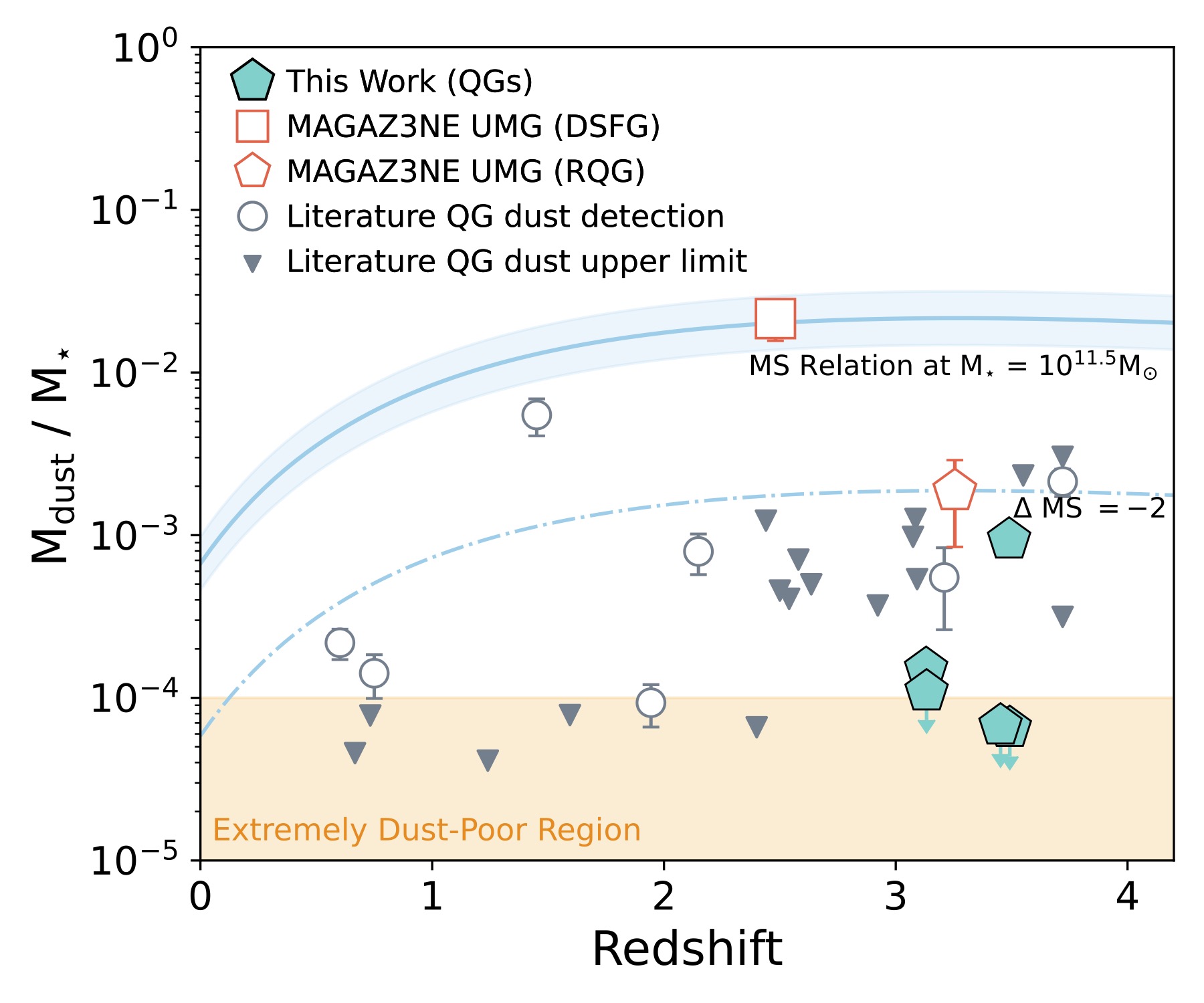
Three of the five ultramassive galaxies have ratios of Mdust/Mstar < 10-4 (Figure 2), placing them among the most dust-poor quenched galaxies confirmed at z > 3. The lone galaxy detected by ALMA contains slightly more dust, with Mdust/Mstar = 10-3, but even this is far below what would be expected for an actively star-forming galaxy. For comparison, typical star-forming galaxies at similar stellar masses host more than 100 times more dust.
Figure 2: The ratio of dust mass to stellar mass versus redshift for massive quenched galaxies (QGs). This quantity measures how dust rich a galaxy is compared to its stellar mass. The ultramassive galaxies in this study (cyan pentagons) fall well below the dust content expected for star-forming galaxies (solid blue line), highlighting their extreme dust deficiency. [Adapted from Chang et al. 2026]
These results raise important questions about how galaxies can become ultramassive, quenched, and nearly dust-free within the first two billion years of cosmic history.
For now, ALMA has delivered a clear answer to the question of “dead or in disguise?”: at least some candidate ultramassive galaxies in the early universe really are quenched, and they are strikingly dust poor. By ruling out the dusty impostor scenario, this study shows that deep ALMA observations can cleanly distinguish genuinely quenched galaxies from dusty star-forming ones, even at the highest stellar masses and earliest cosmic times. How these galaxies lost their dust remains an open question, but one thing is clear: by the time cosmic noon arrived, some galaxies had already finished forming stars and quietly faded into dormancy.
Original astrobite edited by Viviana Cáceres.
About the author, Lucie Rowland:
I’m a fourth (and final!) year PhD student at Leiden Observatory in the Netherlands, studying massive, star forming galaxies in the early universe with ALMA and JWST. It’s a really exciting time to be interested in astronomy, so I hope to make groundbreaking new research more accessible!
Did you know that the space shuttle once launched the Statue of Liberty into space?
In fact, there were two "Lady Liberties" on board Discovery when it lifted off on its fourth flight in April 1985. To be fair, each statue was only 15 inches tall (38.1 centimeters), but they were also each made of copper that was removed from the full-size statue during its then-still-ongoing restoration.
After the weeklong STS-51D mission was over, one of the space-flown statues was placed on display, and the other was melted down to create copper seals, which were then sold to the public by the Statue of Liberty Ellis Island Centennial Commission.
Now scholars may finally be closer to knowing the answer, according to new findings published in the Journal of Ancient History and Archaeology. The research presents evidence drawn from several case studies that help to build the argument that many ancient Roman coin hoards were buried during periods of political upheaval, war, or other catastrophic periods of change, revealing that the recovery of these caches may not have always been practical, or even possible.
The Enigma of Roman Coin Hoards
For many centuries, treasure hunters, archaeologists, and others have made remarkable discoveries of buried hoards of Roman coins across Europe, North Africa, and the Middle East. Although the reasons why coin hoards were buried are sometimes fairly obvious, the real mystery for scholars throughout time has to do with why these troves—often representing significant amounts of wealth—remained unrecovered.
An example of a Roman coin hoard uncovered near Llanvaches, Monmouthshire, in 2006 (Image Credit: Helen Hall/Wikimedia Commons/CC 2.0)
To answer this question, Babeş-Bolyai University researchers Adrian-Daniel Stan and Cristian Gǎzda leveraged one of the world’s largest databases on Roman coin hoards, and based on the data the pair reviewed, they suggest that these “forgotten fortunes” entombed within the earth can be viewed as the fingerprints left behind by some of the darkest periods in the Roman Empire.
A Deeper Look at Roman Coin Hoards
Managed by the Ashmolean Museum and the University of Oxford, the Coin Hoards of the Roman Empire (CHRE) project is an extensive database comprised of more than 18,000 documented hoards.
With data on more than 7.5 million coins, the project’s database provided Gǎzda and Stan precisely the kind of information they needed to contrast discoveries of large troves of wealth buried throughout the ancient Roman world.
However, rather than focusing their study on why Romans hid their valuables in the first place, which has long remained the focus in past archaeological research, the team decided to try to better understand what prevented their reclamation.
Coin hoards were buried for a variety of reasons. Sometimes merchants would hide their wealth to conceal it from thieves or tax collectors. In other instances, treasure caches might have been buried for religious reasons, such as offerings or as part of rituals.
A Roman coin hoard uncovered near Huntingdon, Cambridgeshire (Image Credit: Helen Fowler/CC 4.0)
In at least some instances, circumstantial clues help to illustrate that the hoards had been buried in what were intended as temporary hiding places, sometimes contained within ceramic vessels, bags or pouches made from leather, or within other kinds of containers.
Such discoveries have often been located below the flooring in houses or hearths—locations where it was likely expected that they would have been retrieved by their owners. When these hoards remained buried, it likely means something went wrong.
Aligning with this “catastrophic” interpretation, Gǎzda and Stan relied on spatial and chronological analyses of the CHRE database, which revealed clusters of unrecovered hoard discoveries that frequently coincided with major upheavals that included wars, invasions, and natural disasters known in the historic record.
The Battle of the Teutoburg Forest
One example the research team focused on occurred in A.D. 9, where a trio of Roman legions was obliterated by Germanic tribes. This event, known as the Battle of the Teutoburg Forest, aligned with several coin hoards found around a battlefield area at Kalkriese, as well as the nearby Roman fort of Haltern; a pattern implying that soldiers and civilians had likely buried their valuables, and never had opportunities to recover them.
Martin Disteli’s 1830s lithograph depicting the Battle of Teutoburg Forest, in which Varus is depicted falling on his sword (Public Domain).
Similar patterns were observed in Britain, where concentrations of hoards matched with periods of tribal warfare, as well as the beginning of the Roman conquest in A.D. 43, and other instances. Further south, another concentration appears around Mount Vesuvius just after the devastating eruption that occurred in A.D. 79, which buried Pompeii beneath a blanket of volcanic ash.
Still other examples of hoard “clusters” emerge from the data in areas that include the Danube frontier during the Dacian Wars, and amid invasions that were prevalent during the crisis period the Roman Empire underwent during the third century.
Overall, the patterns reveal that these unrecovered hoards provide a unique archaeological record of upheaval and insecurity in the ancient world that helps to complement and verify written history and other archaeological research.
A Tale of Two Phenomena
Significantly, Gǎzda and Stan observe that there are two distinctive phenomena that emerge from these failures to recover buried treasure. One involved the practical concern of protecting one’s wealth, and avoidance of taxation, while the other involved more tragic circumstances like death, displacement due to battle, invasion, natural disaster, or other dramatic periods of change.
Through this lens of understanding, the buried coin hoards become more than just intriguing discoveries of lost valuables from ancient times: they offer a unique record of some of history’s most unpredictable forces, and a deeper perspective on the ways humans coped with insecurity while trying to survive and cope with changes in the ancient world.
Micah Hanks is the Editor-in-Chief and Co-Founder of The Debrief. A longtime reporter on science, defense, and technology with a focus on space and astronomy, he can be reached atmicah@thedebrief.org. Follow him on X @MicahHanks, and at micahhanks.com.
Author: Jaume Navarro is an Ikerbasque Research Professor at the University of the Basque Country
A few weeks after the invasion of Ukraine by the Russian army, many scientific institutions felt the need to issue public statements against that war. At the time, I was president of the Commission for the History of Physics within the International Union of Pure and Applied Physics (IUPAP) and, as such, I took part in the discussions leading to the final declaration. The timing could not be better for historians of science to make a significant, albeit small, contribution: my commission was working on a project to seriously study the origins and development of IUPAP, which was about to celebrate its centenary. Paying attention to history was important so as to articulate a statement that would avoid past mistakes and incorporate positive experiences of the Union in its one-hundred-year history. Because, like other scientific international unions, IUPAP was born with an idea of peace in mind, yet it had to maneuver through times of war, both hot and cold.
It was after the tragedy of the Great War (1914-1918) that a new wave of internationalism in science took shape. If excessive nationalism had drawn Europe to its worse carnage in history, so the argument went, it was time for international institutions to collaborate in the construction of peace. And scientific research, understood as a cultural enterprise, was one such area in which collaboration rather than competition was to play a key role. In hindsight, one of the ironies of this search for peace was that the losers (Germany, Austria, Hungary, Bulgaria, and what remained of a now highly unstable Ottoman Empire) both collectively and individually, were banned from taking part in the new international order. That meant not only that their national academies could not join the new international unions, but also that individual scientists from those countries were excluded from meetings and collaborations sponsored by the unions. This was particularly poignant in the case of physics.
Indeed, international collaboration had a somewhat long tradition in fields like astronomy or geodesy due to the global scale of some of their research projects. But physics, while the “king of the sciences” in the nineteenth century, had not seen the international cooperation of national academies in the same way. That partly explains why, with the creation of the International Research Council (IRC) by delegates of twelve nations in July 1919, the International Unions of Astronomy (IAU), Geodesy and Geophysics (IUGG) and Pure and Applied Chemistry (IUPAC) immediately approved their initial statutes, soon to be followed by the Mathematical Union (IMU) and the Union for Scientific Radio Telegraphy (URSI); yet, a union of physics would have to wait, both in form and, especially, in practice.
In 1922, a number of physicists from France, Belgium, Britain, the USA and a few other countries met in Paris and came up with a first draft of statutes for an International Union of Physics. It was the young American experimentalist, Robert A. Millikan, who pushed for a name that included both pure and applied physics. The main goals of the Union were the promotion of up-to-date scientific bibliographies, the coordination of fundamental units, and the organization or sponsorship of international conferences. Those present at the meeting to celebrate the fiftieth anniversary of the Société française de physique (SFP) in Paris in December 1923 finally approved the statutes of IUPAP nominating the British and Nobel prize winner William H. Bragg as president, and Henri Abraham, professor of physics at the École Normale Supérieure, as secretary general. But it was informally agreed that the Union would remain basically dormant until it could be fully international; i.e., include German physicists.
Henri Abraham (1868-1943) in 1935. Source: Estudio Harcourt / Public Domain / Wikimedia Commons
By 1924, the vindictive philosophy of the IRC against the Central Powers was being challenged. The Council had grown and now included national academies from up to twenty countries, mostly neutral during the war and who did not see the need for such exclusionary policy. Also, an increasing number of individual scientists were pushing towards a more reconciliatory and inclusive internationalism. French and Belgian representatives were the most reticent to amend the statutes of the IRC and lift the foundational ban. So much so that real changes only came in 1931 when the IRC dissolved and the new International Council of Scientific Unions (ICSU) took its place. From then on, not only was internationalism a real possibility but also each individual scientific union was freer to organize itself as they saw fit.
In the 1920s, however, internationalism in physics materialized in other forms. Two are the best-known and most influential institutions on this aspect: the Solvay Conferences and Niels Bohr’s Institute for theoretical physics in Copenhagen. The former were the initiative of the Belgian industrialist Ernest Solvay to promote relatively small, truly international, by-invitation-only conferences to address pressing issues in both physics and chemistry. After the success of the first two meetings in physics in 1911 and 1913, the third and fourth Solvay meetings in 1921 and 1924 took part in the boycott against the Germans. But, by 1927, the mood had changed and the fifth Solvay conference in Brussels, which eventually became one of the most influential events in shaping the transformation of the early quantum physics into the new quantum mechanics, saw the presence of five German physicists: Max Planck, Albert Einstein, Wolfgang Pauli, Werner Heisenberg and Max Born. In a way, that success was partly due to the tradition that Bohr had managed to create in his institute in Copenhagen. Indeed, Denmark had been a neutral country during the war and the Carlsberg Foundation had generously funded a research center for theoretical physics to keep Bohr in the country. Thanks to both elements, Copenhagen became the central point for physicists and mathematicians to meet and freely exchange ideas on the new quantum physics.
But let us go back to the early history of IUPAP because, while Bohr had played a significant role in bringing together physicists from both sides of the war, he was also partly responsible for the failure of IUPAP to take off. In 1931, Bragg resigned and Millikan was appointed president. His plan was to use his tenure as a springboard for American physicists to become more and more internationally relevant, as well as to materialize the inclusion of the German physical society into IUPAP. He expected to achieve both goals with the organization of a major international physics conference in Chicago in 1933, year in which the wind city was celebrating its centenary. With the presence of a large number of invited physicists IUPAP might finally formalize the German membership.
Source: Weimer Pursell, silkscreen print by Neely Printing Co., Chicago (1933) Source: Public Domain / Wikimedia Commons
Millikan’s grand plan did not succeed. First, the recession after the crash of 1929 affected the organization of events during the “Century of Progress” celebrations and money to invite scientists from abroad was short. Second, IUPAP and all other unions had one national scientific institution representing the country. But Germany had two such societies, the Deutsche Physikalischer Gesellschaft (DPG) and Gesellschaft für Technische Physik (GTP), and the attempts by Millikan and, especially Abraham, who was still serving as secretary, in correspondence with Planck and other German representatives could not settle the question as to which German society was to represent the country in the Union. And, third, the political climate in Germany was changing and the nazi ideology taking hold of the country was certainly not keen on internationalism.
Chicago did finally organize a minor scientific meeting, but it was far from being the major event Millikan had envisaged to expand and consolidate IUPAP. Promoters of the Union did not, however, give up and decided to use a major physics conference organized by the British Institute of Physics and the Royal Society in both London and Cambridge in October 1934 as the place to formalize German membership. And as a sign to underline the true international character of the Union, they offered the presidency to Bohr as icon of internationalism. The correspondence between Millikan, Abraham, Bohr, Schrödinger and a few other physicists show an amusing yet sad chain of misunderstandings: Abraham and Bohr thought Millikan had accepted the presidency by misreading a telegram of the latter; but Bohr did not want to get involved unless the German membership was fully signed, not simply promised. And that never happened.
So, Millikan having resigned and Bohr having rejected the presidency, the soul of the dormant union was its long-serving secretary, Abraham, who worked hard to find a candidate to act as president while things were clarified. In 1937, the Swedish physicist and Nobel Prize winner Manne Siegbahn agreed to be the president of IUPAP, but the Union was still short of activities, cohesion and a clear goal. It was also the indefatigable Abraham who continued his search for ways to keep the Union alive. He proposed a conference in Copenhagen in 1938, with the support of Bohr, or in Stockholm, organized by Siegbahn or, even as late as late as May 1939 he was thinking of a conference in Paris for 1940. None of them ever materialized and World War II not only destroyed the hopes and dreams of having a fully functional and international Union of Pure and Applied Physics, but even more poignantly, ended with the life of its most ardent defendant: Abraham was murdered in Auschwitz in 1943. As we shall see in the next installment, the Union reinvented itself after the war and had to learn how to navigate the new peace of the Cold War.
Further reading:
Lalli, R. and Navarro, J. (2024). Globalizing Physics: One Hundred Years of the International Union of Pure and Applied Physics. Oxford University Press. [Available in open access: https://academic.oup.com/book/58182]

 Login