Login
Researchers Claim to Have Solved the Perplexing ‘Reverse Sprinkler’ Problem That Stumped Feynman
15 July 2026 at 22:22
Physicists have debated which way a submerged sprinkler sucking in water would spin. Careful experiments provide an answer.


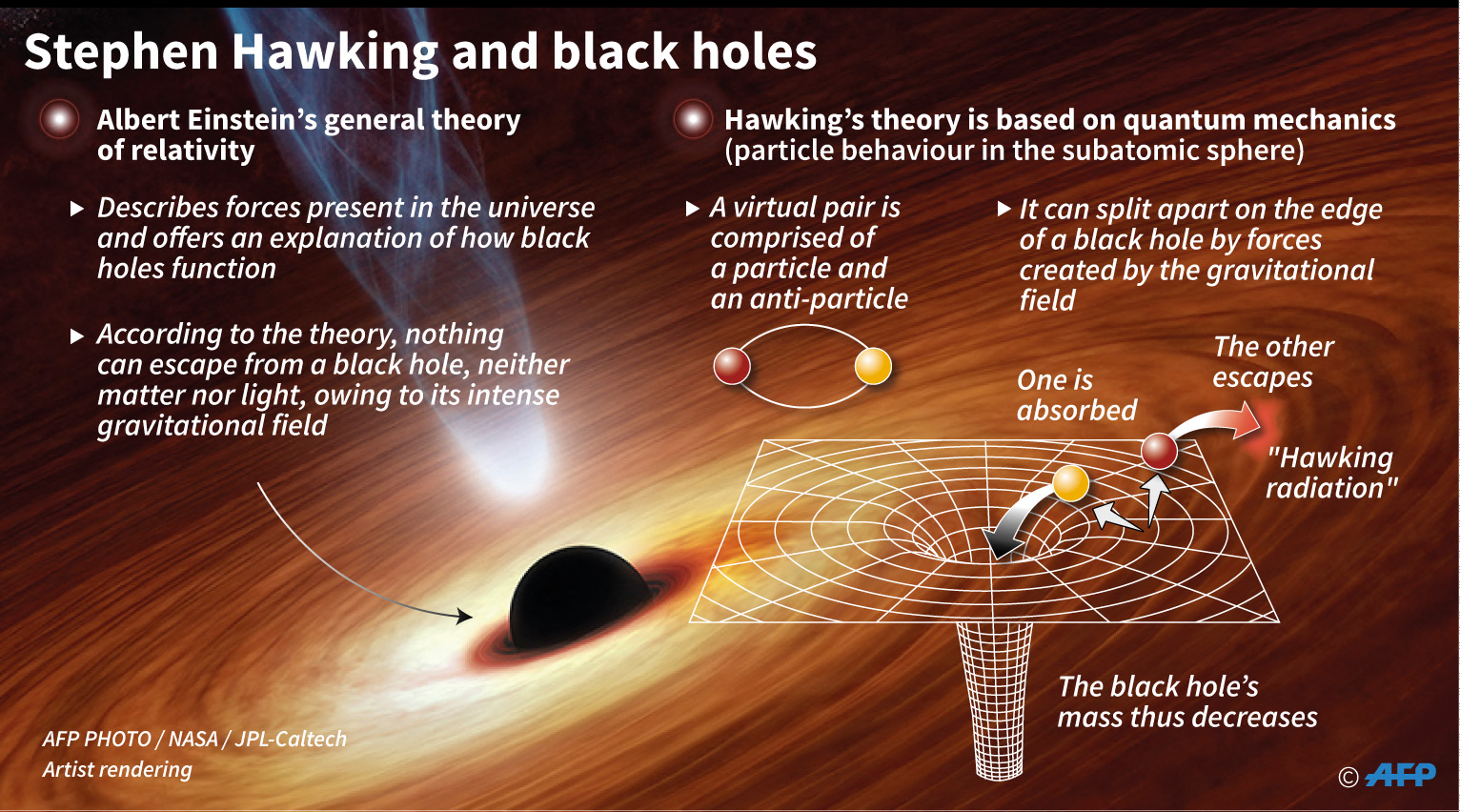
Physicists have coaxed a black hole's most famous glow out of a strand of optical fiber and, for the first time, watched that light react back on the simulated black hole that produced it.
The result gives researchers a rare, hands-on look at Hawking radiation — the faint thermal emission that Stephen Hawking predicted should leak out of black holes — and offers a first clue about the tiny push that could, in principle, make a real black hole slowly evaporate, the research team said in a new study.
Working with a tabletop experiment in optical fibers, the international team detected both the radiation and its long-sought "back reaction" — the way the radiation feeds energy back and reshapes the object that created it.
According to the new study, published July 1 in the journal Nature, the light behaved exactly as Hawking predicted it should: like the glow of a warm object, with a definite temperature and a spectrum that fades away steadily toward higher frequencies. It did so even in a regime where the usual textbook description of a black hole should break down.
Hawking radiation is famous because it sits at the crossroads of physics' biggest ideas.
"Jacob Bekenstein predicted that black holes have an entropy and a temperature, and Hawking calculated the thermal radiation of the black hole," study co-author Ulf Leonhardt, a physicist at the Weizmann Institute of Science in Israel, told Live Science via email. "In Hawking-Bekenstein radiation, quantum physics, general relativity and thermodynamics come together — subjects that are normally in conflict with each other."
The conflict runs deep: General relativity pictures space and time as smooth and continuous, while quantum mechanics describes a world of discrete, unpredictable jumps — and no one has managed to fully reconcile the two.
That combination is exactly what makes Hawking radiation so hard to study. Astronomers have never seen Hawking radiation from a real black hole and probably never will; the glow is far too faint to pick out across the cosmos. So physicists have turned to laboratory stand-ins that obey the same equations, building black hole analogues out of flowing water, ultracold atoms and, as in this study, light.
The trick behind every black hole analogue is a moving medium. "Imagine a swimmer in the sea with a current faster than he can swim," Leonhardt explained. "He is swept away. This is what happens beyond the [event] horizon, and this is why normally nothing can escape the black hole."
A black hole's event horizon is the boundary where that current — space itself, in real life — starts moving faster than anything can travel. To recreate it, the team needed a material that appears to rush along at the speed of light. Their solution was elegant: use light to make the "material."
"In optics we need a material that appears to move at the speed of light," Leonhardt said. "For this we use light itself — in nonlinear optics, light acts like a material."
In practice, the researchers fired an intense, ultrashort "pump" pulse into a thin photonic-crystal fiber — a strand of glass threaded with a pattern of tiny air channels running along its length, which lets researchers fine-tune how light moves through it. As it traveled, the pulse slightly changed how the glass bent light, creating a moving speed bump that raced along with it. A second, much weaker "probe" pulse then ran into this moving front. Where the probe could no longer keep up, an artificial horizon formed — and the black hole analogue was born.
The payoff came in the ultraviolet. According to theory, Hawking radiation is created in pairs: One partner escapes, while the other, carrying "negative" energy, is the mirror image that would fall into a real black hole. In the fiber, that partner showed up as ultraviolet light.
"We counted photons in the ultraviolet that correspond to the Hawking partners beyond the horizon," Leonhardt explained. "They have a wavelength around 233 nanometers. This was our signal."
Just as important as seeing the glow was understanding how it was made. For years, researchers assumed the fiber built up its Hawking radiation through a cascade — a chain of separate steps in which the light is converted first into one intermediate form, and then another, each feeding the next before the radiation finally emerges. The team found that, instead, a single, direct interaction does the job, with the pump and probe light producing the Hawking pair in one clean step. It is a much simpler picture that the researchers said may carry over to other analogues and perhaps even to real black holes.
Because energy has to come from somewhere, making Hawking radiation should nudge the source that created it. For a real black hole, that nudge is how it loses mass and, over unimaginable timescales, evaporates entirely — the process Hawking described in his landmark 1974 paper. No experiment had ever captured that recoil.
Here, the team saw it. Producing the radiation shifted a small fraction of the pump pulse's own light to a slightly different color, leaving a telltale lopsided pattern in the spectrum. That asymmetry, absent in earlier experiments, is the fingerprint of the back reaction, or recoil — the black hole analogue quietly paying the energetic price for its own glow.
The result also speaks to one of the thorniest puzzles in black hole physics: the trans-Planckian problem. Trace Hawking's radiation back to where it was born and the calculation runs into territory no physicist can vouch for — the Planck scale, the vanishingly small size at which space and time are thought to lose their familiar meaning and all known physics gives out. Hawking's prediction, in other words, appears to rest on a foundation that may not exist.
"Any light getting away from the horizon is stretched out enormously," Leonhardt said. "So it must come from waves smaller than the tiniest scale in nature, where the physics is unknown. Would that still give Hawking radiation? That was the question, and we have answered it in our experiment." Remarkably, the glow stayed perfectly thermal even in this extreme regime.
The team's next step is concrete. So far, they have used ordinary laser light, which reproduces the spectrum of Hawking radiation but not its deepest quantum weirdness. Next, the team plans to "go quantum," Leonhardt said. "We will explore how to get into the quantum regime and observe quantum features such as entanglement" — the ghostly link that should tie each escaping Hawking particle to its lost partner.
See how much you know about black holes with our black hole quiz!

The School of Science has announced the winners of its 2025 Awards for Excellence in Teaching and Mentoring. This year, the Teaching Prizes were restructured to acknowledge early- and mid-career teaching excellence, in addition to an overall prize for teaching excellence that includes instructors and non-tenured instructors or lecturers.
Olivia Corradin, assistant professor of biology and a member of the Whitehead Institute for Biomedical Research, received an Award for Teaching Excellence. Corradin’s nominators emphasized that she is an exceptionally clear and engaging educator.
Julien Tailleur, associate professor of physics, received an Award for Excellence in Mentoring and Advising in recognition of his dedication to mentorship. Nominators describe Tailleur as an outstanding research supervisor and group leader who cultivates an open and respectful environment.
John Urschel, Class of 1956 Career Development Assistant Professor of Mathematics, received an Award for Teaching Excellence. Many students call Urschel the best instructor they have had and their favorite professor at MIT, noting that he cares greatly about his students’ success and shows them why linear algebra is “so cool.”
Recipients of the School of Science Awards for Excellence in Teaching and Mentoring were honored alongside School of Science Infinite Expansion and Mile Award winners at a celebratory luncheon.
The School of Science welcomes nominations for the teaching prize at the end of each semester. Nominations can be submitted to the School.
The post Three win School of Science Awards for Excellence in Teaching and Mentoring appeared first on MIT School of Science.
Watering your lawn in the summer can be both pragmatic and fun with so-called "silly sprinklers," designed to create amusing loops and spirals of water jets. And there's some fascinating physics at work to boot. Researchers at New York University's Courant Institute conducted a series of experiments with different silly sprinkler designs to find the answer to a longstanding problem in fluid dynamics, according to a new paper published in the Proceedings of the National Academy of Sciences.
As previously reported, the reverse sprinkler problem is associated with physicist Richard Feynman because he popularized the concept, but it actually dates back to a chapter in Ernst Mach’s 1883 textbook The Science of Mechanics (Die Mechanik in Ihrer Entwicklung Historisch-Kritisch Dargerstellt). Mach’s thought experiment languished in relative obscurity until a group of Princeton University physicists began debating the issue in the 1940s.
Feynman was a graduate student there at the time and threw himself into the debate with gusto, even devising an experiment in the cyclotron laboratory to test his hypothesis. One might intuit that a reverse sprinkler would work just like a regular sprinkler, merely played backward, so to speak. But the physics turns out to be more complicated. “The answer is perfectly clear at first sight,” Feynman wrote in Surely You’re Joking, Mr. Feynman (1985). “The trouble was, some guy would think it was perfectly clear [that the rotation would be] one way, and another guy would think it was perfectly clear the other way.”
© NYU's Applied Mathematics Laboratory
Albert Einstein gave us the theory of relativity, explained the photoelectric effect and predicted the existence of gravitational waves. He revolutionized our understanding of space, time and gravity.
In fact, he is so famous for his brilliance that "Einstein" is synonymous with "genius." But being a genius doesn't mean you're infallible. So was Einstein wrong about anything?
"For sure, he was wrong about tons of things," Nicolás Yunes, a theoretical physicist at the University of Illinois Urbana-Champaign, told Live Science. "We remember him for the things he was right about, for the most part, because the things he was right about shocked the scientific world and eventually those ripples affected everyone on Earth."
Sign up for our weekly Life's Little Mysteries newsletter to get the latest mysteries before they appear online.
For example, one of his most famous predictions was marred by a mathematical mistake. In 1916, Einstein correctly realized that the acceleration of matter could produce ripples in space-time that we now call gravitational waves. But when he and the physicist Nathan Rosen described these waves using mathematics, they ran into a problem: Any solution to the equations of general relativity that would allow for gravitational waves "blew up," Yunes said. "They had these singularities … these divergences. And solutions that diverge and explode like that, they can't be physical representations of reality."
As a result, Einstein changed his mind and decided that gravitational waves couldn't exist. He wrote up his results and submitted them to the journal Physical Review, which had recently begun sending papers to outside experts for peer review. An anonymous reviewer caught an error in Einstein's math, and when Einstein learned about it, he was so furious that he withdrew the paper and submitted it to a different journal.
But the reviewer had spotted a real error: Einstein's mathematical infinities were a coordinate artifact. Much like Earth's lines of longitude seem to converge to a "singularity" at the North Pole even though nothing unusual is happening there on the ground, Einstein's math could have been fixed by using a different set of coordinates.
Without Einstein's knowledge, the reviewer befriended and demonstrated the error to Einstein's assistant, who explained it to Einstein. Einstein corrected the error and republished the paper with the opposite conclusion, showing that gravitational waves do, in fact, exist.
Remarkably, Einstein stumbled on the same error twice — at least, it seemed that way. When examining the mathematics around black holes, he once again calculated impossible infinities — this time, at the edge of a black hole. And once again, he concluded that this must mean the object couldn't exist.
"Einstein remained skeptical of the existence of black holes," John D. Norton, a professor in the Department of History and Philosophy of Science at the University of Pittsburgh, told Live Science in an email. "He was resolute in his judgment that there would be a singularity in space-time already at the event horizon of a black hole, which is now merely regarded as marking the point of no return for those falling into a black hole."
But this time, Einstein was not convinced that he made a mistake. Norton argues this wasn't just stubbornness; it reflected a philosophical belief in how Einstein thought mathematics and physics should relate to each other.
"He was unmoved by alternative analyses that found his mathematical infinities to be merely artifacts of the particular mathematical methods he preferred," Norton said.
Einstein's resistance to quantum mechanics is probably his most famous wrong turn. His central objection was to a phenomenon called quantum entanglement: the idea that two particles can be linked in such a way that measuring one instantly affects the other, no matter the distance between them. In a 1947 letter to his colleague Max Born, he wrote, "I cannot seriously believe in it because the theory cannot be reconciled with the idea that physics should represent a reality in time and space, free from spooky actions at a distance."
Einstein thought this instantaneous phenomenon seemed to violate special relativity, which says that nothing can travel faster than light. As a result, he believed quantum mechanics must be incomplete and that there was some deeper, unknown description of reality that would restore order.
"He died not liking quantum mechanics," Yunes said. It wasn't until 1964, almost a decade after Einstein's death, that John Bell proved entanglement was real.
"Today, a lot of the technology that we have relies on quantum mechanics, and so we know it's correct," Yunes said. "But it's still incompatible with general relativity, with [Einstein's] classical theory."
"It's possible that general relativity is wrong," Yunes said. "It's also possible that quantum mechanics is not the right description when you're talking about systems that are very strongly gravitating and you're looking at Planck-scale-type dynamics," which are incredibly small scales at which quantum effects dominate. For instance, the center of a black hole, which is both compressed to the quantum scale but also sits inside the most intense gravitational field in the universe, is a place where general relativity predicts a singularity that quantum mechanics has no way to describe.
But many of Einstein's mistakes still moved science forward. "General relativity is a good example," Norton said. "Einstein based it on the idea that he was generalizing the principle of relativity to acceleration and on what he soon called Mach's principle. Neither proved compatible with his final general theory of relativity."
Einstein's mistakes might come as a surprise to others, but they didn't to him. Once, when writing a book with his collaborator Leopold Infeld, Infeld told him he was taking special care with it because Einstein's name would appear on it. Einstein laughed and said, "There are incorrect papers under my name, too."
See how much you know about Albert Einstein with our Einstein quiz!
This week's science news was filled with big discoveries from the world of the small, led by a physicist's creation of a mini-universe, which was designed so we can watch time emerge from within an isolated quantum system.
The experiment was performed using a Bose-Einstein condensate — a strange state of matter that consists of thousands of atoms blended into a single quantum object at near absolute zero (minus 273.15 degrees Celsius, or minus 459.67 degrees Fahrenheit). The system showed time speeding up, slowing down and even stopping, depending on what the system was doing.
Those weren't the only highbrow high jinks using a Bose-Einstein condensate we reported on this week. We also covered NASA's upgrade to its mini-fridge-sized laboratory on the International Space Station that will use the bizarre state of matter to probe the quantum world. Back on Earth, physicists also found that complex numbers aren't necessary for quantum mechanics to work and used quantum computers to create a rare material critical to nuclear fusion. And to stick with news from the small (and weird) things of the world, we also reported that scientists have created little diving suits to transform cockroaches into search-and-rescue cyborgs.
The Arctic is the world's fastest-warming region, where sea ice is rapidly disappearing at a rate of 12.2% per decade.
The ice is crucial for maintaining stable sea levels and marine nutrient flows, and for reflecting solar radiation away from our planet, so its precipitous decline is deeply concerning. That's why one team of researchers turned to a surprisingly simple method to stem the ice loss: flooding ice sheets with seawater to thicken them.
The results, despite some major caveats, showed a lot of promise.
Discover more planet Earth news
—Extreme heat waves are making our cities buckle. Investing in urban nature is no longer optional.
If you're as shamefully attached to your devices as I am, you may have wondered about the wildly differing times it can take for them to charge. So what's the science behind fast charging, and does it damage a device's battery more than regular charging does?
—If you enjoyed this, sign up for our Life's Little Mysteries newsletter
It was found amid photos of headstones during a restoration project at Boston's Granary Burying Ground — a gravestone with only one name, "Boston."
That's how a team of conservationists chanced upon the tombstone of Sebastian, a formerly enslaved man who died free in 1729 and chose the city's name as his own.
A search through the historical archives has produced a wealth of information about Boston's past, including his reputation as a hardworking handyman throughout the city, and his emancipation following the death of the man who held him in slavery.
"It's been there all along. We just had to go look and share the story," Michelle Wu, the mayor of Boston, said in a July 4 speech.
Discover more archaeology news
—Neanderthals and modern humans may have shared culture 59,000 years ago in Turkey, study finds
—New sodium metal battery design charges in just 4 minutes and retains its capacity for years
Antibiotic resistance continues to pose a growing danger across the U.S., with more than 2.8 million antimicrobial-resistant infections occurring in the country each year. Last week, we brought you a report from Live Science health editor Nicoletta Lanese, who visited Japan to investigate how that country is curbing its overuse of antibiotics.
Now, in the second part of a feature series into the fight against this "silent pandemic," Nicoletta interviewed medical sociologist Julia Szymczak to dig into the social and emotional drivers of antibiotic overprescription.
If you're looking for things to keep you busy over the weekend, here's a selection from our best opinion pieces, interviews, diagnostic dilemmas and crosswords that we published this week.
—Superintelligent AI in space could explain the Fermi paradox [Opinion]
—Diagnostic dilemma: A woman heard voices for years — but not because of psychosis [Diagnostic Dilemma]
—Live Science crossword puzzle #51: Largest rodent on Earth — 4 down [Crossword]
It doesn't look like much, but this blurry, gray image is the first-ever close-up photo of one of Earth's temporary "quasi-moons" — a fast-spinning asteroid temporarily orbiting the sun in sync with our planet.
Of equal intrigue is the spacecraft that took the image: a secretive Chinese probe that is likely gearing up to land on the space rock and snag a sample — although an unexpected hiccup will make that more difficult.
Want more science news? Follow our Live Science WhatsApp Channel for the latest discoveries as they happen. It's the best way to get our expert reporting on the go, but if you don't use WhatsApp we're also on Facebook, X (formerly Twitter), Flipboard, Instagram, TikTok, Bluesky and LinkedIn.
A new upgrade to the International Space Station's (ISS) quantum laboratory is enabling NASA to probe the behavior of atoms further than ever before, the space agency has announced.
Combining the ISS's newly upgraded "Cold Atom Laboratory" with the near zero-gravity of low Earth orbit, scientists are attempting to understand the properties of so-called "ultracold" atoms in an environment impossible to replicate on Earth. The aim of the mission is to study how clouds of atoms behave at temperatures close to absolute zero (minus 459.67 degrees Fahrenheit or minus 273.15 degrees Celsius) — the coldest possible temperature in the universe, where atoms lose all their energy of motion.
"At the coldest temperatures, matter behaves drastically different from anything we have experienced," Jason Williams, project scientist for the Cold Atom Lab at NASA’s Jet Propulsion Laboratory in Southern California, which built the facility, said in a statement. "The wavelike nature of matter dominates, and ultracold matter can behave in ways that are not only unexpected, but that also enable extremely precise measurements of time, gravity, and motion. The lab has lots of tools — especially with this latest upgrade — to let us probe the nature of the universe."
Atoms and their subatomic particles are quantum mechanical objects whose behavior is fundamentally different from that of the large-scale world. For example, the laws of quantum mechanics predict that particles can be in more than one place at the same time (quantum superposition); can be mysteriously linked with each other over great distances (quantum entanglement); and move through spacetime as waves as well as moving like fixed, solid objects.
But observing these behaviors is notoriously difficult. Firstly, atoms are so tiny that if an atom were the size of a golf ball, then a human teeing one off would stand roughly as tall as the distance from Earth to the moon. Secondly, it’s impossible to isolate measurements of these behaviors for atoms in "normal" environments (like on Earth), as the desired quantum behavior is disturbed by energy from heat and gravity.
To overcome these challenges, the ISS's Cold Atom Laboratory — which is the size of a mini-fridge — uses lasers to cool gases of rubidium and potassium to just above absolute zero. At these temperatures, atoms form a state of matter known as a Bose-Einstein condensate, in which many atoms behave like a single wave of quantum matter.
Not only does this setup allow scientists to observe quantum behaviors on a much larger scale than that of single atoms, but the reduced gravity enables the condensate matter waves to expand and evolve undisturbed for much longer periods than would be possible on Earth.
This is the fourth major upgrade to NASA’s Cold Atom Laboratory since it arrived aboard the ISS in 2018. According to NASA, the significant improvements in this most recent upgrade include a redesigned magnetic trap to contain the cloud of atoms, improved atom sources, and better measurement capabilities.
Scientists launched these upgrades to the ISS in April 2026, and they have since been installed, switched on, and started making state-of-the-art measurements. As well as enabling novel tests of fundamental physics, measurements of these effects are critical in demonstrating future, space-based, highly precise quantum technologies related to positioning, navigation, timing, and gravity sensing. These technologies could one day enable astronauts to navigate on the moon without GPS and produce high-precision maps of Earth’s gravity.
"In the previous century, there was a quantum revolution that led to lasers, cellphones, and MRIs for medical imaging," Ethan Elliott, deputy project scientist at NASA’s Jet Propulsion Laboratory in California said in the statement. "We’re performing Quantum 2.0 – direct manipulation of large quantum states – and we hope for similar gains in quantum technology by advancing this science in orbit."
For the first time, physicists have built a working version of quantum mechanics without complex numbers — numbers that have been considered essential to the theory for nearly a century.
Complex numbers combine a regular "real" number with an "imaginary" one — a multiple of the square root of -1, represented by the symbol i — into a single value, like 3 + 4i. The square root of -1 doesn't correspond to any quantity you could count or measure directly (you can't have negative one apple, for instance), which is why mathematicians call it imaginary.
Still, complex numbers have many useful applications. Engineers use them to describe alternating electrical current. Physicists use them to describe waves. And ever since quantum mechanics was first documented in the 1920s, complex numbers have been built directly into its equations. Quantum mechanics describes particles using something called a wave function, and that description relies on complex numbers.
In 2021, a team of physicists predicted that a version of quantum mechanics built with only real numbers would make incorrect predictions in certain experiments involving multiple particles. The following year, other researchers ran those experiments, and the results matched standard quantum mechanics, not the real-number version. Complex numbers seemed unavoidable.
But that 2021 result rested on one specific assumption: a particular mathematical rule for combining particles. That led physicists to ask a question: Are complex numbers actually necessary to describe reality at the quantum level, or are they just a convenience?
Now, in a new study published June 18 in the journal Physical Review Letters, researchers have found a way around the 2021 result.
"Complex numbers are not needed for quantum mechanics," study first author Pedro Barrios Hita, a theoretical physicist and doctoral student at the German Aerospace Center and Heinrich Heine University Düsseldorf, told Live Science.
The 2021 result relied on a specific mathematical rule called the tensor product, which combines two separate quantum systems into one. If you have two particles and you want to combine them into a single mathematical description, you can use the tensor product. It's a rule taught in every quantum mechanics textbook.
It works well for ordinary complex-number quantum mechanics, but past attempts to build a real-number version around that same rule ran into trouble. They couldn't reproduce the correlations seen in experiments involving three or more entangled particles.
In their new study, Barrios Hita and his colleagues found that the tensor product isn't the only option. They built quantum mechanics around a different rule based on an idea: An action taken on one part of a system shouldn't have any effect on a separate part of it.
In ordinary quantum mechanics, multiplying a particle's state by i is undetectable on its own. But when two particles combine, that i can shuffle over and effectively attach itself to the other particle instead. Physicists call this phase kickback, and it's built automatically into the tensor product.
Barrios Hita's team had to recreate that shuffling using only real numbers. They attached a small "flag" to each particle to keep track of what the imaginary part used to store. Then, they treated certain flag combinations as physically identical, even though they looked different on paper. That grouping step allowed their real-number version to match every prediction of standard quantum mechanics, including the multiparticle cases that had tripped up earlier attempts.
At its core, the trick is simple. A complex number, like 3 + 4i, is really just a pair of ordinary real numbers (3 and 4) — the i is only a label marking which one is the imaginary part. "A complex number is nothing but two real numbers," Barrios Hita said. His team essentially built a bookkeeping system that tracks those two real numbers separately, instead of combining them into one complex number. It took a long time to figure out how to make that work consistently across multiple combined particles. But once they did, Barrios Hita said, the underlying structure turned out to be elegant.
The result puts quantum mechanics in the same boat as other physics theories that are often written using complex numbers purely for convenience, Barrios Hita said.
"There are many other theories, like, for example, electromagnetism," Barrios Hita added, "which has complex numbers at its core. So, these theories are formulated using complex numbers, but [they] are not fundamental. They're just helpful tools to help express equations."
The work doesn't change any experimental predictions or point to new quantum technology. It's also currently limited to systems with a finite number of quantum states. Extending it to infinite-dimensional systems, which show up in many real physics problems, is a natural next step, and other researchers are already looking into it. Barrios Hita is moving on to different research, on how quantum properties like entanglement can be used as a resource.
Still, the study settles a decades-long debate. Complex numbers make quantum mechanics easier to write down, but they aren't required to make it work.
Artificial intelligence is increasingly being used to solve the mathematical equations that describe the physical world, not only to recognize images or generate text. One promising approach, developed over the last decade, is the physics-informed neural network, or PINN: a type of neural network trained not on labeled examples but on the governing equations of a physical system. Instead of learning from many recorded solutions, the network learns by minimizing how badly its output violates the equation it is meant to satisfy. This makes it possible to obtain solutions when little or no experimental data exist even in high dimensions, which is why the approach has attracted so much attention across physics and engineering.
A new study applies 1 the idea to the simulation of acoustic waves of geophysical interest, like seismic imaging subsurface exploration. All of these applications rely on the Helmholtz equation, named after the nineteenth-century physicist Hermann von Helmholtz, which describes how a wave spreads out once its frequency is fixed. Higher frequencies mean more rapid oscillation, and more rapid oscillation is far harder to compute accurately. Conventional numerical methods handle this by using extremely fine computational grids, which quickly become slow and expensive as the frequency rises.
Neural networks offer an appealing alternative because they need no such grid, but they come with a stubborn flaw. Left to their own devices, they learn smooth, slowly changing patterns long before they learn rapidly oscillating ones, a well-documented tendency known as spectral bias, or low-frequency bias. For wave problems, where the interesting behavior is exactly the rapid oscillation, this bias means standard PINNs can take a very long time to train and often still miss fine detail.
The new approach addresses this by building oscillation into the network from the start, using Gabor functions. A Gabor function pairs a wave-like oscillation with a Gaussian envelope that fades toward zero away from its center, so the oscillation stays confined to a small region of space. These functions were introduced in 1946 by the Hungarian-British engineer Dennis Gabor, who later won the Nobel Prize in Physics for inventing holography, as a way to describe signals that are localized in both time and frequency; the same mathematical shape turns out to suit wavefields just as well. Instead of asking the network to invent every oscillation from nothing, the method hands it oscillations that already look like waves and asks it only to work out how they should be positioned and combined across space.
The central innovation is in how that positioning is learned. Rather than having the network output the wavefield directly, it is trained to output a transformed set of coordinates, and the Gabor functions applied in that transformed space produce the final oscillating solution. This shifts the burden of representing the wave’s fine structure into a coordinate mapping, which turns out to be much easier for the network to learn smoothly. Earlier attempts to combine Gabor functions with neural networks needed extra networks or additional parameters to control the position and strength of each function, adding complexity and, at times, instability during training. The new formulation avoids this: it needs no additional trainable parameters beyond what a conventional network of the same size would already have.
A second contribution deals with the edges of the simulated region. Real waves can travel forever, but any simulation must stop somewhere, and naive boundaries send waves bouncing back into the domain as unwanted reflections. The established solution, first devised in 1994 for electromagnetic wave simulations and since adopted across many wave-based numerical methods, is a perfectly matched layer: a boundary region that gradually absorbs outgoing waves instead of reflecting them. Applying this technique inside a neural network training scheme usually calls for cumbersome complex-number arithmetic; the study works around this by splitting the calculation into separate, real-valued components and by supplying an approximate mathematical formula for the wave that would exist in a uniform medium, which keeps the training efficient without sacrificing accuracy near the boundary.
The method was tested across velocity structures of increasing complexity, from a simple layered medium to benchmark models resembling real, geologically folded terrain, and across a range of frequencies. In every case it was compared against an otherwise identical standard network trained the same way. It consistently reached accurate results in far fewer training steps, produced smaller errors, and stayed stable even when the network’s size or the random starting values of its weights were changed, an area where conventional networks, and earlier Gabor-based attempts by other researchers, tended to falter. The gap was largest precisely where standard methods struggle most: at higher frequencies.
Notably, these improvements did not come from making the network bigger. They came from embedding a piece of mathematical knowledge about how waves behave directly into the network’s structure, freeing its limited capacity to focus on learning spatial relationships rather than reinventing basic oscillations over and over. Because the Helmholtz equation also governs electromagnetic waves and other oscillatory phenomena, the same strategy could plausibly extend beyond acoustics, provided the physical equations involved are adapted accordingly. Combining mathematical structure with machine learning can produce methods that are simultaneously faster, more accurate, and less computationally demanding than relying on general-purpose neural networks alone.
Author: César Tomé López is a science writer and the editor of Mapping Ignorance
Disclaimer: Parts of this article may have been copied verbatim or almost verbatim from the referenced research paper/s.
The post Gabor-embedded PINN for overcoming spectral bias in high-frequency acoustic simulations appeared first on Mapping Ignorance.
Authors: Sergi Muria Maldonado, Professor de Didàctica de les Matemàtiques, Universitat de Barcelona; Anton Aubanell Pou, Professor de l’Institut de Formació Continuada i professor jubilat de Didàctica de les Matemàtiques, Universitat de Barcelona, and Jordi Font González, Professor de Didàctica de les Matemàtiques, Universitat de Barcelona
2026 marks 100 years since the death of Antoni Gaudí, the architect of the Basilica of the Sagrada Familia in Barcelona. While the temple’s beauty is extraordinary in its own right, it becomes even more profound when we explore the numerical patterns that lie behind its striking forms.
By contemplating the mathematical principles that underpin its structure, the visual harmony of the whole takes on a new dimension, endowing it with a renewed functionality, balance and coherence.
Mathematician Claudi Alsina i Català deeply studied the mathematics of the Sagrada Família. He undertook his initial studies in this field at the University of Barcelona, and supervised the doctoral thesis of Jordi Faulí, the architect currently in charge of the temple’s ongoing construction.
In his memoirs, Alsina stated:
Many had wondered whether the design of the Sagrada Família contained some module or system of proportions that guided the building’s metric relationships. (…) One Saturday afternoon, sitting at my desk at home, with all the data and documents on this mysterious proportional system – if indeed it existed – I discovered it. The 7.5-metre module and the ratios between the divisors of 12 (1:4, 1:3, 1:2, 3:4, 2:3, 1) seemed to explain a great deal.
It is no surprise that the number 12 plays a prominent role in the structure of the church. Gaudí conceived the Sagrada Família as a synthesis of architecture and religious symbolism, and the number 12 features heavily in the Bible: Jacob’s 12 sons, the 12 tribes of Israel, the 12 apostles and the crown of 12 stars in the Book of Revelation are just a few examples.
But its significance is not merely symbolic. From a mathematical point of view, 12 is a number particularly well-suited to establishing proportions, as it has many divisors. According to Alsina, the relationships between these divisors account for much of the basilica’s proportional system.
Drawing on Alsina’s work, we invite you to take a brief mathematical tour of the Sagrada Família.
The temple’s dimensions are based on the number 12 and a module of 7.5m. It is 90m long (7.5 × 12) and 60m wide (7.5 × 8). The width of the main nave is 45m (7.5 × 6).
In terms of height, the highest vault is that of the apse, at 75m (7.5 × 10), followed by the vault of the transept at 60 metres (7.5 × 8). The nave vault is 45m high (7.5 × 6), the side aisle 30m (7.5 × 4), and the choir 15m (7.5 × 2).
The Tower of Jesus Christ is the central and tallest of the cathedral. It stands at 172.5 metres (7.5 x 23), close to the height of the landmark hill of Montjuïc. It is crowned by a four-armed cross, 17m high and 13.5m wide. Surrounding this are the four Evangelist Spires, which reach a height of 135m (7.5 x 18).

The 138-metre high Tower of the Virgin Mary is the second tallest in the basilica. It is crowned by a 12-pointed star, which rests on three supporting arms. This star has a diameter of 7.5m, and is made up of a regular dodecahedron, with pyramid-shaped pentagonal points rising from each face. Its reflections of daylight and night-time illumination lend this star a unique beauty.
Polyhedrons also feature prominently in the towers of the Sagrada Família. The four towers of the Glory façade are topped by dodecahedrons, the four towers of the Nativity façade by truncated irregular octahedrons, and the four towers of the Passion façade by truncated cubes.
On each of the 12 towers, a spire rises above these polyhedrons. Those dedicated to the evangelists are crowned with regular icosahedrons containing spotlights that illuminate the large cross that sits atop the Tower of Jesus Christ. Just above each icosahedron is a sculpture that symbolically depicts each evangelist. There are numerous star-shaped polyhedrons throughout the church, particularly on the Nativity façade.

Catenary arches feature prominently as key structural elements of the church, as they are a highly effective way to transfer loads to the ground without the need for additional support. They can be seen in the system of sloping columns that support the vaults of the interior naves, the vaults and ceilings themselves, and the Nativity façade.
Inside the Sagrada Família, there are four different types of column. All are double-helix torsion columns – each has a rounded, star-shaped polygonal base, and is formed by the intersection of two opposing Solomonic columns. Above each one is a knot from which different branches emerge, similar to those of a tree, which very efficiently support the towers and the roof of the church.
The skylights in the roof are also one-sheet hyperboloids. Made up of straight lines, they are easy to construct, and optimise the capture and projection of light.
The church has other deeply symbolic hidden features. Take, for instance, the canopy above the high altar, which forms a regular heptagon 5 metres in diameter, whose seven sides symbolise the seven gifts of the Holy Spirit.

On the Passion façade there is a magic square in which the sum of all rows, columns and diagonals is 33. It appears to be inspired by the magic square featured in the engraving Melancholia I by Albrecht Dürer.
The mathematics that underpins the Sagrada Família makes it all the more beautiful. While the building itself is a sight to behold, a deeper understanding of the principles behind it inspires even greater admiration for the enduring genius of Antoni Gaudí.
This article is republished from The Conversation under a Creative Commons license. Original article.
The post The mathematical secrets of Barcelona’s Sagrada Familia appeared first on Mapping Ignorance.