❌

Normal view

Can Arid Planets Keep Their Cool?

14 July 2026 at 17:00

side-by-side images of Venus's surface today and an imagining of what its surface might have looked like in the past

Editor’s Note: Astrobites is a graduate-student-run organization that digests astrophysical literature for undergraduate students. As part of the partnership between the AAS and astrobites, we occasionally repost astrobites content here at AAS Nova. We hope you enjoy this post from astrobites; the original can be viewed at astrobites.org.

Title: Carbon Cycle Imbalances on Arid Terrestrial Planets with Implications for Venus
Authors: Haskelle T. White-Gianella and Joshua Krissansen-Totton
Authors’ Institution: University of Washington
Status: Published in PSJ

The Carbon-Cycle Thermostat

When discussing the habitability of planets, we usually focus on the habitable zone, the region around a star where a planet can host a temperature suitable for supporting liquid water on its surface. Yet, being in the right place doesn’t necessarily guarantee that a planet will be habitable.

A planet also needs the right atmospheric composition to sustain the necessary temperatures for hosting liquid water. A key mechanism found on Earth for maintaining this composition is the geologic carbon cycle, which acts as a built-in climate control system. This cycle begins with volcanic eruptions releasing carbon dioxide (CO2), which then dissolves in rainwater and forms a weak acid that weathers rocks on continents. The weathering products wash into oceans, where they form carbonate rocks, locking carbon away. Eventually, plate tectonics recycles some of that carbon back to volcanoes. The weathering process works faster when the planet is warmer, thus regulating the amount of CO2 and stabilizing the climate over long periods of time (but it should be noted that it can take up to a few hundred thousand years to rebalance this slow carbon cycle through the weathering process).

An important caveat is that the weathering process requires sufficient liquid water on the planet’s surface, so what happens in the case for planets with shallower oceans? Low-mass M dwarfs, the most common type of star found in the galaxy, are expected to host less-massive disks and therefore lower water inventories for forming planets. If more “dry” planets are indeed a more likely outcome of planet formation, we’d want to know how their arid conditions influence their long-term evolution and habitability.

Creating Carbon-Tracking Models

The authors built a model that tracks how water and CO2 move between a planet’s interior, oceans, and atmosphere over 4.5 billion years. The model notably includes the following:

  • A sophisticated weathering model that accounts for how runoff can limit rock weathering, improving upon previous models that only included a temperature dependence on weathering
  • Wind-driven evaporation limits that influence the amount of water evaporation in addition to sunlight-driven evaporation
  • Multiple deep water cycle parameterizations that explore how water moves between the interior and the surface

The model tests for four initial surface water inventories (0.1%, 1%, 10%, and 100% of Earth’s oceans) and then simulates how the surface water, atmosphere, and climate evolve over time.

A Critical Water Threshold

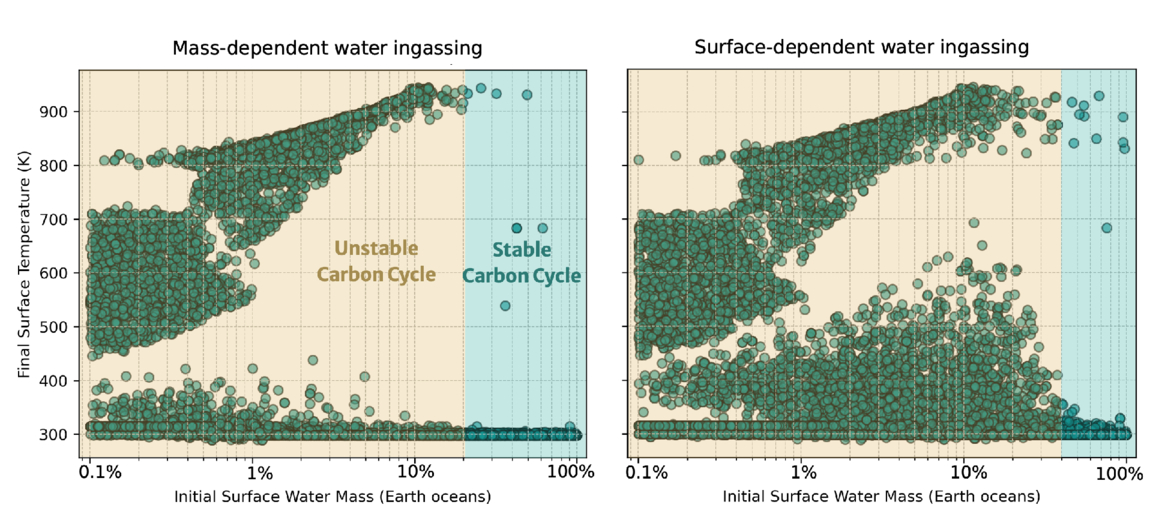
The models reveal that planets require at least 20–50% of Earth’s ocean mass to maintain a balanced carbon cycle. Below this threshold, the carbon cycle becomes unbalanced, leading to devastating consequences for habitability (Figure 1).

two plots of final surface temperature as a function of initial surface water mass

Figure 1: Final surface temperature after simulating 4.5 billion years of evolution as a function of initial water inventory for Earth-like planets. Each dot represents a model run with different assumptions (total carbon inventory, temperature dependence of weathering, soil age, etc.). The yellow region shows where most simulations result in uninhabitable surface temperatures from an unbalanced carbon cycle, and the cyan region shows where most simulations result in habitable surface temperatures and a balanced carbon cycle. The left and right plots show the results for two different parameterizations of the deep water cycle implemented in the model. [White-Gianella & Krissansen-Totton 2026]

For the more arid planets, models reveal a concerning runaway process. Limited surface water reduces precipitation and slows rock weathering. Weathering cannot keep up with volcanic CO2 release, causing CO2 buildup and warming of the atmosphere. The cycle repeats, driving runaway warming until all water evaporates.

Important Implications (Within and Outside Our Solar System)

Looking within the solar system, the results offer an explanation for how a potentially habitable Venus could have transitioned into its current inhospitable state. If Venus had formed with an initial water inventory below this critical threshold of 20–50% of Earth’s ocean mass, then its carbon cycle would have become unbalanced, creating the CO2 inferno seen on Venus today.

In future exoplanet studies, telescopes like the Habitable Worlds Observatory might detect ocean glint (specular reflection from liquid water) or measure land fraction from light curves. Finding a planet in the habitable zone but with limited ocean coverage would likely be bad news, as the planet could be quietly losing its grip on habitability. Astronomers may want to be more careful when looking at seemingly promising planets within their habitable zones.

Original astrobite edited by Natalie Price.

About the author, Jared Bull:

I am a 2nd-year PhD student at Johns Hopkins University. I study brown-dwarf variability and am interested in using time-series observations to uncover dynamic processes within their atmospheres. In my free time I like to read, cook, and do astrophotography.

The post Can Arid Planets Keep Their Cool? appeared first on AAS Nova.

Tiny Underwater Waves in the Ocean Can Affect the Climate Thousands of Kilometres Away

13 July 2026 at 15:38
Calm ocean waves with gentle ripples during sunset, reflecting the sky's colors.Thousands of metres below the ocean’s surface, there are tiny waves moving through the water. Much like breaking waves at the beach, these small waves within the ocean must eventually break. When they do, they create turbulence and mixing, similar to what you feel from a big wave breaking on the beach. This might seem […]

New Research Suggests Human Laughter May Hold a 15-Million-Year Old Secret

29 June 2026 at 13:04

Human laughter may hold a deeper connection to our primate ancestors than previously realized, preserving a 15-million-year-old evolutionary legacy. New research from the University of Warwick suggests the rhythm of laughter has remained largely unchanged across millions of years, offering surprising new insights into the origins of human speech.

Great apes are humanity’s closest living relatives, and species including chimpanzees, bonobos, gorillas, and orangutans all produce laughter-like vocalizations accompanied by smile-like facial expressions.

For years, scientists have wondered whether these vocal expressions share a common evolutionary origin. To investigate, researchers analyzed laughter recordings from 17 apes and humans representing five species: four orangutans, two gorillas, three bonobos, four chimpanzees, and four humans. Examining 140 laughter sequences, they found that every species produced laughter with evenly spaced rhythmic intervals between sounds—a pattern that appears to have been inherited from a common ancestor.

“It is impossible to assess the precursor forms of language directly from our extinct ancestors,” said Dr Adriano Lameria, an Associate Professor with the Department of Psychology at the University of Warwick and a researcher with its ApeTank, said in a statement. “Laughter, being evolutionarily older and having remained shared between all living great apes, provides a rare evolutionary window into the vocal transformations that unfolded across hominid evolution until the first humans appeared on scene.”

“Contrary to the classic notion that the first humans suddenly acquired vocal control capacities remarkably different from their predecessors, laughter evolution tells us that humans lay on a continuum, a prolongation of vocal control capacities that were already being cumulatively honed in for 15 million years,” Lameria added.

The discovery suggests that this rhythmic connection and foundation of laughter was already present around 15 million years ago and has persisted through millions of years of evolutionary change.

“How did humans evolve the remarkable ability to speak? Speech leaves no fossils, and complex language exists only in our own species. But we’ve found a 15-million-year-old clue in an unexpected place: our laughter,” said Dr. Chiara De Gregorio, Honorary Research Associate, Department of Psychology, University of Warwick. 

“Unlike speech, laughter is shared by all living great apes. By comparing how different species laugh, we can see that a basic rhythmic structure has remained unchanged since our last common ancestor. That’s extraordinary,” De Gregorio added.

Even though humans and apes share similarities—with ape vocalizations generally having a deeper resonance and tone—the underlying timing of laughter has remained remarkably stable over millions of years. What distinguishes humans is our greater voluntary control over laughter, allowing us to laugh intentionally in social situations in ways that our primate relatives cannot.

Scientists believe this increased vocal control may have played a key role in the evolution of speech. The human ability to precisely regulate vocal timing, tone, and expression is considered a fundamental component of producing complex spoken language.

The new findings challenge the idea that humans suddenly developed advanced speech abilities unlike those of earlier species. Instead, the research suggests that human communication evolved gradually, building upon vocal capacities that had already been developing in our ancient primate relatives.

Chrissy Newton is a PR professional and the founder of VOCAB Communications. She currently appears on The Discovery Channel and Max and hosts the Rebelliously Curious podcast, which can be found on YouTube and on all audio podcast streaming platforms. Follow her on X: @ChrissyNewton, Instagram: @BeingChrissyNewton, and chrissynewton.com. To contact Chrissy with a story, please email chrissy @ thedebrief.org.

❌