Login

'Time was speeding up, slowing down, or even stopping': Physicist demonstrates a key theory of time by building a 'mini-universe' in his lab
For the first time, a physicist has experimentally watched time emerge from within an isolated quantum system — by creating a “mini-universe.” This bizarre experiment raises an intriguing question: If the universe has nothing outside it, where does time come from?
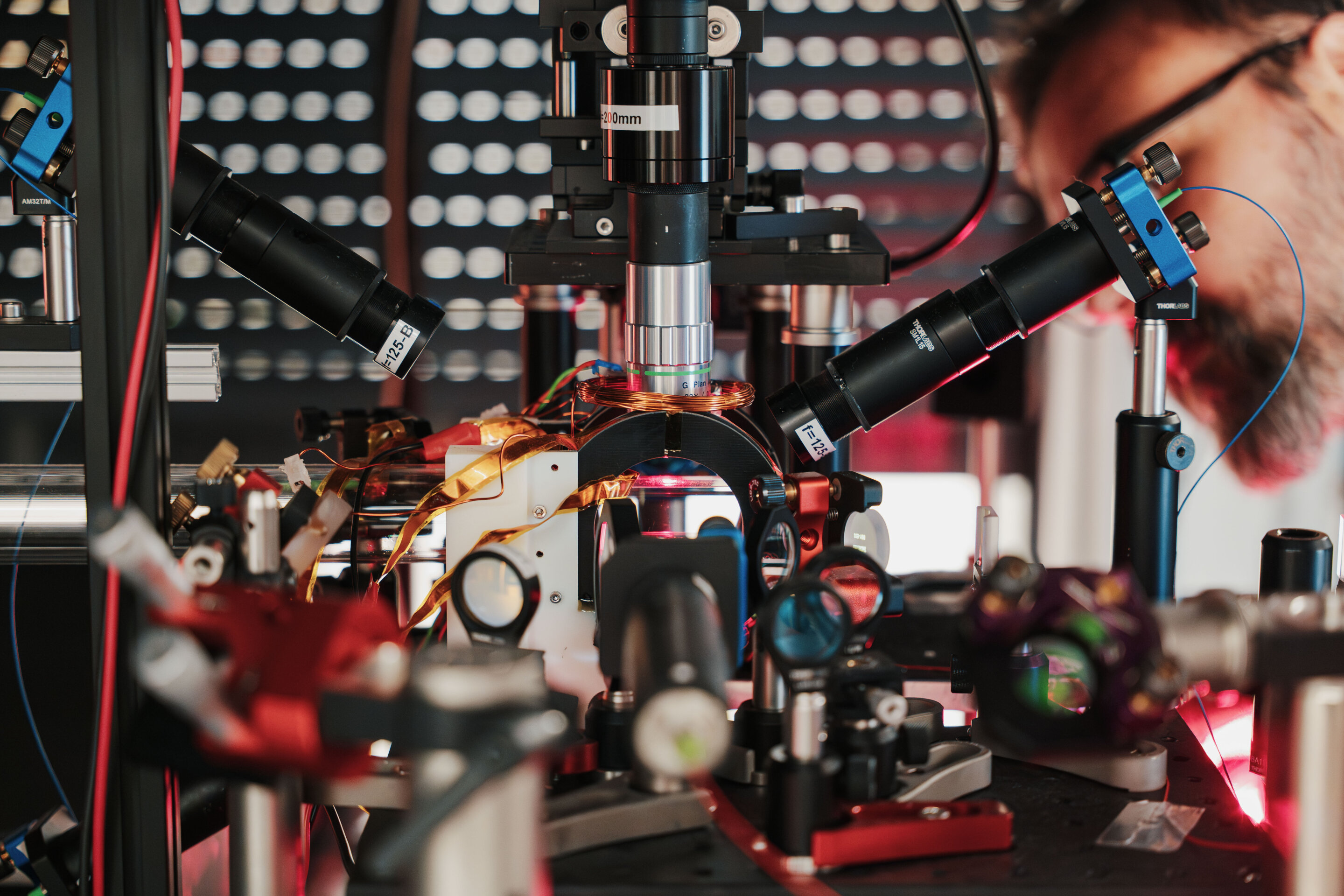
In a new study published June 11 in the journal Physical Review Research, Giovanni Barontini, an experimental physicist at the University of Birmingham in the U.K., used a cloud of ultracold atoms to build his mini-universe. The system was so well isolated from its surroundings that, like the universe itself, it had nothing external to use as a clock. He split that system in two and ignored one half — what he called the "dark sector" — to show that time could arise entirely from within the system.
The result offers the first experimental look on why the universe has time at all. "When you put everything together, things really start to make sense," Barontini told Live Science. "How time inside the system was speeding up or slowing down, or even stopping — this was quite surprising, how well everything came together. Very neatly, in a way. Which is something that doesn't happen that often in experiments."
The work is an experimental verification of ideas that have been floating around in quantum cosmology and thermodynamics for decades. This is not a bombshell claim that time is an illusion, but it is the first time anyone has put those ideas to a direct, quantitative test in the lab.
A universe with nothing outside
Barontini set out to look at a problem that physicists have puzzled over for nearly 60 years. The Wheeler-DeWitt equation — a central equation in quantum gravity, the field that seeks to unify Einstein’s theory of gravity with quantum mechanics — describes the universe as a whole system with no external time parameter. There is no cosmic clock ticking away outside the universe. So where does our experience of time come from?
One influential idea, called relational time, says that time doesn't exist as a fundamental ingredient of reality. Instead, it emerges from relationships inside the universe, with one part of the system acting as a clock for another. But this idea had never been tested directly in the lab.
Barontini's inspiration came from watching his son play with building toys. "I thought that it's something very similar to what we do in our labs," he told Live Science. "We play with very expensive toys. We create our own small samples of reality."
In his lab, that sample is a Bose-Einstein condensate — a state of matter that forms only at near absolute zero. In a Bose-Einstein condensate, thousands of atoms slow to a near standstill and blur together into a single quantum object, behaving as one.
The dark side of time
To mimic a universe with nothing outside it, Barontini placed the condensate in a trap and divided it down the middle with a thin sheet of laser light. He watched one half, the "bright sector," closely and deliberately ignored the other half, which he called the "dark sector."
The atoms in the bright sector sloshed back and forth in the trap, periodically spilling over the barrier and back again. Barontini called the moments when atoms flooded into the bright sector the "Big Bang" and the times when they drained out the "Big Crunch" (the nickname for one theory of how the universe will end, with the universe collapsing in on itself). Then, he tracked how entropy — a measure of disorder, or how spread out energy is within a system — was exchanged between the two halves as atoms crossed the barrier.
Instead of using laboratory time to order events, he built an "entropic time" — a clock defined entirely by how much entropy was flowing between the two halves of the system. If entropy was flowing, time was ticking. If no entropy was exchanged, time stopped. "The entropy exchange between the two systems could be transformed into an internal time variable," Barontini said.
Time speeds up, slows down and stops
What surprised Barontini most was how cleanly everything fit together. The internal, entropic time reliably ordered events in the bright sector. It matched the sequence seen in laboratory time, but it flowed at a different rate.
When entropy was flooding between the sectors, entropic time ran fast. When the exchange slowed, so did the clock. And when the two halves reached equilibrium (no more entropy flowing), the internal clock stopped altogether.
Both time and the arrow of time — maybe they just are born from ignorance.
Giovanni Barontini, experimental physicist at the University of Birmingham
"Time was speeding up or slowing down, or even stopping, depending on what the system was doing," Barontini said.
He then went a step further: Using this internal time, he derived a version of the Schrödinger equation and showed it accurately reproduced what he saw in the experiment. "This was quite surprising, how well everything came together," he said — "very neatly, in a way, which is something that doesn't happen that often in experiments."
Both time itself and the arrow of time — why time flows in one direction rather than the other — may arise from the same source: an observer giving up information. When Barontini chose not to look at the dark sector, he gave up knowledge of that half of the system. That act of ignorance, encoded in entropy, is what gave rise to time in the other half.
"Both time and the arrow of time — maybe they just are born from ignorance," Barontini said. "To have time and to observe, you have to give up some degrees of freedom."
Barontini sees this as just the beginning. The same cold-atom tool kit that generated a miniature Big Bang and Big Crunch in his trap could, in principle, be engineered to simulate far more exotic phenomena, such as black hole analogues, the conditions of the early universe, and what will happen at the moment of the Big Crunch itself.
"These are things we can do very simply, using the tools we already have to engineer our systems," he said.
The study is a proof of concept — a first demonstration that controlled quantum systems can serve as a test bed for some unanswered questions in physics. For now, those questions remain open.