Login

Dead-end bitcoin mining wastes as much energy as Switzerland's entire hydropower generation capacity
Network latency in bitcoin mining is driving massive energy waste — the annual equivalent of the total generation capacity of Switzerland's entire hydroelectric power system, scientists say. This wasted energy results from inefficiencies in the mining process and increasing competition among bitcoin miners.
In a new study published May 26 in the journal PNAS Nexus, the researchers aimed to provide a theoretical model to measure patterns within the networks powering bitcoin's distributed ledger system.
But they also calculated that in 2025, around 16,000 megawatts was wasted by fruitless bitcoin mining attempts, where competing mining efforts exert massive computational power to obtain the same units of bitcoin. This is roughly equivalent to the total generation capacity of Switzerland's 701 hydropower plants, according to statistics from the Swiss Federal Office of Energy.
It's important to note that this figure differs from the total energy consumed by bitcoin mining activity, estimated by researchers to stand at an annual level of 138 terawatt-hours, as of June 2024. This is higher than the annual energy consumption of several developed countries including Norway and the Netherlands.
Energy-guzzling crypto
Concerns around the environmental impact of bitcoin and other proof-of-work blockchain technologies have abounded in recent years.
In 2021, for example, bitcoin mining's water usage, primarily for liquid-cooled computer equipment, equated to more than the domestic water use of 300 million people in rural sub-Saharan Africa, according to a 2023 U.N. report.
Bitcoin is underpinned by a distributed ledger system, called a blockchain, which operates on a "proof-of-work" model. For a new unit of the digital currency to be generated, computing power must be used to solve a digital puzzle. In theory, the first entity to successfully "solve" the problem adds a new "block" of transactions to the ongoing chain and is granted a set quantity of bitcoin in return.
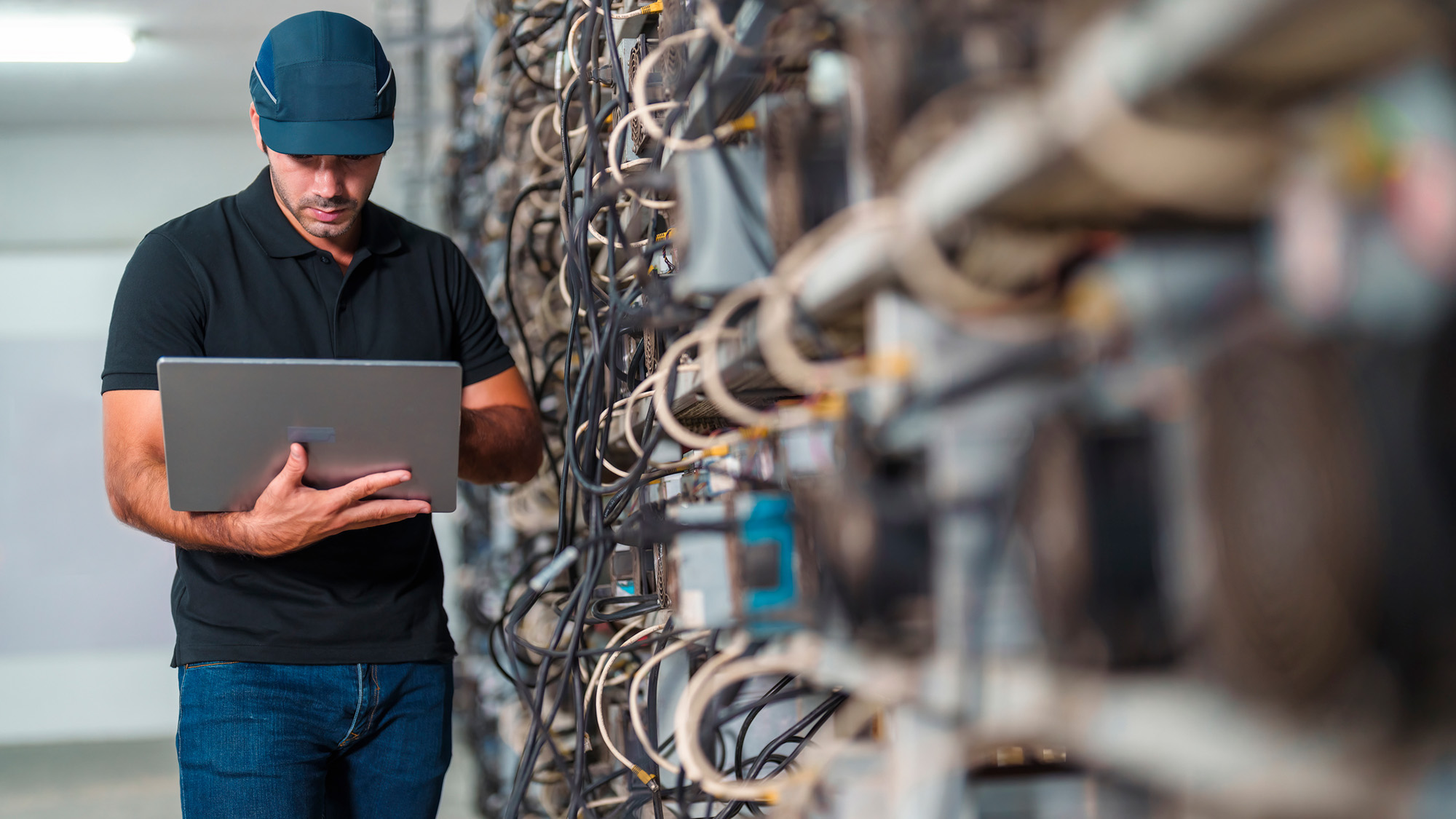
However, due to the explosion of interest in bitcoin as a financial trading asset, the competition for who can be the first to complete a block and claim the rewards has become incredibly fierce. A solution to the puzzle is based on computational power, with specialized hardware providing a greater advantage in speed. It has driven commercial entities to invest in building specialized data centers dedicated to such mining operations.
Because the race to be the first to mine a block is so competitive, the difference between first and second place can be just tiny fractions of a second. This often results in "accidental forks" — where two competing blocks are registered at almost exactly the same time.
In this scenario, the block with the longest chain of subsequent blocks built on top of it will eventually become a verified and legitimate part of the blockchain — earning its miners the bitcoin reward — while the competing block will be seen as invalid and worth nothing.
The energy needed to solve the proof of work and generate these "orphaned blocks" in the first place — as well as any subsequent blocks built on top of them before the winner is decided — is ultimately wasted.
"Despite their indication of a distributed network, accidental forks are an inefficiency of the Bitcoin protocol that leads to wasted computational resources (and thus energy), increasing the cost of network operations and its environmental impact to maintain a given level of security," the researchers wrote in the study.
According to the Crypto Carbon Ratings Institute (CCRI), a cryptocurrency analysis firm, bitcoin is the most dominant cryptocurrency by far, with a market capitalisation of more than $1.1 trillion — more than 80% larger than the next most popular currency, Ethereum. However, instead of proof-of-work, Ethereum uses a different form of consensus mechanism to establish block authorship, called "proof-of-stake," which is significantly less computationally intensive.
While other cryptocurrencies apart from bitcoin also use proof-of-work methods, bitcoin is around twice as large as its next nearest rival in this category, making it orders of magnitude more power-hungry.
Who rules the pool
Whereas previous models for analyzing fork rates treated all miners in the network as equal, this study considered elements such as network latency and geographic distribution, aiming to provide a "null model" — a baseline which can be used as a starting point to inform future analysis.
The model also allowed the researchers to quantify other notable trends, such as the distribution of "mining pools" — consortiums in which mining operators pool their efforts to maximize their potential success. They identified a decline in the dominance of Chinese mining pools from 2022 following the country's ban on bitcoin mining while also discovering high levels of consolidation at the upper level of the bitcoin mining industry.
The report found that just three mining pools produce over 50% of new bitcoin blocks. This is a problem because it risks a "51% attack," whereby unscrupulous miners enter fraudulent information into the blockchain by ensuring that they always produce the longest chain and, therefore, become validated.
This level of consolidation distorts the market for processing fees that bitcoin users pay to have their transactions included in the next block, the researchers added, and could thus allow miners to arbitrarily delay the inclusion of specific transactions.