
❌

Normal view

NASA looks for the origins of interstellar comet 3I/ATLAS | Space photo of the day for June 24, 2026

24 June 2026 at 15:00

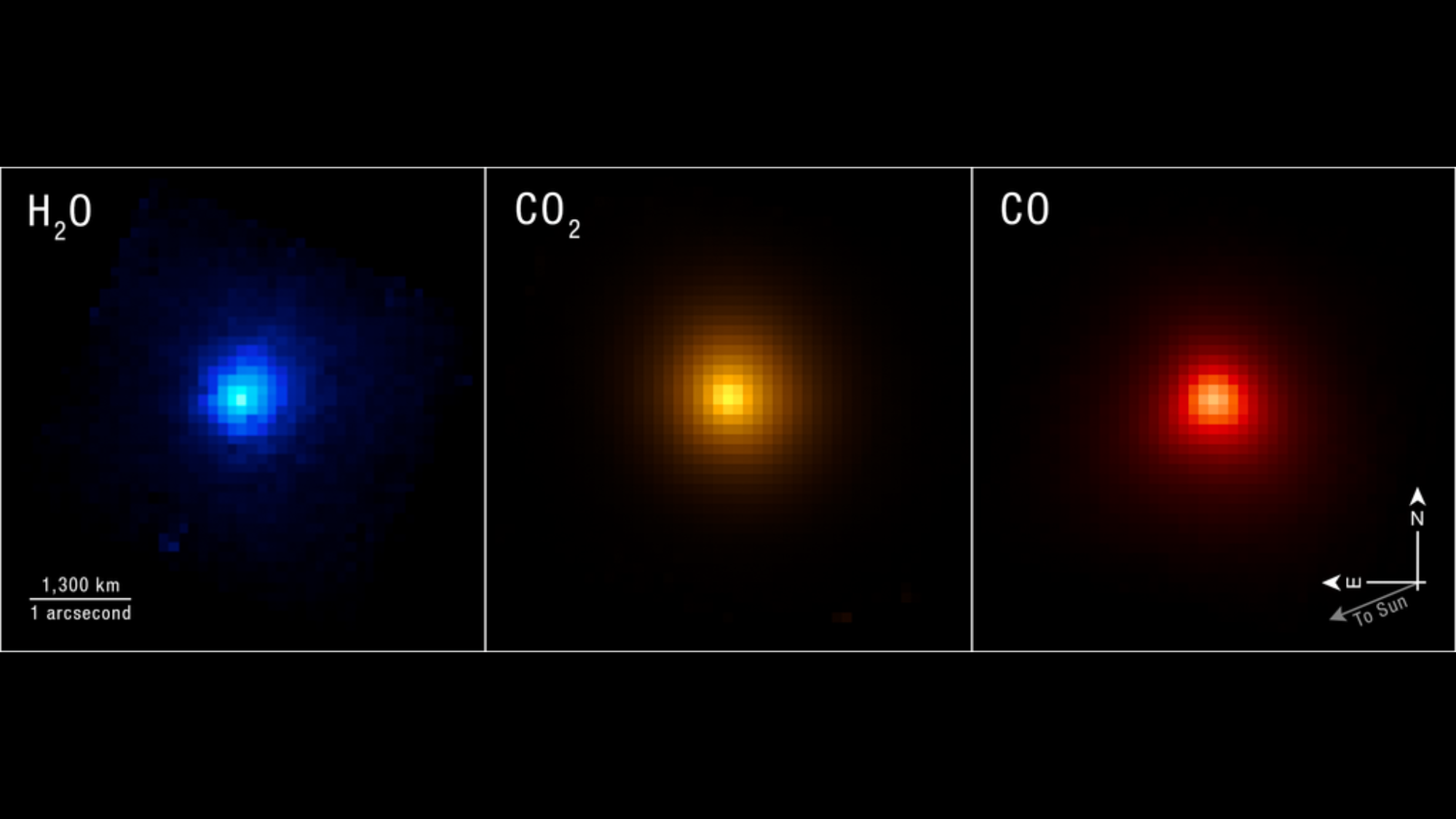
Three boxes contain a glowing center that in the left box is blue, the middle box is yellow, and the right box is red.

Researchers using JWST are finding clues about comet 3I/ATLAS' origins. (Image credit: NASA, ESA, CSA, STScI, Martin Cordiner (CUA, NASA-GSFC); Image Processing: Alyssa Pagan (STScI))

NASA's James Webb Space Telescope is finding clues that are leading scientists closer to understanding the origins of the interstellar comet 3I/ATLAS.

What is it?

Comet 3I/ATLAS captured the world's attention when it was discovered nearly a year ago on July 1, 2025. The comet was first spotted by the Asteroid Terrestrial-impact Last Alert System (ATLAS), and is only the third interstellar object every discovered.

The comet swooped through our solar system, passing by Earth at a far (and safe) distance on its tour of our cosmic neighborhood. It is on a long trajectory that will take it out of our solar system, never to return.

In observations from the James Webb Space Telescope, scientists were able to look in the direction the comet as it began moving away from the sun in December of last year. While in close proximity to our star, the sun's heat warmed the comet, making it extra bright and easy to observe.

With this view, astronomers were able to calculate some of the ratios of the chemicals present in the comet. This further highlighted that the object is from out of our solar system, as they found ratios of carbon and heavy hydrogen not found in comets in our solar system.

Researchers described their results in a new paper published June 22 in the journal Nature.

A chart exploring the new findings about 3I/ATLAS.

This graph shows some of the differences between 3I/ATLAS and comets found in our own solar system. (Image credit: NASA, ESA, CSA, Martin Cordiner (CUA, NASA-GSFC), Leah Hustak (STScI))

Why is it incredible?

Being only the third interstellar object ever found, people were excited about 3I/ATLAS. They were so excited, in fact, that conspiracies about the object sprouted up quickly. Due to it being from outside of our solar system, some claimed that the comet could be some sort of alien spaceship, similar to the initial suspicions about the interstellar object 'Oumuamua found years earlier.

But with new information coming in from space telescopes, and astronomers eager to understand this object better, these clues are leading us closer and closer to the true origins of this strange comet.

SpaceX Dragon says goodbye to the ISS | Space photo of the day for June 23, 2026

23 June 2026 at 15:00

A view out of the window of the ISS sees the SpaceX Dragon capsule with Earth in the background.

SpaceX's Dragon capsule leaves after dropping off some supplies and science at the ISS. (Image credit: NASA/Jessica Meir)

SpaceX's Cargo Dragon capsule shines in the sunlight over Earth as it departs from the International Space Station in a new image snapped from onboard the station.

What is it?

Peering through the window of the International Space Station (ISS), NASA astronaut Jessica Meir snapped a striking photo as she watched a SpaceX Cargo Dragon capsule depart from the station.

With sunbeams gleaming downward, reflecting off of the spacecraft's hull, the Dragon can be seen backing away from the station mere moments after undocking from the port on the station's Harmony module. The undocking is so recent that you can clearly see both the docking port and the hatch of the Dragon where the two connected.

The Dragon disconnected from the space station on June 16, and just one day later, parachuted into the Pacific Ocean off the coast of Southern California where it was retrieved, chock-full of cargo and finished science experiments.

Why is it incredible?

The space station has been in orbit since 1998 and continuously occupied since November, 2000. With decades of work in orbit, it can be easy to take for granted the incredible transport system that supports cutting-edge research hundreds of miles above Earth's surface.

The work done on the station is impressive, but this system is just as mind-boggling. In addition to launching and returning astronauts who perform critical maintenance and repair work on the station on top of their research duties, cargo missions keep the station stocked.

From food and clothing to medical equipment and intricate science experiments, these missions are essential for both keeping astronauts safe and healthy on station as well as continuing the progression of science in-orbit. This back-and-forth between Earth and the space station is an impressive feat, and this photo shows the system fully in-motion.

❌