
❌

Normal view

DARPA’s X-plane designed to maneuver with bursts of air gets new wings attached

24 June 2026 at 15:14

Boeing subsidiary Aurora Flight Sciences has begun installing the wings on the X-65, an experimental drone developed under DARPA’s Control of Revolutionary Aircraft with Novel Effectors (CRANE) program.

The installation brings DARPA and Aurora a step closer to flying the unconventional uncrewed aircraft, which was designed to test flight control using only bursts of pressurized air instead of conventional moving surfaces.

The X-65’s active flow control

The X-65’s key innovation lies in its active flow control (AFC) system. Fourteen AFC effectors embedded across the aircraft’s lifting surfaces use jets of high-pressure air to manage roll, pitch, and yaw.

This will either replace or supplement traditional flaps and rudders. The X-65 incorporates both systems to establish performance baselines before transitioning to AFC-only operation. Essentially, it will allow researchers to flight test the technology while minimizing risk.

An artist’s render of the X-65 drone. Source: Aurora Flight Sciences / X

“The X-65 conventional surfaces are like training wheels to help us understand how AFC can be used in place of traditional flaps and rudders,” Dr. Richard Wlezien, former CRANE program manager at DARPA, said in a 2024 press statement. Sensors will compare the two approaches to evaluate potential benefits.

Aurora Flight Sciences announced the wing’s arrival on social media, noting that the components were built at its West Virginia facility. Integration is underway in Virginia, with the first flight now targeted for 2027.

Novel effectors to enhance survivability

The X-65 features a co-planar joined wing configuration with triangular wing sections on each side that merge at the tips, plus small extensions for a total wingspan of 30 feet.

The triangular wings support testing across multiple sweep angles and feature modular, swappable sections for future AFC configurations.

The aircraft also includes a twin vertical tail, a chin air intake, and a single exhaust. The uncrewed aircraft has a gross weight of approximately 7,000 lbs.

DARPA kick-started the CRANE program in 2020. Though Aurora has advanced to the detailed design and fabrication phases, the program has encountered delays and cost overruns, as reported by The War Zone.

Original flight plans for 2025 slipped after higher-than-expected prototype costs and supply chain issues. Pentagon funding for the effort since fiscal year 2024 has reached nearly $63 million.

Eliminating moving control surfaces could yield multiple advantages. Removing moving parts could result in improved aerodynamics and efficiency, particularly at high altitudes. Reduced mechanical complexity also offers potential weight savings, lower maintenance demands, and greater reliability. For military applications, such systems could have enhanced survivability against battle damage.

The technology holds particular promise for stealth aircraft. Traditional control surfaces create gaps and protrusions that increase radar cross-section and require constant adjustments in fly-by-wire systems. AFC effectors embedded flush with the airframe could help maintain smoother external contours and lower observability.

As Aurora vice president Larry Wirsing stated last year: “The X-65 platform will be an enduring flight test asset, and we’re confident that future aircraft designs and research missions will be able to leverage the underlying technologies and flight test data.”
Self-healing contact lenses repair scratches with just one hour of UV light exposure

24 June 2026 at 01:34

Scratched contact lenses often mean an expensive replacement, even if the damage is minor. Researchers in South Korea have now developed a self-healing material that can repair those tiny imperfections using just one hour of ultraviolet light, opening the door to more durable soft contact lenses.

The new hydrogel-based material restores itself at room temperature and could eventually help wearers extend the life of their lenses instead of discarding them after everyday wear. The technology also combines a protective coating that resists scratches and bacteria, adding another layer of durability for future designs.

UV repairs damage

Researchers Jung-Hyun Choi and Byoung-Ki Cho created the material using a hydrogel, a water-rich polymer network already widely used in soft contact lenses. They redesigned the structure so that ultraviolet light, instead of heat, activates the repair process.

One hour of UV light nearly erases scratches in this self-healing contact lens material. Credit – ACS

Exposure to UV light with a wavelength of 365 nanometers for one hour triggers a chemical reaction known as disulfide exchange. During that process, sulfur bonds temporarily break apart and reconnect with neighboring atoms, allowing the damaged polymer network to gradually rebuild itself.

The team had previously demonstrated a heat-driven self-healing hydrogel, but that approach required several hours of warming. Extended heating dries out contact lenses and makes them unsuitable for everyday use, making room-temperature repair a more practical alternative. Laboratory tests showed the healing process restored scratched samples with high efficiency, leaving behind a nearly seamless surface instead of visible damage.

Protective coating adds strength

The researchers also coated the hydrogel with another polymer designed to reduce bacterial growth and shield the surface from abrasion. That extra layer proved effective during durability testing. Even after repeated contact with fine-grit sandpaper, the coated material maintained its clarity. Transparency declined by only about 2%, suggesting that routine scratches would have little effect on vision quality.

The hydrogel also retained water and displayed mechanical characteristics comparable to those expected from commercial soft contact lenses. Those properties are critical because comfort depends on a lens remaining hydrated throughout the day.

According to the researchers, users could eventually repair minor damage with UV lamps already found in many homes, including devices used for cleaning or curing gel nail polish. The repair process can also be repeated, allowing the material to recover from multiple instances of wear.

More testing ahead

Several steps remain before self-healing contact lenses reach consumers. The material must undergo additional stability evaluations and regulatory review to confirm it can withstand long-term use and repeated repair cycles.

If those hurdles are cleared, the technology could reduce waste and lower replacement costs for millions of contact lens users. Instead of treating every scratch as the end of a lens’s life, future designs may be able to recover from everyday damage and stay in service much longer. The project received funding from the National Research Foundation of Korea.

The study titled “Room-Temperature UV-Induced Self-Healing Hydrogels with Antifouling and Antiscratch Surfaces for Soft Contact Lenses” is published in the journal ACS Applied Polymer Materials.

MIT’s 6 mW chip lets tiny drones see and map their surroundings in real time

24 June 2026 at 01:21

MIT researchers have developed a low-power chip that enables tiny drones and robots to build detailed 3D maps of their surroundings in real time while consuming only about 6 milliwatts of power. The system-on-a-chip, called Gleanmer, could help battery-powered autonomous machines navigate cluttered environments such as industrial ventilation systems, warehouses, tunnels, and other confined spaces where obstacle avoidance is critical.

The technology may also find applications in lightweight augmented reality headsets, allowing them to map indoor environments without draining batteries. The chip combines specialized hardware with a compact mapping algorithm that dramatically reduces the memory and energy needed to create 3D representations of the world around a robot.

Mapping without burden

Building detailed 3D maps typically requires robots to process large volumes of image data and store complex representations of their surroundings. These tasks often demand significant memory and power, making them difficult to deploy on small battery-powered devices.

Instead of relying on conventional voxel-based maps, which represent environments using millions of tiny cubes, the MIT team uses flexible ellipsoid shapes known as Gaussians. These shapes can more efficiently represent curved objects and open spaces while requiring far less memory.

The researchers paired the chip with a mapping algorithm called GMMap, which creates 3D maps from depth images in a single pass. This allows the system to discard image data almost immediately instead of repeatedly storing and processing it.

“At any point in time, we only need to store a few pixels in memory, which significantly reduces the memory footprint our algorithm requires,” said Peter Zhi Xuan Li, one of the study’s co-lead authors.

The system also avoids another common challenge in mapping. As a robot moves, it often observes the same object from multiple angles, creating overlapping representations that increase map size. The MIT team developed a method to merge overlapping Gaussians directly without returning to the original image data.

Tiny chip, big reach

This approach allowed the researchers to keep much of the active data in fast on-chip memory rather than relying on power-hungry external storage. “By having a dedicated memory that just stores the objects you’ve seen in the previous few frames, you can access the data much more efficiently,” said co-lead author Zih-Sing Fu.

In tests involving a variety of previously recorded environments, Gleanmer generated detailed 3D maps in real time while consuming about 6 milliwatts of power. According to the researchers, this is roughly 2.5% of the energy required by the best existing chip designed for map construction.

The chip can also reconstruct obstacles and free space directly from live data streamed from an iPhone camera. By reusing compact Gaussian representations during path planning, the system enables robots to calculate collision-free routes using about 20% of the energy typically required.

“This paper showcases a key example of how you can leverage co-design of the algorithm and hardware to really push energy efficiency,” said Vivienne Sze, professor of electrical engineering and computer science at MIT and senior author of the study.

The researchers believe future versions could become even more efficient by placing computing resources closer to onboard sensors. Beyond robotics, the team is also exploring whether Gaussian-based representations could help computing systems process technical drawings and complex schematics more efficiently.

The research was presented at the IEEE Very Large-Scale Integrated Circuits Symposium.

This is How NASA Flight Tests New Technology

23 June 2026 at 17:00
3 Min Read

This is How NASA Flight Tests New Technology

A white and blue painted jet aircraft flies above a tan lakebed with the gear and wheels out. A model wing hangs below the aircraft’s center line. The cockpit is closed and two pilots are visible inside with flight gear on.
An F-15 aircraft flies above the world’s largest compass rose above NASA’s Armstrong Flight Research Center in Edwards, California, on Monday, April 20, 2026. NASA’s Crossflow Attenuated Natural Laminar Flow (CATNLF) test article is attached to the bottom of the F-15. The project aims to lower fuel costs for future commercial aircraft by testing a scale-model wing designed to improve laminar flow.
Credits: NASA/Jim Ross

Flight tests are a big part of how NASA turns breakthrough ideas into reality. From flying humans faster than the speed of sound to proving designs that helped shape the space shuttle, flight testing transforms bold concepts into safer, more efficient technologies that benefit the public.

“Flight tests are a way to safely and effectively prove new technology, which helps certification authorities certify equipment,” said Wayne Ringelberg, chief pilot at NASA’s Armstrong Flight Research Center in Edwards, California. “It helps industry iterate and make systems better, and it promotes research in areas where new ideas can be developed.”

For nearly 80 years, teams at NASA Armstrong have used flight testing in the Southern California desert to push the limits of aerodynamics and advance aviation. Thanks to that work, NASA-developed innovations are aboard every U.S. commercial aircraft and inside every control tower today.

“The space side of NASA uses flight test, too. Every mission, like Artemis II, is never routine,” Ringelberg said. “Everything we’re doing when flying a test mission is something new or different.”

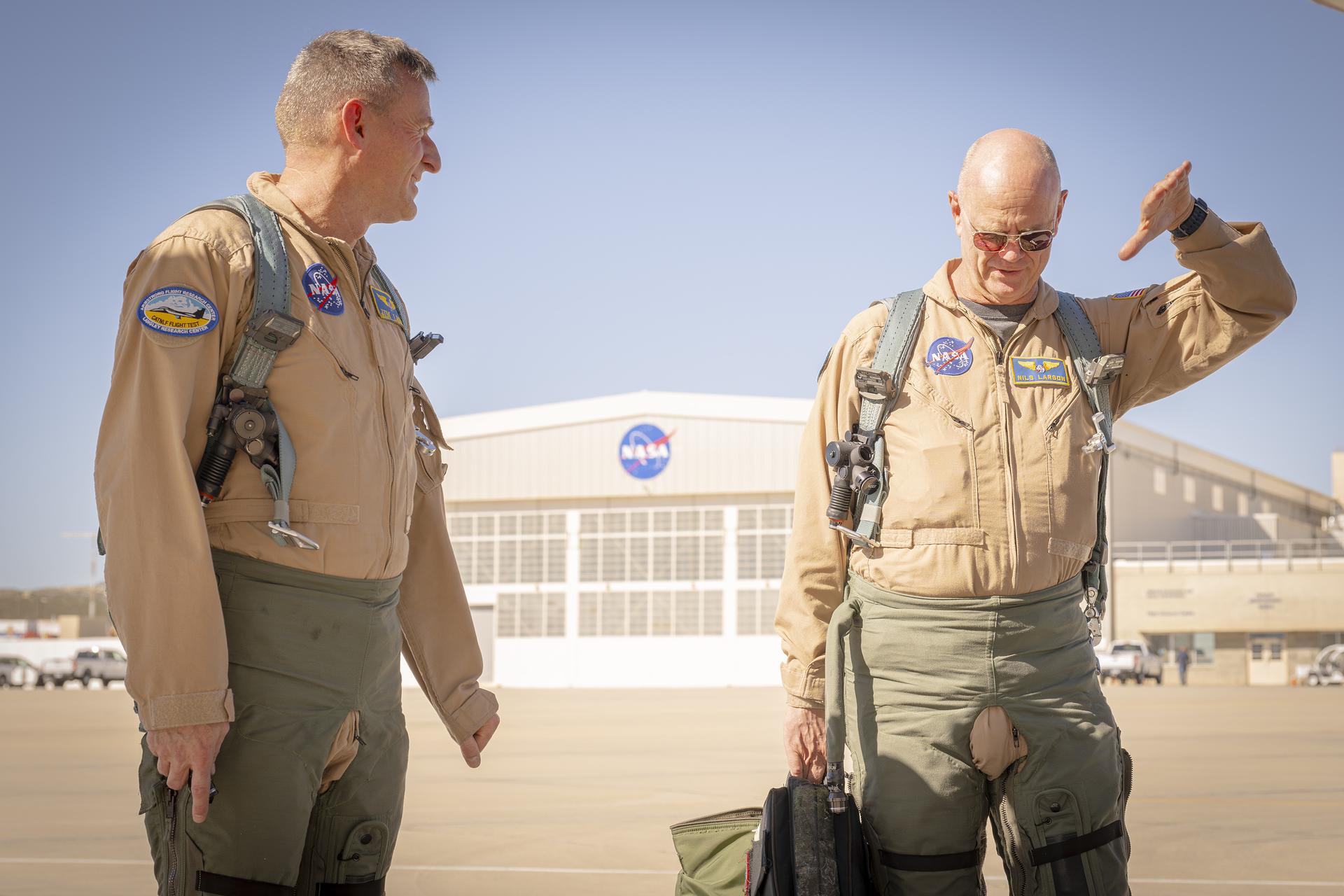
Two men, wearing tan flight suits and green flight gear, walk on a concrete surface away from a building in the background. The man on the left looks at the man on the right as he is moving his left hand in the air. This same man is carrying a bag with flight gear in his right hand.
NASA test pilots Jim Less, left, and Nils Larson walk away from a hangar at NASA’s Armstrong Flight Research Center in Edwards, California, on Thursday, Feb. 4, 2026. The pilots support the agency’s Crossflow Attenuated Natural Laminar Flow (CATNLF) project, which aims to lower fuel costs for future commercial aircraft by testing a scale-model wing designed to improve laminar flow.
NASA/Christopher LC Clark

Every NASA test flight — whether it’s studying new software, hardware, or the revolutionary technology of an experimental X-plane — relies on engineers, researchers, pilots, maintenance crew, control room operators, and many others working together.

“Experienced operators and engineers evaluate how things work in flight,” Ringelberg said. “Most new technologies are designed to work in a lab or can be tested in a wind tunnel or other facility, but you never really know how they’ll perform until you fly them.”

Preflight tests often include computer analysis, simulation, wind tunnel testing, and ground tests focused on an aircraft’s ability to withstand the forces of flight and the environments through which it may fly. After hardware or software is deemed safe to fly, researchers turn the mission over to the flight test team.

To support testing, NASA Armstrong maintains an aircraft fleet modified to create space for new hardware or instruments, as well as the ability to integrate new software. These aircraft are flying laboratories, and pilots are trained to accomplish experimental missions.

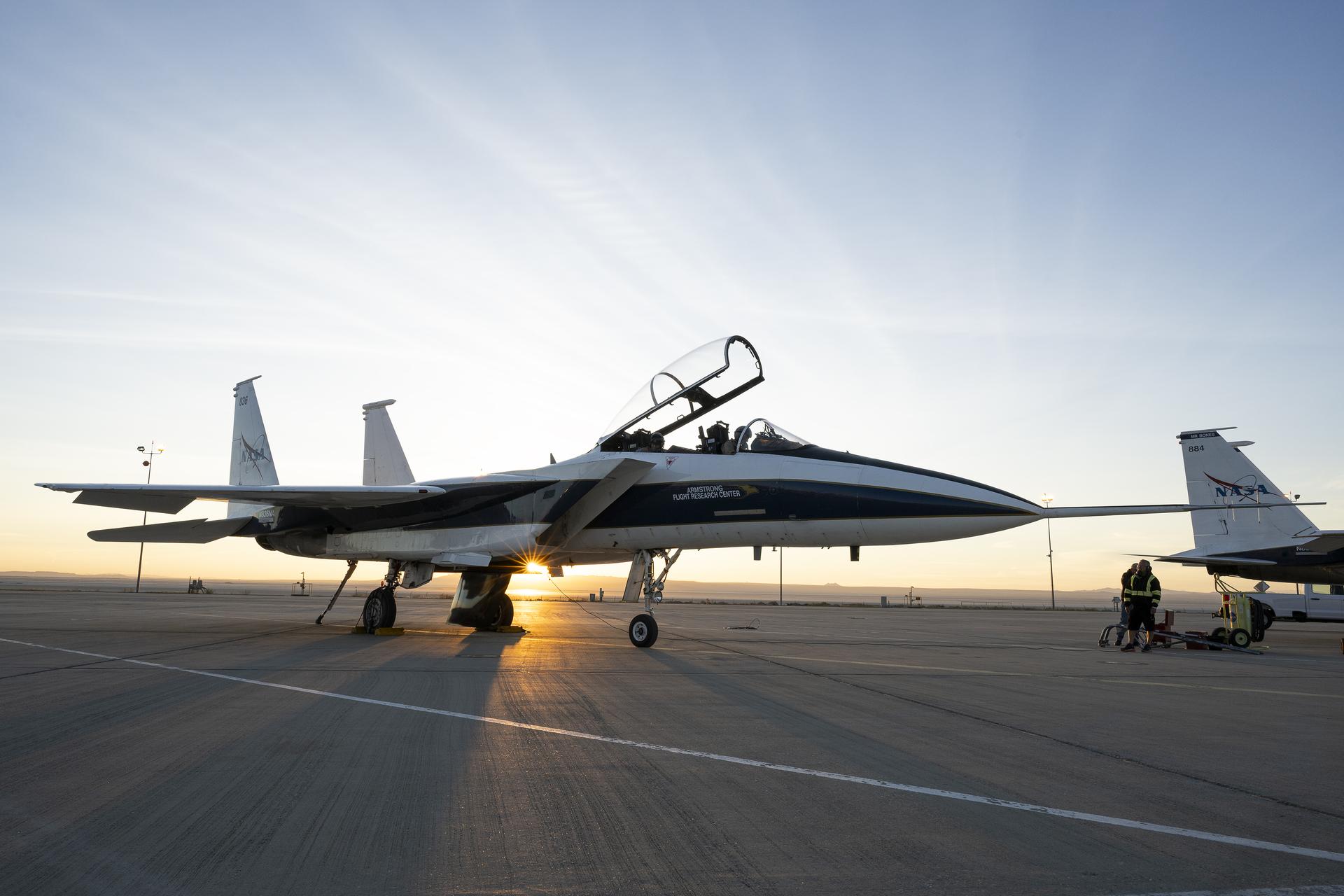
A white and blue painted jet aircraft sits on a concrete surface. The canopy of the aircraft is open, and two pilots sit inside wearing flight gear. The tail of a second jet aircraft is seen to the right of the image, and a desert landscape is seen in the background.
An F-15 research aircraft sits on the ramp at NASA’s Armstrong Flight Research Center in Edwards, California, on Tuesday, March 17, 2026. NASA pilots Jim Less, front seat, and Carrie Worth prepare for the flight. The agency’s Crossflow Attenuated Natural Laminar Flow (CATNLF) test article is attached to the bottom of the F-15. The project aims to lower fuel costs for future commercial aircraft by testing a scale-model wing designed to improve laminar flow.
NASA/Carla Escamilla

For example, flight testing recently helped NASA gather critical data on laminar flow, or the smooth flow of air, over a wing. The work could lower fuel costs for future airliners. Computer modeling, wind tunnel tests, and other methods helped advance the research, but to find out even more about how the wing concept could reduce drag for future airliners, NASA used a scale model in actual flight.

NASA researchers strapped the Crossflow Attenuated Natural Laminar Flow (CATNLF) model wing to the belly of one of NASA Armstrong’s F-15s. The arrangement allowed them to collect all the information they would need without doing the extensive, costly modifications required to install a full-scale wing on an aircraft.

After a flight series is complete, engineers and researchers analyze the data. Did the instrument work as designed? Did the experimental aircraft perform safely at a high altitude? Did the software operate as planned? Each test raises its own set of questions to evaluate.

NASA continues working with academia, the Department of War, and industry partners to advance U.S. aviation through flight test and bring new benefits to the flying public.

Share

Details

Last Updated
Jun 22, 2026
Editor
Dede Dinius
Contact
Keep Exploring

Discover More Topics From NASA

💾

NASA’s Crossflow Attenuated Natural Laminar Flow (CATNLF) project aims to lower fuel costs for future commercial aircraft by testing a scale-model wing desig...
❌