
❌

Normal view

'Everybody wanted to be the first': Apollo astronauts were more competitive, Artemis 2 pilot says

24 June 2026 at 13:00

A lot has changed since NASA last sent astronauts to the moon — including the attitudes of those space explorers.

That's the view of Victor Glover, the NASA astronaut who served as pilot on the Artemis 2 mission around the moon's far side this past April.

"When you look back on the Apollo missions, there was a lot more competition back in the office. Everybody wanted to be the first, and then everybody wanted to be the next," Glover told Angels Broadcast Television on June 12, shortly before he threw out the first pitch before a baseball game between the Los Angeles Angels and the Tampa Bay Rays.

"I think our office learned a lot from them," he added. "There are some good things about that. It makes you work really hard, but it also can create some unnecessary conflict. And so my office really wants to support everybody — wants you to be the guy that does it, and somebody just gets picked to do it, and that's OK."

Glover and his Artemis 2 crewmates — NASA's Reid Wiseman and Christina Koch and Jeremy Hansen of the Canadian Space Agency — did indeed seem to forge a very strong bond during their training and their time in space.

For example, shortly before Artemis 2's April 1 launch, Glover, Koch and Hansen came up with a plan to name a crater on the moon after Wiseman's wife Carroll, who died of cancer in 2020.

"They said the three of them had talked, and they would like to do this," Wiseman said on April 6, the day Artemis 2 looped around the moon and got farther from Earth than any crewed mission ever had. "That was an emotional moment for me. And I just thought that was just a total treasure, that they had thought through this, and they had offered this."

Wiseman, Artemis 2's commander, said he broke down when Hansen radioed mission control with the naming request. In fact, all four astronauts were overcome with emotion at that moment.

"That was, I think, where the four of us were the most forged, the most bonded, and we came out of that really focused on that day ahead," Wiseman said.

an astronaut in a white spacesuit descends from a gold-foil-wrapped spacecraft onto the gray lunar surface, with an american flag planted in the dirt nearby

This image taken by Buzz Aldrin of the Apollo 11 landing site is the only good picture of mission commander Neil Armstrong on the lunar surface. (Image credit: NASA)

The atmosphere was a bit different during the 1960s and early 1970s, as Glover noted; undercurrents of competition and rivalry reportedly ran through the Apollo crews.

For example, multiple people, including Apollo 17 astronaut Gene Cernan, have said that Buzz Aldrin lobbied to be the first person to set foot on the moon, an honor that eventually went to Apollo 11 crewmate Neil Armstrong. (Aldrin has disputed this version of events, saying he didn't want to be the first-ever moonwalker.)

There are other big differences between Artemis and Apollo, of course. Apollo was designed to get people to the moon before the Soviet Union could do so, a goal that was regarded as a national security imperative because it would demonstrate American technological supremacy. As a result of this need for speed, Apollo did not build anything permanent on the moon, leaving behind only flags, footprints and defunct spacecraft.

Artemis, on the other hand, aims to establish a permanent and sustainable presence on Earth's nearest neighbor. If all goes to plan, NASA will build one or more moon bases near the lunar south pole, then use the skills and knowledge gained from this endeavor to get astronauts even farther afield — to Mars.
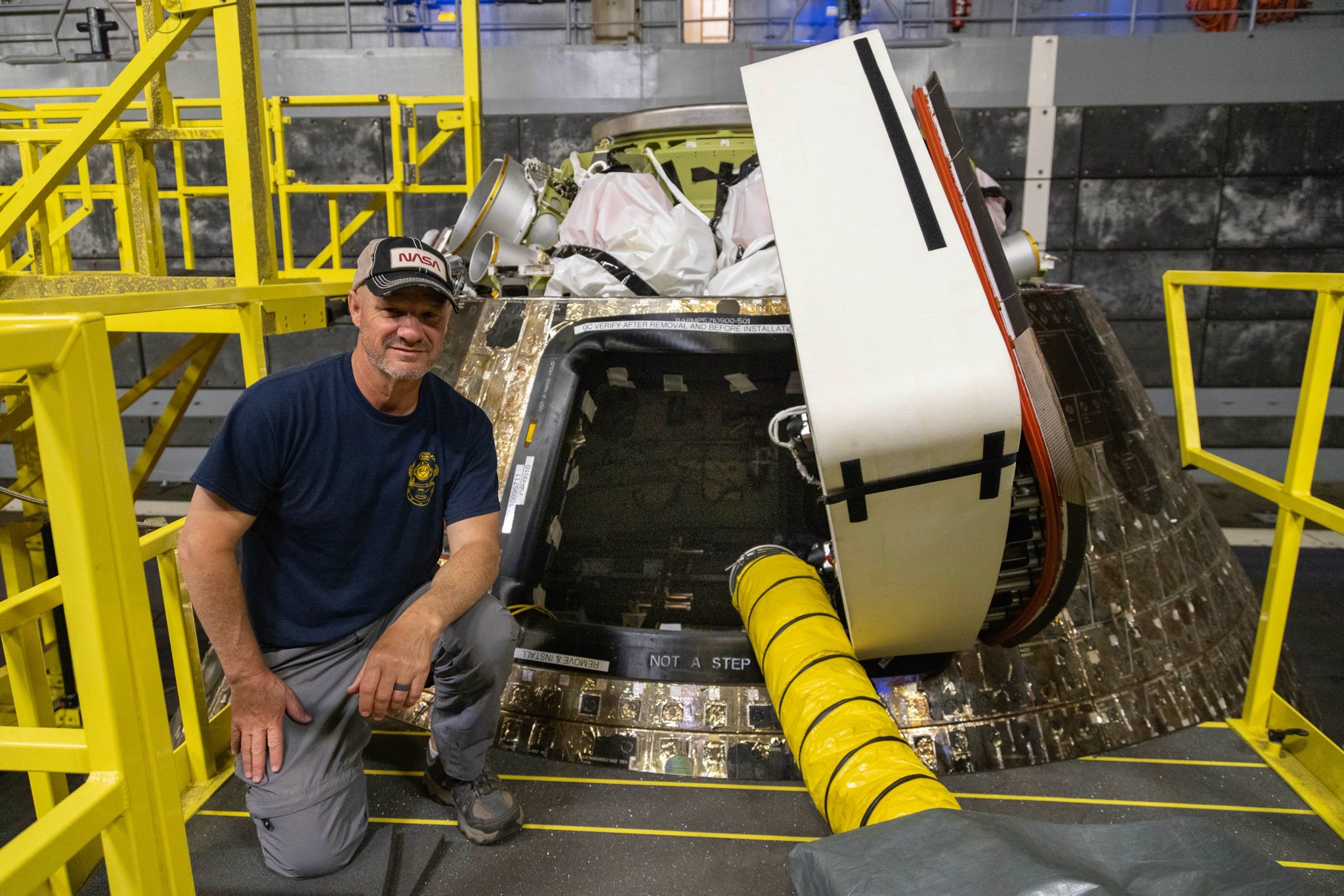
I Am Artemis: Jason Peterson

23 June 2026 at 15:27
4 Min Read

I Am Artemis: Jason Peterson

NASA’s Jason Peterson is the range operations manager at NASA’s Stennis Space Center. For Artemis II, he supported the team responsible for delivering video and communication feeds for launch and splashdown.
Credits: NASA/Danny Nowlin

Jason Peterson’s responsibilities for NASA’s Artemis II mission went beyond his usual role as the range operations manager at NASA’s Stennis Space Center near Bay St. Louis, Mississippi.

For Peterson, working at NASA is a surreal full-circle moment.

“I grew up in DeLisle, Mississippi, right down the road from NASA,” said Peterson. “You would hear NASA testing, the windows would shake, and you knew they were out there. Not in a million years would I have ever dreamed I would work with NASA.”

His career journey took a few turns before reaching the space agency.

“I got out of school, welded, went to college and then to the Air Force. The path to NASA really started to develop from there,” said Peterson.

Peterson spent 24 years in the U.S. Air Force and Air National Guard, working in airfield and air-to-ground range operations, followed by a few years working as an aircraft dispatcher at Airbus Final Assembly Line.

Peterson credits his military experience with preparing him for the 12-to-16-hour workdays that helped bring the Artemis II test flight around the Moon and into view for audiences around the world.

He supported the team responsible for delivering video and communication feeds for the launch of NASA’s SLS (Space Launch System) rocket with the Artemis II crew aboard the Orion spacecraft, and then splashdown in the Pacific Ocean.

During the nearly 10-day mission, NASA astronauts Reid Wiseman, Victor Glover, Christina Koch, and CSA (Canadian Space Agency) astronaut Jeremy Hansen completed a record-setting lunar flyby, taking them 252,756 miles at their farthest distance from Earth.

Aboard the USS John P. Murtha, Peterson was the first on the ship to spot the capsule returning with the crew.

“The sonic boom was the moment it truly hit me. Even though I was tracking the capsule, it did not fully register until then. Chills went down my neck and back. You realize our astronauts are coming home. It was an incredible and emotional moment.”

JASON PETERSON

JASON PETERSON

Range Operations Manager for NASA Stennis

Jason Peterson, NASA Stennis range operations manager, is shown with the Orion spacecraft aboard the USS John P. Murtha on April 13, 2026. Peterson was the first to spot the capsule returning with the Artemis II crew as he supported the team responsible for delivering video and communication feeds during splashdown operations. Credits: NASA
NASA

Peterson operated one of six cameras providing live coverage by using a high‑resolution, multi‑sensor system with thermal capabilities. Using the ship’s heading and Orion’s predicted trajectory, he located the capsule within minutes and began tracking it.

Orion entered Earth’s atmosphere at about 400,000 feet above the planet’s surface, traveling nearly 35 times the speed of sound and about 1,956 statute miles from its splashdown point off the coast of California. Peterson tracked Orion from the release of the small parachutes that first slow and steady the capsule, through the main parachutes opening, and all the way to splashdown.

“You are fully locked in, keeping it centered, in focus, and steady,” said Peterson.

Peterson’s focus on the mission began weeks earlier at NASA’s Kennedy Space Center in Florida.

In the days leading to launch, Peterson worked with the team running full systems checks, staging communications gear, and preparing drones and fixed‑wing camera assets. He helped configure and operate the systems that ensured live video flowed from the launch pad, the crowds, and surrounding air and ground platforms.

On April 1, the launch day of Artemis II, the team unloaded and set up high‑resolution sensors, connection terminals, routers, monitors, fiber lines, and drone equipment. They flew drones to capture crowd scenes and aerial views before liftoff.

As the SLS rocket launched, Peterson’s full attention was on positioning the drone and maintaining the shot.

“There is not much time to step back and take in the moment, as you are concentrating on precision,” said Peterson.

As the mission got underway, Peterson and the team packed up, returned to the facility, and downloaded the day’s footage.

The Artemis II crew were more than halfway to the Moon as Peterson arrived in San Diego on April 4. In the days leading to splashdown, the team loaded and installed high‑fidelity cameras and supporting equipment, all to help the world witness a historic milestone when the Artemis II crew returned to Earth on April 10.

Next up will be Artemis III. NASA will launch four astronauts from NASA Kennedy aboard the Orion spacecraft on the SLS rocket. Building on the successful Artemis II crewed test flight in April, Artemis III will pave the way for future surface missions, with experts like Peterson helping every step of the way.

About the Author

Bo Black

Communications Strategist

Share

Details

Last Updated
Jun 23, 2026
Editor
Catherine Ragin Williams
Keep Exploring

Discover More Topics From NASA

❌