
❌

Normal view

This is How NASA Flight Tests New Technology

23 June 2026 at 17:00
3 Min Read

This is How NASA Flight Tests New Technology

A white and blue painted jet aircraft flies above a tan lakebed with the gear and wheels out. A model wing hangs below the aircraft’s center line. The cockpit is closed and two pilots are visible inside with flight gear on.
An F-15 aircraft flies above the world’s largest compass rose above NASA’s Armstrong Flight Research Center in Edwards, California, on Monday, April 20, 2026. NASA’s Crossflow Attenuated Natural Laminar Flow (CATNLF) test article is attached to the bottom of the F-15. The project aims to lower fuel costs for future commercial aircraft by testing a scale-model wing designed to improve laminar flow.
Credits: NASA/Jim Ross

Flight tests are a big part of how NASA turns breakthrough ideas into reality. From flying humans faster than the speed of sound to proving designs that helped shape the space shuttle, flight testing transforms bold concepts into safer, more efficient technologies that benefit the public.

“Flight tests are a way to safely and effectively prove new technology, which helps certification authorities certify equipment,” said Wayne Ringelberg, chief pilot at NASA’s Armstrong Flight Research Center in Edwards, California. “It helps industry iterate and make systems better, and it promotes research in areas where new ideas can be developed.”

For nearly 80 years, teams at NASA Armstrong have used flight testing in the Southern California desert to push the limits of aerodynamics and advance aviation. Thanks to that work, NASA-developed innovations are aboard every U.S. commercial aircraft and inside every control tower today.

“The space side of NASA uses flight test, too. Every mission, like Artemis II, is never routine,” Ringelberg said. “Everything we’re doing when flying a test mission is something new or different.”
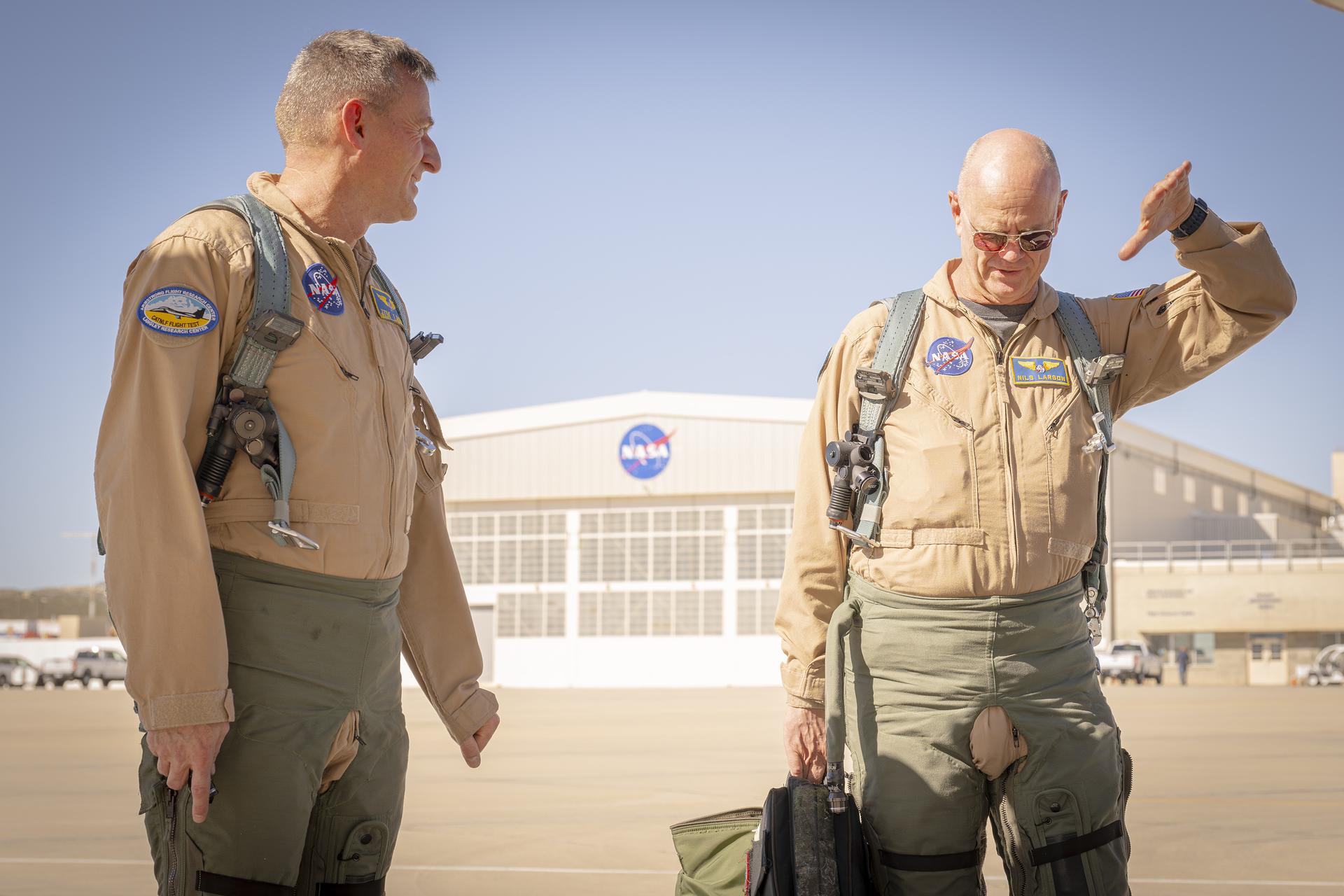
Two men, wearing tan flight suits and green flight gear, walk on a concrete surface away from a building in the background. The man on the left looks at the man on the right as he is moving his left hand in the air. This same man is carrying a bag with flight gear in his right hand.
NASA test pilots Jim Less, left, and Nils Larson walk away from a hangar at NASA’s Armstrong Flight Research Center in Edwards, California, on Thursday, Feb. 4, 2026. The pilots support the agency’s Crossflow Attenuated Natural Laminar Flow (CATNLF) project, which aims to lower fuel costs for future commercial aircraft by testing a scale-model wing designed to improve laminar flow.
NASA/Christopher LC Clark

Every NASA test flight — whether it’s studying new software, hardware, or the revolutionary technology of an experimental X-plane — relies on engineers, researchers, pilots, maintenance crew, control room operators, and many others working together.

“Experienced operators and engineers evaluate how things work in flight,” Ringelberg said. “Most new technologies are designed to work in a lab or can be tested in a wind tunnel or other facility, but you never really know how they’ll perform until you fly them.”

Preflight tests often include computer analysis, simulation, wind tunnel testing, and ground tests focused on an aircraft’s ability to withstand the forces of flight and the environments through which it may fly. After hardware or software is deemed safe to fly, researchers turn the mission over to the flight test team.

To support testing, NASA Armstrong maintains an aircraft fleet modified to create space for new hardware or instruments, as well as the ability to integrate new software. These aircraft are flying laboratories, and pilots are trained to accomplish experimental missions.
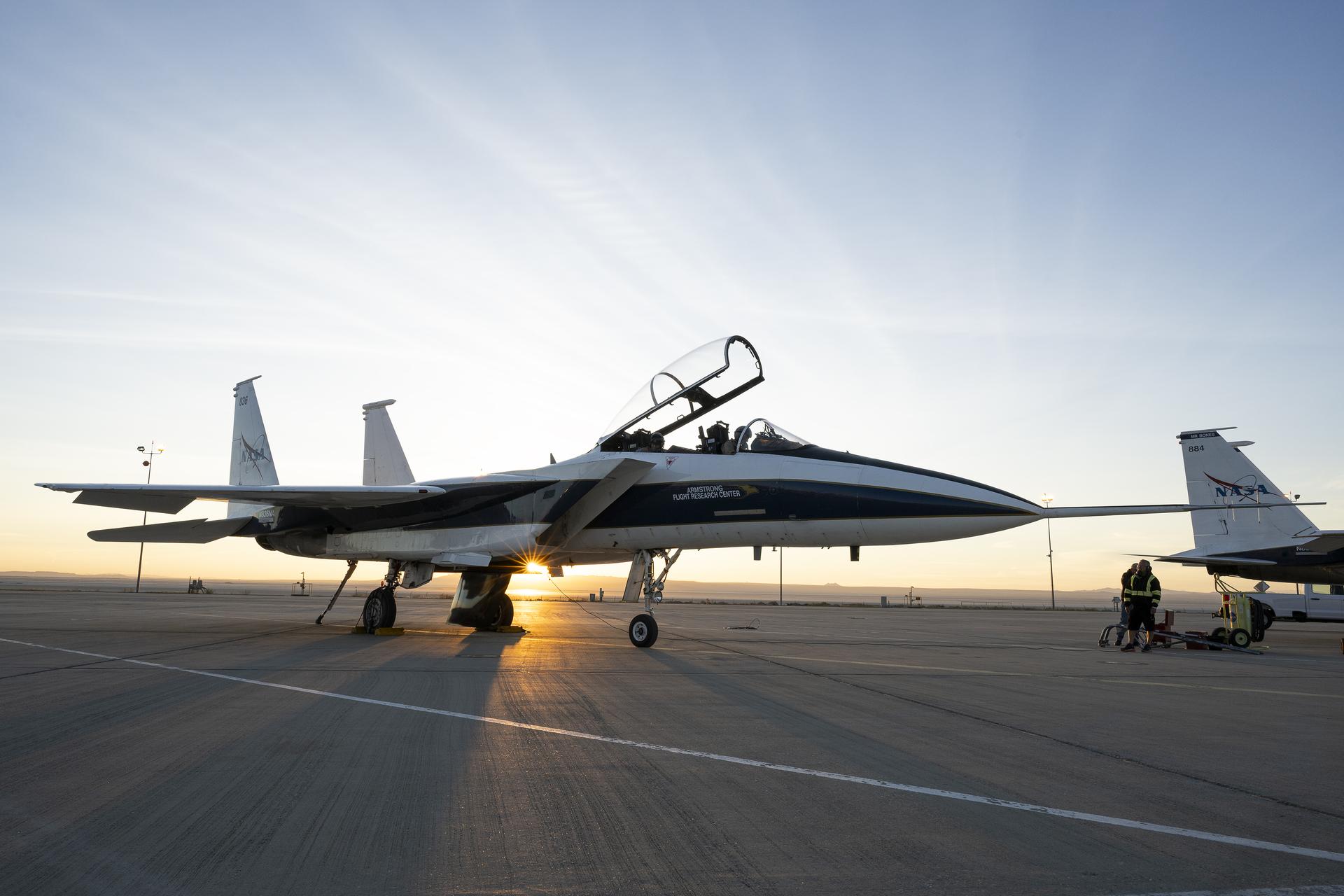
A white and blue painted jet aircraft sits on a concrete surface. The canopy of the aircraft is open, and two pilots sit inside wearing flight gear. The tail of a second jet aircraft is seen to the right of the image, and a desert landscape is seen in the background.
An F-15 research aircraft sits on the ramp at NASA’s Armstrong Flight Research Center in Edwards, California, on Tuesday, March 17, 2026. NASA pilots Jim Less, front seat, and Carrie Worth prepare for the flight. The agency’s Crossflow Attenuated Natural Laminar Flow (CATNLF) test article is attached to the bottom of the F-15. The project aims to lower fuel costs for future commercial aircraft by testing a scale-model wing designed to improve laminar flow.
NASA/Carla Escamilla

For example, flight testing recently helped NASA gather critical data on laminar flow, or the smooth flow of air, over a wing. The work could lower fuel costs for future airliners. Computer modeling, wind tunnel tests, and other methods helped advance the research, but to find out even more about how the wing concept could reduce drag for future airliners, NASA used a scale model in actual flight.

NASA researchers strapped the Crossflow Attenuated Natural Laminar Flow (CATNLF) model wing to the belly of one of NASA Armstrong’s F-15s. The arrangement allowed them to collect all the information they would need without doing the extensive, costly modifications required to install a full-scale wing on an aircraft.

After a flight series is complete, engineers and researchers analyze the data. Did the instrument work as designed? Did the experimental aircraft perform safely at a high altitude? Did the software operate as planned? Each test raises its own set of questions to evaluate.

NASA continues working with academia, the Department of War, and industry partners to advance U.S. aviation through flight test and bring new benefits to the flying public.

Share

Details

Last Updated
Jun 22, 2026
Editor
Dede Dinius
Contact
Keep Exploring

Discover More Topics From NASA

💾

NASA’s Crossflow Attenuated Natural Laminar Flow (CATNLF) project aims to lower fuel costs for future commercial aircraft by testing a scale-model wing desig...

eVTOLS Are Here: Archer Aviation Confirms ‘Midnight’ Aircraft On-Track for FAA Certification, 2028 Olympics

22 June 2026 at 12:55

Electric Vertical Take-Off and Landing (eVTOL) pioneer Archer Aviation has confirmed that it is on track to perform Team USA transport duty during the 2028 Summer Olympics in Los Angeles, California, aboard its Midnight aircraft.

In an email to The Debrief, a company spokesperson said Archer was selected as the Official Air Taxi Provider of the LA28 Olympic Games and Team USA, marking a historic first in the quest for commercial eVTOL operations before the end of the decade.

“Through this exclusive partnership, the two will look to integrate Archer’s Midnight eVTOL aircraft across theLA28 Games in a variety of ways, such as transporting VIPs, fans, and stakeholders, while electrifying vertiport take-off-and-landing hubs for key venues and providing support for emergency services and security,” a company spokesperson explained.

Archer CEO Announces ‘Progress’ Including Upcoming Midnight eVTOL Test Flight in 8 US Cities

Archer Aviation founder and CEO Adam Goldstein recently shared more specific updates about the company’s road to the Olympics and eventually government approval, noting that “we made tremendous progress towards beginning operations in the US later this year, with record FAA certification progress and our most expansive flight testing to date.”

Goldstein also highlighted the company’s recent winning applications to begin pre-certification test flights of Midnight in 8 US states later this year, including New York, Florida, and Texas. According to the CEO, those test flights are part of the eVTOL Integration Pilot Program (eIPP), “which was unlocked through the White House’s Executive Order in June last year.”

Multiple Midnight eVTOL aircraft. Image Credit: Archer Aviation.

“Archer expects Midnight operations in American cities to begin this year as part of the White House’s eIPP and in preparation to serve as the Official Air Taxi Provider of the LA28 Olympic Games, in coordination with the DOT and FAA,” the CEO explained, adding that the two benchmarks “pave the way for Archer to showcase its air taxi technology in parallel with its continued work toward FAA Type Certification for Midnight.”

Six Independently Operating Engines Produce Over 1,500 Horsepower, Last 10,000 Flight Cycles

When asked about the technical aspects that have put Midnight on course to become the first commercial eVTOL air taxi provider in the U.S., the company spokesperson first noted that their aircraft are “designed and manufactured” domestically, which can shorten development timelines and improve quality control. This includes focusing the team’s research and development on what the company termed “differentiating technologies,” including the pioneering aircraft’s unique powertrain.

“Our world-class in-house team, coming with experience from Apple, Tesla, SpaceX and beyond, contribute to our efficient and certifiable electric propulsion design,” the company told The Debrief.

Archer’s Midnight eVTOL aircraft are designed and tested in the United States, reducing quality control issues and increasing design turnaround times. Image Credit: Archer Aviation.

Some of the differentiating technologies the team said set it apart from the competition include rapid charging, long-lasting battery packs “and the capability of >1500 horsepower.” They also note that Midnight’s high-performance battery cells, patented high-voltage architecture, and gearbox are designed to operate reliably for roughly 10,000 “flight cycles” before the vehicle’s battery pack needs replacement.

“We are optimized for electric flight,” the company told The Debrief.

Due to the potential risks in premiering a new vehicle platform, with Archer Aviation telling The Debrief that “eVTOL aircraft are the first new category of aviation in more than 60 years,” the company said Midnight is built as a ‘fly-by-wire’ system, reducing the number of mechanical components that can fail. The company also said that each of Midnight’s engines operates independently “allowing for high levels of redundancy and safety.”

Although the current version of the Midnight eVTOL aircraft is flown by a human pilot, the company told The Debrief that it is “continuing to build the technology stack” required for its longer-term goal of a fully autonomous eVTOL aircraft.

Company Anticipating Final FAA Approval “in the Near Future”

With the 2028 Summer Olympics just two years away, the company said it has transitioned out of a successful Phase 3 of the FAA’s 4-phase Type Certification process, an industry first, and has “already been advancing its work in Phase 4 for some time now.”

“This is where Midnight’s compliance with FAA airworthiness requirements will be demonstrated through formal testing and analysis,” the company told The Debrief.

In his address to shareholders, Goldstein said the company’s flight test program “continued to expand this quarter.” The CEO said this expansion includes piloted VTOL and CTOL flights across its expanded fleet of test aircraft “occurring nearly every day, often multiple times a day.”

eVTOL
Archer Aviation has recently taken over operations at Hawthorne Airport with goals of creating the airport of the future.

To expedite the testing phases leading up to the 2028 Olympics, the company recently took over operations of Hawthorne Airport in Los Angeles County. Goldstein said the move will help Archer develop the local airstrip “into the airport of the future.”

“Located near LAX and several major LA sports and entertainment venues, Hawthorne Airport is expected to anchor Archer’s planned LA air taxi operations while also serving as an innovation hub for next-generation aviation technologies,” the CEO explained.

When asked how soon the company expects to fulfill the FAA’s Phase 4 requirements and gain full certification, the spokesperson told The Debrief that Archer is in the final stages of the process, “and is anticipating approval in the near future.” However, the company also added that their focus is on building a safe, high-performance aircraft, and that once they can demonstrate the safety and versatility of Midnight, “it is the FAA’s job to certify it.”

Christopher Plain is a Science Fiction and Fantasy novelist and Head Science Writer at The Debrief. Follow and connect with him on X, learn about his books at plainfiction.com, or email him directly at christopher@thedebrief.org.

❌