❌

Normal view

Outdoor cats can be exposed to dangerous germs β€” here's how to protect you and your pets, according to more than 400 studies

20 June 2026 at 15:00

Pets form an important part of many people's lives, providing meaningful companionship. However, our pets can sometimes also be a source of unwelcome pathogens and diseases, particularly if they frequently roam outdoors.

We are ecologists and a veterinarian who study wildlife health and the movement of pathogens among wildlife, domestic animals and people. If you let your cat outdoors, or if outdoor cats visit your yard, our recent findings may be relevant.

Zoonotic pathogens are organisms that can infect both animals and humans. From a pathogen's perspective, humans are just another animal host. Wildlife is often emphasized as a source of emerging disease for humans because there are vastly more wild animal species than domestic animal species.

However, even if a pathogen is capable of infecting people, it needs a way to reach us. Humans share more zoonotic pathogens with domestic animals than with wildlife, because domestic animals live close to us. Pathogens benefit even further if they can infect a companion animal.

In our newly published research, we compiled data from more than 400 studies to investigate how a cat's lifestyle, whether they're mostly indoors, outdoor-roaming or feral, affects that cat's likelihood of carrying pathogens that can infect people.

Across this compilation, there were nearly 100 pathogens detected in cats that are considered zoonotic and capable of infecting humans. Familiar examples are rabies, Toxoplasma gondii, roundworms and Salmonella.

Our research

We found that outdoor-roaming pet cats had three to five times the odds of carrying a zoonotic pathogen compared with indoor-only cats. More surprisingly, cats allowed to roam outdoors had similar odds of carrying at least one zoonotic pathogen as feral cats. Outdoor-owned cats carried fewer types of pathogens than feral cats, but the same pathogens that infect feral cats can also infect owned cats.

These risks become a large-scale problem because pet cats that roam freely interact closely with people, wildlife and other domestic animals. Across the studies we reviewed, about 60 per cent of owned cats had unsupervised outdoor access; in some regions, that rate exceeded 90 per cent.

Roaming cats hunt, interact with wildlife or other domestic animals, and move through environments contaminated with pathogens and toxins. Research suggests that cat owners may underestimate hunting by around 80 per cent, meaning that many prey captures and animal contacts go unnoticed.

These interactions are not uncommon and not limited to so-called pest species. Single-country estimates of wildlife killed by cats run into the billions, with more than 2,000 wildlife species documented as prey for domestic cats.

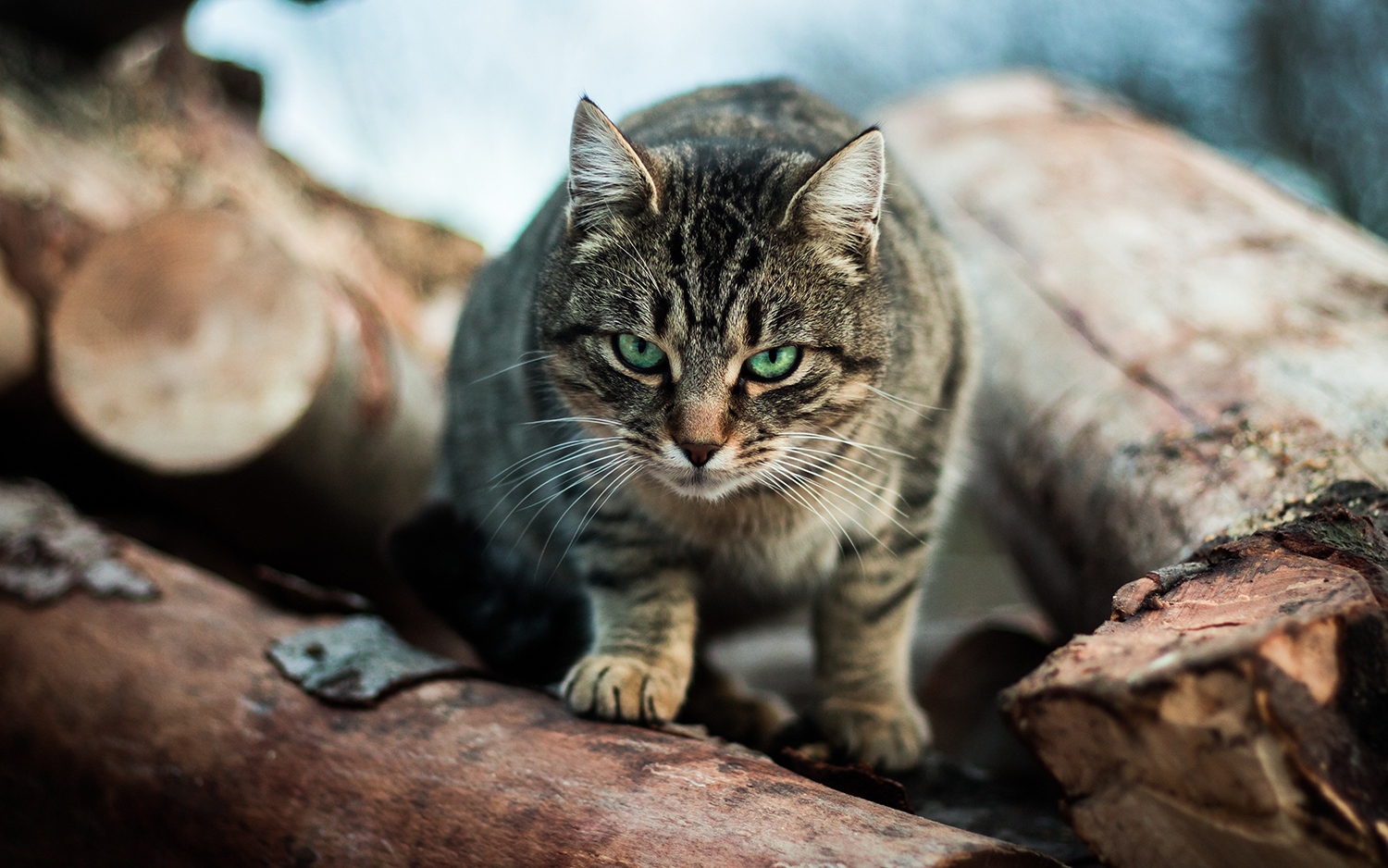
A gray and black striped cat sits on some broken tree trunks and looks at the camera.

Cats hunt animals that can carry zoonotic pathogens, including rodents, birds and bats, many of which would otherwise have little direct contact with people. (Image credit: Anton Darius)

Cats hunt animals that can carry zoonotic pathogens, including rodents, birds and bats, many of which would otherwise have little direct contact with people. Owned cats might bring home rodents carrying viruses, and there are documented cases of cats bringing rabies-positive bats into homes. A cat returning home with prey can therefore create a pathway by which pathogens circulating in wildlife populations reach people.

In addition, it is not only owners who are at risk. Outdoor cats defecate in gardens, parks, playgrounds and other shared spaces, potentially leading to high contamination rates. One study estimated that outdoor cats deposited more than 60 tonnes [60 tons] of feces per 10,000 households each year.

Depending on the parasite, feces can contain hundreds to hundreds of thousands of parasite eggs that can persist in soil or water for months to years, which can infect people or other animals that come in contact with those eggs.

What cat owners can do

The most straightforward intervention is also the most economical and humane: prevent unsupervised roaming. That does not mean denying cats access to the outdoors. It can mean building "catios" or enclosures, leash walks, supervised time outside or other forms of contained outdoor access.

House cats, as well as cheetahs, cougars and lynxes, can purr but can't roar, while other cats, such as lions, tigers and jaguars, can roar but can't purr.

Using systems like "catios" or leash walks can help minimize pathogens for cats. (Image credit: Carlos G. Lopez)

Veterinary care still matters. Treating existing parasitic infections and vaccinating against diseases like rabies are essential precautions, even for indoor cats. Since neither vaccines nor anti-parasitic treatment cover the full spectrum of wildlife-associated pathogens, managing exposure remains the more comprehensive protective approach.

The free-roaming debate is often framed as a false choice: either cats roam freely, or they are deprived of a natural life. That framing is misleading and inconsistent with how we manage other companion animals.

We do not assume dogs need unrestricted access to roads, neighbors' yards or to hunt wildlife to have good welfare. Indoor cats and cats with supervised outdoor access can live healthy, enriched and longer lives.

Policies and strategies that address how and where owned cats roam outdoors can help safeguard biodiversity, feline and wildlife welfare and public health. That is the central insight of One Health, that the same choices that protect ecosystems can also protect the animals and people who share them.

This article was co-authored by David Lapen, who works for and receives research funding from Agriculture and Agri-Food Canada.

This edited article is republished from The Conversation under a Creative Commons license. Read the original article.

How much of a cat fan are you? Find out by taking our cat quiz!

Science news this week: Goblin shark filmed for first time, California close to a major quake, physicists split photon, and inside China's plans to 'tame nature'

This week's science news was filled with things missing and found, with the revelation of the first-ever deep-sea footage of the elusive goblin shark making waves in the press.

Goblin sharks (Mitsukurina owstoni) are mysterious, deepwater creatures that have not changed much since they first appeared on Earth 125 million years ago β€” making them "living fossils." But capturing a recording of the sharks in their deep habitats is exceptionally difficult, and they have previously been seen alive only after being hooked to the surface on fishing lines. Scientists recently filmed not one, but two goblin sharks: The first near Jarvis Island in the South Central Pacific, and the second 6,550 feet (1,997 meters) deep in the Tonga Trench.

If you like your elusive animals on the wilier (and certainly much cuter) side, we also reported on the first ever photographs of the dwarf fox, a species that was believed to be extinct but has been found near a highway in Cozumel, Mexico.

Elsewhere, archaeologists found a second cannonball from the 1836 Battle of the Alamo, meaning they now have one from each side of the conflict. And separate teams of archaeologists discovered the remains of a prehistoric man in Germany who may have been a human sacrifice and signs of a "prototype" Stonehenge close near the famous Stone Age monument.

If you got this far wondering if the "missing" news items were, well, missing, we also covered how a "cold blob" of absent heat in the Atlantic Ocean is shifting Indian summer monsoons, threatening over one billion people; the Texas-size chunk of ice missing from Antarctica; how an ancient chunk of the moon found in Africa hints at a calamitous lunar collision; and a bizarre viral infection that left a woman unable to recognize her own father.

California is scarily close to a major quake

'The system is critically stressed': San Andreas and San Jacinto faults scarily close to major earthquake, study finds

Aerial view of the San Andreas fault and map showing tectonic stress at the San Andreas fault in 2025.

The San Jacinto and southern San Andreas faults have reached their highest levels of tectonic stress in 1,000 years. (Image credit: Left: Cavan Images / Peter Essick / Getty Images; Right: Burkhard et al., 2026 (CC BY 4.0))

The next major Californian earthquake could be closer than we thought, according to an alarming new study.

The research, based on historical modeling of earthquake activity, found that Southern California's San Andreas and San Jacinto fault systems are at their highest levels of tectonic stress in more than 1,000 years; while also being connected by a "gate" system that could make them rupture together.

The exact odds of each event happening and the timing of a possible future rupture are unknown. But the scientists stress that understanding how much strain is building up inside the system could help to prepare for whatever comes next.

Life's Little Mysteries

Why does it take our eyes so long to adjust to the dark?

A close up of a person's brown eye behind the lens of the glasses.

Why does it always take up to an hour for our eyes to adjust to our surroundings if we're out in nature on a dark night? (Image credit: Jackal Pan via Getty Images)

Our eyes are remarkably adaptable, switching from navigating under bright lights to the near pitch-black of a moonless night. But anyone who's stubbed a toe during this acclimation window β€” and that definitely includes me β€” may have once or twice asked themselves why it takes our eyes so long to adjust to the dark. Live Science shed a bit of light on the question.

β€”If you enjoyed this, sign up for our Life's Little Mysteries newsletter

Physicists split a photon

'A mixture from zero to infinity': Physicists split apart a photon β€” and ended up with an improbable swarm of particles

A lightbulb is shattered with various colors coming out of it against a black background

Physicists are studying what would happen if a single particle of light was sliced apart β€” unleashing a swarm of unpredictable outcomes. (Image credit: tiero via Getty Images)

What do you get if you split a photon? Anywhere from zero to an infinite number of more photons, physicists say.

That's the finding made by a new experiment that simulated a photon being sliced by a shutter under various circumstances, revealing the result was anywhere from zero to one to upwards of an infinite swarm of the tiny light particles. The probability of each of these states corresponded to how quickly the shutter cut the photon.

And the unexpected behavior has some truly profound implications for how we view fundamental particles.

Discover more physics news

β€”The world's first nuclear clock just ticked on β€” and it could help detect a fifth fundamental force of physics

β€”NASA's experimental X-59 jet breaks sound barrier twice, reaching Mach 1.4 in step toward 'quiet supersonic' technology

β€”Earth-based telescope shares image of Artemis II capsule near the moon β€” one of the farthest photos of humans ever taken

Also in science news this week

β€”'A completely different story': 300 million-year-old fossils reveal the first vertebrate land dwellers weren't what we thought, researchers claim

β€”Oldest known plague victims found in a 5,500-year-old burial ground in Siberia β€” and many of them were children

β€”Indonesia's near-identical, 'Twin Peaks' volcanoes form striking mirror image β€” Earth from space

β€”Lavish Roman villa discovered outside Rome's walls may have been frequented by Hadrian and Marcus Aurelius

β€”Neuroscientists are searching for the 'cellular substrate of loneliness'

Science Spotlight

'River in the Sky': China's doomed plan to create a 'cloud seeding corridor' tells us how far the country will go to solve its climate crisis

A rocket blasts off from a launch page next to a fence and forested hill.

A cloud-seeding rocket is launched into the sky in Hebei Province in an attempt to generate precipitation. (Image credit: VCG via Getty Images)

China's response to the climate crisis continues to astonish. Over the past two decades, the world's industrial powerhouse has presided over the largest and fastest clean energy buildout in modern history, while also working to bring its carbon emissions to a peak before 2030.

But an underdiscussed aspect of China's climate plans are its bold attempts to geoengineer the environment to be more resilient and better suit human needs. That's why, in his three-part "Taming Nature" series, Live Science's production editor James Price investigated the country's efforts to create a permanent atmospheric river and build the world's biggest dam in earthquake-prone Tibet.

Something for the weekend

If you're looking for things to keep you busy over the weekend, here are some of the best news analyses, crosswords, interviews, opinion pieces and quizzes published this week.

β€”A secretive Chinese probe has just arrived at one of Earth's 'quasi-moons' and will soon attempt a first-of-its-kind landing [News analysis]

β€”Dangerously hot and humid: Rising temperatures in the US make outdoor exercise hazardous [News analysis]

β€”'Is having two legs useful' in space?: Astronaut John McFall explains what life in orbit might be like for the first physically disabled person in space [Interview]

β€”'They reliably chose the statistically more favorable option': A crow researcher explains how these winged geniuses process numbers, and what it could reveal about human math smarts [Interview]

β€”Bow-Wow, Ding-Dong, Pooh-Pooh: Expert explains early theories of how human language evolved β€” and their silly names [Opinion]

β€”Rainforest quiz: Can you sort Earth's largest rainforests from biggest to smallest? [Quiz]

β€”Live Science crossword puzzle #48: Largest fish on Earth β€” 6 across [Crossword]

Science video of the week

Watch bison herd defend a newborn calf from wolf attack in a primeval Polish forest

Wolves attacking a herd of European bison in a forest. In the background we see the wolves biting a newborn bison calf.

Wolves are growing in number across Poland and Belarus, spelling trouble for the region's bison. (Image credit: Wijnands & Borowik, 2026. Ecology and Evolution (CC BY 4.0))

European bison (Bison bonasus) are typically considered to be a non-prey species β€” only being hunted by humans.

But rare and unexpected camera trap footage from Poland's Bialowieza Primeval Forest (the oldest and best-preserved temperate lowland forest in Europe) has called that into question.

In the video, a herd of bison is recorded rallying around a newborn calf to fend off an attack from five wolves (Canis lupus), successfully driving the predators away. It's a nerve wracking watch, and one that could become more common as wolf packs grow in size thanks to a late 1980s hunting ban across the region.

Follow Live Science on social media

Want more science news? Follow our Live Science WhatsApp Channel for the latest discoveries as they happen. It's the best way to get our expert reporting on the go, but if you don't use WhatsApp we're also on Facebook, X (formerly Twitter), Flipboard, Instagram, TikTok, Bluesky and LinkedIn.

Shared Auditory Maps Predict Human and Mouse Decisions

20 June 2026 at 05:47

In a groundbreaking study poised to redefine our understanding of auditory perception across species, researchers have unveiled strikingly similar auditory perceptual maps in both humans and mice. This discovery not only bridges a crucial gap between animal models and human sensory processing but also offers predictive insight into how perceptual decisions are formed during auditory discrimination learning. The implications ripple across neuroscience, psychology, and artificial intelligence, promising new avenues for studying sensory perception and developing advanced hearing-related technologies.

Auditory perceptionβ€”the way organisms interpret and make sense of sound stimuliβ€”is a complex process that involves integrating multifaceted sound attributes such as frequency, intensity, and temporal patterns. While mouse models have long been foundational in auditory research due to their genetic malleability and experimental accessibility, skepticism has persisted about the extent to which their perceptual frameworks parallel those of humans. This novel research offers compelling evidence that these frameworks are not only comparable but also exhibit shared underlying structures.

The study employed a sophisticated experimental design in which both human participants and mice were exposed to a wide array of tonal stimuli varying systematically across multiple auditory dimensions. Using advanced computational modeling and neural decoding techniques, the researchers were able to construct perceptual mapsβ€”conceptual frameworks representing how different sounds are internally organized within the brain’s auditory space. These maps enabled a quantifiable comparison of perceptual similarity and distance between sounds for both species, revealing a remarkable congruence in their auditory representations.

What makes these findings particularly compelling is the demonstration that these perceptual maps are predictive of behavioral outcomes during discrimination tasks. In other words, the way an individual’s brain groups different sounds predicts how well that individual can distinguish between them in learning scenarios. This link between neural representation and perceptual decision-making underlines a fundamental cognitive mechanism shared across mammalian species, offering crucial insights into the principles guiding sensory learning processes.

Beyond the fundamental science, the implications for translational research are profound. Understanding shared auditory perceptual structures facilitates the development of more accurate animal models for studying hearing impairments and neurological disorders affecting auditory processing. It also guides the design of auditory prosthetics, such as cochlear implants, by informing the algorithms that mimic natural sound perception. By aligning animal and human perceptual frameworks, therapies can be tailored with greater precision and efficacy.

A key technical achievement of the study was the use of multidimensional scaling techniques combined with machine learning algorithms to decode auditory neural responses with unprecedented granularity. The researchers collected high-resolution neural data using electrophysiological recordings in mice and non-invasive neuroimaging in humans. This dual approach allowed cross-species alignment of perceptual space, overcoming previous methodological challenges that hindered direct comparisons between human and rodent sensory processing.

Moreover, the study explored dynamic aspects of perceptual learning by measuring how auditory maps evolve through repeated training sessions. The maps exhibited plasticity reflective of learning-induced changes, emphasizing the adaptive nature of auditory perception. This plasticity was mirrored across both species, suggesting an evolutionarily conserved mechanism for tuning sensory systems based on environmental demands and experience.

One of the study’s most innovative aspects lies in its predictive modeling of discrimination performance. By mapping perceptual distances within the auditory space, the researchers could forecast individual differences in learning speed and accuracy, an advancement that holds enormous promise for personalized auditory training protocols. Such protocols could optimize rehabilitation strategies for individuals with auditory processing deficits by targeting specific perceptual aspects most relevant to their unique neural patterns.

The shared structure of auditory perceptual maps also raises intriguing questions about the evolutionary trajectory of sensory systems. The findings suggest that despite divergent evolutionary paths, fundamental auditory processing architectures remain conserved, supporting efficient sound discrimination necessary for survival and communication. This conservation across species underpins the generalizability of animal research findings to human sensory neuroscience.

Furthermore, these insights pave the way for advancing artificial sensory systems, especially in the realm of auditory artificial intelligence. By modeling computational auditory perception after natural neural maps, engineers can design more sophisticated speech recognition systems and assistive devices that better emulate human-like sound processing. The study’s integrative framework thus acts as a blueprint for creating tonal perceptual algorithms with enhanced contextual understanding.

This research also contributes importantly to theoretical debates surrounding sensory representation. By empirically demonstrating a shared, structured perceptual space, the study challenges views that sensory maps are strictly idiosyncratic or species-specific. Instead, it supports a paradigm that sensory systems leverage common organizational principles, rooted perhaps in fundamental neural coding constraints and environmental pressures shaping auditory perception.

The study’s methodology and results were meticulously detailed in a recent publication, where the authors delineated the computational techniques, behavioral paradigms, and statistical analyses that underscored their conclusions. This transparency fosters reproducibility and invites further interdisciplinary collaboration between computational neuroscientists, experimentalists, and cognitive psychologists aiming to unravel the complexities of sensory perception.

Importantly, these findings hold societal relevance beyond academic circles. Hearing loss and auditory processing disorders affect millions worldwide, often hindering communication and quality of life. Technologies and therapies inspired by a unified perceptual mapping approach could revolutionize auditory rehabilitation, offering hope for more effective interventions grounded in a thorough understanding of perceptual neuroscience.

In conclusion, this pioneering work illuminates the common auditory perceptual code shared by humans and mice, demonstrating that the brain’s representation of sound is not merely a byproduct of species-specific adaptations but a fundamental, conserved neural language. This discovery not only furthers scientific knowledge but also catalyzes innovation in medicine and technology, underscoring the power of cross-species research in unraveling the mysteries of the sensory brain.

As this field develops, future investigations are likely to explore how these perceptual maps interact with other cognitive systems such as memory and attention, and how factors such as age, experience, and pathology modulate the structure and function of auditory perception. With burgeoning advances in neurotechnologies and computational methods, the confluence of cross-species neuroscience and perceptual science promises to unlock new dimensions of understanding sensory experience.

Ultimately, the revelation that humans and mice share auditory perceptual maps that predict learning efficacies serves as a testament to nature’s optimization strategies, propelling a unified framework for deciphering sensory perception. This convergence of biology, computation, and psychology heralds a new chapter in auditory neuroscience with far-reaching implications for science and society alike.


Subject of Research: Auditory perceptual maps and discrimination learning in humans and mice

Article Title: Auditory perceptual maps in humans and mice share common structures and predict perceptual decisions in discrimination learning

Article References:
Seiler, J.PH., Cazzetta, G., Ghobadi, A. et al. Auditory perceptual maps in humans and mice share common structures and predict perceptual decisions in discrimination learning. Commun Psychol 4, 98 (2026). https://doi.org/10.1038/s44271-026-00485-w

Image Credits: AI Generated

DOI: https://doi.org/10.1038/s44271-026-00485-w

❌