
❌

Normal view

Aircraft Carrying Swift Boost Satellite Takes off From NASA Wallops

19 June 2026 at 16:41

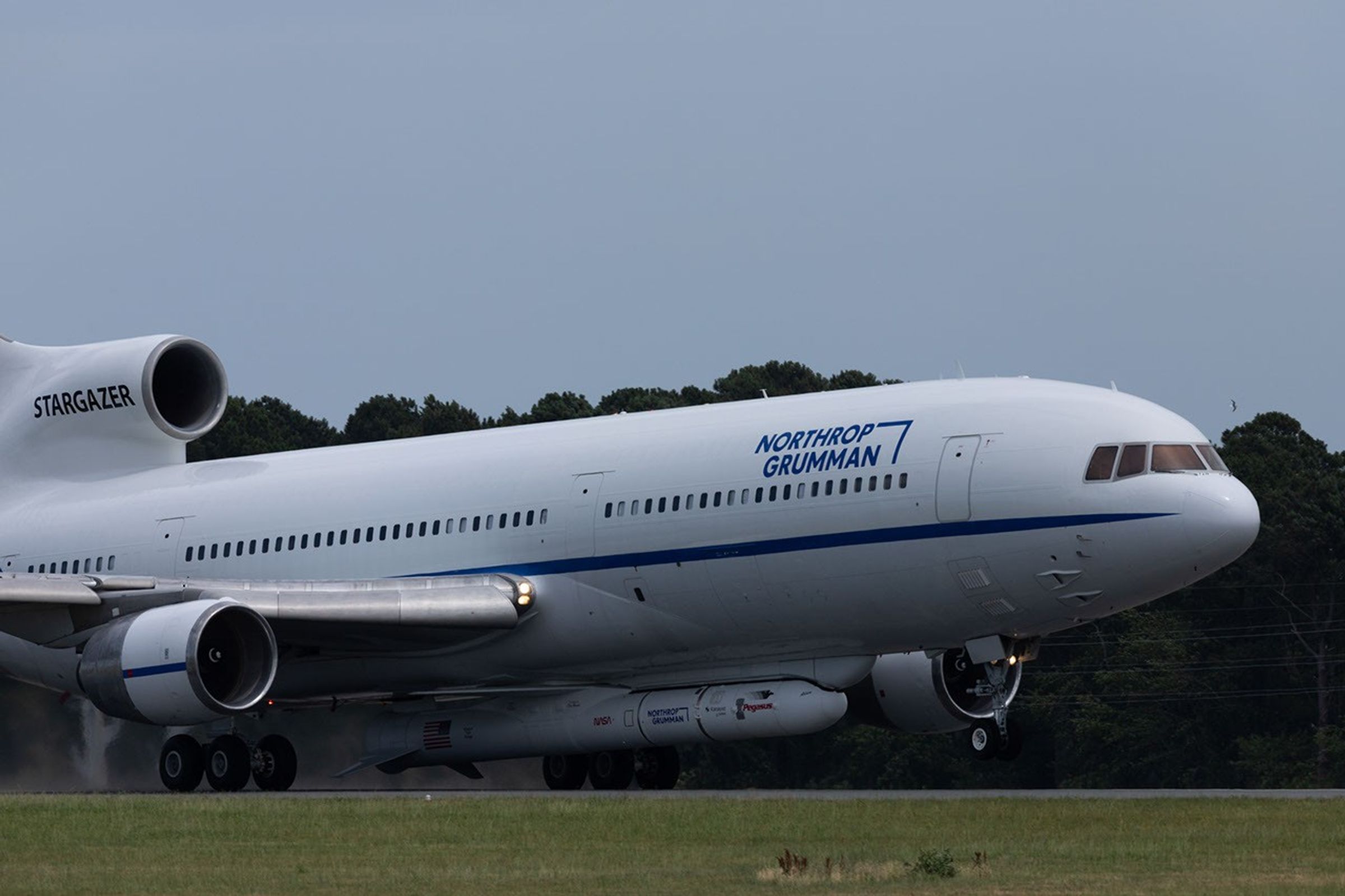
An airplane taking off with a rocket attached to the fuselage
Northrop Grumman’s Stargazer took off Thursday, June 18, 2026, from NASA’s Wallops Flight Facility in Virginia. The modified L-1011 aircraft carried the company’s Pegasus XL rocket hosting LINK, a robotic servicing spacecraft from Katalyst Space. LINK will launch from the air-deployed Pegasus XL later this month on a mission to boost the orbit of NASA’s Neil Gehrels Swift Observatory.
NASA/Jeanette Kazmierczak

An airplane carrying a rocket loaded with a robotic spacecraft designed to raise NASA’s Neil Gehrels Swift Observatory departed the agency’s Wallops Flight Facility in Virginia on Thursday, June 18.

Stargazer, a modified L-1011 operated by Northrop Grumman, took off for Kwajalein Atoll, part of the Republic of the Marshall Islands in the South Pacific Ocean. Attached to the belly of the aircraft was one of the company’s Pegasus XL rockets with LINK inside.

NASA contracted Katalyst Space to design and build LINK to rendezvous and dock with Swift and lift it back to a higher altitude.

Spacecraft in low Earth orbit experience drag caused by our planet’s atmosphere, which gradually reduces their altitude if they do not have propulsion systems to counteract the effect.

Recent solar activity magnified this effect on Swift, which began to sink faster than anticipated.

Katalyst selected Northrop Grumman’s Pegasus XL launch vehicle as the best means of reaching Swift on a short timeline based on orbital and programmatic needs.
A plane taxiing with a rocket attached to the fuselage
Stargazer will carry Pegasus and LINK to Kwajalein Atoll, part of the Republic of the Marshall Islands in the South Pacific Ocean with stopovers in California and Hawai’i.
NASA/Jamie Adkins

Later this month, Stargazer will carry the rocket to an altitude of around 40,000 feet before releasing it.

After several seconds in free-fall, Pegasus XL will fire the first of its three-stage rocket motors, delivering LINK into orbit in about 10 minutes.

Learn more about the Swift mission at:

https://science.nasa.gov/mission/swift/swift-boost-mission/

By Jeanette Kazmierczak
Goddard Space Flight Center, Greenbelt, Md.

The post Aircraft Carrying Swift Boost Satellite Takes off From NASA Wallops appeared first on NASA Science.

Ancient Black Holes May Have Survived a Cosmic Era Before the Big Bang

19 June 2026 at 04:55
Massive Black Hole Galaxy Cosmic Space EnergyA new cosmic bounce model suggests that remnants from a pre-Big Bang Universe may still exist today. What if some of the Universe’s oldest objects are actually older than the Big Bang itself? A new study from the University of Portsmouth suggests that ancient black holes may have survived from a time before the Universe [...]

A bold satellite rescue mission came together in record time, but will it work?

19 June 2026 at 01:39

WALLOPS ISLAND, Virginia—Just 10 months ago, NASA asked three companies if they could do something nobody had done before. Could they build and launch a satellite to save a $500 million astronomy mission at risk of crashing back to Earth? What's more, could they do it in less than a year on a tight budget?

Katalyst Space Technologies, a startup founded in 2020, presented the most compelling solution. "They came back with a response that was technically and programmatically plausible, and then we were like, 'Yeah, let’s do it,'" said Shawn Domagal-Goldman, director of NASA's astrophysics division.

That was in August of last year. In September, NASA awarded Katalyst a $30 million contract to build, test, and launch a small satellite to chase down Swift and latch onto it with three robotic arms. Then, Katalyst's Link servicing spacecraft will boost Swift's orbit back to a safe operating altitude, allowing it to resume scientific observations. Easier said than done.

Read full article

Comments

© NASA/Scott Wiessinger

A bold satellite rescue mission came together in record time, but will it work?

19 June 2026 at 01:39

WALLOPS ISLAND, Va.—Just 10 months ago, NASA asked three companies if they could do something nobody had done before. Could they build and launch a satellite to save a $500 million astronomy mission at risk of crashing back to Earth? What's more, could they do it in less than a year on a tight budget?

Katalyst Space Technologies, a startup founded in 2020, presented the most compelling solution. "They came back with a response that was technically and programmatically plausible, and then we were like, 'Yeah, let’s do it,'" said Shawn Domagal-Goldman, director of NASA's astrophysics division.

That was in August of last year. In September, NASA awarded Katalyst a $30 million contract to build, test, and launch a small satellite to chase down Swift and latch onto it with three robotic arms. Then, Katalyst's Link servicing spacecraft will boost Swift's orbit back to a safe operating altitude, allowing it to resume scientific observations. Easier said than done.

Read full article

Comments

© NASA/Scott Wiessinger

❌