NASA has announced a new commercial partnership for the next satellite headed to the Red Planet.
California-based Relativity Space will design, build and launch the spacecraft that carries NASA's Aeolus instrument suite to orbit around Mars, where the probe will be the first to provide daily measurements of the planet's global environment. Aeolus will collect data on Martian dust and cloud cover, winds and temperatures, according to a NASA release.
"Public-private partnerships like this are a force multiplier for science," NASA Administrator Jared Isaacman said in a statement on Wednesday (June 17).
The newly announced relationship, and others between NASA and private industry, is designed to allow the agency to concentrate its resources on important science discovery. "By pairing NASA’s world‑class instruments with commercial innovation and investment, we can deliver more science, more often, and reduce the time it takes to get essential data into the hands of researchers preparing for future human missions to Mars," Isaacman said.
Aeolus consists of four instruments, designed to work in tandem to create a complete picture of the Martian atmosphere and its behavior. In addition to refining scientific models for the Martian environment, NASA plans to use the data to reduce risks to future robotic and crewed missions landing on Mars' surface.
The science suite includes the Doppler Wind and Temperature Sounder (DWTS‑Ozone), in collaboration with GATS, designed to measure wind speeds and temperatures present up to 37 miles (60 kilometers) above the ground. The Thermal Limb Sounder (TLS), designed with Xiomas Technologies, will create vertical temperature profiles and provide data on atmospheric dust and cloud cover, while the Surface Radiometric Sensor Package (SuRSeP) collects compositional data on those clouds and dust, and tracks how the Martian surface absorbs, stores and releases energy, like heat. Finally, Aeolus' Wide‑Field Context Camera (WFCC) will take daily images to assess atmospheric activity across the whole of Mars.
Relativity Space's Terran 1 rocket successfully blasted off for its test flight but malfunctioned three minutes after liftoff. (Image credit: Relativity Space)
NASA is targeting 2028 for the launch of the Aeolus mission, which will be designed and built at NASA's Ames Research Center in California, where it will also be integrated on Relativity's spacecraft for testing ahead of launch. NASA has committed to support Aeolus' scientific operations for at least one Martian year (approximately 687 Earth days). However, the agency has historically extended its missions to Mars, when able.
NASA was recently forced to end operations of its MAVEN (Mars Atmosphere and Volatile Evolution) probe around Mars, after an anomaly led to a loss of communications with the satellite, but the spacecraft ran for more than a decade beyond its original one-year mission. The agency's only two active satellites orbiting the Red Planet are the Mars Reconnaissance Orbiter (MRO) and Mars Odyssey, which are both operating nearly two decades or more, respectively, beyond their initial mission timelines.
For its part, Relativity will be in charge of designing the Mars-bound spacecraft and will also be responsible for launch and for satellite operations in space. The company's pathfinder launch vehicle, the Terran 1 rocket, lifted off for the first and only time in March 2023, but it failed to reach orbit. The company then pivoted to development of the bigger, partially reusable Terran R rocket, which is expected to debut sometime later this year. Eric Schmidt, who served as Google CEO from 2001 to 2011, was appointed to lead Relativity in March 2025.
WALLOPS ISLAND, Va. — For over 20 years, NASA's Swift space observatory has been conducting prolific science in orbit, hunting for signs of gamma-ray bursts — the most powerful explosions in the universe. Now, it's falling to Earth, doomed to a fiery death by the end of the year as its orbit decays.
But maybe not.
NASA, it turns out, has a daring rescue mission in the works, something never before attempted in space: the Swift Boost mission. The endeavor calls for an untested spacecraft built by the Arizona company Katalyst Space Technologies to rendezvous and dock with Swift — something the observatory was never designed to do — before the observatory falls back to Earth.
NASA’s Neil Gehrels Swift Observatory is falling out of space. NASA has a daring plan to save it with a spacecraft built by Katalyst Space. (Image credit: NASA)
If all goes well, Katalyst's space tug (it's called Link) will lift the Swift observatory into a higher, safer orbit — one that will add years of life to the aging space telescope's mission. Liftoff is officially set for June 27, with Link launching on the last-ever Pegasus XL rocket, an air-launched booster built by Northrop Grumman.
"Frankly, I have to be honest: No one thought it was going to be possible," Shawn Domagal-Goldman, NASA's Astrophysics Division director, told reporters here on Wednesday (June 17). "No one thought we would get as far as we've already gotten today."
What stands out most is how quickly the mission came together.
NASA’s Neil Gehrels Swift Observatory, shown in this artist’s concept, orbits Earth as it studies the ever-changing universe. Launched in 2004, the space telescope's days are numbered as it is falling out of space. (Image credit: NASA’s Goddard Space Flight Center Conceptual Image Lab)
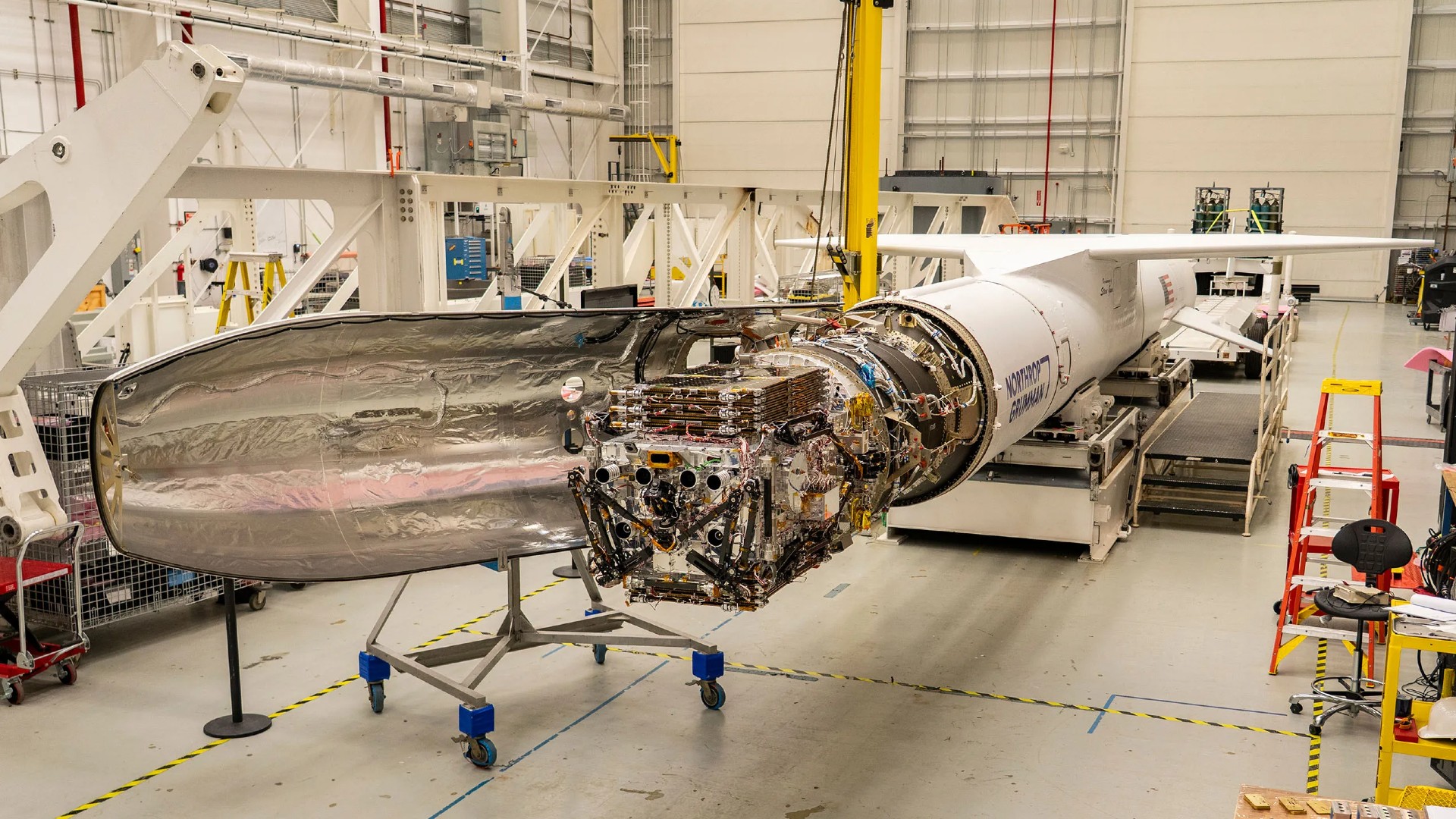
It was just in September 2025 that NASA picked Katalyst to build a spacecraft capable of boosting Swift on a budget of $30 million. That was nine months ago. And now, the finished Link spacecraft — with its three robotic arms, three main Hall thrusters and a suite of other instruments — is packed aboard its Pegasus XL rocket and tucked on the belly of its L-1011 Stargazer carrier plane for a trip to its launch site in the South Pacific's Kwajalein Atoll.
"In the last nine months, we have gone from a clean sheet to a spacecraft that is currently integrated on a rocket on an airplane, ready to go to Kwaj for launch," said Kieran Wilson, Link's principal investigator at Katalyst Space, on Wednesday. "This is an absolutely unprecedented development timeline for this program."
Yet that "swift" timeline, if you will, is essential if NASA is to rescue the Swift space observatory.
Katalyst Space's LINK robotic servicing satellite awaits encapsulation inside a Northrop Grumman Pegasus XL rocket on June 8, 2026, at NASA's Wallops Flight Facility in Virginia. (Image credit: NASA/Ron Beard)
NASA originally launched Swift (its full name is the Neil Gehrels Swift Observatory, after its late principal investigator) in 2004 on a $250 million mission to search the sky for gamma-ray bursts and other high-energy astrophysics phenomena in the cosmos. From its original orbit about 375 miles (600 kilometers) above Earth, Swift was a silent sentinel, ready to quickly pivot to new targets with unprecedented speed.
"Swift was designed to study gamma-ray bursts, short-lived flashes of high-energy light that release more energy in just a few seconds than the sun will in its entire lifetime," Swift principal investigator Brad Cenko told reporters Wednesday. "It's been extremely successful in this regard, detecting over 2,000 of these sources all the way out to the edge of the visible universe."
It was Swift that helped scientists confirm without a doubt that the heaviest elements we know of, including the shiny gold and platinum in the jewelry you're wearing right now, were forged by these explosive cosmic events, Cenko said. Swift was expected to last two years in orbit. It's well into its second decade now, and still in good health — well, except for that "falling out of space" part.
You see, Swift doesn't have thrusters, or a propulsion system of any kind. And over the years, an increase in solar activity — space weather from the sun — has puffed up Earth's atmosphere to create more drag on Swift than expected, pulling it down from its initial orbit.
Last year, the Swift mission team realized the space telescope was falling faster than expected. Without a rescue mission, Swift would crash to Earth by the end of this summer.
"It was okay for a generic spacecraft to come out of orbit," Domagal-Goldman said. "But this was not just any spacecraft. This is an observatory with unique capabilities for astrophysics … It is a swift observatory that can quickly pivot across the night sky to find things that go boom in the night."
"So we decided, yeah, we want to go save this one this time because of how special it is," he added.
Artist's illustration of Katalyst Space Technologies' Link servicing spacecraft approaching and capturing NASA's Swift space observatory on an orbit-boosting mission. (Image credit: Katalyst Space Technologies)
A lot has to go right for Katalyst's Link spacecraft to rescue Swift.
The 937-pound (425-kilogram) spacecraft will launch into an initial testing orbit on June 27 and perform a series of checkouts to ensure that its basic systems (three main engines, 16 reaction control thrusters, solar arrays, robotic arms) are all working properly.
"We'll have a commissioning period of a few weeks, after which we will begin maneuvers in order to approach Swift," Wilson said.
Once Link reaches Swift's orbit, it will perform a series of proximity operations, dock, and then raise the space observatory to its initial orbit over the period of a several months. If that goes to plan, Swift could be back to performing science by this fall, Cenko said. (The telescope has been in a low-power mode to preserve what orbit it can since February.)
If Link is successful, Swift could get another five or more years of life in space. Link, meanwhile, will detach and be intentionally deorbited (meaning it will fall to Earth on purpose) to end its mission.
"All this is challenging and risky," Wilson said. "There's a lot of spacecraft that have had far longer development cycles with far more funding behind them that have failed for mundane reasons."
A lot of simple things can go wrong.
For example, the solar arrays on Link might malfunction, Wilson said. Swift has been in orbit for so long, its protective insulation blankets may be as brittle as glass and break when Link's robotic arms grab on, he added.
Engineers from Katalyst stabilize their Link robotic servicing spacecraft as it moves into a vibration chamber at NASA's Goddard Space Flight Center on April 15, 2026. (Image credit: NASA/Scott Wiessinger)
And then there's the sun. It was increased solar activity that put Swift in its perilous situation. That activity is ongoing. In fact, Swift may be one big solar storm away from doom if the sun fires off a major storm before Katalyst's Link can reach it.
Swift is on track to fall below an altitude of 186 miles (300 km) by October. At that point, it may be too low for Link to reach the observatory. A surprise solar storm could accelerate that fall, but NASA remains hopeful.
"At the moment, we think we have several months where Swift will be at a sufficiently high altitude to give Katalyst folks a great chance to capture and boost us," Cenko said.
Katalyst is banking on the future need for spacecraft servicing and life extension in space. This week, the company raised $12 million in funding to develop an even more capable spacecraft called Nexus, which it plans to "expand satellite servicing to multi-orbit, multi-mission operations."
"Over the last decade or so, we've gotten very good at launching things into space," said Robert Lamontagne, Katalyst's vice president for strategic partnerships. "Katalyst is here really to kind of demark the end of that throwaway model, and the start of a new model."
The first test flight of a Nexus mission could launch in 2027. Its target: a U.S. Space Force satellite called Rooster in geostationary orbit22,236 miles (35,786 km) above Earth, much higher than the Swift observatory. That Nexus-1 mission will launch atop an Ariane 6 rocket next year.
One new mission is setting out to study menstruation in microgravity for the first time ever.
Forty-six years ago, NASA engineers asked Sally Ride if 100 tampons was the right amount to send with her for a six-day spaceflight. Though people laugh at that fact today, there has still never been any scientific study dedicated to studying menstruation in space. But a non-profit called Operation Period aims to change that. Led by Gen-Z researchers, this non-profit works to provide what its founder Manju Bangalore calls "menstrual freedom," which she says would mean everyone can have easy access to menstrual products. Meanwhile, the organization also aims to tackle the wider issues that leave people without such access in the first place. With its upcoming suborbital mission Operation Period-01 (OP-01), this ambitious team is taking their cause into microgravity. On OP-01, the mission's founder will launch to space to conduct the research themselves on a Virgin Galactic suborbital flight in 2027.
In conducting their work here on Earth, Operation Period found that "there were still some of those same gaps in spaceflight medicine," Manju Bangalore, the founder and executive director of Operation Period and research astronaut in training for OP-01, told Space.com. " I want all menstruators to be able to live life with their full dignity and reach their fullest potential, and that includes astronauts."
With a background in physics and astronomical engineering as well as with training in bioastronautics and having spent time working at NASA, Bangalore brings her love of space to this cause. She and Priya Abiram, the Director of Research at Operation Period's Redshift Lab, feel so strongly about their message, even 9 years since the pair founded their non-profit; in fact, with this mission, the two will become some of the youngest South Asian women to travel to space.
"On a personal level, I've always been fascinated by space and human space exploration. It's what's always excited me as a child, and I've kept that curiosity going," Bangalore said. "I didn't think those two missions would ever combine into this. It wasn't something I ever planned, but I'm very grateful to lead this historic mission to advance menstrual health in this way."
And just as this team is excited to bring their research into a suborbital environment, Virgin Galactic is excited to be expanding the range of microgravity science the non-profit supports. "This mission with Operation Period is a powerful example of how Virgin Galactic can continue to support real-time, in-flight scientific investigation into long-overlooked areas of human health, helping advance more inclusive and innovative exploration that delivers insight for both space and life on Earth," Virgin Galactic director of system analysis & research Amber Favaregh said in an emailed statement.
Recently, Operation Period expanded to include a research wing, and this mission will be conducted under that umbrella. The team was not yet able to share specific details on the exact protocol that will be conducted during the mission, information they said will be shared at a date closer to launch, but they did share the current issues that this research aims to begin to address.
Currently, astronauts typically choose to fully suppress their periods during their spaceflights, through hormonal IUDs or oral contraceptive pills. While that is a choice astronauts might continue to make in the future, without data to show the reality of dealing with a period in space, astronauts are left with fewer choices with their own bodies. Comprehensive data on menstruation in space will also be important if astronauts are to complete longer spaceflights or even extended stays on the moon. While the mission has not yet revealed its priorities and exactly what data it will collect, with such limited data on menstruation in space, there is a lot of knowledge to be gained.
While "the data that we have, although limited, says that it is generally safe to menstruate, in terms of long duration missions, we don't have quantitative data," Bangalore said. "We don't have enough data to continue to assist with patient resource allocation for mission planners."
Historic missteps like the "100 questions" moment with Sally Ride highlight an issue that could have big effects on future, longer-term missions. Sure, having a ridiculous number of backup products would ensure that there is no need unaddressed, mass considerations for spaceflight are extremely serious and future missions will need to have better data to know what will be needed in a microgravity environment.
And just like with other science in space, the research conducted in microgravity will also be used on Earth. The pair aim to collect menstruation data that will benefit astronauts as well as people back on our home planet. .
"I think on Earth, there's a lot of gaps right now in menstrual health research," Bangalore said. As just one example, she cited recent findings that menstrual product companies were reporting incorrect absorbency of their products because they were testing products with saline, which is very different from menstrual blood. "This was potentially leading to doctors to underdiagnosed heavy menstrual bleeding, which right now the stats say affects 20% of American menstruators," Bangalore said.
With this being the first mission of its kind, OP-01 will not answer every question that remains about menstruation and space, but it will bring data to a conversation decades in the making. "Our hope is to continue to iterate this research so that we can do future suborbital flights, as well as orbital flights, to continue to create larger data sets," Bangalore said. "I think the point of preliminary studies is to be able to know what questions to ask in the future, so we don't expect that this suborbital flight will solve everything or create all the data that we need, right, but we hope that this will be a good stepping stone."
Momentum for this research was actually sparked by many millions of views on a viral social media video in which Bangalore conducted an early version of a menstrual fluid dynamic experiment in a low-gravity environment aboard a parabolic flight.
This viral moment "ended up being a really cool kind of 'in' to continue talking about destigmatizing periods," she said. "Through that, I got to talk more about the gaps in spaceflight medicine, in terms of menstrual health."
Annie Easley at NASA's Glenn Research Center. (Image credit: NASA)
It's Juneteenth in the U.S. today (June 19), a federal holiday that commemorates the end of slavery in America.
Though the Civil War ended in April of 1865, it wasn't until June 19 that same year when Union soldiers officially enforced the law that all enslaved people would be free. But the end of slavery was only the beginning of the challenges soon to follow; for one, segregation between Black and white people in the U.S., both systemic and informal, persisted for years. And we still live in a time when active racism, and the consequences of prior racism, trickle into many aspects of society.
It indeed affected NASA; Black women at the agency were once discriminated against despite making serious contributions to the space program. Our image of the day today celebrates the accomplishments of one such woman, Annie Easley.
Who is Annie Easley?
In 1955, Annie Easley started working for NASA's predecessor organization, the National Advisory Committee for Aeronautics (NACA). Her job was to serve as a "human computer," which was a position unique to the time. (NACA was dissolved in 1958, and its duties and personnel were taken on by the newly created NASA.)
Human computers at NACA and NASA were women who worked as basically early versions of computer programmers. To be a human computer, you had to be extremely good at mathematics, performing reliable calculations on a consistent basis to aid space missions.
Eventually, though, NASA moved toward the use of machine computers more often; Easley transitioned along with the space agency, ultimately becoming a full-fledged computer programmer.
As NASA explains, Easley's career shifted once again as it progressed. After some time, she took a position as the space agency's EEO, or Equal Employment Opportunity, counselor. She worked with NACA/NASA for 34 years before retiring in 1989. She passed away in 2011.
The importance of NASA's human computers
Like Easley, many of NASA's human computers became computer programmers once the agency made the transition to relying more heavily on machine computers. They together performed hundreds of thousands of calculations for the space program.
Easley alone was able to develop code that was crucial in research of energy-conversion systems, which paved the way for hybrid vehicles like the Centaur upper-stage rocket. Down the line, this work of hers contributed to the 1997 launch of the Cassini spacecraft that headed to Saturn.
However, the story wasn't as golden as it sounds retrospectively. Though NACA started hiring white women as "computers" in 1935, the agency didn't begin allowing Black women to enter the workforce until 1943. And that was only due to a shortage of professionals because of World War 2. In fact, human computers at the agency were not called professionals but rather "subprofessionals," and they were regularly talked down to by men who worked at the organization.
Black women had it particularly bad: They had to jump through hoops imposed by both racism and sexism.
Easley was one of just four African Americans out of 2,500 employees at NACA when she was hired.
In a 2001 interview, Easley recalled her mother saying to her: "'You can be anything you want to. It doesn't matter what you look like, what your size is, what your color is. You can be anything you want to, but you do have to work at it.'"

 Login