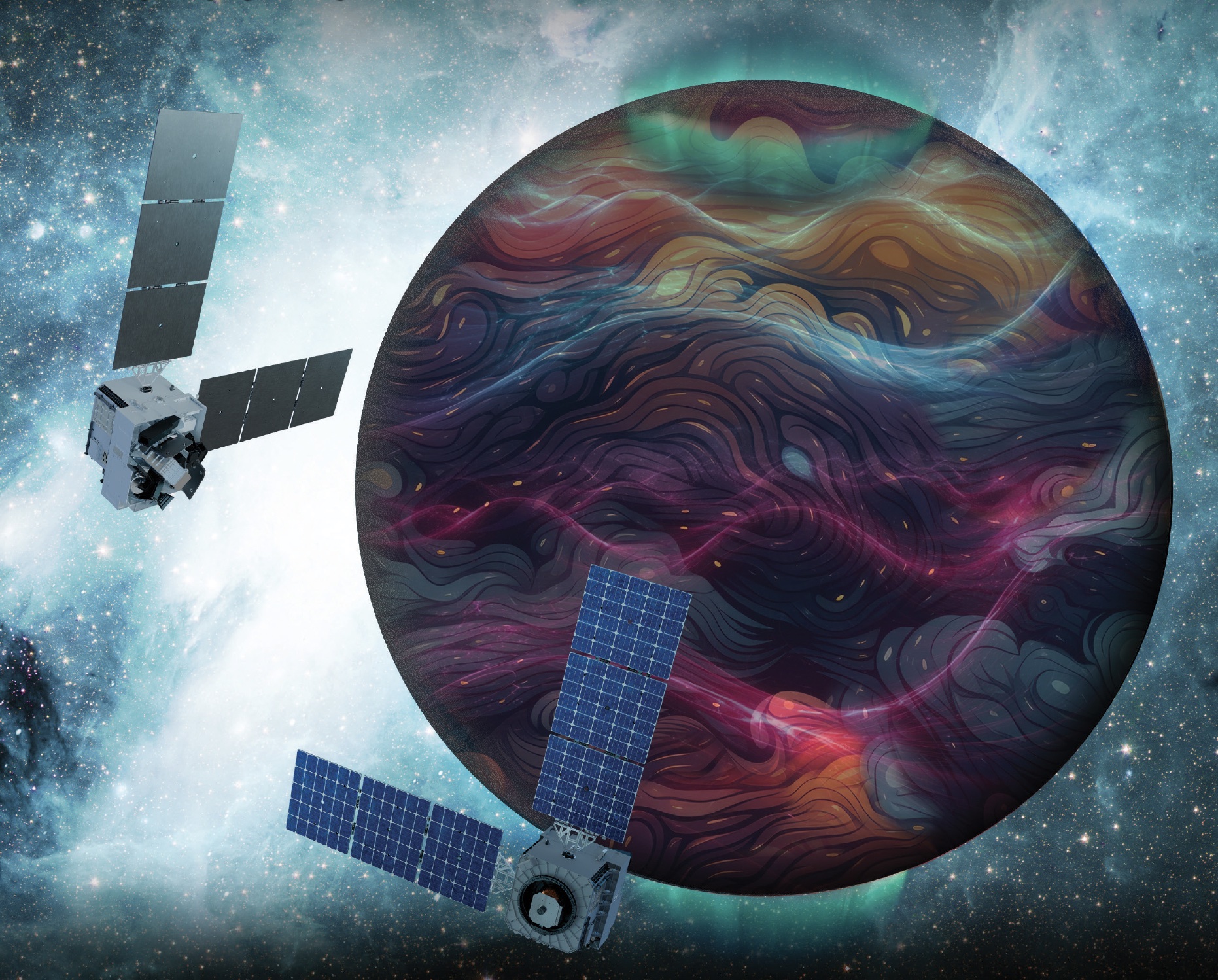
Artist’s rendition of the DAPHNE (Dynamic Atmosphere-Ionosphere Explorer) mission concept. The coloring represents auroras and atmospheric waves in Earth’s atmosphere.
Credit: Laboratory for Atmospheric and Space Physics/Mary Tostanoski
NASA selected a mission concept to research how space weather and dynamics within Earth’s atmosphere influence the space environment and help improve prediction capabilities for impacts on crucial technology, such as GPS and low Earth orbit satellites, as well as astronauts in space.
The DAPHNE (Dynamic Atmosphere-Ionosphere Explorer) mission will enter Phase B of development, which includes planning and design for flight and mission operations. It will use identical twin satellites to study how changes in Earth’s lower atmosphere influence our planet’s upper atmosphere, where space weather is manifested.
“NASA is advancing the United States’ leadership as a space weather-ready nation, and by providing new insights into Earth’s atmosphere we can better predict and prepare for impacts in our daily lives on Earth and in space,” said Nicky Fox, associate administrator, Science Mission Directorate, NASA Headquarters in Washington. “As NASA sends astronauts beyond Earth’s magnetic protection to the Moon, Mars, and beyond, DAPHNE will join the NASA science fleet strategically located across the solar system to provide data that will help mission planners predict and mitigate the effects of space weather for the benefit of all.”
The DAPHNE mission’s low-risk high-return concept will provide coordinated, multi-point measurements of neutral winds, temperature, and composition in the thermosphere. The ionosphere and thermosphere regions are where Earth’s neutral atmosphere transitions into the ionized plasma of space. In this thin shell that surrounds the planet, the atmosphere is in constant motion, shaped by the influence of solar activity and changes in the lower atmosphere and in near-Earth space.
Fundamental observations and physical insights from the DAPHNE mission will incorporate lower-atmospheric energy data to advance space weather predictive capabilities. The mission is led by Aimee Merkel from the Laboratory for Atmospheric and Space Physics at the University of Colorado, Boulder.
The mission will be subject to a confirmation review in 2027, which will assess the progress of the mission and the availability of funds. If confirmed, the total estimated cost of the mission, excluding launch, will not exceed $250 million in fiscal year 2023 dollars, with a mission launch date of no earlier than 2029.
The DAPHNE mission was proposed as a concept study in response to the DYNAMIC (Dynamical Neutral Atmosphere-Ionosphere Coupling) mission announcement of opportunity. Funding and management oversight for this mission is provided by the Solar Terrestrial Probes program at NASA’s Goddard Space Flight Center in Greenbelt, Maryland.
For more information on NASA’s heliophysics missions, visit:
Astronomers have traced a high-energy "ghost particle" back to Shadow Blaster, a star-forming galaxy located 11 billion light-years away. That means that this particle, a neutrino, had been travelling to us ever since the 13.8 billion year-old universe was just around 3 billion years old.
The discovery offers the first evidence that star-forming galaxies like Shadow Blaster play a significant role in populating the universe with mysterious high-energy cosmic ghost-neutrinos. These particles get their spooky nickname because, possessing virtually no mass and no electric charge, they pass through matter with little to no interaction while moving at nearly the speed of light. For context, as you read the preceding sentence, over 65 billion neutrinos streamed through every square inch of your body; that's about 100 billion per square centimeter.
Despite the difficulty associated with detecting such particles, humanity has been spotting neutrinos since the 1960s, but only a few sources of these particles have been identified. Neutrinos are the second most abundant particles in the cosmos after photons, particles of light, and the identified sources are nowhere near enough to account for this abundance. That has prompted the search for other, hidden neutrino sources, especially those which can accelerate neutrinos to high energies. Now that hunt has led to the identification of the incredibly bright Shadow Blaster galaxy, officially designated JCMT0402−0424, which shines in infrared, as a potential neutrino source.
The galaxy JCMT0402−0424, or "Shadow Blaster" identified as a source of a high-energy neutrino detected in 2021. (Image credit: International Gemini Observatory/NOIRLab/NSF/AURA/ALMA (ESO/NAOJ/NRAO))
"Shadow Blaster possesses the kind of dense, gas-rich environment that theoretical models have long suggested could efficiently produce high-energy neutrinos," Yuji Urata of MITOS Science Co., LTD. in Taiwan said in a statement. "If confirmed, Shadow Blaster would be the first-ever individual dusty star-forming galaxy directly linked to a high-energy neutrino event."
Thus far, no other credible candidates exist as potential sources for this high-energy neutrino, designated IC 210922A.
Chasing ghosts
Astronomers were alerted to the existence of IC 210922A half a decade ago when this high-energy neutrino event was detected by the IceCube Neutrino Observatory located in Antarctica. This set the astronomical community scouring space in the direction of the constellation Eridanus for potential sources for an electromagnetic counterpart to this event with a range of telescopes. This turned up no convincing gamma-ray, X-ray or optical counterpart for the neutrino detection, nor could any gamma-ray burst, supernova, or tidal disruption event (in which a black hole violently shreds a star) be linked with IC 210922A.
Urata and colleagues began their personal search with the James Clerk Maxwell Telescope (JCMT), operated by the East Asian Observatory, and the Submillimeter Array (SMA), discovering Shadow Blaster, a galaxy in the right position and with the right level of brightness to be associated with IC 210922A. The team followed this up with an investigation using the Atacama Large Millimeter/submillimeter Array (ALMA), a collection of 66 radio wave antennas in northern Chile.
The detection of this galaxy was possible because it is strongly gravitationally lensed. Gravitational lensing is a phenomenon that occurs when an object of great mass comes between Earth and a distant background source, curving the fabric of spacetime. As light from the background source navigates this curvature, its path is curved. This results in light from the lensed source arriving at different times to our telescopes, causing it to be amplified.
In the case of Shadow Blaster, before the team could learn anything about this distant galaxy, they had to discover more about the object serving as the intermediate gravitational lens, specifically what type of object it is, its mass, and its distance from us. To do this, they turned to the Gemini North telescope and its Gemini Multi-Object Spectrograph (GMOS) and the Gemini Near-InfraRed Spectrograph (GNIRS) instruments.
With the model of a gravitational lens determined, the team discovered that Shadow Blaster is a galaxy with an extremely compact heart filled with dense clouds of gas and dust that is fueling an intense burst of star formation. A region such as this has long been theorized to serve as a powerful particle accelerator. Because Shadow Blaster lacks a feeding supermassive black hole, this research shows that these regions can still serve as cosmic particle accelerators when they harbor sleeping black holes and in the absence of the powerful jets that erupt from active galactic nuclei (AGNs).
As for the overall population of neutrinos, this research could help account for that too. Intensely star-forming galaxies, or starburst galaxies, are believed to have been prevalent around 10 billion years ago in the early universe. Thus, these galaxies could have been producing a multitude of high-energy neutrinos. Proving that may prove difficult, however, as astronomers don't have the good fortune to find all of these galaxies lurking behind a gravitational lens, meaning they may be too faint and distant to study.
"Our analysis suggests that this population could contribute up to roughly 20% of the observed diffuse neutrino background measured by IceCube," Urata concluded,
The team's research was published on Wednesday (June 17) in the journal Nature Astronomy.
Physicists with LHCb Collaboration at CERN’s Large Hadron Collider (LHC) have detected the elusive Ωcc⁺ baryon, a particle containing two charm quarks and one strange quark, completing a long-sought family of doubly charmed baryons first predicted over half a century ago.
Physicists have revealed that the unusual decay of an “exotic” subatomic particle could offer new clues to its mysterious structure.
The discovery, reported by a team of physicists in a study published in Physical Review Letters, argues that it provides the first “crucial discrimination” between current theoretical models of a variety of subatomic particles known as the Ds(2317) meson.
Exotic Subatomic Mysteries
The new research has its beginnings more than two decades ago, with the initial detection of an unusual particle known as the Ds(2317) meson. Part of what makes this particle unique is the fact that it possesses one charm quark (or “c quark,” a kind of elementary particle) and one strange antiquark—the third lightest of all the known quarks.
It was deemed a major discovery at the time, and for good reason: it seemed to point at a significant discrepancy between the particle’s measured mass of 2.317 GeV/c2, and predictions based on estimates that placed it significantly higher, at around 2.4 GeV/c2.
Now, in a new study by researchers with the Belle and Belle II Collaboration, observations of previously undetected behaviors that include never-before-seen light-emissions during the particle’s decay have been described for the first time.
Based on their analysis, the team believes their new findings mark not only a significant first in the study of these particles, but that they may also help researchers solve the longstanding mystery involving apparent discrepancies between the observed and expected mass values for the Ds(2317) meson.
The findings, the team says, could also provide physicists with deeper insights into the fundamental forces that currently bind matter.
Unraveling a Baffling Discrepancy
The team approached the problem by first proposing a range of different models that could potentially describe the internal structure of the Ds(2317) meson. Of key importance was the fact that each of the different models allows researchers to predict a specific range of potential values for the particle’s decay.
This was achieved based on the probability that the Ds(2317 meson will decay by emitting a gamma ray, which was then divided by an entirely separate probability: that the particle would emit a pion—a type of meson with a mass roughly 270 times that of an electron—rather than a gamma ray.
Based on these two possibilities, the team determined that measurements indicating a ratio of greater than 8.1% would point to the likelihood that the meson represents a compact state involving quark-antiquark models.
However, if the calculated value turned out to be lower—specifically in the range of between 0.5% and 4.25%—that would instead favor models that describe the particle as functioning closer to being a sort of molecule-like state of two separate mesons.
Well Above Standard Deviations
With such values in mind, the team then went to work to determine which was more likely with help from data collected by the Japanese KEKB and SuperKEKB electron–positron colliders.
Using this information, the particle’s gamma-emitting decay was successfully detected, revealing a statistical significance above ten standard deviations. Next, the Belle and Belle II Collaboration conducted measurements that showed the decay ratio between photons and pions was close to 7%, placing the determined value smaller than the majority of quark-antiquark models, and at a greater value than those in the molecular models.
“This result provides crucial discrimination between theoretical models of the Ds(2317) structure,” the team writes.
Going forward, the researchers believe additional insights that may help to conclusively reveal the mysterious Ds(2317) meson’s structure may be achievable through more complete measurements of the particle’s decay rate.
The recent paper, “Observation of the Radiative Decay 𝐷*𝑠0(2317)+→𝐷*𝑠+𝛾,” appeared in Physical Review Letters.
Micah Hanks is the Editor-in-Chief and Co-Founder of The Debrief. A longtime reporter on science, defense, and technology with a focus on space and astronomy, he can be reached atmicah@thedebrief.org. Follow him on X @MicahHanks, and at micahhanks.com.
Scientists from Asia Pacific’s largest paint and coating manufacturer have developed a new “ultra-black” automotive coating using carbon nanotubes that absorbs over 99% of the light it receives, resulting in the darkest black of any currently available paint or coating.
The NIPSEA Group’s research team said its new ultra-black coating, which they describe as “deep, jet black,” meets stringent automotive standards, a critical requirement in markets like China, where trendy, luxury vehicles in the darkest colors are in high demand.
Carbon Nanotubes Absorb Light to Create Darkest Black “Ultra-Black” Coating
According to a statement announcing the new ultra-black coating, BMW first introduced a concept car in 2019 with a vertically aligned carbon nanotube (VACNT) array outer coating. Due to the unique material properties of carbon nanotubes, including the ability to bend or absorb light, the researchers said that its introduction “set off a race” among auto manufacturers to create a similar, ‘black hole’ effect with a pronounced dark appearance.
“Automotive coating companies have been actively pursuing innovations in color technology to develop mass-processable ultra-black coating solutions with extreme blackness,” explained Zhiwei Liu, a research chemist with the company’s Color Technology Group, Core R&D, and an author on the study outlining the new coating.
The researchers note that ultra-black coatings are in unusually high demand in Asian countries, where having the darkest vehicle can represent a status symbol. has become a “key selling point” in China.
“Deep black finishes have long been the premium choice and signature color for luxury cars due to their elegant appearance, powerful visual impact, and luxurious undertone,” the researcher explained.
Although scientists have explored more practical ways to achieve the desired ultra-black effect, the new research once again leverages the unusual properties of carbon nanotubes to create an ultra-black coating that is darker than even the darkest commercially available alternative.
Creating a Stable Composite That Meets Automotive Standards
According to the team’s statement, they began by exploring methods to combine the benefits of carbon nanotubes with a black pigment that would serve as the coating’s color base. Critically, the team needed to create a nano-sized carbon black pigment-carbon nanotube composite that was also stable at a wide range of temperatures. and moisture conditions.
After exploring several formulations, Liu and colleagues succeeded in a stable nanotube-pigment composite. Next, the team incorporated the new carbon nanotube-based mixture into a coating binder and sprayed it onto a model car.
Because the new ultra-black coating uses structural absorption of light rather than the carbon black dispersion method used in current approaches, tests revealed an average absorption of 99.90% across all visible wavelengths. The team said its new coating also displayed “excellent long-term stability” during water and humidity tests.
Although the light absorption levels set a new standard for the darkest achievable automotive coating, Liu said advancements in dispersing technology and equipment leave his team “room for improvements.” The researcher highlighted potential advancements in “practical processability of carbon-nanotube-containing nanomaterials.”
Liu and colleagues also noted that increasing the proportion of carbon nanotubes in the material could further increase its light-absorbing capacity. However, they conceded, this approach “would also bring difficulties in industrial-grade processability.”
Future Improvements Include Even Darker Multi-Layer Options
When discussing potential future improvements, the team said scientists could fabricate multilayered ultra-black coatings. In theory, they note that this approach could result in a “gradient refractive index that reduces interface reflection and further enhances light absorption efficiency,” producing an even darker look than their single-layer version.
Although the ultra-black automotive coating is not yet commercially available, the team said they have already completed a “proof of concept” manufacturing design. Still, they conceded, given technical and regulatory challenges that remain, “it may still be a while before ultra-black cars made with this film will be able to hit the road.”
“Further efforts will focus on the verification of coating application window and the comprehensive film performance validations of carbon black pigment-carbon nanotube composite-based ultra-black automotive coating,” Liu concluded.
Christopher Plain is a Science Fiction and Fantasy novelist and Head Science Writer at The Debrief. Follow and connect with him on X, learn about his books at plainfiction.com, or email him directly at christopher@thedebrief.org.
This NASA Hubble Space Telescope image features a swarm of galaxies in the galaxy cluster called CL0016+1609 or MACS J0018.5+1626.
NASA, ESA, H. Ebeling (University of Hawaii), D. Coe (STScI, ESA, JWST); Image Processing: G. Kober (NASA/Catholic University of America)
This NASA Hubble Space Telescope image features a galaxy cluster, called CL0016+1609 or MACS J0018.5+1626, that is very bright at X-ray wavelengths and is one of the most extensively studied clusters at X-ray and radio wavelengths. The X-ray observations of this cluster revealed that it is two clusters merging along our line of sight.
Researchers requested time to observe CL0016+1609 with Hubble’s Advanced Camera for Surveys because that data would help them accurately measure the cluster’s dark-matter distribution, which helps them study the merger and the role of CL0016+1609 in the large-scale structure of the universe. Hubble can’t directly see dark matter, but its infrared and visible light observations can detect dark matter’s gravitational lensing effects on the normal matter Hubble observes.
The data in this image also includes observations with Hubble’s Wide Field Camera 3 taken as part of an observing program that obtained the first Hubble infrared images of 46 massive galaxy clusters and looked for distant galaxies gravitationally lensed by these clusters. Called RELICS (Reionization Lensing Cluster Survey), this survey found some 300 high-redshift candidate galaxies lensed by these clusters.
You can see the faint vertical arc of one of these distant galaxies in the image above. Look for it just to the left of the large elliptical galaxies in the center of the image. Another brighter, though shorter arc is visible just above and to the right of the large elliptical galaxies in the center of the image.
NASA’s Fermi Mission Uncovers Possible Sibling Supernova Remnants
A new study of two supernova remnants, the debris left behind after stars explode, suggests the explosions came from stellar siblings that once orbited each other. The first star’s detonation sent its binary companion hurtling through space, and then, after traveling for thousands of years, the surviving star blew up too.
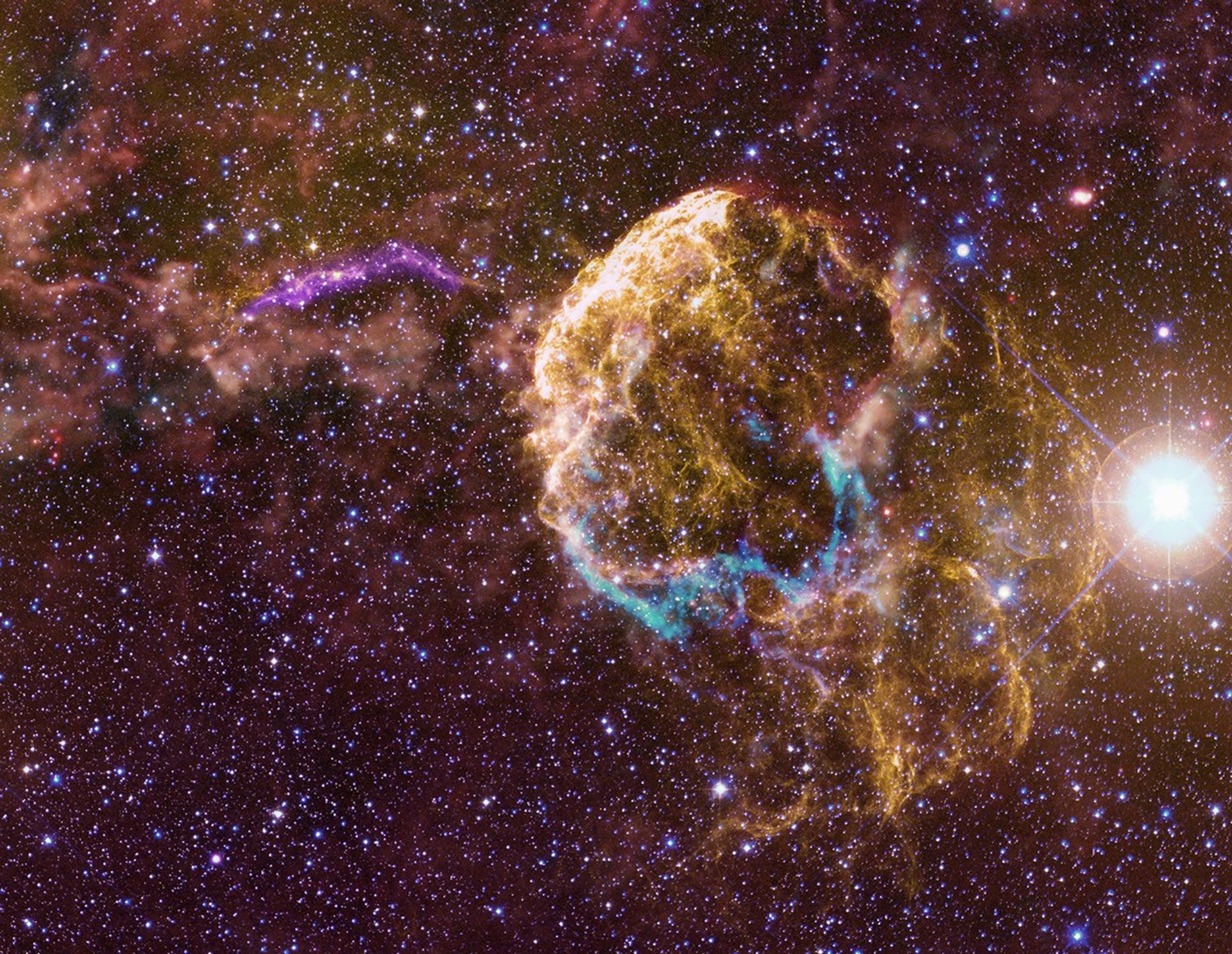
This multiwavelength scene shows the Jellyfish Nebula supernova remnant (right), the interstellar cloud it’s interacting with, and a distinctive curving filament to its upper left. The filament, which is shown here both in optical and ultraviolet (UV) light, is the visible part of an overlapping supernova remnant, G189.6+3.3, that is more prominent in radio and X-rays. Visible light is shown in yellow, UV from NASA’s Neil Gehrels Swift Observatory is shown in violet, and infrared light from NASA’s retired WISE (Wide-field Infrared Survey Explorer) mission appears in cyan, red, and orange. Both remnants are located about 6,000 light-years away in the constellation Gemini. The brilliant star at far right is Propus, also known as Eta Geminorum.
NASA Goddard Space Flight Center and M. Michailidis et al. 2026; optical: DSS; infrared: NASA/WISE/JPL-Caltech/UCLA; ultraviolet: NASA/Swift
“Using 16 years of data from NASA’s Fermi Gamma-ray Space Telescope, our analysis uncovered gamma rays associated with a supernova remnant that was hidden in the glare of its neighbor, the Jellyfish Nebula, one of the brightest gamma-ray-emitting supernova remnants known,” said Miltiadis Michailidis, a postdoctoral fellow in the physics department at Stanford University in California. “There are so many striking connections between the two remnants that we conclude they’re likely related, giving us the first known example of a binary system where both stars have undergone supernova explosions.”
Michailidis presented the findings Wednesday at the 248th meeting of the American Astronomical Society in Pasadena, California. A paper describing the results will appear in a future edition of Nature Communications.
The study focused on a faint supernova remnant called G189.6+3.3, which is mainly visible in X-rays. It is upstaged by its brighter and better-known neighbor, the Jellyfish Nebula (IC 443). The two star wrecks, both located in the constellation Gemini, appear to partially overlap as seen in X-rays. Recent X-ray evidence suggests that hot plasma likely associated with G189.6+3.3 may extend across the entire region, a hint that the overlap may be nearly total.
A massive star explodes when its energy-producing core runs out of fuel and collapses under its own weight, triggering an explosion that blows the star apart. The explosion’s shock wave encloses a hot cloud of debris that rapidly expands into space. So far, astronomers have cataloged about 300 supernova remnants in our galaxy.
The Fermi mission is part of NASA’s fleet of observatories monitoring the changing cosmos to help humanity better understand how the universe works. More than a decade ago, observations from Fermi’s LAT (Large Area Telescope) showed that the shock waves of supernova remnants accelerated particles to within a fraction of the speed of light, a process first proposed by physicist Enrico Fermi — the mission’s namesake — in 1949.
These high-speed particles, called cosmic rays, interact with interstellar gas to produce gamma rays, the highest-energy form of light. Protons make up 99% of cosmic ray particles. To prove that accelerated protons are responsible for the glow, astronomers search for a specific gamma-ray feature. When cosmic-ray protons smash into interstellar gas, they produce a short-lived particle called a neutral pion, which almost immediately decays into a pair of gamma rays. This emission occurs within a specific band of energies associated with the neutral pion’s mass and lies within the range detected by Fermi’s LAT instrument.
In 2013, Fermi observations proved that the Jellyfish Nebula, which is interacting with part of a glowing cloud of hydrogen gas known as Sharpless 249, produced gamma rays through this mechanism. Its neighbor, G189.6+3.3, was discovered in 1994 as part of an X-ray survey by the German-led ROSAT (Roentgen Satellite) mission.
A bright filament of gas lies between the overlapping remnants. New observations of this feature reveal that the shock wave from G189.6+3.3 slammed into dense interstellar gas there and dramatically slowed, key evidence that both remnants are interacting with the same cloud system.
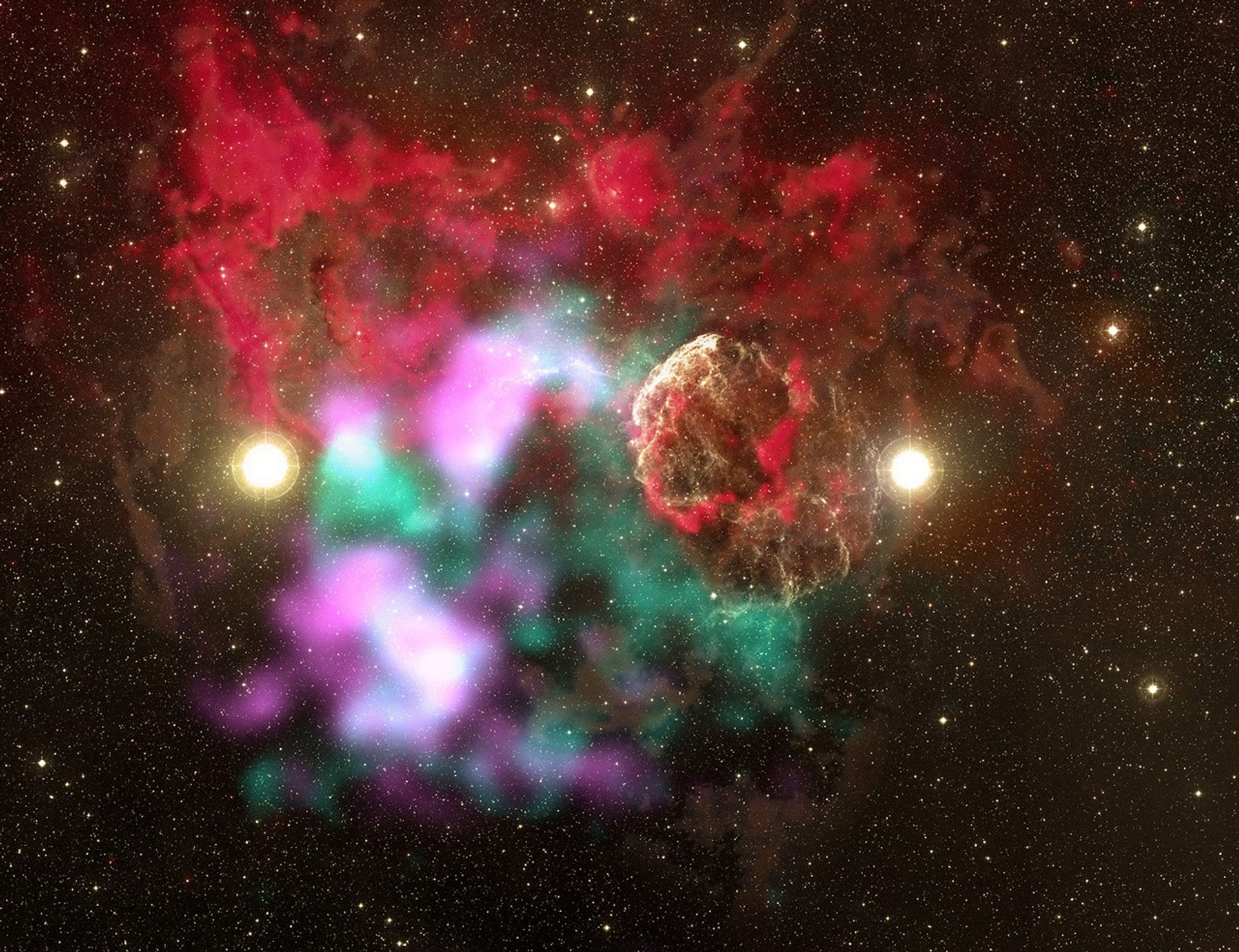
The well-known supernova remnant IC 443 (right) has an older, fainter neighbor (shown here in blue-green and magenta) called G189.6+3.3. A filament of gas between them, glowing in visible and ultraviolet light (violet arc at center), traces the neighbor’s shock wave and shows that both remnants are interacting with the same molecular cloud, shown in red, orange, brown for infrared and radio data and yellow for visible light. Blue-green shows X-rays from the fainter remnant, while magenta shows gamma rays with energies greater than 10 billion electron volts; for comparison, visible light has energies between about 2 and 3 electron volts. In this view, high-energy light from the much brighter IC 443 has been removed for clarity. Gamma-ray emission near the filament stems from protons accelerated in the supernova’s shock wave as it expands into the cloud.
NASA Goddard Space Flight Center and M. Michailidis et al. 2026; radio, MWISP and ESA/Planck; infrared: NASA/WISE/JPL-Caltech/UCLA; optical: DSS; ultraviolet: NASA/Swift; X-ray: SRG/eROSITA; gamma ray: NASA/DOE/Fermi LAT Collaboration
Astronomers think the Jellyfish Nebula is also a candidate PeVatron, a cosmic particle accelerator capable of boosting protons to energies so high they could nearly escape our galaxy. Such particles can produce gamma rays with trillions of times more energy than visible light. Finding a second particle accelerator near the Jellyfish Nebula could offer scientists new clues for how supernova remnants develop into PeVatrons.
“The overlapping remnants, a connecting gas filament, and the availability of data from Fermi and other facilities motivated us to delve into this complex but little-studied region,” said co-author Marianne Lemoine-Goumard, an astrophysicist at the French National Centre for Scientific Research (CNRS) based at the University of Bordeaux. “With Fermi’s LAT instrument, we found gamma-ray emission associated with accelerated protons in the northern part of the fainter remnant. If both remnants are interacting with the same structure, then they must share a common distance from us.”
The team concludes the remnants lie about 6,000 light-years away, their explosion centers are separated by roughly 40 light-years projected onto the plane of the sky, and the original stars may have been 20 or more times the Sun’s mass.
Estimates of the remnants’ ages vary widely, but the team concludes that the age of the Jellyfish Nebula is 8,000 to 9,000 years, while G189.6+3.3 is between 20,000 to 110,000 years old. This means the delay between the explosions could have extended for up to 100,000 years.
In addition, the team conducted computer simulations of a million massive binary systems. They show that systems where the stars orbit close enough to exchange matter and interact during their lives can readily produce dual supernova explosions with similar separations and time delays as those found for the remnants. The team also estimated that the chance of randomly encountering this combination of observed spatial alignment and compatible distances to be less than 1%, strongly supporting a physical association.
“The evidence we’ve compiled — including observations across the spectrum, the chemical and physical properties of the remnants, simulations, and more — paints a compelling picture of a dual supernova event,” said Michailidis.
This study identifies a unique possible example of a binary system where both stars exploded as supernovae and left behind separate, detectable supernova remnants. Astronomers think that most massive stars form in binary or multiple-star systems. The Jellyfish Nebula/G189.6+3.3 complex offers astronomers a rare opportunity to study how massive binary stars evolve, exchange matter, explode, and experience velocity changes — called kicks — induced by the supernova blast. It also provides a powerful new laboratory for understanding how coupled supernova remnants behave, including how they accelerate particles, generate gamma rays, and shape their surrounding environments.
“Fermi’s gamma-ray observations of supernova remnants continue to reveal the dynamic lives of stars,” said Elizabeth Hays, the Fermi project scientist at NASA’s Goddard Space Flight Center in Greenbelt, Maryland. “We can now connect the glowing remains of two massive stars to a powerful pair that evolved together over thousands of years.”
This NASA Hubble Space Telescope image features a swarm of galaxies in the galaxy cluster called CL0016+1609 or MACS J0018.5+1626.
NASA, ESA, H. Ebeling (University of Hawaii), D. Coe (STScI, ESA, JWST); Image Processing: G. Kober (NASA/Catholic University of America)
This NASA Hubble Space Telescope image features a galaxy cluster, called CL0016+1609 or MACS J0018.5+1626, that is very bright at X-ray wavelengths and is one of the most extensively studied clusters at X-ray and radio wavelengths. The X-ray observations of this cluster revealed that it is two clusters merging along our line of sight.
Researchers requested time to observe CL0016+1609 with Hubble’s Advanced Camera for Surveys because that data would help them accurately measure the cluster’s dark-matter distribution, which helps them study the merger and the role of CL0016+1609 in the large-scale structure of the universe. Hubble can’t directly see dark matter, but its infrared and visible light observations can detect dark matter’s gravitational lensing effects on the normal matter Hubble observes.
The data in this image also includes observations with Hubble’s Wide Field Camera 3 taken as part of an observing program that obtained the first Hubble infrared images of 46 massive galaxy clusters and looked for distant galaxies gravitationally lensed by these clusters. Called RELICS (Reionization Lensing Cluster Survey), this survey found some 300 high-redshift candidate galaxies lensed by these clusters.
You can see the faint vertical arc of one of these distant galaxies in the image above. Look for it just to the left of the large elliptical galaxies in the center of the image. Another brighter, though shorter arc is visible just above and to the right of the large elliptical galaxies in the center of the image.
A new study suggests that the collapse of a massive star could spark the creation of a tiny expanding universe rather than a black hole. The resulting object, called a gravastar, would avoid the singularity and event horizon that make black holes so puzzling. Massive stars produce light and heat through nuclear fusion in their [...]
Quantum computing news usually picks up near the end of the year, as companies try to provide evidence that they are hitting benchmarks on time. However, there have been interesting announcements as the summer starts this year, from incremental progress to attention-grabbing promises. As we did earlier this month, Ars has a rundown of some of the most significant announcements.
These include a promise of useful, error-corrected quantum computing as soon as 2028, details on an updated trapped ion processor, and a case in which claims of quantum supremacy have been cut back a bit thanks to advances in more traditional algorithms.
2028 is remarkably soon
Many people in the field expect that useful quantum computers are still about five to 10 years away. While there may be a few useful algorithms that can be run on existing error-prone hardware, almost all of the interesting problems that quantum computing can be applied to will require some form of error correction enabled by linking a small collection of hardware qubits together into what's called a logical qubit. Logical qubits include the redundant storage of information along with neighboring qubits that can be measured to determine when errors occur and how to fix them.

 Login