❌

Normal view

Denisovan DNA influences the immune systems of modern Oceanians — but researchers aren't sure why

18 June 2026 at 21:13

Some people from Oceania harbor thousands of genetic variants inherited from the Denisovans ‪—‬ a mysterious group of extinct humans ‪—‬ that are still active in their immune systems today, a new study finds.

The findings, published June 11 in the journal Science, come from the largest-ever map of Denisovan-inherited DNA ever created. The discovery shows that Denisovan DNA "is not just a remnant of ancient liaisons; it continues to influence our biology today," study co-author Serena Tucci, an assistant professor of anthropology and head of the Human Evolutionary Genomics Laboratory at Yale University, said in a statement.

Experiments revealed 3,127 variants inherited from Denisovans that still function in the immune systems of modern-day people; some of these variants switch genes that turn the immune response on or off, according to the new research.

However, because many of the immune system genes identified also affect other bodily functions, it is unclear exactly how these genes benefited survival, study first author Patrick Reilly, an evolutionary genomics researcher at Yale, told Live Science.

Denisovan DNA is active in humans today

Previous research has already found that some modern-day people in Oceania ‪—‬ a region that includes New Guinea, the Solomon Islands and Fiji ‪—‬ have some Denisovan DNA. For example, people from Papua New Guinea are known to carry up to 5% Denisovan DNA in their genomes thanks to prehistoric trysts with the enigmatic group of humans who lived in Asia and disappeared around 30,000 years ago. This is among the highest proportion in the world, with modern-day East Asians typically carrying only around 0.1% Denisovan DNA.

Previous research has also shown that modern-day Tibetans carry a Denisovan version of the EPAS1 gene that supports their adaptation to living at high altitudes. People living in the highlands and lowlands of Papua New Guinea have different Denisovan gene variants depending on their local environments.

Yet Oceanians are vastly underrepresented in genomic databases. Sequencing the genomes of Oceanians can give a glimpse into the lives of the Denisovans and is essential for closing gaps in health disparities in Pacific Islanders as a whole, Reilly said.

To fill this gap, Tucci and her team sequenced the genomes of 177 Oceanians from 12 populations and compared them to 1,284 previously published genomes from populations worldwide. Then, they compared these segments to the known Denisovan genome and three Neanderthal genomes.

Combined, the team built a catalog containing three times more Denisovan genetic sequences inherited from Denisovans than were previously identified, over 70% of which were unique to Oceanians.

Natural selection increased the frequency of some of these variants in people from Near Oceania, which includes New Guinea, the Bismarck Archipelago and the Solomon Islands in the Pacific Ocean, including genes linked to bone development, metabolism and fertility.

The team also ran experiments to assess whether any of the Densiovan DNA was changing how genes behaved in these populations, Reilly said.

This revealed that Denisovan genetic variants can switch various immune system genes on or off, although the exact immune functions that were targeted varied among the Oceanic populations studied.

Early migrants to Oceania at least 42,000 years ago benefited from Denisovan genes when they entered their new environment and encountered new disease-causing pathogens, Reilly said.

"This is consistent with multiple independent instances of local adaptation in response to novel immune environments and pathogens during human dispersal into the Pacific," the authors wrote in the study.

Although the researchers don't know exactly why natural selection acted on these genes, the findings highlight the major role pathogens played in shaping the way humans and our extinct relatives evolved, Reilly said.

The research is an "outstanding effort to try to understand the biological implications" of the enduring Denisovan genetic variants, Mathilde André, an evolutionary geneticist at the Pasteur Institute in France who was not involved in the study, told Live Science in an email.

The tripling of known Denisovan-inherited genetic sequences, most of which are unique to Oceanians, highlights the need to sequence the genomes from previously unrepresented populations to capture the diversity of Denisovan DNA, André said.

See how much you know about early humans with our human evolution quiz!

Did Neanderthals use rhinoceros teeth as tools?

18 June 2026 at 19:20
The RINO project was born from the discovery of unusual marks on rhinoceros teeth recovered from the prehistoric Payre site in France's Rhône Valley. The study of fossil rhinoceros teeth from this Middle Paleolithic site, dating to around 250,000–130,000 years ago, provides unprecedented evidence that Neanderthals used them as tools.

Hunter-gatherers in Siberia died of a plague outbreak 5,500 years ago

18 June 2026 at 16:04

Plague swept through groups of hunter-gatherers in southeastern Siberia 5,500 years ago, leaving dozens dead in its wake—with DNA from Yersinia pestis bacteria still trapped inside their teeth.

University of Oxford ancient DNA researcher Ruairidh Macleod and his colleagues recently sequenced the telltale bacterial DNA in teeth from plague victims at four ancient cemeteries in the area around Russia’s Lake Baikal. The tragedy that befell these communities is now the earliest known plague outbreak, courtesy of the oldest strain of Y. pestis ever sequenced.

Unearthing a new backstory for the plague

Until recently, scientists who study the evolution of diseases have held two fairly solid ideas about the origins of plague, the disease caused by Yersinia pestis bacteria. It's a scourge so awful that it has gone down in history as not just a plague but the plague. The first idea is that the earliest strains didn't have the right genetic traits to be really lethal. And the second is that the plague first began menacing humans when the first farmers settled in densely packed towns alongside rats and domestic animals.

Read full article

Comments

© Kevin WIlson

Archaeologists Discover Stonehenge ‘Prototype’ Constructed 500 Years Before Britain’s Most Famous Megalithic Site

18 June 2026 at 13:04


A research team from Wessex Archaeology, led by Phil Harding, has announced the discovery of a Stonehenge ‘prototype’ structure, similarly aligned with the solstices, that may have served as an early proof of concept for the more famous structure built 500 years later.

The team behind the historic discovery said that the ancient date represents the earliest known alignment with the solstices and offers potential insights into the religion, belief systems, scientific knowledge, and worship practices of the ancient monument builders.

Location of Stonehenge Prototype Excavated a Decade Earlier

According to a statement announcing the discovery of the Stonehenge prototype, the structure is located 5 kilometers from the better-known stone circle. They also note that Stonehenge’s earliest earthworks were beginning construction around this same time.

Previous expeditions to the site conducted between 2015 and 2017 unearthed 48 pits, which those researchers dated to more than 2,000 years before the new find, or roughly 2,950 BCE. Still, the team notes that earlier efforts uncovered samples of pottery, animal bones, flints, and charcoal, suggesting that “large numbers of people gathered here over a relatively short period of time” to celebrate the longest day of the year.

Notably, one of the pits unearthed in the earlier excavations included what the team described as a possible “viewing station.” The pit also contained a disc-shaped knife, which the team notes “was deliberately placed here possibly as a symbolic reference to the sun disc.”

Still, the original effort left several tantalizing clues, leading to the new excavations.

Stonehenge prototype
Stonehenge (Image by Regina Wolfs from Pixabay)

Wooden Poles Align With the Solstices to Within One Degree

Instead of exploring the previously discovered pits, the team focused on the rest of the site. This effort led to the discovery of a pair of wooden pole pits placed 120 meters apart. According to the Wessex Archaeology team’s statement, the site’s ancient builders positioned the poles in the pits “to form a line pointing directly at the rising sun during the summer solstice and at the setting sun during (the) winter solstice.”

Although little of the structure remains, except for the pits where the poles once stood, the team was able to extract enough organic material to date the likely construction period of the structure. A radiocarbon analysis showed that the summer solstice poles were likely set around 5,000 years ago, more than 2,000 years earlier than the other pits at the same site. Perhaps even more surprisingly, the date placed the construction of the wooden poles roughly 500 years before ancient engineers built the world-famous site of Stonehenge.

Stonehenge prototype
Image Credit: Wessex Archaeology.

To confirm the astronomical alignment, the team reached out to archaeologist Fabio Silva. According to the team’s statement, Dr. Silva, a Skyscape Archaeologist at Stone x Sky and the Skyscape Academy, used ancient reconstructions of the sky and the landscape to show that the structure would have aligned with the summer solstice “within an accuracy of one degree.”

When discussing the site’s potential uses, the researchers note that it would have served as a temporary gathering place for ancient celebrations of the summer and winter solstices until a more permanent structure could take its place. They even suggest that a similar structure may have been used in Stonehenge’s earliest phases, while conceding that traces of any similar alignment would have been erased by later construction.

Harding, who led the excavations, said the discovery of a possible Stonehenge prototype “is probably one of the greatest finds of my career,” while adding that the early date is what makes it so exceptional.

“Up till now, our knowledge of this ancient feat of astronomy was based on Stonehenge and other monuments of a similar period, but what we’ve discovered at Bulford is 500 years earlier than the famous stones we know so well,” Harding explained. “It makes me incredibly proud to be an archaeologist.”

“Part of a Much Longer Conversation Between People, the Land, and the Sky”

Although the ancient structure revealed a scientific knowledge predating Stonehenge by several centuries, Dr Matt Leivers, Senior Research Manager at Wessex Archaeology, said the discovery of a clearly religious site is “fundamental” because it is the earliest example of people building structures at this historically significant location “that aim directly at the solstice.”

“When we talk about the solstice, we’re talking about religion,” Dr. Leivers said. “About how prehistoric peoples understood the cosmos, the world, and their place in it.”

“It’s likely their way of saying to their deities, please keep us in mind, keep us warm and safe,” he added.

Dr Silva noted the historical significance in relation to Stonehenge, since the site shows that ancient communities “were already engaging with both the summer and winter solstices” in the same general area hundreds of years before the larger, more famous stones were put in place. The researcher also said the findings allow historians to see Stonehenge as more than a singular creation, but “as part of a much longer conversation between people, the land, and the sky.”

“Rather than marking the beginning of a story, Stonehenge now more clearly appears to have emerged from traditions and practices with much deeper roots in this landscape,” Dr. Silva concluded.

Christopher Plain is a Science Fiction and Fantasy novelist and Head Science Writer at The Debrief. Follow and connect with him on X, learn about his books at plainfiction.com, or email him directly at christopher@thedebrief.org.

5,000-year-old 'prototype' Stonehenge aligning with solstices discovered near the famous Stone Age monument

18 June 2026 at 00:01

Evidence of two ancient wooden posts aligned with the summer and winter solstices has been discovered near Stonehenge in southwest England. The posts have rotted away, and only traces of the postholes survive. But archaeologists say the structure predated Stonehenge, and they think it was a temporary religious monument until a permanent one was built. They even suggest it may have been a Stonehenge prototype.

Analysis suggests that ancient people used the posts to mark the summer and winter solstices, Phil Harding, an archaeologist at Wessex Archaeology who's leading the project, noted at a news conference on Wednesday (June 17).

"These people were capable of establishing the points on the horizon where the sun rises in the midsummer and sets in midwinter," he said. "This was a pioneering achievement." (The 2026 summer solstice will be celebrated at Stonehenge on June 21.)

Harding's team at Wessex Archaeology, a private firm that often works for the government and local authorities, publicly announced the finds June 18 in the U.K., and a report on their research will be peer-reviewed and published. The ancient monument consisted of the two large, wooden posts, about 400 feet (120 meters) apart, on land near the village of Bulford, a few miles east of Stonehenge.

The land is now controlled by the U.K. Ministry of Defence, but archaeologists have been allowed to excavate there since 2015. They previously found traces of two "henges" ‪—‬ rings of ditches and banks made from earth ‪—‬ and dozens of Neolithic pits from about 5,000 years ago, centuries before Stonehenge was completed. The pits were filled with animal bones, pottery, flints and charcoal, and the researchers think they date to the time that the first phase of Stonehenge was being built.

Solstice alignment

The posts were aligned to point along an axis that marked the direction of sunrise on the summer solstice, or "midsummer's day," and the setting of the sun exactly six months later, at the winter solstice, or "midwinter's day," according to a statement from Wessex Archaeology. The same astronomical alignments are seen at Stonehenge.

The animal bones and other signs of feasting in the pits at Bulford are evidence of large numbers of people gathering for religious festivals. (Signs of ancient feasting have also been found at Stonehenge.)

"When we talk about the solstice, we're talking about religion," Matt Leivers, an archaeologist at Wessex Archaeology and one of the researchers, said in the statement. "What we see at Bulford, and later at Stonehenge, is a way of celebrating and marking the passage of time, but it's also about making sure the world keeps working as it should."

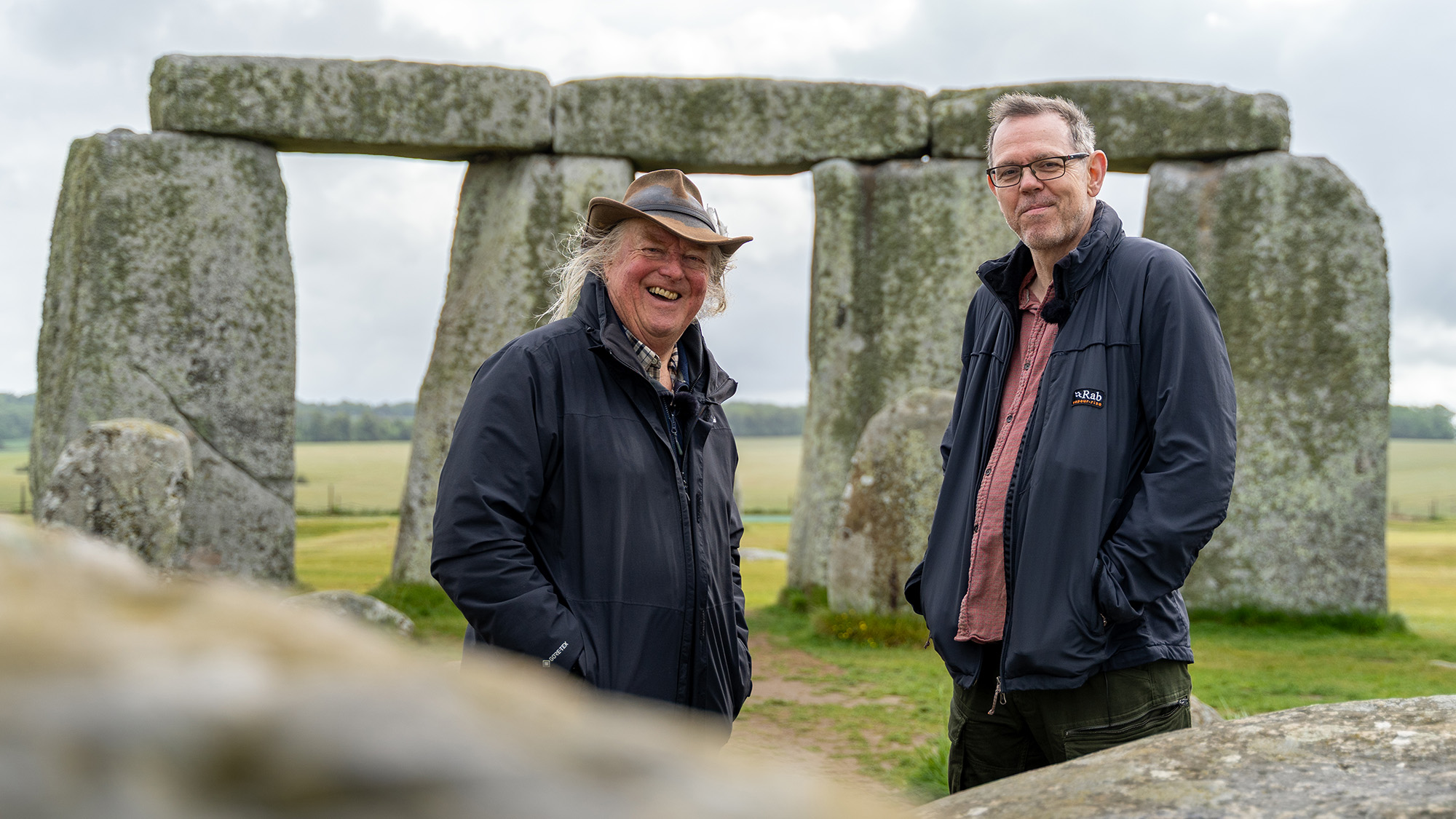
To older men stand next to the vertical stones of Stonehenge

Archaeologists Phil Harding (left) and Matt Leivers led the excavations at the Bulford site, a few miles east of Stonehenge. (Image credit: Wessex Archaeology)

The site predates the largest circles of stones at Stonehenge, which have the same alignments. "What we've discovered at Bulford is 500 years earlier than the famous stones we know so well," Harding said. The researchers even suggest that the Bulford monument may have been a sort of prototype for Stonehenge itself.

Ancient stones

Stonehenge is the world's most famous Neolithic monument, but its original purpose was long a mystery. Archaeological investigations have established that the first earthwork henge was started there about 5,000 years ago, and the famous central stones were added about 500 years later.

Recent discoveries at Stonehenge include evidence of ancient cremations, and many archaeologists now think the monument was originally a burial site. If that's the case, the alignment with sunset on the winter solstice might have represented "new life," as the days then became longer and warmer after the depths of winter. However, no human remains have been found at the Bulford site.

Susan Greaney, an archaeologist at the University of Exeter who was not involved in the research, said the new finds show the importance of the region to prehistoric people. "It is intriguing to think that simple posts were erected here to align with the solstices around 500 years before Stonehenge was built," she told Live Science.

The Bulford monument may have been a temporary "model" for Stonehenge itself, Amanda Chadburn, an independent archaeologist who wasn't involved in the research, told Live Science "If you were designing a very complicated piece of engineering like Stonehenge," she said, "you would have had to understand how to make it before starting."

See how much you know about Stonehenge with our Stonehenge quiz!

Ancient curse tablet bears rare Greek inscription with binding spell intended to harm enemies

17 June 2026 at 22:20
Heidelberg University researchers have deciphered the inscription on an ancient curse tablet, which was once used to invoke deities and demons in order to harm an enemy. The "magical" artifact from the Roman province of Lower Germania was discovered during excavations carried out in the Dutch municipality of Heerlen. The lead tablet, which dates to the 2nd century A.D., is distinctive in that it contains not a Latin but an ancient Greek text in the Egyptian style, as Dr. Rodney Ast, academic director at the Institute for Papyrology, explains.

❌