JCMT0402-0424, a dusty starburst galaxy around 11 billion light-years away, is the strongest candidate yet for the source of the high-energy neutrino event IC 210922A, according to a team of astronomer led by Yuji Urata of MITOS Science Co.
Using NASA’s Goldstone Solar System Radar and NSF’s Green Bank Telescope, astronomers from the University of California, Los Angeles, confirmed that the icy surface of Jupiter’s moon Europa scatters radio energy in an unusually strong and complex way not seen on rocky worlds.
NASA’s Fermi Mission Uncovers Possible Sibling Supernova Remnants
A new study of two supernova remnants, the debris left behind after stars explode, suggests the explosions came from stellar siblings that once orbited each other. The first star’s detonation sent its binary companion hurtling through space, and then, after traveling for thousands of years, the surviving star blew up too.
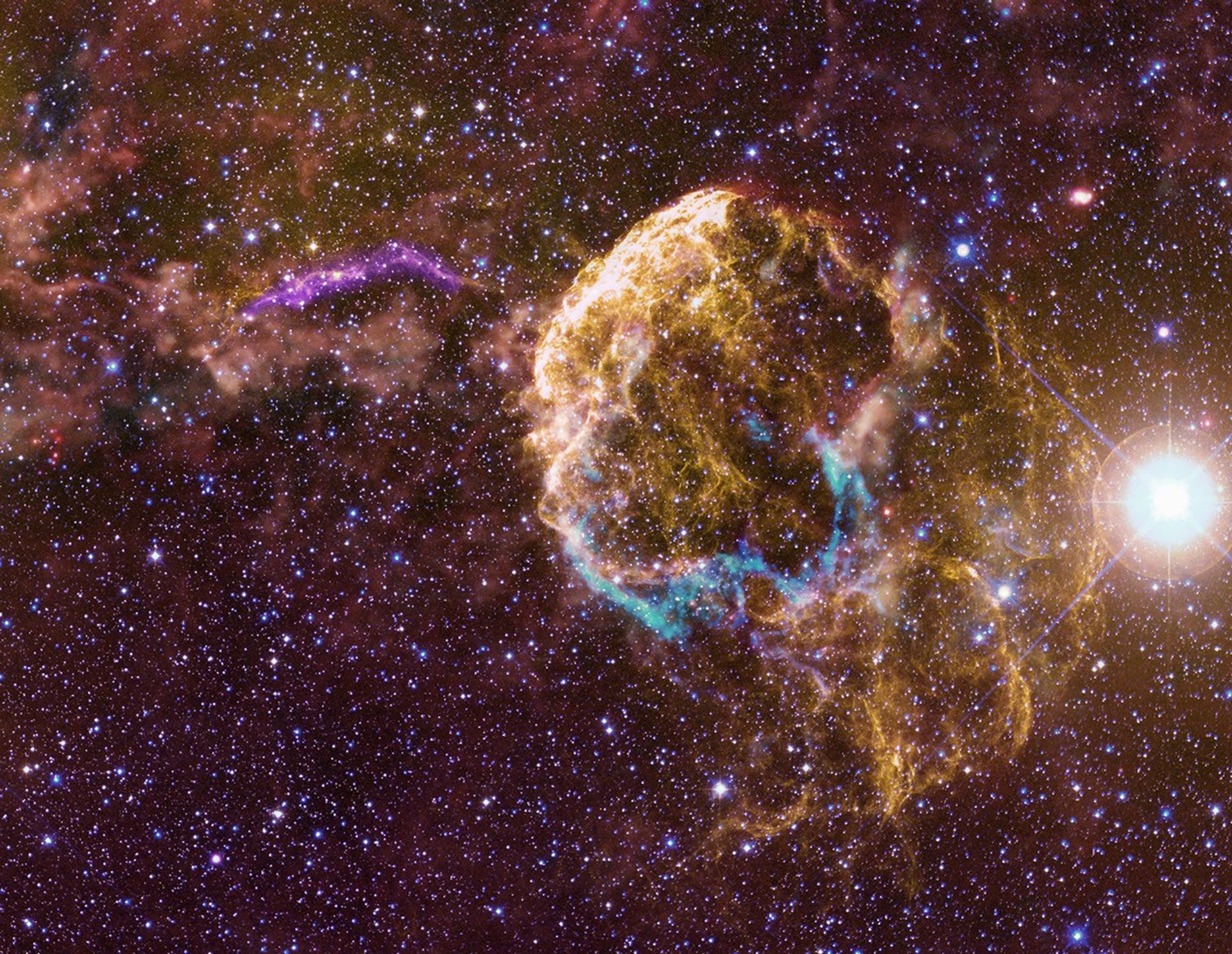
This multiwavelength scene shows the Jellyfish Nebula supernova remnant (right), the interstellar cloud it’s interacting with, and a distinctive curving filament to its upper left. The filament, which is shown here both in optical and ultraviolet (UV) light, is the visible part of an overlapping supernova remnant, G189.6+3.3, that is more prominent in radio and X-rays. Visible light is shown in yellow, UV from NASA’s Neil Gehrels Swift Observatory is shown in violet, and infrared light from NASA’s retired WISE (Wide-field Infrared Survey Explorer) mission appears in cyan, red, and orange. Both remnants are located about 6,000 light-years away in the constellation Gemini. The brilliant star at far right is Propus, also known as Eta Geminorum.
NASA Goddard Space Flight Center and M. Michailidis et al. 2026; optical: DSS; infrared: NASA/WISE/JPL-Caltech/UCLA; ultraviolet: NASA/Swift
“Using 16 years of data from NASA’s Fermi Gamma-ray Space Telescope, our analysis uncovered gamma rays associated with a supernova remnant that was hidden in the glare of its neighbor, the Jellyfish Nebula, one of the brightest gamma-ray-emitting supernova remnants known,” said Miltiadis Michailidis, a postdoctoral fellow in the physics department at Stanford University in California. “There are so many striking connections between the two remnants that we conclude they’re likely related, giving us the first known example of a binary system where both stars have undergone supernova explosions.”
Michailidis presented the findings Wednesday at the 248th meeting of the American Astronomical Society in Pasadena, California. A paper describing the results will appear in a future edition of Nature Communications.
The study focused on a faint supernova remnant called G189.6+3.3, which is mainly visible in X-rays. It is upstaged by its brighter and better-known neighbor, the Jellyfish Nebula (IC 443). The two star wrecks, both located in the constellation Gemini, appear to partially overlap as seen in X-rays. Recent X-ray evidence suggests that hot plasma likely associated with G189.6+3.3 may extend across the entire region, a hint that the overlap may be nearly total.
A massive star explodes when its energy-producing core runs out of fuel and collapses under its own weight, triggering an explosion that blows the star apart. The explosion’s shock wave encloses a hot cloud of debris that rapidly expands into space. So far, astronomers have cataloged about 300 supernova remnants in our galaxy.
The Fermi mission is part of NASA’s fleet of observatories monitoring the changing cosmos to help humanity better understand how the universe works. More than a decade ago, observations from Fermi’s LAT (Large Area Telescope) showed that the shock waves of supernova remnants accelerated particles to within a fraction of the speed of light, a process first proposed by physicist Enrico Fermi — the mission’s namesake — in 1949.
These high-speed particles, called cosmic rays, interact with interstellar gas to produce gamma rays, the highest-energy form of light. Protons make up 99% of cosmic ray particles. To prove that accelerated protons are responsible for the glow, astronomers search for a specific gamma-ray feature. When cosmic-ray protons smash into interstellar gas, they produce a short-lived particle called a neutral pion, which almost immediately decays into a pair of gamma rays. This emission occurs within a specific band of energies associated with the neutral pion’s mass and lies within the range detected by Fermi’s LAT instrument.
In 2013, Fermi observations proved that the Jellyfish Nebula, which is interacting with part of a glowing cloud of hydrogen gas known as Sharpless 249, produced gamma rays through this mechanism. Its neighbor, G189.6+3.3, was discovered in 1994 as part of an X-ray survey by the German-led ROSAT (Roentgen Satellite) mission.
A bright filament of gas lies between the overlapping remnants. New observations of this feature reveal that the shock wave from G189.6+3.3 slammed into dense interstellar gas there and dramatically slowed, key evidence that both remnants are interacting with the same cloud system.
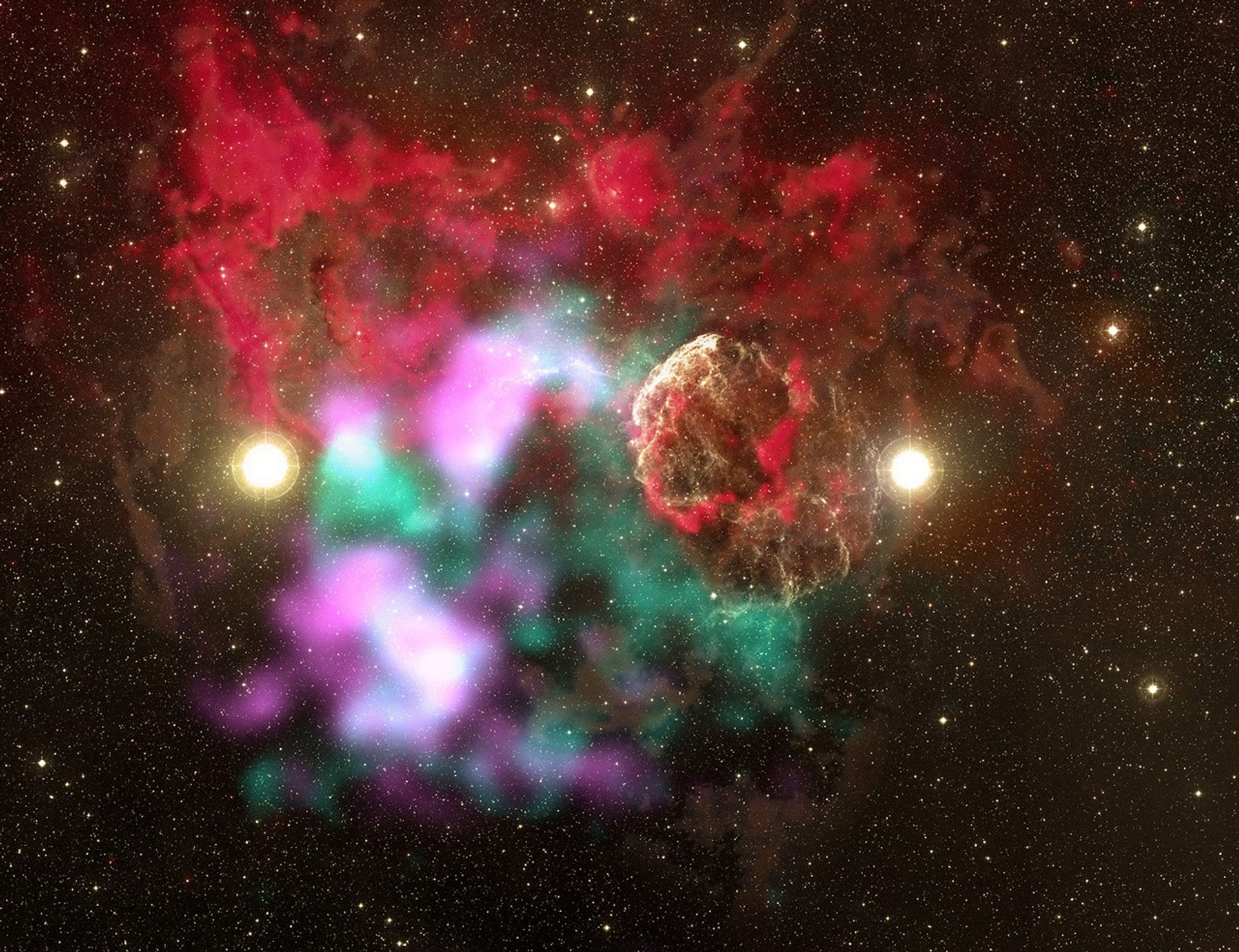
The well-known supernova remnant IC 443 (right) has an older, fainter neighbor (shown here in blue-green and magenta) called G189.6+3.3. A filament of gas between them, glowing in visible and ultraviolet light (violet arc at center), traces the neighbor’s shock wave and shows that both remnants are interacting with the same molecular cloud, shown in red, orange, brown for infrared and radio data and yellow for visible light. Blue-green shows X-rays from the fainter remnant, while magenta shows gamma rays with energies greater than 10 billion electron volts; for comparison, visible light has energies between about 2 and 3 electron volts. In this view, high-energy light from the much brighter IC 443 has been removed for clarity. Gamma-ray emission near the filament stems from protons accelerated in the supernova’s shock wave as it expands into the cloud.
NASA Goddard Space Flight Center and M. Michailidis et al. 2026; radio, MWISP and ESA/Planck; infrared: NASA/WISE/JPL-Caltech/UCLA; optical: DSS; ultraviolet: NASA/Swift; X-ray: SRG/eROSITA; gamma ray: NASA/DOE/Fermi LAT Collaboration
Astronomers think the Jellyfish Nebula is also a candidate PeVatron, a cosmic particle accelerator capable of boosting protons to energies so high they could nearly escape our galaxy. Such particles can produce gamma rays with trillions of times more energy than visible light. Finding a second particle accelerator near the Jellyfish Nebula could offer scientists new clues for how supernova remnants develop into PeVatrons.
“The overlapping remnants, a connecting gas filament, and the availability of data from Fermi and other facilities motivated us to delve into this complex but little-studied region,” said co-author Marianne Lemoine-Goumard, an astrophysicist at the French National Centre for Scientific Research (CNRS) based at the University of Bordeaux. “With Fermi’s LAT instrument, we found gamma-ray emission associated with accelerated protons in the northern part of the fainter remnant. If both remnants are interacting with the same structure, then they must share a common distance from us.”
The team concludes the remnants lie about 6,000 light-years away, their explosion centers are separated by roughly 40 light-years projected onto the plane of the sky, and the original stars may have been 20 or more times the Sun’s mass.
Estimates of the remnants’ ages vary widely, but the team concludes that the age of the Jellyfish Nebula is 8,000 to 9,000 years, while G189.6+3.3 is between 20,000 to 110,000 years old. This means the delay between the explosions could have extended for up to 100,000 years.
In addition, the team conducted computer simulations of a million massive binary systems. They show that systems where the stars orbit close enough to exchange matter and interact during their lives can readily produce dual supernova explosions with similar separations and time delays as those found for the remnants. The team also estimated that the chance of randomly encountering this combination of observed spatial alignment and compatible distances to be less than 1%, strongly supporting a physical association.
“The evidence we’ve compiled — including observations across the spectrum, the chemical and physical properties of the remnants, simulations, and more — paints a compelling picture of a dual supernova event,” said Michailidis.
This study identifies a unique possible example of a binary system where both stars exploded as supernovae and left behind separate, detectable supernova remnants. Astronomers think that most massive stars form in binary or multiple-star systems. The Jellyfish Nebula/G189.6+3.3 complex offers astronomers a rare opportunity to study how massive binary stars evolve, exchange matter, explode, and experience velocity changes — called kicks — induced by the supernova blast. It also provides a powerful new laboratory for understanding how coupled supernova remnants behave, including how they accelerate particles, generate gamma rays, and shape their surrounding environments.
“Fermi’s gamma-ray observations of supernova remnants continue to reveal the dynamic lives of stars,” said Elizabeth Hays, the Fermi project scientist at NASA’s Goddard Space Flight Center in Greenbelt, Maryland. “We can now connect the glowing remains of two massive stars to a powerful pair that evolved together over thousands of years.”
European Commission (EC) President Ursula von der Leyen (pictured) called for closer US-European Union (EU) cooperation on AI at the G7 Summit currently being held in France, arguing both sides have a shared interest in accelerating adoption and ensuring powerful models are introduced safely.
In a post on X following a roundtable with partner countries and AI business executives, von der Leyen stated AI is “developing exponentially” and described it as “the most important technology of our time”. She said the technology “comes with immense potential, but also risks for free, democratic societies”, adding Europe and the US should work together because they “represent 70% of the world market”.
According to Reuters, von der Leyen framed AI safety as a shared interest, stating: “We use each other’s trusted technology, and our financial systems are interconnected. “It is in our mutual interest that our citizens and companies can safely use the best AI models,” she added.
New models The remarks follow a US government order issued earlier this week directing Anthropic to suspend access to its most advanced AI models, Fable 5 and Mythos 5, for foreign nationals over national security concerns.
Although the Trump administration’s letter targeted foreign nationals, Anthropic said compliance would have required verifying the nationality of every user. It therefore shut both models down entirely for all customers.
In an AI sovereignty push earlier this week, French Prime Minister Sebastien Lecornu argued: “We cannot rely on the goodwill of certain partners who, as we have seen in recent days, are capable of cutting off access to the Anthropic model.”
On the issue, von der Leyen said at the summit “the key question of today is how to introduce new models safely,” calling for G7 countries to exchange information and cooperate through independent entities evaluating models before market release.
She also highlighted adoption as a competitive priority, stating Europe and the US are “at par in terms of AI adoption” but that the bloc wants “our own AI future, not in isolation – that is very important – but together with our trusted partners”.
A burial site uncovered by archaeologists in southern Siberia has revealed a series of unusual discoveries, which include ritually broken artifacts surrounding human and horse remains.
The burial site was uncovered in the Sayan Mountains and was discovered during a survey in advance of railway construction planned for the area. Archaeologists believe that the grave dates to the tenth century.
Originally uncovered in 2014, excavations at the site of the unusual grave and several others found nearby have been ongoing, revealing discoveries that researchers say are unusual for the period and location.
“It is quite clear that this is far from an ordinary burial,” according to Andrey Poliakov, a researcher with the Russian Academy of Sciences and one of the co-authors of a new study detailing the findings, which appeared in Bulletin of Novosibirsk State University, Series: History, Philology.
Curious Discoveries in a Siberian Grave
Among the unusual discoveries in the Siberian grave were human remains—those belonging to a woman, as well as a newborn child—and animal remains belonging to a horse, including the creature’s skull, skin, and limbs, and a spine that belonged to a sheep.
The woman’s remains were also accompanied by several artifacts, which included bronze earrings, a spindle whorl crafted from stone, and an iron knife. Also associated with the woman’s remains was a mirror, which archaeologists believe may have been intentionally broken for ritual purposes—a practice maintained by many ancient cultures throughout the world.
The woman’s remains at the burial site in the Sayan Mountains revealed a range of artifacts, many of which were dated to earlier times, suggestive of heirlooms that may represent an “elite” burial (Image Credit: Press Service of the Institute of the History of Material Culture of the Russian Academy of Sciences)
Eastern Connections
Also of interest was the design of the mirror, which features carvings of a vine that winds along the artifact and clusters of grapes. The research team believes this could indicate that this artifact, and possibly some of the others found in the grave, may have originated from China.
Additionally, the researchers report that items associated with the remains of the horse contained within the burial site are associated with older periods, which would have made them antiques at the time they were included within the grave. Another example of artifacts with possible eastern origins includes a stirrup, which features decorations that bear resemblance to ancient art found in China and India.
Such stirrups were often employed by nomads who once dwelt on the Eurasian Steppe, and featured on the left side of their saddles—a position which archaeologists also believe may have held ritual significance.
An Elite Burial from the 10th Century
According to the researchers in their study, “The entire set of items constitutes a complete set of riding horse equipment,” which they say has “an archaic appearance and could be preserved for a long time as ‘family heirlooms’.”
The researchers add that such items were particularly popular in ancient nomadic society along the Eurasian Steppe and were viewed “as an indicator of social prestige” during the 8th and 9th centuries.
The unusual collection of artifacts within the grave was considered a rare find for this region, although further interpretation about the remains of the woman and the infant, which may had been her child, may be required.
The paper, “Riding Horse Equipment from a Medieval Burial on the Idzhim River in the Usinskaya Basin,” by Andrey Poliakov and colleagues, appeared in Bulletin of Novosibirsk State University, Series: History, Philology.
Micah Hanks is the Editor-in-Chief and Co-Founder of The Debrief. A longtime reporter on science, defense, and technology with a focus on space and astronomy, he can be reached atmicah@thedebrief.org. Follow him on X @MicahHanks, and at micahhanks.com.
Space surveillance venture Look Up plans to use Skynopy’s ground station network to help automate its proposed low Earth orbit collision avoidance service, the French startups announced June 17.
Orange stepped up ambitions to drive commercial growth for French start-ups, using the annual VivaTech event in Paris to outline a three-pronged strategy focused on procurement, distribution and enterprise integration.
Orange stated it will buy directly from French start-ups where their technology fits its operational and business needs, use its commercial network to connect companies with public and private-sector buyers and integrate select technology into Orange Business’ enterprise catalogue.
The operator said it aims to boost digital sovereignty by tackling long-standing barriers faced by young French companies, including lengthy contracting processes, limited access to large corporate customers, a lack of commercial references and the complexity of scaling technology at pace.
Separately, Orange Ventures, the group’s investment arm, added it would boost funding for start-ups working in AI, cloud, cybersecurity, health and defence as part of a wider digital trust push.
Orange pointed to several companies it has already worked with under the plan, citing successful partnerships with cybersecurity specialist Anozr Way, circular economy player Circular Place, agentic AI developer H Company and process optimisation firm Kerys.
The initiative forms part of the operator’s partnership with French Tech Mission 2030, a government-backed programme that aims to support the country’s start-ups seeking to move beyond pilots and into commercial deployment.
Orange CEO Christel Heydemann (pictured) said France needs start-ups “capable of reaching industrial scale, sustaining their solutions and rapidly winning their markets,” adding Orange aims to use its “purchasing volume”, “commercial strength” and “integration expertise” to help them grow.
Julie Huguet, director of the French Tech Mission, added “access to customers, trusted relays and smoother sales cycles” were “essential” for start-up growth. She said the partnership with Orange could “generate tangible commercial opportunities for our scale-ups and help bring out the future European technology leaders”.

 Login