
❌

Normal view

NASA’s Fermi Mission Uncovers Possible Sibling Supernova Remnants

17 June 2026 at 18:15

6 min read

NASA’s Fermi Mission Uncovers Possible Sibling Supernova Remnants

A new study of two supernova remnants, the debris left behind after stars explode, suggests the explosions came from stellar siblings that once orbited each other. The first star’s detonation sent its binary companion hurtling through space, and then, after traveling for thousands of years, the surviving star blew up too.
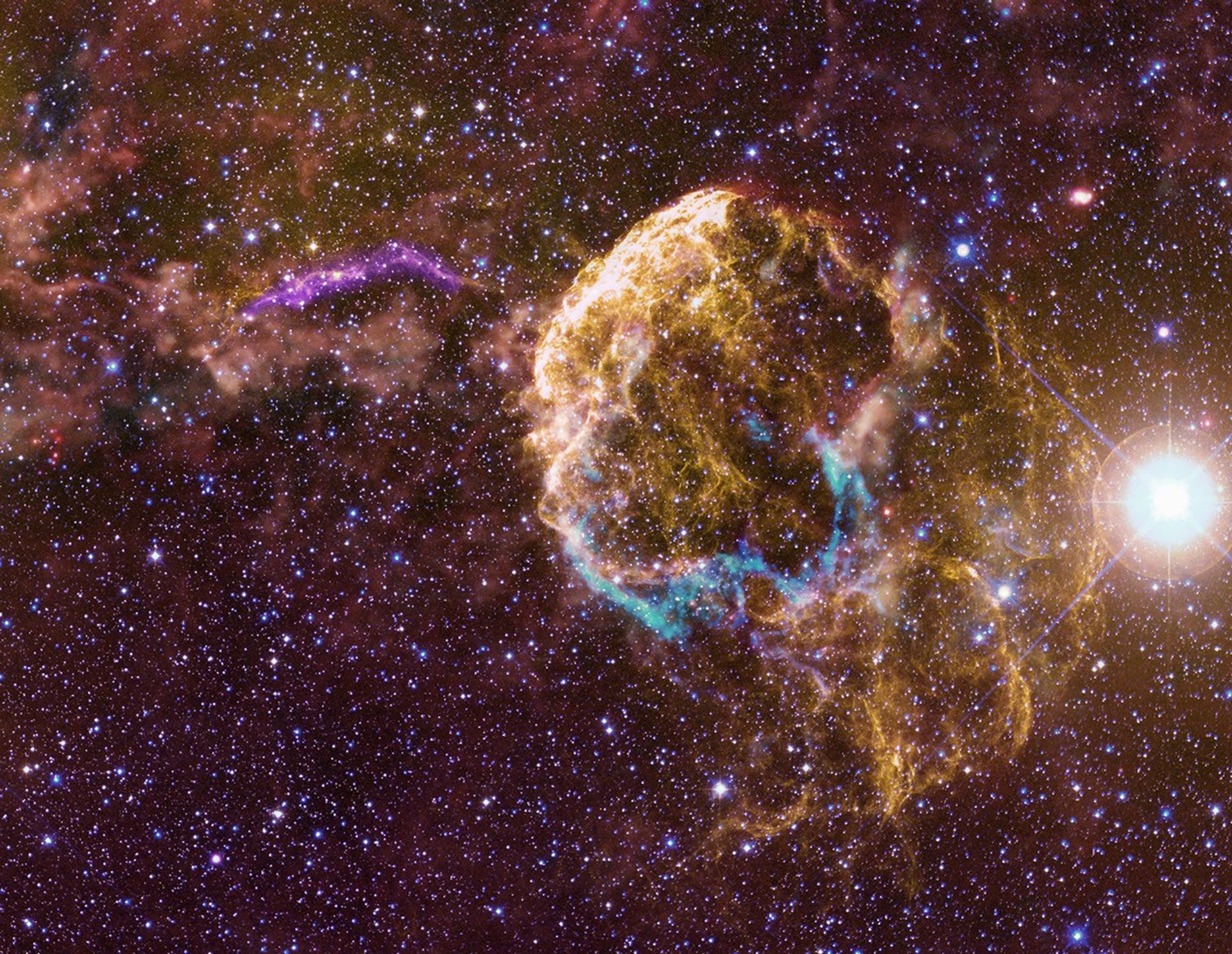
Infrared, visible, and ultraviolet image of the area around the Jellyfish Nebula
This multiwavelength scene shows the Jellyfish Nebula supernova remnant (right), the interstellar cloud it’s interacting with, and a distinctive curving filament to its upper left. The filament, which is shown here both in optical and ultraviolet (UV) light, is the visible part of an overlapping supernova remnant, G189.6+3.3, that is more prominent in radio and X-rays. Visible light is shown in yellow, UV from NASA’s Neil Gehrels Swift Observatory is shown in violet, and infrared light from NASA’s retired WISE (Wide-field Infrared Survey Explorer) mission appears in cyan, red, and orange. Both remnants are located about 6,000 light-years away in the constellation Gemini. The brilliant star at far right is Propus, also known as Eta Geminorum.
NASA Goddard Space Flight Center and M. Michailidis et al. 2026; optical: DSS; infrared: NASA/WISE/JPL-Caltech/UCLA; ultraviolet: NASA/Swift

“Using 16 years of data from NASA’s Fermi Gamma-ray Space Telescope, our analysis uncovered gamma rays associated with a supernova remnant that was hidden in the glare of its neighbor, the Jellyfish Nebula, one of the brightest gamma-ray-emitting supernova remnants known,” said Miltiadis Michailidis, a postdoctoral fellow in the physics department at Stanford University in California. “There are so many striking connections between the two remnants that we conclude they’re likely related, giving us the first known example of a binary system where both stars have undergone supernova explosions.”

Michailidis presented the findings Wednesday at the 248th meeting of the American Astronomical Society in Pasadena, California. A paper describing the results will appear in a future edition of Nature Communications.

The study focused on a faint supernova remnant called G189.6+3.3, which is mainly visible in X-rays. It is upstaged by its brighter and better-known neighbor, the Jellyfish Nebula (IC 443). The two star wrecks, both located in the constellation Gemini, appear to partially overlap as seen in X-rays. Recent X-ray evidence suggests that hot plasma likely associated with G189.6+3.3 may extend across the entire region, a hint that the overlap may be nearly total.

A massive star explodes when its energy-producing core runs out of fuel and collapses under its own weight, triggering an explosion that blows the star apart. The explosion’s shock wave encloses a hot cloud of debris that rapidly expands into space. So far, astronomers have cataloged about 300 supernova remnants in our galaxy.  

The Fermi mission is part of NASA’s fleet of observatories monitoring the changing cosmos to help humanity better understand how the universe works. More than a decade ago, observations from Fermi’s LAT (Large Area Telescope) showed that the shock waves of supernova remnants accelerated particles to within a fraction of the speed of light, a process first proposed by physicist Enrico Fermi — the mission’s namesake — in 1949.

These high-speed particles, called cosmic rays, interact with interstellar gas to produce gamma rays, the highest-energy form of light. Protons make up 99% of cosmic ray particles. To prove that accelerated protons are responsible for the glow, astronomers search for a specific gamma-ray feature. When cosmic-ray protons smash into interstellar gas, they produce a short-lived particle called a neutral pion, which almost immediately decays into a pair of gamma rays. This emission occurs within a specific band of energies associated with the neutral pion’s mass and lies within the range detected by Fermi’s LAT instrument.

In 2013, Fermi observations proved that the Jellyfish Nebula, which is interacting with part of a glowing cloud of hydrogen gas known as Sharpless 249, produced gamma rays through this mechanism. Its neighbor, G189.6+3.3, was discovered in 1994 as part of an X-ray survey by the German-led ROSAT (Roentgen Satellite) mission.

A bright filament of gas lies between the overlapping remnants. New observations of this feature reveal that the shock wave from G189.6+3.3 slammed into dense interstellar gas there and dramatically slowed, key evidence that both remnants are interacting with the same cloud system.
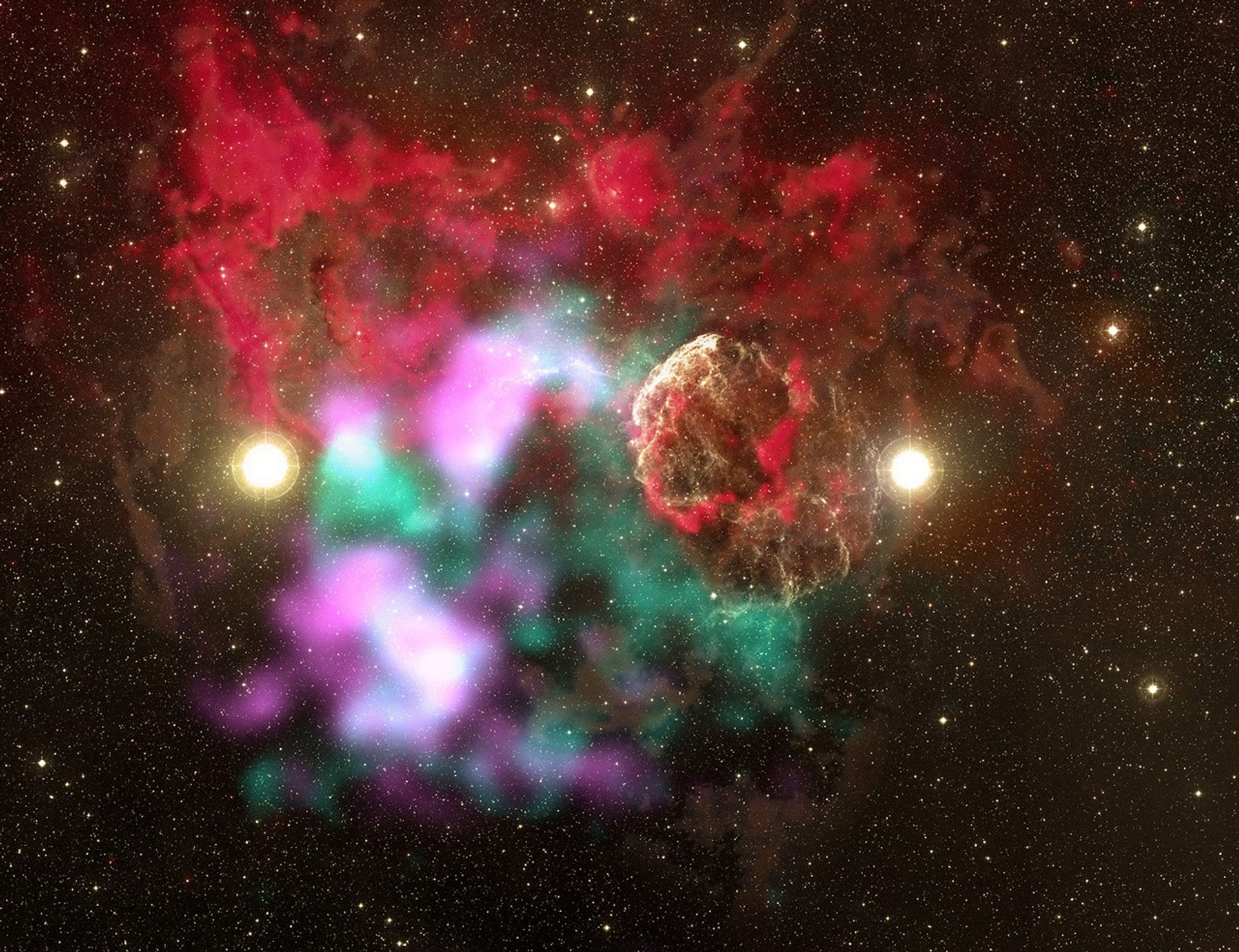
Multiwavelength composite showing high-energy light from the G189 supernova remnant
The well-known supernova remnant IC 443 (right) has an older, fainter neighbor (shown here in blue-green and magenta) called G189.6+3.3. A filament of gas between them, glowing in visible and ultraviolet light (violet arc at center), traces the neighbor’s shock wave and shows that both remnants are interacting with the same molecular cloud, shown in red, orange, brown for infrared and radio data and yellow for visible light. Blue-green shows X-rays from the fainter remnant, while magenta shows gamma rays with energies greater than 10 billion electron volts; for comparison, visible light has energies between about 2 and 3 electron volts. In this view, high-energy light from the much brighter IC 443 has been removed for clarity. Gamma-ray emission near the filament stems from protons accelerated in the supernova’s shock wave as it expands into the cloud.
NASA Goddard Space Flight Center and M. Michailidis et al. 2026; radio, MWISP and ESA/Planck; infrared: NASA/WISE/JPL-Caltech/UCLA; optical: DSS; ultraviolet: NASA/Swift; X-ray: SRG/eROSITA; gamma ray: NASA/DOE/Fermi LAT Collaboration

Astronomers think the Jellyfish Nebula is also a candidate PeVatron, a cosmic particle accelerator capable of boosting protons to energies so high they could nearly escape our galaxy. Such particles can produce gamma rays with trillions of times more energy than visible light. Finding a second particle accelerator near the Jellyfish Nebula could offer scientists new clues for how supernova remnants develop into PeVatrons.

“The overlapping remnants, a connecting gas filament, and the availability of data from Fermi and other facilities motivated us to delve into this complex but little-studied region,” said co-author Marianne Lemoine-Goumard, an astrophysicist at the French National Centre for Scientific Research (CNRS) based at the University of Bordeaux. “With Fermi’s LAT instrument, we found gamma-ray emission associated with accelerated protons in the northern part of the fainter remnant. If both remnants are interacting with the same structure, then they must share a common distance from us.”

The team concludes the remnants lie about 6,000 light-years away, their explosion centers are separated by roughly 40 light-years projected onto the plane of the sky, and the original stars may have been 20 or more times the Sun’s mass.

Estimates of the remnants’ ages vary widely, but the team concludes that the age of the Jellyfish Nebula is 8,000 to 9,000 years, while G189.6+3.3 is between 20,000 to 110,000 years old. This means the delay between the explosions could have extended for up to 100,000 years.

In addition, the team conducted computer simulations of a million massive binary systems. They show that systems where the stars orbit close enough to exchange matter and interact during their lives can readily produce dual supernova explosions with similar separations and time delays as those found for the remnants. The team also estimated that the chance of randomly encountering this combination of observed spatial alignment and compatible distances to be less than 1%, strongly supporting a physical association.

“The evidence we’ve compiled — including observations across the spectrum, the chemical and physical properties of the remnants, simulations, and more — paints a compelling picture of a dual supernova event,” said Michailidis.

This study identifies a unique possible example of a binary system where both stars exploded as supernovae and left behind separate, detectable supernova remnants. Astronomers think that most massive stars form in binary or multiple-star systems. The Jellyfish Nebula/G189.6+3.3 complex offers astronomers a rare opportunity to study how massive binary stars evolve, exchange matter, explode, and experience velocity changes — called kicks — induced by the supernova blast. It also provides a powerful new laboratory for understanding how coupled supernova remnants behave, including how they accelerate particles, generate gamma rays, and shape their surrounding environments.

“Fermi’s gamma-ray observations of supernova remnants continue to reveal the dynamic lives of stars,” said Elizabeth Hays, the Fermi project scientist at NASA’s Goddard Space Flight Center in Greenbelt, Maryland. “We can now connect the glowing remains of two massive stars to a powerful pair that evolved together over thousands of years.”

By Francis Reddy
NASA’s Goddard Space Flight Center, Greenbelt, Md.

Media Contact:
Claire Andreoli
301-286-1940
NASA’s Goddard Space Flight Center, Greenbelt, Md.

The post NASA’s Fermi Mission Uncovers Possible Sibling Supernova Remnants appeared first on NASA Science.

Dark Matter Still a Possibility at the Heart of the Milky Way

17 June 2026 at 15:47

In an ambitious collaboration bridging continents and disciplines, researchers from the University of Vienna and the Lawrence Berkeley National Laboratory have revisited one of astrophysics’ most enigmatic phenomena—the Galactic Center Excess (GCE). For over a decade, the GCE, a subtle yet pervasive gamma-ray glow enveloping the Milky Way’s core, has stimulated intense debate and exploration within the scientific community. This new study, leveraging cutting-edge machine learning methodologies, offers fresh perspectives that reinvigorate the dark matter hypothesis as a viable explanation for the GCE, a prospect previously challenged by conventional analyses.

The Galactic Center Excess presents itself as a roughly spherical halo of gamma-ray emission, extending over thousands of light years around our galaxy’s nucleus. This faint glow eludes straightforward interpretation, primarily due to the complexities of the astronomical environment it inhabits. The region is not only densely packed with astrophysical sources but also exhibits extraordinarily bright and intricately structured gamma-ray emissions, complicating efforts to disentangle the origins of the GCE signal.

Before this study, two primary interpretations vied for dominance in explaining the GCE. One posited that the excess emanates from annihilations of dark matter particles, hypothetical constituents of the universe that interact weakly with ordinary matter and light. Dark matter, while composing approximately 85% of the universe’s matter content, remains elusive, and detecting its indirect signatures through gamma-ray emissions has been a tantalizing goal. The second hypothesis attributes the gamma-ray glow to a population of millisecond pulsars—rapidly rotating neutron stars known for their intense electromagnetic emissions. These pulsars, if sufficiently numerous and faint, could collectively mimic the characteristics of the observed GCE.

However, the astrophysical scenario faced a significant analytical hurdle. Earlier statistical approaches, while sophisticated, did not fully incorporate a vital dimension of the observed data: the energy spectrum of individual gamma-ray photons. Prior analyses predominantly focused on spatial distribution patterns, searching for point sources that could represent pulsars or diffuse emissions consistent with dark matter annihilation. Without the spectral dimension, conclusions remained inconclusive, often biased toward interpretations favoring bright unresolved sources.

The breakthrough in this new research is the implementation of an advanced machine-learning framework that simultaneously evaluates the spatial location and energy distribution of gamma-ray photons captured by telescopes. Training this model required generating over a million simulated gamma-ray skies, replicating a diverse range of scenarios that include both dark matter and pulsar contributions. By synthesizing these rich datasets, the model attains unprecedented sensitivity and discrimination power, uniquely capable of parsing subtle differences in the gamma-ray energy patterns correlated with different source populations.

The enriched analysis dramatically alters the interpretation landscape. The findings demonstrate that the putative point sources—if responsible for the GCE—would need to be extraordinarily faint, to the point where their individual characteristics blur into a diffuse glow nearly indistinguishable from what dark matter annihilation models predict. This faintness requirement for pulsars implies an astronomical population count exceeding 35,000 millisecond pulsars in the central Milky Way region. Such a number challenges existing astrophysical models and contrasts with previous studies that suggested only a few hundred to a few thousand such sources would suffice to explain the gamma-ray excess.

This new quantitative insight reopens the door for dark matter as a plausible explanation. While previous evidence tended to discount dark matter in favor of point sources, the subtlety revealed by including photon energy analysis counters these assertions. It underscores the present limitations in conclusively resolving the GCE’s origin, emphasizing that the dark matter scenario remains firmly on the table alongside pulsar hypotheses.

The difficulty in resolving the GCE nature also reflects broader challenges in high-energy astrophysics—particularly in crowded celestial environments like our galaxy’s core, where overlapping emissions from stars, supernova remnants, and other celestial objects confound the interpretation of indirect dark matter signals. Machine learning, as applied here, represents a transformative tool, capable of synthesizing immense, multidimensional datasets to disentangle complex astrophysical phenomena.

Scientists caution that these findings do not constitute direct evidence for dark matter annihilation; instead, they highlight the incomplete nature of current data interpretations. The inability to definitively favor pulsars over dark matter annihilation underscores the need for next-generation gamma-ray observatories and continued advances in modeling techniques that can incorporate even more nuanced data features, such as temporal variability and polarization signatures.

This research embodies the synergy between theoretical physics, computational innovation, and observational astrophysics, demonstrating how modern data-driven approaches can revitalize longstanding scientific debates. As gamma-ray detection technologies evolve and more data become available, the methodology pioneered here promises further refinement, potentially leading to breakthroughs in identifying signals from the elusive dark sector of the universe.

The Galactic Center Excess remains one of the most compelling mysteries in contemporary astrophysics, symbolizing the frontier where known astrophysical processes intersect with profound questions about the fundamental composition of the universe. Whether future research will tilt the scales decisively in favor of dark matter or pulsars, this study exemplifies the power of interdisciplinary collaboration and sophisticated computational methods to deepen our cosmic understanding.

Moreover, the implications extend beyond academic curiosity. Deciphering the GCE carries the promise of shedding light on the nature of dark matter, a cornerstone of cosmological structure formation and evolution. Success in this endeavor could unveil new physics beyond the Standard Model, revolutionizing our conception of the universe’s fabric and the forces that govern it at the most fundamental level.

As researchers continue to probe the galactic center’s gamma-ray glow, the intellectual journey itself enriches science, reflecting a profound human drive to illuminate the obscure workings of the cosmos. This study marks a significant stride in that journey, blending technology, theory, and observation to navigate a complex astrophysical puzzle whose solution may redefine our place in the universe.


Subject of Research: The Galactic Center Excess in gamma-ray observations and its implications for dark matter and millisecond pulsar populations.

Article Title: Energy Distribution of the Galactic Center Excess’s Sources

News Publication Date: 12-Jun-2026

Web References:
DOI link


Keywords

Galactic Center Excess, gamma rays, Milky Way, dark matter, millisecond pulsars, machine learning, astrophysics, high-energy astrophysics, neutron stars, indirect dark matter detection, gamma-ray astronomy, astrophysical sources

NASA’s Webb Catches Exoplanet Getting Roasted

16 June 2026 at 22:15
 
4 Min Read

NASA’s Webb Catches Exoplanet Getting Roasted

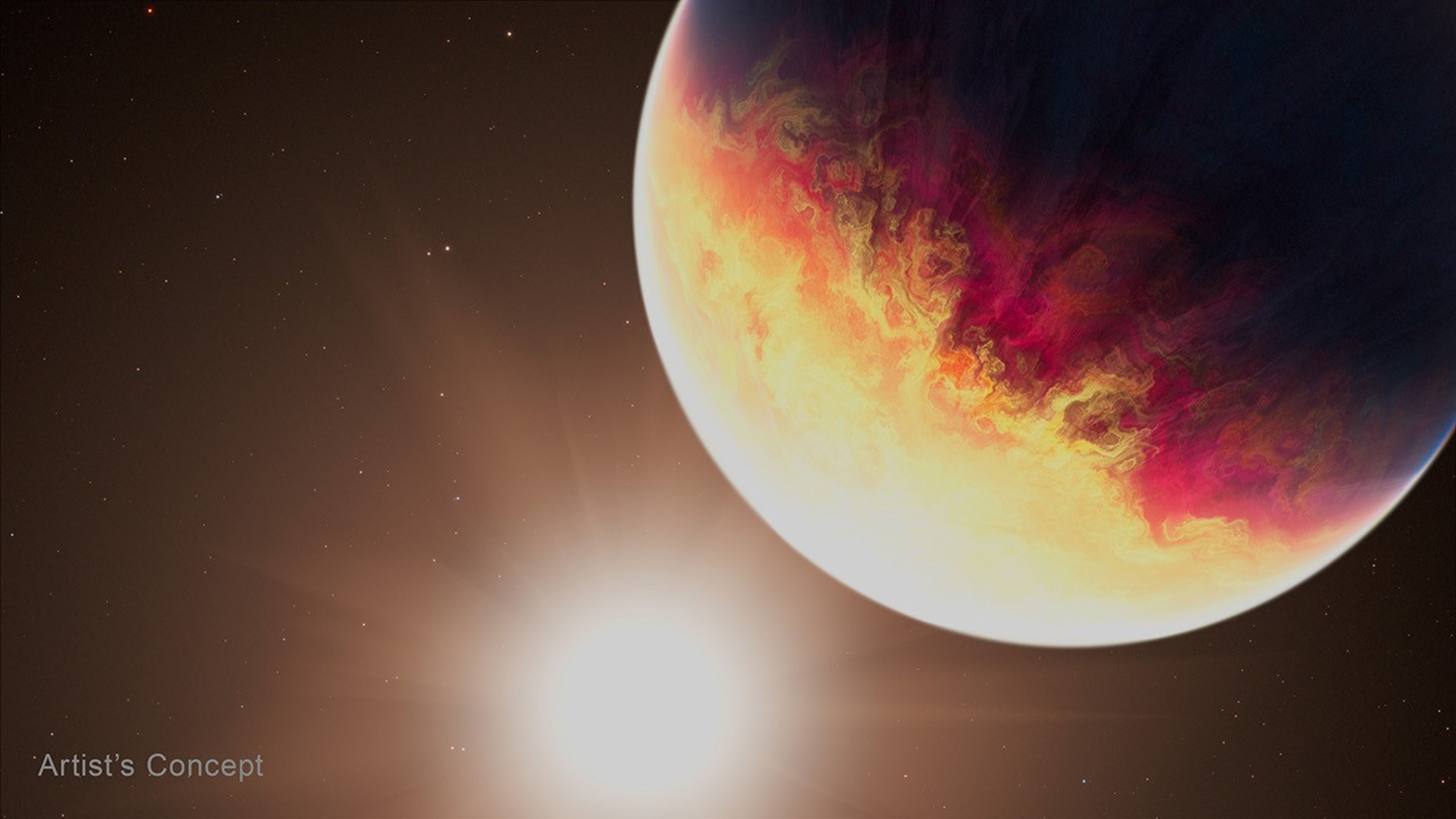
Illustration of a planet and a star, labeled artist’s concept at the bottom left. The planet fills more than a quarter of the image to the upper right, with the bright star to its lower left. The planet is white hot on the star side, fading to yellow that mixes with swirls of bright red across its middle, and eventually fading to black on the side most distant from the star. Distant stars dot the background of space, which is black near the edges of the frame.
This artist’s concept shows exoplanet HD 80606 b being “roasted” as its orbit approaches periastron, the point at which it is closest to its host star, which is similar to our Sun.
Credits:
Artwork: NASA, ESA, CSA, Joseph Olmsted (STScI)

4 min read

NASA’s Webb Catches Exoplanet Getting Roasted

One well-done gas giant, coming right up! That’s the latest from researchers analyzing NASA’s James Webb Space Telescope’s observations of HD 80606 b, an exoplanet four times the mass of Jupiter with an extremely elliptical orbit that sweeps close by its Sun-like star. The research team is presenting their study and preliminary findings Tuesday at the 248th meeting of the American Astronomical Society in Pasadena, California.

“Hot Jupiters are already considered some of the most extreme exoplanets we know of, but even among that population, HD 80606 b is one of the most extreme,” said Tiffany Kataria, the study’s principal investigator at NASA’s Jet Propulsion Laboratory in Southern California. “We typically think of hot Jupiters as hot gas giants sitting right next to their stars, but this planet’s highly eccentric orbit creates a completely different beast.”

As the planet plunges close to its star, Webb shows its temperature skyrockets by 1,100 degrees Fahrenheit. Previous studies have shown that radical temperature swings can cause an exoplanet’s chemistry and clouds to change in real time. According to the research team, the dynamic conditions of HD 80606 b make the planet an ideal target to observe these changes with Webb’s powerful instruments.

Image: Artist’s concept exoplanet HD 80606 b

Illustration of a planet and a star, labeled artistu2019s concept at the bottom left. The planet fills more than a quarter of the image to the upper right, with the bright star to its lower left. The planet is white hot on the star side, fading to yellow that mixes with swirls of bright red across its middle, and eventually fading to black on the side most distant from the star. Distant stars dot the background of space, which is black near the edges of the frame.
This artist’s concept shows exoplanet HD 80606 b being “roasted” as its orbit approaches periastron, the point at which it is closest to its host star, which is similar to our Sun.
Artwork: NASA, ESA, CSA, Joseph Olmsted (STScI)

“Observing a planet like HD 80606 b is actually very efficient because its unusual orbit, with the corresponding swings in temperature and chemical composition, allow us to gather data under varying conditions in just hours and apply those findings to other hot Jupiters or more conventional exoplanets,” said Laura C. Mayorga, co-investigator on the study and an exoplanet astronomer at the Johns Hopkins Applied Physics Laboratory in Laurel, Maryland.

Measurements of temperature and chemical composition were done with spectroscopy, a technique scientists use to break light into its component colors to reveal information about the composition, temperature, motion, and physical properties of objects in space. The team used Webb’s MIRI (Mid-Infrared Instrument) for an extended observation of HD 80606 b before, during, and after its periastron, or closest pass by its star. During periastron, the planet also passed behind the star from Webb’s perspective in what’s known as a secondary eclipse. The observation was years in the planning, as scheduling the time to catch the planet at this point was complex given its extremely elliptical 111-day orbit, and Webb’s own restrictions on where it can look during specific times of the year, based on Earth’s position in orbit around the Sun.

Researchers say they have only begun to peel back the layers of an incredibly rich dataset, but they can clearly see a dramatic shift in the exoplanet’s temperature. “Webb has shown that the planet’s increase in temperature was even more extreme than we anticipated based on Spitzer data,” said Kataria.

In fact, the planet had already been dubbed the “roasted exoplanet” and even got its own poster in NASA’s popular series. NASA’s now-retired Spitzer Space Telescope laid the groundwork of infrared observations of HD 80606 b, showing that more detailed spectroscopic data from Webb would be especially compelling.

“Spitzer did amazing work on this exoplanet, and now Webb is building on that legacy by enabling us to drill down to distinguish specific chemical signatures like methane and carbon dioxide, which is just amazing progress,” said Ryan Challener, co-author and research associate at the Cornell Center for Astrophysics and Planetary Science. “There’s so much to learn from this one dataset here — we really are just getting started deciphering what Webb has to tell us.”

The James Webb Space Telescope is the world’s premier space science observatory. Webb is solving mysteries in our solar system, looking beyond to distant worlds around other stars, and probing the mysterious structures and origins of our universe and our place in it. Webb is an international program led by NASA with its partners, ESA (European Space Agency) and CSA (Canadian Space Agency).

For more information on Webb, visit:

science.nasa.gov/webb

Downloads & Related Information

The following sections contain links to download this article’s images and videos in all available resolutions followed by related information links, media contacts, and if available, research paper and Spanish translation links.

Related Images & Videos

Illustration of a planet and a star, labeled artistu2019s concept at the bottom left. The planet fills more than a quarter of the image to the upper right, with the bright star to its lower left. The planet is white hot on the star side, fading to yellow that mixes with swirls of bright red across its middle, and eventually fading to black on the side most distant from the star. Distant stars dot the background of space, which is black near the edges of the frame.

HD 80606 b (Artist’s Concept)

This artist’s concept shows exoplanet HD 80606 b being “roasted” as its orbit approaches periastron, the point at which it is closest to its host star, which is similar to our Sun.

Related Links

Este Artículo en Español – “Telescopio Webb de la NASA Detecta un Exoplaneto Asandose”

Read:  Webb’s Impact on Exoplanet Research

Watch:  How to Study Exoplanets: Webb and Challenges

Explore:  Eyes on Exoplanets

Print: The Roasted Exoplanet Poster

More Webb: News | Images | Science | Home Page


Share

Details

Last Updated
Jun 17, 2026
Contact
Media

Laura Betz
NASA’s Goddard Space Flight Center
Greenbelt, Maryland
laura.e.betz@nasa.gov

Leah Ramsay
Space Telescope Science Institute
Baltimore, Maryland

Hannah Braun
Space Telescope Science Institute
Baltimore, Maryland

❌