Digital platforms are making it more difficult to focus, read and even engage in democracy
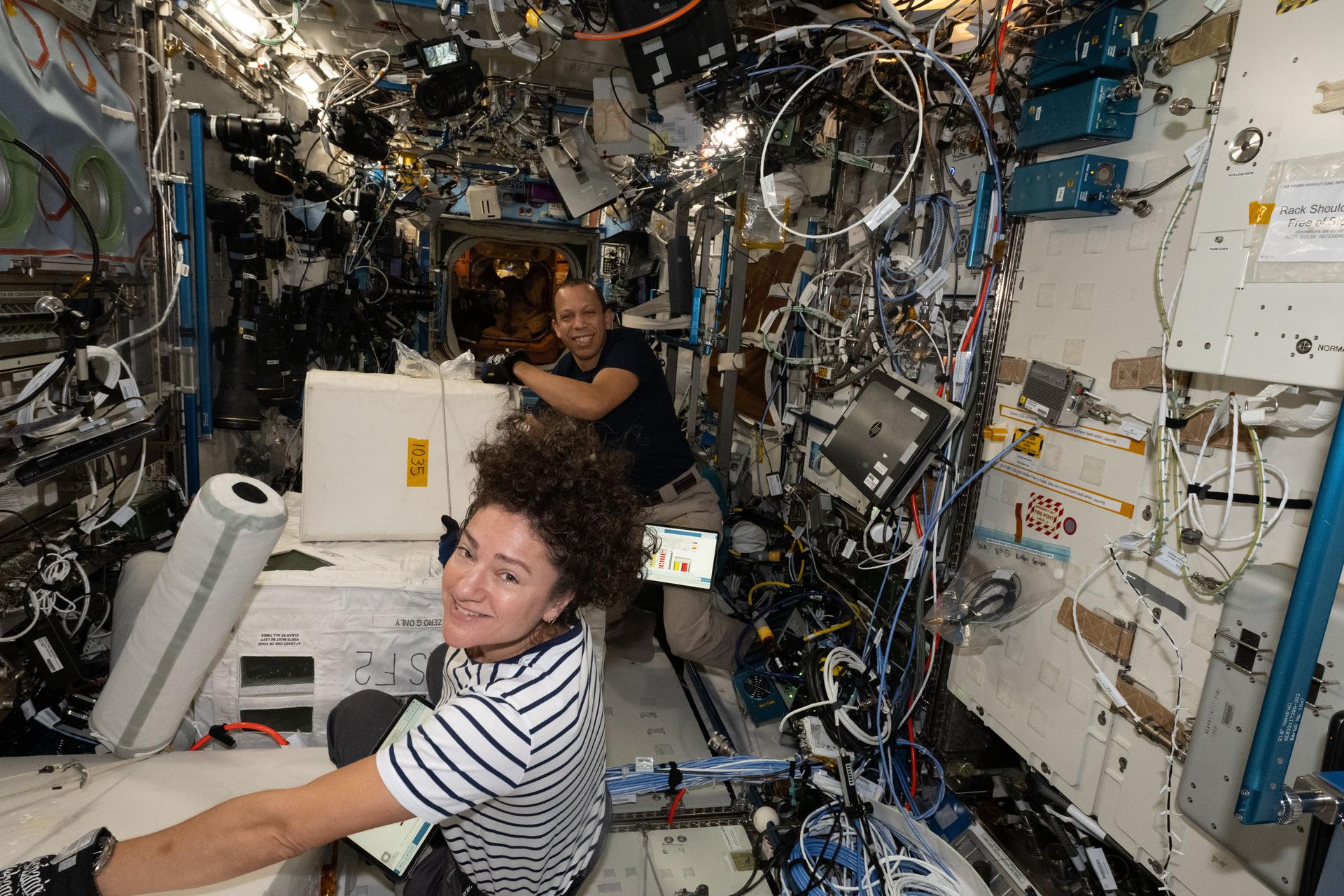
Students in New Jersey will hear from NASA astronauts Chris Williams and Jessica Meir as they answer prerecorded STEM questions while aboard the International Space Station.
The Earth-to-space call will begin at 12:05 p.m. EDT, Thursday, June 18, and will stream live on the agency’s Learn With NASA YouTube channel.
This event is hosted by Newton Public Schools in Newton, New Jersey, for students in grades K-12 and members of the community. This unique opportunity aims to deepen understanding of space exploration and enhance awareness of STEM careers.
Media interested in covering the event must RSVP no later than 5 p.m. EDT, Wednesday, June 17, to Dr. Joseph Piccirillo at: 973-383-7392, x4229 or jpiccirillo@newtonnj.org.
For more than 25 years, astronauts have continuously lived and worked aboard the space station, testing technologies, performing science, and developing skills needed to explore farther from Earth. Astronauts communicate with NASA’s Mission Control Center in Houston 24 hours a day through SCaN’s (Space Communications and Navigation) Near Space Network.
Research and technology investigations taking place aboard the space station benefit people on Earth and lay the groundwork for other agency deep space missions. As part of NASA’s Artemis program, the agency will send astronauts to the Moon to prepare for future human exploration of Mars, inspiring the world through discovery in a new Golden Age of innovation and exploration.
For more information on NASA in-flight calls, visit:
https://www.nasa.gov/stemonstation
The post NASA Astronauts to Answer Questions from New Jersey Students appeared first on NASA Science.
Research Opportunities in Space and Earth Sciences (ROSES)-2025 is an ongoing “omnibus” or “umbrella” solicitation meaning that it includes many individual program elements each with its own topics and due dates. Refer to Table 3 of ROSES-25 for a list of those program elements. The ROSES-25 “Summary of Solicitation” is the front matter that sets the default backstop rules for each of the program elements in ROSES-25.
ROSES-25 Amendment 59 makes several additions, changes, and clarifications to the ROSES-25 Summary of Solicitation to conform with Agency and administration priorities, see Sections I, I(g), II(a), II(b), III(b), III(d), V(b)ii, VI(c) & VIII(b). New text is in bold.
Important and substantial revisions to 2 CFR 200, the government-wide guidance for grants and cooperative agreements are proposed to take effect October 1, 2026, see https://www.federalregister.gov/documents/2026/05/29/2026-10817/regulation-for-federal-financial-assistance#h-8. Many types of currently allowable costs, such as but not limited to publications, research or events outside the United States, and domestic conferences may be restricted, denied, or may be allowable by legal exception or special award conditions only. Public comments on the revisions to 2 CFR 200 may be submitted until July 13, 2026, at https://www.regulations.gov/commenton/OMB-2026-0034-0001
On or about June 15, 2026, this Amendment to the NASA Research Announcement “Research Opportunities in Space and Earth Sciences (ROSES) 2025” (NNH25ZDA001N) will be posted on the NASA research opportunity homepage at https://solicitation.nasaprs.com/ROSES2025 and will appear on SARA’s ROSES blog at: https://science.nasa.gov/researchers/solicitations/roses-2025/
Questions concerning this amendment to ROSES-25 may be directed to SARA@nasa.gov.
Europa

This rover and its aerial sidekick were assigned to study the geology of Mars and seek signs of ancient microbial…

On a mission to “touch the Sun,” NASA's Parker Solar Probe became the first spacecraft to fly through the corona…

NASA’s Juno spacecraft entered orbit around Jupiter in 2016, the first explorer to peer below the planet's dense clouds to…

The post Amendment 59: Several Updates to the ROSES-25 Summary of Solicitation appeared first on NASA Science.
Students in New Jersey will hear from NASA astronauts Chris Williams and Jessica Meir as they answer prerecorded STEM questions while aboard the International Space Station.
The Earth-to-space call will begin at 12:05 p.m. EDT, Thursday, June 18, and will stream live on the agency’s Learn With NASA YouTube channel.
This event is hosted by Newton Public Schools in Newton, New Jersey, for students in grades K-12 and members of the community. This unique opportunity aims to deepen understanding of space exploration and enhance awareness of STEM careers.
Media interested in covering the event must RSVP no later than 5 p.m. EDT, Wednesday, June 17, to Dr. Joseph Piccirillo at: 973-383-7392, x4229 or jpiccirillo@newtonnj.org.
For more than 25 years, astronauts have continuously lived and worked aboard the space station, testing technologies, performing science, and developing skills needed to explore farther from Earth. Astronauts communicate with NASA’s Mission Control Center in Houston 24 hours a day through SCaN’s (Space Communications and Navigation) Near Space Network.
Research and technology investigations taking place aboard the space station benefit people on Earth and lay the groundwork for other agency deep space missions. As part of NASA’s Artemis program, the agency will send astronauts to the Moon to prepare for future human exploration of Mars, inspiring the world through discovery in a new Golden Age of innovation and exploration.
For more information on NASA in-flight calls, visit:
https://www.nasa.gov/stemonstation

For years, the cloud market has made a simple promise: Move workloads to large-scale platforms, gain better resilience, and worry less about downtime. That promise was never entirely wrong, but it is becoming less complete. The latest findings from Uptime Institute’s seventh Annual Outage Analysis suggest that the outage landscape is changing in ways that should concern both cloud providers and cloud customers. The biggest risks are no longer limited to broken physical infrastructure. They are increasingly tied to the complexity of the systems used to run, coordinate, update, and recover that infrastructure.
The most alarming number in the report is that IT and networking issues accounted for 23% of impactful outages in 2024. Uptime Institute links these increases to growing IT and network complexity; the long-term shift toward colocation, cloud, and third-party digital services; and the resulting increase in change-management failures and misconfigurations. That number is more than a statistical footnote. It points to a structural change in how outages happen and why cloud outages are becoming such a stubborn problem.
Hardware redundancy can protect against component failures, but it doesn’t help much when the outage stems from a bad configuration, an automation error, a faulty network change, or an underappreciated control-plane dependency. In those cases, the infrastructure itself may remain intact while the system that governs it breaks down. The industry is learning that resiliency is less about duplicating equipment and more about managing complexity. Today’s increasingly distributed and software-defined environments cannot operate safely at scale.
Uptime’s findings show that power remains the leading cause of major outages, underscoring that traditional infrastructure engineering still matters a great deal. But even as providers continue to improve physical resilience, outages can still arise from the digital and procedural layers above it. Cloud platforms are now dense stacks of services, APIs, orchestration systems, software-defined networks, identity controls, failover logic, and third-party dependencies. That complexity creates more possible points of interaction and more opportunities for an error in one layer to cascade into several others.
This helps explain why outages can feel more surprising today than they did a decade ago. In older data center models, an outage often had a more apparent root cause, such as a power event, a cooling failure, or a hardware fault. In cloud environments, the trigger may be a small configuration change that propagates across regions, a policy update that unintentionally blocks service communication, or a network control failure that affects seemingly unrelated services. These are not failures of raw infrastructure capacity. They are failures of complexity management.
The report’s language around change management and misconfiguration is especially important because it challenges one of the most common assumptions in the cloud market: that scale automatically produces better operational outcomes. The reality? Scale can magnify both strengths and weaknesses. Large cloud providers have more engineering talent, more sophisticated tools, and more redundancy than almost any enterprise customer. But they also run far more interconnected systems at far greater speeds with far more automation. A single process failure can have a wider blast radius.
Another important lesson from the Uptime analysis is that automation has not removed the human factor. If anything, it has changed its form. Even in highly automated environments, human error remains central to the problem. The report notes that in 2025, the share of outages caused by human failure to follow procedures rose by 10 percentage points compared with 2024. A related industry summary of the report notes that 58% of human error-related outages were caused by staff failing to follow established procedures.
That matters because cloud providers often position automation as the answer to reliability. Automation is essential, but it only works as well as the operational model that surrounds it. If teams deploy changes too quickly, rollback paths are weak, approval chains are bypassed, or procedures are incomplete, automation can accelerate failure rather than prevent it. In a modern cloud environment, a human mistake is rarely just a single keystroke. It is more often a design weakness in process, governance, testing, or accountability.
This is also why customers should resist the comforting notion that outages are somebody else’s problem once workloads move to the cloud. Provider-side mistakes remain real, but customer architectures are increasingly entangled with provider networking, identity, observability, and platform services. When an outage occurs, the customer may not have caused it, but they still bear the business impact. The shared responsibility model does not end with security. It extends to resilience planning as well.
The Uptime data points to a clear conclusion: Cloud providers need to treat operational discipline as a first-class design requirement. That starts with better change management. High-risk changes should be tested more aggressively, staged more gradually, and accompanied by stronger rollback mechanisms. Providers also need better dependency mapping to understand how a change in one control layer can affect services far beyond its immediate scope. If the system is too complex to clearly explain, it is too complex to operate.
Providers also need to improve procedural quality. The rise in outages caused by failing to follow procedures suggests that procedures are being ignored under operational pressure or that they are too cumbersome, outdated, or unclear for real production conditions. Neither explanation is comforting. Stronger runbooks, better training, more realistic failure drills, and tighter operational guardrails are not glamorous investments; they are increasingly central to resilience.
Another pressure point is visibility. Uptime notes that software-based and distributed resiliency tools can improve availability, but they also introduce new risks and complicate root-cause analysis. Cloud providers need more transparent and faster incident diagnosis, not just more layers of abstraction. Customers cannot build trust in resilience if every major incident becomes a long exercise in reconstructing opaque service dependencies after the fact.
What’s the financial impact of more frequent problems? Uptime’s 2024 analysis found that 54% of respondents reported that their most recent significant outage cost more than $100,000, and 20% said it cost more than $1 million. These are not edge-case losses. They show that outages remain costly even if they are less frequent than in earlier years.
Customers need to stop evaluating cloud resilience through uptime promises and start evaluating it through failure behavior. How does a provider isolate faults? How transparent is incident communication? How portable are workloads if a major service degrades? How dependent is the architecture on a single region, network path, identity service, or control plane? These are not just technical questions; they are now critical business questions.
The core lesson from Uptime’s data is simple. Outages are becoming a bigger problem for cloud providers and customers because the cloud’s biggest vulnerabilities are increasingly tied to complexity, process failures, and control-plane mistakes, not just broken infrastructure. In addition to adding redundancy, the next phase of cloud improvement will focus on building systems that are easier to understand, safer to change, and more disciplined to operate.

Across the stories today, a common thread emerges around the gap between scientific urgency and practical action — from coral reefs that might survive climate change to political systems struggling to keep pace with environmental reality.
The day’s coverage points to growing momentum around citizen-led conservation, revealing how communities are stepping in where institutions fall short. In Britain, volunteers are using remote cameras to protect red squirrels while citizen scientists help restore bog insect populations through coordinated community efforts. Meanwhile, American homeowners are banding together in group buying programs, saving thousands of dollars on heat pumps while collectively advancing climate solutions one neighborhood at a time.
Yet this grassroots energy exists alongside troubling institutional retreats. The UK government appears ready to scale back electric vehicle targets after industry pushback, while critical monitoring systems for Atlantic ocean currents — which could collapse ten times faster than previously predicted — may lose funding just when we need them most. It’s a reminder that progress and pressure often arrive together, creating political tensions that can undermine long-term environmental goals.
The human cost of these delays becomes starkly visible in places like Delhi, where thermal imaging revealed that 43.5°C air temperatures translated into furnace-like conditions on urban surfaces, or in the Marshall Islands, where researchers race to identify “super reefs” that might survive rising ocean temperatures. Behind the numbers are real communities adapting in real time, from Thai rubber farmers navigating new EU deforestation rules to climate-displaced people facing growing barriers to safety as extreme weather events multiply.
Perhaps most striking is how wildlife serves as both victim and indicator of these broader pressures. Little terns face their most challenging breeding season yet due to dog disturbances, while a single black-headed gull spotted in Australia sends bird enthusiasts flying across the continent — a reminder of how rare the unexpected has become. Meanwhile, Mexican long-tongued bats continue their nightly dance through agave flowers, unknowingly keeping the tequila industry alive through pollination, even as global wildlife trade creates what scientists call “pandemic roulette” by moving billions of animals across unnatural boundaries.
The most promising thread runs through stories of restoration and discovery. A former banker is bringing back Australia’s lost Big Scrub rainforest, while Amazon deforestation drops to nearly decade-low levels, showing environmental progress is possible when political will aligns with practical action. Century-old Antarctic research voyages are revealing early clues to El Niño patterns, and scientists have identified hidden pollutants driving 15 percent of global warming — knowledge that could reshape climate policy.
Indigenous scholar Tyson Yunkaporta’s argument that “false narratives drive environmental destruction” feels particularly relevant amid today’s stories. From conservation groups rejecting shark culling calls in favor of drone technology to the controversy over displaying an African elephant at a political convention, the battle over environmental stories — which ones we tell, which ones we fund, which ones we act upon — shapes outcomes as much as any scientific discovery.
As the week unfolds, all eyes will be on whether these citizen-led conservation efforts can scale fast enough to compensate for institutional hesitation, and whether the gap between scientific understanding and political action will narrow or continue to widen in the face of accelerating environmental change.
The post Delhi Hits 43.5°C as Urban Heat Islands Intensify, Thames Microplastics Study Launched While Dog Disturbances Threaten Record Little Tern Breeding Season — Today’s Environmental Briefing for Mon, Jun 15 2026 first appeared on EnviroLink Network.

© Nina Riggio for The New York Times