❌

Normal view

Black Hole Baby Photos: JWST and Chandra Observe M31-2014-DS1

4 March 2026 at 17:00

illustration of M31-2014-DS1

One of the most luminous supergiant stars in the Andromeda Galaxy, M31-2014-DS1, has disappeared, potentially leaving behind a black hole shrouded in dusty gas. What do new infrared and X-ray observations tell us about this event?

Failure to Explode?

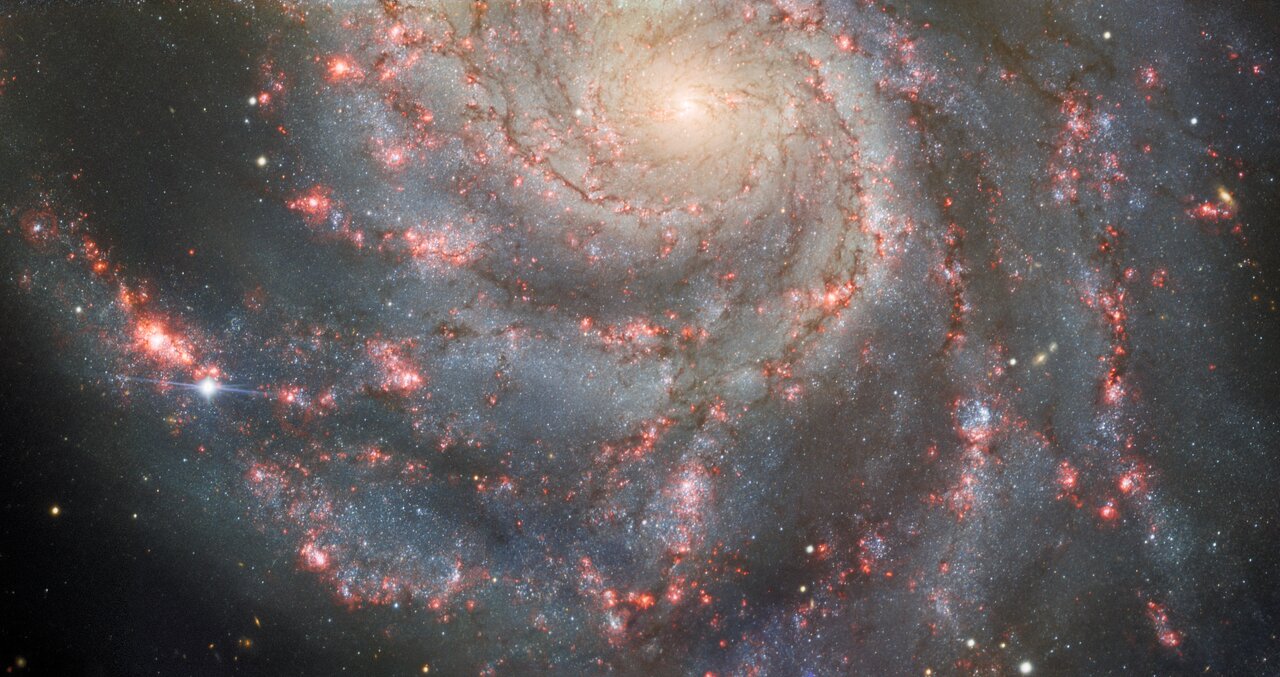
SN 2023ixf in Messier 101

This image from Gemini North shows the supernova SN 2023ixf along one of the spiral arms of Messier 101. Though less showy than core-collapse supernovae, “failed” supernovae may be another way to form stellar-mass black holes. [International Gemini Observatory/NOIRLab/NSF/AURA; CC BY 4.0]

Massive stars are famous for going out with a bang. After swelling into supergiants, these stars bring their brief lives to a close in a cosmic fireworks show: a supernova explosion that creates a neutron star or a black hole.

But a splashy supernova explosion may not be the only way for a massive star to go out. As observations have begun to suggest, some massive stars may — for reasons not yet fully understood — quietly collapse in upon themselves, going out with a whimper rather than a bang. Though less spectacular and far harder to spot, these “failed” supernovae highlight a possible pathway for the formation of stellar-mass black holes.

A Newborn Black Hole in a Dense, Dusty Blanket

Just last month, researchers reported their discovery of a potential failed supernova. The supergiant M31-2014-DS1 suddenly brightened in 2014 before fading to obscurity, leading researchers to suspect that the star had experienced a failed supernova and created a black hole. The event shared similarities with another failed supernova candidate, NGC6946-BH1.

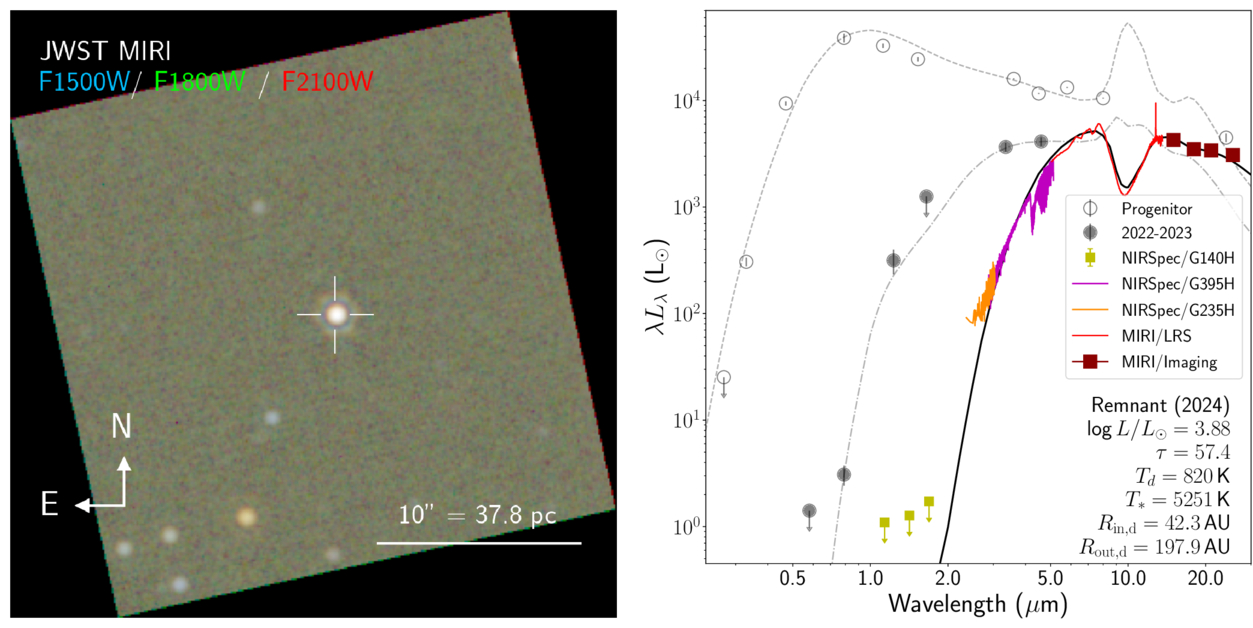
JWST data of M31-2014-DS 1

Left: A JWST image of M31-2014-DS 1. Right: Spectral energy distributions of the progenitor star/the remnant using data from 2005 to 2012 (empty circles), 2022 to 2023 (filled circles), and 2024 (colored lines). Click to enlarge. [De et al. 2026]

In a new article published in the Astrophysical Journal Letters, Kishalay De (Columbia University; Flatiron Institute) and coauthors have used JWST and the Chandra X-ray Observatory to learn more about what remained after M31-2014-DS1 disappeared. The JWST observations show an extremely red object that has faded considerably in just a few years, with a deep absorption feature from silicate dust and numerous narrow molecular absorption lines. Chandra did not detect any X-rays.

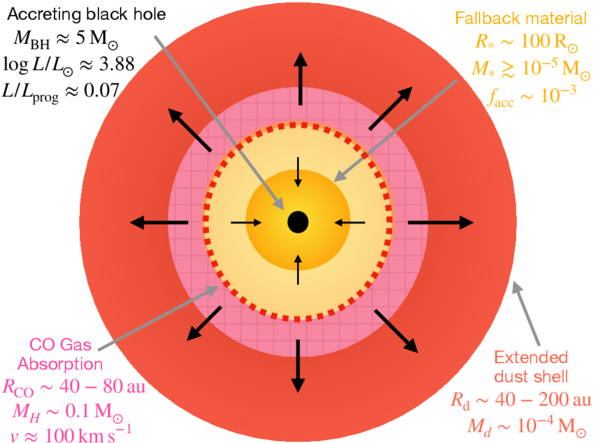
Together, these observations support a model in which the collapsing star ejected its outer layers in a relatively low-energy event (somewhere in the broad ballpark of one hundred-millionth to one ten-thousandth the energy of a typical core-collapse supernova) and formed a black hole. Some of the ejected material fell backward and fed the newborn black hole, while the remainder created a dense blanket that blocked the light from the accreting black hole from view.

Continued Evolution

schematic of the gas surrounding a newborn black hole

Cartoon showing the authors’ model and the model parameters inferred from the observations. Click to enlarge. [De et al. 2026]

In observations from 2024, the source had faded to just 7% of the progenitor star’s luminosity, supporting the conclusion that the star has disappeared and what lies beneath the dusty ejecta is a black hole. De’s team expects that as time goes on, the gas that obscures the accretion-powered luminosity of the newborn black hole will expand and become less dense along our line of sight. At some point — estimated to be no sooner than about 27 years from now — the X-ray emission from the accreting black hole should pierce the dusty shroud and become visible to sensitive X-ray observatories. In the infrared, JWST will be able to track the source’s evolution caused by continued dust creation in the expanding shell.

Thanks to its location in a neighboring galaxy, M31-2014-DS1 has granted astronomers a front-row seat to a poorly understood pathway for black hole formation. Going forward, we can expect further insights into M31-2014-DS1 and, hopefully, the discovery of many more sources like it.

Citation

“Fading into Darkness: A Weak Mass Ejection and Low-Efficiency Fallback Accompanying Black Hole Formation in M31-2014-DS1,” Kishalay De et al 2026 ApJL 999 L25. doi:10.3847/2041-8213/ae468d

The post Black Hole Baby Photos: JWST and Chandra Observe M31-2014-DS1 appeared first on AAS Nova.

Black Holes with a Shared Background

19 November 2025 at 17:00

A rendering of three white stars, two of which are very close together.

What if there was one process capable of creating every type of detectable stellar-mass black hole system? Recent research suggests there might be, and that it involves a triple-star system.

Three Separate Contexts

Stellar-mass black holes, or black holes that are at most a few hundred times the mass of the Sun, pop up in a number of different environments in the Milky Way. Astronomers have known since the 1960s that these black holes are the engines behind accreting low-mass X-ray binaries; more recently, researchers at gravitational wave observatories such as LIGO have found pairs of black holes orbiting each other just prior to merging; and, in just the past few years, scientists using the Gaia spacecraft have found black holes on wide, prowling orbits around still-burning stars.

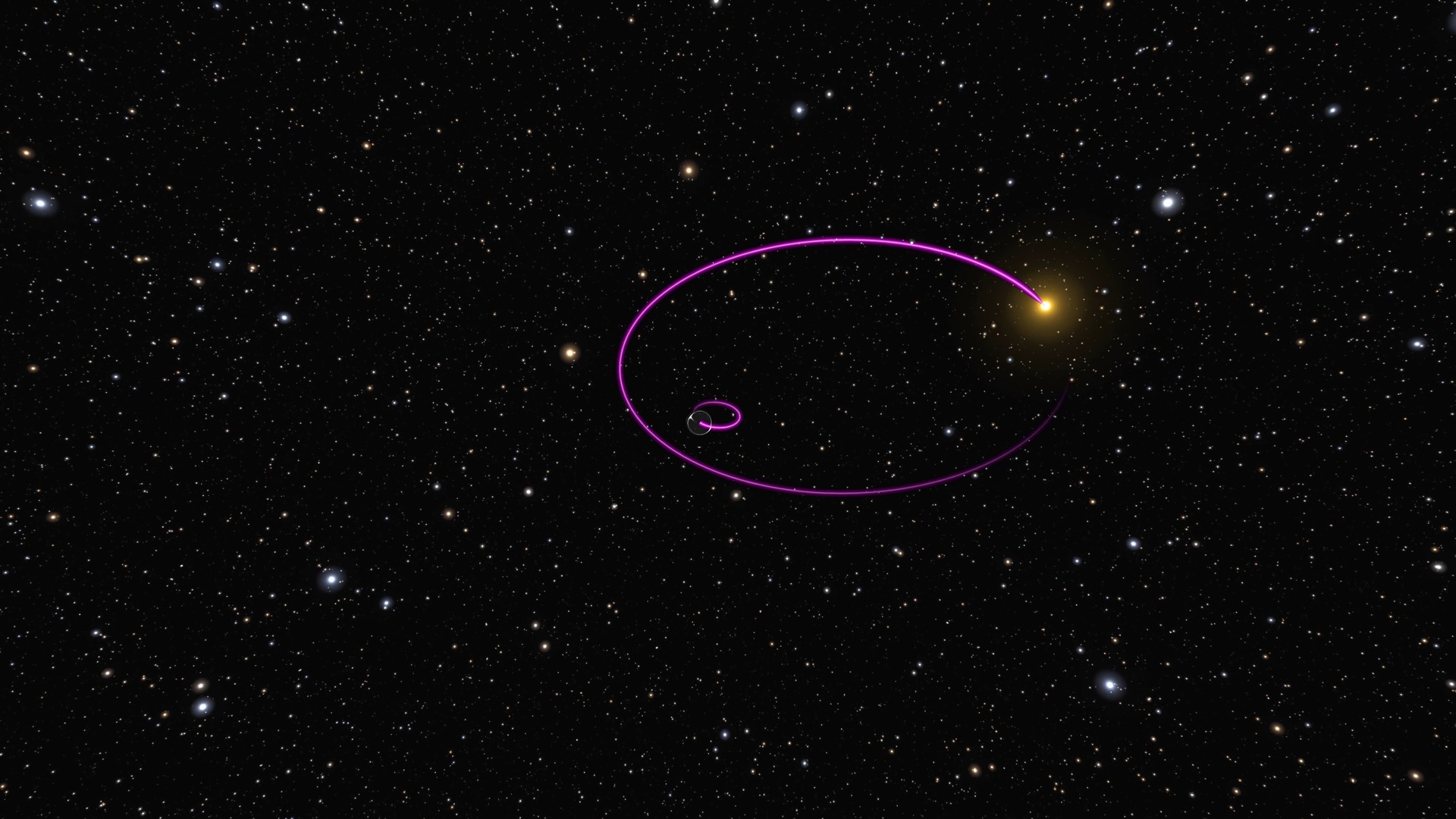
A photograph of a patch of the night sky with two nested purple ovals overlaid.

An illustration of the first black hole discovered with a star on a wide orbit. The black hole moves along the smaller inner ellipse, while its companion star orbits along the wider outer one. [ESA/Gaia/DPAC]

Although each of these scenarios involves a black hole, it’s unclear how exactly these black holes are related to one another, or if they’re related at all. For instance, do low-mass X-ray binaries form the same way as the binary black holes observed with LIGO? Are the wide star–black hole binaries discovered by Gaia destined to eventually merge as two black holes, or are they a separate population altogether?

Recent research led by Smadar Naoz (University of California, Los Angeles) offers a potential answer to this question of relatedness — that each of these situations forms through the same underlying process.

Triples Systems

An illustration of multiple stars evolving along different pathways indicated by arrows.

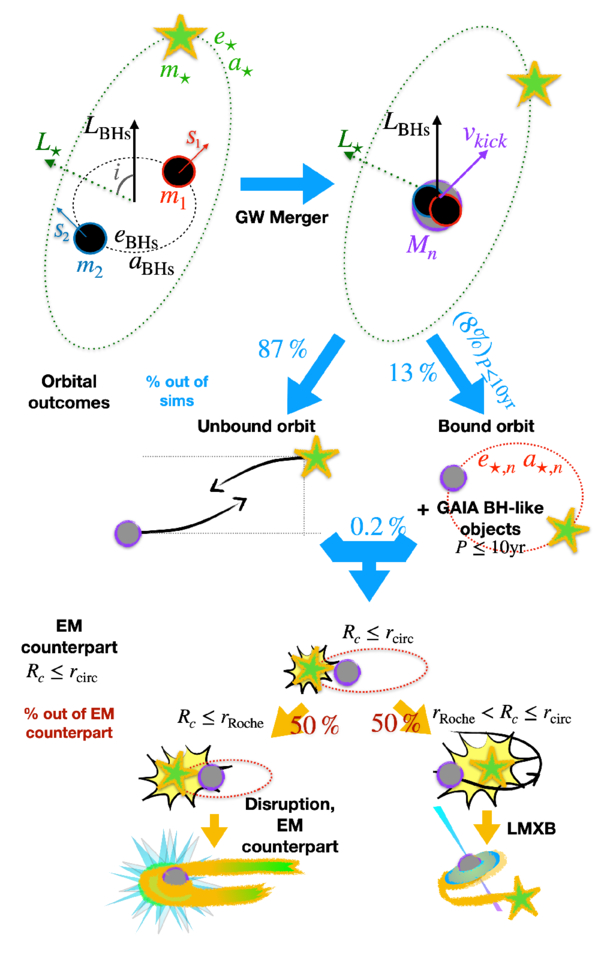
A schematic illustration of how triple-star systems can produce all three types of observable stellar-mass black hole systems. Click to enlarge. [Naoz et al. 2025]

The mechanism Naoz and collaborators describe would work as follows. First, three stars begin their lives all bound together via gravity. Two of these stars orbit each other fairly closely, but the third hangs back much farther away. After the two inner stars burn out and collapse into black holes, they undergo the kind of collision commonly observed by LIGO and merge together. This process gives the resulting larger black hole a “kick,” meaning it goes flying off away from the site of the impact with some new velocity.

What happens next depends on the geometry of the system and the direction of the kick. If the remnant black hole gets shot away from the third star, it might just drift off on its own and leave the star behind. If the kick isn’t too strong, the remnant will remain gravitationally bound to that third star, and the system will eventually look like the star–black hole pairs observed by Gaia. Finally, if the kick sends the remnant toward the third star, some dramatic outcomes become possible: either the black hole starts nibbling on the star and the system becomes a low-mass X-ray binary, or the black hole simply smashes into the star, destroying it completely in a large, flashy explosion paired with a gravitational wave signal.

The authors stress that this mechanism is almost certainly not the only way that these three stellar-mass black hole systems form. However, it is exciting to consider a common thread underlying such seemingly different scenarios, and with upgrades coming to gravitational wave observatories, we can hope for tests of its feasibility in the near future.

Citation

“Triples as Links Between Binary Black Hole Mergers, Their Electromagnetic Counterparts, and Galactic Black Holes,” Smadar Naoz et al 2025 ApJL 992 L12. doi:10.3847/2041-8213/ae0a20

The post Black Holes with a Shared Background appeared first on AAS Nova.

Do X-Rays Help or Hurt Massive Black Hole Formation?

17 November 2025 at 17:00

Illustration of a supermassive black hole enveloped in gas

Editor’s Note: Astrobites is a graduate-student-run organization that digests astrophysical literature for undergraduate students. As part of the partnership between the AAS and astrobites, we occasionally repost astrobites content here at AAS Nova. We hope you enjoy this post from astrobites; the original can be viewed at astrobites.org.

Title: Massive Black Hole Seed Formation in Strong X-Ray Environments at High Redshift
Authors: Kazutaka Kimura, Kohei Inayoshi, and Kazuyuki Omukai
First Author’s Institution: Tohoku University
Status: Published in ApJ

Environments of Massive Black Holes

Astronomers have found that nearly every observable galaxy hosts a central supermassive black hole (SMBH) — a black hole more than a million times more massive than the Sun. Using JWST, they have peered back into the early universe to observe some of the earliest galaxies, and these early galaxies also contain SMBHs. In fact, many of these galaxies seem to contain SMBHs that are more massive than we expected them to be this early in the universe.

We believe that most black holes form at the ends of the lives of massive stars, which collapse under their own gravity when they run out of fuel. We expect that this happened to the first stars too, forming “light” (as in “lightweight”) seeds of SMBHs with masses up to about 100 solar masses. Astronomers also think that the right conditions in the early universe could lead to the formation of a “heavy” seed with a mass on the order of 104 solar masses or more; this kind of black hole is called a direct-collapse black hole (DCBH).

In order to form a DCBH, a gas cloud needs to collapse without fragmenting to form star clusters and stars — if stars form, there won’t be enough mass funneled to the center of the cloud to form the DCBH. One important criterion for this to happen is the absence of coolants, like metals and molecular hydrogen (H2), which cause fragmentation. One way to eliminate H2 is with a particular type of ultraviolet light called Lyman-Werner radiation, which can destroy H2 molecules. However, recent results from the Hydrogen Epoch of Reionization Array (HERA) suggest that early galaxies emitted more X-rays than expected, which would increase the amount of H2 and make it less likely for DCBHs to occur. Today’s authors investigate the feasibility of forming DCBHs in these X-ray-bright environments.

Modeling Black Hole Formation

Today’s authors model the collapse of gas in dark-matter halos that have a nearby neighboring halo. This neighboring halo emits radiation like ultraviolet light and X-rays that impact the formation of molecules like H2, which affects the gas chemistry. This radiation is typically emitted by hot gas in star-forming regions. The authors also track quantities like the gas density and temperature as the gas collapses. Once the gas collapses enough, a star forms at the center and continues to accrete surrounding material. Once this star evolves and reaches the end of its life, it becomes a black hole.

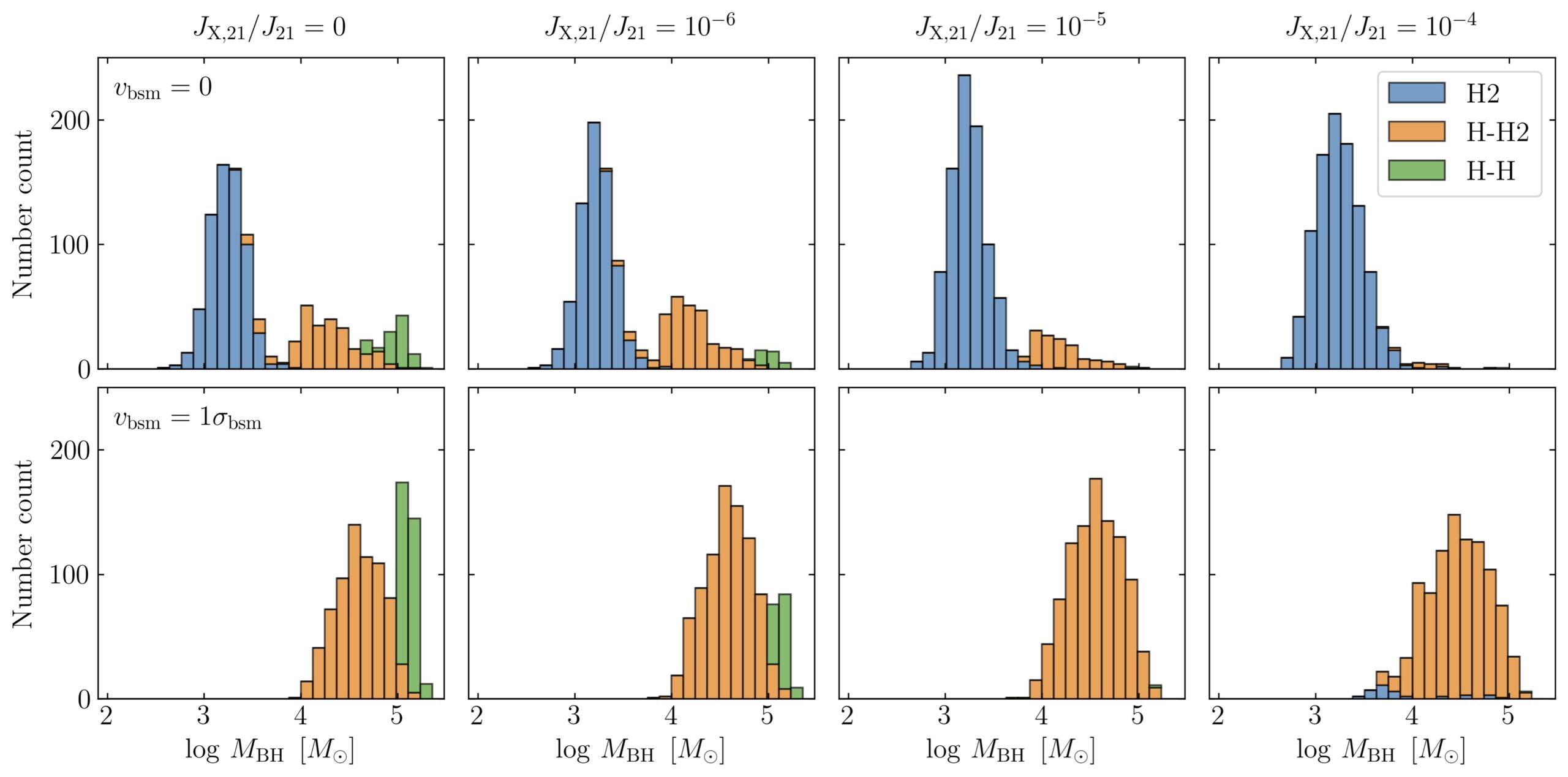
The authors considered different intensities of X-ray radiation relative to a critical value of Lyman-Werner radiation believed to destroy enough H2 to form a DCBH, which is called J21. They explore values of the X-ray intensity Jx relative to J21, considering ratios of 0, 10-6, 10-5, and 10-4.

Another important consideration was the baryonic streaming velocity. This is the relative bulk velocity between baryonic (i.e., “normal”) matter and dark matter in the early universe. Higher streaming velocities can delay the collapse of gas in dark-matter halos, which affect gas properties like density, temperature, and chemistry. The streaming velocity depends on the redshift, z, which is given by σbsm = 30 km/s (1+z)/(1+z0), where z0 = 1,100. This “standard” relationship has been calibrated with measurements from observations. The authors consider two cases for the streaming velocity: vbsm = 0 and vbsm = 1σbsm, which are denoted in the figures below.

X-Rays and Seed Suppression

The first main results are shown in Figure 1. The authors find that a large number of intermediate-mass seeds form from H2 cooling, shown in blue, regardless of the X-ray intensity. A smaller number of higher-mass seeds form from H–H2 and H–H cooling, but these cooling processes become suppressed as the X-ray intensity increases. This is because the increased X-ray intensity converts more H to H2. Interestingly, accounting for the streaming velocity all but wipes out black hole formation via H2 cooling except at very high X-ray intensities.

histograms of seed black hole mass

Figure 1: Mass distributions of seed black holes. The top row uses a baryonic streaming velocity of 0 and the bottom row uses the standard streaming velocity. Columns represent increasing X-ray intensities (left to right). Colors represent the dominant cooling mechanisms: H2 (blue), atomic hydrogen H transitioning to H2 (orange), and solely H (green). [Kimura et al. 2025]

Another main set of results are the black hole mass functions (that is, the number density of black holes for a given black hole mass), shown in Figure 2. Note that this differs from Figure 1 because we are now accounting for the number density of black holes, not just the number, and we are no longer categorizing black holes based on their cooling mechanism. As before, we see that most massive black holes are eliminated with a high X-ray intensity and no streaming velocity, but a higher streaming velocity tends to produce more massive black holes regardless of the X-ray intensity. These black hole mass functions provide a useful comparison to observational results from telescopes like JWST.
histograms of seed black hole number density

Figure 2: Seed black hole mass functions for low and high X-ray intensities (left and right columns, respectively). Rows are the same as in Figure 1. [Kimura et al. 2025]

In summary, today’s authors find that a high X-ray intensity leads to less-massive black holes due to the increased amount of H2, but accounting for the baryonic streaming velocity can produce massive black holes even with a large amount of X-rays. The number densities of these black holes appear to agree with observations from JWST, meaning that this could be a promising formation mechanism for the observed SMBHs in the early universe.

Original astrobite edited by Sparrow Roch.

About the author, Brandon Pries:

I am a graduate student in physics at Georgia Institute of Technology (Georgia Tech). I do research in computational astrophysics with John Wise, using machine learning to study the formation and evolution of supermassive black holes in the early universe. I’ve also done extensive research with the IceCube Collaboration as an undergraduate at Michigan State University, studying applications of neural networks to event reconstructions and searching for signals of neutrinos from dark matter annihilation.

The post Do X-Rays Help or Hurt Massive Black Hole Formation? appeared first on AAS Nova.

❌