❌

Normal view

Playing Pool with Planets

22 May 2026 at 17:00

artist's impression of hot Jupiter exoplanets

Each Jupiter-size planet in the galaxy falls into one of three distinct categories: hot, warm, or cold. A new study suggests that despite the apparent differences between these populations, they may have all formed from the same underlying dynamical process: a game of pool played at planetary scales.

A Diversity of Jupiters

Though our solar system has only one Jupiter-size planet, elsewhere in the galaxy we have found three different species of these massive gas giants. Cold Jupiters closely resemble their namesake and orbit far from their host stars; hot Jupiters are the opposite and are found whipping around their stars on extremely close-in orbits. In between these are the warm Jupiters, which tend to orbit in the intermediate space between 0.1 and 1.0 au.

A rendering of a star with lots of spots and flares with a planet in the foreground.

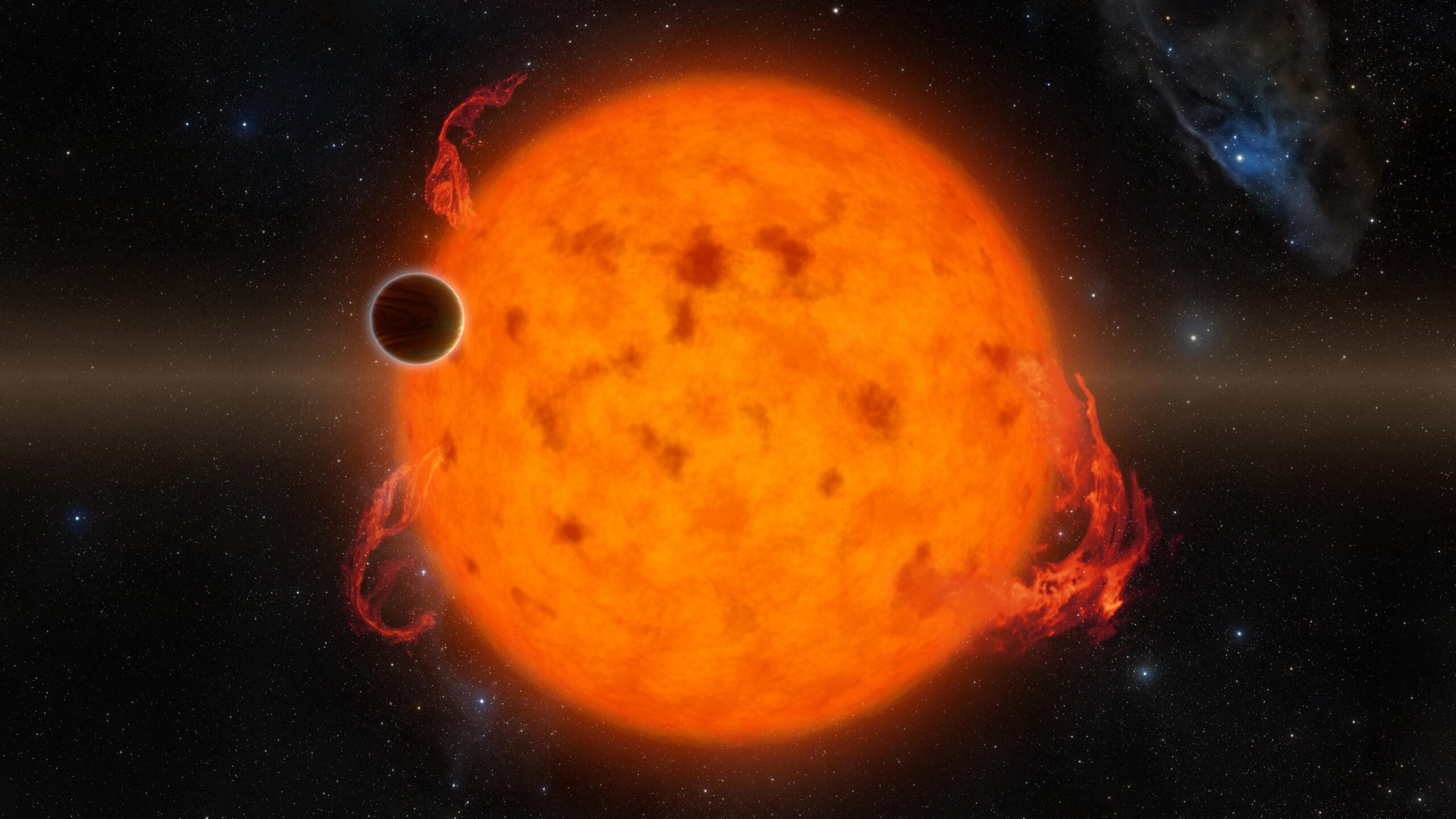
An artist’s depiction of a hot Jupiter. These planets orbit extremely close to their host stars, but likely got to their locations by scattering inward from more distant orbits. [NASA/JPL-Caltech]

Though these three populations are defined by their orbital distances, they differ from each other in other ways as well. For example, hot Jupiters almost never have nearby companions; if there are any other planets circling the same star, they’re usually far-out cold Jupiters. They can also orbit in pretty much any direction, including opposite the direction of their star’s spin, and are usually on perfectly circular orbits. In contrast, warm Jupiters often have friends nearby, are much more aligned with their stars’ spins, and can have modest eccentricities.

Given these differences, it’s often thought that each of these populations arrived at its current location through different dynamical processes and that the history of the warm Jupiters is likely quite different from the history of the hot Jupiters. However, a new study led by Julia Esposito (Georgia Institute of Technology) has proposed an alternative view. Maybe these populations, though they appear different now, were all created by the same process: planet–planet scattering.

Virtual Planetary Billiards

A cartoon of Jupiters at different distances from the sun with labelled arrows flowing inwards and outwards from each.

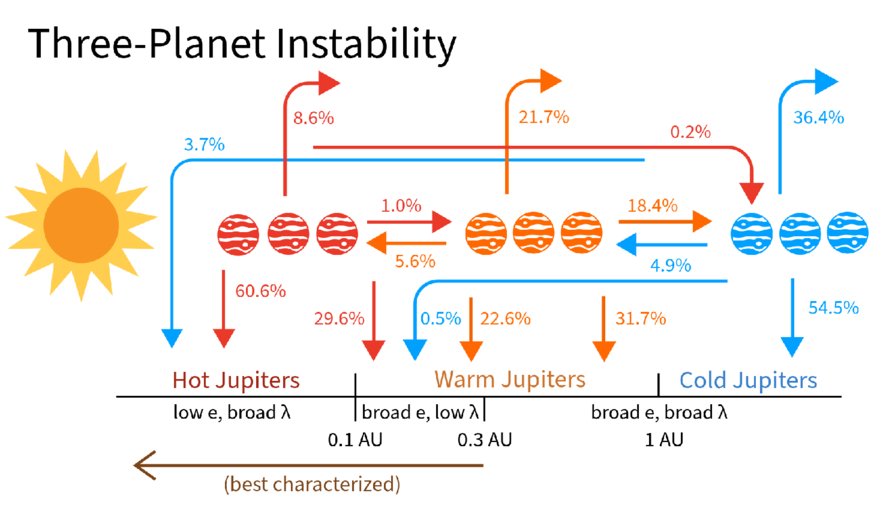
A schematic showing where different planets ended up as a function of where they scattered from during their evolution. Click to enlarge. [Esposito et al. 2026]

Esposito and collaborators set up 1,500 virtual planetary systems with three massive planets each, then simulated how the orbits evolved before probing the final configurations. In crucial contrast to previous simulation studies, the team initialized their Jupiters across a range of different distances and included the effects of tides sapping energy from orbits of planets that got too close to their host stars.

At the end of the simulation, the team surveyed the digital carnage. Almost every virtual system ended with only two planets after either ejecting one away from the star or having two planets collide. But, remarkably, the remaining two-planet systems looked tantalizingly similar to what we actually observe, with a mix of hot, warm, and cold Jupiters. Even more exciting, the end populations were highly correlated to where the violent scattering event took place.

For example, the warm Jupiters were almost all produced by “warm scattering” simulations, where the scattering took place between 0.1 and 1.0 au. The planets that survived the simulations and ended up as warm Jupiters matched all of the properties of the real warm Jupiter population: they had nearby companions, were moderately eccentric, and were mostly aligned with their stars. The hot Jupiters, meanwhile, were almost all produced by “cold scattering” events where the flybys happened far from the star and resulted in one planet hurtling inwards. These also matched all of the observed properties of real hot Jupiters.

The researchers concluded that planet–planet scattering can produce both the warm and hot Jupiter populations so long as you let the planets scatter from a variety of different distances. This exciting theoretical insight, if correct, would mean that astronomers could stop searching for different pathways to create each population. Happily, this model also provides testable predictions, and the authors lay out how the theory could be supported or disproven with additional data. Through virtual experiments like these, astronomers continue to build up an understanding of how the wide range of planetary architectures observed across the galaxy came to be.

Citation

“Unified Formation Channel of Hot and Warm Jupiters via Planet–Planet Scattering,” Julia Esposito et al 2026 ApJL 1003 L3. doi:10.3847/2041-8213/ae61b0

The post Playing Pool with Planets appeared first on AAS Nova.

Monthly Roundup: A Deep View of Planet-Forming Disks with ALMA

28 May 2025 at 17:00

radio images of eight protoplanetary disks

Protoplanetary disks, the sites of planet formation around young stars, are rich and complex objects. An in-depth investigation of 15 protoplanetary disks has recently been published in a Focus Issue of the Astrophysical Journal Letters. This investigation leveraged the exquisite resolution and sensitivity of the Atacama Large Millimeter/submillimeter Array (ALMA), a moveable network of 66 radio dishes in the Atacama Desert in Chile.

Featuring high-resolution observations of multiple gas species, updated image processing techniques, and state-of-the-art modeling, the exoALMA project examines the early stages of planet formation, when protoplanets embedded within dusty disks induce rings, gaps, spirals, and other structures.

This Monthly Roundup consists of quick snippets describing each of the currently published research articles in the exoALMA Focus Issue of the Astrophysical Journal Letters. Each snippet links to the corresponding research article, and the Focus Issue landing page is linked at the bottom of this post.

Introducing exoALMA

exoALMA disks

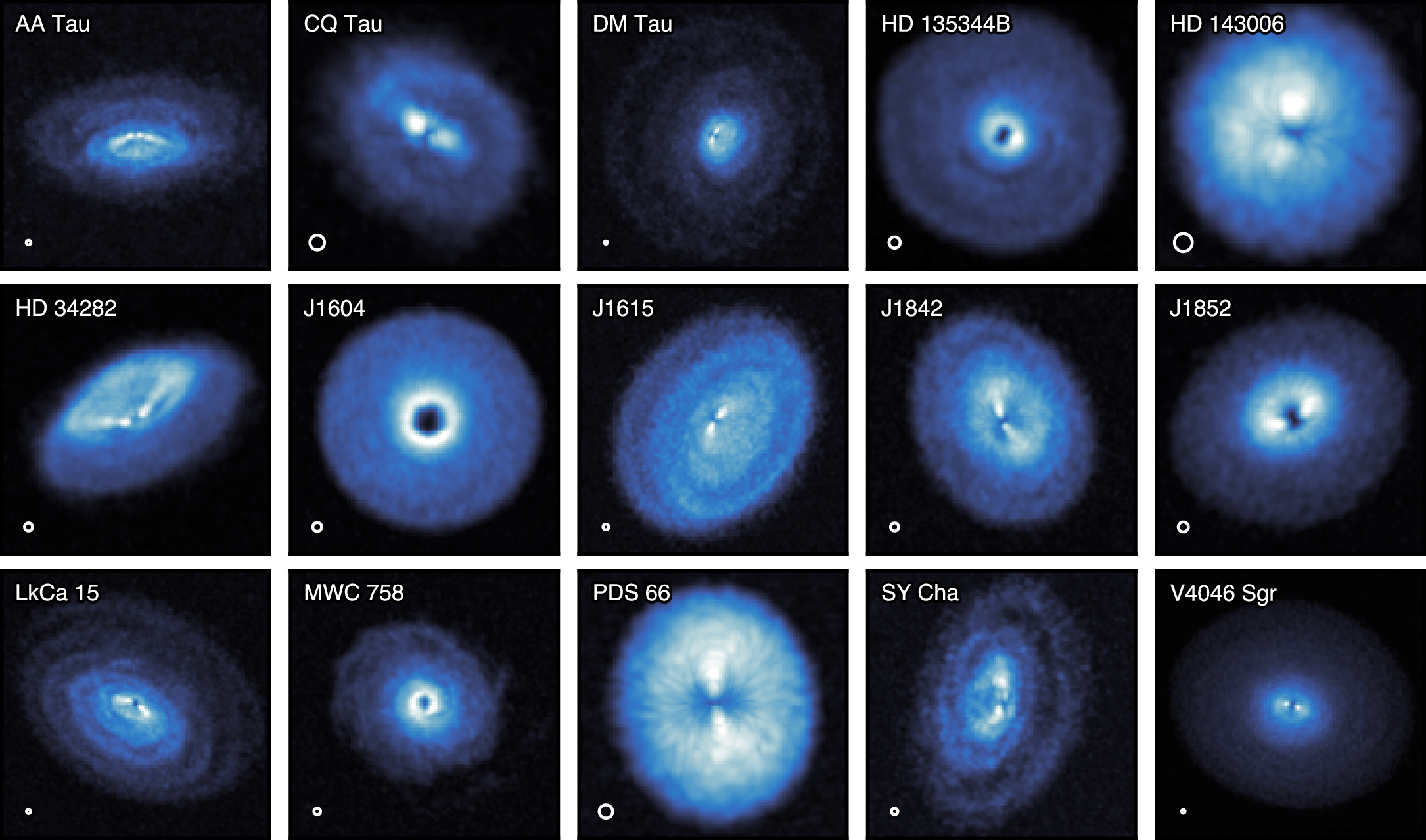
The full exoALMA sample. All 15 disks show evidence of substructure in their gas emission. [Teague et al. 2025]

First up, exoALMA project PI Richard Teague (Massachusetts Institute of Technology) and collaborators introduced the survey, the disk sample, and the science goals. The team mapped the dust and gas distributions of 15 protoplanetary disks that were selected for their brightness, large size, lack of obscuration, and low inclination angles. The three key science goals were to 1) detect protoplanets hidden within the disks, 2) study the disks’ dynamical structures, especially as these structures relate to instabilities that can perturb the disks and determine their lifetimes, and 3) determine the disks’ density and temperature structure.

Interpreting interferometric data from ALMA requires special care, as Ryan Loomis (National Radio Astronomy Observatory) and coauthors show in their overview of the data calibration and imaging pipeline. The team described their methods of processing the data, including a recently developed alignment method that greatly reduces the number of artifacts that could be mistaken for planet-induced velocity perturbations.

plot of emitting surface of J1615

Emitting height from images processed using the standard method (CLEAN) and using regularized maximum likelihood (RML). [Adapted from Zawadzki et al. 2025]

Although extreme care was taken not to introduce spurious signals through the calibration process, it’s critical to perform additional tests to confirm that detected signals are real, rather than artifacts. To that end, Brianna Zawadzki (Wesleyan University) and coauthors presented exoALMA images processed with a procedure called regularized maximum likelihood. The regularized maximum likelihood–processed images showed the same non-Keplerian features as the images processed with the standard algorithm, suggesting that these features are real.

Analysis Methods and Toolkit Testing

Analyzing observations of protoplanetary disks is challenging, motivating Thomas Hilder (Monash University) and collaborators to take the first step toward addressing issues like beam smearing, the creation of probabilistic data products, and incorporating a realistic noise model. Using their newly developed methods, the team analyzed several disks in the exoALMA sample, finding velocity substructures at greater velocities than existing methods.

Vertical structure and Keplerian rotation of the exoALMA sample

Vertical structure and Keplerian rotation of the exoALMA sample as inferred from modeling. Click to enlarge. [Izquierdo et al. 2025]

Andrés Izquierdo (University of Florida; Leiden University; European Southern Observatory) and collaborators described their methodology for investigating gas structure in the exoALMA sample. The team’s fitting method allowed them to separate the contribution of a disk’s front and back sides from the rest of its emission, leading to estimates of the orientation and vertical profile of each disk.

Jaehan Bae (University of Florida) and collaborators drew attention to the tools astronomers use to interpret observations of protoplanetary disks — namely, forward models. Bae’s team used five different hydrodynamics models to simulate a protoplanetary disk harboring an embedded giant planet. Then, they used two radiative transfer models to simulate carbon monoxide channel maps and calculate the temperature of the disk. Finally, they extracted the location of the synthetic planet. This investigation ultimately showed good agreements between the model outputs, showing that any combination of the models tested in this work is suitable.

plots of nonaxisymmetry of the exoALMA sample

Residual signal-to-noise ratio for the exoALMA sample, ordered from least to most nonaxisymmetric. Rings and gaps are marked with solid and dashed ellipses, respectively. Click to enlarge. [Curone et al. 2025]

Seeking Structure

A team headed by Pietro Curone (University of Milan; University of Chile) examined the rich ALMA dataset for signs of structure within the disks. The team modeled each disk with an axisymmetric model, then subtracted off the best-fitting model to reveal substructures and asymmetries in the disks. Several features were revealed, including shadows, offsets between inner and outer disks, spiral structures, and crescent-shaped asymmetries. Though one disk, PDS 66, was apparently without any internal structure, this investigation showed that structures are common in this sample of large, bright disks. Further work is needed, however, to explore whether these features are common in the disk population as a whole.

Maria Galloway-Sprietsma (University of Florida) and collaborators identified the disk surfaces that emit particular spectral lines. The team found that 12CO traced the upper atmosphere of the disks, while 13CO — an isotopologue of the more common molecule 12CO — and CS (carbon monosulfide) probed deeper regions. In addition, nearly all of the disks showed evidence of localized substructure, highlighting the need for theoretical work to explain the wide variety of disk structures and behaviors.

Evidence for Planets

exoALMA images of disks with velocity kinks due to the presence of a planet

From top to bottom: velocity kinks associated with an embedded planet; 12CO observations with the identified velocity kinks; filtered ALMA observations, showing the location of the planetary wake; exoALMA continuum emission; and polarimetric images. The blue circles show the locations of the purported planets. Click to enlarge. [Pinte et al. 2025]

Christophe Pinte (University Grenoble Alpes; Monash University) and collaborators analyzed substructures revealed by 12CO emission. These images revealed arcs, spiral arms, and kinks in 13 out of the 15 disks in the sample. Of these, six were consistent with wakes forming due to planets with masses between 1 and 5 Jupiter masses orbiting at 80–310 au.

Charles Gardner (Rice University; Los Alamos National Laboratory) and coauthors focused on LkCa 15, a disk that appears markedly different in dust and gas emission. The disk’s dust continuum emission shows a 40-au-wide region depleted of dust, while the gas emission, traced by CO, shows no depletion of gas in the same region. Though previous infrared observations have suggested that this dust-depleted region could host massive planets, Gardner’s team concluded that a chain of small planets or processes unrelated to planet formation likely excavated the region instead.

A team led by Jochen Stadler (Côte d’Azur University) searched for deviations from Keplerian rotational velocity — potential evidence for embedded protoplanets. The team discovered deviations up to 15% from the background velocity, with deviations appearing at both large and small radial scales. Rings and gaps visible in the dust emission tended to align with gas pressure maxima and minima, respectively. However, the team also found gas pressure structures in the outer disk that were beyond the dust emission and were not accompanied by rings or gaps.

Comparison of kinematic and emission-line-derived masses for the exoALMA sample

Comparison of kinematic and emission-line-derived masses. Click to enlarge. [Trapman et al. 2025]

Masses and Abundances

A team led by Cristiano Longarini (University of Cambridge; University of Milan) put the disks of the exoALMA sample on the scale. By modeling the rotation curves of 12CO and 13CO, the team constrained the masses of 10 disks and their central stars. Leon Trapman (University of Wisconsin-Madison) and collaborators also considered the problem of disk masses. The team used CO and N2H+ emission to measure the gas masses of 11 disks in the exoALMA sample and compared the results to previous kinematic measurements. The two sets of measurements tend to agree within a factor of three.

Giovanni Rosotti (University of Milan) and collaborators introduced a new model that connects the emitting height of CO molecules to the gas surface density and temperature. Unlike existing models, the team’s new model can be applied to optically thick observations. Comparing the results of this new method with dynamical estimates relying on interstellar medium abundances of CO yields lower gas masses, suggesting that the CO abundance in the protoplanetary disks studied is depleted relative to the interstellar medium.

Turbulence, Traps, and Vortices

Protoplanetary disks are expected to experience turbulence, large-scale gas motions, and instabilities. Marcelo Barraza-Alfaro (Massachusetts Institute of Technology) and collaborators investigated whether a program like exoALMA could detect signs of these processes at work. The team used 3D numerical simulations to explore the observational signatures of the vertical shear instability, the magnetorotational instability, and the gravitational instability. They found that rings, arcs, and spirals can arise from instabilities. While spirals present in the disks in the exoALMA sample could feasibly be due to the magnetorotational instability or the gravitational instability, ring-like and arc-like features due to the vertical shear instability were not detected.

Tomohiro Yoshida (National Astronomical Observatory of Japan; The Graduate University for Advanced Studies) and collaborators reported on their detection of pressure-broadened emission-line wings in RX J1604.3−2130 A. This detection allowed the team to constrain the disk’s gas surface density — a critical property related to the mass available to form planets. They also clearly showed a dust ring coinciding with a gas pressure maximum, proving that gas pressure maxima can create dust traps. The gas-to-dust surface density ratio at the location of this dust trap suggests that the disk has already birthed protoplanets or the dust trapping efficiency is low.

dust crescents in four protoplanetary disks

Locations of crescent-shaped dust clumps in the four disks from this study. Click to enlarge. [Adapted from Wölfer et al. 2025]

Vortices are theorized to shepherd dust grains into crescent-shaped traps, providing an environment for dust grains to clump together and grow into planetesimals and eventually planets. Lisa Wölfer (Massachusetts Institute of Technology) and collaborators searched for kinematic signatures of dust-trapping vortices in CO line emission from four disks that exhibit crescent-shaped concentrations of dust. None of the four disks exhibited the clear signature of a vortex, and higher-resolution data or observations of emission lines that trace motions closer to the midplane of the disk may be necessary to probe this signal further.

The full list of articles in this Focus Issue can be found here.

Citation

“exoALMA. I. Science Goals, Project Design, and Data Products,” Richard Teague et al 2025 ApJL 984 L6. doi:10.3847/2041-8213/adc43b

The post Monthly Roundup: A Deep View of Planet-Forming Disks with ALMA appeared first on AAS Nova.

Are Hot Sub-Neptunes Just Failed Hot Jupiters? Maybe.

20 May 2025 at 17:00

Illustration of a sub-Neptune exoplanet and its host star

Editor’s Note: Astrobites is a graduate-student-run organization that digests astrophysical literature for undergraduate students. As part of the partnership between the AAS and astrobites, we occasionally repost astrobites content here at AAS Nova. We hope you enjoy this post from astrobites; the original can be viewed at astrobites.org.

Title: The Hottest Neptunes Orbit Metal-Rich Stars
Authors: Shreyas Vissapragada and Aida Behmard
Authors’ Institutions: Carnegie Science Observatories; Flatiron Institute and American Museum of Natural History
Status:
Published in AJ

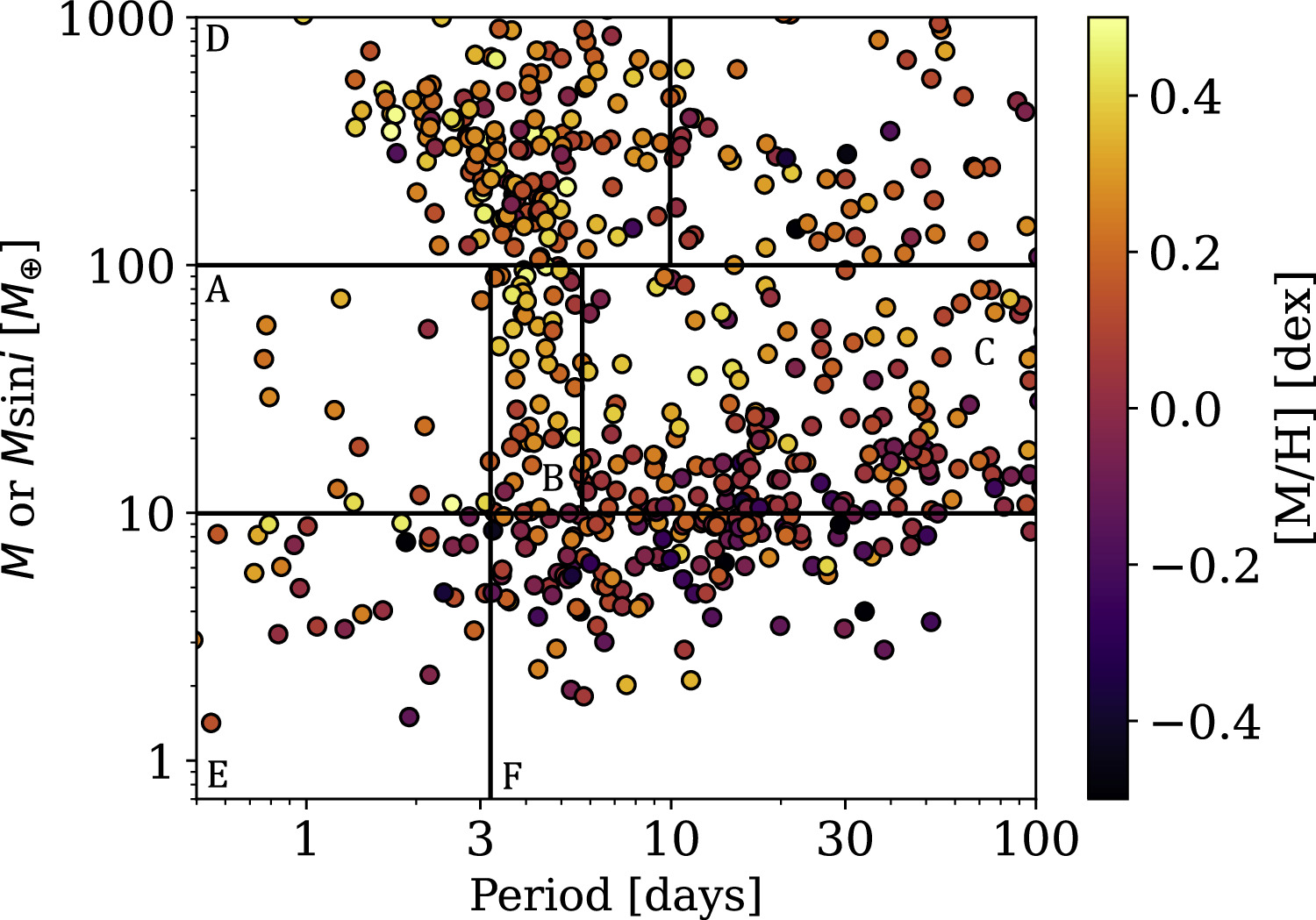
Sub-Neptune exoplanets, those between the size of Earth (1.0 REarth) and Neptune (4.0 REarth), are the most common type of planet discovered to date, with every other star hosting at least one on average. However, the class of “sub-Neptunes” is itself divisible into sub-categories based on the planet’s orbital period: these are called “hot,” “warm,” and “cold” for planets that are very close to their star, at a medium distance from their star, and farthest out, respectively. While the lines dividing these three categories are a little blurry, recently the community has begun roughly defining them as those with orbital periods shorter than 3.2 days (hot), those with periods between 3.2 and 5.7 days (warm), and those with periods longer than 5.7 days (out to 100 days, cold). The orbital period of the planet is directly related to the planet’s distance from its host star, so planets with longer orbital periods are farther out from their stars.

Furthermore, it seems that planets in these three categories are not equally abundant across the galaxy: cold sub-Neptunes are far more common than warm sub-Neptunes, which in turn are more common than hot sub-Neptunes. In fact, hot sub-Neptunes are seemingly so rare that exoplanet scientists have coined the term “the Neptune desert” to convey the emptiness of this region of parameter space (see Figure 1 below). But if sub-Neptunes are so common overall, why are the hottest of this class of planets so rare?

There are a few working hypotheses for how hot sub-Neptunes form, each of which predicts that their formation be very rare. First, perhaps they formed in the same way as the common cold versions, but through unique circumstances avoided having their atmospheres stripped by photo-evaporation from the star. Second, they may have formed via collisions of many small planets in the early days of the planetary system, creating one large planet on a short orbit. Or third, they could be “failed” hot Jupiters, meaning they initially formed as much more massive Jupiter-like planets and then, through one or more mechanisms, lost most of their mass until reaching their present-day size.

Today’s Astrobite reports on an article that attempts to find the most likely of these three formation mechanisms. The authors focus on the metallicity of the host stars of hot Neptunes (defined as those with masses between 10 and 100 Earth masses) and ask the question, “Do the host stars of hot Neptunes have a similar metallicity distribution to host stars of any other class(es) of planets?” The idea being, if another class of planets forms around similar host stars, perhaps the planets themselves formed through similar mechanisms.

The authors set out to test the hot Neptune (A) host-star population against four other populations of planet hosts: warm Neptunes (B), cold Neptunes (C), hot Earths (E), and hot Jupiters (D). See Figure 1 for where these populations lie on the period–mass plane. Metallicity studies are often difficult to perform for a number of reasons: first, it is difficult to measure precise metallicity for a single star, and second, data from different instruments and/or different measurement techniques are often inconsistent with each other. The authors have come up with a way to get around both of these issues by using a single source for their data: the Gaia mission’s radial-velocity spectrometer, through which they were able to collate precise measurements in a homogeneous fashion.

plot of mass versus period for different exoplanet host stars

Figure 1: The mass–period plane of exoplanets with metallicity color-coded. The lettered boxes denote different classes of planets, with hot sub-Neptunes marked as “A.” The authors compare the host stars of these planets to the host stars of other populations of planets. The orbital period of the planet is on the x-axis, the mass (or best mass estimate) is on the y-axis, and color indicates metallicity. [Vissapragada & Behmard 2025]

With this data, the authors find that the metallicity distribution of the host stars for hot Neptunes is similar to that of both warm Neptunes and hot Jupiters, but different for hot Earths and cold Neptunes. This means that hot and warm Neptunes likely formed via the same mechanism as hot Jupiters, or are themselves the remnants of hot Jupiters that just couldn’t hold onto most of their mass for one or multiple reasons. This has implications for our understanding of planet formation in general, and better contextualizing of the hot Neptune desert in particular. If hot Neptunes are the remnants of failed hot Jupiters, then perhaps they will exhibit other qualities that are known in the hot Jupiter population. For example, that they are usually found as single-planet systems, or with a distant giant planet or star that could have facilitated high-eccentricity migration. In future studies, it will be interesting to target these hot sub-Neptunes with JWST and compare their transmission spectra with those of hot Jupiters to see if the atmospheres of these two kinds of planets are consistent with one another as well.

Original astrobite edited by Catherine Slaughter.

About the author, Jack Lubin:

Jack received his PhD in astrophysics from UC Irvine and is now a postdoc at UCLA. His research focuses on exoplanet detection and characterization, primarily using the Radial Velocity method. He enjoys communicating science and encourages everyone to be an observer of the world around them.

The post Are Hot Sub-Neptunes Just Failed Hot Jupiters? Maybe. appeared first on AAS Nova.

To Be or Not to Be Aligned: Exploring Spin–Orbit Alignment Trends for Exoplanetary Systems

2 May 2025 at 17:00

hot jupie

Understanding exoplanetary system architectures is crucial to uncovering how planetary systems form and evolve. A recent study homes in on the XO-3 system to explore how planets orbit their host stars and what that may mean for their formation pathways.

Alignment Trends

Observations of exoplanetary systems have unveiled multiple interesting properties and characteristics that have expanded our understanding of planet formation beyond our solar system. One such property is the spin–orbit alignment — the direction a planet orbits its host star with respect to the star’s spin. In our solar system, the planets orbit in the same direction the Sun is spinning, but for many exoplanets, this is not the case.

stellar obliquity diagram

Star–planet systems demonstrating spin–orbit alignment and an example of a 40 degree spin–orbit misalignment. Click to enlarge. [AAS Nova/Lexi Gault]

Over the last few years, researchers have noticed a trend in which systems with high planet-to-star mass ratios tend to be more aligned, while planets with smaller mass ratios tend to exhibit larger spin–orbit misalignment. For example, hot Jupiters orbiting small, cool stars tend to remain aligned, while hot Jupiters orbiting massive, hot stars often are misaligned. 

There’s one exception to this trend: planet XO-3b. Orbiting a hot star and within a high planet-to-star mass ratio system, XO-3b was the first exoplanet observed with a high spin–orbit misalignment and has thus been the subject of multiple studies. However, its orbital angle is still uncertain. If this planet is truly an outlier, this would further complicate our understanding of planet formation mechanisms.

Getting to Know XO-3b 

To confirm whether XO-3b is a true outlier and understand why this planet does not bend to the trend, Jace Rusznak (Indiana University) and collaborators acquired new observations of the XO-3 system with NEID, a radial velocity instrument on the WIYN 3.5-meter telescope. By observing how the star’s radial velocity changes as the planet passes in front of the star, they can precisely determine the spin–orbit alignment of the planet as well as measure the properties of the XO-3 system.

Combining the new radial velocity measurements with previous Transiting Exoplanet Survey Satellite (TESS) data for XO-3b, the authors determine that the planet has a spin–orbit misalignment of 40.2 degrees. To confirm that this planet is truly an outlier, the team constructs a sample of single-star exoplanetary systems using the NASA Exoplanet Archive. They find a statistically significant difference in the alignment of systems with planet-to-star mass ratios above and below 2×10⁻³. With a high planet-to-star mass ratio of 9×10⁻³, the XO-3 system is unusually misaligned compared to other systems with similar planet-to-star mass ratios. 

spin orbit misalignment

Spin–orbit angle distribution for cool-star systems (top) and hot-star systems (bottom) as a function of planet-to-star mass ratio. The location of the XO-3 system is labeled, showing its high misalignment compared to other systems of similar planet-to-star mass ratios. Click to enlarge. [Rusznak et al 2025]

Undetected Companion

Now left with the conundrum of how XO-3b wound up misaligned, the authors consider the possibility of an undetected stellar binary companion that could have pulled the planet out of line. Previous observations of XO-3 did not directly observe a physically associated stellar companion, but errors in the Gaia astrometry of the star are atypically high for a single-star system. These errors could be the result of an undetected stellar companion gravitationally interacting with both XO-3 and its planet. 

Further observations of the XO-3 system are required to confirm that the system is actually a stellar binary, but if a second star is found, XO-3b would no longer be an outlier in the spin–orbit alignment versus planet-to-star mass ratio trend. This would increase the significance of the emerging relationship that, for single-star systems, planets with high planet-to-star mass ratios tend to be aligned even around hot stars, suggesting that planets in such systems are born aligned and stay that way.

Citation

“From Misaligned Sub-Saturns to Aligned Brown Dwarfs: The Highest Mp/M* Systems Exhibit Low Obliquities, Even around Hot Stars,” Jace Rusznak et al 2025 ApJL 983 L42. doi:10.3847/2041-8213/adc129

The post To Be or Not to Be Aligned: Exploring Spin–Orbit Alignment Trends for Exoplanetary Systems appeared first on AAS Nova.

❌