❌

Normal view

Self-driving, solar-powered cars that talk to each other? What vehicles might look like in 10 years.

9 October 2026 at 17:00

Imagine you're road-tripping across the country 10 years from now. You spend a few minutes charging your electric vehicle and then set off — and your car's solar paint keeps it charged as you drive.

Your eyes are on the stunning scenery, taking in the vistas along Route 66 or the grandeur of the Rocky Mountains, or you're catching up on messages. Your hands barely touch the wheel, and your foot doesn't push a pedal. Your car communicates with others on the road, so there's no need to brake suddenly or swerve. That's because it knows a vehicle five cars up from you has done so, and all those in between are slowing at exactly the right pace to avoid dramatic changes in trajectory.

And when you park for the night, your car makes you money, selling the excess energy it's harvested from its paint back to the grid. Or maybe you don't feel like being in the driver's seat at all, so you hail a self-driving car and take a nap in the back seat in between adventures.

Some of that scenario may become a reality in the next 10 years, at least for those who are using the most cutting-edge cars on the market. Although there's some heavy speculation involved in that futuristic vision, vehicle manufacturers are already incorporating increasingly sophisticated automated driving technology into high-end personal vehicles, and self-driving taxis are coming to dozens of U.S. cities.

What's more, dramatic changes in range, cost and charging speed for electric vehicles (EVs) are arriving at a rapid pace. While some of these technologies may not wind up in personal cars, others are already taking to the roads.

An ecosystem of connected vehicles

Some car models within the next decade may interact with their surroundings in new ways, including by communicating with other cars to avoid collisions, drawing energy from natural sources, or letting drivers get paid for sending their cars' unused energy back to the grid.

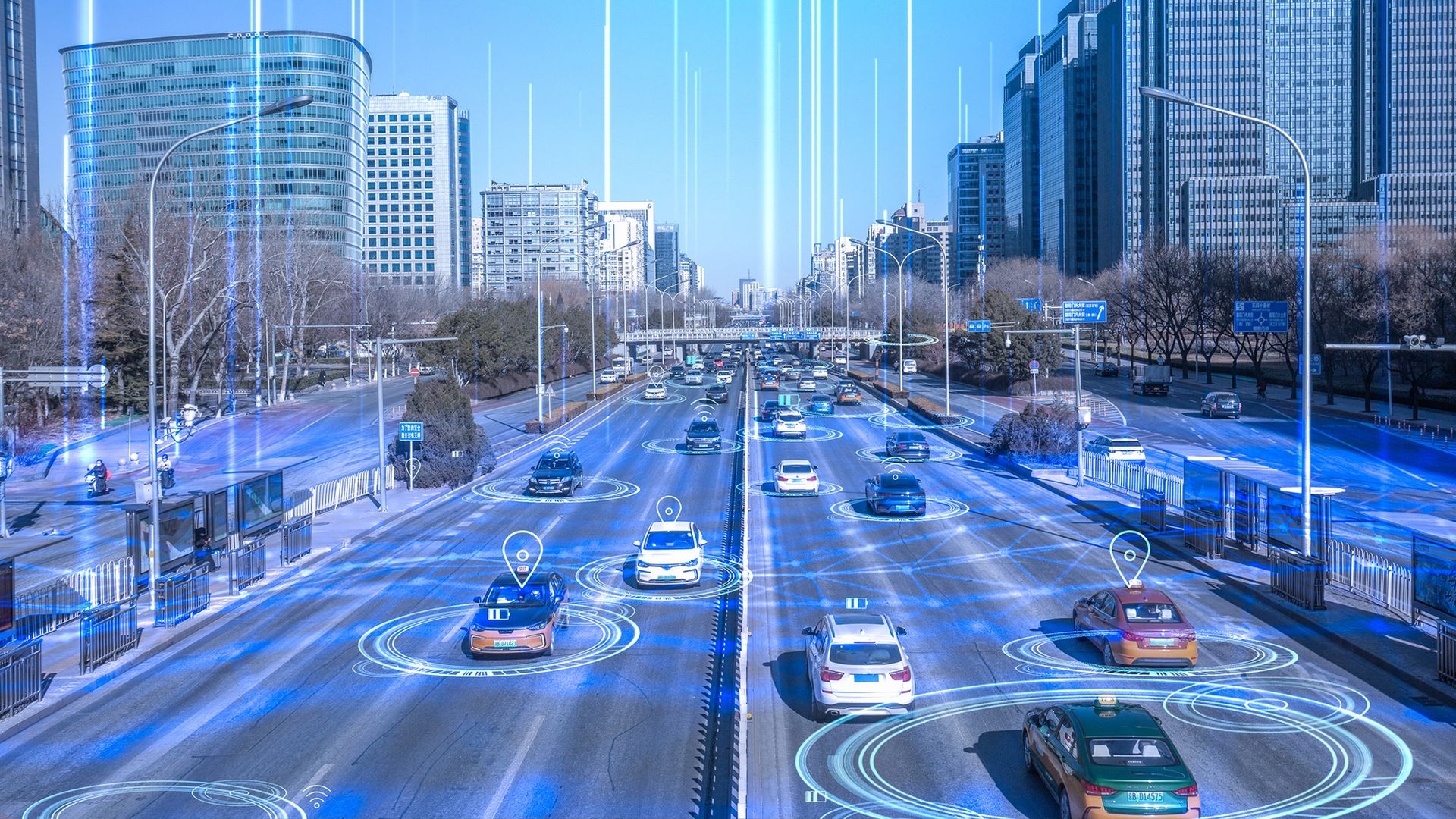
An image of cars on the road overlaid with blue circles and lines.

Some researchers are developing technology to connect cars on the road, which could make for smoother braking and less traffic. (Image credit: lupengyu via Getty Images)

If you're driving an EV, you might avoid the hassle of finding a charger when you're at work or running errands. In 2024, EV company Aptera unveiled a prototype car equipped with solar panels. Those panels — on the car's hood, roof, dashboard and hatch — allow the vehicle to travel about 40 miles (64 kilometers) per day on solar power. That's more than the average American drives per day. Aptera's vehicle can also travel up to 400 miles (640 km) on a standard electrical charge.

Some sunlight-powered cars might ditch the solar panels altogether in favor of a more integrated design. In 2024, Mercedes-Benz revealed it was researching a photovoltaic paint that could convert sunlight into energy for electric cars. In sunny cities such as Los Angeles, the company calculated, the paint could draw in enough energy to power the car for nearly 7,500 miles (12,000 km) per year. The tiny particles in the paint convert about 20% of the energy from sunlight into electricity, which is comparable to the efficiency of existing solar panels.

You might even be able to sell some of the energy stored in your car's battery back to the grid. EV owners could charge during the day or late at night, when the demand for electricity is lower and pay lower rates for electricity. Then, in the evenings when the electrical grid is under more strain and the price of electricity is higher, they could sell that stored energy back at a profit.

Standardized software programs that throttle EV charging speeds during peak hours already exist. Drivers can use them if, for example, they want to keep charging costs down by primarily charging their cars during off-peak hours when electricity costs are lower, or if they want to use electricity only from solar power to charge, said Rajit Gadh, a researcher who studies EV charging and scalability at UCLA. But the process for sending energy back to the grid is a different story. Individual manufacturers haven't yet landed on a standard way to tell cars when and how much energy to discharge, Gadh said.

"What is needed is really [for] every EV charging vendor ‪—‬ and every EV manufacturer, actually ‪—‬ to have this protocol built in, adhere to it in its full specification, and make it available," Gadh told Live Science.

With the right protocols, though, cars of the future will be able to do more than interface with the electrical grid. "Vehicle-to-everything" technologies could enable cars to communicate with infrastructure and other vehicles to avoid traffic and collisions.

Some cars today are already equipped with vehicle-to-vehicle (V2V) communications. These systems use short-range radio signals to alert other V2V-equipped vehicles of the car's speed, direction of travel and braking patterns. The radio signals can travel about 1,000 feet (300 meters), allowing the vehicle to receive data from cars that are not in the driver's line of sight.

V2V systems could help reduce traffic collisions by warning drivers about oncoming cars they can't see yet — for example, by alerting a driver to another car speeding toward an intersection or coming around a bend as the driver is passing another vehicle on a twisty, two-lane highway. Not all cars have the technology, though, so its practical utility is limited for now.

Hands off the wheel; eyes off the road

Some driver assistance technologies, such as lane departure warnings and cruise control, have been on the market in personal cars for decades. These technologies and more recent assistive features require the driver to be in control of the vehicle, but theoretically, they make driving easier. For example, Tesla's Full Self-Driving (Supervised) mode handles most steering and braking tasks, but safe operation requires the driver to keep their eyes on the road and be ready to take over at a moment’s notice. In the next several years, drivers will likely see new features that automate driving in more contexts.

Some of these features will allow drivers to take their attention off the road entirely and enjoy some in-car entertainment, as long as they're alert and able to retake control of the vehicle within a few seconds if conditions change. Technologies that fully automate driving in many circumstances within certain service areas will likely be in about 4% of cars on the market by 2035, according to a white paper from the World Economic Forum.

In cars equipped with these features, "you're still going to have driver controls, but under certain circumstances, it will be effectively an automated vehicle," Luke Neurauter, who leads the Division of Vehicle, Driver and System Safety at the Virginia Tech Transportation Institute, told Live Science.

Mercedes-Benz introduced its Drive Pilot system for two consumer car lines in 2022. On the entire German Autobahn network and on certain freeways between and around Los Angeles, San Francisco and Las Vegas, during heavy traffic, the system lets the driver turn their attention toward other activities, such as reading a book or eating lunch, while the car handles steering and keeping pace with other nearby vehicles.

But as the artificial intelligence (AI) models that control autonomous driving improve and become better able to handle unusual scenarios — often called "edge" or "corner" cases — on the road, drivers will be able to hand over control to their cars in more situations, said Rahul Jain, an electrical and computer engineer at the University of Southern California.

You're still going to have driver controls, but under certain circumstances, it will be effectively an automated vehicle.

Luke Neurauter, director of the Vehicle, Driver, & System Safety Division at Virginia Tech Transportation Institute

Future AI systems might "have some reasoning ability, and then because of that, it can handle these corner cases much better than current systems are able to do," Jain told Live Science. For example, a car might be able to better respond to an indecisive pedestrian who suddenly enters a crossing, assess whether to enter potentially hazardous conditions such as flooded roads, or safely navigate around unusual circumstances, such as construction work, on a highway.

While some systems will enable drivers to make fewer decisions, others that may roll out in the next several years will track a driver's attention and alert them with sounds, an indicator light or haptic feedback when their focus falters. These systems use cameras and software to track head position, eye movement and steering-wheel input to ensure drivers are focused on the road even when they're using assistive features such as lane centering, Neurauter said.

In addition to looking for distracted driving, the technology might expand to monitor drivers for fatigue and alcohol impairment, he added. That information could then affect "whether or not other features become active, or change how they act, based on the driver state at that moment in time," Neurauter said. Proposed legislation could make this technology a requirement in new vehicles as early as 2027, but technological hurdles and concerns over privacy and false positives could stall its implementation.

The technology could also assist drivers who become unable to safely operate the vehicle — for example, if the driver falls asleep or experiences a medical emergency. If a car detects that the driver is not holding the steering wheel or actively controlling the vehicle, it could send a series of visible, audible, or tactile alerts. If the driver doesn’t respond to those cues, a car might turn on its hazard lights and come to a stop. Some vehicle manufacturers are already rolling out such technology; for example, Volkswagen has made it available in all new vehicles from model year 2025.

Fully autonomous vehicles

While personal cars may not offer full automation, highly automated car services will become much more common as rideshare vehicles in major metro areas. In some cities, like San Francisco, commuters already rely heavily on autonomous vehicles from Waymo. The company has rolled out its cars in nearly a dozen cities —‬ including Dallas, Houston, Atlanta and Los Angeles —‬ and has announced plans to expand service to more than 20 additional locales. Other companies ‪—‬ such as Nuro and Volkswagen’s MOIA ‪—‬ are testing their vehicles with human drivers on board before rolling out full public service.

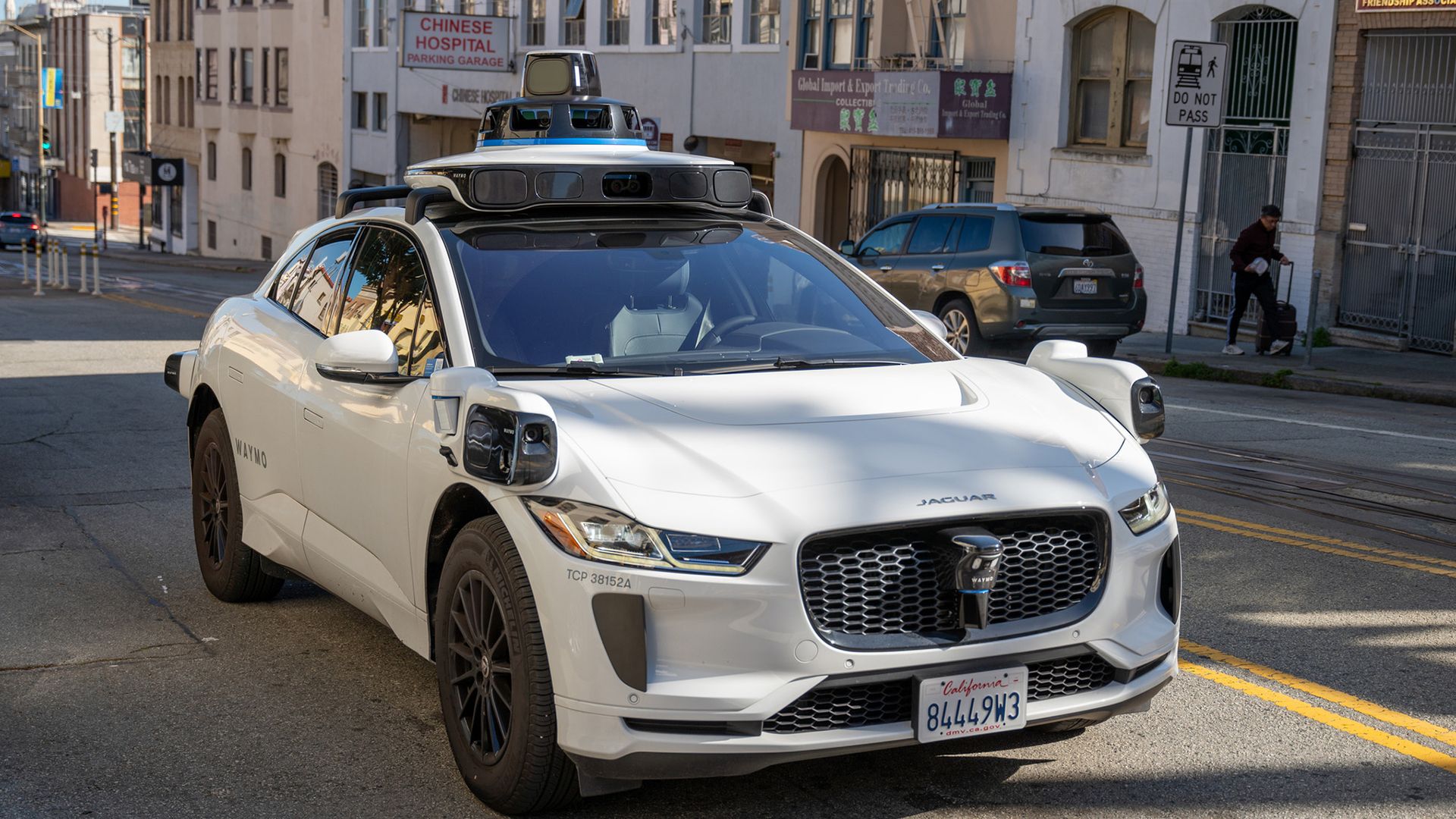
A white car with a camera on top is seen on a city street.

Autonomous cars are rolling out in new regions at a rapid pace, but a patchwork of laws and regulations governing self-driving cars may affect whether they wind up in a city near you. (Image credit: Marc Dufresne via Getty Images)

Currently, autonomous vehicles navigate by combining information from preloaded, high-resolution maps and real-time radar, lidar and visual data collected by cameras and sensors attached to the car. An onboard computer uses that information to build a 3D map of its surroundings. Right now, the cost of these sensors makes them impractical for consumer vehicles, Jain said, but they’re becoming cheaper as manufacturers scale up production. The cars also use an AI model trained on both common and unusual driving situations to anticipate how other vehicles and pedestrians will behave and plot a safe path forward, Jain added.

Developing those high-resolution maps takes time, which is one of the main reasons autonomous rideshares aren’t available everywhere yet. Mapping usually involves decking out a car with high-end visual sensors and lasers and driving it throughout the region. Although cities like San Francisco have been mapped with this level of precision, much of the U.S. has not.

"It's very difficult to do overnight," said John Dolan, an autonomous-driving researcher at the Carnegie Mellon University Robotics Institute.

Complexities also tend to arise in city environments, where unexpected stops are more common and there are many pedestrians who behave unpredictably or jaywalk. But interstate highway driving doesn't face as many of those obstacles, and that could enable autonomous long-haul drives.

"[Autonomous] trucking, I would expect, would be the first thing that's going to happen" in terms of autonomous travel outside of major cities, Jain said. A few driverless trucks are already on the road: Pittsburgh-based company Aurora deployed the technology on I-45 in Texas, between Dallas and Houston, in 2025, with plans to expand across the southern U.S.

Longer range and faster charging

While there's speculation involved in predicting the range of self-driving capabilities available in a decade, the picture for EVs is a little clearer.

Right now, lithium-ion batteries dominate the EV market. Each cell in a lithium-ion battery has two electrodes, commonly a layered graphite electrode and a metal oxide or phosphate electrode, separated by a liquid electrolyte solution. Lithium ions migrate back and forth between these two electrodes when a person charges and discharges the battery.

Many electric cars with lithium-ion batteries can already travel more than 300 miles (480 km) on a charge. But that's not ideal for a long-range car trip, because charging stations are few and far between in the country's vast interior and charging takes longer than filling up a gas tank.

Solid-state batteries, which replace the liquid electrolyte with a solid electrolyte made of ceramic, polymer or sulfide materials, could make that cross-country trip in an EV a practical option, allowing an electric car to travel more than 750 miles (1,200 km) on a single charge. Some prototype battery packs can already achieve this range under controlled conditions. If a solid electrolyte were paired with an anode made of pure lithium, rather than graphite or hard carbon, it would allow the battery to store more energy than a lithium-ion cell of similar mass can.

It'll be a fantastic commuter car, but you're not going to go on a family trip from Montreal to California so easily.

Eric McCalla, battery materials chemist at McGill University in Canada

Solid-state batteries may also enable faster charging. In current batteries that use liquid electrolytes, charging and discharging the battery too quickly can cause dendrites, thin branches of lithium that stretch across the cell and short-circuit the battery. A solid electrolyte could, in theory, block those dendrites, which would enable cars to charge fully in just 10 to 15 minutes. The higher energy density from a lithium metal anode also translates to a greater range than that from a similarly sized lithium-ion battery, Eric Wachsman, director of the Maryland Energy Innovation Institute at the University of Maryland, told Live Science.

Cheap EVs

Many of the raw materials that go into existing lithium-ion batteries are concentrated in a handful of geographic areas. In 2023, Australia, China and Chile mined about 85% of that year's lithium supply; China mined the majority of graphite used that year as well. And battery materials still make up a significant portion of an electric vehicle's cost.

Sodium-ion batteries could be cheaper and easier to source. Sodium is plentiful in Earth's crust, which means mining could be done throughout the U.S., potentially with a comparatively low environmental impact.

Such batteries also rely on a more widely available electrode material. Sodium ions are larger than lithium ions, so they don't fit in between layers of graphite like lithium ions do. Instead, sodium-ion batteries use hard carbon electrodes.

I would be surprised to see them in cars in the next decade. I've been surprised before, though.

Eric McCalla, battery materials chemist at McGill University in Canada

"When you cook at home and your soup boils over and you get this black ring around your pot, this is hard carbon," Maximilian Fichtner, a solid-state chemist at the Helmholtz Institute Ulm for Electrochemical Energy Storage in Germany, told Live Science. "You can produce this from sucrose or from biomass, from whatever. You can do that everywhere."

The downside is that hard carbon holds less sodium than graphite holds lithium, said Eric McCalla, a battery materials chemist at McGill University in Canada. That means sodium-ion batteries can't store as much energy relative to their mass, and they don't last quite as long as their lithium counterparts.

"The range won't be as large," McCalla told Live Science. "It'll be a fantastic commuter car, but you're not going to go on a family trip from Montreal to California so easily."

Manufacturers are already bringing sodium-ion technology to market. For instance, the Chinese company CATL began mass-producing the batteries in February and claims that their battery packs enable EV ranges over 250 miles (400 km).

But new technologies are being developed rapidly. For example, some scientists are making sodium-ion batteries that use solid electrolytes, combining the higher energy density of solid-state lithium batteries with the cost savings of sodium batteries.

This hybrid battery chemistry is still in the early stages of development, experts told Live Science. "I would be surprised to see them in cars in the next decade," McCalla told Live Science in an email. "I've been surprised before, though."

Bumps in the road

The future we're describing is the utopian scenario. But the biggest obstacles are likely not technological but rather regulatory, economic, political or cultural, experts said.

"We're going to try to guess at a timeline of when some of these things are going to come in, and odds are, we're going to be wrong," McCalla told Live Science. "Odds are, we're going to be slower than we think."

Solar panels may not wind up being the most economic or practical way to increase EVs' range, while scaling up manufacturing capacity for next-generation batteries is expensive and could slow EV adoption in the U.S. The utility of vehicle-to-vehicle communications, meanwhile, could be limited by a slow rollout and adoption of V2V-equipped cars among drivers.

Whether EVs will be ubiquitous will likely come down to their affordability relative to gas-powered vehicles, which is affected not just by manufacturing and technological advances but also domestic policy choices, such as whether to subsidize EVs or their charging networks.

One challenge for manufacturers is that the automated features drivers prefer may not always be safer. A recent review of automated systems found that those focused on driver safety, such as automatic safety or lane centering, tend to reduce crashes, while those focused on comfort, such as adaptive cruise control, can increase accidents. The authors proposed that such systems make it easier for people to disengage or become distracted while driving and possibly overestimate the capabilities of the system.

And there are other kinks to work out for autonomous rideshare vehicles. In December 2025, a horde of Waymos stalled during a power outage, clogging San Francisco intersections. The cars are programmed to treat dark traffic signals as four-way stops, according to a statement from Waymo, but they occasionally ping human operators for confirmation. During the outage, the number of confirmation requests spiked, leading to delayed responses — and lengthy traffic jams. The company says it has since released software updates that allow its vehicles to act more decisively at dark signals. But questions remain about how the fleet will respond in natural disasters, and some have expressed frustration that autonomous rideshare vehicles already slow down ambulances, fire trucks and police cars responding to emergencies.

One of the biggest roadblocks to automated driving is the regulatory environment, Neurauter said. Regulations on self-driving vehicles vary by state, and some, such as New York, effectively prohibit driverless vehicles entirely. Where they are legal, they often must carry higher insurance and pass testing, which could limit their rollout.

"When we get into automated driving, the driving behavior is being governed by software that's installed on a computer that's in the vehicle," Steven Shladover, a research engineer at the University of California, Berkeley, told Live Science. "That gets us into a messy gray area where both the federal and the state roles kind of overlap, and that's politically very complicated." For example, different states could end up with different rules for establishing who's legally responsible for an accident involving automated driving.

In 10 years, you'll almost certainly be able to drive from Los Angeles to Las Vegas in an autonomous vehicle. But if you want to drive to New York City, you might have to stop in New Jersey — and take a train into the city.

Help us improve Live Science Pro: We're always trying to make our content better. Leave us feedback about Pro here.

Waymo Calls Cops on Passengers With Assault Rifle

18 September 2026 at 14:35

Waymo called the cops on two youths in San Francisco after catching them handling an assault rifle while in the back of one of its robotaxis, according to local reports. Both passengers, a boy and a girl, have been arrested.

On the morning of September 4, Waymo intervened and pulled over a vehicle after detecting a “violation of our terms of service involving a firearm,” a company spokesperson told the LA Times, after which it alerted emergency services.

Police were called to the scene in the city’s Richmond District just before 4 AM, and conducted a “high-risk vehicle stop,” a spokesperson for the San Francisco Police Department told SFGATE.

When officers searched the car, they found a “ghost gun” — an untraceable, homemade firearm assembled from kits or 3D-printed parts — imitating an AR-style assault rifle. They also found, less ominously, some “suspected marijuana and mace spray.”

The young pair were arrested and booked into a juvenile detention center, the spokesperson told SFGATE, and are facing charges related to illegally possessing a firearm. Their ages and identities haven’t been released.

Robotaxis rely on a host of cameras to observe their surroundings, and they also closely monitor what happens inside their cabs, making them an obviously bad choice to take a joyride in or possibly commit crimes. It remains unclear, though, what the teens intended by toting around their makeshift rifle.

This isn’t the first time Waymo has tipped off local law enforcement about its own passengers. In July, it pulled over a car and alerted the San Mateo Police Department after realizing that its riders, two 15-year-old boys, were reportedly drinking in the backseat and shooting water beads out of a toy gun.

There have also been incidents of unruly and possibly illegal behavior in its cars that didn’t lead to arrests. As Waymos and other robotaxis become more popular, rowdy passengers will almost certainly become a more frequent problem.

More on robotaxis: Oops! Many Tesla Cybercabs Actually Do Have Steering Wheels, Undercutting a Core Promise

The post Waymo Calls Cops on Passengers With Assault Rifle appeared first on Futurism.

Bumbling Cybercab Gets Trapped in Hotel Parking Lot, Drops off Passenger Right Where He Started

17 September 2026 at 20:56

In Austin, a man’s attempt to be chauffeured out of his hotel in style was foiled when his confused ride couldn’t even pull out of the building.

His ride, of course, was a Tesla Cybercab — Elon Musk’s self-driving, steer-wheeling free robotaxi.

“The Robotaxi arrived… and then couldn’t get out of the hotel parking lot,” the man, who claims to be a computer engineer, wrote on X, posting brief footage of his trip.

As he went on to explain, construction workers had blocked off one of the lanes. And the gleaming gold Cybercab, in all its canny computing power, couldn’t see the other lane that was left open.

He never made it to his destination, but he did arrive at a destination, albeit rather unceremoniously. The Cybercab “drove back and forth four times,” he said, “and then stopped and said I had arrived!”

“Not a great first experience!” he concluded. “Clearly this technology is nowhere close to being ready for large scale deployment.”

So I arrived in Austin and decided to take a robotaxi ride into work..

The Robotaxi arrived… and then couldn’t get out of the hotel parking lot. There was construction in one lane.. but it couldn’t see the other open lane. It drove back and forth 4 times and then stopped and… pic.twitter.com/101F04Al9n

— PK (@paul_k_0907) September 15, 2026

Tesla rolled out its two-seater Cybercabs in Austin earlier this month, after years of anticipation. The company had already operated a Robotaxi service in the city for over a year using modified Model Ys, but the Cybercab represents its first purpose-built robotaxi — and with its complete lack of driver controls like steering wheels and pedals, its no-turning-back commitment to pursuing genuine human-free driving. (Many of its Robotaxis still requiring a human safety monitor inside the car, something the company is clearly conscious about.)

It hasn’t made quite the splash that Tesla may have hoped, however, with many investors underwhelmed by the Cybercab’s launch. While the golden cars haven’t been involved in any high profile incidents yet, the software’s autonomous capabilities haven’t stacked up impressively next to robotaxi leader Waymo. The company is also being investigated by federal regulators over how it self-certified that the vehicles were safe for the road despite their lack of conventional controls.

The Cybercab’s hotel misfire is part of a long chain of weird behavior by Tesla’s robotaxis. Customers — many of whom are Tesla enthusiasts and boosters — complain that they often pick up and drop them off at inconvenient locations, ranging from the middle of busy intersections to hidden alleys, or at absurd distances from their actual destination.

Still, Tesla boosters have been hard at work trying to hype up the cars. Roughly a week before a Cybercab got trapped at a hotel, another Tesla account posted a video bragging about how a Cybercab picked them up from their own hotel. 

“You’ll feel like a VIP getting into this car!” he extolled.

More on Tesla: Cybercabs Are Taking Psychotic Routes That Turn Tiny Trips Around the Neighborhood Into Hour-Long Nightmares

The post Bumbling Cybercab Gets Trapped in Hotel Parking Lot, Drops off Passenger Right Where He Started appeared first on Futurism.

It’s Looking Like Tesla’s Cybercab Might Actually Be Illegal to Sell

16 September 2026 at 17:46

Almost immediately after Tesla unleashed its steering wheel- and pedal-free Cybercabs on the streets of Austin, Texas this month, regulators at the National Highway Traffic Safety Administration cried foul.

The regulator opened an investigation — an audit query, specifically — mere hours after the launch, aiming to find out whether the new Cybercab “meets all applicable Federal Motor Vehicle Safety Standards,” or FMVSS.

Days later, the agency followed up with a “Special Order” requiring the Elon Musk-led company to prove under oath that its Cybercabs meet federal safety standards, which were originally intended for human drivers, as Electrek reports. It’s a considerable escalation over its original query, and failure to do so by September 30 could force Tesla to pay a fine of up to $139 million. Falsifying information could land a responsible officer at the company in prison for up to 15 years.

Tesla’s efforts to brute force its self-driving vehicles onto public streets could end up meeting many more regulatory roadblocks from here, effectively making them illegal to sell. (Whether anybody will actually want to take on all those risks by investing in a fleet operated by Tesla is a separate, albeit just as hard to answer, question.)

Tesla self-certified its autonomous robotaxi as compliant with all vehicle safety standards, which assume a human driver behind the wheel. But given the lack of any physical driver controls, the NHTSA unsurprisingly has its doubts about them actually meeting these standards, given the Special Order.

The Cybercab’s lack of a brake pedal could especially make it difficult to meet certification standards. The FMVSS makes it clear that the brakes need to be activated “by means of a foot control.”

Put simply, Tesla appears to have taken some liberties in self-certifying its Cybercab, a decision that could end up coming back to haunt it. One possibility is that the EV maker temporarily bolted on physical controls, including a steering wheel and pedals, while going through the process, only to remove them ahead of delivery, as Electrek points out, a move that flaunts the FMVSS certification rules.

Amazon’s Zoox, in contrast, played by the rules and proved its cars were safe. The company managed to get an exemption from the NHTSA for its autonomous vehicles in July, which also lack a steering wheel and pedals.

It’s only the latest instance of an Elon Musk-led firm flaunting regulations to get what it wants, an ask-for-forgiveness-later approach that clearly isn’t going all too smoothly even under a government run by the billionaire’s allies.

Musk has made it clear again and again that he doesn’t believe in government intervention, with his business empire shamelessly breaking environmental rules, and abusing his workers.

“Regulations, basically, should be default gone,” Musk said last year shortly after forming the much-maligned “Department of Government Efficiency.” “Not default there, default gone.”

More on the Cybercab: There’s a Huge Economic Problem With Tesla’s Cybercabs

The post It’s Looking Like Tesla’s Cybercab Might Actually Be Illegal to Sell appeared first on Futurism.

The Volkswagen ID.3 GTI could struggle to win over the hot-hatch faithful — despite being the most powerful GTI it’s ever made

16 September 2026 at 17:00
  • Volkswagen reveals all about the upcoming ID.3 GTI
  • It’s the second model in the lineup to wear the marque’s famous badge
  • Rear-wheel drive and its weight could deter the faithful

Volkswagen has taken the wraps off its highly anticipated ID.3 GTI, arguably the closest thing we will get to a fully electrified Golf GTI until the German marque decides to make one.

This is the second model in the lineup to wear the famous performance badge, after VW announced that the smaller ID. Polo would also be given the red-hot treatment.

Volkswagen says the ID.3 GTI will follow the ID. Polo GTI into production, with the former due to launch in the first quarter of 2027.

It’s also a sign that Volkswagen is getting more serious about this high-performance electric stuff, after pussyfooting around with the slightly warmer but very confusing GTX badging on earlier ID.3s and, perhaps most bizarre of all, the ID. Buzz.

But soon, customers will be able to get behind the wheel of an all-electric hatchback that boasts 240 kW (326 hp), 545 Nm (403 lb-ft) of torque and a 0-62 mph sprint time of just 5.6 seconds. As a show of defiance, the ID.3 GTI has one horsepower more than the previously most potent Golf GTI Edition 50.

But unlike any other GTI model in history, power from the single motor is delivered to the rear wheels, while engineers told Evo Magazine that they tweaked the software to prevent those rear tires from spinning up when the full force of the torque is unleashed, even with traction control deactivated.

Volkswagen ID 3 GTI

(Image credit: Volkswagen)

Unlike the Hyundai Ioniq 5 N and 6 N, as well as the cheeky little Honda Super N, Volkswagen hasn’t decided to offer simulated gear shifts to increase driver engagement, but it has introduced fake engine noise into the cabin to crank up the sportiness.

While the exterior now comes in the famous Tornado Red GTI paint color and sports some bespoke 20-inch alloy wheels, the majority of the performance touches have been added inside the cabin, where tartan-style upholstery and a big GTI button on the steering wheel give the game away.

Volkswagen claims that despite the performance on tap, its ID.3 GTI will still manage 373 miles on a single charge, although peak charging speeds are capped at 183 kW, making it difficult to perform the sort of rapid, track-day battery top-ups that Hyundai’s high-performance EVs are capable of.

Analysis: A tough crowd to please

Volkswagen ID 3 GTI

(Image credit: Volkswagen)

Volkswagen has more than 50 years of GTI history, and nearly all of those vehicles sporting the famous badge have been celebrated by fans, owners and journalists alike.

From the first Golf GTI in 1975 to the more recent Edition 50, they’ve all delivered scampering, front-wheel-drive thrills alongside Volkswagen’s comfort, build quality, usability and purposefully restrained styling. Fans can argue all day long about which iteration was the GOAT, but it’s generally agreed that they are all some of the best hot hatches ever made.

Attempting to transfer this badge into the electric era was always going to be a tough ask, as everything that made some of the best GTIs legendary is missing here.

According to Top Gear, the new ID.3 GTI weighs around two tons, which is a good 500kg heavier than even the weightiest ICE Golfs, while the decision to send power to the rear wheels will fundamentally alter the way this electric GTI behaves.

Couple this with the lack of synthesized (or real) gear shifting and other technological wizardry that makes Hyundai and Honda’s performance EVs feel more engaging, and what we are left with might be the fastest and most powerful ID.3, but is it really a true Golf GTI successor?

I’d love to be proven wrong, but I feel Volkswagen is going to have a tough time convincing petrolheads to ditch their Mark 7 Golf GTIs and climb into this.

Cybercabs Are Taking Psychotic Routes That Turn Tiny Trips Around the Neighborhood Into Hour-Long Nightmares

16 September 2026 at 13:36

The Tesla Cybercab is innovating impressively impractical ways of getting from Point A to Point B.

One Cybercab passenger in Austin complained that what should’ve been a ten minute trip devolved into a 70-minute long nightmare as the steering-wheel-free robotaxi spiraled its way down the most circuitous route possible. 

The driverless cab started the journey by driving in the complete opposite direction of the destination for miles, the exasperated passenger wrote in a Reddit thread, then turned around and took a “massive” detour through east Austin.

If it was instead a Google Maps car trying to image every inch of the city, you’d have to admit it was a job well done.

“My Cybercab held me hostage for an hour,” the rider wrote in the post, spotted by Electrek. “Guess the Cybercab wanted the scenic route today.”

According to Electrek, the reason that the trip took so long is almost certainly because the Tesla Cybercabs can’t drive on highways yet. The consequently tortuous routes that the cabs have to take may not immediately be clear to a passenger, though, as the app only shows a price estimate and not a projection of how long the trip will take, the blog noted.

Like other robotaxi services, the Cybercabs — which use a version of Tesla’s Full Self-Driving software that hasn’t been released to the public — operate only within a geofenced area that’s been extensively mapped. (Waymo, the leading robotaxi company, does already allow its cars to use highways in some cities.)

There are other signs that the Cybercabs (and Tesla’s confusing named “Robotaxis,” which are self-driving taxis in the form of modified Model Ys, instead of a purpose-built vehicle), are still walking on eggshells compared to its competitors. Some passengers say that the cabs also avoid railroad crossings, which could add to trip times. (Tesla is being investigated for FSD frequently going haywire near these crossings and driving into the path of oncoming trains.)  

Do all these restrictions make for a properly autonomous cab? If you had a time machine, you could go back to 2019 and ask CEO Elon Musk for an answer: “If you need a geofence area, you don’t have real self-driving!” he infamously proclaimed.

More on Tesla: Tesla Investors Disturbed by Cybercab’s Obvious Lack of Progress

The post Cybercabs Are Taking Psychotic Routes That Turn Tiny Trips Around the Neighborhood Into Hour-Long Nightmares appeared first on Futurism.

Tesla Investors Disturbed by Cybercab’s Obvious Lack of Progress

15 September 2026 at 16:20

There was no livestream and the media wasn’t invited. We didn’t even see a euphoric Elon Musk embarrassing himself on stage.

Tesla’s rollout of its two-seater Cybercab robotaxis on the streets of Austin, Texas, this month left investors scratching their heads. With little fanfare, the company stated on Musk’s social media platform X that “Cybercab rides” would “open to public” on September 4.

The “Cybercab event was largely a bust,” tweeted Future Fund Advisors co-founder Gary Black at the time. “The launch offered little detail and key questions remained unanswered.”

The lack of enthusiasm has reignited concerns over the company’s ability to catch up with some extremely steep competition. Its fleet remains extremely small and limited to a geofenced area of Austin. Major regulatory hurdles could make expansion into other states exceedingly challenging. Early testing and data gathering in New York City required the company to install steering wheels and hire human drivers for its Cybercabs, effectively turning them into glorified — and cramped — Tesla EVs.

Investors are already peering through the thin coating of gaudy, gold-colored paint. As a group of asset managers and traders, who — perhaps ironically — refer to themselves as the “Bears of Wall Street” noted in a post on Seeking Alpha, they’re maintaining a “rating of Sell for Tesla.” That’s in large part due to “mounting risks,” such as a “negative free cash flow, surging [capital expenditures] above $25 billion, intensifying competition, and regulatory audits delaying robotaxi expansion.”

The Cybercabs are one of three pillars Musk has bet the fate of Tesla on, along with its humanoid robot Optimus and AI. But without any meaningful strides almost two years after Musk first showed off its robotaxi to the world, investors are left wanting a lot more.

That’s especially true as regulators are starting to ask some tough questions, with the National Highway Traffic Safety Administration opening a probe into the safety certification of its Cybercabs.

The company is also looking to a spend over a whopping $25 billion this year and taking on even more debt, with a “borrowing capacity” of up to $30 billion, as it attempts to stay relevant in the fast-moving AI race.

“Capex will grow for the next two or three years as we expand our Robotaxi fleet, expand our production capacity for Optimus, make investments for semiconductor fab, install solar manufacturing capacity, and AI compute infrastructure, in addition to all the other expansions we’ll do for other manufacturing for automotive,” the company’s CFO Vaibhav Taneja told investors in July.

Waymo continues to run circles around the company, offering its services across ten US metropolitan areas and providing half a million paid rides per week.

Meanwhile, its core business of selling cars continues to atrophy. While delivery numbers have recovered somewhat from a disastrous 2025 performance, the numbers still have a lot of ground to regain.

Then there’s the specter of a possible merge with Musk’s SpaceX, which is looking increasingly likely, at least in the long run. It’s a highly risky move that could saddle Tesla with even more debt.

“All of those risks make us believe that Tesla remains greatly overvalued even after the volatility of the last two months,” the Bears of Wall Street argued, valuing the company’s stock at “around 78 percent below the current market price.”

“The Cybercab launch was the catalyst that was supposed to justify Tesla’s valuation, and it delivered almost nothing that investors could measure,” the group concluded. “Instead of a fleet expansion plan, the company got a federal investigation, while its main competitor keeps adding cities.”

More on the Cybercab: Oops! Many Tesla Cybercabs Actually Do Have Steering Wheels, Undercutting a Core Promise

The post Tesla Investors Disturbed by Cybercab’s Obvious Lack of Progress appeared first on Futurism.

What happens when driverless cars break the law? 

14 September 2026 at 14:48

Driverless cars, once a distant techno-optimist’s dream, are making their way into more cities, racking up miles and attracting a loyal fan base. They’re also increasingly racking up tickets and driving in ways that would land a human driver in hot water. 

During July Fourth celebrations this year, several Waymo autonomous robotaxis operating near San Francisco’s Golden Gate Bridge reportedly hit technical trouble that led to at least one vehicle driving over an exploding firework with two passengers inside. The riders (who luckily escaped harm) said they smelled smoke coming out of the vehicle and promptly bolted at the next intersection.

A couple of months earlier, a California driver claimed a pair of Waymos cut her off and blocked her from moving forward for nearly 50 minutes, causing a traffic pile-up and frantic 911 call. Halfway across the country, as many as five Waymos in Austin blocked police and emergency crews responding to an active shooting that left four people dead and a dozen injured. 

“The question is not if this is going to turn into a deadly situation for someone, but when,” Austin City Council member Paige Ellis said at a meeting following that incident.  

Human drivers in any of these situations would likely face a confrontation with police and the real possibility of a citation—or worse. But that calculus changes when there’s no one behind the wheel. Across the country, cities and states are still figuring out how to sanction a driverless vehicle that breaks the law, even as the well-financed companies operating them rack up thousands of dollars in parking tickets with seemingly few consequences.

To call the situation a work in progress is an understatement. Many localities that allow these vehicles on public roads still lack clear legal mechanisms for issuing moving violations. Where laws do exist, enforcement remains light-handed. Experts in autonomous vehicle (AV) policy tell Popular Science that this seemingly basic question, “what happens when a driverless car breaks the law?”, is still surprisingly complicated to answer.

“In principle, AVs are licensed drivers and someone owns and operates them,” University of Southern California Gould School of Law professor Gregory Keating tells Popular Science. “They should be treated like any other licensed driver.”

Despite spending years studying this very issue, Keating says the path forward remains hazy. 

“In practice, I don’t know what’s going on,” he adds. 

Driverless cars are racking up parking tickets

Cars breaking laws, whether driven by humans or algorithms, fall broadly into two categories: traffic violations and moving violations. Anyone who’s gotten a parking ticket is familiar with the former, and increasingly, so are driverless cars. In 2024, Waymo, by far the most common robotaxi operating today, accrued over 589 parking tickets in San Francisco and $65,065 in fines, according to The Washington Post. The Post reported another 75 tickets further south in Los Angeles. In Austin, where the company more recently started commercial operations, Waymo has reportedly received 20 parking-related citations as of June 23. Zoox, another robotaxi firm backed by Amazon, also received a citation for parking in a tow-away zone. 

[Related: Why are ‘driverless’ cars still hitting things?]

Cops issuing those tickets basically approach it the same way as they would a car with a human driver. Matthew Raifman, autonomous vehicle and traffic lead at UC Berkeley’s SafeTREC, tells Popular Science that in these cases, it’s the vehicle, not any individual behind the wheel, that’s on the hook–the same as it would be for a human-driven car. Parking tickets already work this way: If you borrow a friend’s car and get a ticket, it’s the car’s registered owner who pays, not the friend who parked it. Since an AV’s registered owner is the company that operates it, that same logic extends easily to driverless cars. A traffic cop who comes across an empty, illegally parked driverless car can simply print a ticket and place it on the windshield. At the end of the day, perhaps after picking up more passengers, the AV returns to a depot where a human employee collects the ticket and sends it up the chain for payment. 

How cops are supposed to arrest a car with no driver 

Ticketing driverless cars for more serious moving violations gets more complicated. Most municipalities still don’t have clear mechanisms for citing these vehicles when they block traffic, make illegal U-turns, or commit other mistakes that would normally lead to tense conversations with police. The core issue is confusion over who is held responsible when no human is actually making the mistake.

If a police officer observes an AV committing a moving violation, they generally flash their lights to signal the vehicle to pull over. Robotaxis are programmed to use their onboard sensors to detect police flashers, though some vehicles have struggled to do so in the past. If the AV pulls over, the officer must determine who the rogue car belongs to. Today, with only a handful of robotaxi firms operating, that detective work is pretty simple. But it could get much trickier in the near future as more AV companies enter the market, or if individuals begin owning and operating their own autonomous vehicles.

“Just because robotaxis are dominant right now doesn’t mean that robo taxis will dominate in the future,” University of South Carolina law professor and AV policy expert Bryant Walker Smith tells Popular Science. “We could have one company that develops the automated driving system, another company that puts it on a vehicle, another company that buys the vehicles.” 

A clear example of how this confusion can play out occurred late last year in Northern California. San Bruno police, conducting a DUI operation, say they spotted a driverless Waymo make an illegal U-turn in front of them. Officers pulled the wayward Waymo over and contacted a human representative through the car’s speakers to report a “glitch.” But because there was nobody behind the wheel, no ticket or citation was issued the way it would have been if a human driver were involved.

“Since there was no human driver, a ticket couldn’t be issued (our citation books don’t have a box for ‘robot’),” a San Bruno Police Department Facebook post explained following the incident reads.

“That’s right… no driver, no hands, no clue.”

“I’ve been in a Waymo but, being a mere passenger, I’ve never poked around in the glove compartment to see if they carry their ‘papers’ around approximately the way that human beings do,” Keating says. 

Worries about AVs breaking the law aren’t hypothetical. A recent CNN analysis of federal government records and social media footage found hundreds of driverless cars running red lights, driving into oncoming traffic, ignoring emergency road closures, and executing other potentially dangerous maneuvers. Around that same time, Waymo temporarily pulled its vehicles from highways following reports from the National Highway Traffic Safety Administration (NHTSA) of at least 13 instances where they drove into active construction zones. The company has since started resuming highway routes. 

Waymo and independent supporters of AV rollouts generally have repeatedly claimed that, even when taking these issues into account, autonomous systems get into fewer crashes and drive safer than humans. Recent research lends credence to that argument in certain cases, but AVs are still limited in where and how they can operate. 

“No technology is perfect, but while human drivers can only learn from their individual experiences, Waymo takes community feedback and applies those safety learnings to our entire fleet,” a Waymo spokesperson told CNN in June.

A new type of ‘ticket’ for autonomous vehicles 

Regulators hope some creative new legislation can help clear up the confusion. California enacted a law allowing police to issue a “notice of noncompliance” to AVs. The whole point of these notices, and why they mark an important step forward, is to create an official record for when an AV makes a mistake, Raifman notes. Those notices are then updated in the California DMV’s system within 72 hours. Prior to this, police didn’t have a clear way to document when an AV violated the law, creating a gap that contributed to uncertainty about how well the technology works in the real world.  

Still, actually punishing human drivers and AVs isn’t a one-to-one comparison. When humans make mistakes, they receive points on their driver’s license. Rack up enough points, and a driver risks losing their license altogether. As Raifman points out, notices of noncompliance attempt to apply a similar deterrent for AV companies. The notices are recorded, added up, and factored into whether state regulators continue granting those companies permits to operate autonomously. Too many violations, especially those causing major traffic issues or injuries, could lead to a company’s permit being revoked. But unlike humans, AV makers don’t have to worry about individual monetary fines for these moving violations.

An autonomous Waymo car drives into the blocked off Potrero Annex construction site while a construction worker watches.
An autonomous Waymo car drives into the blocked off Potrero Annex construction site while a construction worker watches. Image: Getty Images Thomas Hunter II/Alamy Live News

“It’s an indirect mechanism to enforcement, but it is not enforcement through money and points,” Walker Smith said.

Raifman compares this enforcement method to how regulators manage pollution from power plants. Local governments often grant permits allowing a facility to emit certain pollutants, but only up to a specified amount. If a plant exceeds that or otherwise violates its permit, regulators can issue a notice of violation, which, depending on its severity, can lead to a permit suspension or even cause operation to shut down. 

That’s a different process than the one facing an individual resident who pollutes their own backyard. In that case, they’d likely just receive a citation. In both the power plant case and now with AVs, enforcement relies on an ongoing back-and-forth between corporations and regulators, rather than a single punishment to an individual.

That may make sense on paper, but it’s also frustrating for everyday drivers, many of whom are just now seeing AVs spring up in their towns and on their roads without their input. The frustration shows up in comment sections and forums, with some describing what can seem like two separate rules or laws–one for humans and another for robots and their owners. 

“They pay the fine and just keep doing what they are doing,” one Reddit post on the topic reads. “This is the corporate reality we live in, where corporations are supposedly people, but have none of the responsibilities or need to deal with things like following the law that the rest of us do.”

Raifman believes enforcement and accountability for driverless cars are broadly improving, but he also empathizes with annoyed drivers who feel the status quo is unfair. One major issue contributing to that frustration, he notes, is that the “pain” felt by a human driver and an AV company violating the same law isn’t equal. A robotaxi company accruing hundreds of thousands of dollars in parking tickets can simply shrug it off as a cost of doing business. For a human driver living on a budget, however, just a few tickets can severely impact their finances.

“I think that’s where there’s an asymmetric relationship compared to humans, and I think that’s a source of frustration,” Raifman says. 

Autonomous vehicles are a physical manifestation of growing AI anxiety 

That pent-up frustration stems, in part, from a familiar pattern in tech: innovations move fast, maybe breaking some things along the way, and regulators end up playing catch-up. Right now, cities with the most exposure to driverless cars (San Francisco, Los Angeles, Phoenix, and Austin) have just begun to sort out what fair and consistent enforcement looks like, even as the technology keeps expanding well ahead of it. 

In just the last year, Waymo has nearly quintupled its fleet, from around 700 vehicles to nearly 4,000, according to The New York Times. Zoox and Tesla are both preparing significant robotaxi launches in multiple cities, and changes to federal rules mean many of these vehicles won’t even have visible steering wheels or pedals. Driverless 18-wheelers are already barreling across Texas highways, and the prospect of individual car owners swapping on true hand-off, eyes-off driving features in their own vehicles gets closer every day. 

And even if the AV supporters are right that the technology is ultimately safer than humans, sheer scale means more and more people will end up watching these vehicles behave badly. In a climate where public trust in automation and AI broadly is souring, driverless carmakers may have more incentive than ever to keep their cars from running afoul of the law, not just to satisfy regulators, but because the cars themselves have become a material stand-in for how people feel about AI writ large.

“I think people are going to put a lot of their hopes and fears about AI generally disproportionately on automated vehicles because they’re so visceral and physical and real and obvious,” Walker Smith said.

In Ask Us Anything, Popular Science answers your most outlandish, mind-burning questions, from the everyday things you’ve always wondered to the bizarre things you never thought to ask. Have something you’ve always wanted to know? Ask us.

The post What happens when driverless cars break the law?  appeared first on Popular Science.

Oops! Many Tesla Cybercabs Actually Do Have Steering Wheels, Undercutting a Core Promise

12 September 2026 at 12:01

Elon Musk’s Tesla has a lot of catching up to do when it comes to its Robotaxi autonomous ride-hailing network.

The company is currently operating a fleet of just 45 of its cramped Cybercabs in Austin, Texas, still falling well short of investor and Tesla bull Dan Ives’ lofty expectations of the company adding “$1 trillion of value” for Tesla “over the coming years” with the service.

And unlike their counterparts in Texas and Florida, the Cybercabs that were recently spotted on the streets of New York City are featuring an unusual relic of a supposedly soon-to-be-bygone era: a steering wheel.

As Gothamist reports, the golden-hued cabs in the Big Apple are being overseen — and perhaps even operated — by a human in the driver’s seat with an old-fashioned steering wheel. It’s a significant departure from the original, steering wheel- and pedal-less Cybercabs Musk unveiled in 2024.

Officials confirmed the drivers are testing a “supervised” self-driving system, which still requires them to be able to take over control at any point. But Tesla refuses to say how many Cybercabs there are in the city or for how long they will be testing.

There’s likely a good reason Tesla has opted to go with more traditional controls. After all, it hasn’t even started the permit application process for autonomous vehicle testing with the New York Department of Motor Vehicles, as the Gothamist confirmed.

The EV maker is looking to collect driving data, not imminently launch a robotaxi service in the city.

In short, Tesla has a very long road ahead of it before it could ever roll out its Cybercabs nationally, let alone in other major urban areas. Other companies, however, have a massive head start, with Waymo claiming that it has already completed over half a million paid rides a week throughout the first quarter of this year. While Tesla has remained notably quiet on the matter, its numbers likely fall far short of that, considering it’s only operating with a fleet of a few dozen vehicles.

Meanwhile, Amazon’s Zoox vehicles received approval from regulators in late July to begin charging for rides in cars that don’t have a steering wheel. The company has been operating services free of charge in Las Vegas and San Francisco since 2025, according to the Associated Press.

More on Cybercabs: There’s a Huge Economic Problem With Tesla’s Cybercabs

The post Oops! Many Tesla Cybercabs Actually Do Have Steering Wheels, Undercutting a Core Promise appeared first on Futurism.

Lawyers Already Lining Up to Defend Victims of Cybercab Crashes

11 September 2026 at 21:03

Tesla’s mawkishly sleek new Cybercab has begun rolling out to Austin, Texas this week, with more sighted in cities like New York, Washington DC, and San Diego. It’s the latest development in the world of self-driving taxi cabs — and in one dubious economic indicator, the nation’s personal injury attorneys are on high alert.

Case in point, the New Jersey based law firm Sarofiem and Antoun already has a blog post up courting customers wronged by Cybercab accidents. Billing himself as a “Tesla Cybercab accident lawyer,” Kerollos Antoun poses an important question: “if a driverless Tesla Robotaxi causes an accident, who is responsible when there is no human driver behind the wheel?”

Though Antoun concedes that Cybercabs don’t appear to currently be active in New Jersey, his blog registers a laundry list of considerations considering who can be held liable in accidents involving the autonomous vehicles — each highly theoretical and short on concrete answers.

“Could autonomous-driving software cause an accident,” for example? “Potentially,” Antoun writes. “If an accident occurs, attorneys may need to determine whether the autonomous system perceived the environment correctly and whether the vehicle’s response contributed to the crash.”

Other firms, like Funes Law in Miami and Angel Reyes and Associates in Austin, offer similar pitches: if you’re in an accident with a Cybercab, they want to litigate your case.

Though the tailor-made Cybercab blogs follow a familiar pattern of opportunism by corporate law firms, their point is fair enough. The technology behind Cybercabs is in a very early stage, and the legal precedent is even younger.

Whichever firm happens to scoop up the first Cybercab injury case would be making legal history — a chance to litigate a brand new product made by one of the most valuable companies in the world.

Though self-driving cars are only a few years old at this point, they’ve already resulted in startling legal firsts. In August of 2025, a jury in Miami handed down a landmark verdict against Tesla over a fatal crash involving a Model S being driven on the company’s “Autopilot” mode.

In that case, the total damages came out to a whopping $243 million — a landmark verdict that the nation’s accident attorneys are eager to replicate as Tesla’s gold-tinted coupe hits the pavement.

More on Tesla: Deranged Stalker Seizes Control of Woman’s Tesla Software to Terrorize Her While Driving

The post Lawyers Already Lining Up to Defend Victims of Cybercab Crashes appeared first on Futurism.

Deranged Stalker Seizes Control of Woman’s Tesla Software to Terrorize Her While Driving

11 September 2026 at 14:54

It’s no secret that car owners have handed an immense amount of control over their vehicles to software. From infuriating touchscreens and convoluted user interfaces, to advanced — albeit flawed — driver assistance programs, we’ve never been more removed from the actual driving experience.

The situation become particularly harrowing for Sydney native Narghiza Ergashova, who watched helplessly as her former partner — who she says had already been abusing her for four years — started remotely controlling her Tesla from his smartphone.

As The Guardian reports, police records detail her terrifying experience at the hands of her domestic abuser, 50-year-old businessman Enrico Pucci, last year. Ergashova found that Pucci had activated a “parental control” profile on the vehicle, going as far as to tail her in his own car as he yelled at her about her new partner.

“You thought you’d get away with this,” he yelled, according to police records quoted by The Guardian. “I am in your car. I am in your maps.”

While Ergashova technically owns the vehicle, Pucci had previously offered to “assist her” by using the accompanying Tesla app, giving him extensive control over the car.

According to Tesla’s website, parental controls can be accessed via the accompanying mobile app and allow the user to change a long list of settings.

It also allowed Pucci to bring the Tesla to a crawl at just 25 mph on main roads, for instance, by activating a “Valet Mode” intended to only be used by valets. That caused “significant safety issues for the victim on the road,” according to the police documents.

Pucci also started setting the cabin temperature of the vehicle to extremely cold and hot temperatures and could even predetermine when the car could be driven by implementing curfew hours, features clearly intended for young learners.

“The victim has not had any control of her vehicle since she noticed the parental control profile added on the 1st November 2025,” law enforcement noted. “The accused has been the only one with access to the vehicle’s controls utilising the Tesla app. This has caused the victim significant stress, mental harm and fears for her physical safety when operating her own vehicle.”

Ergashova’s abuser has an extensive track record. Pucci has been convicted of 30 domestic violence-related offences, according to the Sydney Morning Herald, including eight counts of stalking, two counts of choking, one count of coercive control, and assault leading to bodily harm. He has also been convicted of creating revenge porn and theft.

Fortunately, he has been brought to justice. Pucci pleaded guilty and was sentenced to two years in prison last week.

More on Tesla: Tesla Robotaxi With No Driver Spotted Smashing Through Traffic Barriers

The post Deranged Stalker Seizes Control of Woman’s Tesla Software to Terrorize Her While Driving appeared first on Futurism.

There’s a Huge Economic Problem With Tesla’s Cybercabs

10 September 2026 at 16:08

Tesla’s flashy unveiling of its Cybercab robotaxi in 2024 left some glaring questions unanswered.

The sleek, gold-colored coupé impressed with a futuristic design, but baffled onlookers with its cramped two-seat interior, lack of a charging port, and a dubious, far-too-good-to-be-true $30,000 price tag.

Just under two years later, the first Cybercabs are starting to hit the streets in Austin, Texas — and Tesla is just itching to sell you one. Last week, the EV maker started handing out a “Robotaxi interest form,” as Electrek reported at the time, in an apparent effort attract would-be entrepreneurs willing to buy an entire fleet of the unusual vehicles.

Put simply, the idea is to share revenue from ride income with Tesla while the vehicles operate on the carmaker’s network, using its self-driving tech.

It’s part of a much broader plan. For many years, Tesla CEO Elon Musk has promised that its Full Self-Driving-enabled vehicles, including the Cybercab, could effectively turn into an appreciating money-printing machine, allowing owners to sit on their couch and magically watch the money roll in.

As early as 2018, Musk promised investors that he saw the “future as kind of a shared electric autonomy, so that you’d be able to do ride-hailing or share the car any way,” likening it to “some combination of like Uber, Lyft, and Airbnb.”

But there are plenty of reasons businesspeople should hesitate before takeing Tesla up on the offer of operating a Robotaxi fleet, as Electrek‘s Fred Lambert argued in a compelling essay this week.

Basically, he pointed out, “if running a fleet of Cybercabs were actually profitable, Tesla wouldn’t sell you a single one.” It’s like claiming you’ve found an infinite money glitch — and then instead of quietly profiting off it, selling a get-rich-quick book on how to do it yourself.

There are also looming technical questions. Musk’s lofty promises of a vehicle that completes ride-hailing requests autonomously while also appreciating in value has little, if any, bearing with reality in 2026. To the contrary, the EV maker’s offerings are among some of the fastest depreciating vehicles on the market today.

Then there’s the questionable value proposition. Tesla controls the entire network, the self-driving software, and prices. It even “sets the split,” as Lambert argues. Instead, fleet owners are stuck eating the “capital cost and the depreciation, while Tesla keeps the software margin and its cut of every fare.”

In other words, “you don’t own a business in that arrangement. You own the downside.”

It’s a dubious business opportunity closely reminiscent of Tesla’s infamous FSD advanced driver assistance software. Owners once shelled out a massive $15,000 — before it became exclusively a $99 a month subscription — to access a feature that’s still a complete disaster, leading to fatal collisions and terrifying close calls even after many years of development.

Not only are they spending the equivalent of a small car on faulty software, they’re willing to shoulder the risk as well. Tesla has a long track record of trying to wriggle out of lawsuits arising from these accidents, arguing it was the driver’s fault for engaging the software and not paying attention.

Much like its regular lineup of FSD-enabled vehicles, Tesla’s Cybercab relies entirely on a camera-based autonomous driving system, an approach that experts say is fundamentally flawed.

Nonetheless, as the Austin American-Statesman reports, local investors in Austin are chomping at the opportunity to run their own Cybercab fleet.

Meanwhile, regulators from the National Highway Traffic Safety Administration are watching closely. The agency opened a probe into the Tesla, questioning that its new Cybercab “meets all applicable Federal Motor Vehicle Safety Standards.”

More on the Cybercab: Tesla’s Glitchy Cybercab Accidentally Lets Passengers Access Controls to Manually Drive the Car Using Virtual Joystick on In-Vehicle Screen

The post There’s a Huge Economic Problem With Tesla’s Cybercabs appeared first on Futurism.

Tesla’s Glitchy Cybercab Accidentally Lets Passengers Access Controls to Manually Drive the Car Using Virtual Joystick on In-Vehicle Screen

9 September 2026 at 20:14

One of the selling points of Tesla’s much-hyped Cybercab — its purpose-built robotaxi — is that it doesn’t need manual controls. That’s why it doesn’t even come with a steering wheel or pedals.

But an early passenger who got to ride one of the self-driving cars after they launched in Austin last week discovered that they secretly have manual controls hidden in a touchscreen — the most practical way to control a car, as everyone knows — after its software glitched out and accidentally revealed them.

The passenger, Matthew Skrzypczak, wrote on X over the weekend that when he got in his Cybercab to take it for a spin, the display, instead of showing an interface to let him start his ride, showed a “virtual joystick for manual driving.” 

“I have a feeling I wasn’t supposed to see this,” he wrote. 

In a video he uploaded, the display shows a splitscreen view of various camera angles and an area that lets you control several of the car’s functions. Crucially, there’s also a touchscreen joystick for shifting the car into gear, which says “forward” at the top and “reverse” at the bottom.

Skrzypczak was able to close the door and honk the horn successfully, but when he tries to move the car it doesn’t budge — which is probably for the best, since there were pedestrians nearby — though this may be because he was simply using the joystick wrong.

This feature is almost certainly intended for Tesla employees, and it’s unclear why a passenger like Skrzypczak, and at least one other who noted the issue, was able to access it. To be clear, manual controls are obviously necessary in case an employee or emergency workers needs to move the vehicle when it’s malfunctioning. But putting it behind a slippery touchscreen is also far less practical than an old-fashioned steering wheel and pedal, which is all being done so CEO Elon Musk can have bragging rights.

The workaround hasn’t proved amusing to regulators. Shortly after Tesla launched Cybercab rides in Austin, the National Highway Traffic Safety Administration opened an audit into how Tesla self-certified that the vehicles were safe for the road despite their lack of conventional manual controls.

More on Tesla: Tesla Driver Killed After Self-Driving Mode Stops in the Middle of a Highway

The post Tesla’s Glitchy Cybercab Accidentally Lets Passengers Access Controls to Manually Drive the Car Using Virtual Joystick on In-Vehicle Screen appeared first on Futurism.

Amazon Cargo Jet Crashes Just Feet From Parking Lot Full of Tesla Cybercabs, Killing Five

8 September 2026 at 18:45

An Amazon Prime Air cargo jet ripped right past the landing zone at the Miami International Airport on Sunday afternoon, struggling to stop itself in time before overrunning the runway and crashing into a cleaning crew and a nearby SUV.

It was a tragic incident, killing five innocent people.

The Boeing 767-300 also barreled right through a chain-link fence that was protecting a highly unusual lot of vehicles: photographs of the scene show the dented nose of the airliner just a few dozen feet away from a kennel of parked Tesla Cybercabs.

Tesla CEO Elon Musk has banked the future success of his EV maker on the gold-colored self-driving vehicles, which are too small to fit more than two passengers and lack both steering wheels or pedals. Their sudden appearance in a story about a deadly airliner disaster had the billionaire taken aback. However, instead of offering his condolences after the tragedy, Musk simply tweeted the word “Weird” in response.

The peculiar cameo also led to plenty of questions over Tesla’s plans to roll out the cars outside of Austin. Just last week, the Cybercabs were deployed for the first time in the Texas city, but the company has yet to announce any imminent launches in Miami.

Regulators from the National Highway Traffic Safety Administration watched closely following last week’s deployment, which comes just shy of two years after Tesla first showed off its Cybercab. As Bloomberg notes, the light on details event was “uncharacteristically low-key,” offering no livestream or media coverage.

The “Cybercab event was largely a bust,” tweeted Future Fund Advisors co-founder Gary Black. “The launch offered little detail and key questions remained unanswered.”

Indeed, regulatory approval is hazy for vehicles without any traditional driver controls, a topic that’s especially pertinent to Tesla. Musk has bet the company’s entire future on the success of its Cybercabs and its humanoid robot, dubbed Optimus.

With neither showing any signs of a significant public rollout any time soon, Wall Street is bound to keep asking some tough questions.

More on the Cybercab: Tesla Loses Trademark to “Cybercab” Due to Its Own Staggering Incompetence

The post Amazon Cargo Jet Crashes Just Feet From Parking Lot Full of Tesla Cybercabs, Killing Five appeared first on Futurism.

The People Maintaining Waymo’s Self-Driving Cars Are Being Treated Horribly, Insider Claims

4 September 2026 at 19:58

As work conditions go, the transition from licensed taxi cabs to the rideshare model represented a significant step backwards for drivers in the US. Stable wage jobs became “side gigs,” while human managers were replaced by labyrinthine algorithms. And forget fleet maintenance — under the new model, disenfranchised drivers were now responsible for their own vehicle’s upkeep, and all the financial burdens that come with it.

Yet with robotaxis from brands like Waymo and Tesla spreading through US cities like wildfire, even the Uber-fied gig economy is starting to become untenable for workers. Rising in its place is the “robotaxi handling” industry, bring with it contract jobs that are somehow even more grueling than the rideshare gigs they’re replacing.

A startling interview with an anonymous Waymo contractor by Bay Area Current details precisely how degrading these jobs can be. The worker, identified only as a “Robotaxi Handler,” outlines a poorly organized jobsite where incognito enforcers routinely snitch on undertrained contractors on behalf of management. Oh, and there’s poop to clean — lots of poop.

Starting off, the handler clarifies that although their work is for Waymo vehicles, they actually report to a third-party company called Transdev US, which handles the messy logistics behind the autonomous cabs. (Neither company commented on Bay Area Current‘s interview.)

Per the worker, Transdev’s hiring process amounts to a kind of Soylent Green approach to human resources, in which dozens of contractors are rounded up sight unseen, onboarded en masse, and then culled from the herd when they inevitably fall behind.

“There’s no interview process,” the worker explained. “They weed people out over time based on whether or not you can keep up with that process and adapt really quickly.”

After that rapid-fire orientation, workers can be assigned to various Waymo facilities all over their home city, with job duties rotating on a daily basis.

“Who gets placed in those specific jobs gets decided by managers the day of,” the robotaxi handler told Bay Area Current. “So your job changes every day depending on how much experience you have, how long you’ve been there, and how friendly you are with the managers.”

Sometimes those roles involve troubleshooting — updating software, cleaning sensors, and uploading Waymo data to company servers. It also includes unsticking Waymos when they clog up traffic, which is becoming a frequent occurrence in San Francisco. That can put workers in a precarious situation in which they have to choose whether to follow company orders not to interfere with a piece of tech still in its infancy.

“The policy for Transdev and Waymo is actually to let [the car] sit there and figure it out, because if we disengage it whenever there’s an issue, then the cars don’t have a chance to figure out the issue itself,” the worker explained. “But when it gets really bad, then we have to — what are you going to do? There’s 50 cars all stuck and people off the street yelling at us and threatening us.”

Other times, handlers can be assigned to cleaning tasks. This becomes especially unpleasant near the end of the week, when weekend revelers leave all kinds of nasty surprises for handlers to mop up.

“Typically that’s when there’s the most throw-up, the most disgusting things in the back,” the handler told Bay Area Current. “Even poop, there’s a lot of cleaning up poop. Way more than you think.”

“One time there were two pig heads in the backseat of the car and the cleaner had to clean it up,” the worker continued. “I assume they just went to the market to make a stew or something, but they forgot their pig heads. They were just rolling around in the back of the car.”

This worker’s arduous experience wrangling Waymos in San Francisco may just a taste of things to come as robotaxis hit the streets across the US.

More on Waymo: It Turns Out That When Waymos Are Stumped, They Get Intervention From Workers in the Philippines

The post The People Maintaining Waymo’s Self-Driving Cars Are Being Treated Horribly, Insider Claims appeared first on Futurism.

Tesla Driver Killed After Self-Driving Mode Stops in the Middle of a Highway

3 September 2026 at 13:49

A Tesla running one of its self-driving modes was rear-ended after stopping in the middle of a Arizona highway, Electrek reports, with the driver found dead at the scene. Grimly, it’s not the first accident of its kind.

The crash occurred on October 31, 2025. According to local reports at the time, the 2020 Tesla Model 3 was struck by an F-350 pickup around 3 AM on the eastbound Loop 202 in Mesa, Arizona. None of the contemporaneous reports made note of whether the Tesla had one of its driver-assist systems engaged.

Electrek, however, managed to match the collision to a redacted crash report that Tesla provided in its filings to the National Highway Traffic Safety Administration. These were shared under a Standing General Order that requires automakers to report crashes involving a driver-assist system that’s considered to have an SAE Level 2 of automation or higher, meaning that it can partially drive itself under the right conditions and with constant supervision.

The report states that an automated driving system — either Autopilot or Full Self-Driving — was “verified engaged” during the accident. The vehicle’s “pre-crash movement” is listed as “stopped – 0 mph,” indicating it stopped in the middle of the road. None of these details were shared publicly at the time of the accident.

Electrek says that this is the second time that a Tesla Model 3 with a driver-assist system engaged apparently stopped in a highway before a crash that killed its driver; it also happened in Florida, just weeks before the second one.

What happened is unclear. Tesla’s self-driving software has a well-known “phantom braking” problem that causes the cars to brake unexpectedly, but this is typically to slow the vehicle down, not stop it completely. Going from highway speeds to a grinding halt would be an extraordinary, if not unprecedented, example. It’s also possible that the driver fell asleep behind the wheel or experienced some kind of medical episode that rendered them unable to respond.

The upshot is that we’re more or less being kept in the dark. These details, and whether the car was running the now-obsolete Autopilot or its more advanced successor FSD is impossible to know, because Tesla censored that section of the crash report. It has long redacted crucial information in these reports reports under the guise of protecting “confidential business information,” a practice that is legal but rarely used to the extent that Tesla does. It has gotten in trouble with regulators for how it reports crashes, though. Last year, the NHTSA launched an investigation into Tesla for repeatedly failing to report crashes in time.

More on Tesla: Teslas Are Still Driving Into Oncoming Freight Trains

The post Tesla Driver Killed After Self-Driving Mode Stops in the Middle of a Highway appeared first on Futurism.

Researchers Alarmed as GPS Readings Suddenly Veer Off by 33 Feet, Enough to Crash Self-Driving Cars

1 September 2026 at 21:09

In November of last year, scientists warned of a “severe” solar storm, the strongest in over two decades, colliding with the Earth.

Solar storms are the result of a surge in solar activity, with the Sun unleashing a barrage of charged particles that can trigger spectacular auroras — and wreak havoc with communications satellites and radio signals — when they reach the Earth’s magnetosphere.

Beyond being ferocious enough to delay the launch of a Mars-bound NASA spacecraft, the storm wreaked absolute havoc with GPS systems back on the ground for hours at a time. As detailed in a new paper published in the journal Geophysical Research Letters, a team of scientists found that global navigation satellite systems experienced “significant positioning errors” of over 33 feet during the superstorm, “large enough to disrupt precision agriculture and autonomous transportation industries” across the continental United States.

That’s enough risk to warrant a careful study on these types of events can impact human activity on Earth.

“The results underscore the importance of accurate understanding of various space weather phenomena to enhance our predictive capabilities through coordinated observations and physics‐based modeling and ultimately reducing disruptions to RF applications during space weather events,” the paper reads.

The researchers analyzed observations from several scientific instruments spread out across the US to watch the chaos unfold last November. The Aurora Oval, a ring-shaped area of pronounced activity around the Earth’s geomagnetic north pole where auroras conventionally occur, was pushed south toward the equator. This triggered a “horizontally extended band of intense density gradients” in the upper atmosphere, causing fluctuations in how long signals take to travel through it.

The result: “significant positioning errors at mid-latitudes,” the researchers noted.

The researchers also found that as the auroras became brighter, the observed irregularities became more intense, deteriorating GPS accuracy accordingly.

Fortunately, while farming equipment like GPS-equipped tractors would’ve likely been affected, the November storm occurred long after the farming season concluded.

However, that wasn’t the case for the May 2024 superstorm, which scientists estimate cost farmers half a billion dollars in damages.

“Had the November superstorm occurred during the farming season in the American sector, it could have caused significant economic losses for the American farming industry, in addition to affecting the autonomous transportation industry,” the paper reads.

More on the solar storm: Scientists Say the Largest Solar Storm in Two Decades Is About to Blast Earth

The post Researchers Alarmed as GPS Readings Suddenly Veer Off by 33 Feet, Enough to Crash Self-Driving Cars appeared first on Futurism.

❌