❌

Normal view

Metasurface optical device boosts nonlinear frequency conversion

17 September 2026 at 09:30

By combining a band-structure engineered multi-quantum-well heterostructure with a nanostructure known as a metasurface, physicists in Austria and the US have created a device that can efficiently transform light into different frequencies – including those at technologically important near-infrared wavelengths. Their technique, which boosts nonlinear frequency conversion, could help in the development of smaller and more efficient components for telecommunications, quantum information transfer and other photonics technologies.

Nonlinear frequency conversion is an optical process in which a material is used to generate light of a different frequency to that incident on the material. It is now routinely employed in a wide range of photonics devices that rely on frequency mixing, ultrafast signal processing, broadband and pulsed light sources, and high-speed light modulation. It is also used to generate entangled photon pairs for quantum communication. One common type of frequency conversion, and the one used in this new study, is second-harmonic generation. Here, two input photons are combined to produce one photon with twice the energy.

Efficient nonlinear devices require light with high electric field strengths and materials that respond to these intense electromagnetic fields by producing a light polarization that is not directly proportional to the applied field. “Only a handful of such nonlinear crystals exist and these have complicated structures with weak nonlinearities, which means they require high optical powers to make photons interact with each other,” says Marcus Ossiander from the Institute of Experimental Physics at TU Graz in Austria, one of the authors of the new study published in Nature Nanotechnology. “While, new such crystals emerge from time to time, their structure is fixed, which dictates which light wavelengths they work at and how efficiently.”

Asymmetrically coupled multi-quantum wells

Recently, a group of researchers at the University of Texas at Austin in the US, led by Seth Bank, also an author of this latest study, succeeded in creating an optical nonlinearity not via a new crystal structure but by growing a semiconductor metamaterial made from nanoscale layers of gallium arsenide and aluminium gallium arsenide. These layers contain multiple quantum wells that are asymmetrically coupled to each other.

The quantum wells confine electrons in one dimension while allowing them to move freely in the other two dimensions, something that has the effect of restricting their energy levels into discrete, quantum states. Since they are asymmetrically coupled, the electrons end up mainly moving in one direction when exposed to light. This so-called “one-way street leads to increased nonlinear electron oscillations, allowing light waves to interact with each other extremely efficiently and exceed naturally occurring nonlinearities.

Ossiander and his colleagues, including Federico Capasso at the Harvard John A. Paulson School of Engineering and Applied Sciences (SEAS), have now added a second, two-dimensional metamaterial atop the first one. This metasurface, which consists of titanium dioxide pillars, each several hundred nanometres in size, precisely creates the particular light polarization required to deflect incoming light so that it scatters along the one-way street. This enhances the interactions between light waves even further and so increases the intensity of light in the structure.

An extra lap

Researchers have known for a while now that metasurfaces are extremely good at resonantly trapping light and increasing the interaction of light with matter. Usually, the process is straightforward, explains first author Pernille Undrum Fathi, who works in Capasso’s group: you implement a resonant metasurface, and it enhances, for example, the nonlinear effects that you are aiming for.

“The new material sent us for an extra lap, however, because, during our experiments, we discovered that the designable second-order nonlinear susceptibility tensor element (the required incident polarization) is different to that of conventional materials,” she says. “Therefore, when we shone light at exactly normal incidence, the metasurface–material combination generated light waves whose polarizations cancelled each other out completely, so annihilating any enhanced optical nonlinearity.”

However, the researchers found that tilting the sample by just 0.3° broke this symmetry and solved this challenge. Indeed, they were able to increase the effective nonlinear conversion of the light to three orders of magnitude higher than that for a non-patterned heterostructure. The effect is also higher than previously reported values for comparable devices at near‑infrared wavelengths.

“Nonlinear optics are ubiquitous in modern science and technology, with examples including the generation of light at new frequencies (where lasers might be unavailable), all-optical signal processing and the generation of entangled photon pairs for quantum communication,” Ossiander tells Physics World. “Enhancing the fundamental processes enabling this technology will allow for much more efficient, compact devices and enable new measurements that would previously be impossible.”

Metasurfaces offer an excellent route to control and enhance the interaction of light with matter, and the team was intrigued to find out what could be made possible when combining these materials with nanostructures, adds Fathi.

“Working with new materials of course comes with additional uncertainty, and we spent a lot of time learning about and understanding the mechanisms of these new structures and how the particular nonlinear tensor elements of this material interact with the resonant modes introduced by the metasurface,” she says.

“The material we studied is very interesting but also complex,” adds Ossiander, noting that the reseachers believe they can learn how to make even better use of the designer nonlinearity in it by further investigating its fundamental properties. “Indeed, there is a new publication in Optica by Bank’s group on how to improve the multi-quantum-well material even more.”

The post Metasurface optical device boosts nonlinear frequency conversion appeared first on Physics World.

Beginning in 1990, New York City repaved streets with asphalt containing crushed recycled glass. By 1995, crews had used 250,000 tons of glass in resurfacing applications across the city, including a section of Fifth Avenue in front of the Plaza Hotel.

17 September 2026 at 06:00

For a few years in the early 1990s, a lot of New York streets sparkled. Picture a Manhattan avenue at dusk, wet from a passing shower, the streetlights and headlights catching something in the road surface itself. Not the usual dull black, but a faint, restless glitter, as if the asphalt had been dusted with something. That shimmer was crushed bottles. The city had figured out how to grind its glass waste into the road.

The material had a name that told you exactly what it was: glassphalt. It went from a curiosity nobody trusted, to something people demanded outside their own buildings, and then it quietly disappeared. And it’s a small case study in why good recycling ideas so often don’t stick.

The glittering street, and why the city made it

Asphalt is mostly sand and gravel held together by a black binder. Glassphalt is what you get when crushed glass replaces part of that sand and gravel.

The Federal Highway Administration, in its guidelines on waste glass in pavement, says road-surface mixes with roughly 10 to 15 percent crushed glass perform fine. From 1989, the city’s transportation department started putting the glass content of its mix at about 10 percent.

The FHWA called the New York program the “most aggressive” glass-recycling paving effort in the country. From 1990 through 1995 the city used roughly 225,000 metric tons, about 250,000 tons, of glass in resurfacing. By 1991, crews had already laid glassphalt on nearly 900 lane-miles of Manhattan and Brooklyn streets.

What made the idea clever, as far as we can tell, is the kind of glass it used. Bottle recyclers want clean glass sorted by color. They won’t buy the mixed-color material that piles up at the bottom of a recycling stream. Glassphalt didn’t care about color. It could swallow exactly the low-value waste glass that nobody else wanted and turn it into road. The city reported saving about $500,000 a year by using crushed glass in place of some sand and gravel, and keeping 38,000 tons of glass out of landfills in the process.

From public suspicion to actual demand

People did not warm to it right away. A road that shimmers looks, at first glance, like something is wrong with it. But the turnaround, if the accounts from the time are right, was fairly complete.

Harold Watson, the transportation department’s assistant commissioner for asphalt operations, had become something of an in-house champion for the material. Watson said in 1991: “Now, when we do a road, if we don’t have glass on it, people come in and start complaining.”

That’s a nice story about public mood, not a measured fact, and it comes from a fan of the material, so we’d hold it loosely. Watson was clearly frustrated by a quieter resistance too. In his telling, “There’s a lot of people who can’t find anything wrong with glassphalt but won’t say anything good about it.” Read that as one supporter’s view rather than a neutral account, but it captures the odd spot the material was in: hard to fault, hard to fully endorse.

The Plaza, and a request for more sparkle

The clearest sign that the public had come around involved one very visible stretch of Fifth Avenue. After the city resurfaced the section in front of the Plaza Hotel with glassphalt, the hotel’s owner, Donald Trump, wanted the surrounding streets given the same treatment. A recycled-glass road surface had become something worth lobbying for outside a luxury hotel.

There’s something funny in that. The exact same crushed bottles a bottle plant would reject as worthless were, when spread across Fifth Avenue and lit up after rain, a selling point. The sparkle did real marketing work that the engineering never asked for.

Why the biggest glass-paving program in the country faded

None of the appeal saved it. The program’s central weakness was that its raw material came from curbside recycling collection, and collection is expensive.

During a budget crisis, Mayor David Dinkins floated suspending the recycling operation to save about $65 million a year, which would have cut off the glass supply. Commissioner Lucius Riccio said at the time: “That would be a shame. We’re doing a record amount of paving and we could use all the glass they could give us.” That tension is the whole story in miniature. The paving side wanted all the glass it could get, and the collection side that fed it was the first thing on the chopping block when money got tight.

What we take from a road paved with bottles

New York didn’t invent glassphalt. Baltimore had paved at least 17 streets with it from the mid-1970s through the mid-1980s, chasing the same sparkle.

What New York proved was that the idea could run at real scale, absorb hundreds of thousands of tons of the exact glass nobody else wanted, and win over a skeptical public along the way.

The sparkle was arguably the least interesting thing about it. It got the headlines, it got Trump lobbying, it made a wet avenue look faintly enchanted. But the real achievement was much plainer: a workable use for low-value mixed glass that would otherwise cost money to bury.

The reason it faded had nothing to do with whether the roads glittered, and everything to do with the fragile system behind it, the collection network and the raw cost of glass against dirt-cheap gravel. A recycling idea can be sound as engineering and still lose to logistics. That, more than the shine, is what a road made of bottles has to teach.

The post Beginning in 1990, New York City repaved streets with asphalt containing crushed recycled glass. By 1995, crews had used 250,000 tons of glass in resurfacing applications across the city, including a section of Fifth Avenue in front of the Plaza Hotel. appeared first on Space Daily.

Epstein had huge cache of child sex pics; victims sue to find out who's in them

16 September 2026 at 22:42

On Tuesday, two survivors of child sex abuse accused the Justice Department of failing to notify dozens of victims found in Jeffrey Epstein’s massive collection of child sex images.

In a proposed class action, survivors explained that Epstein apparently started collecting child sex images in the 1990s, many of which the DOJ recovered after his arrest. In 2025, the FBI started reviewing “tens of thousands of videos” containing illegal child sexual abuse material (CSAM) and issued a memo confirming that “a large volume of images” seized depicted likely minors.

Some of these victims may have had contact with Epstein, as the disgraced financier kept a "modelbook" of nude photos of young girls roped into his ring. However, the FBI also identified hundreds of CSAM images in cache, which include approximately 15–20 images of known CSAM dating back to the 1990s. And so far, the DOJ has largely ignored those victims, who likely never met Epstein and have no way of knowing if he possessed, transported, or traded their images, survivors alleged.

Read full article

Comments

Get your teeth into the cutting edge of materials science

16 September 2026 at 14:00
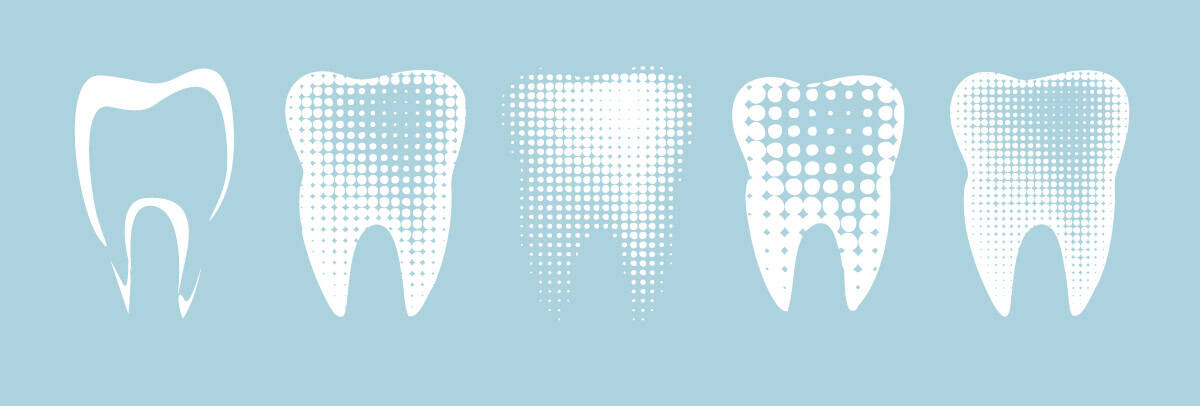
Illustration of three teeth with various textures
Dental work Fitting false teeth, bridges and crowns requires an empirical understanding of how ceramics, metals and other materials interact. (Courtesy: Shutterstock/Ihnatovich Maryia)

My dentist, Dr Albora, told me I needed a new tooth. He made me bite down on a U-shaped tray filled with polyether, an elastomeric material that’s been used in dentistry for decades. I tried not to gag while the gooey stuff set. Albora then waggled it off and sent the imprint to a company on Long Island that makes false teeth. But as my tooth’s colouring was unusual, Dr Albora said I had to go there myself.

A week later I drove to Marotta Dental Studio, where Igor Binshteyn sat me in a chair, lifted my lip and inspected a tooth to the side of my upper jaw. He was helping to fabricate its replacement and needed to get the exact colour.

As Binshteyn finished, I remarked teasingly on the company’s car park, which was chock full. Do you need that many people to make false teeth? What could possibly be involved to make things smaller than the nail on my little finger?

Binshteyn laughed. “Follow me”.

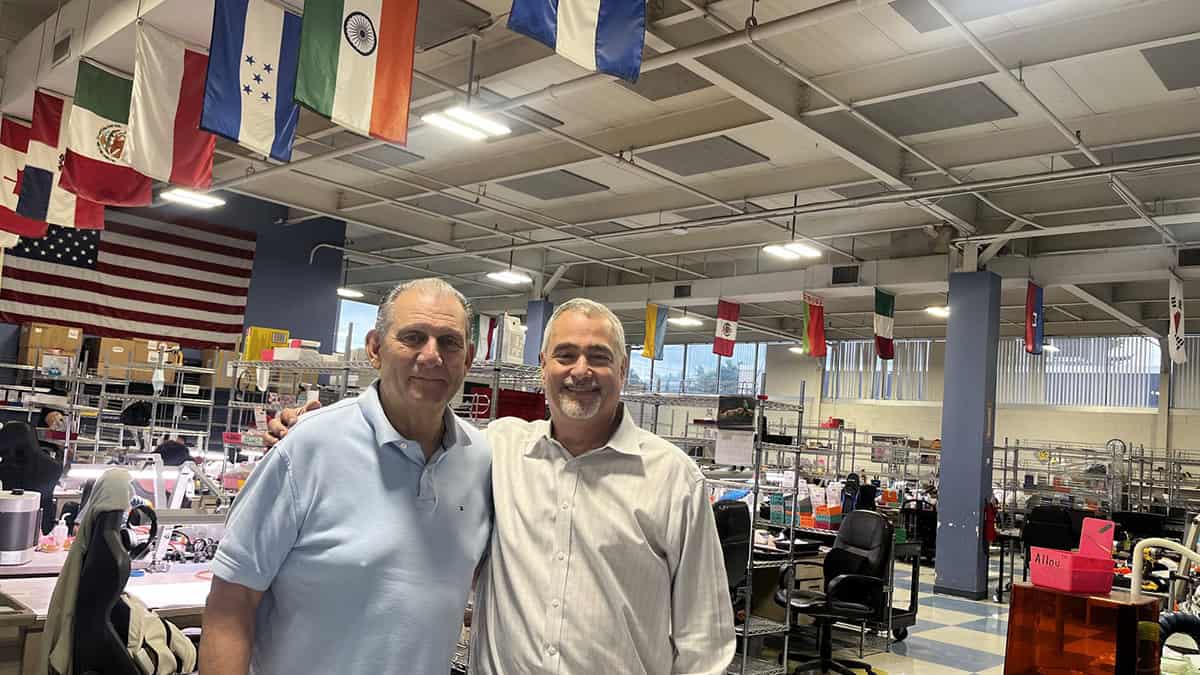
Dental workshop with Lenny Marotta and Steven Pigliacelli
Warm welcome Lenny Marotta (left), who founded Marotta Studio in 1981 and his brother-in-law and Marotta’s vice-president, Steven Pigliacelli in the lab. The flags are for the nationalities and national backgrounds of the 50 or so technicians working there. (Courtesy: Robert P Crease)

He opened a door to a huge undivided warehouse-like space about 1200 square metres in size. Some 50 people were working at lines of tables where the steady hum of conversation was punctuated by the noise of ovens, lathes and grinding machines; imagine the sounds of a metalworking shop in a busy train station.

“Do you want a tour?” Binshteyn said.

Of course I did.

Open wide

My tour guide was Marotta’s vice-president, Steven Pigliacelli, who teaches prosthodontics at New York University. A prosthodontist is a dental specialist who has completed dental school and, in the US, has had at least three additional years of advanced training to focus on restoring and replacing missing or damaged teeth. As I learned, prosthodontists must practice materials science.

The lab has two paths for making teeth, Pigliacelli explained, each with different materials and methods. The first is known as “porcelain-fused-to-metal”, or PFM. It begins with technicians applying gypsum – hydrated calcium sulphate – to create stone replicas of the jaw and teeth from the impressions given to them by dentists such as Albora.

Gypsum has different coefficients of expansion for different dental purposes, and textbook formulas give the amounts of liquid for each kind. But Marotta employees found that tiny amounts of water must be added or subtracted to the gypsum to compensate for things like humidity and temperature before the gypsum is used. “It took us months,” Pigliacelli explained, “to realize that how it’s shipped, how it’s stored, what season it is – all these affect the material.”

I watched as a technician sectioned a stone jaw replica to cut out a tooth, turn it into a master model called a die, and test it in an articulator that mimics jaw movements. I saw another wax that die, use a lost wax technique to create a solid gypsum frame, and cast a silver-palladium alloy. That creates the metal inner core for the tooth, called a coping, which is shaped and finished before porcelain is applied. Porcelain is baked onto the coping in another area of the lab.

“The metal and porcelain need closely matched coefficients of thermal expansion or the porcelain can separate from the metal,” Pagliacelli told me. “Every once in a while a company tells us ‘We’ve got this really cool new alloy!’, but we need to match the coefficients of expansion in the ceramic material. We’re working with sensitive materials for sensitive applications, and we have to experiment with and adapt them. This stuff about materials you don’t learn in school but work out in the lab.”

Smile for the camera

The second path to making a tooth involves scanning the teeth rather than waxing a die. The electronic files are worked on in the computer, printed out, reworked and rescanned, and milled by a CAD machine using materials such as zirconia – nicknamed “ceramic steel” – and EMAX, a lithium disilicate glass-ceramic. Zirconia is extremely hard and used for teeth that endure heavy grinding forces, while EMAX is more aesthetically pleasing and often used for front teeth.

“So we have two parallel paths, PFM and digital scans”, Pigliacelli said. “It’s usually a personal choice of the dentist”. But external pressures are driving a move away from PFM, he said. Five years ago the price of palladium – a key component of the PFM alloy – soared as it was increasingly used in devices to reduce auto and other emissions. “That’s cut down on the PSM market.”

Igor showing teeth staining
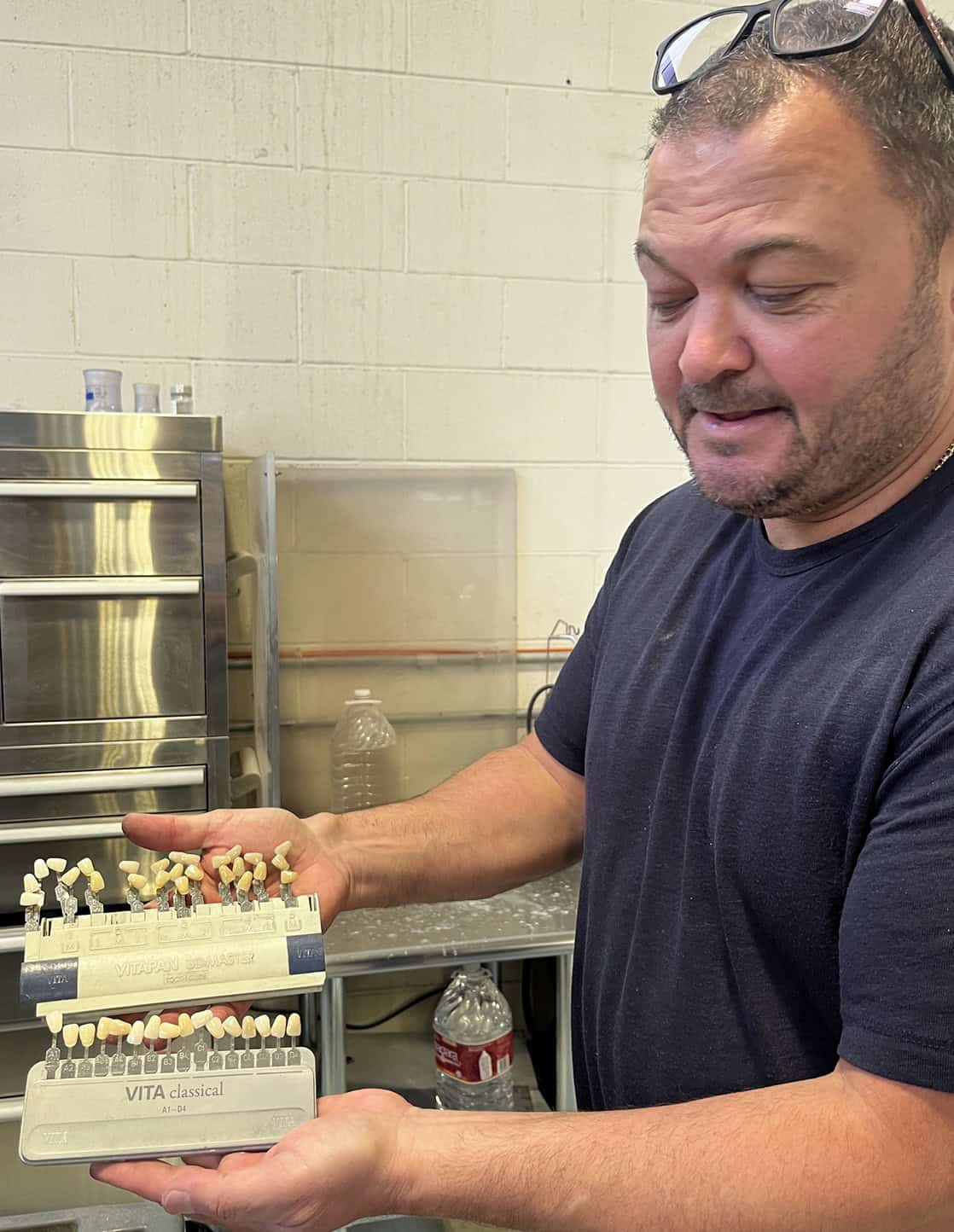
Say cheese Igor Binshteyn shows off his tooth colour guide. (Courtesy: Robert P Crease)

In another corner of the lab I ran into Binshteyn again, who was using different porcelains and ceramic stains to create colours. “Teeth are not a solid colour,” he said, “but vary in shade from reddish near the gum line to lighter colours toward the biting edge. They also vary in translucency.” (Check this out yourself.) Furthermore, the colour of a tooth must match not its neighbours but the corresponding tooth on the other side of the mouth. To make a natural-looking tooth, Igor picks out a base colour and then layers in shades of porcelain.

As my lab tour went on, Pigliacelli showed me different materials for different applications. One challenge is making teeth for a person with bulimia, whose acidic oral environment can corrode dental materials. Other challenges arise with people who have had failed implants, or temporomandibular joint – or TMJ – a disorder involving jaw joints and muscles.

On the way out I met Lenny Marotta, Pigliacelli’s brother-in-law, who had founded Marotta Studio in 1981. Marotta is fascinated by the history of dental materials, which include bone, ivory, wood, gold and silver. He showed me his collection of early prosthodontic instruments, including milling machines, furnaces, hammers and air compressors.

Later, Marotta also pointed out a strange-looking oven. “That’s for processing vulcanite, a hardened rubber material widely used for dentures before modern plastics.” But he’s been unable to find a museum interested in old prosthodontic stuff. “Nobody knows we exist,” he complained.

The critical point

I’d assumed that materials science was required to make prosthetic teeth biocompatible, corrosion resistant, and able to withstand mechanical motions such as crushing, biting and grinding. I also knew that teeth have to be made economically enough to be widely available, aesthetic enough to be desirable, and versatile enough to withstand a variety of oral environments.

But I had no idea how much materials science was required to bring all these properties together.

Back in his office, Dr Albora installed the tooth and handed me a mirror. I had to pull up my lip to see it way on the side of my mouth. “I’d have to smile before somebody notices it,” I complained. “Well,” he said, “that’s for just in case you do.”

The post Get your teeth into the cutting edge of materials science appeared first on Physics World.

In 2025, researchers ground retired wind turbine blades into powder, stirred it into a gel and set it into an insulation composite. The composite combined low density with much greater compressibility than many of the insulating aerogels and composites it was compared with, squashing to a fifth of its thickness without breaking apart.

16 September 2026 at 11:00
Wind turbines under a clear blue sky symbolize clean energy and sustainability.

A wind turbine blade is basically glass fibre set in hardened resin. The fibres give it strength, the resin holds them in place, and the two are bonded so tightly that a blade can survive wind, rain and stress.

That same toughness is the problem once the blade comes down. Thermoset epoxy does not melt back into a workable liquid, and its stable chemical bonds are difficult to break. So retired blades are typically cut into sections and sent to landfill.

That is the waste a group of researchers decided to work with. In a 2026 study published in ACS Applied Engineering Materials, a team at Xi’an Shiyou University, with collaborators at the Beijing Institute of Technology and Monash University, ground old blade material into powder and turned it into a lightweight, sponge-like insulation.

Here is what came out of the lab, and how it stacks up against the size of the problem.

It squashes to a fifth of its thickness and springs back

The most surprising thing about the material is how far you can crush it without wrecking it. The team reports it took a squeeze of over 80 percent and recovered, meaning you can press it down to roughly a fifth of its height and it bounces back. That matters because conventional silica aerogels are famously fragile. They insulate well but can be brittle. A material that can take a squeeze and spring back is far easier to handle and install.

The trick is in the structure. Instead of a solid block, the composite is a network full of tiny connected pores, with the blade powder stiffening a soft, springy scaffold. 

It combined low density with unusually high compressibility

Weight is where the main result sits. The material reached a density of 0.184 grams per cubic centimetre while sustaining more than 80 percent compressive strain. The authors say the composite showed “a superior combination of low bulk density (0.184 g cm–3) and high compressive strain (>80%), outperforming a wide range of reported silica-based or organic aerogels and composites.”

A caution is warranted: that line is the researchers describing their own work, not an outside verdict. “Outperforming” is their framing, and the comparison is against numbers from other published papers rather than a head-to-head test by a neutral lab. The figures themselves are measurable; whether the material performs as well in practice is the kind of thing other labs and larger-scale testing would need to settle.

It holds heat in about as well as ordinary insulation

Being light and squishy would not count for much if heat poured straight through it. It doesn’t. The composite measured a thermal conductivity of 0.068 watts per metre-kelvin, and lower is better here because it means less heat gets across. For comparison, ordinary glass wool building insulation sits around 0.04. So the blade composite is not a record-setting insulator, but it is in a sensible range for the job while remaining highly compressible.

It self-extinguishes instead of feeding a flame

Insulation lives inside walls and roofs, so how it behaves near fire matters. The team reports enhanced flame self-extinguishing capability, meaning it tended to stop burning once the flame source was removed rather than carrying the fire along. Again, this is one lab result on lab samples, though, and real fire-safety ratings require standardised testing. Read it as promising, not certified.

It turns a landfill problem into the raw material

The reason any of this is interesting is the sheer number of blades headed for the ground. Worldwide, the mass of blades expected to be discarded by 2050 may reach about 43 million tonnes. Right now, around 12,000 blades are retired across Europe and the US each year, and they are typically cut up and sent to landfill. A process that takes that same material and makes something useful flips the equation.

As the authors put it, reusing the blade waste “not only helps to reduce environmental burdens and resource waste but also opens up avenues for generating high-performing, useful materials.”

Where this actually sits

This is one study and one set of lab measurements. The chemistry is clever and the numbers look good, but the gap between a lab composite and a pallet of insulation shipped to a building site is wide. The paper doesn’t answer the questions that fill that gap: cost, batch-to-batch consistency, how the material holds up over years inside a wall, and whether grinding and processing old blades at scale actually makes economic sense.

That last question is the real hinge. Something has to make the recycled route cheaper or required before a lab result becomes a real supply chain.

None of that takes away from what the team built. This is a good answer to a narrow question, which is whether hard-to-recycle blade waste can be turned into a useful, light, tough insulating material at all. The evidence here says yes. The bigger question, whether it can be done by the tonne cheaply enough to matter, is still open.

The post In 2025, researchers ground retired wind turbine blades into powder, stirred it into a gel and set it into an insulation composite. The composite combined low density with much greater compressibility than many of the insulating aerogels and composites it was compared with, squashing to a fifth of its thickness without breaking apart. appeared first on Space Daily.

Above-average correlative materials characterization

16 September 2026 at 04:21
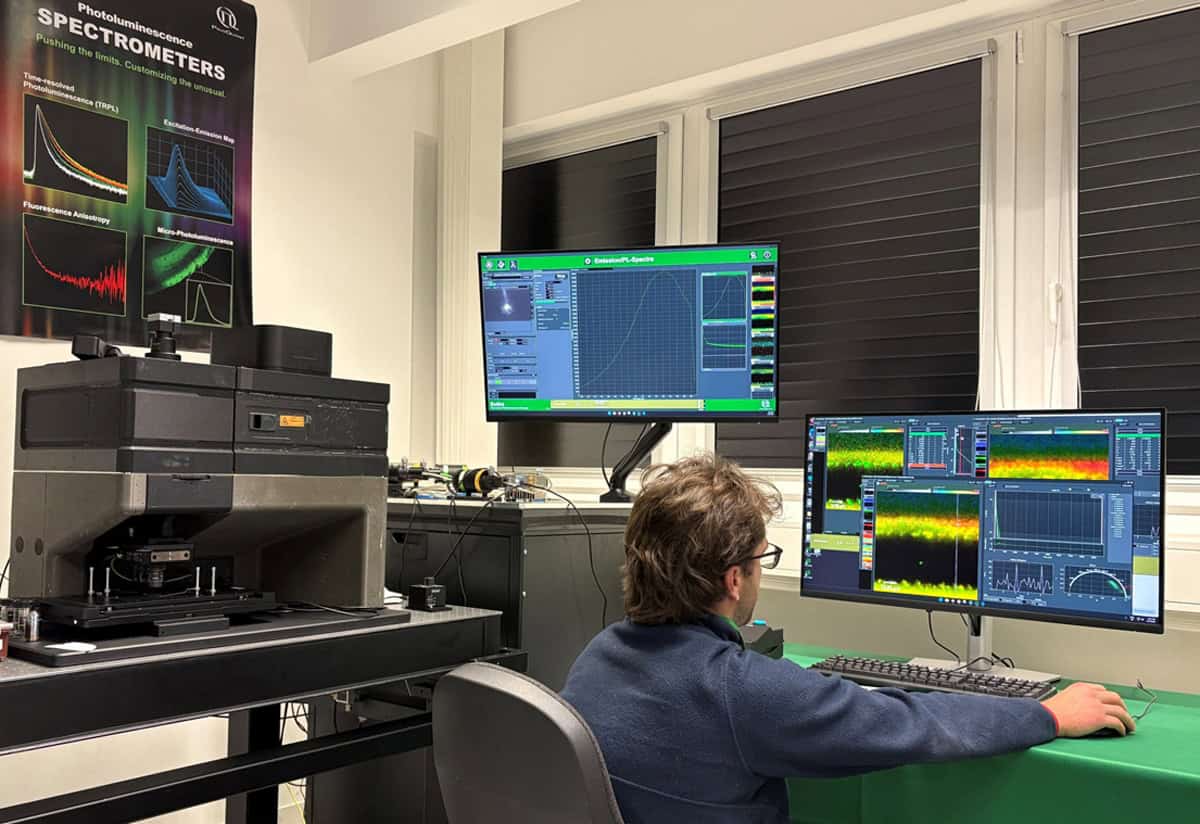
Maxim Simmonds measuring perovskite solar mini module samples with Solira. (Courtesy: PicoQuant)

When evaluating new materials for optoelectronic applications – perhaps promising solar panel materials like halide perovskites or semiconductor compounds for microLED displays – optical characterization is almost always the materials scientists’ first port of call. And up to now steady-state photoluminescence (PL) has been the de facto workhorse for this task.

This non-destructive and highly sensitive technique involves optically exciting a sample and recording the integrated intensity and wavelength of re-emitted photons. Through this, researchers gain a quick understanding into a material’s electronic structure, optical transitions and emission characteristics.

However, these spectra alone can be misleading. Materials with substantially different microscopic properties can generate similar steady-state PL results, masking the fundamental physical dynamics that govern the material’s performance in the real world. To gain deeper understanding of a given material, a more comprehensive and correlated approach is needed.

Blinding average

The core issue lies in the fact that steady-state PL provides a time-integrated view of the emission and depending on the measurement geometry, may also average over spatial variations. Steady-state PL records a static equilibrium in which charge carrier generation balances recombination. This means that, on its own, it does not directly reveal how these excited charge-carriers evolve and ultimately dictate how a device manipulates energy and light.

For example, although two semiconductor thin films may show identical steady-state emission, they can perform very differently in a real device. One film might have long carrier lifetimes consistent with low non-radiative losses – useful in solar cells, for example – while the other could suffer from high defect densities that are masked by strong light absorption or intense excitation light.

Conversely, weak emission does not necessarily mean poor material quality. Again using a layered solar cell as an example, dim luminescence often signals fast, beneficial charge extraction across an interface rather than harmful defect recombination (where structural imperfections convert charge-carrier energy into wasted heat). Because steady-state measurements only show an overall average, they cannot separate these competing mechanisms.

Resolving in time, space and spectrum

Time-resolved PL (TRPL) is a key technique in illuminating these hidden dynamics. Unlike steady-state PL, which continuously bathes a sample with light, TRPL uses a short laser pulse and measures how the photoluminescence intensity evolves afterwards. This can reveal carrier dynamics over timescales ranging from picoseconds to microseconds.

TRPL is particularly important in materials where local variations strongly influence device behaviour. For instance, it can expose the difference between regions that exhibit long-lived emission consistent with efficient radiative recombination, and those that exhibit fast decay caused by, for example, defect recombination.

Of course, steady-state PL averages over time and space, and therefore TRPL only solves part of the problem. Spatially resolved TRPL addresses the missing spatial dimension. Combining a high-precision, motorized XY stage with TRPL’s precise timing, spatially resolved TRPL forms a 2D map that directly correlates localized structural features – such as grain boundaries and defects – with variations in carrier kinetics across the surface.

Complementary to these techniques is time-resolved emission spectroscopy (TRES), which combines spectral selection with time-resolved detection to measure how emission dynamics vary across the spectrum. By recording wavelength-dependent decay behaviour, TRES reveals how different spectral contributions evolve following excitation.

In short, where TRPL reveals kinetics over time and spatially resolved TRPL locates variations in space, TRES adds a spectral dimension, showing how the emission spectrum evolves after excitation. This allows researchers to track changes in the distribution of photon energies over time to understand carrier evolution and gain insight into the mechanisms underlying material behaviour.

A correlative approach

Though powerful in isolation, reconciling insights across these different instruments is slow and prone to errors. There can be microscopic differences between samples or even within positions in a single sample that dramatically alter emission spectra. Moreover, moving a sample between separate instruments is fraught with difficulty, potentially damaging the sample or causing delays that lead to sample degradation.

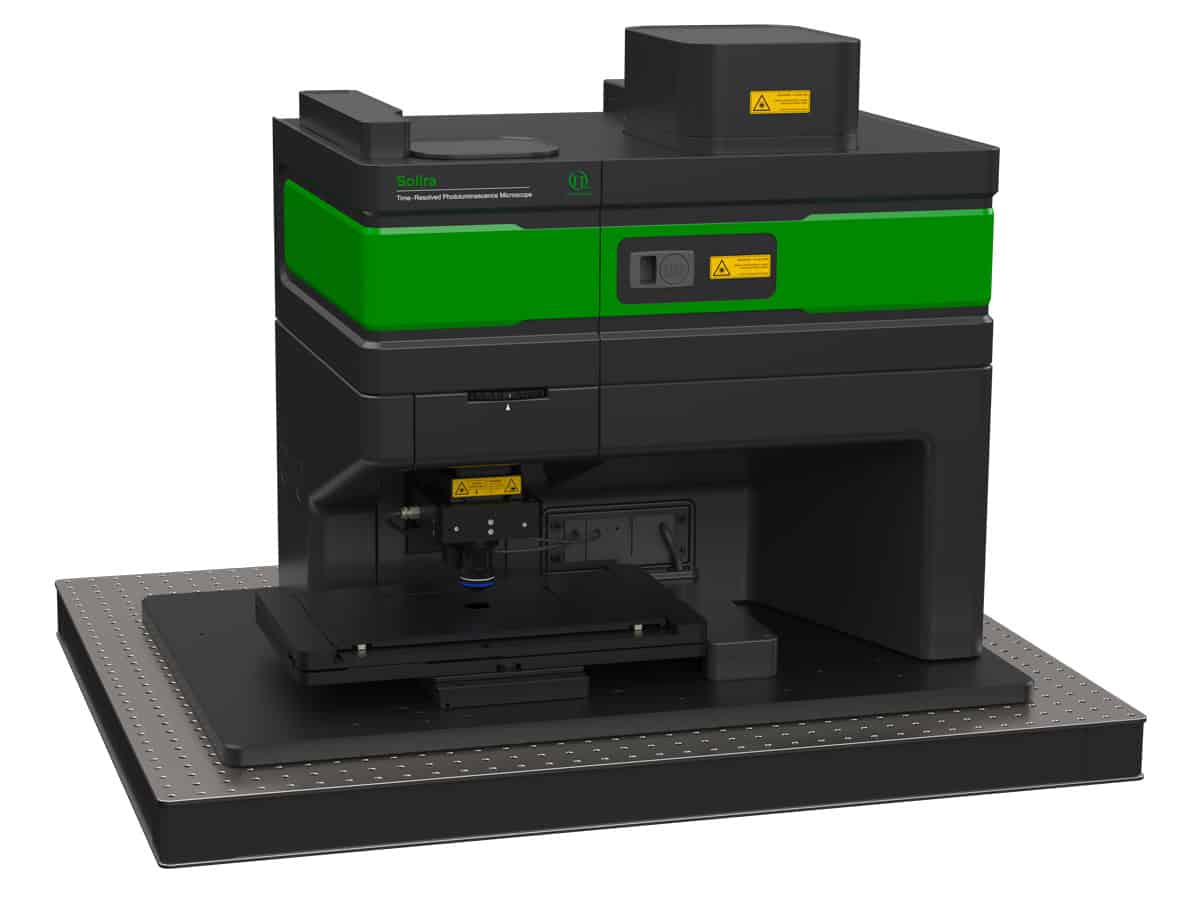
PicoQuant’s Solira, an all-in-one time-resolved photoluminescence microscope for flexible optical characterization of materials and optoelectronic devices. (Courtesy: PicoQuant)

More comprehensive and reliable physical insight comes when temporal, spatial and spectral factors are recorded correlatively on the exact same sample region. This need for correlation is the motivation behind PicoQuant’s Solira, an integrated workflow platform for steady-state PL, TRPL, spatially resolved TRPL and TRES (the latter when combined with the complementary FlexLambda Kit), as well as additional imaging techniques, such as hyperspectral imaging, required for different scientific questions.

Bringing these techniques together within one configurable microscope system means a materials scientist can gain a more informed interpretation of material behaviour. For instance, they can identify the relevant emission bands at selected points of interest with steady-state PL. They can then wield TRPL to measure the associated decay kinetics, before perhaps applying TRES to resolve how those kinetics vary across the emission spectrum.

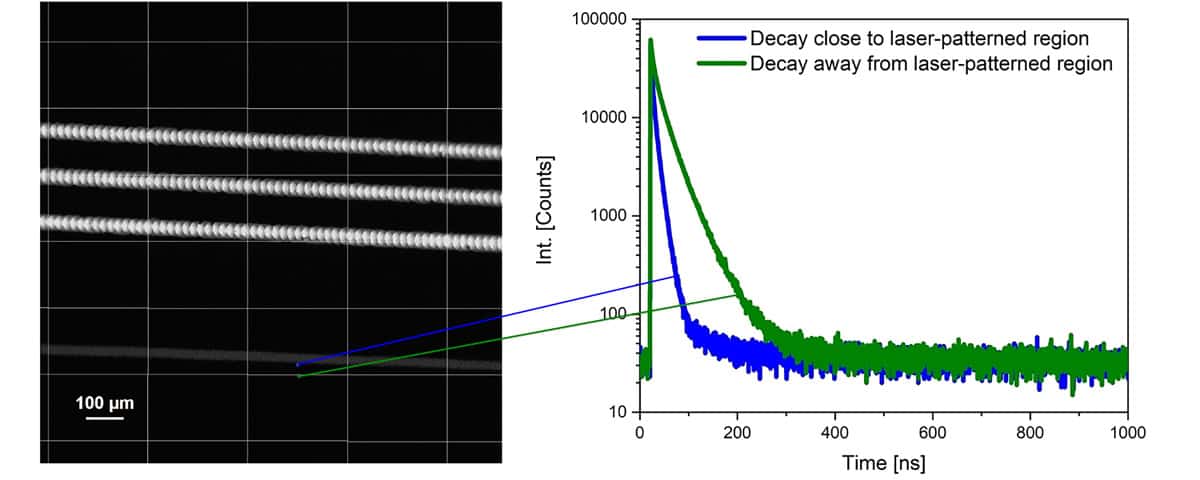
TRPL decay curves recorded at positions close to and away from a laser-patterned region of a perovskite solar mini module sample. The decay measured adjacent to the structured line exhibits faster PL decay dynamics compared to the unmodified region farther from the laser-patterned area. (Courtesy: PicoQuant)

Bright demonstration

The power of this correlated approach was demonstrated recently by Professor Eva Unger’s group at Helmholtz-Zentrum Berlin, Germany, with measurements carried out by Maxim Simmonds. Investigating perovskite solar mini-modules, the team worked with PicoQuant and used Solira to locate precise laser-patterned lines – microscopic scribes used to interconnect individual cells in a solar module – before verifying emission from the active layer. Localized TRPL measurements then revealed significantly faster decay dynamics next to these laser cuts compared to the pristine bulk material, indicating altered carrier recombination or diffusion near structured features.

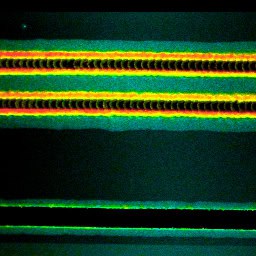
Spatially resolved TRPL image recorded from a sample of a perovskite solar mini module, showing photoluminescence lifetime differences between laser-patterned lines and bulk material. The structured regions remain photoluminescent, indicating that the laser process modifies local photophysical properties rather than completely removing the emissive material. (Courtesy: PicoQuant)

However, point measurements alone were not enough to discern whether the laser had fully removed the perovskite or merely modified it. Switching to spatially resolved TRPL imaging on Solira revealed that measurable photoluminescence persisted along the laser-patterned lines. This showed that laser structuring had altered local photophysical properties rather than eliminating the active layer – a conclusion only made possible by consistently mapping charge-carrier dynamics across temporal, spatial and spectral dimensions together on one setup.

As semiconductor materials and optoelectronic devices become more complex, optical characterization tools must keep pace. By unifying these tools within an integrated workflow platform such as Solira, materials scientists now have the means to paint a more complete picture of material characteristics and thereby unlock the next generation of innovative functional materials.


The post Above-average correlative materials characterization appeared first on Physics World.
Researchers Turned “Empty Space” Into a Tool for Superconductivity

16 September 2026 at 00:31
Schematic of Vacuum Fluctuation Enhanced SuperconductivityResearchers used a specially designed cavity to strengthen quantum vacuum fluctuations and enhance superconductivity in a thin material. Empty space is not truly empty. Even a vacuum contains restless quantum fluctuations, and researchers have now shown for the first time that these normally subtle effects can be engineered to strengthen superconductivity. The work, led by [...]

A Material Just a Few Atoms Thick Reveals Strange New Magnetism

15 September 2026 at 01:23
Ultrathin Material Quantum MagnetismA material once thought to be nonmagnetic may reveal a hidden magnetic side when made just a few atomic layers thick. A newly proposed class of magnetism known as altermagnetism could open new possibilities for making computer memory smaller and more efficient. Now, researchers have found evidence that ruthenium dioxide, a quantum material long debated [...]

Harnessing sunlight to fight bacteria

14 September 2026 at 12:00

Billions of people still suffer from hunger and food insecurity worldwide. Meanwhile, microbial contamination causes a third of global food waste annually, resulting in major economic losses and illnesses. Although antibiotics and pesticides help control contamination, their excessive use can promote bacterial resistance or leave toxic residues. 

One alternative uses materials that generate highly reactive forms of oxygen when exposed to light, called photocatalysts, to prolong food freshness. These molecules kill bacteria by damaging their cell components in a process called photodynamic inactivation or PDI. However, current PDI systems rely on energy-intensive lasers and long exposure times because the bacteria’s protective cell membranes block reactive oxygen molecules. As a result, the systems don’t kill bacteria effectively and risk overheating food, affecting its freshness and nutritional value.

Scientists at Zhejiang University in China thought that it would be possible to achieve a PDI system using accessible, free sunlight with the right photocatalyst. Moreover, they also wanted to integrate this photocatalyst into food packaging to combat microbes during storage. 

To make the photocatalyst, the researchers mixed water with a glue-like plant fiber that provides structural support, called pectin, and a chemical from plant seeds that supplies phosphorus, called phytic acid. Then they heated the mixture in a sealed reactor at 220ºC (428ºF) for 5 hours to form tiny structures composed of a carbon core surrounded by a phosphorus-rich shell called phosphorus-modified carbonized polymer dots or PCDs.

To incorporate the PCDs into film packaging, the researchers dissolved equal amounts of a plant fiber from konjac, called glucomannan, and another plant-derived molecule, called carboxymethylcellulose, in warm water to form a network of entangled molecular chains. Then, they added 1.5 milligrams of PCD per milliliter to this mixture, which linked the chains together like molecular fasteners. Finally, they added a moisture-binding chemical called glycerin to prevent brittleness. The researchers cast this mixture onto separate Petri dishes and dried them, forming thin, plastic-like PCD films.

To test the films, the researchers placed Escherichia coli bacteria between 2 sterilized film sheets and exposed the samples to either darkness or simulated sunlight for 20 minutes. They then transferred the microbes onto agar plates and incubated them for 15 hours, allowing surviving bacteria to form visible colonies. They compared the number of bacterial colonies with those of untreated samples to calculate the percentage of bacteria the films eliminated in each environment. 

Tests under darkness showed that the films eliminated about 60% of the bacteria. The researchers attributed this result to the positive electrical charge of PCDs, which attracts the bacteria’s negatively charged cell surfaces. The electrical attraction stresses their cell membranes, interfering with essential life processes. This result suggested that the films use a separate charge-based antibacterial mechanism apart from PDI, which requires light to work.

Under simulated sunlight, the films eliminated nearly 100% of the bacteria. The researchers identified 2 principal mechanisms causing this. First, the PCDs acted as tiny heaters that generated localized heat, which stretched holes in the bacterial membranes, allowing contents to leak out of their cells through a process called photoporation. Second, the PCDs generated reactive oxygen molecules that could then penetrate the bacteria. Once inside the cells, these molecules irreversibly damage the bacteria’s internal components and genetic material through PDI. 

The researchers also investigated whether PCD films could serve as food packaging by using them to wrap fresh strawberries. Compared with conventional nonbiodegradable polyethylene packaging where visible rotting occurred, the PCD films kept the strawberries fresh for more than 4 days by suppressing bacterial growth and regulating moisture levels. When the team tested whether the films were toxic, they found that the films are safe for humans and compatible for food applications. They also buried the films in soil for 24 days and found that they degraded by 78%, demonstrating biodegradability suitable for packaging fresh foods.

The team concluded that PCD films could be a biodegradable food packaging that combines plant-based materials with multiple antibacterial strategies. The films retained antibacterial activity in darkness and became more effective under sunlight through the combined effects of photoporation and PDI. These findings demonstrated that by combining multiple mechanisms into a single material, researchers can create multifunctional food packaging that remains effective across different storage conditions.

The post Harnessing sunlight to fight bacteria appeared first on Sciworthy.

Hybrid graphene–MXene–WS₂ terahertz metasurface detects chikungunya virus via machine learning

11 September 2026 at 11:38

Scientists have unveiled a computational design for a terahertz metasurface biosensor that combines five distinct materials—graphene, MXene, tungsten disulfide, gold, and copper—into a single multilayer architecture capable of detecting refractive-index changes associated with chikungunya virus infection. The study, published in Results in Optics by G. Arunachalam, A.R. Kalaiarasi, Giri.G. Hallur, and V. Parthasarathy, reports a numerically predicted sensitivity of 907 GHz per refractive-index unit, among the highest values reported for hybrid-material terahertz biosensors, and couples the electromagnetic design to an XGBoost machine-learning surrogate model that predicts sensor behavior with accuracies exceeding 99.8 percent.

Chikungunya virus is an enveloped, positive-sense single-stranded RNA alphavirus transmitted primarily by Aedes aegypti and Aedes albopictus mosquitoes. While mortality remains low, generally below 0.1 percent, the broader public health burden arises from severe polyarthralgia that can persist for months or even years in a substantial fraction of patients across tropical and subtropical regions. With no approved antiviral therapy or licensed vaccine currently available, diagnostic accuracy sits at the center of clinical management and transmission control. Yet existing diagnostic tools face significant practical constraints, particularly in point-of-care and field settings.

Serological methods such as enzyme-linked immunosorbent assay suffer from cross-reactivity with related alphaviruses, including Ross River and O’nyong-nyong viruses, reducing diagnostic specificity. Real-time reverse transcription polymerase chain reaction offers high sensitivity during the acute phase but depends on laboratory infrastructure, trained personnel, and controlled sample handling. Virus isolation in cell culture provides confirmatory results but requires biosafety level-3 facilities and extended processing time. These limitations have motivated the search for rapid, label-free sensing approaches capable of operating at clinically relevant concentrations in decentralized environments.

The new work turns to the terahertz band, spanning roughly 0.1 to 10 THz, which lies between microwave and infrared regions of the electromagnetic spectrum. Terahertz radiation is non-ionising, with photon energies in the millielectronvolt range, allowing interaction with biological samples without causing ionising damage. Crucially, terahertz waves couple to low-frequency vibrational and rotational modes of biomolecules such as proteins, nucleic acids, and polysaccharides, producing measurable spectral features that support label-free detection. Because biological media including blood plasma and viral suspensions exhibit refractive-index variations in this domain, differences on the order of 0.01 to 0.02 refractive-index units can shift resonance frequency and field distribution when coupled to resonant sensing structures.

The proposed sensor is built around a periodically repeated square unit cell containing two identical square resonators, 2000 nanometers on a side, coated with tungsten disulfide—a two-dimensional transition metal dichalcogenide with strong light–matter interaction, high carrier mobility, and excellent dielectric confinement. This layer localizes the electric field in the sensing region and increases the interaction volume between the resonant field and the surrounding analyte. A pair of concentric circular rings, 3200 and 3800 nanometers in diameter and functionalized with MXene, surrounds the resonators, enhancing electromagnetic coupling, promoting efficient charge transport, and strengthening plasmonic interactions between resonator elements. An outer gold ring, 6000 nanometers in diameter, serves as the main plasmonic resonator supporting strong localized surface plasmon resonances with low optical loss. The entire multi-resonant assembly is embedded within a monolayer graphene sheet measuring 14,000 by 14,000 nanometers, which acts as a broadband absorber and a high-mobility charge transport medium whose electrically tunable chemical potential allows dynamic, active control of the resonance characteristics. Copper elements woven into the architecture provide supplementary conductive pathways that reinforce current distribution and coupling among the hybrid resonators. The structure rests on a silicon dioxide substrate, chosen for its low dielectric loss and mechanical robustness, which preserves the resonance quality factor.

The authors stress that the multilayer design is compatible with established microfabrication techniques. Fabrication would begin with a cleaned silicon dioxide substrate, followed by polymer-assisted transfer of monolayer graphene and thermal annealing. Gold and copper resonators can be deposited through electron-beam evaporation or magnetron sputtering with lift-off patterning, MXene rings through solution-based deposition, and the tungsten disulfide layer through chemical vapor deposition or thin-film transfer. With a unit-cell dimension of approximately 14 micrometers, the required feature sizes fall comfortably within conventional photolithography capabilities, and because fabrication imperfections remain far smaller than the operating terahertz wavelength, moderate tolerances are expected to have only limited influence on the electromagnetic response. For biosensing, the graphene surface could subsequently be functionalized with chikungunya-specific antibodies or aptamers using EDC/NHS or pyrene-based linker chemistries.

The electromagnetic modeling, performed in COMSOL Multiphysics, reveals a pronounced resonance at 0.355 THz, where electric-field simulations show the strongest and most spatially extensive enhancement. Varying the graphene chemical potential from 0.1 to 0.9 electronvolts produced dramatic modulation of the transmission contrast, which increased roughly 36-fold at the highest bias, from less than one percentage point to more than 27 percentage points, while peak transmission remained essentially unchanged above 98.6 percent. This asymmetric response—stable maxima paired with strongly modulated minima—arises because increasing chemical potential enhances graphene’s intraband conductivity, deepening resonant absorption through stronger light–matter interaction. The sensor also demonstrated remarkable angular robustness, maintaining peak transmittance above 97.8 percent across incident angles from 0 to 80 degrees, an important tolerance for realistic deployment where normal incidence cannot always be guaranteed.

Geometric optimization identified an outer circular resonator radius of 2500 nanometers and a square resonator side length of 2500 nanometers as the dimensions that maximize resonance strength, driving minimum transmittance down to approximately 65 to 67 percent and signifying optimal electromagnetic confinement within the active sensing region. When evaluated across refractive indices from 1.33 to 1.39, a range encompassing reported values for healthy plasma (approximately 1.35 RIU), healthy platelets (1.39 RIU), chikungunya-infected plasma (1.33 RIU), and infected platelets (1.38 RIU), the optimized configuration achieved a maximum sensitivity of 907 GHz/RIU, a figure of merit of 18.519 RIU⁻¹, a minimum detection limit of 0.061 RIU, a sensor resolution of 55.178, and a refractive-index resolution of 0.001 RIU. In comparative benchmarks against recently reported graphene- and hybrid-material-based terahertz biosensors—including graphene/copper/aluminum, graphene/silicon dioxide, MXene–graphene–black phosphorus, and graphene-integrated copper–silver designs—the proposed architecture’s sensitivity exceeded most published values, reflecting the synergistic field confinement produced by the five-material stack.

The machine-learning component addresses one of the central bottlenecks in metasurface development: the computational cost of repeated full-wave finite-element simulations during structural optimization. The team trained an XGBoost regressor, an ensemble method based on gradient-boosted decision trees, on simulation data covering incidence-angle variation and circular-ring dimension variation, using stratified sampling with 80 percent of data for training and 20 percent held out for independent testing, alongside five-fold cross-validation and grid-search hyperparameter optimization. The model captured more than 99.7 percent of response variance on unseen data, with mean absolute percentage errors below 0.162 percent and prediction accuracies from 99.838 to 99.959 percent. Acting as a computational surrogate, the trained model enables rapid interpolation across the design space without sacrificing the fidelity of the underlying electromagnetic model.

The authors are careful to frame the work as a computational proof-of-concept rather than an experimentally validated diagnostic. The sensor detects changes in the local dielectric environment surrounding the resonators, not viral particles or nucleic acids directly, and refractive-index sensing alone cannot intrinsically distinguish chikungunya from other viruses with similar dielectric properties. Analytical specificity in practice will depend on surface biofunctionalization with chikungunya-specific recognition molecules immobilized on the graphene or gold sensing surface. Future work will focus on device fabrication, biofunctionalization, calibration with reference refractive-index standards, experimental validation with clinically relevant plasma and platelet samples, and systematic evaluation of selectivity against related arboviruses—steps that would transform this numerically validated platform into a practical tool for rapid, label-free infectious disease diagnostics in the field.

Subject of Research: Label-free terahertz metasurface biosensing for chikungunya virus detection using a hybrid graphene–MXene–WS₂–Au–Cu architecture with machine-learning-assisted optimization

Article Title: Hybrid graphene–MXene–WS₂ terahertz metasurface detects chikungunya virus via machine learning

Article References: Arunachalam, G., Kalaiarasi, A., Hallur, G., & Parthasarathy, V. (2026). Machine learning-assisted hybrid graphene–MXene–WS₂ terahertz metasurface biosensor for highly sensitive label-free chikungunya virus detection. Results in Optics, 25, Article 101149. https://doi.org/10.1016/j.rio.2026.101149

Image Credits: AI Generated

DOI: 10.1016/j.rio.2026.101149

Keywords: chikungunya virus detection, computational biosensor design, high sensitivity biosensors, hybrid graphene MXene WS₂, machine learning in biosensing, multilayer architecture, nanomaterial-based sensors, public health diagnostics, refractive index sensing, terahertz metasurface biosensor, virus diagnosis in field settings, XGBoost surrogate model

Researchers picked oyster, mussel and cockle shells off Irish beaches, crushed the 3 kinds of shell into grains, and dropped them into water carrying rare earth metals at concentrations similar to badly polluted industrial runoff. The oyster grains took up as much as roughly 1.5 grams of metal for every gram of shell.

11 September 2026 at 10:00
Collection of empty oyster shells in natural setting, showcasing coastal beauty.

A single gram of crushed oyster shell pulled in up to around 1.5 grams of rare earth metal, more than the shell’s own weight, out of water spiked with the kind of contamination you would expect from severe industrial pollution. A throwaway material, the sort of thing you might crunch underfoot on a beach, holding more than its mass in metals that the electronics and clean-energy industries fight over.

That’s the finding a Trinity College Dublin team reported in early 2026. Below, we walk through what they actually did, why oysters won and mussels and cockles fell short, and how much of this holds up once you leave the lab bench.

What the researchers actually did

The setup was low-tech at the front end. As reported in The University Times, the team collected oyster, mussel and cockle shells from beaches around Dublin, cleaned them, dried them, and crushed them into small grains. Then they dropped those grains into solutions carrying three rare earth elements and watched what happened over time. The three metals were lanthanum, neodymium and dysprosium, at concentrations chosen to mimic badly polluted water.

The chemistry underneath is where it gets interesting. Shells are mostly calcium carbonate, and in the rare-earth-rich water that calcium carbonate dissolves and is replaced, more or less on the spot, by new solid minerals built around the rare earth metals. In the peer-reviewed paper, published in Science of the Total Environment, the crushed shells were reacted with the metal-rich solutions across a wide range of temperatures, 25 to 205 degrees Celsius for up to three months. What you end up with is not the original shell soaking up metal like a sponge, but the shell being rebuilt, mineral by mineral, into something new.

As principal investigator Juan Diego Rodriguez-Blanco put it, “the process is entirely mineral-driven – the shells naturally transform dissolved rare earth elements into new solid minerals, so this isn’t a process that is difficult to drive, or one that requires much financial outlay or technical equipment.” That last part is a lab-based expectation rather than a proven cost sheet, but the appeal is easy to see: no exotic reagents, no elaborate rig, just waste shell and time.

Why oysters won and the others didn’t

All three shells are made of the same basic stuff, so why did oysters run away with it? The answer is structure. Oyster shell has a porous, layered microstructure, and that lets the dissolve-and-replace reaction work its way right through the grain rather than stalling at the surface. That’s how oyster grains reached uptake of up to roughly 1.5 grams per gram.

Mussels and cockles behaved differently, and the reason is more physical than chemical. A crust of new mineral formed quickly on the outside and then sealed the grain off, so the reaction couldn’t reach the inside. In those shells, the study reports that more than half of the original shell was left unchanged once that crust became impermeable. Same starting material, very different outcome, decided by how the shell is put together.

Why pull rare earths out of water at all

Rare earth elements are the unglamorous ingredients in a lot of modern hardware, from the magnets in wind turbines and electric motors to phone components. Mining them is expensive and messy, and industrial processing can leave behind runoff carrying dissolved metals. Two problems are tangled together here: recovering a valuable resource, and cleaning up water that carries it.

The shell angle is attractive partly because the raw material is a nuisance to begin with. As first author Rémi Rateau described it, “every year, the global aquaculture industry generates millions of tonnes of shell waste, much of which is discarded or sent to landfill.”  Rateau also noted that “relatively small amounts of shell waste could remove substantial quantities of rare earth metals from contaminated water.” 

What this is, and what it isn’t

This is one study, and it is a lab result. The concentrations were high by design, the conditions were controlled, and real industrial wastewater is a far messier soup of competing ions, organics and pH swings than a prepared solution in a flask. The team is upfront that the work still needs pilot-scale testing under genuine conditions before anyone talks about a deployable cleanup system. A promising lead is not a finished product, and this sits firmly in the former category.

Our read lands roughly where the team’s does. The measured uptake is striking, the input material is cheap and otherwise wasted, and the driving chemistry looks simple. Rodriguez-Blanco frames the ambition plainly: “we can start designing” low-cost strategies to remove critical metals from contaminated waters while giving new value to a major waste product. Start designing is the honest verb. On the strength of these numbers, it’s a lead worth taking out of the beaker and testing against the real, dirty water it was built to handle.

The post Researchers picked oyster, mussel and cockle shells off Irish beaches, crushed the 3 kinds of shell into grains, and dropped them into water carrying rare earth metals at concentrations similar to badly polluted industrial runoff. The oyster grains took up as much as roughly 1.5 grams of metal for every gram of shell. appeared first on Space Daily.

Non-reciprocal interactions keep particles in collective motion

11 September 2026 at 10:00
Illustration of non-reciprocal interactions
Breaking action–reaction symmetry Non-reciprocal interactions occur when one particle influences another more strongly than it is influenced in return. This figure shows how unequal electrohydrodynamic attraction between differently sized particles generates non-reciprocal interactions and self-propelled particle pairs. (Courtesy: Yutaka Sumino, Tokyo University of Science, Japan)

Attractive interactions between particles do not necessarily lead to these particles aggregating. This is the new finding from researchers at the Tokyo University of Science in Japan who say this behaviour comes from non-reciprocal interactions amongst particles of different sizes that exert unequal forces on each other. These interactions could serve as a general design principle for creating active matter with a structure that continuously reorganizes rather than simply relaxing towards a static state.

Nature abounds with examples of active matter, with some well-known examples being flocks of birds, fish and insects, sheets of biological cells and swarms of bacteria. Researchers have been trying to copy this collective behaviour and make synthetic active materials – such as self-propelled colloids and dense phases of mechanically driven biopolymers – in the laboratory. Before such applications see the light of day, however, they need to first understand the fundamental physics of these systems.

In their new study, a team led by Yutaka Sumino and Kiwamu Yoshii of Tokyo University of Science’s department of applied physics, came across a system in which colloidal particles interact through electrohydrodynamic flow. “We found that mixing particles of two different sizes in such a system completely changed the collective behaviour of these particles,” explains Sumino. “Instead of forming increasingly large crystal-like aggregates, as is the case for particles with the same size, the system remained highly dynamic.”

The physicists’ experiment involved suspending polystyrene colloidal particles with radii of 1 and 1.5 µm in water and confining them between transparent indium tin oxide-coated electrodes. This set up allowed them track more than 10,000 particles and quantitatively analyse their dynamics for more than an hour, as opposed to just a few minutes in previous such studies.

Newton’s third law holds

When the researchers applied an alternating electric field to the system, they observed electrohydrodynamic flows around the particles, the strength of which increased strongly as the size of the particles became bigger. The electrohydrodynamic-mediated attractive interactions therefore became asymmetric, they explain, something that causes larger particles to attract smaller ones more strongly. This imbalance leads to non-reciprocal interactions, meaning that a larger particle pushes a smaller one, but a smaller one doesn’t push back.

While the effective interaction between the particles appears to break Newton’s third law, it doesn’t because there is no violation of momentum conservation, explains Sumino: momentum is transferred to the surrounding fluid through the induced flows and is ultimately dissipated through friction with the substrate.

The researchers also observed that particles of different sizes spontaneously pair together to form asymmetric structures with a distinct front and tail. These pairs behave as self-propelled units and move through the suspension – even though individual particles cannot propel themselves. As more self-propelled pairs form, they assemble into larger clusters, but these clusters do not continue growing into large aggregates and instead repeatedly fragment, rearrange themselves and reform. Importantly, they note: “the larger particle tends to be at the front of these moving pairs. This head-heavy size asymmetry, together with excluded-volume interactions, promotes the fragmentation of larger clusters and thereby prevents continuous coarsening”.

Sumino and Yoshii combined their experiments with numerical simulations, thereby identifying non-reciprocal pair motion as the microscopic origin of this behaviour.

The results, they say, suggest that non-reciprocal interactions can serve as a general design principle for creating active materials with structures that continuously reorganize rather than simply relaxing toward a static state. “An interesting aspect,” explains Sumino, “is that self-propulsion does not need to be built into each individual particle: it can emerge collectively from non-reciprocal interactions between particles that do not self-propel on their own.”

If such interactions can be controlled externally, they could provide a way to design microscopic systems that collectively gather, transport, fragment or mix materials, he tells Physics World. “Possible directions include programmable active materials and microrobotic systems, although these applications are still some way off.”

Reporting their findings in Physical Review Letters, the researchers say they would now like to understand how general this non-reciprocal mechanism is and whether the same principle – collective activity emerging from non-reciprocal interactions – can be transferred to other experimental systems. In the system studied in this work, the strength of the non-reciprocity depends on parameters such as particle size, composition and the applied electric field. By systematically tuning these parameters, they aim to explore what other types of collective states can be generated and whether transitions between them can be controlled.

“A more detailed hydrodynamic analysis of the system is also needed to develop a quantitative understanding of the interactions and ultimately predict the collective motion of the colloids,” says Sumino.

The post Non-reciprocal interactions keep particles in collective motion appeared first on Physics World.
Researchers took biochar made from human waste at a treatment plant in Warangal, India, ground it into a fine black powder and mixed it into concrete in place of a tenth of the cement. After 91 days the concrete was 21 percent harder to crush.

11 September 2026 at 07:00
From above of textured background of rough surface with loose texture cracks and sand

Concrete is the second most-used substance on Earth after water, and the cement that holds it together is one of the biggest headaches in climate policy.

Making cement means heating limestone until it breaks down, a process that accounts for around 8 percent of global CO2 emissions. And we are not slowing down. Concrete production is projected to climb from roughly 14 billion cubic metres a year toward 20 billion by mid-century. So anything that lets you use less cement per wall, without the wall getting weaker, is worth a close look.

That is the claim in a new paper out of India, and it comes with an unusual ingredient: human waste. A team turned treated sewage sludge into a fine black powder, swapped it in for a tenth of the cement, and got concrete that ended up harder to crush, not softer.

It’s one study, and an early-access version still subject to edits, so treat what follows as a promising result, not a settled fact.

Why cement is the part worth fixing

The problem with concrete is not the gravel or the sand or the water. It is the cement paste that binds them together. Estimates of cement’s climate footprint vary a bit depending on how you count, landing somewhere between 5 and 8 percent of global human-caused CO2 emissions each year. Most of that comes from the chemistry of making cement, not the fuel in the furnace. That is why switching to cleaner energy alone will not fix it.

One line of research has spent years asking whether you can replace some of that cement with biochar. Biochar is a carbon-rich char made by heating organic matter with very little oxygen. The appeal is twofold: you use less cement, and the carbon in the char, which the original plant or waste pulled out of the air, gets locked inside the building instead of released. The open question has always been whether the concrete survives the swap.

What the Warangal team actually did

The material here started at a sewage-sludge treatment plant in Warangal, in the Indian state of Telangana, a facility set up as a public-private partnership to tackle the city’s sewage problem. Human solid waste that would otherwise be dumped or burned gets processed there.

V Srinivas Chary, whose institution is a partner on the project, praised the operation, saying that “From the toilet to the final conversion of the biochar, the process is scientific and comprehensive.” 

The research team, led by civil engineer Raghuvesh Tiwari of Manipal University Jaipur with colleagues at Louisiana Tech University, took that sludge, dried it, and heated it to between 350 and 450 degrees Celsius with very little oxygen. That heating step drives off gases and leaves char behind. They ground the char into a powder, then replaced 5, 10, and 15 percent of the cement in test concrete with it and ran the usual checks: how well it resisted crushing and bending, how much it shrank, how much water it soaked up, how many gaps it had inside.

Dumped waste versus a carbon sink in the wall

The study sets up a pointed contrast. Normally a city’s sewage sludge is a liability to be disposed of, and a builder’s cement is a material whose production loads the atmosphere. Both are problems flowing toward waste and emissions. The first is bigger than you might think: a single person produces up to around 400 grams of faeces a day, which across a city becomes a constant stream that has to go somewhere.

The idea here is to route that stream into the wall. The waste replaces some of the cement, and the carbon in the char stays put instead of being burned off. It is a tidy story on paper: two problems that might cancel out a slice of each other. The caveat is that this study did not actually measure the carbon side of that ledger, so the climate benefit is still an argument rather than a number the paper delivered.

Why it got stronger, not weaker

The surprise is that adding a char to concrete made it tougher. The study reports this clearly for the middle dose. As the authors put it, “After a 91-day curing period, concrete with a 10% biochar substitution demonstrated a 21% increase in compressive strength and a 42% increase in flexural strength.” The 5 percent mix was close behind, gaining about 20 percent in crushing strength and 36 percent in bending strength over the same period. Those gains are measured against this study’s own plain concrete, not a universal benchmark.

There is a limit, though, and the study found it. The 15 percent mix did worse. Past a certain point, the char stops helping and simply dilutes the cement, a useful reminder that the good result here depends on getting the dose right. The authors’ own summary is careful: the results indicate that biochar at the 5 and 10 percent levels “yields significant improvements in concrete properties.”

The catch, and what still has to be proven

A strong lab result is not a paving slab. Several things stand between this and a real building site, and the paper is upfront about the biggest one. Sewage sludge can carry heavy metals, and whether those slowly leak out of the finished concrete over time is an open question. That is not something you can wave away when the material might end up in a school foundation or a water channel.

How long it lasts is the other unknown. The tests ran to 91 days in controlled conditions. Real structures face decades of freezing and thawing, wetting and drying, weight and vibration, and nobody has shown yet how this concrete holds up over that span. The researchers say themselves that more work is needed to assess how it performs under real-world conditions such as freeze-thaw cycles and extreme temperatures. 

What the study earns, we think, is attention rather than adoption. The explanation is plausible, the numbers are real for the mix that was tested, and the idea that a waste stream and a carbon-heavy material might each solve part of the other’s problem is worth chasing. 

The post Researchers took biochar made from human waste at a treatment plant in Warangal, India, ground it into a fine black powder and mixed it into concrete in place of a tenth of the cement. After 91 days the concrete was 21 percent harder to crush. appeared first on Space Daily.

Unveiling how nanoparticles create iridescence in ancient ceramics

10 September 2026 at 21:50
Scientists led by the Universitat Politècnica de Barcelona and the ESRF, the European Synchrotron, have revealed the chemical reactions in nanoparticles that created a unique, shimmering effect in the painting on ninth-century Islamic ceramics. The results are published in Science Advances.

Porous material offers the benefits of graphene in 3D

10 September 2026 at 14:43

My guest in this episode of the Physics World Weekly podcast is Marco Caffio, who is co-founder of iGii. The UK-based company has developed a porous 3D carbon nanomaterial called Gii, which it manufactures for a range of customers and applications.

Caffio describes Gii as a 3D version of graphene that delivers many of the useful electronic, structural and chemical properties of that 2D wonder material. Unlike graphene, which can be difficult to manufacture and integrate into devices, Caffio explains that Gii can be customized for use in practical technologies such as chemical sensors, batteries and heaters.

We also chat about the genesis of the company and Caffio offers career advice to physicists who are keen on working in the materials-technology sector.

The post Porous material offers the benefits of graphene in 3D appeared first on Physics World.
Why an insulator can conduct electricity along its edges

By: DIPC
10 September 2026 at 14:00

Nickel disulfide, NiS₂, is an unusual material. Its interior behaves as an electrical insulator, blocking the flow of current, while certain parts of its surface conduct electricity freely. This contradiction has puzzled physicists for decades, and a recent study offers a detailed explanation. The conduction, it turns out, is confined to tiny one-dimensional steps on the surface, and these narrow conducting channels are a direct consequence of how electrons are arranged inside the crystal.

Mott insulator

NiS₂ shares its crystal structure with pyrite, the mineral sometimes called fool’s gold. At ordinary conditions, its electrons do not move freely through the lattice: the strong electrical repulsion between them opens an energy gap that keeps the bulk of the material insulating. This behaviour defines what physicists call a Mott, or charge-transfer, insulator, a category of materials that simple band theory cannot explain. Band theory predicts that any material with a partially filled outer electron shell should conduct electricity, yet compounds like nickel oxide obstinately insulate instead. In 1949, the physicist Nevill Mott showed why: if two electrons crowding the same atomic site cost more energy than is available, the electrons stay locked in place and no current flows, regardless of what band theory predicts. NiS₂ behaves in much the same way.

Yet electrical-transport measurements had repeatedly found that crystals of NiS₂ conduct through their surfaces. Earlier scanning-tunnelling experiments helped explain part of the puzzle: the broad, flat surface remains insulating, but the electronic gap narrows sharply near atomic-scale steps, tiny cliffs just one or two atoms high where the surface abruptly changes level. A new study 1 confirms this picture and examines the steps with much higher spatial resolution than before.

A not that smooth surface

A scanning tunnelling microscope (STM) works by bringing an extremely sharp needle close enough to a surface that electrons can leak across the gap between tip and sample. Measuring that leakage at different energies reveals both the surface’s shape and how easily electrons can enter or leave it. In NiS₂, these measurements uncovered electronic states concentrated tightly along the step edges: the states extend for a long distance parallel to a step but stay confined to roughly one to two nanometres across it. In other words, the electrons are effectively free to move in one direction while remaining trapped in the other two, forming genuine one-dimensional conduction channels.

NiS₂
Surface spectra of the terminations observed in STM. Source: M. Iraola, H. Guo et al (2026) Nature Communications doi: 10.1038/s41467-026-76126-x

Two distinct kinds of surface step were observed, depending on whether the outermost atomic layer exposes nickel or sulfur atoms. Both carry electronic states associated with their steps, but they are not equally important. The nickel-terminated steps host states that sit right at the energy where electrical conduction happens, making them the most likely explanation for the surface conductivity that transport experiments had measured for years. The sulfur-terminated steps also host states inside the insulating gap, but their energy is positioned further away, making them less directly responsible for carrying current.

The study also tested what happens when a magnetic field is applied perpendicular to the surface. The step-edge states survived fields as strong as 10 tesla, a field far stronger than any produced by a laboratory magnet used for everyday purposes. Their intensity weakened somewhat, particularly on the sulfur-terminated steps, but the states were never destroyed. This robustness matters because NiS₂ already displays complicated magnetic behaviour of its own, which might easily have disrupted a more fragile conducting state.

The deeper explanation lies in how electrons are distributed inside the crystal. In an ordinary insulator, the occupied electronic states can usually be pictured as clouds centred on the atoms themselves. NiS₂ is different: calculations show that part of its electron density is naturally centred at special positions between atoms, specifically near the midpoints of pairs of sulfur atoms, where no atom actually sits. Physicists call these obstructed charge centres, and materials built around them belong to a class known as obstructed atomic insulators, a concept that grew out of a broader effort over the past decade to classify materials by the geometry, and not just the energy, of their electron states.

NiS₂
The concept of obstructed atomic insulator. In an OAI, the valence bands are induced from Wannier functions localized at obstructed Wannier charge centers (OWCCs)—symmetric positions in the crystal not occupied by any ion. Wannier functions are the localized molecular orbitals of crystalline systems. Source: M. Iraola, H. Guo et al (2026) Nature Communications doi: 10.1038/s41467-026-76126-x

Not ordinary metallic defects

This arrangement is not a chemical accident; it is protected by the symmetry of the crystal. When the crystal is cut to form a surface, though, the special positions that hosted this electron density can no longer fit together the way they did in the bulk. At a step edge, this mismatch creates what is known as a filling anomaly: an imbalance in how the available electronic states can be occupied, which leaves behind a state inside the insulating gap, localized right at the edge. Calculations of artificial step structures reproduce the main features seen under the microscope, including this localization, supporting the idea that the conducting channels are not ordinary metallic defects caused by broken chemical bonds, but a direct consequence of the crystal’s underlying electronic geometry.

The study also settles a long-standing question about NiS₂’s magnetism at low temperature. Below about 39 kelvin, the nickel magnetic moments arrange themselves into a non-collinear antiferromagnetic pattern, with neighbouring moments pointing in different directions that largely cancel out. Below about 30 kelvin, they rearrange again into a state that produces a small but measurable net magnetization. New neutron-diffraction measurements support a revised model of this low-temperature arrangement, resolving a debate about the material’s magnetic ground state that had lasted for roughly fifty years.

Taken together, the results give NiS₂ a significance well beyond its peculiar conducting surface. The material shows that strong repulsion between electrons, magnetism, and the geometry of electronic states can coexist within a single crystal. Such geometric protection is normally associated with topological materials, in which certain electronic states are shielded from disorder or defects by the crystal’s symmetry. The new results suggest that this protection can survive even when strong interactions push a material into being an insulator, making NiS₂ a rare setting for studying how the quantum-mechanical arrangement of electrons decides where electricity is allowed to flow within an otherwise insulating crystal.

Author: César Tomé López is a science writer and the editor of Mapping Ignorance

Disclaimer: Parts of this article may have been copied verbatim or almost verbatim from the referenced research paper/s.

References

  1. Mikel Iraola, Haojie Guo, Fabio Orlandi, Sebastian Klemenz, Martina O. Soldini, Sandra Sajan, Pascal Manuel, Jeroen van den Brink, Titus Neupert, Miguel M. Ugeda, Leslie M. Schoop & Maia G. Vergniory (2026) One-dimensional conduction channels in the correlated Mott NiS2 arising from obstructed Wannier charges Nature Communications doi: 10.1038/s41467-026-76126-x ↩

The post Why an insulator can conduct electricity along its edges appeared first on Mapping Ignorance.

Unique zipper reaction converts perfluoroalkyl chains via defluorination and borylation

9 September 2026 at 17:22

In a development that could reshape how chemists recycle one of the most persistent classes of synthetic molecules ever made, researchers have reported a new catalytic strategy that strips fluorine atoms from perfluoroalkyl chains in a controlled, sequential fashion while installing a single boron group at the chain’s terminus. The work, published in Nature Communications, introduces what the authors call zipper polydefluorination-monoborylation, a transformation that walks down a perfluoroalkyl skeleton and removes multiple fluorine atoms in a stepwise cascade before capping the partially defluorinated product with a boron substituent. The achievement addresses a longstanding challenge in fluorine chemistry: while carbon-fluorine bonds are prized in materials and pharmaceuticals for their extraordinary stability, that same stability makes them notoriously difficult to break selectively, leaving chemists with few tools for converting perfluorinated waste streams into useful building blocks.

Perfluoroalkyl substances, often grouped under the umbrella of PFAS chemistry, owe their remarkable properties to the strength of the carbon-fluorine bond, which at roughly 485 kilojoules per mole in fully fluorinated chains ranks among the strongest single bonds that carbon forms. This bond strength, combined with the sheer electronegativity of fluorine, means that perfluoroalkyl groups resist oxidation, hydrolysis, and thermal degradation under nearly all conventional conditions. As a consequence, perfluorinated chains accumulate in the environment and resist standard degradation pathways, prompting intensive research into defluorination methods ranging from photocatalytic single-electron transfer to reductive hydrodefluorination with metal hydrides. Yet most existing approaches suffer from a common limitation: they either remove fluorine indiscriminately, collapsing the entire chain to a mixture of products, or they remove only a single fluorine atom, offering little control over the degree of defluorination. The new study demonstrates a way to achieve the best of both worlds, delivering multi-fluorine removal in a predictable pattern while simultaneously introducing a versatile functional handle.

The conceptual heart of the method lies in what the authors describe as a zipper mechanism. Rather than removing fluorine atoms at random positions along the chain, the reaction initiates at a defined site and then propagates along the perfluoroalkyl backbone one carbon at a time, much as a zipper opens tooth by tooth. At each step along the chain, a fluorine atom is expelled and replaced in sequence, with the reaction front advancing until a thermodynamic or kinetic stopping point is reached. The monoborylation component of the process ensures that once the zipper has run its course, the resulting olefinic or anionic intermediate is intercepted by a boron reagent, furnishing a product in which the boron group occupies a predictable position derived from the original perfluoroalkyl terminus. Organoboron compounds are among the most valuable intermediates in modern synthetic chemistry, serving as partners in Suzuki-Miyaura cross-coupling and as precursors to alcohols, amines, and halides, so their installation at a defluorination site effectively converts a chemical dead end into a synthetic launching pad.

Mechanistically, the transformation draws on the characteristic reactivity of organoboron reagents toward geminal difluoroalkenes, the partially defluorinated intermediates that arise when consecutive fluorine atoms are eliminated from a perfluoroalkyl chain. Perfluoroalkyl chains, when subjected to strong bases or reductive conditions, can undergo sequential beta-fluoride elimination events, each generating a more highly unsaturated species. The boron reagent in the reported system engages these unsaturated intermediates through addition pathways that install boron at the terminal carbon while generating a carbanionic center adjacent to the remaining difluoromethylene unit. That newly formed carbanion is perfectly positioned to expel another fluoride ion, regenerating an unsaturated handle one carbon further down the chain and setting up the next iteration of the cycle. This intimate coupling of borylation and defluorination is what gives the reaction its chain-walking character: each borylation event creates the conditions for the next defluorination event, and the process ripples along the chain until the fluorine reservoir is exhausted or the reagents are consumed.

The practical significance of the work becomes apparent when one considers the fate of the fluorine atoms themselves. In the zipper process, fluorine is released as fluoride ion, which under the reaction conditions is sequestered by silicon-containing trapping agents to form robust silicon-fluorine bonds. Fluorosilicates of this kind are stable, isolable, and, importantly, compatible with industrial processes for recycling fluorine back into hydrofluoric acid, the feedstock from which essentially all synthetic organofluorine compounds are made. In this sense, the method does more than transform perfluoroalkyl chains into borylated products; it also lays the groundwork for closing the fluorine cycle, recovering the fluorine content of persistent molecules in a form that can be fed back into the chemical economy. With global concern over PFAS contamination intensifying and regulatory pressure on fluorinated chemicals mounting, technologies that enable fluorine recovery rather than dilution into the environment carry considerable weight.

From a synthetic chemistry standpoint, the products of the reaction open multiple downstream avenues. Because the boron substituent is installed at a defined position on a partially fluorinated alkyl or alkenyl framework, the resulting molecules retain a programmable mixture of carbon-fluorine bonds and carbon-boron functionality. The remaining fluorine atoms can tune the lipophilicity, metabolic stability, and dipole moment of the scaffold, properties that are actively exploited in medicinal chemistry when designing fluorinated drug candidates. Meanwhile, the boron group serves as a convertible handle, allowing the defluorinated carbon center to be joined to aromatic rings through cross-coupling, oxidized to alcohols, or aminated in homologation reactions. In effect, the method converts a chemically inert perfluoroalkyl group, useful mainly as a passive coating or tail, into a functionalized partial-fluoro skeleton that can participate in the full toolkit of carbon-carbon and carbon-heteroatom bond formation.

The reported study also sheds light on the factors governing how far the zipper travels along a given chain. Chain length, the nature of the substituent anchoring the perfluoroalkyl group, and the stoichiometry of the base and boron reagent all influence the number of fluorine atoms removed and the distribution of products obtained. Through systematic variation of these parameters and careful analysis of the reaction mixtures by nuclear magnetic resonance spectroscopy and mass spectrometry, the authors map out the scope of the transformation across a range of perfluoroalkyl substrates, from short perfluoroethyl groups to longer chains approaching those found in commercial fluorosurfactants. Control experiments interrogating individual elementary steps support the proposed sequential elimination-addition mechanism and rule out alternative pathways involving radical fragmentation or random beta-scission, underscoring the unusually high degree of positional control the method achieves.

Beyond its immediate synthetic utility, the work contributes to a growing body of research aimed at taming the carbon-fluorine bond through the strategy of defluorinative functionalization. Over the past decade, chemists have developed an impressive repertoire of reactions that replace fluorine in perfluoroalkyl and fluoroarene substrates with groups ranging from hydrogen to sulfur, nitrogen, and carbon substituents. What distinguishes the zipper approach is its multiplicity and its directionality: instead of a single substitution event at a single site, the reaction performs many substitutions in a choreographed sequence along a chain, effectively treating the perfluoroalkyl group as a one-dimensional lattice to be patterned at will. This conceptual reframing, from defluorination as bond-breaking to defluorination as programmable editing, may inspire analogous strategies for other polyfluorinated motifs, including perfluoroarenes and perfluoropolyethers, two additional classes of highly persistent fluorinated materials.

Challenges remain before such chemistry can move from the laboratory bench to environmental remediation at scale. The reaction conditions reported rely on strong bases and moisture-sensitive boron reagents handled under inert atmosphere, and the substrates studied are discrete, soluble perfluoroalkyl compounds rather than the polymeric or adsorbed PFAS species that dominate environmental contamination. Scaling the chemistry will require sourcing boron reagents economically, managing the large quantities of fluoride generated, and integrating the transformation with upstream methods for extracting perfluoroalkyl pollutants from water and soil. Nevertheless, the demonstration that a perfluoroalkyl chain can be unzipped in a controlled manner, with fluorine captured in recyclable form and a valuable boron handle installed, establishes a credible chemical pathway toward defluorination that is both productive and selective, a combination that has eluded the field for decades.

As policymakers and scientists grapple with the legacy of fluorine chemistry, work of this kind illustrates a middle path between the wholesale abandonment of fluorinated molecules and their indefinite persistence in the biosphere. The fluorine atom confers properties that industry and medicine continue to depend upon, and the ability to disassemble fluorinated architectures on demand, recovering both the carbon skeleton as a functionalized building block and the fluorine content as a recyclable salt, points toward a more circular future for organofluorine chemistry. The zipper polydefluorination-monoborylation strategy reported in Nature Communications is an early but striking example of that vision made concrete at the molecular level, and it is likely to prompt rapid efforts to extend the concept across the breadth of persistent fluorinated chemicals.

Subject of Research: Controlled sequential defluorination of perfluoroalkyl chains coupled with terminal borylation (zipper polydefluorination-monoborylation)

Article Title: Zipper polydefluorination-monoborylation of perfluoroalkyl chains

Article References: Albers, S. L., Harzendorf, J. K., Deliaval, M., Köllmann, J., & Streuff, J. (2026). Zipper polydefluorination-monoborylation of perfluoroalkyl chains. Nature Communications, 17(1), Article 9502. https://doi.org/10.1038/s41467-026-77437-9

Image Credits: AI Generated

DOI: 10.1038/s41467-026-77437-9

Keywords: perfluoroalkyl chains, defluorination, polydefluorinative borylation, organoboron compounds, carbon-fluorine bond activation, PFAS degradation, fluorine recycling, geminal difluoroalkenes, cross-coupling, sustainable chemistry

More than 2,500 retired New York subway cars were dropped into the Atlantic between 2001 and 2010, not as illegal dumping but as a planned reef programme, and marine biologists who kept watch found the sunken trains quickly turned into some of the richest artificial habitats along the eastern seaboard.

9 September 2026 at 15:00

The Metropolitan Transportation Authority, which runs the New York City subway system, had a problem in the late 1990s. It was in the middle of a major fleet modernisation programme that was going to retire roughly two and a half thousand ageing subway cars over the following decade. These were mostly the red-painted R-33 and R-36 cars that generations of New Yorkers had ridden through the 1970s, 80s and 90s, followed by the older stainless steel Brightliners that would come off the tracks later. Each retired car was worth essentially nothing as scrap. Each also cost the MTA roughly twelve thousand dollars to dispose of through conventional demolition. Which meant the total disposal bill for the fleet retirement, at prevailing rates, was going to run to something north of thirty million dollars. And the MTA, being a public transit authority in a permanent state of budget crisis, was not enthusiastic about that particular expense.

The solution the agency arrived at, in partnership with a handful of coastal state governments and the U.S. Fish and Wildlife Service, was one of the more counterintuitive recycling programmes of the early twenty-first century. Instead of paying to demolish the cars, the MTA would clean them, ship them south by rail and barge, and drop them into the ocean off the eastern seaboard. There they would form artificial reefs. The states would get new marine habitat for essentially free. The MTA would save the disposal costs. And the fish would, in theory, work out what to do with the rest.

How you turn a subway car into a reef

According to the New York Transit Museum’s own summary of the MTA Artificial Reefing Program, produced in collaboration with the programme’s former director Michael Zacchea and Robert Martore of the South Carolina Department of Natural Resources, the operation ran from August 2001 through to April 2010 and deployed more than 2,500 deaccessioned train cars to underwater sites off the coasts of New Jersey, Delaware, Virginia, South Carolina, and Georgia. The first phase concentrated on the Redbird fleet, which was already being pulled off the tracks in 2001, and which had a particularly recognisable red livery that made the sunken cars a photographable subject long after they had gone down. The Delaware Bay took approximately six hundred and nineteen Redbird cars alone, at a site now known as the Redbird Reef, located sixteen and a half nautical miles off Indian River Inlet at a depth of around eighty feet. Subsequent phases involved the stainless steel Brightliner fleet, which was deployed at reef sites further down the coast through the second half of the decade.

The engineering of the actual reef deployment was not trivial. Each car had to be stripped down first. According to the New Jersey Division of Fish and Wildlife’s own news bulletin on the deployment of 44 stainless steel subway cars at the Atlantic City Reef site in April 2008, every car went through a full preparation process before it went into the water. Windows were removed. Wiring was pulled out. Plastic components, degradable materials, hydraulic fluids, oils, and grease were all stripped or drained. The remaining shell was inspected to make sure that when the car eventually corroded, nothing toxic would leach into the surrounding marine environment. Only after that inspection was the cleaned steel body loaded onto a barge and towed offshore.

The actual sinking process was almost comically straightforward. The cars, weighing around eighteen tonnes each in their prepared state, were rolled off the deck of the barge by a hydraulic tipping mechanism and simply dropped through the water column to the seabed below. The MTA covered all of the cleaning, transport, and deployment costs. Individual cars in the New Jersey deployment measured roughly sixty feet long, ten feet wide, and eleven feet tall. Deployed in tight clusters at pre-selected coordinates, they formed roughly the same kind of hard-structure habitat that a natural rocky reef would offer, but at a scale and geometry that had never previously existed on the sandy Atlantic continental shelf.

What the fish did with them

What happened next surprised the marine biologists monitoring the sites, though it probably shouldn’t have. The subway car reefs, unlike almost any natural feature of the mid-Atlantic seabed, offered vertical structure. They offered cavities and shelter. They offered hard surfaces for sessile organisms to colonise. And they were essentially unlimited in supply. Marine invertebrates began settling on the exposed steel within weeks. Barnacles arrived. Blue mussels followed. Sponges and soft corals began to establish themselves on the vertical surfaces. Within a year or two, the once-bare metal shells of the retired subway cars had become the physical scaffolding of thriving benthic communities that had not existed anywhere on that stretch of ocean floor beforehand.

The fish arrived in response. Delaware’s Department of Natural Resources and Environmental Control has since documented that the invertebrate communities colonising the artificial reef structures provide up to four hundred times more food per square foot than the bare sandy ocean floor they replaced. Species that had been effectively absent from the region because of the lack of suitable habitat began to appear regularly at the sites. Sea bass, tautog, tuna, mackerel, flounder, scup, and triggerfish were all documented in significant numbers within a few years of the deployments. Recreational fishing operators in the coastal towns of Delaware, New Jersey, and Virginia found their nearshore catches rising. Dive operators found themselves with a genuinely unusual attraction to offer. The sunken subway cars, which had cost the MTA nothing to dispose of and had cost the states essentially nothing to acquire, became one of the more productive artificial reef complexes anywhere on the North American Atlantic coast.

The programme was not without complications. Inspection reports from New Jersey in 2009 found that some of the newer stainless steel subway cars were showing significant structural damage after only a few years underwater, which prompted the state to pause further stainless steel deployments while investigations continued. Not every car remained intact. Not every deployment site delivered the ecological returns the biologists had hoped for. And the specific question of whether artificial reefs simply concentrate existing fish populations rather than creating new ones is still debated within the marine biology community. But the general pattern held across the majority of the deployment sites through the 2010s and 2020s. The bare sand became structured habitat. The structured habitat became invertebrate communities. The invertebrate communities became feeding grounds. And the feeding grounds became fisheries.

By the time the programme officially ended on Earth Day 2010, 2,580 New York subway cars had been placed on ocean reef sites along the eastern seaboard of the United States. The MTA had saved something close to thirty million dollars in disposal costs. Delaware alone had received nearly a thousand of them. The Redbird Reef off Slaughter Beach now covers roughly 1.3 square miles of what used to be featureless sand and is one of the most biologically productive stretches of continental shelf in the entire mid-Atlantic region. Which is a strange kind of legacy for a fleet of subway trains that once carried millions of people through the tunnels underneath Manhattan and Queens. The trains never made it to the recycling yard. They made it to the ocean floor instead. And the fish have been living in them ever since.

The post More than 2,500 retired New York subway cars were dropped into the Atlantic between 2001 and 2010, not as illegal dumping but as a planned reef programme, and marine biologists who kept watch found the sunken trains quickly turned into some of the richest artificial habitats along the eastern seaboard. appeared first on Space Daily.

❌