Scientists melted diamonds with a powerful laser to take some of the most precise measurements of the mineral's elusive melting point — and found that previous experiments were off by more than 1,300 degrees Fahrenheit (700 degrees Celsius).
It's odd to think of diamond, the hardest natural material on Earth, melting — but melt it does when blasted with extremely powerful lasers under the right conditions. Understanding how diamond responds to shock waves from lasers is an important part of developing nuclear fusion, the process that powers stars. Nuclear fusion is also a potential energy source for the future, so researchers have put a lot of effort into developing models that describe and predict how diamond behaves.
However, diamond is weird. Although the experimental data and theoretical models match up pretty well most of the time, there have been some strange discrepancies scientists haven't been able to explain. The biggest one is the 2,240 F (1,244 C) — roughly 20% — difference between previous experimental data and model-predicted melting temperatures of diamond. There's also been some debate about whether diamond reorganizes its atoms into a different kind of solid carbon before turning into a liquid at the end of the melting process.
Researchers have struggled to explain these discrepancies because the conditions diamond melts at are so extreme that it's extraordinarily difficult to measure it in labs on Earth. However, new experiments may finally offer the solution that scientists have pursued for two decades.
In a study published Aug. 13 in the journal Nature Physics, scientists zapped tiny plates of synthetic diamond with an ultraviolet laser, creating shock waves that were so powerful that as they passed through the samples, the diamond changed from transparent to mirror-like. The strong increase in reflectivity is one indication the diamond melted. By combining this change with measurements of how brightly the diamonds glowed while being zapped, the researchers mapped the melting temperature with great precision.
"We were able to take tiny diamond samples and shock compress them to temperatures hotter than the surface of the sun and to pressures higher than the center of Neptune and Uranus — and still measure atomic structure, temperature, density and optical reflectivity," study co-author Marius Millot, a research scientist at Lawrence Livermore National Laboratory in California, said in a statement.
The team found that the diamond sample's melting temperature was more than 1,300 F lower than previously thought — putting the melting point in line with theoretical predictions and finally explaining the long-held discrepancy.
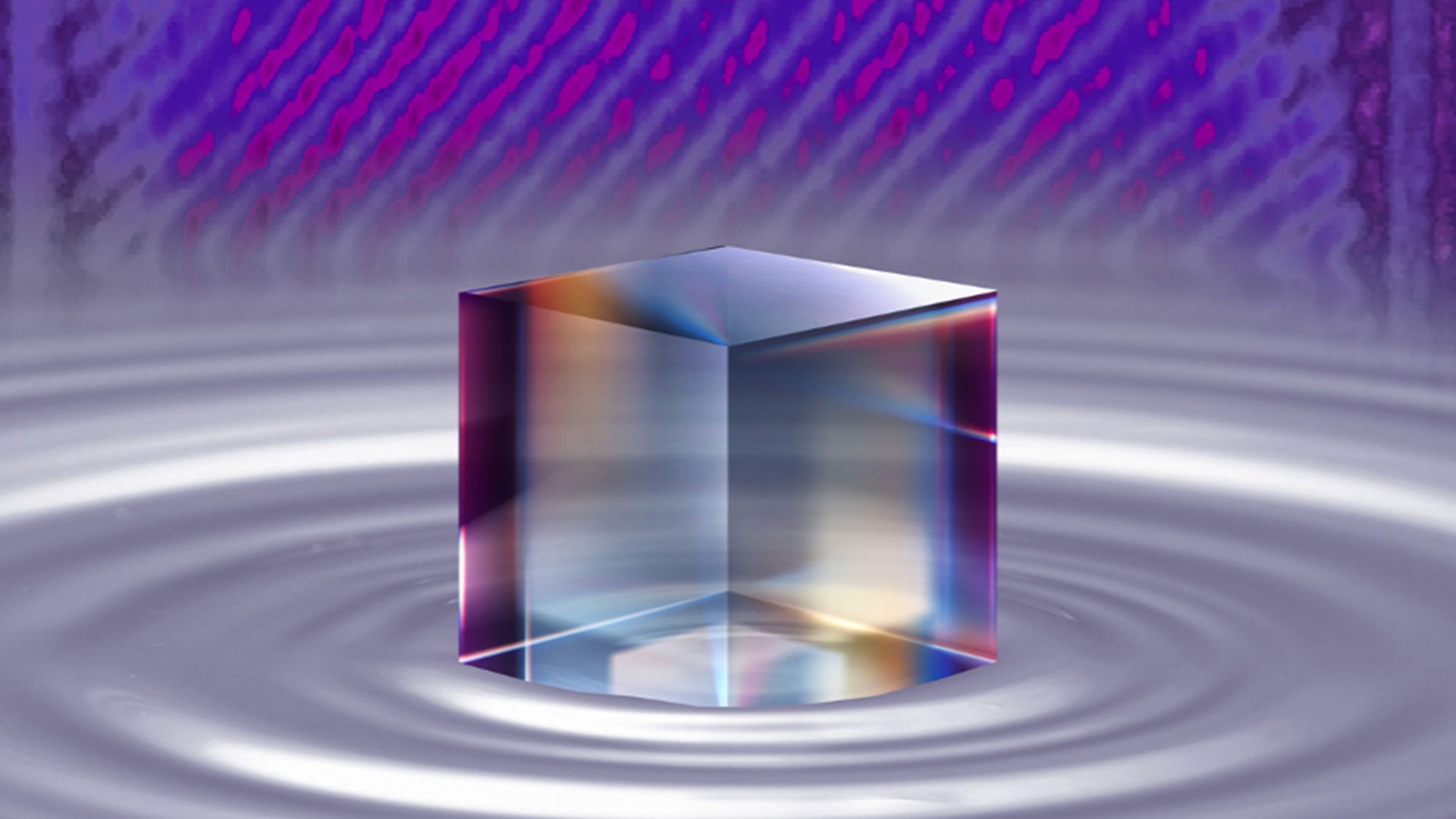
An artist's concept of a solid chunk of diamond floating in a metallic liquid carbon pool. The new experiment proves this sort of situation is possible deep within other planets. (Image credit: James Wickboldt/LLNL)
The team also measured the samples' atomic structure with X-ray diffraction and saw that the diamond didn't transition to a different kind of solid carbon before melting, possibly because the energy required to rearrange the atoms was too large, the researchers wrote.
However, they also hypothesized that multiple shocks could be powerful enough for this transition to occur and that the way the shocks are applied to the diamond might affect how it changes phase. Understanding this is important for nuclear fusion research, as certain types of experiments involve lasers melting and crushing a diamond capsule to put the capsule’s contents, solid deuterium and tritium, under more than 30 petapascals of pressure and temperatures higher than 180 million F (100 million C), the requisite conditions for a fusion chain reaction to occur.
The researchers found that between about 660 and 1,060 gigapascals of pressure and at around 12,140 F (6,727 C), diamond exists as solid chunks floating in liquid carbon. As the pressure increases, more diamond transitions into liquid carbon, which is thought to be a very strange material. Unlike most forms carbon takes on Earth — like coal, graphite and diamond — liquid carbon is metallic, so it conducts electricity. It's also denser than diamond. So hypothetically, if you somehow were to put liquid carbon in a cup without instantly vaporizing it, a chunk of solid diamond could happily bob around in it like an ice cube in a glass of water.
Knowing how diamond behaves under such extreme conditions is also important for understanding the ice giant planets Uranus and Neptune. Based on measurements from the Voyager 2 spacecraft in the late 1980s and lab experiments on Earth, scientists think it literally rains huge chunks of diamond inside these planets and that their mantles may have liquid carbon oceans with diamonds floating around like icebergs. The new research means scientists can make better predictions about the planets’ interiors and their carbon cycles.
Tristan Buckmaster, a mathematician at New York University, had just spent months working on what he believed could be a life-defining mathematical proof. Then, during a Sept. 6 meeting with OpenAI employees, he claims that he was issued a stark warning: "Why would you ruin your career?"
That exchange, which Buckmaster described in a detailed public statement this week, sits at the heart of a ballooning controversy around a famous set of mathematical equations called Navier-Stokes.
OpenAI says its artificial intelligence (AI) model has solved an outstanding problem tied to this 200-year-old set of fluid dynamics equations. The set of equations appears on the list of one of the seven Millennium Prize Problems posed by the Clay Mathematics Institute, and its solution comes with a $1 million reward. Buckmaster had been working on the same problem. And he has questions about how the company got there so fast.
The OpenAI breakthrough
The Navier-Stokes equations were formulated in the early 1800s by Claude-Louis Navier and George Gabriel Stokes. They're basically Newton's second law of motion for fluids, describing how any fluid moves: Push air with a fan blade, and the equations predict how that air will flow; or heat the atmosphere with sunlight, and they help forecast tomorrow's weather. They describe how planes fly and how blood moves through your arteries.
The problem is that nobody has proved whether the equations always produce finite answers. Could there be rare conditions that make the equations go haywire? This is called a "blowup," or singularity, which happens when a quantity that should represent something physical (like fluid speed or pressure) spirals toward impossible infinities at certain points in space and time.
Imagine the swirl of water circling a bathtub drain. The Navier-Stokes equations describe how it spins faster as it tightens toward the center. A blowup would mean the math predicts that spin is accelerating forever — an infinite speed at a single point. The bathtub can't do that, but if the equations can, that means the model we trusted for years is wrong and we wouldn't even know where it breaks.
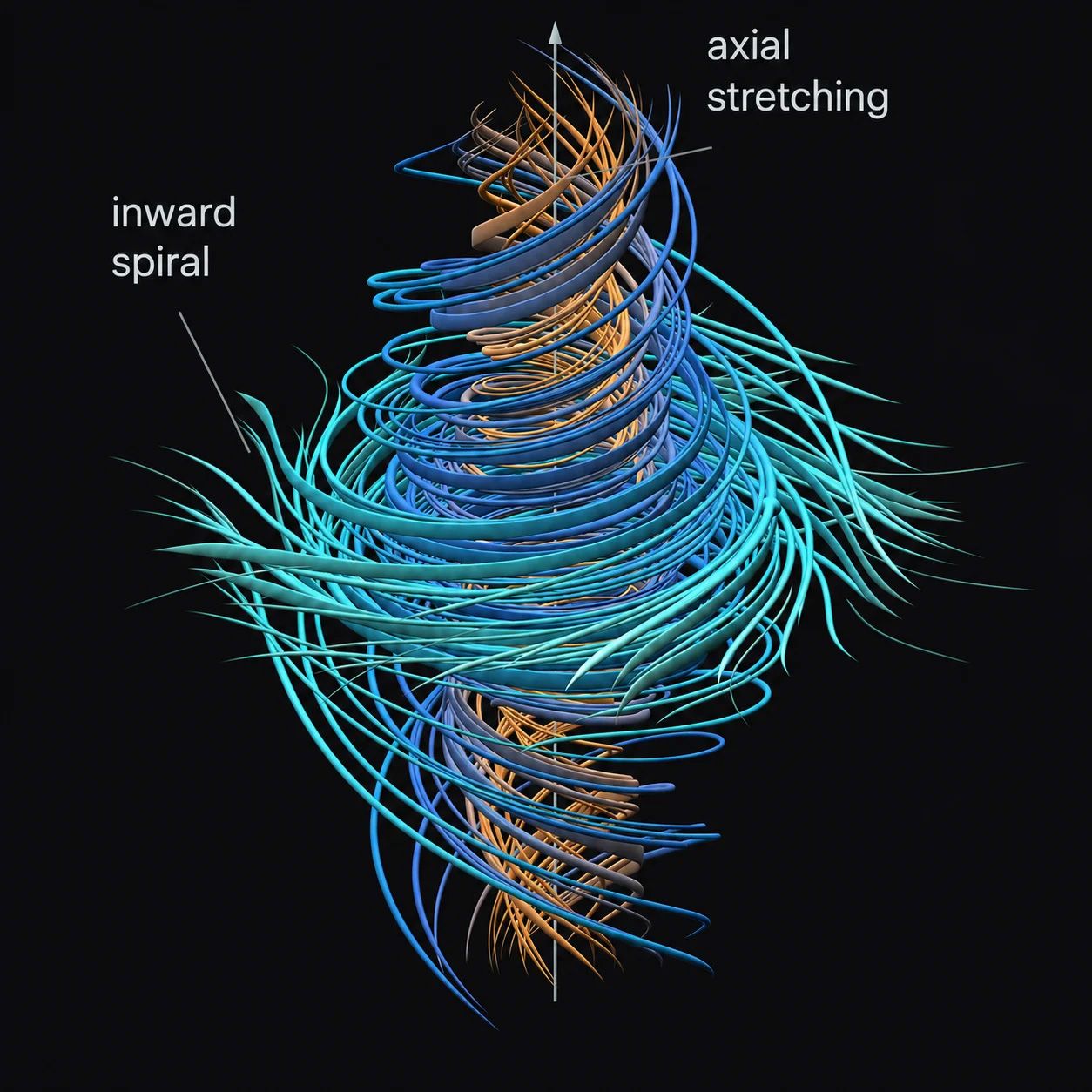
OpenAI generated this model of local incompressible motion while pushing the Navier-Stokes equations to their limits. Orange shows faster angular rotation; teal shows slower rotation. The trajectories show inward spiraling and axial stretching. (Image credit: OpenAI)
Whether the Navier-Stokes equations can blow up is one of the most famous unsolved questions.
To find the answer, OpenAI used a technique called "forcing" — giving the simulated fluid a smooth, controlled nudge from the outside. Imagine flicking a spinning top with your finger to see if it would fall over — or, in the case of the Navier-Stokes equations, blow up.
OpenAI set roughly 10,000 AI agents to simultaneously work on the problem. The agents worked for about 88 hours straight, with 100 of them starting with the relatedEuler equations. This is a simpler cousin of Navier-Stokes that discards viscosity to describe fluid motion without internal friction.
After roughly 50 hours, OpenAI's agents found blowups in the Euler equations, OpenAI representatives wrote in a statement. This discovery convinced them that Navier-Stokes was within reach, and they turned their attention to the bigger problem.
OpenAI described the singularity as a vortex spiraling tighter and tighter, stretching and thinning like pulled taffy. The result was a fluid that, mathematically, spins itself into infinity.
OpenAI ran the proof through a program called Lean, software that checks every step of a mathematical argument. The agents "sent 2.7 million messages and used approximately 130 billion output tokens," OpenAI representatives wrote in the statement. At a Sept. 8 news conference, company representatives said a similar effort performed by a customer would have cost $15 million.
The controversy
The result has created a blowup of its own within mathematics, centered around claims that OpenAI's models may have been given a head start by using the work of Tristan Buckmaster and Levent Alpöge, a mathematician at rival AI company Anthropic.
The two mathematicians had been working on the same strategy (smooth forcing) applied to those same Euler equations. The approach itself was developed by Diego Córdoba, a mathematician at the Institute of Mathematical Sciences in Madrid, and Luis Martínez-Zoroa, another mathematician at CUNEF University in Madrid. Almost no one else in the field was using it.
Buckmaster said that on Aug. 15 that he and Alpöge achieved blowup results for the Euler equations with smooth forcing. On Sept. 3, Buckmaster wrote that he received word through Alpöge that OpenAI had caught wind of their progress and adopted the same method.
"When I heard 'forced,'" Buckmaster wrote in his public statement, "it was a bright red flag."
His concern was that the smooth-forcing approach wasn't obvious or widespread. "The ideas making this line of attack possible are due to Córdoba and Martínez-Zoroa," Buckmaster wrote, crediting the two mathematicians who developed the technique. "Almost nobody else I know of was working on it."
And yet, according to OpenAI, the company launched its Navier-Stokes effort on Sept. 1 — the same day it heard "rumors of other Millennium Prize resolutions." Buckmaster claimed, in his public statement, that those rumors were about his and Alpöge's work specifically.
Sam Altman, OpenAI's CEO, acknowledged that the company had learned of Buckmaster and Alpöge's work before making its announcement. "We were curious if ours could do it too," he wrote on X. He added that "the approaches appear to be different" — a claim Buckmaster disputes.
OpenAI's CEO Sam Altman acknowledged that the company had learned of Buckmaster and Alpöge's work before making its announcement. "We were curious if ours could do it too," he wrote on X. (Image credit: Chip Somodevilla via Getty Images)
OpenAI's statement names both Buckmaster and Alpöge, credits their independent resolution of the forced Euler problem, and says the company offered to co-publish.
"I did not get an answer"
Buckmaster also revealed that he had been using OpenAI's Codex coding assistant throughout his research, putting drafts of the work into the tool. OpenAI trains its models on user interactions, and Buckmaster said he asked the company directly whether his Codex sessions had been accessed.
"I asked whether the model had been trained on, or had access to, our sessions in Codex, into which we had been putting all our drafts," he wrote. "I asked again, about training, and I did not get an answer."
OpenAI's enterprise agreements govern how customer data can be used. But it's unclear whether Buckmaster was using Codex under an enterprise agreement or as an individual consumer — a distinction that may determine whether his drafts were available for training.
In a statement on X, OpenAI representatives denied that company employees or agents saw the pair's work "by any means" until it was publicly released. However, "we cannot rule out that de-identified data derived from their usage of our products helped improve our models," they added.
Then, there is the question of authorship. Buckmaster alleges that Sébastien Bubeck, who leads OpenAI's math research, twice pushed for Alpöge to be cut from the paper that the two mathematicians were preparing. Buckmaster emphasized that Alpöge works at Anthropic, a rival AI company.
We were curious if ours could do it too.
OpenAI CEO Sam Altman on X.
It was at that same Sept. 6 meeting that Buckmaster claimed that OpenAI presented him with two options, both of which required cutting Alpöge from authorship. He declined and said he told Bubeck that if OpenAI released its result as proposed, he would go public. Bubeck allegedly replied, "If you don't want me to be nice, then I don't have to be nice."
Bubeck has flatly denied the allegations, calling them "false and inflammatory" in a statement on X. "We did not use their prompt or proofs to prompt our models," Bubeck told Wired. Mark Chen, OpenAI's chief research officer, said at last night's news conference that he was "a little disappointed with the allegations."
"I have not seen OpenAI's proof," Buckmaster wrote. "I do not know what their model did, or how. I do not know whether our data was used. I am not accusing anyone of anything." He has called for an independent investigation into how OpenAI's work began.
In a closing line, he wrote, "I would much rather be talking about mathematics, Luis and Diego's ideas, and what this all means for the rest of us."
The community response
Córdoba, one of the original developers of the forcing technique, said he was stunned by how quickly the result had materialized. "We're a little bit in shock," he told Scientific American.
Other mathematicians have also responded to the news, with some expressing open dismay at how the results were released.
"We have now seen that even the rumor of someone working on a massive problem can trigger a massive amount of AI-powered effort to flatten it before the original research project has time to reach its full potential," Terence Tao, a professor of mathematics at UCLA, wrote on Mastodon. "The incentives may now be pointing in the direction of no longer sharing any promising research directions with the broader community, which would reverse centuries of traditions of open science and do serious long-term damage to the future of the field."
OpenAI's proof still awaits formal peer review, and the Clay Mathematics Institute has not yet issued an official verdict confirming or denying OpenAI's proof. But the episode has already surfaced troubling questions for the mathematics community. For example, when a company trains its models on the interactions of millions of users, who really owns the answers that emerge? And what does AI's involvement mean for the future of the field?
Those questions, unlike the Navier-Stokes problem, may not have a clean proof.
Over dinner at a gaming convention around 2010, board game designer James Ernest turned to his friend Eric Harshbarger and asked a question: Could you design a set of dice so that each player in a group — whether two people or any number — could grab one, roll and have a perfectly equal shot at going first? The rule is simple: Roll your dice, and whoever lands the highest number goes first. The hard part is making that outcome truly fair for every player, no matter how many are at the table.
There could be no ties and no rerolls.
Harshbarger, a mathematician at Auburn University in Alabama, didn't have an answer that night. But the question stuck. Over the next 15 years, he and a loose network of collaborators casually worked to crack what became known as the "go first dice" problem.
Now, they finally have the answer: a set of five 60-sided dice, collectively engraved with every number between 1 and 300, with no repeats. To mark the achievement, Harshbarger built five giant, wooden replicas of these hexecontahedrons (60-sided 3D shapes), each carved from a different type of wood. They are now on permanent display in Auburn's new mathematics building.
The problem with dice
To understand why it was so hard to crack the problem, it helps to understand the simple part.
"The easy thing is to avoid ties; you just put different numbers on all the dice," Harshbarger told Live Science. "The problem comes in how you distribute those different numbers across the dice so that the probability is equal not only for the whole set but for any subset."
That second condition is what makes the problem devilish. Ernest's request wasn't just that eight players could roll fairly; it was that any subset of players could grab any dice from the bag roll and still have equal odds. If five people are playing, each takes a die. Three people? Same thing. The numbers on each die had to be arranged so that the fairness held no matter how many people showed up to play.
Harshbarger looped in his childhood friend Robert Ford, a mathematician at Dalton State College. Within weeks, they had a three-player solution: numbers 1 through 18, spread across three standard six-sided dice in exactly the right arrangement. Four 12-sided dice, Ford later worked out entirely by hand, could accommodate four players fairly.
By 2012, Harshbarger was giving talks about the four-player set at math conferences, and The Guardian covered the story. His inbox erupted. He started selling handmade sets from home — buying blank, 12-sided dice; etching numbers onto each face with a laser cutter in his workshop; and then inking every number by hand. At his peak, he was dropping off 30 envelopes at the post office at a time, several times a week, shipping sets to customers around the world.
But as the team dug deeper into the math, they discovered that the dice were doing something even more remarkable than they'd realized: The configurations determined not only who went first but also the entire turn order, with every possible sequence of players equally likely to come up.
"If four people rolled, the chance that players finished in the order A, B, C, D was just as likely as C, B, D, A, or any of those combinations," Harshbarger said. "'Go first dice' is actually a bit of a misnomer, because they do much more than just determine who goes first; they actually determine the ordering of all the players."
This property, which the team calls permutation fairness, became the standard they chased for every set of dice from that point on.
More combinations than atoms in the universe
Four players was one thing. Five was another entirely.
Mathematically, the team knew a five-player same-shape set was feasible. But finding it meant searching an incomprehensibly large space of possible number arrangements.
"We're talking literally more than the number of atoms in the universe — like 10 to the 128th power combinations," Harshbarger said. "There's just no way, even if we had a billion billion years and all the computers, all the AI. We still couldn't do it today."
They couldn't brute-force their way to an answer. They needed mathematical shortcuts: symmetries and patterns to shrink the search space. But even then, years passed without a practical solution. Every path they found hit the same wall: dice too large to hold, too many sides to manufacture.
"My goal was a set for five players that can actually be manufactured, that you can hold in your hand, that board gamers could buy and roll," Harshbarger said. "Even for a problem that is silly and pointless as far as gameplay — just mathematically, can you buy these things and roll them, and they work? You can't do that with 180-sided dice."
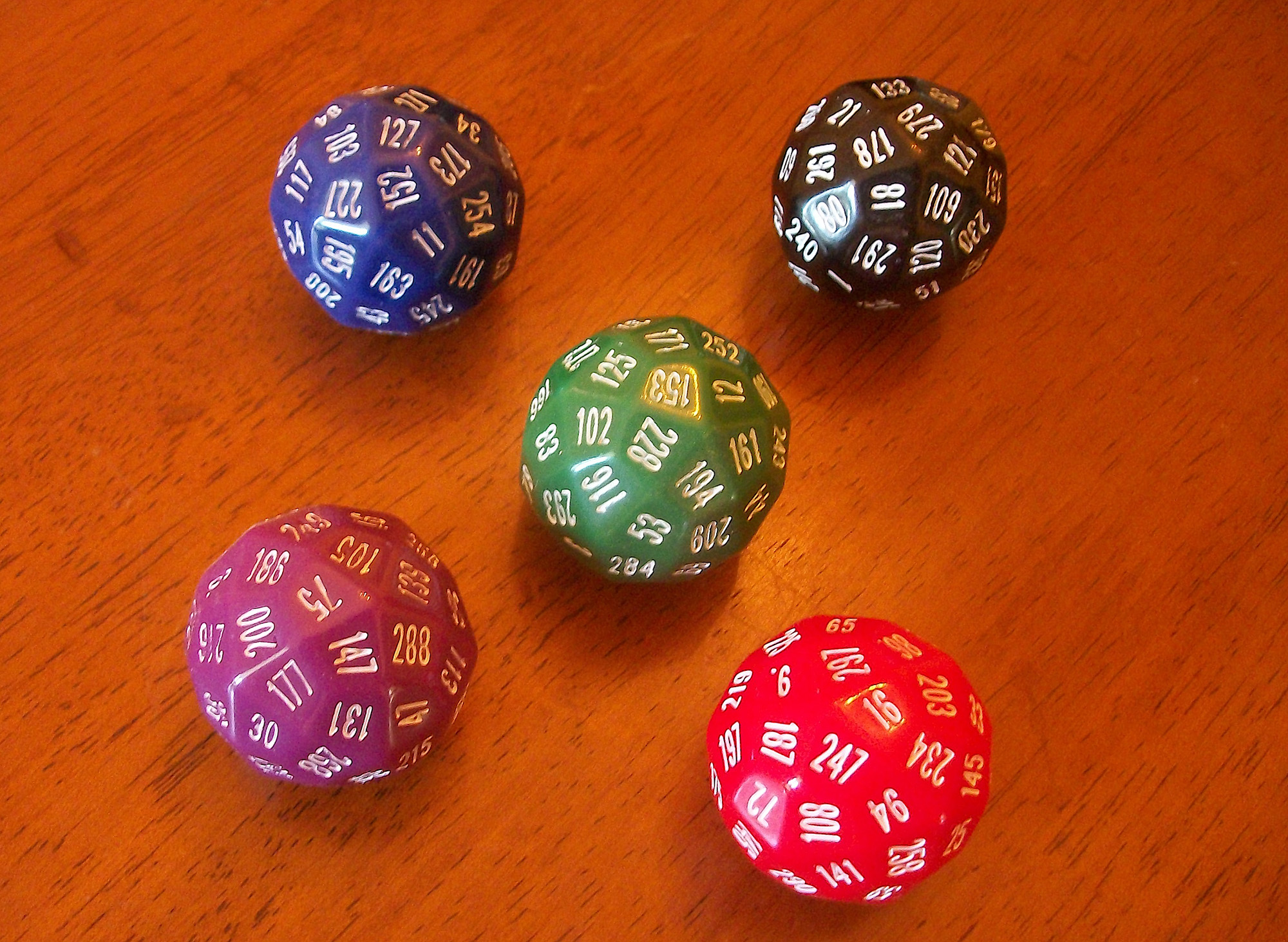
The five go-first dice, each with 60 sides, are designed so that any subset of players can grab one, roll and have an equal chance of winning. Each of these dice carries a unique set of numbers from 1 to 300. (Image credit: Eric Hashbarger )
Then, in mid-2023, Canadian software engineer Paul Meyer emailed Harshbarger out of the blue. He had been studying patterns in Harshbarger's four-player data and had written a program to exploit them. He hadn't expected it to work right away.
It did. Meyer found a configuration offive 60-sided dice that satisfied every condition.
"I double-checked his work and went, 'Oh my goodness; we've been searching for so long for this. This is amazing,'" Harshbarger said.
The four-player set had long since been picked up by retailers —Maths Gear in the U.K. andMath Art Fun in the U.S. — so Harshbarger had stopped hand-making those years earlier. Now, the five-player version was real and small enough to manufacture.
But the story had one more turn. Auburn University was building a new home for its mathematics department and was looking for sculptural ideas to fill it. Harshbarger proposed building giant versions of the five new dice out of wood. The department agreed.
He spent months in his wood shop, constructing five oversize dice. Each is from a different type of wood: pine, poplar, oak, walnut or mahogany. The five sculptures now stand inAuburn's new math building, which opened this fall.
For Harshbarger, the whole point is making math impossible to walk past.
"When people see giant dice or little dice, they're fascinated just by the geometry," he said. "The hope is, they see these things and go, 'Oh, this is math too, and this is interesting.' Some of the most fun math problems are ones that are easily understood and not easily answered."
For the first time, physicists have measured the tiny quantum shift an object acquires by falling through Earth's gravity — an effect of Einstein's relativity that was predicted almost a century ago but never observed.
Researchers placed ultracold rubidium atoms into a superposition, a quantum state in which a single particle takes two paths at once. In this experiment, one path put the atom in free fall while the other kept it motionless. Recombining the atoms revealed an almost imperceptible difference between the two paths.
The measurement, published Sept. 2 in the journalScience Advances, shows that Einstein's equivalence principle — the idea at the heart of general relativity — still holds when it is pushed into the quantum world, creating a small but tantalizing link between relativity and quantum mechanics.
"The principle says that acceleration and gravity cannot be distinguished locally," Vlatko Vedral, a physicist at the University of Oxford and a co-author of the new study, told Live Science via email.
Einstein's happiest thought
The classic illustration of the equivalence principle is a thought experiment known as Einstein's elevator. A person sealed in a windowless elevator cannot tell whether the floor is pressing against their feet because the elevator is parked motionless on Earth or because it is being accelerated through empty space. Einstein called that realization the "happiest thought" of his life and built general relativity around it.
For heavy, everyday objects, the equivalence principle has been tested to extraordinary precision. Quantum objects are a different matter. They behave like waves, and each wave carries a quantity called phase — essentially, where its crests and troughs sit. Phase cannot be seen directly, but when two versions of the same particle are recombined, any mismatch between their phases shows up as an interference pattern. The two waves reinforce each other in some places and cancel each other out in others, thereby changing the odds of where the particle turns up.
Theory says that a wave in free fall should build up phase relative to an identical wave held still and that this phase should grow with the cube of the falling time. Therefore, doubling the fall time multiplies the effect eightfold. Charles Galton Darwin, a grandson of the famous naturalist, and Earle Kennard both documented this prediction in 1927 — but no one had measured it until now.
An atom that falls and stays still at once
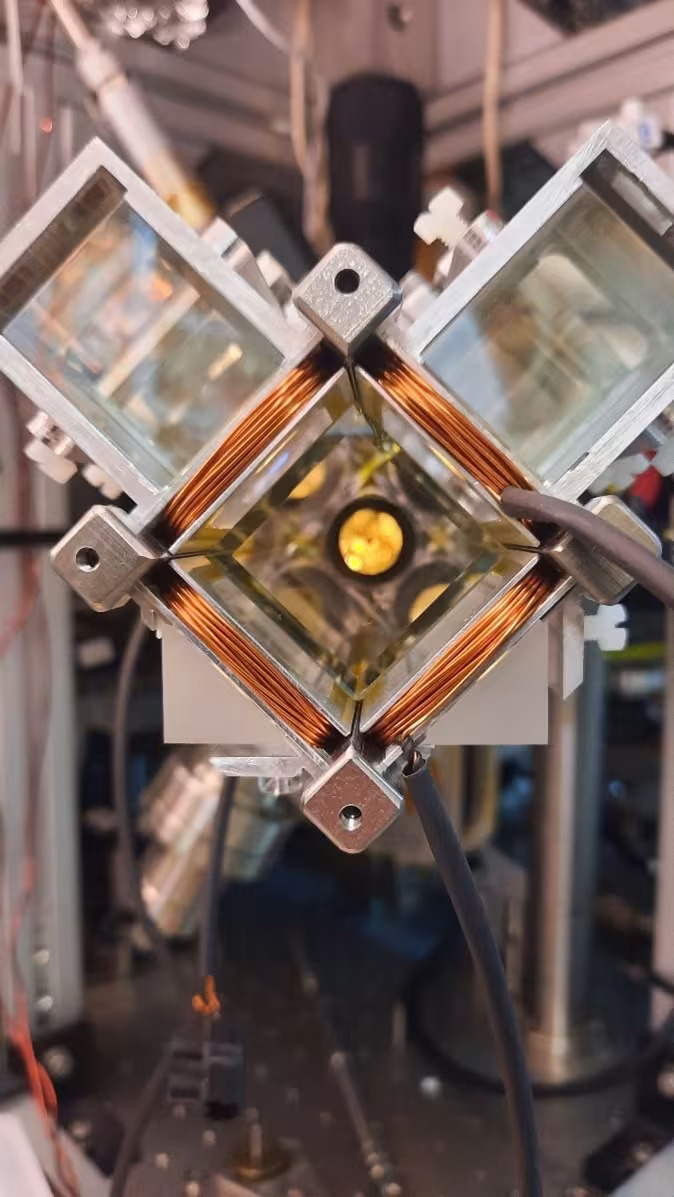
This apparatus, called 2D MOT, feeds the science chamber with cold atoms. (Image credit: Or Dobkowski)
Catching the effect required an instrument with one arm genuinely at rest with respect to Earth and the other in genuine free fall — something no previous experiment could supply. Matter-wave experiments going back to the neutron interferometry of the 1970s had measured gravity in other ways, but never with that pair of trajectories.
The team behind the new study, led by physicistRon Folman at Ben-Gurion University of the Negev in Israel, chilled roughly 20,000 rubidium atoms into anexotic state of matter called a Bose-Einstein condensate, released them from their magnetic trap and ran the interferometer about 113 micrometers beneath an "atom chip" patterned with gold wires only 2 micrometers thick.
Radio and microwave pulses put each atom into a superposition of two magnetic states. A magnetic kick launched one of them upward, and a fraction of a millisecond later, a second pulse made that half insensitive to magnetic fields so that it rose and fell under gravity alone. The other half remained magnetically sensitive and felt a force tuned to cancel gravity exactly, leaving it suspended in place.
At the top of the arc, the two halves of a single atom stood about 7.5 micrometers apart — about seven times the width of the atomic wave itself — before the sequence was reversed to bring them back together. The team named the device the quantum Galileo interferometer, after the scientist who first argued that all objects fall at the same rate.
"Two different accelerations can be superposed, zero [acceleration] and the Earth's gravitational acceleration, and the resulting quantum interference measured," Vedral said.
A phase predicted almost 100 years ago
The researchers tracked the interference signal as they stretched the free-fall time to about 2.4 milliseconds. Across 633 runs over 5.3 hours, they recorded 13 complete oscillations, each one a full cycle of phase built up between the two halves of the atom. The growth followed the cube of the falling time, matching the theoretical model to within about 2.5%.
"The phase between the two elements of the superposition, which grows as the cube of the duration of the experiment and which was predicted a long time ago, in 1927, has now finally been observed for the first time," Vedral said.
The result matters because the same phase can be derived in two completely different ways: One treats gravity as a force acting on a quantum wave; the other moves into the falling frame, where gravity vanishes, and invokes the equivalence principle. Both give the same answer, and that agreement is what allows quantum mechanics and general relativity to coexist.
"They tell us that, at this level of accuracy, there is no conflict between quantum physics and gravity," Vedral said. "In other words, the equivalence principle is perfectly compliant with quantum mechanics."
The difficulty of bringing the two halves back together
The hardest part of the experiment was the recombination. Because the two halves of the atom end up moving at very different speeds, returning them to overlap in both position and motion is extremely demanding. Physicists Marlan Scully, Berthold-Georg Englert and Julian Schwinger named the problem the "Humpty-Dumpty effect." The magnetic fields also curve across the atom cloud, distorting the two halves in different ways.
The contrast of the interference fringes started at 80% for short runs and faded to 20% for the longest run, setting a practical ceiling on how long the experiment can run. The authors also cautioned that their measurement does not rule out every theory in which the equivalence principle breaks down, because some of those theories predict the same phase.
The team now wants to test the equivalence principle under more general conditions, such as the "same experiment in a rotating frame," Vedral said. "Even more interestingly, performing an experiment in which two such systems are superposed and can gravitationally affect one another" would further test the results, he added.
That last idea points toward one of the field's central open questions. Scaling up the technique from atoms to far heavier objects, such as nanodiamonds, would let physicists ask whether gravity itself follows quantum rules and would open a route to testing the conjecture — championed by study co-author and Nobel laureate Roger Penrose — that gravity is what destroys quantum superpositions in the first place.
Every second of every day, Earth is bombarded by particles from outer space. Some of these particles are obstructed by our planet's atmosphere but can spray down other particles, while others can zoom through the atmosphere and easily pass through anything, including us.
You won't feel these particles darting through you, but it raises a question: How many cosmic particles are actually passing through your body at any moment?
The most common particles that stream through us from outer space are ghostly specks known as neutrinos. "An estimated 100 trillion neutrinos pass through each of us every second," Michael Pravica, a professor of physics at the University of Nevada, Las Vegas, told Live Science.
Neutrinos barely interact with regular matter. Nearly all of them pass through us and the rest of the planet without leaving a trace. "The fact that most of these particles never interact with us demonstrates that there is an underlying reality to our existence, much of which we are not even aware of," Pravica said.
Neutrinos originate from nuclear activity. Nearly all of the neutrinos zipping through us come from the nuclear fusion reactions that power the sun, although some neutrinos originate much farther away, even other galaxies, Lu Lu, an assistant professor of physics at the University of Wisconsin-Madison, told Live Science.
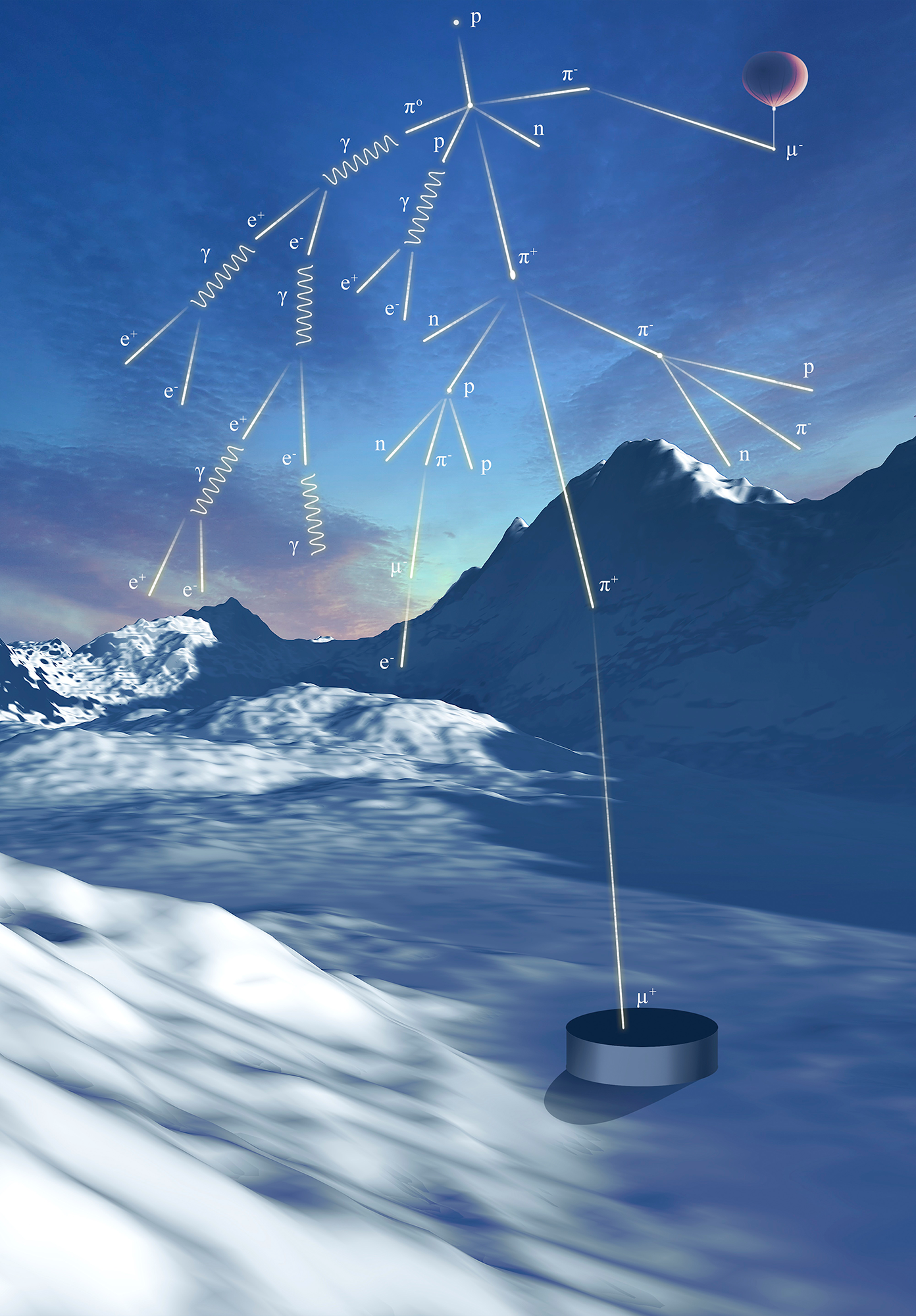
Cosmic rays are mostly either protons, which are the nuclei of hydrogen atoms, or the atomic nuclei of heavier elements (which contain both protons and neutrons), such as helium or iron. Electrons and positrons (the antimatter counterparts of electrons) also make up a tiny fraction of cosmic rays.
When cosmic rays hit Earth, they are generally blocked by molecules of air high in our planet's atmosphere, Lu said. However, these collisions can generate showers of secondary particles that make it to the ground. These include muons, which are negatively charged subatomic particles that are much like electrons except more than 200 times more massive.
At sea level on Earth, about one muon passes through per 0.15 square inch (1 square centimeter) per minute, Lu said. "For a person, the number ranges from tens to hundreds per second," she noted. "Roughly one or two pass through a hand each second."
Because muons are electrically charged, they can interact with matter they encounter. "Their paths can be made visible in a cloud chamber," a box of vapor in which a trail of mist can be seen when a charged particle streaks through the vapor, Lu said.
In contrast, neutrinos are not electrically charged. They also have almost no mass. These two qualities make it very difficult to detect neutrinos, which is why they're often dubbed "ghost particles."
The IceCube Neutrino Observatory in Antarctica. (Image credit: Christopher Michel, CC BY-SA 4.0)
Detecting cosmic particles
Scientists estimate the number of neutrinos that pass through our bodies by recording "the tiny fraction that happen to collide with matter inside or close to a detector," Lu said. "Everything else follows by working backward from those few."
For instance, the IceCube Neutrino Observatory in Antarctica surrounds 0.24 cubic mile (1 cubic kilometer) of ice with thousands of light sensors. "When a neutrino interacts with an atomic nucleus in the ice, it produces fast-moving charged particles, and those particles emit a faint flash of blue Cherenkov light, which the sensors record," Lu said. "From the pattern and brightness of that light, we can reconstruct the neutrino's energy and direction."
To estimate how many neutrinos pass through Earth based on these recorded interactions, "we account for the size of the detector, how long it operated, its detection efficiency, and the probability that a neutrino of a given energy interacts at all," Lu said. "It is a bit like estimating the number of fish in a river from the few caught in a very coarse net. If you know the size of the net, how long it was in the water, and how easily fish slip through it, you can work backward to the whole river."
This illustration shows how cosmic rays — electrically charged, highly energetic particles — interact with Earth's atmosphere. Although the atmosphere obstructs cosmic rays, they can spray down secondary particles, including muons. Research into these secondary particles can be carried out with atmospheric balloons or advanced detectors built underground or underwater, to shield them from other radiation. (Image credit: MARK GARLICK/SCIENCE PHOTO LIBRARY via Getty Images)
When it comes to the neutrinos that IceCube studies, although trillions pass through each of our bodies every second, nearly none of them interact with our atoms. "You would expect no more than roughly one interaction in your body, perhaps a few, over an entire lifetime," Lu said.
These rare interactions would have virtually no effect on us. Given how little energy such an interaction would deposit, such neutrinos "pose no health risk at all," Lu said.
In contrast, the showers of particles resulting from cosmic ray impacts can potentially affect human biology. "At ground level, muons dominate the penetrating charged particles reaching us from cosmic-ray showers," Lu said. "At higher altitudes, and especially during air travel, other secondary particles, particularly neutrons, contribute a significant share of the biologically relevant dose."
Still, any effects from these cosmic-ray showers are generally small. "For an average person, cosmic radiation contributes roughly 0.4 millisieverts per year, about the same as a few chest X-rays spread across the year, out of a total natural background of about 2.4 millisieverts from all sources," Lu said. "The dose varies with altitude, latitude and shielding. At typical ground level, muons and other cosmic-ray particles are not considered a significant health hazard. Life on Earth has been bathed in them from the beginning."
So, every second, there are about 100 trillion neutrinos and tens to hundreds of muons passing through your body per second, and maybe a tiny scattering of neutrons and other cosmic particles or debris from cosmic particles impacting the atmosphere.
These cosmic particles may lead to a variety of discoveries. For instance, scientists have used muon detectors to identify hidden passageways in pyramids. And "high-energy neutrinos allow us to study some of the most violent and otherwise hidden environments in the universe, such as the regions surrounding black holes, exploding stars and other powerful cosmic accelerators," Lu said.
"Because neutrinos interact so weakly, they can escape from dense regions that light may not be able to penetrate," she explained. "They therefore carry information directly from the places where some of nature's most energetic particles are produced."
All in all, "the particles streaming through us are a constant reminder that we are not separate from the universe," Lu said. "We are part of a cosmic story stretching back 13.8 billion years."
See how much you know about black holes with our black hole quiz!

 Login