Algo que não passou despercebido durante a apresentação do iPhone Duo, primeiro smartphone dobrável da Apple, foi a animação ao abrir e fechar o aparelho — uma cortesia da versão adaptada do iOS especialmente para o modelo.
Como quase nada é impossível no mundo dos desenvolvedores, essa animação já foi transportada para o macOS graças ao DuoHinge, que adiciona uma ilusão de ótica interativa de dobra à tela física do seu MacBook.
Ao acessar diretamente o sensor de ângulo da tampa integrado ao Apple Silicon, o DuoHinge projeta sua área de trabalho em tempo real em um plano 3D virtual vertical, aplicando perspectiva realista via raycasting, dispersão gaussiana de vidro em duas passagens e dispersão cromática nas bordas conforme você fecha a tela.
An iPhone Duo–style hinge animation, but on a MacBook. Sometimes it’s fun to build things just because. pic.twitter.com/grYKra4X91
Uma animação de dobradiça no estilo do iPhone Duo, mas em um MacBook. Às vezes, é divertido criar coisas simplesmente pelo prazer de fazê-lo.
O processamento da área de trabalho ocorre localmente no dispositivo, utilizando a taxa de atualização da tela integrada (até 120Hz em telas compatíveis) por meio do ScreenCaptureKit e shaders Metal personalizados, tudo encapsulado em uma camada transparente que permite cliques através dela, sem interromper seu fluxo de trabalho.
O aplicativo lê o sensor de ângulo da tampa e suaviza o movimento de acordo com a cadência de renderização. Um ícone vetorial do MacBook, no estilo da Apple, gira e espelha o ângulo real da sua tela nas barras de menu do macOS (no modo claro ou escuro).
O DuoHinge é gratuito, não contém assinaturas, nem rastreia quantas vezes você abre o seu MacBook. Ele exige pelo menos o macOS Sonoma 14 e pode ser baixado diretamente pela página no GitHub — ao iniciar o aplicativo pela primeira vez, abra-o na barra de menus e conceda permissão de Gravação de Tela e Áudio do Sistema quando o macOS solicitar.
To take advantage of the iPhone Duo's dual-display design, Apple is introducing new Camera app features that are unique to the foldable iPhone.
Smart Take
Smart Take uses AI to determine when everyone (including the iPhone owner) is ready for a group shot, so no one has to use a timer or stay out of the picture to capture the image.
You can prop up the iPhone Duo in a half-folded orientation, get in frame, and then wait for the group shot to be taken.
Kid Cue
Kid Cue shows little Peanuts animations to children so they look at the camera when you're taking a photo.
Duo Preview
With Duo Preview, the Camera app shows a live preview of the shot on both displays, so the subject you're taking a photo of can make adjustments.
Duo FaceTime
Nearby friends can participate in a FaceTime call using the outer display while the iPhone owner uses the inner display, so nobody has to crowd around the iPhone or pass it around to get on video.
Duo FaceTime is not the same as Dual Capture, which records video with both the front and rear cameras. Duo FaceTime specifically uses the outer display to allow another person to join in on a call.
Unique Form Factor Features
The iPhone Duo can be used in multiple orientations, including when it's half-folded. The Duo stands up on its own, for taking FaceTime calls and recording video without holding it.
The folding mechanism acts like a built-in tripod and stand, so it's also useful for selfies and long exposures. You can also capture selfies with the higher-quality 48MP rear camera while using the outer display as a viewfinder, which isn't something you can do with a slab iPhone.
Camera Hardware
The iPhone Duo has a "Dual Fusion" two-camera setup with a 48MP Main camera. It's basically the same camera that's in the iPhone 17 (not the 17 Pro), offering 26mm 24MP images by default, along with 12MP 2x "telephoto" images at 52mm.
The camera supports sensor-shift optical image stabilization, but not the second-generation version available in the Pro models. It also does not support spatial photos or the ProRAW format.
It also includes a 48MP Ultra Wide camera with a 13mm focal length and macro capabilities. Since there's no Telephoto lens, the iPhone Duo is limited to 2x optical-quality zoom in, 2x optical zoom out, and digital zoom up to 10x for images.
Other Camera Capabilities
Like the iPhone 18 Pro and Pro Max, the iPhone Duo supports the latest Photographic Styles, which adds texture and grain parameters.
Video
Smart focus tracking is a feature new to the iPhone Duo and the iPhone 18 Pro models. It uses AI to keep a subject in focus at all times, and pick up subject tracking if the subject exits the frame and then reappears.
The Duo supports 4K Dolby Vision video recording at up to 120 fps, and Cinematic mode for recording videos in 4K Dolby Vision at up to 60 fps. For the first time, Cinematic mode effects can be added to a video after capture on the Duo and iPhone 18 Pro. Apple also says there's improved low-light video on the Duo when recording at 1080p.
Time-lapse video recording with stabilization up to 4K Dolby Vision is a new iPhone 18 Pro and iPhone Duo option. It's especially useful on the iPhone Duo because you can record a stable video without the need for a tripod.
Front Camera
The iPhone Duo's outer front-facing camera is 12MP, not 18MP like the iPhone 17 and iPhone 18 Pro models. It otherwise has the same features.
The inner display has a 1080p FaceTime camera that's under the display.
Missing Camera Features
Compared to the iPhone 18 Pro and Pro Max, the iPhone Duo has a more rudimentary camera system. It lacks many features available on the Pro models.
iPhone Duo gives Apple its first foldable iPhone and introduces a hardware format that required considerably more than adding a hinge to an existing handset. The device combines a 7.6-inch inner display with a compact 5.4-inch outer screen, while iOS 27 has been adapted around the different positions, orientations, and multitasking possibilities created by the folding design.
Apple unveiled the device on September 9, positioning it above the conventional iPhone lineup with a starting price of $1,999 in the U.S. Preorders open October 16, followed by availability on October 23 in more than 70 countries and regions.
The pricing puts iPhone Duo firmly into premium-device territory, but the more significant distinction is how much of the underlying iPhone experience has been reconsidered around the larger display.
Image Credit: Apple Inc.
iPhone Duo turns one phone into two screen formats
When closed, iPhone Duo uses a 5.4-inch Super Retina XDR outer display intended to work much like a compact conventional smartphone. Apple says it provides more than 90% of the screen area of iPhone 18 Pro despite the smaller physical footprint.
Opening the device reveals a 7.6-inch OLED Super Retina XDR panel. The inner display is 50% larger than the screen on iPhone 18 Pro Max and uses a nano-texture finish intended to reduce reflections and make the crease less visually prominent.
Both displays support ProMotion refresh rates up to 120Hz, Always-On functionality, HDR, and peak outdoor brightness of 3,000 nits. Apple has also retained the same display aspect ratio between the inner and outer screens, allowing interfaces and content to resize proportionally when the phone is opened or closed.
The design results in some unusual dimensions for an iPhone. Duo measures 5.2mm thick when open and 11.3mm when folded, with a weight of 254 grams. Its frame and hinge cover use grade 5 titanium, while Ceramic Shield 2 protects the outer display, while Ceramic Shield covers the back of the device. The device carries an IP68 water- and dust-resistance rating.
Touch ID is built into the side button rather than relying solely on Face ID, giving users a consistent authentication point regardless of how the phone is positioned.
iPhone Duo makes iOS 27 part of the folding design
iPhone Duo would have limited value as a larger iPhone if applications simply stretched across the inner screen. Apple instead adapted iOS 27 to treat the additional space as a new working area.
Split View brings two applications side by side on an iPhone for the first time. Users can also open two windows from the same app, save pairs of applications for repeated use, and switch between tasks without collapsing everything back into a single full-screen view.
Interface elements have moved as well. Navigation controls, Lock Screen elements, and the Dock can appear along the side of the display to preserve vertical space, while Dynamic Island has been reworked for both screens. When the device is open, the Home Screen can display two pages alongside Today View.
Several physical positions have their own uses. The phone can sit partially folded on a surface for video playback, FaceTime calls, workouts, photography, or StandBy. Apple has also confirmed future support for Apple Pencil with USB-C on either display, extending the inner panel toward note-taking, markup, and sketching.
Third-party developers will determine how useful that larger canvas becomes over time. Netflix, Zoom, and Slack are among the companies already adapting their apps for the folding interface.
Image Credit: Apple Inc.
A20 Pro and dual batteries address foldable compromises
Foldable phones create difficult thermal and battery constraints because internal space is divided across two halves. Apple’s response is a custom hardware layout centered on A20 Pro, the same chip used in the iPhone 18 Pro family.
The 2-nanometer processor combines a six-core CPU, seven-core GPU, and dual 16-core Neural Engine. Apple says the chip can deliver up to 35% better sustained performance than iPhone 17 Pro when paired with Duo’s vapor-chamber cooling system.
A custom package connects A20 Pro directly to the vapor chamber, an arrangement designed to manage heat during gaming, AI processing, and prolonged multitasking on the larger display.
Battery capacity is similarly divided. iPhone Duo places a high-energy-density battery in each half of the enclosure and manages them as a single power system. Apple rates the phone for up to 31 hours of video playback using the inner display or up to 44 hours on the outer screen. With both displays used equally, the company estimates up to 24 hours of use per charge.
Wired fast charging can reach 50% in about 20 minutes, while MagSafe or Qi2 wireless charging can reach the same level in approximately 30 minutes.
The worldwide eSIM-only design also frees internal volume for battery capacity. Connectivity includes Apple’s N1 wireless chip with Wi-Fi 7, Bluetooth 6, and Thread, alongside the C2 cellular modem.Cameras use the iPhone Duo displays in new ways
Cameras use the iPhone Duo displays in new ways
The camera system consists of a 48MP Fusion Main camera and 48MP Fusion Ultra Wide. The main sensor also provides an optical-quality 2x option, while video recording reaches 4K Dolby Vision at up to 120 frames per second on the primary camera.
The folding design also gives the cameras capabilities that go beyond their conventional specifications. Users can shoot a selfie with the rear cameras while framing themselves on the outer display, while Duo Preview lets a subject see the live composition from the opposite side of the phone.
Smart Take uses on-device models running on A20 Pro to recognize when people appear ready for a group photo and automatically capture the image. Kid Cue can display Peanuts animations on the outer screen to attract a child’s attention toward the camera.
An under-display FaceTime camera sits beneath the inner panel, while the outer screen uses a 12MP Center Stage camera. Duo FaceTime can also place another participant on the outer display when people are gathered around the device.
Siri AI brings personal-context understanding and onscreen awareness to iOS 27, while the broader Apple Intelligence experience includes new photo-editing tools and other capabilities across apps. On the inner display, users can keep a Siri conversation visible alongside another app.
iPhone Duo will ship in Night Sky and Star White with 256GB, 512GB, 1TB, and 2TB storage options. iPhone Duo will ship with iOS 27.1 when it becomes available on October 23, while Apple says USB-C Apple Pencil support will arrive later in the year.
Esteja você de olho nos recém-anunciados iPhones 18 Pro e 18 Pro Max ou no badalado iPhone Duo, é bem provável que já tenha pensado em maneiras de economizar na hora de comprar um desses novos aparelhos. Como sempre, uma das melhores alternativas é optar por fazer isso nos Estados Unidos, com um cartão internacional da Nomad!
Parceira de longa data do MacMagazine, a Nomad está oferecendo 5% de cashback (limitado a US$100) para quem abrir uma conta até 30 de setembro com o cupom MAC26 e converter pelo menos R$3.500 (aproximadamente US$700/600€) — assim, você consegue adquirir seu iPhone novinho em folha com uma economia extra. 💵
Vamos usar como exemplo o iPhone 18 Pro de 256GB, que sai por US$1.200 nos EUA e por R$12.000 no Brasil. No momento da redação desta matéria, a cotação do dólar gira em torno de R$5,14, o que significa que, considerando encargos de 3,5% e uma taxa de serviço de 1,9%, o mais novo flagship da Maçã pode acabar saindo por ~R$6.504 — valor que cai para cerca de R$6.178 com cashback supracitado!
Vendido oficialmente por US$1.300/R$13.000, o iPhone 18 Pro Max pode acabar saindo por apenas ~R$6.693, enquanto o atual queridinho da galera, o iPhone Duo (preço tabelado de US$2.000/R$22.000), tem o potencial de lhe custar algo em torno de R$10.840!
Em outras palavras, caso você esteja planejando trocar de iPhone por agora, uma compra internacional com o cartão da Nomad torna-se uma das melhores opções — principalmente considerando que os preços no varejo nacional continuarão bem altos por um tempo.
Abra sua conta Nomad e ganhe até 5% de cashback!
Como dito, para aproveitar essa oferta, basta abrir sua conta internacional na Nomad até 30 de setembro e converter pelo menos R$3.500.
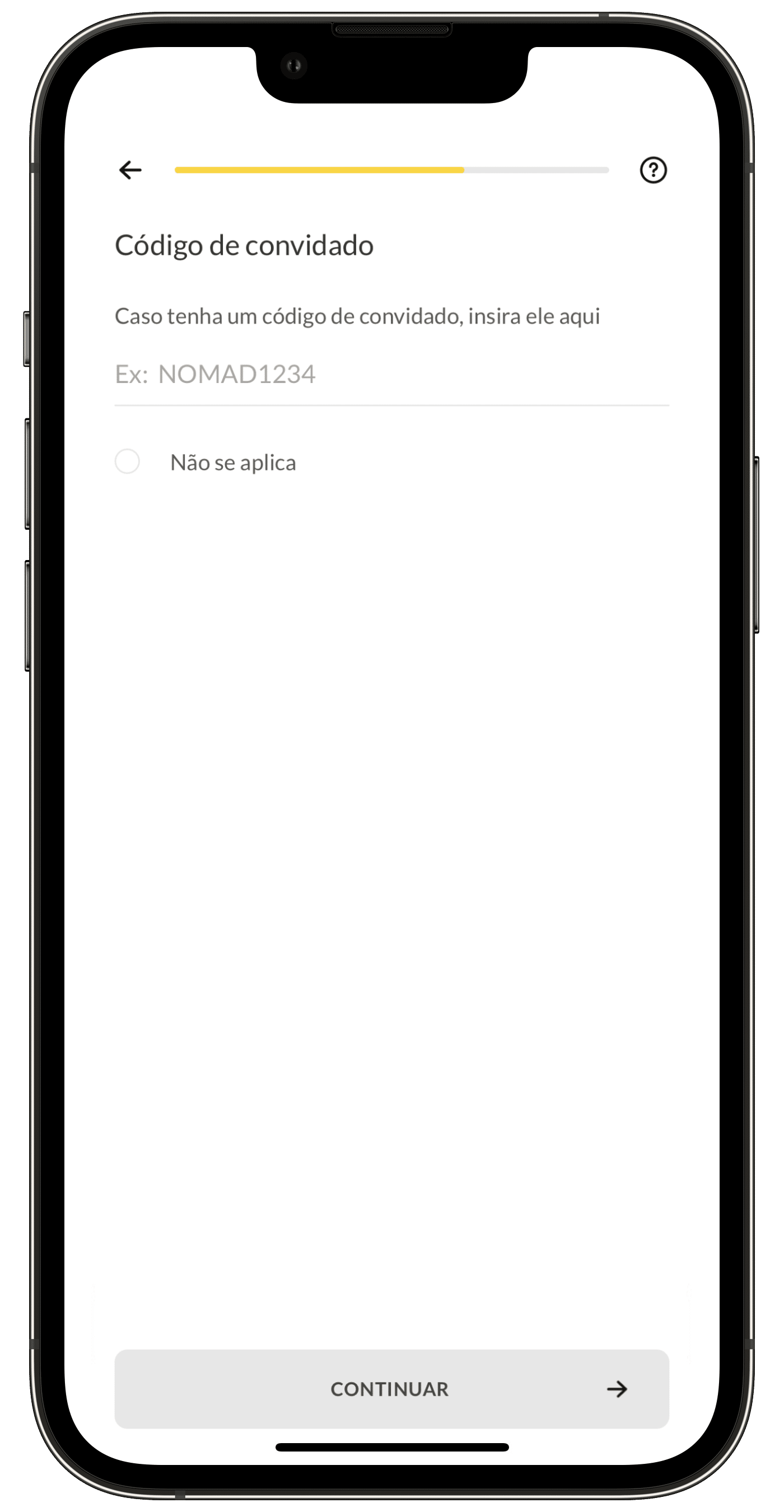
Para tal, baixe o app da Nomad e cadastre-se usando o código MAC26 no campo “Código de convidado”:
Nesta tela, digite o cupom MAC26 para ganhar 5% de cashback!
Sobre a Nomad
A Nomad foi a primeira a oferecer uma conta em dólar hospedada nos Estados Unidos, sem nenhuma taxa de abertura, anuidade ou manutenção. O cartão da empresa é aceito em mais de 180 países, oferecendo taxas bastante menores que as dos cartões de crédito internacionais.
A conta bancária da Nomad é assegurada em até US$250 mil pelo Community Federal Savings Bank, membro do fundo garantidor dos EUA (FDIC), para cada tipo de conta por titular, e permite que você faça/receba transferências de outras contas da Nomad sem nenhum custo, além de transferências para contas americanas (via Wire Transfer) e outras pagando bem menos do que as taxas cobradas nos EUA.
E não para por aí: com a sua conta Nomad você tem acesso a descontos em lojas parceiras e ainda pode aproveitar o Nomad Lounge, que concede acesso a uma das melhores salas VIP do Terminal 3 do Aeroporto Internacional de Guarulhos (SP).
Só na Nomad você tem uma conta internacional sem taxas mensais de manutenção, além de poder desfrutar de toda a praticidade e segurança que ela oferece!
NOTA DE TRANSPARÊNCIA: O MacMagazine recebe uma pequena comissão sobre vendas concluídas por meio de links deste post, mas você, como consumidor, não paga nada mais pelos produtos/serviços usando os nossos links de afiliado.
With the iPhone Duo, Apple has entered the foldable smartphone market years after Samsung, Google, Huawei, and others, and it is doing so with a $1,999 book-style device designed less as a novelty and more as a bid to change what mainstream buyers expect from a phone.
The iPhone Duo, unveiled September 9th, folds from a compact 5.4-inch outer display into a 7.6-inch inner screen — Apple’s largest iPhone display yet — while keeping the same aspect ratio on both panels. Closed, it is roughly passport-shaped. Opened, Apple says it is the company’s thinnest iPhone at 5.2 millimeters. Preorders begin October 16th, with stores getting the device on October 23rd.
That timing and price put the Duo in the same neighborhood as Samsung’s Galaxy Z Fold 8 and Google’s latest Pixel foldable, rather than in a category of its own. Foldables still account for only a sliver of global smartphone shipments. The question hanging over the launch is whether Apple’s combination of hardware polish, iOS software and ecosystem pull can expand that niche.
As Bloomberg News’ Edward Ludlow writes, that is precisely the test Apple is setting for itself: whether the Duo can shift consumer tastes, not merely win over people who already buy folding phones.
Apple spent years studying the complaints that have kept foldables on the fringe — visible creases, fragile hinges, awkward software and devices that feel like two phones taped together. The company is pitching a titanium hinge with more than 100 precision parts, a nano-texture finish meant to make the crease less noticeable, IP68 dust and water resistance, and an iOS experience built around split apps, fluid open-and-close transitions and later Apple Pencil support.
New CEO John Ternus has called the Duo the most transformational change to iPhone since the original, arguing that hardware and software engineered together can redefine what a foldable is for. Marketing chief Greg Joswiak has been blunter about rivals: existing foldables, in Apple’s view, were not particularly inspiring.
The compromises are still visible. The Duo is heavier than some Android competitors. It uses a side-button Touch ID rather than Face ID, drops a physical SIM slot and lacks the variable-aperture camera of the iPhone 18 Pro models. Higher storage configurations climb well above $2,000.
Those trade-offs make the first Duo look like a halo product — a statement device for early adopters and Apple loyalists rather than an immediate volume seller. Analysts and industry veterans have long argued that new form factors often need two or three generations before they become mass-market. Apple’s bet is that its installed base, developer influence, and reputation for finishing products can compress that timeline.
If the Duo works, Ludlow writes, it will not just give Apple a new high-end SKU. It will signal that foldables have left the enthusiast ghetto. If it remains a pricey curiosity, the category will stay what it has been for most of the past seven years: impressive, expensive and still waiting for the mainstream.
MacDailyNews Take: Apple will sell every single iPhone Duo it has already made and can make for the foreseeable future.
Please help support MacDailyNews — and enjoy subscriber-only articles, comments, chat, and more — by subscribing to our Substack: macdailynews.substack.com. Thank you!
Apple arrived slightly late to foldable phones. As per Bloomberg Tech, that delay looks less like a miss and more like a choice.
In a segment titled “Apple’s Foldable iPhone Duo Shows the Upside of Waiting,” Bloomberg News’ Chris Welch walks through an early look at the $1,999 iPhone Duo and argues that Apple’s first foldable already raises the bar rivals spent years chasing. He joins Ed Ludlow to talk hinge, display, and software — the three places earlier foldables most often felt unfinished.
The Duo folds a 7.6-inch inner display into a 5.4-inch cover screen and a passport-like closed shape. Apple priced the 256GB model just under $2,000, with higher storage climbing toward $3,000.
Preorders start October 16; the phone goes on sale October 23. It uses the same A20 Pro chip as the new slab iPhones, carries an IP68 rating, and supports a later Apple Pencil software update.
Watch the video via Bloomberg here.
MacDailyNews Take: Yup.
If and when Apple debuts a foldable iPhone, they’ll be showing the world how it should be done and what to copy going forward. As usual. — MacDailyNews, February 27, 2019
As with fingerprint and facial recognition, when Apple debuts a foldable iPhone, then foldable smartphones will have been done right. — MacDailyNews, January 17, 2019
Please help support MacDailyNews — and enjoy subscriber-only articles, comments, chat, and more — by subscribing to our Substack: macdailynews.substack.com. Thank you!
In the Duo dev video, they describe how text buttons can’t be moved to the new vertical sidebar, as opposed to icon buttons.
I wonder if that’s one of the reasons Liquid Glass pushed hard for icon buttons, even though these are harder to understand; they make the vertical layout possible at all.
I think the problem with the iPhone Duo for developers is mostly that it does not create any new opportunities in the form of a new market or a new audience.
Apple finally shipped a foldable phone, and the most interesting thing about it is not the hinge. It is what happens when you stop treating the iPhone Duo like a book and start treating it like a laptop.
Bend the device partway, rest the bottom half on a table, and iOS 27 splits the 7.6-inch inner display into two jobs. The top half becomes a landscape screen for the app, document, or video you are actually using. The bottom half turns into a touch keyboard and control deck. That is the mode that makes the $1,999 iPhone Duo feel less like a foldable smrtphone and more like a pocket computer.
Apple has spent years insisting that foldables should not feel like two phones glued together. The Duo is its answer: a passport-shaped handset with a 5.4-inch outer display that opens into a 7.6-inch inner panel, both sharing the same 1:1.4 aspect ratio so content does not warp when you unfold it. The software is the real product. iOS 27 watches the hinge, not just the open/closed state. Content slides away from the crease. Speakers retune as the halves move. And the keyboard follows the posture of your hands.
The laptop pose is the feature people will actually use
Apple and reviewers keep circling the same demo. Set the Duo down half-open, like a tiny clamshell. Video, Mail, Notes, or Safari stay on the upper pane. Playback controls and a full or split on-screen keyboard occupy the lower pane. Slightly more fold and the keyboard splits left and right, so thumbs can type while you hold the device like a book. No settings menu. The crease becomes the dividing line.
That is why the Duo suddenly looks like an argument for a larger sibling. A 7.6-inch inner screen is close to an iPad mini, which is enough for email, messages, and a movie on a tray table. It is not enough for a spreadsheet, a long draft, or two serious windows without feeling cramped. Once you have tasted laptop posture on a phone, a 12- or 13-inch foldable iPad that does the same thing stops sounding like a rumor and starts sounding like the obvious next product.
Apple already designed the Duo to feel “as natural and intuitive as iPad.” Split View finally arrives on iPhone. You can park two apps side by side, or two windows of the same app. Saved app pairs come back later. Controls migrate to the vertical edge so the content column stays tall. StandBy works without a charger: tent the phone on a nightstand and it becomes a clock, photo frame, or widget slab. Those are iPad ideas squeezed into a pocket. They work. They also expose the size ceiling.
Why a foldable iPad now feels inevitable
A foldable iPad has been in the rumor mill for years: first as a ~20-inch board that folds to something closer to a 13-inch slate, later as a delayed 2028 or 2029 project after cost and weight problems. The Duo changes the brief. Apple no longer has to invent hinge software from scratch. It already has angle-aware layouts, a crease-aware keyboard, tent mode, table-top sensors in each half, and developer APIs for reserved fold regions. Scaling that system to a tablet is relatively easy.
Imagine the same half-fold grammar on a larger canvas. Top half: a proper landscape document, timeline, or browser. Bottom half: a real-size software keyboard, or a trackpad zone, or a palette of tools. Apple Pencil on the Duo already hints at the tablet version of that idea. On a phone, Pencil is a nice extra. On a foldable iPad, it is the point: sketch on the upper pane, keep reference material or a keyboard on the lower one, then flatten the device into a single drawing board.
The Duo also proves Apple will move iOS elements when the hardware demands it. Dock and navigation sit on the side. The status bar collapses into a corner puck. Dynamic Island runs vertically. Third-party apps that are not ready get a safe area; apps built for iOS 27.1 can use the full inner panel. That same discipline would make a foldable iPad less of a novelty and more of a second computer.
The iPhone Duo makes an iPad Duo feel necessary rather than greedy. The phone version is a proof of concept. It shows that Apple can make a hinge feel like an input device: slightly open for thumb typing, tented for widgets, laptop-angled for media and mail. The missing piece is area. Give that same software a screen that can hold a full page of text above a usable keyboard, and the “pocket laptop” pitch stops being a clever demo and becomes a category.
Apple did not announce an iPad Duo this week. It did something more useful. It shipped the interaction model first, on the device people actually carry every day. After a few weeks of using the Duo half-folded on a café table, a lot of people will not want a bigger phone. They will want the same trick, at iPad scale.
MacDailyNews Take: An iPad Duo that folds into a laptop pose would steal the exact jobs for which a lot of people already use a MacBook Neo or even MacBook Air: email, docs, browsing, video, light travel work. The iPhone Duo already shows the posture: screen on top, keyboard/controls below. Scale that to iPad size and the “why did I bring a laptop?” question gets louder.
An iPad Duo would not wipe out MacBooks, for the same reasons the iPad Pro never did:
• Software ceiling. iPadOS is still app-and-touch first. Serious windowing, files, terminals, IDEs, and pro apps still live more comfortably on macOS.
• Input. A software keyboard on glass is fine in a pinch. All-day typing still favors a real keyboard and trackpad. People who need that will keep buying Airs and Pros.
• Apple’s own mix. Apple has long accepted overlap: iPad Pro vs. MacBook Air, iPhone vs. iPad mini. A foldable tablet would shift the mix, not collapse it. Some MacBook Neo and Air buyers become Duo buyers; some Duo buyers still want a Mac at the desk or on the go.
Net effect of an iPad Duo: partial cannibalization of entry-level MacBook sales, plus some new demand from people who would never haul a laptop, but would fold a tablet. The Macs most at risk would be mostly MacBook Neo with some MacBook Air.
Please help support MacDailyNews — and enjoy subscriber-only articles, comments, chat, and more — by subscribing to our Substack: macdailynews.substack.com. Thank you!
Apple’s first foldable phone, the iPhone Duo, did not arrive because the company suddenly discovered folding screens. It arrived, executives say, because they finally had a product that felt like Apple.
In a sit-down at Apple Park with Tom’s Guide and TechRadar after the September event, CEO John Ternus and marketing chief Greg “Joz” Joswiak described a long, stubborn process: watch the category, reject most of what they saw, then redesign the hardware and iOS until the thing in their hands made them say yes.
“Our history had never been to rush into something with something half-baked,” Joswiak said. The concept itself was simple—a big display that folds into a pocket—but “what we saw others doing wasn’t particularly inspiring.” Two phones awkwardly stuck together produced a bulky square that “wasn’t really designed for the way you want to use a phone.”
Ternus framed the wait as a quality bar, not a calendar. “It’s always about when do we feel like we have a product idea that meets our bar… for quality and durability, but also for design.” The Duo, he said, became “such a good example of hardware and software coming together.” Internally it was a “green field” — a chance to rethink aspect ratio, hinge, display stack, and the OS itself.
The crease was the industry’s loudest complaint. Apple’s answer was a polymer-glass OLED stack with glass on both sides of the panel, plus a new way of applying the nano-texture finish already familiar from iPad and MacBook Pro. The inner surface is polymer, not glass — “cheap-feeling plastic surfaces… wavy, wrinkly,” Ternus said of rivals. Nano-texture “just wipes that all out. It’s beautifully flat. It feels amazing to touch.”
The first time he saw a working prototype: “It was like, yes, that’s it. This is what I want.” Then the hard part: “How do we go make it happen and make it real?”
They also locked the project down harder than usual. Leaks had already confirmed a foldable and even guessed at the unusual aspect ratio. “We put the extra security on it,” Joswiak said. “We had a very funny code name, which I won’t even repeat… We said we’re going to keep this one extra secret… and it worked.”
Software was treated as equally unfinished. Unfolded, the Duo is meant to feel like a small iPad, not a stretched phone. Controls moved to the right so the same thumb that works the closed “passport” shape still finds them when the device opens. “You open it up, it’s there under your right thumb again,” Ternus said. Consistent aspect ratios between inner and outer screens let interfaces scale instead of breaking.
Apple Pencil support — the first on an iPhone — was presented as opportunity, not heresy. “I’ve never really thought of it as a rule,” Ternus said of Steve Jobs’s old “no stylus” line. The Duo works without a Pencil. Some people will want one on the large inner canvas. “It’s called iPhone Duo for a reason. It is like two products.”
The price, which crosses the $2,000 mark, got a familiar defense: complexity and value, plus a line of other phones for everyone else. “This is an incredibly complex and well-engineered device,” Ternus said. iPhone 18 Pro and Pro Max remain “the exact right device for a lot of our customers.” Joswiak piled on: the Pros are “iPhone 17 Pro on steroids,” with “massive year-on-year improvements.”
That includes a six-blade mechanical variable aperture. Open it for more light in the dark; stop it down so a group shot keeps both the front row and the back row sharp. Everyday users get automatic choices. Photographers get manual aperture, shutter, and focus. “Best of both worlds,” Ternus said. Asked whether tiny moving blades would survive drops, he noted iPhones already have moving focus and stabilization hardware. “This is what we do… material selection… reliability testing to make sure that things are going to be just as good many years down the road as they are on day one.”
Joswiak was less measured. “The product quality that we have… there’s nobody in the industry close to what we have.” How often does an iPhone fail? “It just [doesn’t].”
The A20 Pro, Apple’s first 2nm phone chip, is sold the same way: not as a spec sheet, but as experiences. Computational photography and on-device AI get more headroom. Graphics performance is up about 40 percent year over year — “that doesn’t come around very often” — paired with a new vapor chamber. Sustained performance jumped similarly. “This thing is on steroids,” Joswiak said. Reliability and software updates, he added, are why used iPhones hold value: “You want it to be fast three years down the road, four years down the road. Something like the A20 Pro is a monster.”
Asked who actually assembles those aperture blades — hands or robots — Ternus smiled: “That’s for us to know.”
Launch day itself, he said, is “why we do what we do.” Yesterday was “a particularly fun one.” After a decade of watching foldables, Apple’s executives sounded less like they had joined a category than like they had finally finished one.
MacDailyNews Take: For so many years, it’s been such an easy choice: We’re getting iPhone Pro units. This year, with the Duo, we have a much more difficult choice!
Please help support MacDailyNews — and enjoy subscriber-only articles, comments, chat, and more — by subscribing to our Substack: macdailynews.substack.com. Thank you!
In a joint interview with Tom's Guide and TechRadar, new Apple CEO John Ternus and marketing chief Greg Joswiak explained why the company waited until now to release a foldable, its design philosophy, and how it kept the iPhone Duo under wraps.
Ternus said the timing always comes down to when a product idea meets Apple's bar "for quality and durability, but also for design." He said the device "was like a greenfield of opportunity for us because it was an opportunity to rethink so many different things."
Apple took a hard look at what other foldable makers were offering and felt it "wasn't particularly inspiring," said Joswiak, adding that Apple's approach was "twofold – no pun intended."
First, Apple believes the device's wider 1:1.4 aspect ratio is the answer to designs that resemble two phones "awkwardly stuck together," said Joz. Second, Apple worked on the software to make the Duo "unlike any foldable that's out there."
As for the foldable display, Ternus said the inner screen's top layer is polymer, not glass, which meant devising an entirely new way of making Apple's nano-texture finish. Rival displays, he said, are "kind of cheap-feeling plastic surfaces. They don't feel good to touch, they're kind of wavy, wrinkly."
"The nano-texture just wipes that all out," he added. "It's beautifully flat. It feels amazing to touch and it's incredibly durable."
Joswiak said he is "super proud" that Apple kept the project relatively secret: "We put the extra security on it. We didn't talk about it to anybody. We had a very funny code name, which I won't even repeat, that had nothing to do with it. But we said we're going to keep this one extra secret because, look, people knew through leaks that we were working on a foldable."
Leakers did get the aspect ratio right, Joz conceded. "There were a lot of coincidental instances of people finding that an interesting aspect ratio. And this is when we said, okay, we're going to really keep this one locked down – and it worked."
As for the $1,999 starting price, Ternus mused: "Yes, it's more expensive than the other phones, but we think it's great value." Joz added: "It's called iPhone Duo for a reason. It's like two products."
You can watch the full interview via the embedded video above or on the YouTube website. Pre-orders for the iPhone Duo begin Friday, October 16, ahead of an October 23 launch.
Samsung Display has signed a three-year exclusive supply agreement with Apple to provide foldable display panels for the iPhone Duo and future models, reports Chinese leaker Instant Digital.
The iPhone Duo is the first device on the market to feature Samsung's M16 OLED material set, said to bring improvements to brightness, color performance, lifespan, and power efficiency over previous OLED generations. Apple will reportedly pay around $250 per panel, making it one of the device's priciest components.
Controlos deslocados para a lateral, duas páginas de ecrã principal, um novo modo standby e suporte inédito ao Apple Pencil. Saiba tudo o que a Apple mudou no iOS 27, a pensar na interface do ecrã dobrável do iPhone Duo.
Apple’s rumored iPhone Duo and Samsung’s Galaxy Z Fold8 are taking different approaches to one of the biggest visual challenges in foldable phones: the display crease.
According to a video comparison published by technology journalist Joanna Stern on September 10, the two foldable phones show surprisingly similar crease performance when viewed straight on, although differences become easier to spot when the displays are tilted toward a light source.
iPhone Duo and Galaxy Z Fold8 Show Subtle Creases
Stern’s 18-second comparison video shows both phones running the same New Things webpage with their displays set to maximum brightness. The devices are then viewed from several angles to highlight how the center of each foldable screen reflects light.
When viewed directly from the front, the central crease on the iPhone Duo is difficult to distinguish. The Galaxy Z Fold8 also appears relatively smooth from this angle, although a narrow reflection can become visible when the phone is moved.
The difference becomes more noticeable when either device is tilted toward a light source. Under those conditions, the fold area catches reflections and makes the crease easier to identify.
This suggests that crease visibility is not determined solely by the physical shape of the display. Surface treatment, internal support materials and the way a panel handles reflections can all affect what users actually see in everyday use.
iPhone Duo Uses a Nano-Texture Inner Display
Apple is reportedly taking a surface-focused approach with the iPhone Duo.
The 7.6-inch inner display is said to feature a nano-texture surface treatment designed to reduce glare and reflections. By limiting reflected light, the finish could also make the central fold less visually obvious in bright environments.
That could be particularly useful when using the large inner screen near windows, outdoors or under strong overhead lighting, where reflections can make even a relatively shallow crease stand out.
However, reducing reflected light is not the same as eliminating the physical fold. The display still needs to bend repeatedly, so the underlying crease remains an important part of the engineering challenge for Apple’s first foldable iPhone.
Galaxy Z Fold8 Takes a Structural Approach
Samsung is using a different strategy with the Galaxy Z Fold8.
The phone reportedly uses Samsung’s Flex Titanium structure, which combines a titanium alloy film with a titanium plate beneath the foldable display. The structure is intended to provide additional support to the flexible panel while helping reduce the visual impact of the crease.
Samsung also equips the Galaxy Z Fold8 with an anti-reflective main display. This is important because reflected light can exaggerate the appearance of a fold, particularly when the screen is viewed from an angle.
In other words, Samsung’s approach combines structural reinforcement and reflection control, while Apple’s reported solution puts more emphasis on the display’s surface treatment.
Which Foldable Has the Better Crease?
Based on the short comparison, neither phone appears to completely eliminate the crease. Instead, both manufacturers seem to be focusing on making it less noticeable during normal use.
The iPhone Duo’s nano-texture treatment could give it an advantage when reflections are the main reason the crease becomes visible. Meanwhile, Samsung’s Flex Titanium construction addresses the physical support of the folding panel while its anti-reflective display helps reduce distracting reflections.
The more meaningful comparison will likely come after both phones have been used for a longer period, especially as foldable display technology continues to evolve. Viewing a brand-new foldable at different angles can show how noticeable the crease is, but it does not reveal how the display will perform after thousands of folding cycles.
iPhone Duo vs Galaxy Z Fold8: Early Takeaway
The reported comparison suggests that Apple and Samsung are approaching foldable display creases from slightly different directions. Apple appears to be using display surface technology to reduce glare and improve visual uniformity, while Samsung is combining a reinforced internal structure with an anti-reflective screen.
For users, the practical difference may be less about completely removing the crease and more about how easily it disappears during everyday viewing.
The iPhone Duo’s final display design, crease performance and other specifications remain subject to official confirmation. A longer hands-on comparison will ultimately provide a better indication of which foldable delivers the cleaner-looking inner screen.

 Login