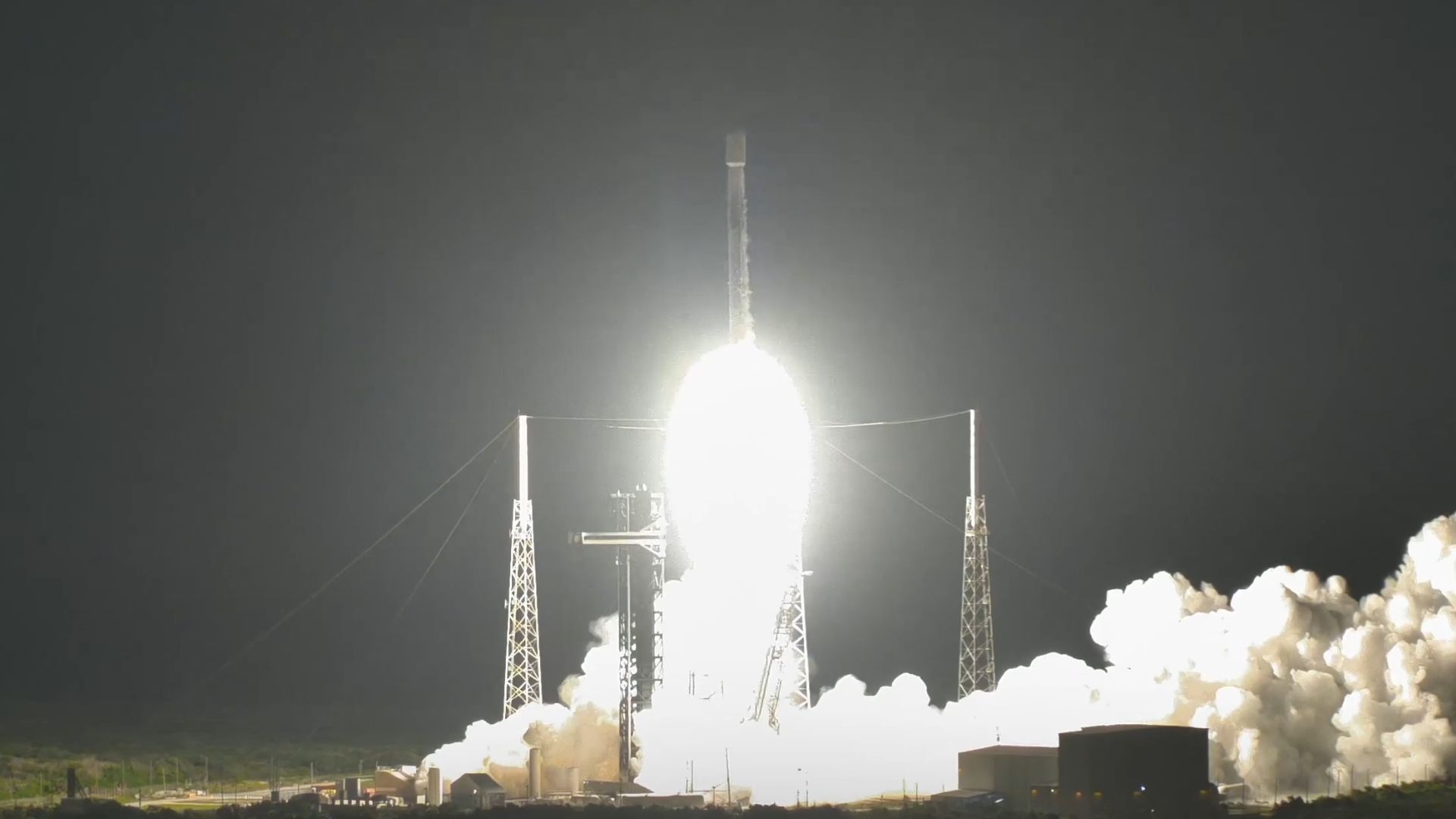
SpaceX launched a secret mission for the U.S. Space Force today (Sept. 10) from California's central coast.
A Falcon 9 rocket lifted off from Vandenberg Space Force Base today at 11:42 a.m. EDT (1542 GMT; 8:42 a.m. local time), kicking off a mission called USSF-153.
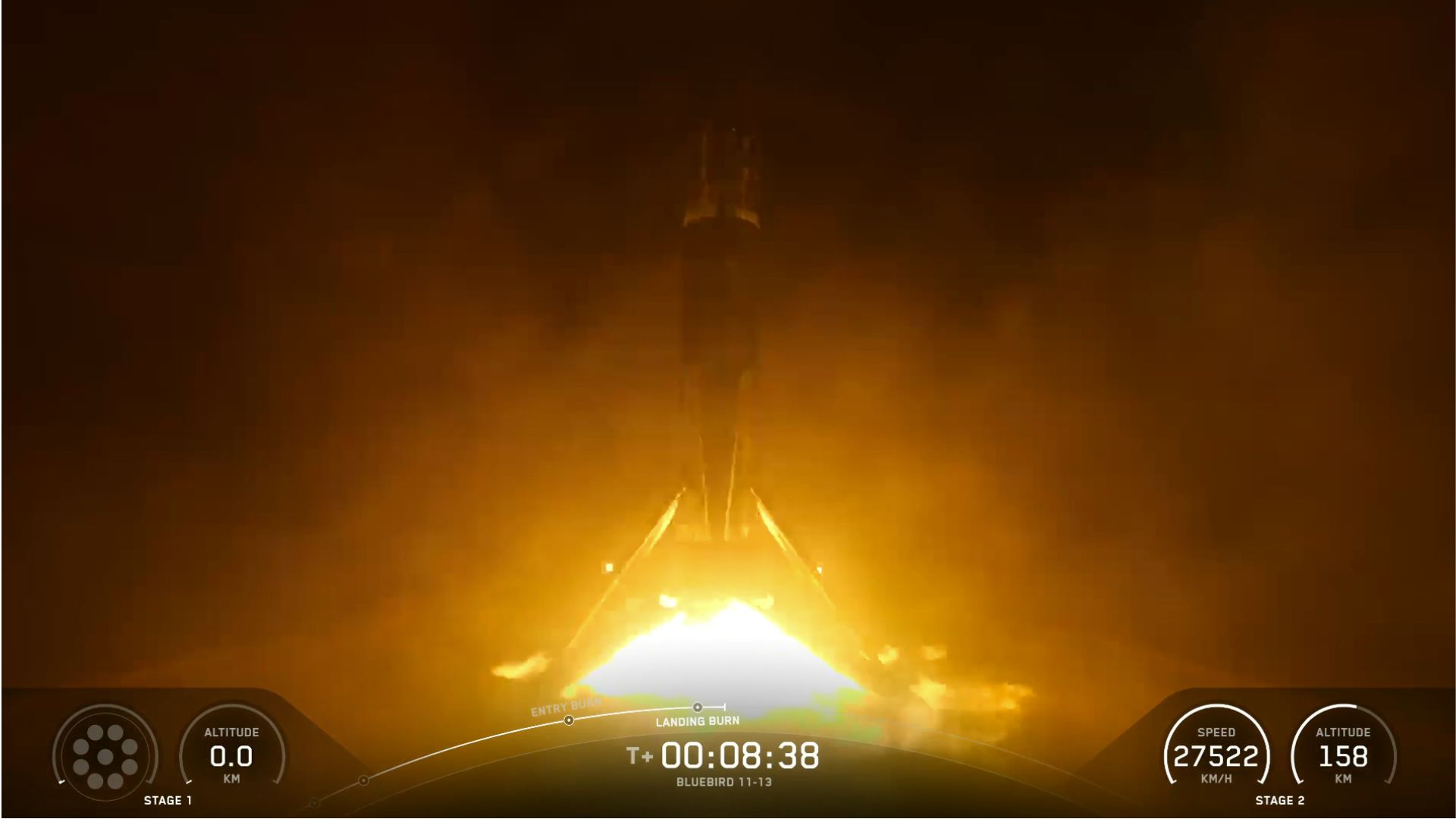
The rocket's first stage came back to Earth about 8.5 minutes later, landing in the Pacific Ocean atop the SpaceX drone ship "Of Course I Still Love You." It was the 27th flight for this particular booster, which is designated B1801. The record for a SpaceX rocket is 37, set last month during a launch of the company's Starlink internet satellites.
The first stage of a SpaceX Falcon 9 rocket rests on the deck of a drone ship after launching the USSF-153 mission from Vandenberg Space Force Base in California on Sept. 10, 2026. (Image credit: SpaceX)
USSF-153 is a classified mission, so little is known about its payloads — what they are or where exactly they're headed. We didn't get much clarity from the webcast, which ended shortly after the Falcon 9's first stage landed.
However, the location of that touchdown provided some potentially useful information about USSF-153, according to NextSpaceflight.com.
The mission might be carrying "a batch of classified LEO [low Earth orbit] satellites for a U.S. government entity based on SpaceX's Starshield satellite bus, based on locations of rocket stage drop zones being exact fits with previous Starlink Group 15 launches," the outlet wrote.
"Starshield leverages SpaceX's Starlink technology and launch capability to support national security efforts," SpaceX wrote in a description of the Starshield program.
Today's launch was the 104th Falcon 9 mission of 2026. Eighty of the rocket's flights this year have been dedicated to building out the Starlink megaconstellation, which currently consists of more than 11,000 active spacecraft.
Editor's note: This story was updated at 11:55 a.m. ET on Sept. 10 with news of successful launch and rocket landing.
SpaceX launched 27 more of its Starlink internet satellites to orbit today (Sept. 6).
The spacecraft rode to low Earth orbit (LEO) atop a Falcon 9 rocket, which lifted off from California's Vandenberg Space Force Base at 10:26 a.m. EDT (1426 GMT; 7:26 a.m. local California time). The Falcon 9 rose into blue morning skies — something of a rarity for California's central coast, which is often cloaked in fog.
The Falcon 9's first stage came back to Earth as planned 8.5 minutes later, landing in the Pacific Ocean on the SpaceX drone ship "Of Course I Still Love You."
A SpaceX Falcon 9 rocket launches 27 Starlink satellites into orbit from Vandenberg Space Force Base in California on Sept. 6, 2026. (Image credit: SpaceX)
It was the 19th flight for this particular booster, which is designated B1088. This marks about the halfway point to the SpaceX record of 37 flights, which was set by B1067 during a Starlink launch on Aug. 25.
The Falcon 9's upper stage, meanwhile, carried the 27 Starlink satellites to LEO, deploying them on schedule 62 minutes after launch.
SpaceX's sooty Falcon 9 rocket first stage on the drone ship Of Course I Still Love You in the Pacific Ocean after a successful launch and landing on Sept. 6, 2026. (Image credit: SpaceX)
Today's launch was the 103rd Falcon 9 mission of 2026. Eighty of those flights have been dedicated to building out the Starlink megaconstellation, by far the largest satellite network ever assembled. It currently consists of more than 11,000 active spacecraft, according to astronomer and satellite tracker Jonathan McDowell.
Starlink missions fly exclusively out of Vandenberg these days. SpaceX used to launch them from Florida as well, but the company recently put those missions on hold until it gets its Starship megarocket up and running on the Space Coast.
SpaceX will rely on Starship to launch its next-gen Starlink V3 satellites, which are bigger and more capable than the current V2. The company wants to assemble a network of about 100,000 Starlink V3s in LEO, Elon Musk has said.
No rocket had ever reached orbit from Western European soil — until today.
The German company Isar Aerospace launched its Spectrum rocket from Andøya Space Center in northern Norway today (Sept. 5) at 4:12 p.m. EDT (2012 GMT; 10:12 p.m. local time in Norway). A little over seven minutes later, it etched its name into the record books, settling into an elliptical path around our planet.
"This is right now making history — making history for Spectrum, making history for Isar, making history for Europe,” Nikolaos Perakis, Spectrum chief engineer at Isar, said during today's launch webcast, which the company produced in collaboration with NASASpaceflight. "I'm incredibly proud of this massive achievement."
The view from the second stage of Isar Aerospace's Spectrum rocket after it reached orbit on Sept. 5, 2026. (Image credit: Isar Aerospace/NASASpaceflight)
This was Spectrum's second bite at the apple: The two-stage, 95-foot-tall (28-meter-tall) rocket first flew in March 2025, lifting off from Andøya on a flight Isar called "Going Full Spectrum." But, as often happens on debut missions, Spectrum suffered an anomaly that day; it came crashing back to Earth less than a minute after launch.
"A comprehensive investigation was completed within two months of the launch," Isar wrote in a September 2025 update. "The findings identified an unintended opening of the vent valve and a loss of attitude control at the start of the roll maneuver as the initiating events that led to the in-flight failure."
The company took the lessons learned that day and geared up for flight number two, "Onward and Upward," which was originally supposed to launch in January.
An issue with a pressurization valve nixed that plan, however, pushing the flight to March. Bad weather and an intruding boat scuttled multiple attempts that month, and an April 9 try was scrubbed due to a leak in a composite overwrapped pressure vessel.
Isar next tried to fly on June 15 but stood down after "detecting off-nominal behavior in the vehicle's fluid systems," according to a company update that day on X. But the company got that issue under control, rolling Spectrum back to the pad for today's launch.
"We had some delays, obviously," Petrakis said during the webcast. "We had some setbacks, but we came back stronger from them. And it validates this tremendous amount of engineering across all the teams, and that's what brings us into orbit."
Spectrum didn't carry viable payloads on its debut flight, but it did today: Five cubesats and one non-deployable scientific experiment went up on "Onward and Upward."
Spectrum's upper stage needed to deploy those payloads before Isar could declare full mission success. And deployment couldn't occur until after the rocket performed a circularization burn to get out of its initial elliptical orbit, which was estimated to feature a closest approach to Earth of 112 miles (180 kilometers) and a farthest-away point of 311 miles (500 km).
Spectrum was able to check those boxes, ultimately deploying the payloads as planned, Isar announced via X about two hours after launch.
So today was a very big day for Isar, which is thinking big with Spectrum. The company sees the rocket — which can haul about 2,200 pounds (1,000 kilograms) of payload to low Earth orbit — becoming a workhorse launcher of small to medium-size satellites down the road, and its infrastructure supports that vision. Isar says its manufacturing facility near Munich can churn out more than 30 of the rockets per year.
“Flight 2 is a big, big milestone, big success," Petrakis said. "But this is just the beginning. So I'm really looking forward to the next steps."
Spectrum is the first rocket to reach orbit from Western Europe, but others have long flown from a different part of the continent — the Russian part. For example, Plesetsk Cosmodrome has hosted orbital launches for about six decades now. (About 25% of Russia lies in Europe, with the rest classified as part of Asia.)
Editor's note: This story was updated at 4:45 p.m. ET with news of successful launch and orbital insertion, then again at 8:35 p.m. ET with news of payload deployment.
Concentrations of dangerous pollutants from rocket launches and satellite reentries in Earth's upper atmosphere might reach treacherous tipping points if constellations of hundreds of thousands of orbiting data centers get deployed in the next decade, experts say.
There's no question that Earth has an AI data center problem. By 2030, AI data centers may be responsible for up to 17% of electricity consumption in the U.S., according to a forecast by the Electric Power Research Institute. New fossil fuel power plants are being built to feed the growing demand for electricity, and aging ones are kept online despite decarbonization plans. On top of that, huge amounts of water are taken from already strained reservoirs to cool the computers.
Companies such as SpaceX, Amazon and Blue Origin say they have a solution: moving the power-hungry data crunching infrastructure into space, where solar power is easy to produce, and heat can be radiated out into the frigid vacuum. Combined, those companies have filed applications to the U.S. Federal Communications Commission to launch more than a million orbiting data centers in the next 10 years. Most of those will belong to SpaceX, if all goes to plan; Elon Musk has said the company wants to operate a million-satellite AI constellation all by itself.
The plans are making atmospheric scientists tear their hair out. If all these projects come to fruition, the number of satellites being launched to space and reentering the atmosphere will increase 100 times compared to today's numbers.
Moreover, the data center satellites will be much larger than the spacecraft orbiting Earth today. This large mass will translate into higher quantities of polluting propellant needed to loft these systems off Earth and a much larger amount of metals vaporizing in Earth's atmosphere during reentry. Neither is good news for our planet's air.
Pristine upper atmosphere
"Launches and the reentries are really the only things that humans do that deposit material directly into the upper atmosphere," Aaron Boley, an astronomy professor and space sustainability researcher at the University of British Columbia, told Space.com. "And the way things mix in the upper atmosphere means that the launch and reentry emissions are by far more impactful."
Most rockets emit black carbon, which could worsen global warming. Satellite bodies are mostly made of aluminum, which likely turns into aluminum oxide when burned in the presence of oxygen. Aluminum oxide is known for its ability to trigger ozone depletion, a hazardous process that was successfully thwarted by the Montreal Protocol of 1987.
Currently, scientists don't have a precise understanding of the chemical reactions that occur between the pollutants and the atmospheric gases at high altitudes. They also don't understand the tipping points, which may mean the difference between minor and major impacts on the climate. What is worse, pollutants in the upper atmosphere remain much longer than those emitted by cars and factory chimneys close to the ground.
"Close to the ground, we have rain and wind that removes pollution from the atmosphere within weeks," Eloise Marais, a professor of atmospheric chemistry at University College London, told Space.com. "If we put it into the higher layers of the atmosphere, we rely on very slow atmospheric processes to bring this pollution back down."
Too many launches
Black carbon from rockets, for example, can stay in the atmosphere for three years, scientists think, meaning its concentrations could dangerously rise in the near future.
SpaceX's Starship megarocket is likely to play a key role in the deployment of data center constellations. Unlike SpaceX's current workhorse launcher Falcon 9, which burns a form of the aviation fuel kerosene, Starship combusts the much cleaner combination of methane and liquid oxygen. But Marais cautions that Starship's size and the much more frequent launches that will be needed to deploy the vast constellations would result in an overall increase in the pollution injected into the upper atmosphere.
"Starship is a bigger rocket burning more propellant," Marais said. "So, in terms of each rocket launch, the difference almost offsets. It has potential per launch to produce quite similar amounts of black carbon."
Andrew Wilson, a space sustainability researcher at Glasgow Caledonia University in the U.K., told Space.com that every single Starship launch produces around 76,000 metric tons of carbon dioxide equivalent. That's about as much as 17,727 gasoline-powered passenger cars emit in a year.
And up to 77,000 Starship launches — some 15,300 per year — might be needed, according to estimates by Ars Technica, to deploy SpaceX's planned million-data-center constellation. That's a lot of rocket pollution added into the atmosphere. For comparison, there were just 324 orbital rocket liftoffs globally in 2025, according to Space News.
SpaceX's Starship megarocket launches on its 13th test flight, on July 24, 2026. (Image credit: SpaceX)
The space junk rain
Then there is the toxic ash from reentering satellites. Today, nearly 19,000 operational and defunct satellites orbit Earth, according to the European Space Agency. Currently, the most numerous type of satellite in Earth orbit is SpaceX's Starlink V2 Mini, each of which weighs about 1,760 pounds (800 kilograms). But SpaceX's orbital data centers are likely to be much more massive. Featuring solar arrays 246 feet (75 m) wide, every data center satellite might weigh up to 7.5 metric tonnes, according to available estimates.
Industry insiders expect that SpaceX and other providers would want to replace their AI satellites every five years with newer technology, as they do with existing communications satellites. As a result, tens or even hundreds of tons of metal may be reentering the atmosphere every year in the future, exceeding the amount of natural space rock that hits the planet.
The materials that satellites are made of are not naturally present in Earth's atmosphere, which means the consequences of such reentries can be unpredictable.
"Only 10 years ago, the reentries were not really a concern, because there were much more natural meteorites entering the atmosphere per year," Wilson said. "But if you have hundreds of thousands or millions of satellites in space at any one time, you are essentially going to create a rain of man-made materials, electronic equipment and metals that otherwise wouldn't be coming into the atmosphere."
He added that the situation is akin to ongoing climate change, which shows no signs of slowing down as humanity has so far failed to reduce carbon emissions.
"This is the most objects we've ever had in space, and we're continuing to propose more and more and more and more and more," Wilson said. "And there seems, in my opinion, to be very little consideration for the environment."
Not enough funding is currently flowing into research to answer the unknowns, Marais added.
"We need way more observations and way more time to be able to look into that," she said.
Boley concurred: "We absolutely have to understand, and we have to understand that before we actually launch a million satellites. Not that we launch them and wait [to see] what happens."
The plans of the satellite companies are stirring protests also among astronomers, who fear that the light pollution the constellations create will impact astronomical observations. A recent study by the European Southern Observatory concluded that, if all currently planned satellite constellation projects were to be built, astronomical research from the surface of Earth would no longer be possible.
Rocket Lab plans to start launching even more frequently and flexibly, thanks to a new portable spaceport system called "GHOST."
GHOST — short for "Global Hypersonic & Orbital Spaceport Technology" — turns the company's "Electron and HASTE rockets into a launch-anywhere, launch-anytime capability for multi-launch flight campaigns and critical national security missions," Rocket Lab representatives said in a statement today (Aug. 10).
"Packaged entirely within standard shipping containers, GHOST deploys complete rockets, launch infrastructure, ground support and range control systems anywhere in the world," they added.
Electron is Rocket Lab's workhorse orbital rocket, giving small satellites dedicated rides to the final frontier. The expendable 59-foot-tall (18-meter-tall) launcher debuted with a test flight in 2017 and has 83 missions under its belt to date.
As its full name suggests, HASTE ("Hypersonic Accelerator Suborbital Test Electron") is a suborbital version of Electron that customers use to test various technologies in the hypersonic flight environment. HASTE first flew in June 2023 and has flown nine times to date, most recently in June of this year.
Rocket Lab currently flies from two different launch sites — one on the North Island of company founder and CEO Peter Beck's native New Zealand and one at Wallops Island in Virginia. But the company recently announced plans to fly out of Alaska's Pacific Spaceport Complex as well, and GHOST will expand its launch footprint even further.
"Electron and HASTE revolutionized small orbital launch and hypersonic testing. Now we're making it easier to deploy them wherever they're needed most, whether that's for missile defense testing or sovereign orbital launch capability," Beck said this afternoon during Rocket Lab's second-quarter 2026 earnings call.
"We've mastered the art of building launch sites," he added. "Now we're making them deployable worldwide."
Rocket Lab intends to deploy its two planned pads at the Pacific Spaceport Complex using GHOST, Beck said during the call. The company was inspired to develop the portable spaceport system, he added, to meet the needs of a HASTE customer, who expressed a desire for Rocket Lab to be "a little bit more mobile than we are."
Rocket Lab currently flies out of two pads at its New Zealand site and one at Wallops, though it has built a second pad at the Virginia facility to accommodate launches of its coming Neutron rocket.
Neutron will be bigger and more powerful than Electron, and partially reusable as well; its first stage is designed to come back to Earth for recovery and reflight, like SpaceX's Falcon 9.
Rocket Lab originally wanted to fly Neutron for the first time in 2024, but the new launcher has yet to leave the ground. Such delays aren't uncommon in the case of new rockets, and the company is making considerable progress with Neutron, according to Beck.
"Every part of the vehicle has now seen significant testing," he said during today's call. "As with any complex development program, we've had to tweak a few things along the way, but we're moving now into final checkout and assembly of all of our flight hardware before integrating them at the pad."
The company is on target to deliver the first Neutron to that Wallops pad in the fourth quarter of this year, Beck added.
China's latest rocket launch ended in failure this morning, lighting up the skies with some unwanted fireworks.
The state-owned China Aerospace Science and Technology Corporation (CASC) launched a Long March 7A rocket today (Aug. 10) from the Wenchang Space Launch Site, in the country's Hainan province, just after 8:00 a.m. EDT (1200 GMT; 8:02 p.m. local time). Around 85 seconds into the launch, the rocket exploded, generating a massive fireball and a cloud of smoke and debris while still soaring through Earth's atmosphere.
CASC had not yet released a statement about the incident by the time of this story's publication, but video reposted to social media captured the shock of onlookers the moment that the rocket burst into flames. Based on such views, the mission will almost certainly be deemed a complete failure, with total loss of vehicle and payload.
The Long March 7A's four side boosters and core stage detach as a full cluster during first stage separation, which typically occurs just under three minutes after liftoff. As today's incident occurred just 85 seconds into flight, the rocket was still engaged in the main stage's initial engine burn to escape Earth's atmosphere.
The 7A — a variant of China's Long March 7 rocket family — stands just over 197 feet (60 meters) tall and combines the first two Long March 7 stages with a hydrolox (liquid hydrogen and liquid oxygen)-powered third stage capable of launching up to 7 tons to geostationary transfer orbit (GTO).
A Long March 7A rocket carrying the ChinaSat 4B satellite launches from the Wenchang Spacecraft Launch Site on Aug. 10, 2026. The launch was not successful. (Image credit: Meng Zhongde/VCG via Getty Images)
According to China National Radio, today's launch carried China's Zhongxing-4B spacecraft,, a communications satellite presumably bound for GTO. China's Zhongxing satellites provide telecommunications and broadband internet services and are also thought to provide services for China's military.
It is unclear what repercussions today's explosion may have on upcoming launches, including a Chinese Zhuque-3 rocket liftoff scheduled for Monday evening. That mission is scheduled to fly from China's Jiuquan Satellite Launch Center, more than 1,500 miles (2,415 kilometers) from Wenchang, at 7:45 p.m. EDT (2345 GMT; 7:45 a.m. local time), and is expected to feature a first-stage landing attempt.
CASC uses the standard Long March 7 rocket, which shares its core stage with the 7A, as its launch vehicle for delivering cargo to the Tiangong space station in low Earth orbit about every eight months. The most recent of those missions launched in May, putting the next resupply launch sometime around January 2027. Depending on the cause of this morning's explosion, that mission and others could face delays as China investigates the incident.
Editor's note: This story was updated at 4:20 p.m. ET on Aug. 10 with new photos of the launch.
Japan's H3 rocket flew for the ninth time ever this afternoon (Aug. 10).
The H3 lifted off from Tanegashima Space Center today at 3:23 p.m. EDT (1923 GMT; 4:23 a.m. on Aug. 11 local time), carrying the Michibiki 7 navigation satellite aloft.
The H3's upper stage deployed Michibiki 7 into its target orbit 29 minutes later, eliciting cheers from the folks in mission control.
A closeup of the H3's first stage powering the rocket to orbit on Aug. 10, 2026. (Image credit: JAXA)
The two-stage H3 is the successor to Japan's workhorse H-2A rocket, which retired last year after a total of 50 flights.
The H3 — which stands 187 feet or 207 feet (57 or 63 meters) tall, depending on what type of payload fairing it employs — debuted in March 2023 and had eight liftoffs under its belt before today.
Two of those eight were failures — the debut flight and the launch of Michibiki 5 in December of last year. But the H3 bounced back from that latter anomaly two months ago, successfully delivering six satellites to orbit on June 11.
Michibiki 7 will be part of Japan's Quasi-Zenith Satellite System (QZSS), a homegrown navigation system that operates high above Earth in geosynchronous orbit.
"This system is compatible with GPS satellites and can be utilized with them in an integrated fashion," Japanese officials wrote in a description of the QZSS project. "QZSS can be used even in the Asia-Oceania regions with longitudes close to Japan, so its usage will be expanded to other countries in these regions as well."
The QZSS network will eventually consist of 11 satellites, if all goes according to plan. There are five such spacecraft operating in orbit at the moment.
Michibiki 7 is carrying a payload for the United States as well — the Situational Awareness Camera Hosted Instrument (SÃCHI), which was developed for the U.S. Space Force by the MIT Lincoln Laboratory. This is the second of two SACHIs to go up on a QZSS satellite; Michibiki 6, which launched atop an H3 in February 2025, hosts the other one. (Yes, Michibiki 6 launched before Michibiki 5.)
"This program will allow the United States to monitor satellite behavior within the GEO belt over a very interesting part of the world," Mark Huber, a technical staff member in the Lincoln Laboratory's Space Systems and Technology Division, said in a statement in December 2020.
"It is also a pathfinder in several ways," he added. "The U.S. team is blueprinting methods to allow sensitive data sharing between the United States and Japan."
Editor's note: This story was updated at 3:55 p.m. ET on Aug. 10 with news of successful launch and satellite deployment.
The rocket's first stage returned to Earth as planned about 8.5 minutes later, landing in the Pacific Ocean atop the SpaceX droneship "Of Course I Still Love You." It was the 16th flight for this particular booster, which is designated B1093.
A SpaceX Falcon 9 rocket launches 24 Starlink internet satellites from California's Vandenberg Space Force Base on Aug. 8, 2026. (Image credit: SpaceX)
B1093's most recent flight before today was on July 14, when it launched 27 Starlink satellites to LEO from Vandenberg.
Meanwhile, the Falcon 9's upper stage continued carrying the 24 Starlink satellites toward LEO today, deploying them about 61 minutes after liftoff as planned.
Today's launch was the 92nd Falcon 9 liftoff of 2026, and the 71st of the year devoted to building out the Starlink megaconstellation.
Starlink, by far the largest orbiting network ever assembled, currently consists of more than 10,900 active satellites — and it's growing all the time.
It looks like Starship's two-week-long ocean adventure won't have a happy ending.
The SpaceX megarocket conducted its 13th test flight on July 24, lifting off from the company's Starbase site in South Texas. Things went pretty well on Flight 13, especially for Starship's 171-foot-tall (52 meters) upper stage, known as Ship, which splashed down as planned in the Indian Ocean off the coast of Western Australia.
In an unexpected first, Ship survived that homecoming, staying in one piece even after toppling over and hitting the waves. It remains intact still, and SpaceX is towing it toward shore in Western Australia to get a better look. But the ambitious effort is unlikely to succeed, SpaceX founder and CEO Elon Musk told us today (Aug. 7).
SpaceX works to get the upper stage from Starship's 13th test flight to shore from its Indian Ocean splashdown site. This is a screenshot from a video the company posted on X on Aug. 7. (Image credit: SpaceX)
"Unfortunately, ship recovery is not looking good right now. Nonetheless, we were able to obtain close-up photos of critical regions of the heat shield and engines for future upgrades," Musk wrote this afternoon via X, the social media site he owns.
He was responding to a SpaceX post from an hour or so earlier, which provided an update about the recovery effort and shared two photos and a video of the activities.
The recovery team has "been overcoming challenging conditions and increasingly rough seas as they attempt to guide the 52m long spacecraft to port," SpaceX wrote in the post.
The SpaceX Recovery team is still working to recover Flight 13’s Starship from the Indian Ocean. They’ve been overcoming challenging conditions and increasingly rough seas as they attempt to guide the 52m long spacecraft to port pic.twitter.com/ECT5FyCvr7August 7, 2026
Starship is the biggest and most powerful rocket ever built, standing about 408 feet (124 meters) tall when stacked. Both of its stages — Ship and the Super Heavy booster — are designed to be fully and rapidly reusable, a breakthrough that SpaceX thinks will revolutionize spaceflight.
A key enabler of rapid reuse is Ship's heat shield, which protects the vehicle during its downward trips through Earth's atmosphere. Musk has described heat shield development as perhaps the biggest challenge on Starship's road to operational flight — but that challenge may now be in the rearview mirror.
"I don't want to jinx it or anything, but I think I'd consider the heat shield problem solved at this point," Musk said on Tuesday (Aug. 4), during SpaceX's first-ever quarterly earnings call.
It's no surprise that Starship and Flight 13 came up in that call. The megarocket is key to SpaceX's ambitious future plans, which include assembling and operating a million-satellite AI constellation in Earth orbit.
Flight 13 was similar to previous Starship test missions; it was a suborbital jaunt that ended with Super Heavy coming down in the Gulf of Mexico and Ship landing in the Indian Ocean.
There was a big milestone, however, in addition to Ship's unexpected transition to seagoing vessel: During its time in space, the upper stage deployed 20 functional Starlink V3 satellites, the bigger, next-gen variant of SpaceX's broadband spacecraft.
These satellites quickly came back down to Earth on July 24, but Flight 13 was a vision of the future nonetheless. SpaceX wants to operate a constellation of 100,000 or so Starlink V3s, and this network will be lofted by Starship.
A private rescue spacecraft is having troubles of its own in Earth orbit.
LINK, a satellite built and operated by the Arizona company Katalyst Space Technologies, launched July 3 on a daring and unprecedented mission: Rendezvous with NASA's Swift space telescope and boost the observatory to a higher orbit before it falls out of the sky.
About three weeks after launch, however, LINK started spinning at an unexpected rate, a problem that caused a temporary communications dropout and a reset of its satellite platform. And two of LINK's three orientation-controlling reaction wheels stopped working.
Spacecraft operators always work hard to fix such problems when they crop up, but there's a special urgency where LINK is concerned. It needs to reach Swift soon, or atmospheric drag will pull the observatory — which possesses no thrusters of its own — down past a point of no return. NASA thinks this boundary lies at around 186 miles (300 kilometers) above Earth, an altitude that Swift is expected to reach by October.
So the original plan called for LINK to meet up with Swift in early August, just a month after launch — pretty much as soon as commissioning work on the rescue craft wrapped up. That's not going to happen at this point, but mission teams haven't given up on the rescue attempt. Indeed, they're making progress on getting LINK back up to speed, as a new update relates.
"LINK originally was in a multi-axis spin rotating at about 9 degrees per second, which resulted in sporadic communications and impeded LINK’s progress toward Swift," NASA officials wrote in the update, which the agency posted on Thursday (Aug. 6).
"Using a series of burns from one of LINK’s electric propulsion thrusters, the Katalyst team now has slowed that spin to about 1.47 degrees per second," they added. "Katalyst plans to keep LINK at that spin rate as it proceeds with next steps for the mission."
Those next steps include uploading flight software updates "with new attitude controllers designed to maintain LINK’s stability in its current configuration," NASA officials wrote. "These updates would allow LINK to begin maneuvering to align with Swift’s orbit."
The updates are expected to be beamed up to LINK "in the coming days," according to the update.
Artist's illustration of Katalyst Space Technologies' Link servicing spacecraft approaching and capturing NASA's Swift space observatory on an orbit-boosting mission. (Image credit: Katalyst Space Technologies)
Swift — officially known as the Neil Gehrels Swift Observatory, launched in 2004 to study gamma-ray bursts, the most energetic events in the universe.
The $250 million telescope's initial altitude was about 375 miles (600 km). But it has fallen considerably since then, and the descent is accelerating: The lower Swift goes, the more atmosphere it encounters and the greater the force of frictional drag becomes.
Swift is still working just fine, which explains why NASA wants to save it. Last September, the agency awarded Katalyst $30 million to build LINK — a refrigerator-sized spacecraft with three robotic arms — and fly its rescue mission.
That's a very tight timeline, but Katalyst hit it, getting LINK ready by its launch date and checking off a number of commissioning milestones before running into trouble. The company has experience delivering under pressure, so maybe it can pull off the rescue craft's rescue before it's too late.
The Chinese commercial launch company Landspace is set for a second attempt at catching an orbital booster.
The startup launched its first Zhuque-3 rocket in December 2025, in what was a milestone for Chinese rocket reusability efforts. While the Zhuque-3 second stage successfully reached orbit, the first stage exploded in a dramatic fireball during its final powered descent toward the landing pad.
Now, Landspace is poised for a second attempt at liftoff and landing, with airspace closure notices indicating that launch is scheduled from the Dongfeng commercial space innovation pilot zone at Jiuquan spaceport, in northwest China, at around 7:45 p.m. EDT on Aug. 10 (23:45 GMT, or 7:45 a.m. Beijing time, Aug. 11).
UPDATE | ZhuQue-3 Y2 Reusable Launch Vehicle Completed Static Fire TestOn June 29, 2026, LandSpace's ZhuQue-3 Y2 reusable launch vehicle successfully completed a static fire test at the Dongfeng Commercial Space Innovation Pilot Zone.The test comprehensively verified the… pic.twitter.com/G9EzZbnyqBJune 29, 2026
The company conducted a successful static fire test on June 29 in preparation for the launch.
"All systems operated normally, and test data and results met expectations, validating the correctness and coordination of system operations and laying a solid foundation for upcoming flight missions," Landspace stated in a post that day on the social media platform X.
Zhuque-3 is a 216-foot (66-meter) stainless steel rocket powered by methane-liquid oxygen engines. It's similar in capabilities to SpaceX's Falcon 9, and is capable of sending 40,350 pounds (18,300 kilograms) of payload to low Earth orbit (LEO).
The Aug. 10 launch will be China's fourth orbital booster recovery attempt. The first was the Zhuque-3 launch in December 2025; the second was the debut, just days later, of the Long March 12A, which also reached orbit but with a first-stage recovery attempt ending in flames. The third try, using the Long March 10B, took place on July 10. That one was successful: China made history, becoming just the second country to land an orbital booster, in this case using a vessel equipped with a net-capture system.
Landspace, when it makes its expected second attempt next week, will use a powered descent and landing legs, similar to the Falcon 9.
A Japanese Earth-observing satellite got to orbit early this morning (Aug. 6), five weeks later than originally planned.
The spacecraft — a radar satellite that will be operated by the Tokyo-based company iQPS — lifted off atop a Rocket Lab Electron vehicle from New Zealand today at 5:18 a.m. EDT (0918 GMT; 9:18 p.m. local time).
It was a deferred round two for the mission: Rocket Lab originally tried to launch it on June 30 but aborted that attempt at the last second. The company has not yet revealed what caused that abort.
A Rocket Lab Electron rocket launches "The Grain Goddess Provides" mission for the Japanese company iQPS from New Zealand on Aug. 6, 2026. (Image credit: Rocket Lab)
Everything went well on this morning's flight, which Rocket Lab called "The Grain Goddess Provides." The Electron deployed the iQPS satellite into its target orbit about 357 miles (575 kilometers) above Earth, Rocket Lab announced via X this morning.
The spacecraft — known as QPS-SAR-13 or MIKURA-I, after a Japanese goddess associated with abundance and prosperity — will study our planet using high-resolution synthetic aperture radar (SAR), which can peer through clouds and collect imagery both day and night.
iQPS is building a constellation of 36 such SAR satellites in low Earth orbit. Electron is the primary launcher for this network; "The Grain Goddess Provides" was the eighth of a total of 15 launches that Rocket Lab will conduct to help assemble the constellation.
A closeup of the Electron's nine first-stage Rutherford engines in action on Aug. 6, 2026. (Image credit: Rocket Lab)
Today's mission was the 92nd overall for Rocket Lab and the company's 13th of 2026. Most of these flights have involved the 59-foot-tall (18 meters) Electron, the company's workhorse small-satellite launcher. But a growing number these days are performed by HASTE, a suborbital variant of Electron that allows customers to test technologies in a hypersonic flight environment.
Blue Origin is close to figuring out why its New Glenn rocket went boom a few months ago.
The explosion — which destroyed the rocket and some key pieces of pad infrastructure — occurred on May 28 during a routine engine test at Florida's Cape Canaveral Space Force Station. Blue Origin has been working hard ever since to determine the cause of the anomaly, and it has made considerable progress, according to a new update.
"The anomaly originated at the main oxygen valve on one of the BE-4 engines, which was later confirmed by hardware recovery and inspections," Blue Origin CEO Dave Limp said via X on Wednesday afternoon (Aug. 5). "Extensive component-level and engine hotfire tests have been conducted to understand the failure mode better and inform mitigations."
Like SpaceX's workhorse Falcon 9 rocket, the 320-foot-tall (98-meter) New Glenn features a reusable first stage, which is powered by seven BE-4s and designed to launch at least 25 times. The heavy lifter is a big part of Blue Origin's ambitious plans, which include helping humanity establish a foothold in the final frontier.
"The rocket is engineered with the safety and redundancy required to fly humans, and will enable our vision of building a road to space for the benefit of Earth," Blue Origin's website states.
The company, and NASA, are counting on the rocket to get important hardware to the moon. New Glenn will be the ride for Blue Origin's Blue Moon, one of two crewed landers that NASA picked to get astronauts to and from the lunar surface for its Artemis program. (The other is SpaceX's Starship.)
And there's an important Blue Moon mission coming up: the first test flight of the prototype Mark 1 lander, which is scheduled to make an uncrewed lunar touchdown by the end of this year, if possible. That mission will help prove out the vehicle's capabilities ahead of crewed flights.
Wanted to give an update on the hotfire anomaly investigation. Progress continues. The anomaly originated at the main oxygen valve on one of the BE-4 engines, which was later confirmed by hardware recovery and inspections. Extensive component-level and engine hotfire tests have…August 5, 2026
New Glenn debuted in January 2025 and has flown two more times since, in November 2025 and April 19 of this year. There was an issue on that most recent launch, which carried up AST SpaceMobile's BlueBird 7 communications satellite: New Glenn failed to deploy the payload into the proper orbit, and it was lost.
Despite that issue, and the May 28 explosion, Limp expressed confidence that Blue Origin will soon get New Glenn up and running again.
"The path forward is clear," he added in Wednesday's X post. "We're making small modifications to the valve that can be quickly retrofitted to existing engines. We’re manufacturing the updated hardware, which will be ready by the end of this month. In parallel, we're working through the remaining fault tree analysis."
SpaceX will make some history this month, if all goes according to plan.
The company aims to launch the 14th test flight of its Starship megarocket before August is out, Elon Musk said today (Aug. 4) during SpaceX's first-ever quarterly earnings call. Starship will deploy viable payloads into orbit on Flight 14, something it has never done before — and there will be other unprecedented action as well.
"I'd say things look very good, and that's why we, assuming we receive regulatory approval to do so, will attempt to catch the Ship with the tower on the next flight, which is tentatively scheduled for the end of this month," Musk said during today's call.
"Ship" is the 171-foot-tall (52 meters) upper stage of Starship, which also features a giant first-stage booster called Super Heavy. Both of these elements are designed to be fully and rapidly reusable — a breakthrough that, combined with Starship's immense power, will revolutionize spaceflight, according to SpaceX.
And "things look very good" is a reference to Starship Flight 13, which lifted off on July 24. Musk was talking specifically about Ship's performance on that suborbital jaunt, which ended with the upper stage's soft splashdown in the Indian Ocean, off the coast of Western Australia.
Ship's heat shield survived the harrowing downward trip through Earth's atmosphere in great shape on Flight 13, according to SpaceX (as did the entire vehicle, which is still in one piece to this day). And that gives SpaceX confidence to plan for a tower catch on Flight 14 — a crucial component of Starship's future reusability.
"I don't want to jinx it or anything, but I think I'd consider the heat shield problem solved at this point," Musk said.
Starship's two launch towers at its Starbase site in South Texas feature large "chopstick" arms, which stack Super Heavy and Ship atop the pad — and can also catch the vehicles when they come back to Earth at the end of their missions.
SpaceX has already executed a tower catch with Super Heavy on three Starship test flights, but it has not yet tried to do so with Ship. So Flight 14 could be momentous, provided SpaceX gets permission from regulators to make an attempt.
Flight 14 will also carry up a batch of SpaceX's V3 Starlink satellites, a larger and more capable version of the spacecraft that currently populate the company's broadband megaconstellation. Flight 13 toted 20 Starlink V3s, but Ship deployed them into suborbital space; the satellites will be placed into an operational orbit on the upcoming mission, if all goes to plan, Musk said.
SpaceX goes public
Musk founded SpaceX as a private company back in March 2002. It stayed that way until this past June 12, when SpaceX went public via the richest IPO in history, which raised $86 billion and valued the company at $1.77 trillion.
SpaceX now has to provide earnings reports every quarter, starting with Q2 of this year. And these first publicized numbers show considerable improvement compared to a year ago, according to the company.
The newly released report states that total revenue in the March-June time period was up 92% over the same stretch in 2025 — $7.8 billion versus $4.1 billion. And SpaceX had a net loss during this span of $541 million, down from a net loss of $1.0 billion in Q2 2025.
More than half of this quarter's revenue — about $4.3 billion — came via the company's Starlink satellite-internet megaconstellation. That number crystallizes a truth that has been apparent for a while now — SpaceX is not just a launch company anymore.
Rockets will bring in a smaller and smaller share of SpaceX revenue over the coming years, if all goes according to plan. Launch will continue ceding this financial ground to Starlink, but also, increasingly, to SpaceX's artificial intelligence (AI) operations.
Indeed, SpaceX sees itself becoming more and more of an AI outfit over time. A few months ago, the company revealed that, over the long haul, it's targeting a "total addressable market" of $28.5 trillion per year, nearly $23 trillion of which will be in the field of "enterprise AI applications." That's quite an ambitious goal; in 2025, the gross domestic product of the entire United States was a little less than $31 trillion.
Speaking of ambitious: SpaceX plans to make a lot of this money via an orbiting constellation of one million AI data centers, which together will comprise a constellation known as Starmind. (Yes, SpaceX has a thing for "Star" names.)
SpaceX expects to start launching operational Starmind spacecraft in 2027, Musk said during today's call. It will take a lot of Starship launches to get the network up and running, but he doesn't see that as a bottleneck.
"We expect the cadence of flights to be increasing rapidly, and, probably a year from now, we will be doing at least one flight a day, possibly more," Musk said.
A SpaceX Falcon 9 rocket carrying three of AST SpaceMobile's massive direct-to-cell BlueBird satellites launched from Florida's Cape Canaveral Space Force Station at 3:50 a.m. EDT (0650 GMT) on Wednesday, minutes after the opening of its 96-minute window.
Today's launch further expands AST SpaceMobile's constellation in low Earth orbit (LEO), which will beam internet service directly to unmodified smartphones once operational.
The newcomers bring the total number of BlueBird spacecraft launched to 13 and marks a significant milestone toward getting the constellation fully up and running, according to AST SpaceMobile.
A SpaceX Falcon 9 rocket launches on Aug. 5, 2026 carrying a trio of BlueBird satellites to orbit. (Image credit: SpaceX)
"This orbital launch, combined with expanded manufacturing capacity and the recent successful launch and deployment of BlueBird satellites 8, 9, and 10, position us for beta services later this year with our space-based cellular broadband coverage," Scott Wisniewski, the company's president, said in a July 28 statement.
AST SpaceMobile began assembling its constellation with "Block 1" spacecraft, which have communications arrays that cover 693 square feet (64.4 square meters) when unfurled.
The Falcon 9 first stage went on to perform its 30th landing on the deck of the drone ship "A Shortfall of Gravitas." (Image credit: SpaceX)
That's pretty big, but the company upped the ante with BlueBird 6, which reached LEO atop an Indian LVM3 rocket in December 2025. That was the first "next-generation" BlueBird, a class whose antennas cover a whopping 2,400 square feet (223 square m).
Prior to today's launch, there had been four next-gen BlueBirds in LEO — numbers 6, 8, 9 and 10. (BlueBird 7 was lost shortly after liftoff this past April after its Blue Origin New Glenn rocket suffered an anomaly.) So, BlueBirds 11 through 13 nearly double the off-Earth population.
"These next-generation BlueBird satellites are expected to deliver nearly double the peak download speeds achieved by the company's initial Block 1 BlueBird satellites, which recently demonstrated peak download speeds of 98.9 Mbps directly to standard smartphones," AST SpaceMobile wrote in the same statement.
The Falcon 9's first stage returned to Earth roughly 8.5 minutes after launch today as planned, touching down in the Atlantic Ocean on the SpaceX drone ship "A Shortfall of Gravitas."
It was the 30th launch and landing for this particular booster, according to a SpaceX mission description. The rocket also flew the BlueBird 8-10 mission in June.
The Falcon 9's upper stage, meanwhile, went on to deploy the three BlueBird satellites into LEO over an 11-minute span beginning 53.5 minutes after liftoff.
Editor's note: This story was updated at 5 a.m. ET on Aug. 5 with news of successful launch, rocket landing and satellite deployment.
SpaceX has launched yet another batch of its Starlink internet satellites to the final frontier.
A Falcon 9 rocket lifted off from California's foggy Vandenberg Space Force Base today (Aug. 4) at 1:05 p.m. EDT (1705 GMT; 10:05 a.m. local time), carrying 24 of the broadband spacecraft toward low Earth orbit (LEO).
It was the 90th Falcon 9 liftoff of the year and the 70th of 2026 devoted to building out the Starlink megaconstellation.
A SpaceX Falcon 9 rocket launches 24 Starlink internet satellites from California's Vandenberg Space Force Base on Aug. 4, 2026. (Image credit: SpaceX)
The rocket's first stage came back to Earth as planned about 8.5 minutes after launch, touching down on the SpaceX droneship "Of Course I Still Love You," which was stationed in the Pacific Ocean. It was the 34th mission for this particular booster, which is designated B1063.
That's just two flights shy of the Falcon 9 reuse record, which was set last month on a different Starlink launch.
If all goes according to plan, the 24 Starlink satellites will be deployed into LEO about 61 minutes after liftoff. They'll join quite a few other spacecraft in the Starlink megaconstellation — nearly 10,900 at last count.
There's some other SpaceX action on tap today as well. At 4:30 p.m. EDT (2030 GMT), the company will host a webcast to discuss its first-ever public earnings report, which covers the second quarter of 2026. You can listen live via SpaceX's X account.
SpaceX was a private company from its founding in 2002 until mid-June of this year, when Elon Musk took it public in the largest IPO in history.
German startup Rocket Factory Augsburg (RFA) just put the brakes on its first launch.
While testing its RFA One rocket on the launch pad at the U.K.'s SaxaVord Spaceport on the Shetland Islands in Scotland, the company found "an issue with the vehicle that requires further investigation," RFA wrote on X on Wednesday (July 28). Previously, the launch had been expected to happen in August or September, but RFA did not disclose a new launch date.
RFA did not disclose the nature of the issue, but said it would de-stack the staged rocket and that it would provide more details as the investigation continues. The situation means that the U.K. will need to wait at least a few more weeks to attempt its first-ever vertical launch from the region, amid global constraints in launch capacity and calls for increased European spaceflight autonomy.
RFA One, a smaller rocket designed to launch smaller satellites, is a three-stage rocket that will eventually include a reusable first stage in an effort to push down cost and to increase launch cadence. It will target a range of orbits, with examples including geosynchronous (where a satellite can constantly look at one area of the Earth), polar (allowing satellites to scan the whole Earth, as the planet orbits underneath) or sun-synchronous (which gives consistent lighting conditions.)
It's common for new rockets to encounter issues during development, including in later stages such as integrated pad testing or even during the first launch, because spaceflight is inherently hard. That said, there is more pressure on startup launching companies than ever to achieve their goals quickly, for commercial and defense reasons.
Rocket Factory Augsburg conducts a hot fire test of their RFA One launcher stage at Saxavord Spaceport in November 2024. (Image credit: RFA)
Rockets are in high global demand in large part due to constantly launching satellite batches for large satellite constellations, most especially SpaceX Starlink, and planned orbital data centers. Simultaneously, the U.S. Department of Defense is asking companies to launch more often for security missions, such as the quick-turnaround VICTUS HAZE mission that Rocket Lab launched in June only 16 hours and 42 minutes after receiving the military's request.
Conflicts in Ukraine and Iran and other defense activities, meanwhile, have pushed other countries into more sovereign launch work that is accelerating already ongoing spaceport construction, in jurisdictions such as the U.K., Europe and Canada.
RFA has been trying to position itself as one of the leading new companies in Europe, on the back of receiving a spaceflight operator license in January, from the UK Civil Aviation Authority, for the SaxaVord spaceport launch. Meanwhile, SaxaVord is working to become an alternative to older, busier launch ports (especially Kourou's Guiana Space Centre, a popular location for high-profile launches such as the James Webb Space Telescope.)
"This is a groundbreaking moment for RFA and for Europe's space industry," Jörn Spurmann, RFA chief commercial officer, said in a statement released shortly after his company obtained the license. "Securing the first-ever launch license outside the European Space Agency's established site in Kourou is not just a regulatory milestone—it's a powerful endorsement of our technical excellence and a turning point for European space innovation."
Rumors are also abounding in the industry that the popular SpaceX Falcon 9 rocket, which companies worldwide use for rideshare missions, might not be accepting slots for its popular Transporter series beyond 2028 or 2029. If this happens, the demand in launch capacity transferring from SpaceX might lead to more opportunities for companies such as Rocket Lab and RFA One, assuming more rockets are ready in time.
SpaceX has sent yet another batch of its Starlink internet satellites into orbit.
A Falcon 9 rocket carrying 24 of the broadband spacecraft lifted off from California's Vandenberg Space Force Base on Friday (July 31) at 11:08p.m. EDT (8:08 p.m. local time; 0308 GMT on Aug. 1).
The rocket's first stage came back to Earth as planned 8.5 minutes later, touching down in the Pacific Ocean atop the SpaceX droneship "Of Course I Still Love You." It was the 26th mission for this particular booster, which is designated B1081.
The 24 Starlink satellites were deployed into low Earth orbit (LEO) 61.5 minutes after liftoff as planned, SpaceX confirmed via X.
They're joining more than 10,800 other spacecraft in the Starlink megaconstellation, by far the largest satellite network ever assembled.
A batch of SpaceX's Starlink satellites is seen high above Earth before deployment from their Falcon 9 rocket on July 31, 2026. (Image credit: SpaceX)
SpaceX has now launched 89 Falcon 9 missions in 2026, 69 of which have been dedicated Starlink flights.
The company also has three other liftoffs under its belt this year — one launch of its powerful Falcon Heavy vehicle and two test flights of Starship, the fully reusable megarocket SpaceX is developing to help humanity settle the moon and Mars, among other tasks.
We just got an amazing new view of SpaceX's Starship vehicle, thanks to one of the company's next-gen Starlink satellites.
Starship, the biggest and most powerful rocket ever built, launched on its 13th test flight from South Texas last Friday (July 24). The suborbital jaunt was similar in many respects to past Starship test missions, with one big exception: This time, the vehicle deployed a batch of functional, next-gen Starlink internet satellites into space.
Six of those "Starlink V3" spacecraft carried cameras, so that SpaceX could get good views of the heat shield on Starship's upper stage, which is known as Starship, or simply Ship. The satellites did that job and more, capturing amazing views of Ship as it cruised away from them high above Earth.
View of Starship in space from a Starlink V3 satellite on Flight 13.This composite is made of imagery from four separate cameras on a single satellite. Six of the satellites were equipped with cameras to scan Starship’s heat shield and transmit imagery down to operators to… pic.twitter.com/sNTHHz5vLrJuly 31, 2026
SpaceX shared one such view on X Friday evening (July 31) — a 65-second video that stitches together imagery taken by four different cameras on a single Starlink V3 satellite.
The video starts with an up-close view of the shiny, 171-foot-tall (52 meters) Ship. We see more of the vehicle as the footage rolls and the two spacecraft get farther and farther apart. Toward the end, we see Ship in its entirety, and we get a sense of its activity; three of its six Raptor engines are firing, and small puffs of white vapor indicate that the vehicle is engaging its fine-tuning reaction control thrusters.
Like all Starship test missions to date, Flight 13 targeted a suborbital trajectory. So the 20 Starlink V3 satellites, the first ever to reach space, did not stay up for long; they came back down to Earth about 20 minutes after deploying into the final frontier.
Their successors will get higher — and there will be many of them. According to a filing with the U.S. Federal Communications Commission, SpaceX wants to operate a megaconstellation of 100,000 Starlink V3 satellites.
Starship will be key to building and maintaining this constellation, which will require many launches of the brawny, fully reusable rocket. (SpaceX currently operates a constellation of nearly 11,000 Starlink satellites, but those V2 craft are considerably smaller than the 4,400-pound V3 iteration.)
SpaceX's Starship upper stage splashes down in the Indian Ocean to wrap up its 13th test flight on July 24, 2026. (Image credit: SpaceX)
Ship seems to have checked all of its boxes on Flight 13. After deploying the satellites and successfully reigniting one of its Raptors in space, it splashed down on target in the Indian Ocean off the coast of Western Australia about 65 minutes after liftoff.
The vehicle survived its harrowing return trip through Earth's atmosphere in one piece and remains intact today, as far as we know; SpaceX recently shared a photo of the vehicle bobbing in the Indian Ocean five days after splashdown.
But Starship's giant first-stage booster, known as Super Heavy, had a few issues on Flight 13. Its landing burn employed only five of a planned 13 Raptor engines, for example, and the booster hit the waters of the Gulf of Mexico at a higher velocity than intended. (Super Heavy has a total of 33 Raptors, all of which fire at liftoff.)
Starship remains in the development phase, but SpaceX wants to get the megarocket operational soon. It's slated to fly on NASA's Artemis III astronaut mission to low Earth orbit in mid-2027 and to land a crew near the moon's south pole on Artemis IV in late 2028.
NASA is planning to send two maneuverable probes to lunar orbit in order to learn how spacecraft are affected by the complex gravitational environment near the moon.
The mission, known as CAPSTONE 02, is currently aiming to launch in 2027. It will see the two probes maneuver in close proximity to one another and fly in "formation" so mission operators can better understand the gravitational effects spacecraft experience in cislunar space. This area of space is under the influence of both Earth's gravity and the moon's, meaning spacecraft operating there will have to navigate what are known as "three-body orbits."
While testing spacecraft maneuverability in these complex orbits, CAPSTONE 02 will also study communication and navigation systems that will be used in NASA's planned Artemis missions of lunar exploration and moon base construction. "This mission represents an important step in the maturation of cislunar capabilities," said NASA's Sean Fuller, Moon Base CAPSTONE manager, in an agency statement. "CAPSTONE 02 lays the foundation for lunar infrastructure and commercial services that support Artemis, Moon Base, and future missions to deep space."
The two CAPSTONE 02 probes are being built by Terran Orbital Systems, Inc. Once in space, they will alternate jobs while flying in formation, switching between what NASA calls "chaser" and "target" roles.
The spacecraft pair will use celestial navigation, optical sensors and data collected by telescopes on the ground during these maneuvers. This is similar to how NASA will use a variety of data to help its Orion spacecraft meet up with a lunar lander en route to the moon.
"Transporting crew to the lunar surface from cislunar orbit depends on knowing how well navigation systems will perform during these operations. Since these conditions can't be fully recreated on Earth, they must be tested in space," NASA wrote in its statement outlining the CAPSTONE 02 mission.
An artist's rendering of NASA's Orion spacecraft meeting up with SpaceX's Starship on the planned Artemis III mission. (Image credit: SpaceX)
As its name implies, this will be the second mission under NASA's CAPSTONE program, or Cislunar Autonomous Positioning System Technology Operations and Navigation Experiment. The first CAPSTONE probe launched in 2022 and operated for four years before NASA officially concluded its mission in June 2026.
That microwave-oven-sized CAPSTONE spacecraft tested communications tech and became the first spacecraft to test three-body orbits around the moon, according to a NASA statement.
CAPSTONE was tested in what is known as a near rectilinear halo orbit. This is a fairly gravitationally stable orbit, thanks to the nearly equal pulls of both Earth's gravity and the moon's.

 Login