Ultra-cold quantum sensors cut X-ray uncertainty, improving nuclear material assessments


It turns out Jean-Luc Picard was an even better starship helmsman than the writers knew. A physicist has gone through the details of a warp-speed trick from the first season of Star Trek: The Next Generation and found a subtlety the show missed. But instead of a plot hole, the detail he found actually makes the maneuver more impressive… as well as a great opportunity to teach about a lesser-known feature of the theory of relativity.
Níckolas de Aguiar Alves, a physicist at the Federal University of ABC in Brazil, first watched Next Generation as a master’s student. When he got to the episode "The Battle" in the show’s first season, the plot reminded him of his relativity coursework.
In "The Battle," a Ferengi leader reminds Picard of a battle he fought years ago as captain of a ship called the Stargazer. Under fire from a mysterious attacker, Picard’s ship’s shields were down. He had to get closer without taking a hit, so he made a gamble. Picard ordered the Stargazer to charge the enemy ship at warp speed (meaning faster than light), then stop abruptly and fire. By going faster than light, Picard anticipated that the other ship would see two images of the Stargazer: where it reached warp speed and where it stopped. If they fired on the wrong image, they would miss the Stargazer, and Picard could win the battle.


© Paramount
Nickel disulfide, NiS₂, is an unusual material. Its interior behaves as an electrical insulator, blocking the flow of current, while certain parts of its surface conduct electricity freely. This contradiction has puzzled physicists for decades, and a recent study offers a detailed explanation. The conduction, it turns out, is confined to tiny one-dimensional steps on the surface, and these narrow conducting channels are a direct consequence of how electrons are arranged inside the crystal.
NiS₂ shares its crystal structure with pyrite, the mineral sometimes called fool’s gold. At ordinary conditions, its electrons do not move freely through the lattice: the strong electrical repulsion between them opens an energy gap that keeps the bulk of the material insulating. This behaviour defines what physicists call a Mott, or charge-transfer, insulator, a category of materials that simple band theory cannot explain. Band theory predicts that any material with a partially filled outer electron shell should conduct electricity, yet compounds like nickel oxide obstinately insulate instead. In 1949, the physicist Nevill Mott showed why: if two electrons crowding the same atomic site cost more energy than is available, the electrons stay locked in place and no current flows, regardless of what band theory predicts. NiS₂ behaves in much the same way.
Yet electrical-transport measurements had repeatedly found that crystals of NiS₂ conduct through their surfaces. Earlier scanning-tunnelling experiments helped explain part of the puzzle: the broad, flat surface remains insulating, but the electronic gap narrows sharply near atomic-scale steps, tiny cliffs just one or two atoms high where the surface abruptly changes level. A new study 1 confirms this picture and examines the steps with much higher spatial resolution than before.
A scanning tunnelling microscope (STM) works by bringing an extremely sharp needle close enough to a surface that electrons can leak across the gap between tip and sample. Measuring that leakage at different energies reveals both the surface’s shape and how easily electrons can enter or leave it. In NiS₂, these measurements uncovered electronic states concentrated tightly along the step edges: the states extend for a long distance parallel to a step but stay confined to roughly one to two nanometres across it. In other words, the electrons are effectively free to move in one direction while remaining trapped in the other two, forming genuine one-dimensional conduction channels.

Two distinct kinds of surface step were observed, depending on whether the outermost atomic layer exposes nickel or sulfur atoms. Both carry electronic states associated with their steps, but they are not equally important. The nickel-terminated steps host states that sit right at the energy where electrical conduction happens, making them the most likely explanation for the surface conductivity that transport experiments had measured for years. The sulfur-terminated steps also host states inside the insulating gap, but their energy is positioned further away, making them less directly responsible for carrying current.
The study also tested what happens when a magnetic field is applied perpendicular to the surface. The step-edge states survived fields as strong as 10 tesla, a field far stronger than any produced by a laboratory magnet used for everyday purposes. Their intensity weakened somewhat, particularly on the sulfur-terminated steps, but the states were never destroyed. This robustness matters because NiS₂ already displays complicated magnetic behaviour of its own, which might easily have disrupted a more fragile conducting state.
The deeper explanation lies in how electrons are distributed inside the crystal. In an ordinary insulator, the occupied electronic states can usually be pictured as clouds centred on the atoms themselves. NiS₂ is different: calculations show that part of its electron density is naturally centred at special positions between atoms, specifically near the midpoints of pairs of sulfur atoms, where no atom actually sits. Physicists call these obstructed charge centres, and materials built around them belong to a class known as obstructed atomic insulators, a concept that grew out of a broader effort over the past decade to classify materials by the geometry, and not just the energy, of their electron states.

This arrangement is not a chemical accident; it is protected by the symmetry of the crystal. When the crystal is cut to form a surface, though, the special positions that hosted this electron density can no longer fit together the way they did in the bulk. At a step edge, this mismatch creates what is known as a filling anomaly: an imbalance in how the available electronic states can be occupied, which leaves behind a state inside the insulating gap, localized right at the edge. Calculations of artificial step structures reproduce the main features seen under the microscope, including this localization, supporting the idea that the conducting channels are not ordinary metallic defects caused by broken chemical bonds, but a direct consequence of the crystal’s underlying electronic geometry.
The study also settles a long-standing question about NiS₂’s magnetism at low temperature. Below about 39 kelvin, the nickel magnetic moments arrange themselves into a non-collinear antiferromagnetic pattern, with neighbouring moments pointing in different directions that largely cancel out. Below about 30 kelvin, they rearrange again into a state that produces a small but measurable net magnetization. New neutron-diffraction measurements support a revised model of this low-temperature arrangement, resolving a debate about the material’s magnetic ground state that had lasted for roughly fifty years.
Taken together, the results give NiS₂ a significance well beyond its peculiar conducting surface. The material shows that strong repulsion between electrons, magnetism, and the geometry of electronic states can coexist within a single crystal. Such geometric protection is normally associated with topological materials, in which certain electronic states are shielded from disorder or defects by the crystal’s symmetry. The new results suggest that this protection can survive even when strong interactions push a material into being an insulator, making NiS₂ a rare setting for studying how the quantum-mechanical arrangement of electrons decides where electricity is allowed to flow within an otherwise insulating crystal.
Author: César Tomé López is a science writer and the editor of Mapping Ignorance
Disclaimer: Parts of this article may have been copied verbatim or almost verbatim from the referenced research paper/s.
The post Why an insulator can conduct electricity along its edges appeared first on Mapping Ignorance.

Researchers at the University of the Witwatersrand (Wits) in Johannesburg, South Africa, have succeeded in harnessing a relatively unexplored property of light – its topology – to robustly transfer information through the atmosphere. The work could advance the development of more reliable long-distance optical communications, including space-based ones, and connect remote and underserved communities worldwide.
Their work is detailed in two separate studies, one based on classical and the other on quantum optics. These studies show that the topological information can remain remarkably robust – even when the states of light carrying this information are subject to the severe distortions caused by atmospheric turbulence. Instead of relying entirely on increasingly sophisticated hardware or computational algorithms to correct atmospheric distortions before or after light transmission, the new concept provides a fundamentally different way of thinking about robust optical communication in complex environments, such as air or water, they say.
Both studies are based on the same fundamental idea: creating an optical topological structure known as a skyrmion in a light field and testing whether it remains robust when it passes through a distorting environment, explains Andrew Forbes, who is head of the Structured Light Lab at the Wits School of Physics. Skyrmions are quasiparticles with a two-dimensional, knot-like structure and were first observed in magnetic materials. They have, however, recently been seen in electromagnetic fields and the electric field of light waves. Here, the swirling structures are created by twisting the polarization or spin vectors of light in space so that every polarization is found exactly once, twice, three times and so on – the count being the skyrmion number. Skyrmions are topologically stable, which means that external perturbations do not affect them in any way.
In the first study, Forbes and colleagues used laser light with a wavelength of 532 nm shaped into various vectorial beams using a spatial light modulator and a modified Mach–Zehnder interferometer to generate optical skyrmions with skyrmion numbers of 1, 2 and 3. These numbers, which are always whole integers, describe how twisted the vortex-like structure of the skyrmion is. They then sent the laser light through a 270-m-long real-world free-space optical link located on Wits’ Braamfontein campus in the centre of Johannesburg.
The researchers measured the topology of the skyrmions with a Stokes polarimetry setup and found that the skyrmion number remains robust in a wide variety of atmospheric conditions, ranging from “calm, cool morning air to the highly erratic and intense distortions at midday” when it is hotter. “This result holds true even when the vectorial polarization of the underlying laser beam has been highly scrambled by atmospheric turbulence effects – and was therefore unrecognizable,” says Forbes.
In the second work, the team created the topology through the in-built correlations between two photons entangled in their optical angular momentum (OAM). The OAM quantum states are not themselves stable in distorting environments and the information they encode is easily lost. The researchers investigated the robustness of a skyrmion with a skyrmion number of 1 in a controlled laboratory environment by studying photons in media with varying levels of turbulence.
The result? Despite local distortions, the skyrmions maintained topological numbers close to 1. This, they say, suggests the topological number is fundamentally decoupled from modal crosstalk induced by the turbulence and the spreading of an individual photon’s OAM.
Despite the very different physical systems, both experiments reveal a similar result, says Forbes: the conventional properties of optical fields can be strongly degraded by distortions, while the topological information encoded in those states remains remarkably robust. Together, the two works demonstrate that topology can be harnessed in both classical and quantum optical systems as a robust carrier of information in very different communication and information-processing scenarios.
Topology is a concept that appears throughout physics, from fundamental particle physics to magnetism and condensed matter systems. In many of these systems, explains Forbes, topology comes with a physical protection mechanism – such as an energy barrier – that explains why a topological structure is resistant to external disturbances. In optics, however, the situation is rather different. Optical topologies can be created and manipulated with relative ease, but their robustness is not necessarily guaranteed by any particular underlying physical protection mechanism. “We therefore wanted to address a fundamental question: how robust is optical topology when light encounters a real-world, highly distorting environment?
“The atmosphere provides a particularly interesting testbed because it is highly relevant to optical sensing and communications and represents an extreme case where the distortions vary rapidly both in space and time,” he tells Physics World. “Demonstrating robustness in this setting was therefore both a fundamental test of the dynamics and resilience of optical topologies and an indication of its potential practical value.”
One of the major challenges was simply doing precision optical experiments outdoors, he adds. “We had to contend with the unpredictability of nature: changes in sunlight and temperature, wind, rain and even the thermal expansion of buildings, which can affect optical alignment, making it difficult to maintain stable measurements over long periods.”
Another hurdle to overcome was to find a way of measuring the optical topology itself. Existing methods to do this can be quite sensitive to experimental noise and imperfections, so the researchers say they had to carefully distinguish genuine changes in the optical channel from apparent changes introduced by the measurement process. Ultimately, this meant developing new ways to both obtain and process the experimental data so that they could reliably track the topological properties of the light despite the noise that was present.
Applications include free-space optical, satellite and space communications, and linking remote or underserved communities, where atmospheric turbulence and the lack of physical infrastructure can present significant challenges, says Forbes. “More broadly, topology could be useful beyond communication,” he adds. “Indeed, its underlying robustness could potentially be exploited for optical sensing, information processing and other applications where light has to propagate through complex or noisy environments.”
The quantum experiment adds another possibility, he notes. “We know that entanglement decays in real-world conditions that are not pristine. Our work shows that despite this, the quantum information stored in the topology remains intact. This may allow us to distribute information across a quantum network in a more reliable and robust manner.”
Looking ahead, the Wits researchers say they will now assess whether the robustness they have observed extends to other kinds of challenging environments, such as underwater and biological tissue, where scattering, birefringence and other phenomena can be much more prevalent than in the atmosphere.
“We also want to develop detectors and techniques for measuring optical topology,” says Forbes. “Improving how we characterize these structures will be important for moving from proof-of-principle experiments towards practical applications.
“Finally, we would like to actually exploit the robustness of the topology we have identified in high-speed communication experiments. This means implementing realistic communication protocols and investigating how much information can be reliably transmitted using a ‘topological alphabet’.”
The post Skyrmion topology makes long-distance optical communications more robust appeared first on Physics World.

Using NASA’s Chandra X-ray Observatory, scientists have discovered a new class of objects behaving unlike any they have seen before. Astronomers suggest these newly spotted objects in other galaxies may help solve not one, but two long-standing questions in astrophysics.
These mysterious objects give off unusually low-energy X-rays but intense levels of ultraviolet radiation. This discovery is featured in a paper published Wednesday in Nature Astronomy.
“We’ve never encountered a group of objects that act like this,” said Mustafa Muhibullah of the University of Alabama who led the study. “Of course, the next step was to try to figure out what these things are.”
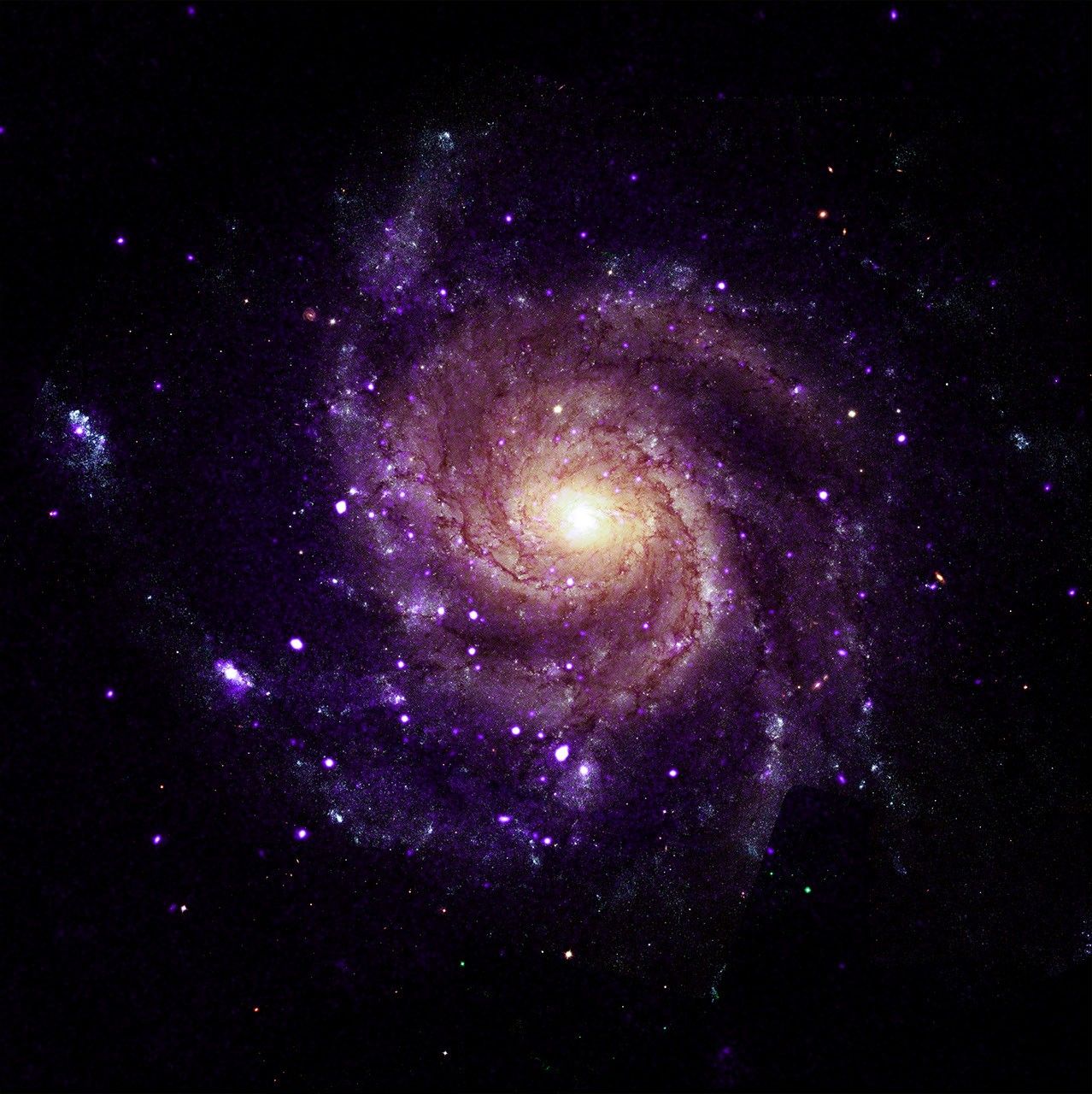
The researchers found a total of 84 of these “hypersoft X-ray sources” – so named because they give such low-energy X-rays – in the six different galaxies they searched, using data openly available to the public in the Chandra archive. Two of the galaxies are spirals, M31 (the Andromeda galaxy) and M101 (the Pinwheel galaxy), while the other four are ellipticals. They found hypersoft X-ray sources both in regions of active star formation and areas where there are older stars.
The team spotted the sources by finding objects that appeared in Chandra images taken at the lowest X-ray energies but vanished in higher-energy images. That means these objects give off far more low-energy X-rays than high-energy ones. Because low-energy X-rays border energetic ultraviolet radiation on the electromagnetic spectrum, the researchers determined that these sources are producing large amounts of energetic ultraviolet radiation as well.
It is unclear what types of objects are responsible for these low-energy X-rays and intense ultraviolet radiation. The team thinks they most likely involve a black hole, neutron star, or white dwarf pulling material from a companion star. The material pulled from the companion star is heated up to produce X-rays before falling onto the white dwarf or neutron star, or into the black hole. Such binary systems have been seen before, but not with such bright ultraviolet radiation and low-energy X-rays.
The discovery suggests that there may be large populations of binary systems with energetic ultraviolet radiation that have been undetected until now.
“These clandestine X-ray sources are actually among the most energetic objects in galaxies, and they could be solving two cosmic mysteries at once,” said Muhibullah.
Scientists think that some white dwarf systems pulling material from companion stars may eventually explode as a supernova – known as a Type Ia – that is critical for measuring the expansion of the universe. These supernovae played a key role in discovering that this expansion is accelerating. Astronomers have been looking for the stars that turn into Type Ia supernovae for many years, so far without success.
“If we could find a way to spot these Type Ia supernova explosions before they go off, that would be really important,” said co-author Jimmy Irwin, also of the University of Alabama. “Right now, we study them after they’ve exploded, and astronomers have struggled to understand what is actually ignited.”
The other mystery these hypersoft X-ray sources might explain is what strips electrons from gas between the stars in some galaxies. This stripping of electrons is important to probe because it can affect how quickly stars form and influence the life cycles of galaxies. Hot, massive stars play a role, but they do not completely explain what is causing this stripping. The intense levels of ultraviolet radiation from the hypersoft X-ray sources may play a vital role.
Why were these hypersoft X-ray sources not found until now? In addition to the low-energy X-ray output, which is very difficult for X-ray telescopes to detect, the high-energy ultraviolet radiation is readily absorbed by helium and hydrogen gas that fills the space between the stars, creating a nearly impenetrable barrier to look through.
“By combing through the Chandra archive, we were able to eliminate what used to be a blind spot for telescopes,” said co-author Rosanne Di Stefano of the Center for Astrophysics | Harvard & Smithsonian. “That’s how we found what appears to be a new class of cosmic objects with remarkable qualities.”
NASA’s Marshall Space Flight Center in Huntsville, Alabama, manages the Chandra program. The Smithsonian Astrophysical Observatory’s Chandra X-ray Center controls science operations from Cambridge, Massachusetts, and flight operations from Burlington, Massachusetts.
Read more from NASA’s Chandra X-ray Observatory
To learn more about NASA’s Chandra mission, visit:
This release features a composite image of a spiral galaxy, M101; one of six identified galaxies housing a new class of mysterious objects that give off unusually low-energy X-rays.
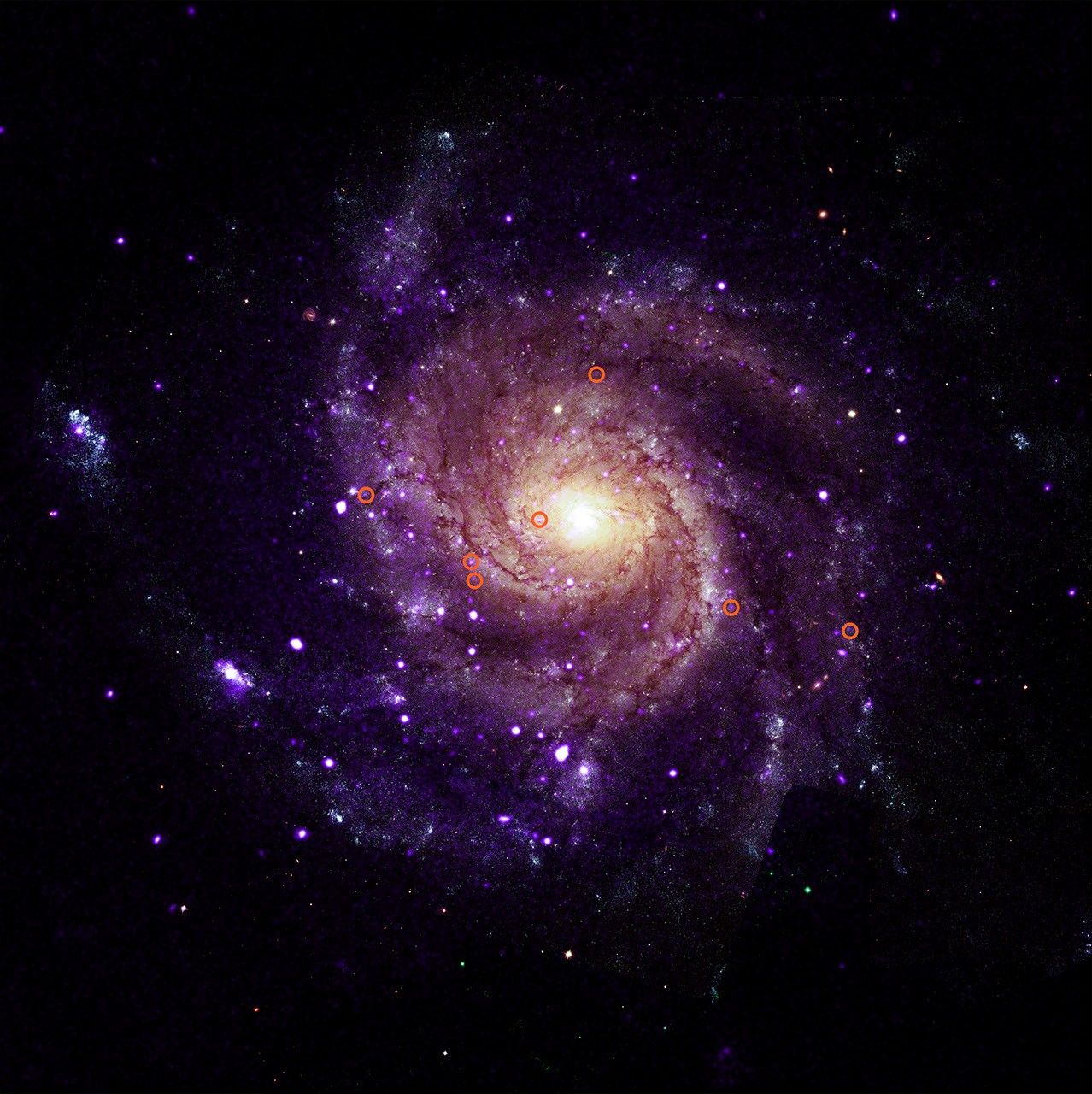
In this composite image, M101 faces us directly. It has multiple arms in shades of purple, spiraling clockwise around a golden yellow core. Scattered along and between the arms are scores of tiny specks in white and purple. Most of those specks are pairs of stars, but seven of them are a mystery.
To casual observers, the unusual objects are visually indistinguishable from the other specks of light in the galaxy. An annotated version of the composite image is included in this release, with red circles around the mysterious specks for easy identification.
These mystery specks behave like no other class of object discovered before. The curious objects give off X-rays of such low energy, they in fact produce large amounts of ultraviolet radiation, as UV radiation borders X-rays on the electromagnetic spectrum. Searching images of galaxies with low-energy X-rays in the Chandra Observatory archive, scientists have found a total of 84 such objects spread across M101 and five other galaxies. They have dubbed these mysterious objects “hypersoft X-ray sources.”
Chandra X-ray Observatory

Since its 1990 launch, the Hubble Space Telescope has changed our fundamental understanding of the universe.

Webb is the premier observatory of the next decade, serving thousands of astronomers worldwide. It studies every phase in the…

The Nancy Grace Roman Space Telescope will settle essential questions in the areas of dark energy, exoplanets, and astrophysics.

Scientists have designed a lightweight aluminum material inspired by eggshells that could one day help protect spacecraft from fast-moving pieces of space debris. Nearly one million pieces of debris larger than 1 centimeter are believed to be orbiting near Earth. These fragments can travel at extremely high speeds, so even a relatively small object can […]
The post Eggshell-Inspired Aluminum Shield Could Protect Spacecraft from High-Speed Debris appeared first on Knowridge Science Report.