❌

Normal view

Magnetic field first kills superconductor, then brings it back to life

28 August 2026 at 12:00

Unconventional superconductors are poorly understood materials with exceptionally useful properties. One example is their response to magnetic fields. In conventional superconductors, applied magnetic fields suppress superconductivity by either breaking up the paired electrons that facilitate it (Cooper pairs) or introducing magnetic flux which introduce resistance when it moves through the material. However, in a few unconventional materials, competition between ferromagnetic ordering, where the magnetic moments align to point in the same direction, and superconducting ordering, where paired electron moments point in opposite directions, can lead to a phenomenon known as re-entrant superconductivity (RSC). This is where, in an applied field, the magnetic ordering will at first destroy superconductivity, but when the field increases further, the superconductivity reappears.

An international team of physicists led by Denis Maryenko of Japan’s RIKEN Center for Emergent Matter Science has now observed this phenomenon for the first time in a two-dimensional (2D) unconventional superconductor. “We did not look for the RSC, and it was extremely surprising that we saw that,” Maryenko tells Physics World.

2D or not 2D

RSC has previously been observed in three-dimensional ferromagnetic materials such as CeRh2As2, organic superconductors and possibly in so-called heavy fermion compounds such as UTe2. However, 2D materials have several advantages over 3D ones when it comes to superconductivity. For example, in the conductor MoS2, the material’s electronic band structure and spin-orbit coupling (SOC) combine to keep the electron spins pointing in a direction perpendicular to the sample’s surface. This locking greatly increases the value of the upper critical field, which is the maximum magnetic field at which superconductivity can persist.

Since 2D superconductivity had previously been observed at interfaces between KTaO3 and other materials, the RIKEN team took this as a starting point. “Our approach was to grow LaTiO3, [since] that has good lattice matching [to KTaO3], which is beneficial for epitaxial growth,” Maryenko explains.

Writing in Science Advances, the physicists describe how they performed magnetotransport measurements on their LaTiO3/KTaO3 heterostructures to understand how these samples behaved in the presence of increasingly large applied magnetic fields. “We just wanted to see how the critical magnetic field behaves as a function of temperature, but suddenly we started seeing something else emerging at a rather low field: a resistive peak that seemed to separate two superconducting regions,” Maryenko says.
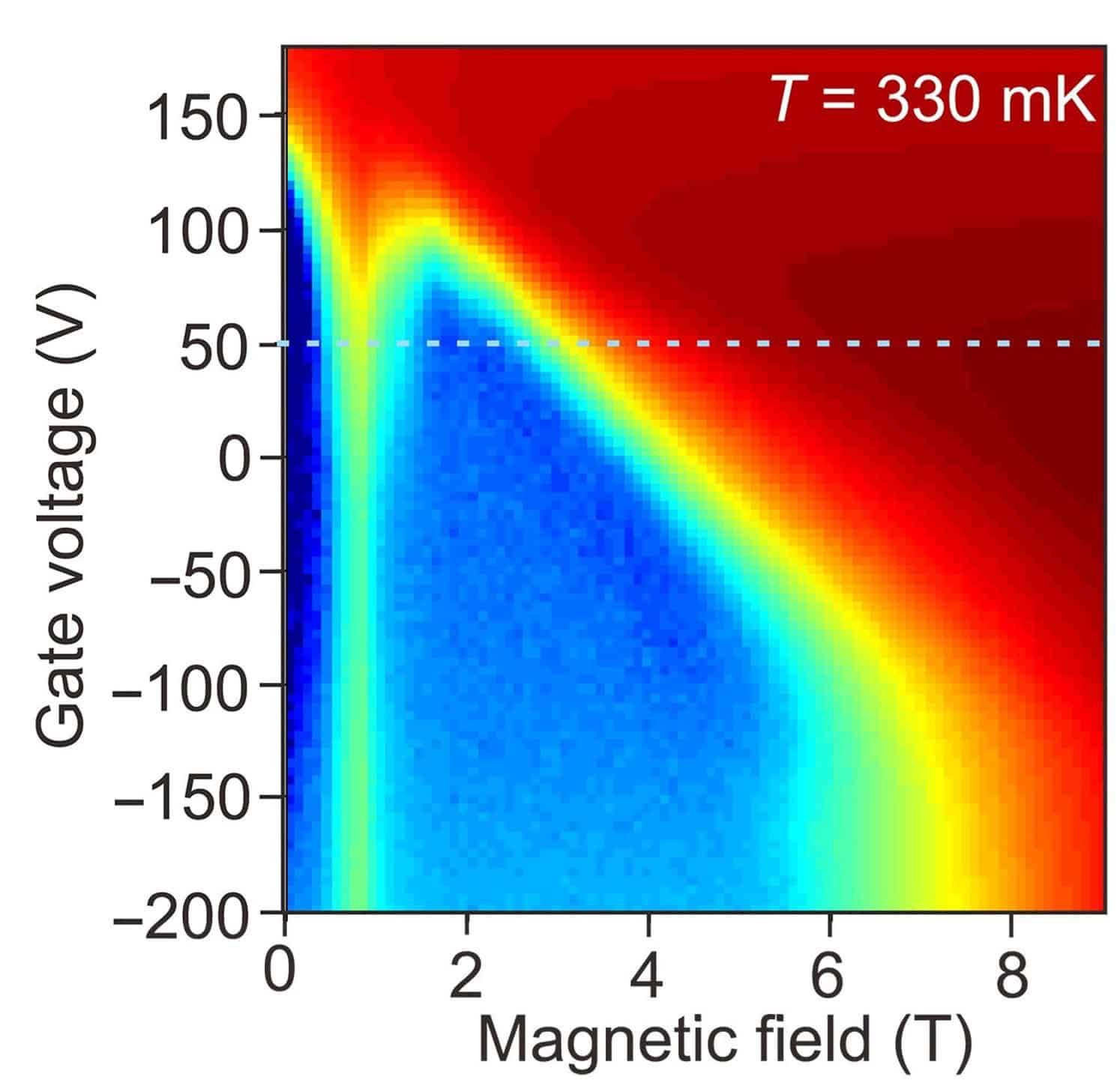
Rainbow colour plot of the interface resistance as a function of magnetic field and gate voltage. Higher gate voltages and magnetic fields are generally coloured red, but at a field of 0.9 T, there's a bright streak that appears to bleed down from the red area and stand out against the blue background.
Reentrant superconducting response: A plot of the interface resistance as a function of magnetic field and gate voltage, showing reentrant superconductivity at a magnetic field of around 0.9 T. (Courtesy: D Maryenko et al. Science Advances 12 26 DOI: 10.1126/sciadv.aeg0460)

This cusp, he explains, appears at a magnetic field B∗ of 0.9 T with zero resistance measured at both lower and higher applied fields. In this experiment, B∗ is independent of temperature and the concentration of charge carriers, which Maryenko and colleagues controlled experimentally by tuning a gate voltage across the interface.

Explaining re-entrant superconductivity

The researchers considered several possible explanations for the RSC, including Zeeman splitting, orbital effects and something called the Jaccarino-Peter effect, where internal and external magnetic fields compensate for each other and cancel out.

To identify the correct explanation, Igor Maznichenko and Sergey Ostanin from Martin Luther University in Germany and Arthur Ernst from Johannes Kepler University in Austria performed ab initio calculations to determine the electron band structure for the interface. These calculations identified the presence of a so-called Van Hove singularity, where for certain momenta, the electrons will have very high density of states.

Then, Vitalii Dugaev from Rzeszów University of Technology in Poland and Evgeny Ya Sherman at the University of the Basque Country in Spain developed a SOC-based model, taking inspiration from symmetry arguments and the ab initio band structure calculations. In the absence of an applied field, they found that there is a p ↔−p symmetry in the bands. This means that electrons with opposite momenta will have the same energy, so two electrons that form a Cooper pair, and have the same energy, have a total momentum equal to zero. In other words, the system favours spin-singlet Cooper pairs which form easily.

Applying a field breaks this symmetry, thereby reducing the Cooper pairing efficiency and decreasing the critical temperature Tc for the onset of superconductivity. On the other hand, the applied field also shifts the electrons closer towards the Van Hove singularity, increases the density of states and increases Tc. The combination of these opposing effects results in a minima appearing in Tc(B), hence RSC. The discovery of RSC in these materials establishes the system as a robust platform for studying unconventional superconductivity in 2D systems.

The post Magnetic field first kills superconductor, then brings it back to life appeared first on Physics World.

Quantum entanglement explains why strange metals are so strange

17 July 2026 at 09:00
Illustration showing a cubic lattice of electrons glowing with an eerie green light
Correlation explanation: Quantum entanglement between electrons in strange metals appears to account for some of their unusual behaviour. (Courtesy: Harald Ritsch / TU Wien)

“Strange” metals owe at least some of their peculiar properties to the quantum entanglement of their electrons. This finding comes from physicists at the Vienna University of Technology in Austria, who used a concept from quantum information science to guide their experiments. A similar approach, they say, could also yield a better understanding of certain high-temperature superconductors and other correlated quantum materials.

Electrons travel relatively unimpeded through most metals, but in the 1980s, scientists identified puzzling exceptions in certain cuprate high-temperature superconductors. Further examples of this “strange” metal behaviour subsequently turned up in other classes of materials, including heavy-fermion materials, pnictides and organic compounds. This resistive behaviour cannot be explained by theories that treat electrons as independent, non-interacting particles, nor by theories that include interactions while treating electrons as quasiparticles. And although multiple recent theoretical works suggested a possible role for entanglement, experimental evidence was lacking.

A novel statistical tool

To investigate further, a team led by solid-state physicist Silke Bühler-Paschen used facilities at the Institut Laue-Langevin (ILL) in Grenoble, France to perform inelastic neutron scattering measurements on a heavy-fermion metal with the chemical formula Ce3Pd20Si6. According to team member Federico Mazza, who conducted this part of the study, the scattered neutrons would normally each transfer their energy to individual particles.

However, when the researchers analysed their data using a concept called quantum Fisher information – roughly, a measure of how sensitively a quantum state depends on a given parameter – they found that they could not explain what they were seeing in terms of particles behaving independently. Instead, the data indicated that groups of at least nine quantum-entangled entities were acting collectively. Mazza says this provides direct evidence of highly multipartite quantum entanglement in the material – and, in turn, a new way of understanding why strange metals are so strange.

The parent state of high-temperature superconductivity

The strange metal state is of great interest because physicists consider it the “parent” state of high-temperature superconductivity, though it also occurs across other materials platforms. “We had suspected that some of the intriguing properties of this state might be related to entanglement but were not able to pin it down until now,” Bühler-Paschen explains. “The results are a great success for us. They confirm that our unusual approach of using methods from quantum information science for solid-state physics studies of novel materials can reveal fundamentally new insight.”

Photo of Federico Mazza in the lab at the ILL
Neutron scattering: Federico Mazza at the Institut Laue Langevin. (Courtesy: ILL Grenoble)

The experiments, which are detailed in Nature Physics, were not without challenges. For starters, the researchers needed to identify an ideal material to study the effect they were looking for and then grow it as a large, high-quality single crystal. Once they secured inelastic neutron scattering beamtime at the ILL’s powerful high-resolution triple-axis spectrometer – a difficult feat in itself – Bühler-Paschen notes that they had to obtain and analyse the data at the highest standards and support it with simulations. “Last but not least, [we had to] communicate with our peers that multipartite entanglement contains valuable information beyond correlation functions and scaling analyses,” Bühler-Paschen recalls.

Rather than being a “detail” of one particular material, Bühler-Paschen says the team’s result suggests that enhanced multipartite entanglement might be an integral part of the strange metal state. Verifying this, however, will require studies on other strange metals across materials classes, she says.

“Looking further ahead, we can envision that this aspect of strange metals finds application in quantum devices,” she tells Physics World. “It could also help us better understand high-temperature superconductors and other materials in which electrons are so strongly correlated that they lose their (quasi)particle nature.”

The post Quantum entanglement explains why strange metals are so strange appeared first on Physics World.

New superconducting diode gives greater control over the flow of electrons

2 July 2026 at 15:00

Like a two-lane highway with one lane empty and the other clogged with traffic, superconducting diodes allow electrons to flow without resistance in one direction while encountering normal, resistive conditions in the other. First demonstrated experimentally in 2020, these devices have considerable potential as platforms for fundamental studies of quantum materials and as building blocks for superconducting electronics.

For many applications, being able to control the flow of electricity through the diode – or even reverse its polarity – is essential. In principle, there are several ways of doing this because the efficiency of the superconducting diode effect (SDE) depends on many factors. Examples include magnetic field, temperature and diode design as well as intrinsic properties such as the momentum of the Cooper-paired superconducting electrons and their spin-orbit coupling.

In practice, though, some of these properties are more easily changed than others. To return to the highway analogy, it’s much more straightforward to alter the flow of traffic by posting new road signs, rather than by rebuilding the road or redesigning the cars.

In a recent paper in Chinese Physics Letters, Yanwu Xie, Yishuai Wang, Wenze Pan and Meng Zhang of Zhejiang University in Hangzhou, China describe a new superconducting diode platform that makes it far easier to change the device’s configuration, and thus to control the flow of superconducting electrons through it. Physics World spoke to them about their research and its possible applications.

How did you get the idea for this new type of superconducting diode?

This work started with an unexpected experimental observation. While we were making routine current-voltage measurements on a conventional strip-shaped superconducting device constructed at the interface between two materials, LaAlO3 and KTaO3 (LAO/KTO), we noticed a pronounced difference between the critical currents in opposite directions. Given the growing interest in the SDE, this surprising result immediately caught our attention and prompted us to investigate its origin.

What is special about these two materials?

The properties of conventional superconducting diodes are typically locked into their fixed physical structures, such as Josephson junctions or patterned vortex pinning sites. This inflexibility makes post-fabrication tuning or reconfiguration of the diode characteristics extremely challenging.

Two-dimensional oxide interface superconductors such as LAO/KTO and LaAlO3/SrTiO3 are good candidates for overcoming this problem. The strong spin-orbit coupling near the interface enables possible finite-momentum Cooper pairing, while the extremely low superfluid density and intrinsic two-dimensional nature of the materials create ideal conditions for studying vortex dynamics and magnetic flux behaviour.

In addition, these systems have exceptional tuneability. Their superconducting states can be well controlled through both global substrate gating and local conductive atomic force microscope (cAFM) lithography, which opens new possibilities for post-fabrication SDE engineering.

What was the most challenging aspect of this research?

The most challenging part was unravelling the frustrating sample-to-sample variability we encountered early on. We now know that the SDE in conventional LAO/KTO devices stems from asymmetric vortex entry conditions caused by random, fabrication-induced edge imperfections. At the time, however, even devices with nominally identical geometries exhibited wildly different SDE efficiencies and polarities, showing no discernible systematic trend.

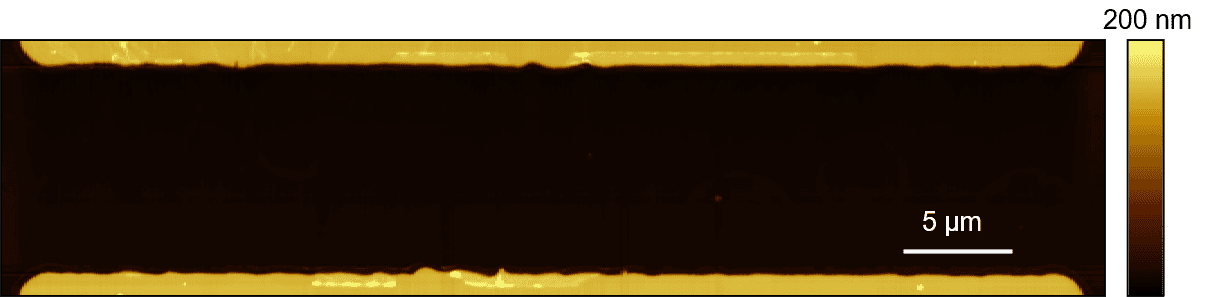
The breakthrough came when AFM imaging revealed random edge defects on the superconducting channels. To test whether these random imperfections were indeed the root cause, we used cAFM lithography to “straighten” the originally photolithography-produced rough channel boundaries. This atomic-scale trimming strongly suppressed the SDE, providing unambiguous evidence for the vortex edge asymmetry mechanism.

AFM image showing two horizontal yellow-orange surfaces separated by a larger black gap. The inner edges of the surfaces are visibly bumpy.
Channel edges: An atomic force microscopy (AFM) image of the LAO/KTO channel in the diode, showing the roughened edges. (Courtesy: Yanwu Xie)

We then turned this challenge into an opportunity. By using cAFM to re-shape the channel edges repeatedly and in a non-volatile way, we transformed a source of random sample variability into a tool for deterministic, on-demand quantum device control.

What are some possible applications for this editable superconducting diode?

The nonreciprocal transport of charge carriers – exemplified by p-n junctions in semiconductor diodes – is a cornerstone of modern electronics. Similarly, superconducting diodes are emerging as pivotal components for superconducting electronics. What distinguishes our approach is our ability to reversibly modify the diode polarity and efficiency within the same device through nanoscale control of the superconducting channel geometry. This editability may enable reconfigurable superconducting circuit elements and adaptive circuit architectures, while also providing a versatile platform for investigating the role of geometry-associated vortex dynamics in nonreciprocal superconducting transport.

What will you do next?

We plan to fully exploit the unique cAFM lithography capability of our oxide interface platform to systematically investigate how tailored vortex-boundary configurations shape the SDE. The diode performance can be further optimized by mapping out the precise relationship between channel geometry, vortex entry barriers and rectification efficiency.

In parallel, we plan to introduce artificial pinning centres (such as nanoscale insulating dot arrays) directly into the superconducting channel. This will allow us to engineer asymmetric vortex-pinning landscapes within the bulk of the channel. Combining this engineered flux pinning with the asymmetric vortex-boundary mechanism demonstrated in the current work offers a promising route toward achieving a robust, deterministic and highly controllable superconducting diode.

The post New superconducting diode gives greater control over the flow of electrons appeared first on Physics World.

Scientists Uncover New Evidence of Mysterious ‘Time-Reversal Symmetry Breaking’ in This ‘Exotic’ Kagome Metal

16 June 2026 at 16:24

Physicists report the discovery of new evidence for a mysterious quantum state in an unusual class of materials, in findings that could illuminate a long-running debate over how these systems transition into superconductivity.

In physics, symmetry breaking refers to processes in which a symmetric state collapses from its initial state of disorder into a more ordered one, albeit now possessing less symmetry.

The new research findings reveal evidence that time-reversal symmetry, a fundamental kind of symmetry in nature, appears to be broken at temperatures significantly higher than previously recognized.

The research was detailed in a recent study published in Nature Physics.

Mysterious Kagome Metals

In their study, an international team of researchers led by a team at the Korea Advanced Institute of Science and Technology focused on what are known as kagome metals—a variety of ferromagnetic quantum materials possessing unique qualities.

For their study, the researchers used a specific kagome metal called Cesium Vanadium Antimonide (CsV₃Sb₅), a novel material first discovered in 2021 by researchers at UC Santa Barbara’s NSF Quantum Foundry.

The researchers found that during experiments with the material, which is recognized as a candidate superconductor, CsV₃Sb₅ showed indications that time-reversal symmetry was broken at temperatures significantly higher than previously recognized.

This is significant because it is suggestive of an elusive phenomenon physicists call loop-current order, which describes a state in which the circulation of electrons throughout a material occurs in persistent microscopic loops.

A Signal Emerges

Using an advanced photoemission technique, the team was able to uncover subtle differences in the way electrons respond to circularly polarized light, which is light that is produced using an electric field vector that rotates in a circle as the light wave propagates, equaling one complete rotation for each wavelength.

Based on the team’s measurements, a distinctive signal emerged, which they say is consistent with a time-reversal symmetry-breaking state, meaning that their observations provide what may be the best experimental evidence to-date for an exotic quantum state of matter known as loop-current order, wherein electrons spontaneously assume microscopic wave-like formations.

Loop-current order in kagome metals has been an ongoing area of study for physicists, and the team’s new findings offer what may be the best evidence yet uncovered.

Exotic States and High-Temperature Superconductivity

One reason the team’s findings are so significant is that their results offer some clarity for the otherwise complex sequence of phase transitions that are known to occur within CsV₃Sb₅.

Based on their research, the team now believes loop-current order manifests as the temperature begins to decrease, which is then followed by a periodic rearrangement of electrons known as a charge density wave. Finally, superconductivity then follows, accompanied by the absence of electrical resistance altogether.

Fundamentally, the team’s work could offer new insights into the behavior and characteristics of strongly correlated quantum materials, which could hold promise for future studies involving the mechanisms that produce exotic states of matter.

“These insights deepen our understanding of the phase landscape in kagome metals and highlight connections with a correlated system exhibiting analogous transition hierarchy,” the team reports.

In the future, such studies may also help scientists finally attain the long-sought goal of high-temperature superconductivity, whereby materials capable of conducting electricity with zero resistance, and at temperatures above 30 K (-243°C), helping to reduce the current expenses associated with cooling systems required for superconducting, and ultimately helping to bring these high-power engineering technologies into commercial viability.

The team’s recent study, “Evidence of time-reversal symmetry breaking above the charge density wave order in a kagome metal,” was published in Nature Physics.

Micah Hanks is the Editor-in-Chief and Co-Founder of The Debrief. A longtime reporter on science, defense, and technology with a focus on space and astronomy, he can be reached at micah@thedebrief.org. Follow him on X @MicahHanks, and at micahhanks.com.

Breakthrough Technique Reveals Atomic Secrets of Record-Breaking Superconductors

Artistic Representation of the Interior of a Diamond Anvil CellScientists have achieved a first in studying lanthanum superhydrides, a class of materials that could help unlock superconductivity at much higher temperatures. The dream of transmitting electricity without energy loss has driven decades of superconductivity research. Some of the most promising candidates yet are superhydrides, hydrogen-rich materials that, under immense pressures, have exhibited superconducting behavior [...]
❌