Lipid droplets in the kidneys may help cats maintain a consistent chemical “scent identity.” Scent marks can linger long after an animal has moved on, allowing urine and other chemical signals to carry information across both distance and time. Yet the molecules responsible for odor do not remain unchanged. They evaporate, break down, and shift [...]
What began as a routine police response to a reported break-in turned into a brief standoff between nature and technology. Last week, law enforcement in the city of Kirkland, Washington (just northeast of Seattle) responded to a 911 call from a resident reporting loud banging inside their home. Officers arrived expecting a human intruder, but were instead greeted by a more literal cat burglar: a trapped and confused bobcat.
Not wanting to risk a claw to the face, the officers backed out and reassessed the situation. They ultimately decided to deploy a remote-controlled drone into the house, to monitor the feline intruder from a safe distance. Video captured from the drone’s perspective and released on Facebook, shows the frustrated bobcat standing by a staircase, growling and arching its back at the hovering machine. After a brief standoff with the buzzing, metal alien, the bobcat carefully retreated, sidestepping into an adjacent empty room.
Police were then able to close their door and keep the bobcat isolated until a team from the Washington Department of Fish and Wildlife arrived. Wildlife officials then sedated the cat, loaded it into a crate, and transported it to nearby Forbes Creek. The feline was then released back into the wild, startled but safe. As for how a bobcat ended up in the house in the first place, Kirkland Police believe the adventurous intruder climbed a tree and jumped through an open window, possibly lured in by the resident’s indoor cat. Both the owner and its likely shocked cat were unharmed, according to the police. Thankfully, curiosity didn’t kill this cat.
The Kirkland Police Department did not immediately respond to Popular Science’s request for comment.
The aerial deployment was made possible by a public safety drone program the Kirkland Police began in 2022. Today, they reportedly maintain five drones and have 17 FAA-licensed pilots ready to operate them. The typical use cases for those drones include search and rescue, tactical search, scene documentation, and, apparently, bobcat removal.
The bobcat before its release near Forbes Creek. Image: Kirkland Police Department.
Drones are changing the way police surveil wildlife…and people
Drones and robotic dog-like quadrupeds are reshaping how local communities approach wildlife management. In Japan, authorities deploy a combination of camera-equipped drones and robotic Monster Wolves to locate and deter bears following a record spike in human-bear encounters driven by urban sprawl and declining farmland. In the United States, police in Santa Fe, New Mexico, recently used an aerial drone to track an errant bear wandering near a school. Expanded drone programs are also playing a greater role in locating lost or missing pets. Just last month, firefighters in t Florida used a remotely controlled drone to find an overly adventurous dog trapped in a storm drain.
But this increased prevalence of drones comes with other, more controversial concerns as well. Police forces around the country are ramping up “drones as first responder” programs, which civil liberty critics say could introduce unreasonable surveillance. Law enforcement around the country has already used these drones to monitor political protesters. Meanwhile, Immigration and Customs Enforcement (ICE), is reportedly interested in using Boston Dynamics’ quadruped robot “Spot” to aid in immigration operations. Private security companies like Flock and Axon are also investing heavily in aerial surveillance drones.
Cats are known for the whiskers on their faces. However, if you look closely, you can see that they also have whiskers on their legs. So why do cats have leg whiskers?
To answer why they're useful, it's important to understand what whiskers are. Technically known as vibrissae, whiskers are specialized hairs that are stiffer and several times thicker than other hairs. Although whiskers themselves do not contain nerves, their bases are rooted in specialized receptacles loaded with nerve endings, making whiskers very sensitive.
"Facial whiskers are as sensitive as human fingertips," Robyn Grant, a sensory biologist at Manchester Metropolitan University in the U.K., told Live Science.
A cat's whiskers around the nose, which are also known as the mystacial vibrissae, are the longest whiskers they have, according to the veterinary reference book "The Feline Patient" (Wiley, 2025). Although there is variation among cats, on average there are 12 mystacial whiskers set in four rows on each side of the muzzle.
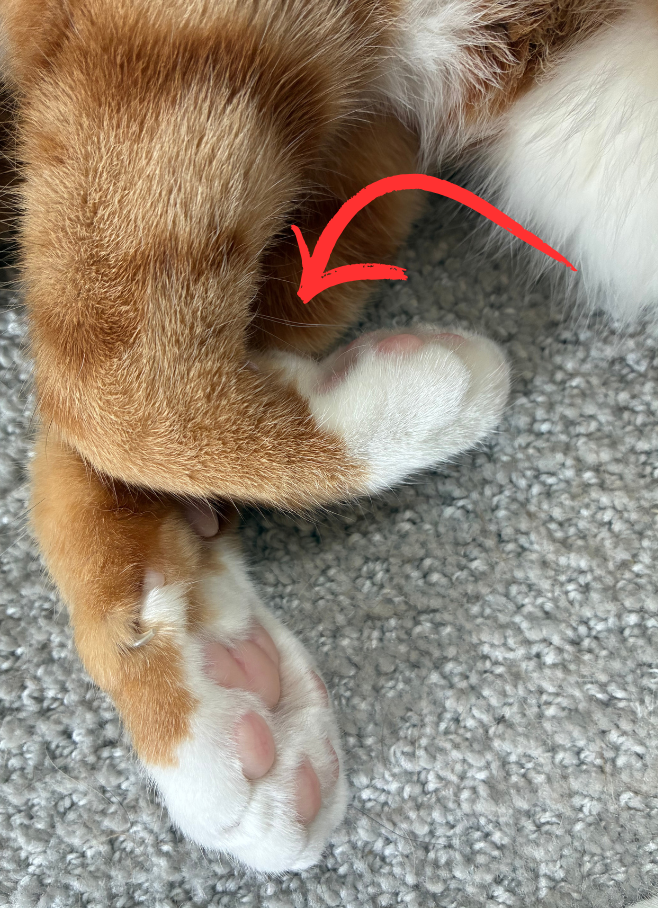
Cat leg whiskers, scientifically known as carpal vibrissae, are attached to their forelegs. (Image credit: Future)
Facial whiskers help cats hunt when light is limited or when their vision is poor. Although cats are good at seeing distant objects, "cats can't really focus on anything less than 10 inches (25 centimeters) from their eyes, so they use their whiskers to figure out where things are," Jonathan Losos, an evolutionary biologist at Washington University in St. Louis and author of "The Cat's Meow: How Cats Evolved from the Savanna to Your Sofa" (Viking, 2023), told Live Science.
In addition, cats have a tuft of whiskers known as superciliary vibrissae above each eye. These whiskers help protect the cat's vision by triggering a blink when stimulated by anything that might fly into their eye, according to The Feline Patient.
Cats also have chin whiskers (mandibular vibrissae) and whiskers on each side of the head, between the ear and chin (genal vibrissae). These also help cats stay aware of the space around them.
Leg whiskers
Cats also possess a tuft of four to six whiskers on the back of each front leg, each about 0.8 to 1.2 inches (2 to 3 centimeters) long. These are known as carpal vibrissae.
"Carpal refers to the bones that, in humans, are in our wrists," Losos said. "Carpal whiskers are attached to cat forelegs near the carpal bones." However, in cats, the carpal bones are not located in the same place as the human wrist. Rather, they "are further up the leg, because cats essentially walk on their toes and not their palms," he explained.
Cats are not the only animals with carpal whiskers. "Most carnivores have them, and many rodents do, as do lemurs and armadillos," Losos said. "Dogs don't have them, but other canine species do. Rabbits don't have them either, nor do ungulates — that is, hooved animals, such as horses and cattle."
The species that have carpal whiskers "tend to be the ones that either grasp things with their forelimbs or climb up trees," Losos said. "The idea is that if it's hard for the animals to see what they're grasping, carpal whiskers can help supplement their vision. Perhaps cats have them and dogs don't because cats can move their forearms laterally from side to side and put their palms together to grab things, whereas dogs can't."
It remains uncertain what role carpal whiskers play in cats, but they likely "guide locomotion — that is, safe forepaw placement — especially during complex locomotion, such as climbing," Grant said. "They might guide prey handling too."
How much of a cat fan are you? Find out by taking our cat quiz!
Pets form an important part of many people's lives, providing meaningful companionship. However, our pets can sometimes also be a source of unwelcome pathogens and diseases, particularly if they frequently roam outdoors.
We are ecologists and a veterinarian who study wildlife health and the movement of pathogens among wildlife, domestic animals and people. If you let your cat outdoors, or if outdoor cats visit your yard, our recent findings may be relevant.
Zoonotic pathogens are organisms that can infect both animals and humans. From a pathogen's perspective, humans are just another animal host. Wildlife is often emphasized as a source of emerging disease for humans because there are vastly more wild animal species than domestic animal species.
However, even if a pathogen is capable of infecting people, it needs a way to reach us. Humans share more zoonotic pathogens with domestic animals than with wildlife, because domestic animals live close to us. Pathogens benefit even further if they can infect a companion animal.
In our newly published research, we compiled data from more than 400 studies to investigate how a cat's lifestyle, whether they're mostly indoors, outdoor-roaming or feral, affects that cat's likelihood of carrying pathogens that can infect people.
Across this compilation, there were nearly 100 pathogens detected in cats that are considered zoonotic and capable of infecting humans. Familiar examples are rabies, Toxoplasma gondii, roundworms and Salmonella.
Our research
We found that outdoor-roaming pet cats had three to five times the odds of carrying a zoonotic pathogen compared with indoor-only cats. More surprisingly, cats allowed to roam outdoors had similar odds of carrying at least one zoonotic pathogen as feral cats. Outdoor-owned cats carried fewer types of pathogens than feral cats, but the same pathogens that infect feral cats can also infect owned cats.
These risks become a large-scale problem because pet cats that roam freely interact closely with people, wildlife and other domestic animals. Across the studies we reviewed, about 60 per cent of owned cats had unsupervised outdoor access; in some regions, that rate exceeded 90 per cent.
Roaming cats hunt, interact with wildlife or other domestic animals, and move through environments contaminated with pathogens and toxins. Research suggests that cat owners may underestimate hunting by around 80 per cent, meaning that many prey captures and animal contacts go unnoticed.
These interactions are not uncommon and not limited to so-called pest species. Single-country estimates of wildlife killed by cats run into the billions, with more than 2,000 wildlife species documented as prey for domestic cats.
Cats hunt animals that can carry zoonotic pathogens, including rodents, birds and bats, many of which would otherwise have little direct contact with people. (Image credit: Anton Darius)
Cats hunt animals that can carry zoonotic pathogens, including rodents, birds and bats, many of which would otherwise have little direct contact with people. Owned cats might bring home rodents carrying viruses, and there are documented cases of cats bringing rabies-positive bats into homes. A cat returning home with prey can therefore create a pathway by which pathogens circulating in wildlife populations reach people.
Depending on the parasite, feces can contain hundreds to hundreds of thousands of parasite eggs that can persist in soil or water for months to years, which can infect people or other animals that come in contact with those eggs.
What cat owners can do
The most straightforward intervention is also the most economical and humane: prevent unsupervised roaming. That does not mean denying cats access to the outdoors. It can mean building "catios" or enclosures, leash walks, supervised time outside or other forms of contained outdoor access.
Using systems like "catios" or leash walks can help minimize pathogens for cats. (Image credit: Carlos G. Lopez)
Veterinary care still matters. Treating existing parasitic infections and vaccinating against diseases like rabies are essential precautions, even for indoor cats. Since neither vaccines nor anti-parasitic treatment cover the full spectrum of wildlife-associated pathogens, managing exposure remains the more comprehensive protective approach.
The free-roaming debate is often framed as a false choice: either cats roam freely, or they are deprived of a natural life. That framing is misleading and inconsistent with how we manage other companion animals.
We do not assume dogs need unrestricted access to roads, neighbors' yards or to hunt wildlife to have good welfare. Indoor cats and cats with supervised outdoor access can live healthy, enriched and longer lives.
Policies and strategies that address how and where owned cats roam outdoors can help safeguard biodiversity, feline and wildlife welfare and public health. That is the central insight of One Health, that the same choices that protect ecosystems can also protect the animals and people who share them.
This article was co-authored by David Lapen, who works for and receives research funding from Agriculture and Agri-Food Canada.

 Login

 Lipid droplets in the kidneys may help cats maintain a consistent chemical “scent identity.” Scent marks can linger long after an animal has moved on, allowing urine and other chemical signals to carry information across both distance and time. Yet the molecules responsible for odor do not remain unchanged. They evaporate, break down, and shift [...]