O Threads disponibilizou uma nova versão do seu painel de insights destinado aos criadores da plataforma, expondo com mais clareza o funcionamento do seu algoritmo.
Além de seguir apresentando a quantidade de visualizações, espectadores, curtidas e republicações, agora o painel conta com resumos gerados pela Meta AI sobre o desempenho da conta e de postagens individuais, comparando o alcance e engajamento da sua conta.
Em um salto qualitativo, a IA da Meta é capaz de detalhar a porcentagem de queda nas visualizações e interações, bem como as preferências do público e o perfil demográfico médio dos seus seguidores.
Mas, como observado pelo Engadget, apesar das adições houve a remoção de uma métrica: a das visualizações sobre cliques em links. Antes mesmo dessa decisão da Meta, a intenção (ou falta dela) da empresa quanto à saída do app já foi motivo de muitas especulações, sobretudo se a Meta boicotava (ou não) o alcance dos criadores que adicionavam links externos em suas publicações.
The state is considering extending the life of its last nuclear power plant, Diablo Canyon, and allowing construction of new reactors to help meet its clean energy goals.
Established nuclear plants like Diablo Canyon in California tend to produce relatively affordable power.
The state is considering extending the life of its last nuclear power plant, Diablo Canyon, and allowing construction of new reactors to help meet its clean energy goals.
Wildfire scientists have unveiled a new rapid risk-assessment tool that shows substantial wildfire danger to homes and buildings in three major Arctic communities, revealing that between 14% and 26% of structures in Anchorage, Fairbanks, and Whitehorse face high or very high risk from approaching flames. The study, led by Jennifer I. Schmidt of the University of Alaska Anchorage together with Robert H. Ziel, Monika P. Calef, Anna Varvak, and Julio C. Postigo, was published in the International Journal of Disaster Risk Science. Rather than relying on complex fire-behavior simulations that demand specialist analysts and expensive software, the approach combines datasets that most local governments already possess: building footprints, zoning maps, and readily available vegetation layers. The result is an updatable, affordable portrait of which buildings face the greatest threat and where mitigation dollars can do the most good.
The urgency behind the work is hard to overstate. Wildfire costs and damages in the United States alone are now estimated at between USD 394 billion and 893 billion annually, and the 2019 to 2020 Australian fire disasters cost nearly USD 100 billion. The Arctic, often imagined as too cold and wet to burn, is not immune: since 1980, wildfires have cost Alaska between USD 2 billion and 5 billion, with projections suggesting costs could rise 68% by the end of the century. Canadian suppression expenses are expected to climb by 60 to 110% relative to the 1980 to 2009 baseline. Meanwhile, structure loss from wildfire has doubled over the past two decades in the western United States, and western Canada has suffered major structure-loss events in four of the last eight fire seasons. Nearly half the global population now lives within the wildland-urban interface, the zone where people and forests meet or intermingle, making tools that translate fire science into actionable local maps increasingly vital.
The researchers’ central premise is conceptually simple but technically consequential: for a structure to be at high risk, a flammable hazard must exist nearby, within roughly 500 meters, and the surrounding landscape must exhibit high wildfire exposure. The method begins with a flammability hazard layer at 30-meter resolution, built from a modified version of NASA’s ABoVE Landcover dataset in which generic evergreen classes were refined to reflect locally flammable species such as black spruce, white spruce, lodgepole pine, and subalpine fir, each assigned hazard ratings from 0 to 100. Critically, the team treated structures themselves as fuel. Each building contributes three fuel units to the surrounding flammability score, a value chosen after systematic testing of one through ten fuel units; three proved optimal, nudging densely built environments up a hazard category without causing wholesale reclassification. Structure density was computed at 90-meter resolution, multiplied by three, and added to the vegetation-based hazard to produce an enhanced flammability hazard layer.
Wildfire exposure, the second pillar of the assessment, captures the potential for hazard to travel. It is calculated as the average flammability hazard within a 100-meter or 500-meter radius, representing the likelihood that fire can reach and burn a given location even if the local fuels themselves are sparse. Exposure values, also ranging from 0 to 100, are classified into five tiers from very low to extreme, and concentrated pockets of flammable vegetation drive scores upward. The third ingredient is structure vulnerability, produced by multiplying the enhanced flammability hazard by a structure importance factor derived from zoning data: residential buildings and critical infrastructure such as hospitals, schools, and nursing homes receive the highest weight, followed by commercial and other structures. Where zoning was unavailable, as on military installations like Joint Base Elmendorf-Richardson in Anchorage and Fort Wainwright and Eielson Air Force Base in Fairbanks, the team collaborated with base personnel or interpreted aerial imagery to classify neighborhoods. The final risk score synthesizes hazard, exposure, and vulnerability into six categories, from extremely low to very high.
The results paint a nuanced picture of Arctic fire danger. Fairbanks showed the greatest proportion of structures in the top two risk categories at 26%, followed by Whitehorse at 22% and Anchorage at 14%. Anchorage, paradoxically, had the highest share of buildings in the top vulnerability tiers, 42%, yet the lowest risk, a consequence of its large urban footprint where dense housing raises vulnerability but fragmented, less-flammable vegetation and abundant developed ground suppress exposure. Fairbanks and Whitehorse, with structures woven into spruce- and pine-dominated boreal landscapes, showed closer alignment between vulnerability and risk. Anchorage was also the only study area where more than 1% of cells jumped two or more flammability categories when buildings were counted as fuel, at 7%, reflecting its 27% share of structure area containing seven or more buildings per cell. The analysis also confirmed the primacy of exposure: when a structure’s wildfire exposure was extreme, at least 87% of such buildings landed in the highest risk category across all three communities.
A key innovation lies in how the team redrew the wildland-urban interface itself. Traditional WUI maps distinguish urban, interface, and intermix zones; the researchers added a fourth category, the transmission zone, marking areas roughly 2.4 kilometers beyond the WUI boundary where fire could move into a community and where fuel breaks might be sited. Within the 500-meter buffer around structures, urban areas were defined by exposure values of 20 or less, interface zones by 21 to 60, and intermix by values above 60, cross-referenced with Alaska and Yukon wildfire management designations that prioritize suppression from critical down to unplanned or wilderness levels. Fairbanks claimed the largest overall WUI footprint, and the transmission zone proved the largest category in every study area, spanning 23,347 square kilometers around Anchorage, 6,180 square kilometers around Fairbanks, and 665 square kilometers around Whitehorse. Across all sites, most structures fell within interface zones, 52 to 61%, followed by intermix at 20 to 35%. Thousands of buildings sit in the high-risk interface and intermix zones where mitigation should concentrate: 15,537 structures in Anchorage, 16,212 in Fairbanks, and 3,734 in Whitehorse.
The method faced its most demanding test against a real disaster. On 17 August 2019, during southcentral Alaska’s hottest and driest summer on record, the likely human-caused McKinley wildfire was driven by high winds across 13.3 square kilometers in three days, destroying 52 residential structures, 84 outbuildings, and three commercial buildings, affecting 1,028 properties and forcing roughly 350 to 400 people to evacuate. By comparing pre-fire aerial imagery from 2017 with post-fire imagery from 2020 at 0.3-meter resolution and linking vanished buildings to the Matanuska-Susitna Borough structure database, the team identified exactly which structures burned. The verdict was statistically compelling: burned structures had significantly higher wildfire exposure than those that survived, and the proportion of burned structures with exposure values above 60 was significantly larger than among unburned ones. Structure risk scores above 60 were also significantly associated with burning. Notably, the test held even under conditions so extreme that normally resistant, low-flammability fuels were igniting.
The study’s design was shaped by sustained community engagement. Through workshops in 2019, 2021, and 2023, along with 15 to 20 meetings organized by Anchorage community councils and landowner associations and public events ranging from wildfire awareness days to Arbor Day, residents and agency staff reshaped everything from color schemes to model parameters. One consequential example: Anchorage residents and fire managers insisted that the maps reflect the spruce beetle outbreak first detected in 2016 and peaking around 2020, which killed and removed many spruce trees. The team responded with rules derived from aerial detection surveys, reclassifying white spruce cells in areas of beetle intensity of 11% or greater to mixed forest, and shifting mixed forest cells to open shrub, while a succession model updated vegetation on areas burned within the last 30 years. This iterative dialogue ensured outputs that both wildfire practitioners and the general public can interpret, a prerequisite the authors see as central to building fire-adapted communities.
The practical implications for planning are direct. Because mitigation funding is often tied to officially designated WUI areas, the ability to rapidly recalculate boundaries from updated building layers expands funding opportunities and keeps pace with community growth. The framework also points to different interventions in different zones: structures in intermix areas, surrounded by vegetation, benefit most from fuel treatments, while those in interface zones, where flammable vegetation is scarcer, are better served by home hardening measures such as fire-resistant roofs, siding, decks, screens, and unburnable buffers. Given that wildfire activity tends to occur where exposure exceeds 60, the authors recommend concentrating resources on the top two risk categories. Where national products like wildfirerisk.org rely on generalized fuel layers that can overestimate unburnable area in WUI zones and are updated too slowly for annually burning landscapes, this approach trades complexity for transparency, using local data that governments already collect. The underlying wildfire exposure toolbox is publicly available on GitHub, and the team argues that empowered residents, equipped with accurate, current, neighborhood-scale information, are crucial to reducing wildfire risk, particularly where communities may prefer action without government intervention.
Subject of Research: Rapid assessment of wildfire risk to structures and wildland-urban interface delineation in Arctic communities using local vegetation, building footprint, and zoning data.
Article Title: Fueling Fire-Adapted Communities Through a Rapid Wildfire Structure Risk Assessment
Article References: Schmidt, J. I., Ziel, R. H., Calef, M. P., Varvak, A., & Postigo, J. C. (2026). Fueling Fire-Adapted Communities Through a Rapid Wildfire Structure Risk Assessment. International Journal of Disaster Risk Science, 17(2), 351-362. https://doi.org/10.1007/s13753-026-00716-y
In a development that could reshape how chemists recycle one of the most persistent classes of synthetic molecules ever made, researchers have reported a new catalytic strategy that strips fluorine atoms from perfluoroalkyl chains in a controlled, sequential fashion while installing a single boron group at the chain’s terminus. The work, published in Nature Communications, introduces what the authors call zipper polydefluorination-monoborylation, a transformation that walks down a perfluoroalkyl skeleton and removes multiple fluorine atoms in a stepwise cascade before capping the partially defluorinated product with a boron substituent. The achievement addresses a longstanding challenge in fluorine chemistry: while carbon-fluorine bonds are prized in materials and pharmaceuticals for their extraordinary stability, that same stability makes them notoriously difficult to break selectively, leaving chemists with few tools for converting perfluorinated waste streams into useful building blocks.
Perfluoroalkyl substances, often grouped under the umbrella of PFAS chemistry, owe their remarkable properties to the strength of the carbon-fluorine bond, which at roughly 485 kilojoules per mole in fully fluorinated chains ranks among the strongest single bonds that carbon forms. This bond strength, combined with the sheer electronegativity of fluorine, means that perfluoroalkyl groups resist oxidation, hydrolysis, and thermal degradation under nearly all conventional conditions. As a consequence, perfluorinated chains accumulate in the environment and resist standard degradation pathways, prompting intensive research into defluorination methods ranging from photocatalytic single-electron transfer to reductive hydrodefluorination with metal hydrides. Yet most existing approaches suffer from a common limitation: they either remove fluorine indiscriminately, collapsing the entire chain to a mixture of products, or they remove only a single fluorine atom, offering little control over the degree of defluorination. The new study demonstrates a way to achieve the best of both worlds, delivering multi-fluorine removal in a predictable pattern while simultaneously introducing a versatile functional handle.
The conceptual heart of the method lies in what the authors describe as a zipper mechanism. Rather than removing fluorine atoms at random positions along the chain, the reaction initiates at a defined site and then propagates along the perfluoroalkyl backbone one carbon at a time, much as a zipper opens tooth by tooth. At each step along the chain, a fluorine atom is expelled and replaced in sequence, with the reaction front advancing until a thermodynamic or kinetic stopping point is reached. The monoborylation component of the process ensures that once the zipper has run its course, the resulting olefinic or anionic intermediate is intercepted by a boron reagent, furnishing a product in which the boron group occupies a predictable position derived from the original perfluoroalkyl terminus. Organoboron compounds are among the most valuable intermediates in modern synthetic chemistry, serving as partners in Suzuki-Miyaura cross-coupling and as precursors to alcohols, amines, and halides, so their installation at a defluorination site effectively converts a chemical dead end into a synthetic launching pad.
Mechanistically, the transformation draws on the characteristic reactivity of organoboron reagents toward geminal difluoroalkenes, the partially defluorinated intermediates that arise when consecutive fluorine atoms are eliminated from a perfluoroalkyl chain. Perfluoroalkyl chains, when subjected to strong bases or reductive conditions, can undergo sequential beta-fluoride elimination events, each generating a more highly unsaturated species. The boron reagent in the reported system engages these unsaturated intermediates through addition pathways that install boron at the terminal carbon while generating a carbanionic center adjacent to the remaining difluoromethylene unit. That newly formed carbanion is perfectly positioned to expel another fluoride ion, regenerating an unsaturated handle one carbon further down the chain and setting up the next iteration of the cycle. This intimate coupling of borylation and defluorination is what gives the reaction its chain-walking character: each borylation event creates the conditions for the next defluorination event, and the process ripples along the chain until the fluorine reservoir is exhausted or the reagents are consumed.
The practical significance of the work becomes apparent when one considers the fate of the fluorine atoms themselves. In the zipper process, fluorine is released as fluoride ion, which under the reaction conditions is sequestered by silicon-containing trapping agents to form robust silicon-fluorine bonds. Fluorosilicates of this kind are stable, isolable, and, importantly, compatible with industrial processes for recycling fluorine back into hydrofluoric acid, the feedstock from which essentially all synthetic organofluorine compounds are made. In this sense, the method does more than transform perfluoroalkyl chains into borylated products; it also lays the groundwork for closing the fluorine cycle, recovering the fluorine content of persistent molecules in a form that can be fed back into the chemical economy. With global concern over PFAS contamination intensifying and regulatory pressure on fluorinated chemicals mounting, technologies that enable fluorine recovery rather than dilution into the environment carry considerable weight.
From a synthetic chemistry standpoint, the products of the reaction open multiple downstream avenues. Because the boron substituent is installed at a defined position on a partially fluorinated alkyl or alkenyl framework, the resulting molecules retain a programmable mixture of carbon-fluorine bonds and carbon-boron functionality. The remaining fluorine atoms can tune the lipophilicity, metabolic stability, and dipole moment of the scaffold, properties that are actively exploited in medicinal chemistry when designing fluorinated drug candidates. Meanwhile, the boron group serves as a convertible handle, allowing the defluorinated carbon center to be joined to aromatic rings through cross-coupling, oxidized to alcohols, or aminated in homologation reactions. In effect, the method converts a chemically inert perfluoroalkyl group, useful mainly as a passive coating or tail, into a functionalized partial-fluoro skeleton that can participate in the full toolkit of carbon-carbon and carbon-heteroatom bond formation.
The reported study also sheds light on the factors governing how far the zipper travels along a given chain. Chain length, the nature of the substituent anchoring the perfluoroalkyl group, and the stoichiometry of the base and boron reagent all influence the number of fluorine atoms removed and the distribution of products obtained. Through systematic variation of these parameters and careful analysis of the reaction mixtures by nuclear magnetic resonance spectroscopy and mass spectrometry, the authors map out the scope of the transformation across a range of perfluoroalkyl substrates, from short perfluoroethyl groups to longer chains approaching those found in commercial fluorosurfactants. Control experiments interrogating individual elementary steps support the proposed sequential elimination-addition mechanism and rule out alternative pathways involving radical fragmentation or random beta-scission, underscoring the unusually high degree of positional control the method achieves.
Beyond its immediate synthetic utility, the work contributes to a growing body of research aimed at taming the carbon-fluorine bond through the strategy of defluorinative functionalization. Over the past decade, chemists have developed an impressive repertoire of reactions that replace fluorine in perfluoroalkyl and fluoroarene substrates with groups ranging from hydrogen to sulfur, nitrogen, and carbon substituents. What distinguishes the zipper approach is its multiplicity and its directionality: instead of a single substitution event at a single site, the reaction performs many substitutions in a choreographed sequence along a chain, effectively treating the perfluoroalkyl group as a one-dimensional lattice to be patterned at will. This conceptual reframing, from defluorination as bond-breaking to defluorination as programmable editing, may inspire analogous strategies for other polyfluorinated motifs, including perfluoroarenes and perfluoropolyethers, two additional classes of highly persistent fluorinated materials.
Challenges remain before such chemistry can move from the laboratory bench to environmental remediation at scale. The reaction conditions reported rely on strong bases and moisture-sensitive boron reagents handled under inert atmosphere, and the substrates studied are discrete, soluble perfluoroalkyl compounds rather than the polymeric or adsorbed PFAS species that dominate environmental contamination. Scaling the chemistry will require sourcing boron reagents economically, managing the large quantities of fluoride generated, and integrating the transformation with upstream methods for extracting perfluoroalkyl pollutants from water and soil. Nevertheless, the demonstration that a perfluoroalkyl chain can be unzipped in a controlled manner, with fluorine captured in recyclable form and a valuable boron handle installed, establishes a credible chemical pathway toward defluorination that is both productive and selective, a combination that has eluded the field for decades.
As policymakers and scientists grapple with the legacy of fluorine chemistry, work of this kind illustrates a middle path between the wholesale abandonment of fluorinated molecules and their indefinite persistence in the biosphere. The fluorine atom confers properties that industry and medicine continue to depend upon, and the ability to disassemble fluorinated architectures on demand, recovering both the carbon skeleton as a functionalized building block and the fluorine content as a recyclable salt, points toward a more circular future for organofluorine chemistry. The zipper polydefluorination-monoborylation strategy reported in Nature Communications is an early but striking example of that vision made concrete at the molecular level, and it is likely to prompt rapid efforts to extend the concept across the breadth of persistent fluorinated chemicals.
Subject of Research: Controlled sequential defluorination of perfluoroalkyl chains coupled with terminal borylation (zipper polydefluorination-monoborylation)
Article Title: Zipper polydefluorination-monoborylation of perfluoroalkyl chains
Article References: Albers, S. L., Harzendorf, J. K., Deliaval, M., Köllmann, J., & Streuff, J. (2026). Zipper polydefluorination-monoborylation of perfluoroalkyl chains. Nature Communications, 17(1), Article 9502. https://doi.org/10.1038/s41467-026-77437-9
Uma investigação da Gamers Nexus, feita em conjunto com a Level1Techs e investigadores independentes, revela que as smart TVs OLED da LG captam áudio do ambiente mesmo em standby, e enviam dados para a divisão de publicidade da empresa.
Light and dark regions speckle the Sun and other stars, complicating the interpretation of exoplanet transmission spectra. New modeling suggests that faculae — bright areas on the visible surface of the Sun — appear dark on cooler stars, adding a new wrinkle to this challenge.
Dark Spot, Bright Spot
This image from the Daniel K. Inouye Solar Telescope shows solar convective cells called granules. The bright points in the dark lanes between granules are regions of enhanced magnetic field strength. [NSO/AURA/NSF; CC BY 4.0]
It’s an adage as old as exoplanet science itself: know thy star, know thy planet. This recommendation is key when using transmission spectroscopy to tease out the components of an exoplanet’s atmosphere; the backdrop to this process is a rotating star dotted with ever-changing active regions, and the better the star’s behavior is understood, the more reliable the extracted spectrum becomes.
The Sun is freckled with dark spots — sunspots — as well as bright regions called faculae. Sunspots form where the Sun’s magnetic field bubbles up, creating pockets of cooler, less luminous plasma. Solar faculae form in regions of concentrated magnetic field, creating bright spots that line the dark crevasses between convective cells.
Other stars also have starspots and faculae, but thus far, astronomers have no direct observations of faculae on any star except the Sun. Out of necessity, researchers interpreting exoplanet spectra assume that faculae on other stars are similar to those on the Sun — but are they actually?
Would a Facula on Any Other Star Look as Bright?
To explore what faculae might look like on stars other than the Sun, Alexander Shapiro (University of Graz; Max Planck Institute for Solar System Research) and collaborators turned to three-dimensional radiative magnetohydrodynamics simulations and radiative transfer modeling. Their aim was to simulate the appearance and spectra of faculae on stars of spectral type G2, K2, M0, and M4 — from Sun-like to substantially smaller and cooler than the Sun.
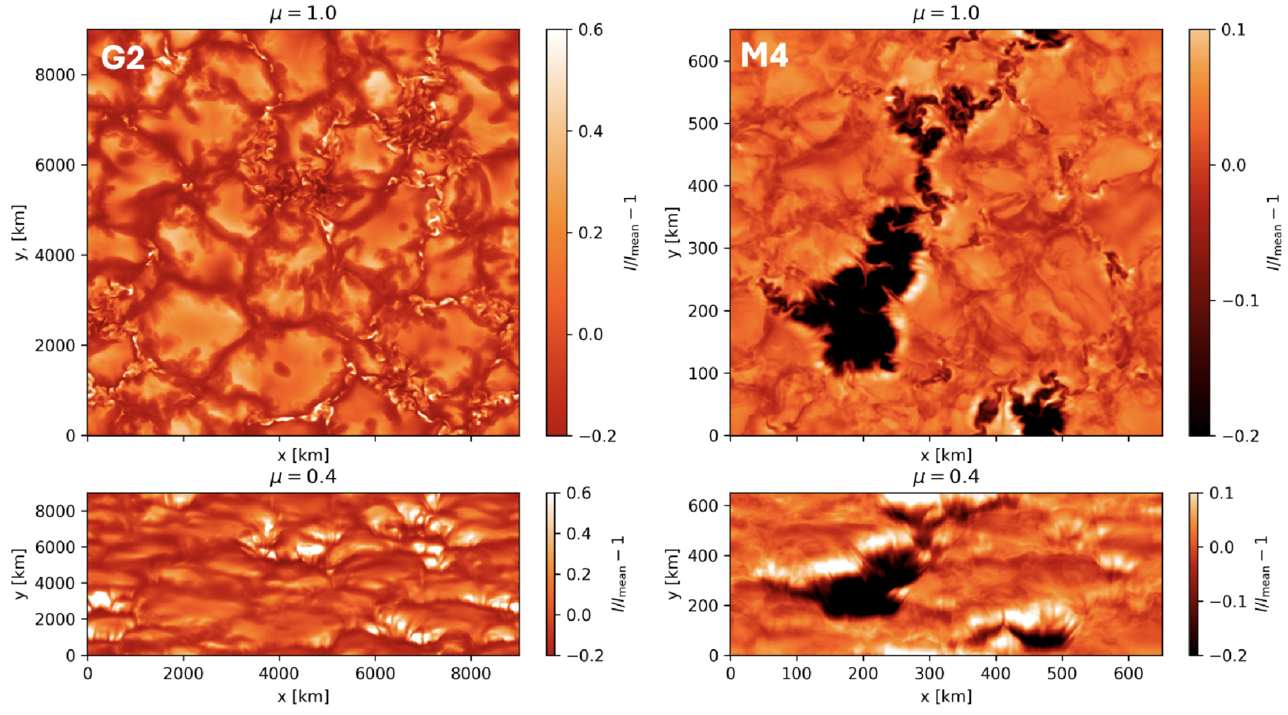
Simulated faculae on a Sun-like star (left) and an M4 star (right). These images show the faculae at 600 nm. Click to enlarge. [Shapiro et al. 2026]
The modeled faculae on the Sun-like G2 star were bright, as expected. On the K2 and M0 star, these features were fainter, with the faculae on the M0 star being roughly as bright as the surrounding stellar surface. On the M4 star, the faculae were darker than surrounding areas, upending the assumption that faculae on all stars are brighter than the stellar surface.
Exoplanetary Effects
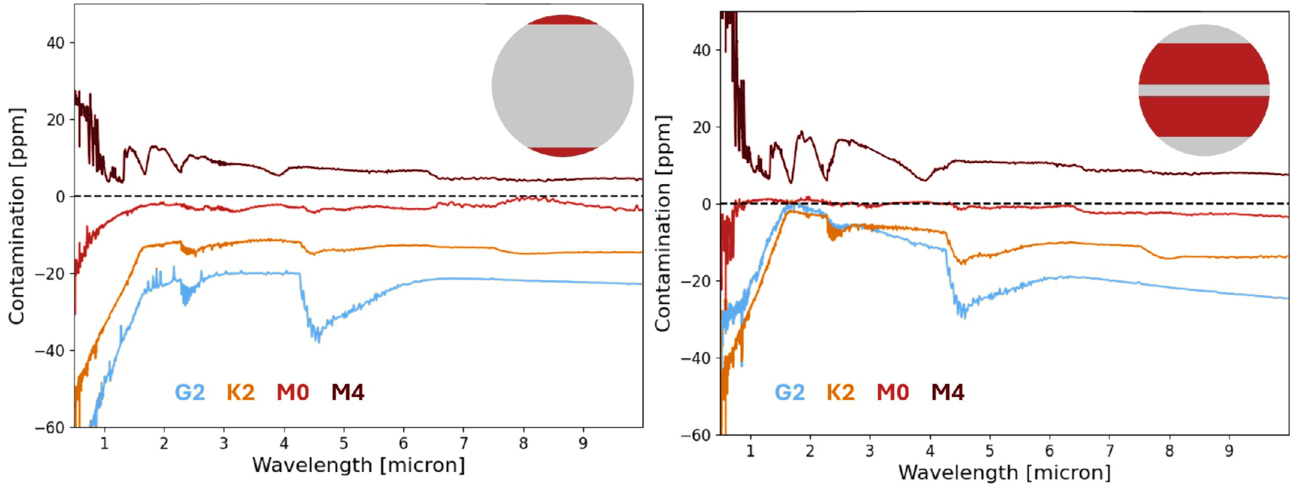
The transition from bright faculae on Sun-like stars to dark faculae on M4-class stars directly affects interpretations of exoplanet transmission spectra. The existence of dark faculae increases the derived exoplanet radius, whereas bright faculae on Sun-like stars decrease the derived radius. The contamination due to the faculae is wavelength dependent, with the largest contamination occurring at shorter wavelengths. This contamination, if not fully accounted for, can mimic spectral features from an exoplanet’s atmosphere.
Contamination of transmission spectra by faculae near a star’s poles (left) and closer to the star’s equator (right). Faculae are bright for the simulated G2, K2, and M0 stars, and they are dark on the simulated M4 star. Click to enlarge. [Shapiro et al. 2026]
What determines whether faculae appear brighter or darker than their surroundings? Using a qualitative framework, Shapiro and coauthors found that the appearance of faculae can be traced to a few competing factors: the strong magnetic fields within faculae prevent the incursion of hotter material (making the spots appear darker), while the magnetic field lowers the opacity of the gas in that region, allowing us to peer deeper and glimpse hotter material (making the spots appear brighter). On cooler stars, effects related to higher surface gas pressure tilt the balance in favor of darker faculae.
Citation
“The Curious Case of Dark Faculae on M Dwarf Stars,” A. I. Shapiro et al 2026 ApJ1008 24. doi:10.3847/1538-4357/ae7105
As the 2026-2027 NFL season kicks off, the Philadelphia Eagles are giving new meaning to their signature “Fly, Eagles, Fly” fight song. The football team is partnering with the National Marine Sanctuary Foundation for Birds Supporting Birds, an initiative to support seabirds off the coast of Massachusetts (and in New England Patriots’ territory) this fall.
The team is supporting NOAA’s Stellwagen Bank National Marine Sanctuary Shearwater Tagging Project, an ongoing initiative dedicated to studying the great shearwater (Ardenna gravis) and their migration. Great shearwaters are large, white-and-grey seabirds known for their epic journeys. They travel thousands of miles every year from their remote South Atlantic breeding grounds up to the cooler North Atlantic waters during the nonbreeding season. According to the National Marine Sanctuary Foundation, they fly the equivalent of over 200,000 football fields across the Atlantic Ocean every single year.
Birds Supporting Birds will help support researchers in Stellwagen Bank, an 842-square-mile marine sanctuary east of Boston, to tag great shearwaters and track their migratory routes across the Atlantic.
“The Eagles are directly funding researchers to attach lightweight, solar-powered satellite transmitters to great shearwaters,” Joel R. Johnson, President and CEO of the National Marine Sanctuary Foundation, tells Popular Science. “These tags track the birds’ migration patterns around the Eastern Seaboard and down to the Southern Atlantic Ocean in real time.”
Lovingly known as “The Birds” by their incredibly devoted fanbase, the football team is leveraging their platform to bring attention to ocean conservation and highlight environmental stewardship.
A major 2015 study found that the Gulf of Maine is warming faster than 99 percent of the ocean due to climate change. While the water has slightly cooled since 2021, a report published by NOAA in July found that the environment in the Gulf of Maine still remains unstable. These changes in ocean temperature, currents, and other conditions can impact the seabirds’ food supply.
Great shearwaters are reliable indicators of an ecosystem’s health, who rely on small fish called sand lance in their diets. Whales, dolphins, bluefin tuna (Thunnus thynnus), and other key Gulf of Maine species also rely on these fish belonging to the family Ammodytidae in their diets. By studying great shearwaters and their health, researchers can better understand what is happening in the local ecosystem as a whole.
Researchers at Stellwagen Bank National Marine Sanctuary used satellite tracking technology in 2013. These tags are lightweight and attached to the birds with degradable thread. They have small solar panels so scientists can monitor the birds’ routes over extended periods.
Researchers have now deployed tags on Phil, Franklin, Hoagie, and Liberty, four great shearwaters with very Philly-appropriate names.
Great shearwaters can help scientists understand an ecosystem’s health. Image:National Marine Sanctuary Foundation.
“We are thrilled to invite the public to follow Phil, Franklin, Hoagie, and Liberty in real time on our interactive maps and social channels, bringing everyone along on our shared mission to protect our ocean waters and marine life,” says Johnson, who lists bald eagles (Haliaeetus leucocephalus), great blue herons (Ardea herodias), and great shearwaters among his favorite birds.
Live interactive maps will be available soon on the Stellwagen Bank National Marine Sanctuary and National Marine Sanctuary Foundation’s website, so you can follow the great shearwater’s epic journey, while the Eagles (or your favorite team) compete on the gridiron.
The Goodram PX700 is a budget PCIe 4.0 drive that delivers everything you need: good performance, great power efficiency, and all in a single-sided package that runs cool. Sometimes it really is as simple as picking one drive to meet whatever your storage needs are at the moment. It’s not the first model that comes to mind for this segment, but in our testing it performed better than expected as a good drive that may otherwise run under the radar.
Goodram is not a new or no-name company, even if the “good RAM” moniker seems a little too on the nose. Instead, it’s a memory assembler in the EU with quite some history. This, in fact, makes it more approachable in comparison to a lot of the new names we have seen on AliExpress and increasingly on Amazon. We expect reliability or at least good support from the company, and the TBW on this one seems to reflect that this isn’t an ultra-budget drive.
On the contrary, performance was not just what we expected – considering we’ve reviewed many drives in this segment, many with the same or comparable hardware – but above. Sometimes only by a small amount, but the gaps are real. Anywhere performance mattered, it delivered. One expects trade-offs for that, but in fact the PX700 is very power-efficient, and the drive provides an excellent storage experience. The only downsides are sustained write performance – which is of little importance in most cases – and, unfortunately, the price. At the right price point, this would be a great pick for any device.
The Goodram PX700 covers the most popular capacities of 1TB, 2TB, and 4TB. Smaller drives can be popular for upgrades and basic boot usage, especially with how prices are now, but modern flash scales best at 1TB and up. 8TB drives are great as a larger storage solution but require a significant investment. The PX700 sticks to what will sell, predominantly 1TB and 2TB. At the time of review, these are priced at $346 and $418, respectively. These prices are high and probably point to a lack of stock more than anything else. While the 1TB price is double what it should be, at 2TB a drive of this type should be closer to $300. Naturally, one has to take into account the pricing volatility in an SSD market besieged by a NAND shortage, but we recommend looking in that range for this drive or one comparable to it with similar or the same hardware.
The drive is full-fledged Gen 4 with performance up to 7,400 / 6,500 MB/s for sequential reads and writes and up to 1 million random read and write IOPS at 4TB with only 820K write at 1TB/2TB. This is standard for the class and is more than enough performance for everyday tasks, gaming, productivity workflows, and more. The drive has the standard five-year warranty with up to 600TB of writes for every TB. The last part of that is worth a second glance because it indicates this drive can come with TLC rather than QLC flash, since TLC, aside from being faster, has better endurance than QLC. However, we have reasons to believe our sample has QLC, which we will point out where the evidence supports that reasoning. We want to emphasize that you should not assume what flash a drive uses based on TBW alone.
Goodram PX700 Software and Accessories
Goodram does not offer any specialized or custom software for its SSDs. You will have to rely on third-party solutions. Software for SSDs essentially falls into three categories: health management, performance, and data backup. SSD toolbox applications from manufacturers will usually cover the first two, with, typically, an OEM version of Acronis True Image for the last. For free alternatives, we recommend CrystalDiskInfo for health information, CrystalDiskMark for basic benchmarking, and MultiDrive for data backup and imaging. MultiDrive is made for Windows and has a bootable WinPE image, so for other operating systems you can opt to use Clonezilla instead.
Goodram PX700: A Closer Look
Tom's HardwareTom's Hardware
The PX700 is a single-sided drive at all capacity points. This makes it compatible with a wider range of systems and, if you need to cool the drive, it’s easier to tackle just one side of components. As it turns out, the drive runs cool enough that you probably don’t have to worry about this – check the Power Consumption and Temperature section below – but it’s still worth pointing out. The data on the rear label is standard, but we do want to say a little bit more about the listed manufacturer.
Wilk Elektronik is a Poland-based memory company, which makes this interesting, as that means the PX700 is a European-assembled SSD. Goodram covers the mainstream parts and IRDM enthusiast, although this is the first SSD from them that we’ve reviewed. As we are going to dig into the hardware in this section, we will say that the drive's silicon is sourced from Asia, as with virtually every SSD. If we say a drive is made in Poland, this means the drive is assembled, tested, and covered by warranty in Poland with an EU anchor. For some, that might be a positive factor in any purchasing decision.
Tom's HardwareTom's HardwareTom's Hardware
Identifying the hardware here is half simple and half challenging. The controller is clearly the Maxio MAP1602, a four-channel, DRAM-less part that’s been a budget champion for quite some time. There is not much mystery there aside from maybe this being a later revision, typically used for higher capacities.
The flash is more difficult. We can ascertain that these are 512GB NAND flash packages from the “512G” – given modern flash is 1Tb or 128GB, four dies per package for a total of sixteen dies. That’s perfect for maximizing performance out of this controller. The “W2533” is likely the manufacture date of week 33, year 2025. All this indicates is that this is, at least, not older flash, although we already know it has to be 2,400 MT/s at a minimum to hit the specified performance.
It makes a lot of sense for the PX700 to use TLC flash, though, given the TBW and the fact that we’ve been seeing this controller with 232-Layer Micron TLC more frequently lately. The Biwin Black Opal NV7400 comes to mind. However, Goodram has access to YMTC flash, and that includes QLC. YMTC rather than Micron QLC is more likely, given the latter is in high demand in enterprise. Normally, you could use certain utilities to identify the flash, but firmware for this controller is often encrypted to avoid revealing the flash ID. It’s still possible to get around this with leaked MP tools, but otherwise the best way to identify it is simply to look at the performance. We’ll be doing that in this review with comparison drives to help back up the investigation.
The Goodram PX700 is in a tight spot with ample competition in today’s market. This has been true for some years now, but some more recent releases have turned up the heat. These would include the Sandisk WD Blue SN5100 with its fantastic random read latency, the Crucial P310 with surprisingly good all-around performance, and even the Samsung 990, which was a very late arrival. Existing drives with comparable hardware to the PX700 include the Acer FA200 with QLC flash plus the Biwin Black Opal NV7400, Addlink A93, and Inland TN470 with TLC. The last of these also uses a Phison controller rather than the more common Maxio MAP1602. Lastly, we have the budget-minded Kingston NV3, which is always looming in the background.
Trace Testing — 3DMark Storage Benchmark
Built for gamers, 3DMark’s Storage Benchmark focuses on real-world gaming performance. Each round in this benchmark stresses storage based on gaming activities including loading games, saving progress, installing game files, and recording gameplay video streams. Future gaming benchmarks will be DirectStorage-inclusive and an evaluation for future-proofing is included where applicable.
Tom's HardwareTom's HardwareTom's Hardware
The PX700’s 3DMark results are spot-on for a drive of this caliber, hanging out at around 40µs for latency with bandwidth over 700 MB/s. This level of performance is excellent for gaming, and the only drive that wouldn’t fall into that category is the NV3. The NV3 is still fast enough for a games drive and remains a good budget choice, but there are faster options like the PX700. We want to emphasize that the PX700 is better than it looks in this lineup because it’s effectively within range of all drives but one, the WD Blue SN5100.
Among the QLC-based drives, the WD Blue SN5100, 990, and P310 all notably score near the top. The BiCS flash in the first drive is known for its responsiveness and, yes, it will give you a small edge with game load times. However, the 990 is right up there with the P310, which means there is no shortage of viable options. Most slower drives, from a gamer’s perspective, will be last-generation or slower PCIe 4.0, which means it’s not hard to find drives that are very fast for games. This means that the deciding factor might lie outside of 3DMark performance, such as drive reliability.
Trace Testing — PCMark 10 Storage Benchmark
PCMark 10 is an industry standard trace-based benchmark that uses a wide-ranging set of real-world traces from popular applications and everyday tasks to measure the performance of storage devices. The results are particularly useful when analyzing drives for their use as primary/boot storage devices and in work environments.
Tom's HardwareTom's HardwareTom's Hardware
While the PX700 is merely mediocre against the competition in 3DMark – its absolute performance is quite good, though – its showing in PCMark 10 is better. This is again a scenario where the drives with TLC flash, including the TN470 with Phison’s controller, are underwhelming. This can be confusing to buyers who have relied on the mantra that TLC is better than QLC. There are reasons for the surprise here, although the general idea that benchmarking is often looking at ideal scenarios is perhaps the easiest answer.
These drives, whether TLC or QLC, rely on pSLC cache as much as possible to give you the best performance. This pSLC mode is not equivalent to native pSLC and is generally the same speed regardless of the flash type. QLC, however, tends to lead TLC in some ways and follow it in others. For example, QLC gets larger benefits from optimizations, so it may see advanced techniques first. This includes improvements to 4K latency. On the other hand, QLC has four planes when TLC has advanced to six. As we’ve seen with BiCS flash, which is four-plane against six-plane TLC from Micron and YMTC, fewer planes can lead to lower effective latency. The advantage of a higher plane count is in bandwidth but does not come without costs and drawbacks.
The PX700 is also faster than a QLC-based drive with the same controller, like the FA200. In that case, the FA200 uses twice as many dies – thirty-two – which puts more load on the controller. This can increase latency. In general, the idea has been that bigger drives are faster, which is certainly true in many cases. Larger drives will have more bandwidth and can reach higher IOPS due to improved parallelization. However, past four dies for each channel – this is where the PX700 falls, and the FA200 exceeds – you are increasing power consumption and overhead. So, the PX700 is in a sweet spot for how this benchmark tests.
We would go on to say that the P310, WD Blue SN5100, and 990 all beat the PX700. These are all QLC-based drives with a range of controllers. We’ve already explained the BiCS factor. Samsung’s newer QLC is also very good. The P310 has always been a bit of an outlier, as on paper its hardware shouldn’t perform as well as it does. Considering Crucial used to rely at least partially on proprietary controllers, we think this is a situation where they did a lot of optimization. WD and Sandisk also did this with the Black SN8100/Optimus Pro GX 8100 so there’s some “special sauce” at play. The PX700 being the best of the rest is a point in its favor, as those are the drives it’s competing with in the real market.
Console Testing — PlayStation 5 Transfers
The PlayStation 5 is capable of taking one additional PCIe 4.0 or faster SSD for extra game storage. While any 4.0 drive will technically work, Sony recommends drives that can deliver at least 5,500 MB/s of sequential read bandwidth for optimal performance. Based on our extensive testing, PCIe 5.0 SSDs don’t bring much to the table and generally shouldn’t be used in the PS5, especially as they may require additional cooling. Check our Best PS5 SSDs article for more information.
Our testing utilizes the PS5’s internal storage test and manual read/write tests with over 192GB of data both from and to the internal storage. Throttling is prevented where possible to see how each drive operates under ideal conditions. While game load times should not deviate much from drive to drive, our results can indicate which drives may be more responsive in long-term use.
Tom's HardwareTom's HardwareTom's Hardware
For the PS5, we can recommend almost any drive if it meets the PS5’s minimum requirements in any real way. The PX700 significantly exceeds that, so the question is more about value. What does this drive offer that others don’t? For this category, this often means leaning towards drives with heatsinks and/or higher reliability. Reliability is a difficult quality to measure, although a warranty gives some peace of mind. As for heatsinks, you can always add your own. So drawing lines here becomes more difficult.
We would point to our Power Consumption and Temperature section below for some additional support. The PX700, as we will see, runs coolly, which is a big positive for the PS5. Performance-wise, it’s right up there with the other drives and only really behind the Blue SN5100. You don’t have to go with a big brand to get good results here, and the PX700 will serve you well.
Transfer Rates — DiskBench
We use the DiskBench storage benchmarking tool to test file transfer performance with a custom 50GB dataset. We write 31,227 files of various types, such as pictures, PDFs, and videos to the test drive, then make a copy of that data to a new folder, and follow up with a reading test of a newly written 6.5GB zip file. This is a real-world type workload that fits into the cache of most drives.
Tom's HardwareTom's HardwareTom's Hardware
The PX700 does very well here, and we wanted to give some background on this test and what it means to put that into perspective. Whether you’re copying between drives or copying to and from the same drive, there are some universal principles. One is that there will be a bottleneck, and usually this will be on the write side of things, as drives write slower than they read. Flash memory, in particular, has to erase cells before they can be written again, which leads to some curious behavior under certain workloads. More generally, though, a write has higher latency – with flash again, this is due to the technology and how multi-bit cells usually need multiple write passes – and writes must be acknowledged, while reads just come from usually static media.
If you have drives that are of different classes – NVMe and SATA, or PCIe 4.0 and PCIe 3.0 – then you would expect the slower class of drive to be the bottleneck even if it’s on the read side. This is also universal, going back to the days when HDDs got faster as they got bigger. SSDs also generally get faster with capacity, but flash is so fast that these rules are no longer absolute. This is complicated by other facets of the technology like pSLC caching and TLC versus QLC flash, where with sustained writes you can have dramatic changes in performance. This is a problem because many people buy drives thinking mostly about transfer performance, and when they hit a low that’s nowhere near the box-rated speed, they panic.
Our DiskBench testing takes all of this into account as it’s closer to a real-world workload, including using different file sizes. Transferring a bunch of large files is fast. Copying lots of small files – and any veteran of hard drives will know this from backing up Windows or documents manually – can be very slow, even on SSDs. So we do a mix. Moreover, we’re doing an on-drive copy, which helps rule out external factors. Much of what you do on your system can be cached in system memory, which can give misleading metrics depending on what you’re doing.
What we’re leading up to here is that the PX700 is the fastest drive on the list for reads and not far off first place for copying. Considering it’s up against some of the best budget drives out there, that’s no mean feat. This is, again, a real-world workload and probably more meaningful than something like 3DMark is for game load times.
Yes, the difference between the best and the worst drive for reads is under 10%, but nobody wants to buy a drive and feel bad about how fast it feels. The PX700 feels like a premium drive – the weaker write performance here is real, but most of what you’re doing will be read-heavy – and if you’re building a PC for someone with it over, say, the Samsung 990, they won’t know the difference. That is a common refrain regardless, but it helps underline the value of reliability. People buy Samsung and WD/Sandisk for a reason. Given Goodram’s European basis, there is some reason to celebrate the performance here while also acknowledging it’s not a no-name brand from AliExpress.
Synthetic Testing — ATTO / CrystalDiskMark
ATTO and CrystalDiskMark (CDM) are free and easy-to-use storage benchmarking tools that SSD vendors commonly use to assign performance specifications to their products. Both of these tools give us insight into how each device handles different file sizes and at different queue depths for both sequential and random workloads.
The PX700 has very steady performance in ATTO. We have no real complaints there. If we turn to sequential performance in CDM, we see more of the same. We would mostly look at QD1 reads for that, being a real-world metric, and it’s roughly on par with the NV7400 there. If we turn to random 4KB read performance at QD1, it’s a little bit further down the list but still hangs with excellent drives like the P310. Anything below about 45µs here is solid in our book. This drive should be quite responsive. If we were forced to be critical, we would point out that high QD 4KB write performance is low. Luckily, this is not a real-world workload for a drive of this type.
Sustained Write Performance and Cache Recovery
Official write specifications are only part of the performance picture. Most SSDs implement a write cache, which is a fast area of pseudo-SLC (single-bit) programmed flash that absorbs incoming data. Sustained write speeds can suffer tremendously once the workload spills outside of the cache and into the "native" TLC (three-bit) or QLC (four-bit) flash. Performance can suffer even more if the drive is forced to fold, the process of migrating data out of the cache in order to free up space for further incoming data.
We use Iometer to hammer the SSD with sequential writes for 15 minutes to measure both the size of the write cache and performance after the cache is saturated. We also monitor cache recovery via multiple idle rounds. This process shows the performance of the drive in various states, including the steady-state write performance.
Tom's HardwareTom's HardwareTom's Hardware
The PX700 starts off in the pSLC cache mode, writing at 5.8 GB/s for over 86 seconds. Speeds are slightly higher for the first two seconds, something we have seen before with this controller, but ultimately we’re looking at a 500GB cache. This is Exhibit A of why we would identify the flash as QLC. 4-bit QLC flash operating in a 1-bit pSLC mode is trading four times the capacity for performance, which means a 2TB drive will generally have a 500GB cache at most. A 3-bit TLC drive could have a larger cache, although there is nothing precluding it from having 500GB, even if this seems hard to be coincidental.
A TLC drive with a smaller-than-maximum-sized cache would probably be able to maintain some speed, though. The PX700 immediately falls into a folding mode – it’s waiting for data to be moved from pSLC to the native flash – with an average speed of 163 MB/s. TLC flash can at times be this slow, but it’s less likely, and especially less likely if it has space to spare. Even the FA200, with the same hardware, is faster. The FA200 does have twice the flash, of course, but the controller is essentially saturated. Rather, the FA200’s cache speed of 5.54 GB/s is slower than the PX700’s – and this could be from having more flash – which means the post-cache speed will be higher. This reinforces the position that the drive is using QLC. Of course, we could have thrown the 2TB HP FX700 into the mix to further prove this point, but we think comparing a 4TB drive is a more valuable approach.
It goes without saying that this is the first real failing of the PX700 in our review. However, it’s expected of a QLC SSD with a massive cache. We don’t consider it disqualifying. You are not buying a budget SSD to hammer it with writes. On the other hand, the 600TBW per TB warranty makes you assume you could do that to some extent. Also, the lower performance here could creep up in a fuller-drive experience. We also can’t exclude the fact that some PX700s come with TLC flash. Which means, taken as a whole, you should assume QLC will perform like the TLC competition 99% of the time.
Power Consumption and Temperature
We use the Quarch HD Programmable Power Module to gain a deeper understanding of power characteristics. Idle power consumption is an important aspect to consider, especially if you're looking for a laptop upgrade as even the best ultrabooks can have mediocre stock storage in terms of capacity and performance. Desktops are often more performance-oriented with less support for power-saving features so we show the worst-case for idle.
Some SSDs can consume watts of power at idle while better-suited ones sip just milliwatts. Average workload power consumption and max consumption are two other aspects of power consumption but performance-per-watt, or efficiency, is more important. A drive might consume more power during any given workload but accomplishing a task faster allows the drive to drop into an idle state more quickly, ultimately saving energy.
For temperature recording we currently poll the drive’s primary composite sensor during testing with a ~22°C ambient. Our testing is rigorous enough to heat the drive to a realistic ceiling temperature but real-world temperatures will vary due to the environment and workload factors.
The PX700 comes back into our good graces with very good results in our power testing. It’s essentially tied for second with the FA200, which is hardly surprising given the hardware similarity. Only the BiCS8-based WD Blue SN5100 pulls away from the pack. We would consider every drive on this list to be sufficiently power-efficient for laptop use, although the 990 is closer to the lower end of that range. Certainly 550 MB/s per watt or higher is an excellent result and indicates a drive that can be run without a heatsink most comfortably. As for idle pull – we test under desktop conditions, which can also match poorly-optimized power settings – the PX700 is not unusually power-hungry and, in fact, better than the WD Blue SN5100. That’s a bonus.
Temperature-wise, we have good news. Goodram touts the graphene label on this drive, which, in our experience, does actually help with cooling, especially on a drive with four flash packages. The PX700 in our testing peaked at 61°C, nearly 30°C below the initial throttling point, well beyond the 20°C of headroom we like to see. The MAP1602 does tend to be a hotspot more than alternatives like the Phison E27T on the P310 and TN470, but a heat-spreading label does help. In our estimation, this is a cool-running drive that would be great anywhere.
We use an Alder Lake platform with most background applications such as indexing, Windows updates, and antivirus disabled in the OS to reduce run-to-run variability. Each SSD is prefilled to 50% capacity and tested as a secondary device. Unless noted, we use active cooling for all SSDs.
Goodram PX700 Bottom Line
The Goodram PX700 is a model budget PCIe 4.0 SSD. It matches or exceeds all of the expected performance points; it's power-efficient, and it uses a simple single-sided design without a heatsink. The only problem is that a “budget” drive has to be affordable. Current prices in the U.S. for this drive leave something to be desired. However, if it can match or beat the prices of other drives in this class, it’s probably one of the better choices available. In part, this is because we’d be liable to trust Goodram over non-names – the TBW alone shows it means business – and, on the other hand, the drive actually outperformed our expectations. Aside from the sustained write performance, this drive really feels premium. You don’t need a Samsung, WD, Sandisk, or even Crucial drive to feel like you have next-gen storage.
(Image credit: Tom's Hardware)
Let’s look at what we mean by that for your use. Game and app loading times are heavily reliant on random and sequential reads at low QD. The PX700 does well there. You also may be transferring files a lot, and the DiskBench results are mighty. For your laptop or HTPC, you might want something that’s power-efficient and, if space is a concern, something that stays cool without a heatsink, and this applies to PS5 use as well. The PX700 ran cool in our test with just the graphene label and was very efficient. You’re not getting a shorter warranty with lower TBW, as with Samsung’s 990 or some QLC-based drives, and we know where this drive is assembled. It’s hard to look at this combination and not feel like it’s a stellar drive if you can find it at a normal price.
Aside from price, our only complaint would be sustained write performance. It’s pretty dissapointing, although we should point out that it’s also expected. The drive also has trade-offs here. Namely, its standard pSLC write performance is better than the 4TB FA200, and in the 2TB HP FX700’s ballpark, so you’re not getting nothing for that later drop. The PX700, in fact, is faster folding than the FX700, too. In the grand scheme of things, this isn’t a big deal, as you should never hit that state – this drive should effectively be fast enough for a 1GbE network, if that’s a bottleneck – and having a bit faster peak performance does translate to better marks on some of our benchmarks. The drive could take a hit in some cases, such as when it's very full, in which case getting a drive with DRAM and guaranteed TLC flash could assuage your fears.
For most use cases, though, the PX700 is more than good enough and, in fact, punches above its weight in our opinion. It would be a good option for just about any type of machine. PS5, laptop, HTPC, desktop, you name it. Primary or secondary drive, just fine. You don’t even need a heatsink. The capacity range is solid – you’re not going to find 8TB on a drive like this – and you can bring your own software. Performance is good enough to overlook any QLC flash use, so our main problem remains the price. Get it down to the same ballpark as the other drives in our list, and you have a contender. We hesitate to put an exact dollar amount for that because SSD prices are volatile, to say the least, so compare it to comparable drives such as the ones we matched it against today.
British American Tobacco is expanding its Vuse business in the United States with a new version of the Vuse Pro vaping system and four flavored pod options. The rollout is notable not only because of the return of fruit-flavored Vuse products in selected U.S. markets, but also because the device incorporates age verification and Bluetooth connectivity into the activation process.
The new Vuse Pro pods are available in Peach, Berry, Watermelon and Fresh Mint. Vuse’s U.S. website lists the pods at 5.0% nicotine by weight (NBW) and identifies them as nicotine-salt products.
The products have begun appearing in Ohio and selected U.S. markets. However, they have not received FDA marketing authorization, making the launch an important development in the country’s changing regulatory environment for flavored vaping products.
Vuse Pro Makes Age Verification Part of Device Activation
The biggest difference between the new Vuse Pro system and a conventional closed-pod vape is the role played by the smartphone app.
Instead of treating age verification solely as a retail requirement, the Vuse Pro setup connects the process with the device itself. Users must complete the required age-verification process through the Vuse Pro App, enable Bluetooth and pair the smartphone with the device before the vape can be activated.
This creates an additional access-control layer after the purchase.
The app is also designed to provide several device-management functions, including:
Manual locking and unlocking
Automatic locking
Find My Vape
Battery-related reminders
Bluetooth device management
Factory reset
The system can also use Bluetooth proximity as part of its locking function. When the device moves outside the configured Bluetooth range, Auto-Lock can prevent further use until the paired smartphone is used to unlock it.
That makes the Vuse Pro more than a conventional rechargeable closed-pod system. Software becomes part of the product’s access and security architecture.
Four Flavored Vuse Pro Pods Are Now Listed in the U.S.
Vuse lists these products at 5.0% NBW, meaning nicotine by weight. The company also confirms that its closed-system products use nicotine salts.
The four flavors give Vuse a broader U.S. lineup than a product strategy focused only on traditional tobacco and menthol profiles.
The timing is significant. BAT had already indicated that it planned a phased expansion of flavored Vuse products in the U.S. during the third quarter of 2026. In its 2026 first-half communications, the company said it was strengthening age-verification controls while preparing to commercialize flavored vapor products.
The current rollout therefore appears to be part of a broader strategy rather than a one-off product launch.
Closed-Pod Design Keeps the User Experience Simple
Vuse Pro remains a rechargeable closed-pod system.
Instead of requiring users to fill a tank manually, the system uses prefilled pods that are inserted into the device. The device is draw-activated, while the app handles additional connected functions.
This approach is different from open-pod systems that allow users to select their own e-liquid and refill the cartridge.
For Vuse, the closed architecture also provides tighter control over the consumable used with the device. Users choose from the available Vuse Pro pods rather than mixing or filling e-liquid themselves.
The U.S. Vuse website currently identifies Vuse Pro as a 5.0% NBW nicotine-salt system.
Bluetooth Has a Bigger Role Than Simple Connectivity
Bluetooth is often included in connected consumer electronics as a convenience feature. With Vuse Pro, its role is more closely connected to device access.
Pairing the vape with the Vuse Pro App is part of the initial activation process. Bluetooth also supports functions such as device locking, unlocking and locating.
That makes the smartphone an important part of the overall user experience.
The concept is different from simply adding an app that displays battery information or usage statistics. In this case, the connected software is integrated into how the hardware is accessed.
This could become an important direction for regulated nicotine products as manufacturers look for additional ways to combine age controls with connected hardware.
Vuse Pro Adds Flavors While U.S. Regulations Remain Complex
The rollout is taking place against a complicated U.S. regulatory background.
Current reporting indicates that the new Vuse Pro flavored products have appeared in Ohio and selected other markets even though they have not received FDA marketing authorization. Reynolds American has said the products are being sold in accordance with applicable state regulations and that the company is using measures such as identification requirements and purchase limits to address underage access.
State rules remain important because flavored-vape restrictions differ across the country. Some states and jurisdictions have enacted restrictions or bans covering flavored vaping products.
As a result, availability of the new Vuse Pro flavors should not be interpreted as nationwide authorization or nationwide availability.
BAT Is Building on Vuse’s Existing U.S. Position
The new product also arrives from a strong position in the U.S. closed-system market.
BAT reported that Vuse held a 55.9% value share of tracked rechargeable closed-system vapor channels in the first half of 2026, representing a 4.1-percentage-point increase from the end of 2025. The company said Vuse’s share was more than twice that of its closest competitor.
BAT has therefore been expanding the Vuse portfolio from an established base rather than attempting to introduce an entirely new brand.
The company’s 2026 strategy also calls for a phased distribution of new Vuse Pro flavored pods. Reporting from 2Firsts indicates that BAT planned approximately 25,000 retail outlets during the third quarter and another 25,000 in the fourth quarter, although the company has not disclosed the number of stores currently carrying the products.
Vuse Pro Specifications and Product Details
Feature
Vuse Pro
Company
Reynolds American / R.J. Reynolds Vapor Company
Parent Company
British American Tobacco
Brand
Vuse
Product
Vuse Pro
Category
Rechargeable closed-pod vaping system
Pod Type
Prefilled Vuse Pro Pod
Activation
Draw-activated
Initial Setup
Vuse Pro App, age verification and Bluetooth pairing
Connectivity
Bluetooth
App Functions
Lock/unlock, Auto-Lock, Find My Vape, battery reminders
Water Resistance
IPX4
Charging
USB rechargeable
Full Charging Time
Approximately 50 minutes
Flavors
Peach, Berry, Watermelon, Fresh Mint
Nicotine Strength
5.0% NBW
Nicotine Type
Nicotine salts
Market
United States
FDA Marketing Authorization
Not authorized
Public U.S. product information does not currently provide a complete set of technical specifications such as battery capacity, e-liquid volume, coil construction or an official puff-count rating. It is therefore better not to treat those figures as confirmed specifications.
Why the App Matters to the Vuse Pro Launch
The most interesting aspect of the new Vuse Pro is not necessarily the hardware.
The larger change is the relationship between hardware, software and age control.
Traditional age verification normally happens when a customer buys a regulated product. Vuse Pro introduces another step by connecting device activation with an age-verification process through a smartphone application.
That creates a product ecosystem in which the device can remain connected to a specific smartphone while offering functions such as Auto-Lock and Find My Vape.
For manufacturers, this approach could provide additional tools for managing access. For consumers, however, it also means that the vape is less independent from the smartphone than a conventional closed-pod device.
FDA Status Should Be Clearly Distinguished From Enforcement Policy
One point is particularly important when discussing the U.S. Vuse Pro launch: FDA enforcement policy and FDA marketing authorization are not the same thing.
Current reports state that the Vuse Pro flavored products being sold in selected U.S. markets have not received FDA marketing authorization.
At the same time, the FDA’s 2026 enforcement approach has changed the regulatory environment for certain unauthorized vaping products. That change in enforcement priorities should not be described as equivalent to formal authorization.
This distinction matters because consumers and retailers may otherwise interpret market availability as evidence that a product has completed the FDA’s marketing authorization process.
What the Vuse Pro Launch Means for the U.S. Vape Market
The new Vuse Pro rollout combines two developments that have become increasingly important in the U.S. vaping market: flavored products and stronger age-access controls.
Peach, Berry, Watermelon and Fresh Mint expand Vuse’s current flavor offering, while the app-based activation system gives the company a way to connect age verification with the device itself.
BAT’s broader strategy suggests that this is part of a planned expansion of Vuse rather than an isolated experiment. The company has publicly discussed phased flavored-pod commercialization and stronger age-verification measures as part of its U.S. strategy.
The result is a Vuse Pro system that is increasingly defined not just by its pods and battery, but by the software surrounding the device.
For the U.S. market, the more important question may be whether app-based age verification, Bluetooth access controls and regulated flavored pods become a more common model for next-generation vaping products.
For now, Vuse Pro represents a notable example of how nicotine-device manufacturers are combining connected technology with age-access measures while navigating a rapidly changing U.S. regulatory landscape.
Two researchers who study the debilitating sleep disorder have won a prestigious Lasker Award. Their research in animals laid the groundwork for a new drug that addresses the condition’s root cause.
Le Google Pixel 9a profite de la rentrée et des French Days pour alléger son prix chez Cdiscount : le smartphone 5G de 256 Go tombe à 404 € avec le code COCORICO15. Une bonne occasion de passer au Pixel sans faire surchauffer la carte bancaire.
Apple planned to introduce high-end in-ear AirPods with built-in cameras for analyzing the surrounding environment at today's event, but the launch has been pushed to next year, Bloomberg's Mark Gurman reports.
In early August, Gurman said the earbuds were progressing well enough to potentially ship before the end of the year. By mid-August, though, he reported that Apple had pulled the model from its 2026 road map, pushing the camera AirPods to a 2027 launch alongside the 20th-anniversary iPhone instead. Today's event will still include new AirPods 5 models.
We've seen huge price rises this year for PC hardware, but RAM and SSDs have been especially affected. The global DRAM shortage, mostly caused by AI data center demands hoovering up all of the available stock, has caused prices to skyrocket. That's why this 4TB Crucial T705 SSD, down to $502.51, is a good deal in the current market, especially given its high capacity.
Looking at Camelcamelcamel's price data, we can see that this drive was hitting almost $700 just a few weeks ago. Several price drops since have meant that the 4TB Crucial T705 is now almost below $500 for the first time in February. Along with a decent price drop, this Crucial drive is now the cheapest Gen 5 SSD you can pick up, with the next-cheapest model, the Samsung 990 Evo Plus, $60 more expensive at the moment.
It's not even a fair comparison, too, as the entry-level 990 Evo Plus only supports PCIe 5.0 over two lanes, not four, meaning you're only getting Gen 4-equivalent speeds. The Crucial T705 is a high-performance drive that's much faster, and right now, much cheaper.
This Crucial T705 4TB SSD is the cheapest Gen 5 SSD on the market right now. It offers read and write speeds of up to 14,500 MB/s and 12,700 MB/s apiece.View Deal
SSDs that offer Gen 5 speeds are a real step up over their slower Gen 4 counterparts. The T705 will offer you sequential read and write speeds of 14,500 MB/s and 12,700 MB/s, which is significantly faster than the fastest Gen 4 SSD on the market, the Samsung 990 Pro, which taps out at 7,450 MB/s. The T705 ships with 232-Layer Micro TLC memory modules and uses the Phison E26 controller.
It's also one of the fastest you can buy, period, rivalling the WD_Black SN8100, which hits speeds of 15,000 MB/s. That drive will set you back $659.99 right now, too, a significant increase compared to the deal on offer here. The Crucial T705 drive scored an Editor's Choice award for its sustained read/write performance at high speed, along with 4.5 stars in our review.
While we wished that SSD prices were back down to what we saw 18 months ago, it's good to see that high-performance drives like this one can still drop in price. The $502.51 sale price for this Crucial T705 4TB SSD is a seriously good one in the current market, and you won't be able to beat it for speed or price. Grab it at this price while you can.
Le Ninja Foodi AF200EU passe sous la barre des 100 € pour les French Days ! Cdiscount affiche cet Air Fryer double cuve de 7,6 litres à seulement 99,99 € au lieu de 179,99 €. À ce tarif, le four risque de prendre quelques jours de congé.
Apple's hotly anticipated ‘Surprise and Shine’ event is happening now, and we're on the ground in California bringing you all the big announcements as they happen.
Leading the list of rumored-to-be-unveiled products is Apple's first foldable iPhone — expected to be called either the iPhone Duo or iPhone Ultra — which, if it does arrive, would represent the biggest iPhone shake-up in recent history. This dual-screen device could also skyrocket the popularity of foldable phones more generally, so Samsung and Google executives are surely paying close attention.
Elsewhere, Apple looks set to refresh its wearable, earbud, and smart home lines with new Apple Watches, AirPods, and HomePods, respectively — and we may even see a new version of the Apple TV 4K, which hasn't been updated since 2022.
Proceedings kicked off at 10am PT / 1pm ET / 6pm BST — or 3am AEST on September 10 if you're in Australia — and you can follow along below for our live reaction to new CEO John Ternus' first-ever Apple Event.
Today's ‘Surprise and Shine’ Apple event is taking place at the Steve Jobs Theater in Apple Park, California, but you can follow along via the livestream video embedded above or via Apple’s official event page.
Proceedings kicked off at 10am PT / 1pm ET / 6pm BST, which is 3am AEST on September 10 if you're in Australia, but you'll be able to re-watch the stream once the event finishes (we're expecting things to wrap up around 12pm PT / 3pm ET / 8pm BST, or 5am AEST in Australia).
Live updates
Good morning, folks! It's Apple Day — the most important date in the annual tech calendar and the busiest day of the year for the TechRadar office (sigh).
I'll be bringing you the latest iPhone, AirPods, and Apple Watch rumors ahead of the event's kick-off later today, and trust me: there's a lot to cover.
First, a quick reminder of what's happening: Apple's ‘Surprise and Shine’ event is scheduled to start at 10am PT / 1pm ET / 6pm BST today (that's 3am AEST on September 10 if you're in Australia).
This is the 2026 edition of Apple's annual product showcase, and we're expecting to see as many as nine (yes, nine) new products unveiled.
Of those nine rumored products, the most hotly anticipated is Apple's first foldable iPhone, which we've been referring to as the 'iPhone Ultra' for close to a year now. But at the very last minute, the rumor mill has spat out an unexpected new name for this folding device...
Could the iPhone Ultra be the iPhone Duo?
According to seasoned Apple tipster Mark Gurman, the iPhone Ultra will in fact be called the iPhone Duo. It's pretty hard to believe that such a drastically different name has emerged just hours before the product itself is due to be unveiled — so we're still a tad skeptical about its authenticity — but Gurman has an excellent track record when it comes to Apple predictions.
Apple landed on the iPhone Duo name for the foldable iPhone and a $2,000 starting price, eating the additional memory costs. Storage capacities will reach 2 terabytes and roughly $3,000. It’ll ship in October, has support for the Apple Pencil and come in dark blue + white. https://t.co/58VLtVNka6September 9, 2026
Gurman adds in the same X post that the iPhone Duo will have a starting price of $2,000, rising to $3,000 for the 2TB model. And, yes, in case you were in any doubt: those numbers would make the Duo the most expensive iPhone of all time.
Another important note: Gurman says Apple's first foldable iPhone will have Apple Pencil support. Steve Jobs won't be happy...
(Image credit: Apple)
Let's talk AirPods
(Image credit: Future)
Moving away from the iPhone for the moment, let's talk AirPods. Today, we're expecting Apple to announce two new AirPods models: the AirPods 5 without ANC (active noise cancellation), and AirPods 5 with ANC.
Both models are set to use Apple's new H3 chipset, which should improve audio processing and reduce latency, though it remains to be seen how different the AirPods 5 with ANC will be from the AirPods Pro, which already offer ANC.
In any case, we're not expecting to see any camera-equipped AirPods launch today, despite rumors suggesting that such a product is indeed in development.
(Image credit: Apple)
Today might also be the day we finally get a successor to the HomePod mini. This smaller, more affordable version of the standard Apple HomePod (which now exists as the HomePod 2) was released way back in November 2020, but hasn't been updated since.
More than 20 (!) new iPhones have launched in that same period, so to say the HomePod mini 2 has been a long time coming would be an understatement.
Rumored upgrades for the HomePod mini include a faster chipset (duh!), superior audio quality, and Siri AI functionality.
A clear message from Samsung
(Image credit: Samsung)
If you walk around London, New York, or Seoul today, you may spot Samsung's new tongue-in-cheek advertising campaign, dubbed ‘Welcome to Foldables’.
The Galaxy Z Fold 8 manufacturer is clearly hoping to remind people that it has spent a decade developing foldable technology, and that Apple — if it does release its first foldable today — is late to the party.
That said, Samsung isn't totally against Apple's late entry into the foldables market. Speaking to Bloomberg last year, Samsung's President and COO of the company’s Mobile eXperience (MX) division, Won-joon Choi, said: "I think healthy competition with other companies will bring more innovations, and then bring more benefits to consumers. So we are welcoming others to join this category, which we created back in 2019 [...] Having another global company join this category, I think it's good for the industry, and also, it's going to be great for consumers."
Don't forget about the iPhone 18 Pro
A quick word on the iPhone 18 Pro and Pro Max, which will likely be the forgotten children of today's Apple Event while also being the best-selling Apple products of the next 12 months.
Gurman says both phones will have smaller, more functional Dynamic Islands, an upgraded vapor chamber (read: they won't get as hot), and "major" new camera hardware. Rumors suggest a variable aperture feature could be chief among this new hardware, which would make the iPhone 18 Pro and Pro Max some of the best camera phones around.
The iPhone 18 Pro and iPhone 18 Pro Max will have a smaller and upgraded Dynamic Island that can support three tasks at once (up from two currently), major new pro camera hardware and software, plus an upgraded vapor chamber. https://t.co/58VLtVNka6September 9, 2026
Now look, I can live without the Action button, a SIM card slot, and a telephoto camera, but no Face ID or MagSafe? I'm not sure I would spend $2,000 on an iPhone without those two features, which feel pretty essential to how I use my iPhone every day.
Thinking of selling your iPhone 17 Pro? Do so ASAP
(Image credit: Apple / Future)
Here's some last-minute advice for you: if you're planning on selling your current iPhone 17 Pro or Pro Max to fund an upgrade to the iPhone 18 Pro line, you should head out to your local tech store and do so ASAP. Why? Because current iPhones could fall in value by up to 30% once the new models launch.
“Many people will make the mistake of waiting to see what new features the next iPhone range has before trading in their old device, but our data clearly shows that waiting just a few weeks could mean a significant hit on the amount customers can get for it," Joe Armstrong, Head of Trading at musicMagpie, tells TechRadar. "Those who wait until October may see handsets drop by an average of £48 and up to £122."
It's the same story in the US and Australia, and while Armstrong references October as the hard trade-in deadline, your absolute best bet is to sell your current iPhone before 12pm PT / 3pm ET / 8pm BST today.
Of course, selling before the iPhone 18 Pro has even been announced would leave you with no phone until the new models begin shipping later this month, but some retailers will allow you to lock in a sale price today and keep using your phone for a few more weeks. That's the ideal scenario during this precarious time of year for iPhone trade-in values.
First official look at the iPhone Ultra?
New Apple CEO John Ternus has just posted what appears to be a tease for one of the company's new iPhones on X. There's no Tim Cook-style "Good morning!" here, nor even a reminder of today's event start time. Instead, Ternus has shared a 14-second clip of a spotlight shining down on the corner of what looks like an iPhone. Is this a hint that the iPhone Ultra/Duo won't have four straight edges à la the Samsung Galaxy Z Fold 8, or a reference to the rumored variable aperture feature on the iPhone 18 Pro?
Oh, and the Apple Store website is now closed for maintenance, which typically happens right before the company refreshes its product lineup. Not long to go now!
Regarding Ternus' teaser post on X, some Apple fans are pretty convinced it refers to the iPhone 18 Pro's variable aperture, rather than the company's first foldable iPhone. Perhaps we'll get a second teaser video before the event kicks off at 10am PT / 1pm ET / 6pm BST?
Pro phones to come to variable aperture!Notice how the light source widens up and then convergesJust a guess !September 9, 2026
In terms of what won't be unveiled today, we're not expecting Apple to announce new MacBooks, iPads, or Vision Pro-style VR hardware. Software upgrades will most likely take a backseat, too, after iOS 27, Siri AI, and WatchOS 27 were all announced at WWDC 2026 back in June (though it's worth noting that these new OS packages will almost certainly be released alongside their corresponding hardware products in September).
(Image credit: Future)
TechRadar's Editor at Large, Lance Ulanoff, has touched down in Apple Park. His first stop? The official Apple Store, which appears to be temporarily boarded up in preparation for new products.
The Boys Are Back in Town
(Image credit: Future)
Lance has now been joined by Jacob Krol, TechRadar's US Managing Editor for News. Between them, they'll be bringing you hands-on impressions and videos of everything Apple is announcing today — including, we hope, the company's first foldable iPhone.
OK, I'm pretty sure I know what the winning response will be (it rhymes with "grindstone culture"), but cast your vote below for your most anticipated announcement from today's Apple Event:
Just two hours to go! A reminder that today's event kicks off at 10am PT / 1pm ET / 6pm BST (or 3am AEST if you're in Australia, but if you're reading this from Sydney: go back to sleep).
Here's Lance and Jake on their predictions for today's event:
The sun is out at Apple Park! Incidentally, it was raining cats and dogs during last year's event, so perhaps the universe is telling us we're in for a more exciting set of announcements in 2026.
(Image credit: Future)
Watch out for watches
The Apple Watch Series 11 (Image credit: Future)
The foldable iPhone Duo and iPhone 18 Pro won't be the only stars of today's event: Apple Watches also look set to get an overhaul, starting with the Apple Watch Series 12.
Now, if you're expecting major design upgrades, prepare to be disappointed. According to the latest rumors, the Series 12 will look similar to its predecessor, the Apple Watch Series 11 — though one rumor does hint at ceramic case options, which would be a nice touch. We’ve also heard that the Series 12 could have a new LTPO display instead of the classic OLED, but we’re taking this claim with a pinch of salt.
For now, we’re expecting the biggest upgrades to come inside the watch. Specifically, the Series 12 is tipped to house Apple’s new S12 chipset, which should be powerful enough to support Siri AI, as well as a larger battery for a much-needed battery life boost.
(Image credit: Apple)
The premium Apple Watch Ultra is also tipped to get another update today, but again, it won't necessarily look any different from the current model. Some speculate that the Watch Ultra 4 will be identical in appearance to the Watch Ultra 3, while others claim it will have a bigger screen and slimmer build.
Of course, the biggest updates will likely come under the hood, with the Watch Ultra 4 set to get a new chipset — a no-brainer given Siri AI’s imminent rollout — and a suite of new sensors for more accurate health tracking.
Look out for new health-tracking software
While both new Apple Watch models will almost certainly get hardware upgrades, Apple is also expected to unveil new wellbeing tracking tools for health-minded users. A new default Readiness app is expected to launch for the Apple Watch home screen, delivering a new and improved recovery experience for users — because what you do after a workout is just as important as the workout itself.
The Workout app could be getting an overdue facelift, too. The new version will reportedly let you record individual reps and sets for strength routines to help you keep track of your progress. I’ve been using my iPhone's Notes app in the gym for years, so this is one feature I’m hoping will make an appearance at today's event.
Another handy health tool we’re expecting to see unveiled is always-on heart rate data tracking, which will monitor your activity and recovery over 24 hours using only your heart rate. This sounds exciting, but given that only the Ultra 4 is expected to get new sensors, it’s likely that this feature will be exclusive to Apple's most premium wearable.
(Image credit: Future)
Just 45 minutes to go — Lance and co. are being ushered into the Steve Jobs Theater to take their seats.
The current foldable competition
The Xiaomi 18 Fold (Image credit: Future)
Switching focus back to Apple's first foldable iPhone, there are currently three similarly sized devices available on the market right now: the Samsung Galaxy Z Fold 8, the Xiaomi 18 Fold, and the Huawei Pura X Max.
The first of that trio is the big competition for the iPhone Duo/Ultra. The Z Fold 8 is available globally, and it's been well-received by reviewers and customers as a sturdy, pocket-friendly phone designed for content consumption above all else. Apple will surely ensure its foldable iPhone one-ups the Z Fold 8 in some way, but we're not sure how just yet. I'm banking on a less-visible crease or a superior camera array.
The Xiaomi 18 Fold and Huawei Pura X Max are only available in China, but both may look more similar in appearance to Apple's foldable iPhone than the Galaxy Z Fold 8. Both phones have two rounded corners when closed and four when open, while Samsung's phone is straight-edged whichever way you slice it.
(Image credit: Future)
Lance and Jake have taken their seats inside the Steve Jobs Theater. It's getting real now.
We're kicking off with... iPhone?! I wasn't expecting that. Ternus says the iPhone represents the perfect intersection between AI and hardware. Private Cloud Compute delivers "personal intelligence that's actually personal."
OK we really are getting straight into the new iPhones. I respect it!
(Image credit: Apple)
First up is the iPhone 18 Pro and iPhone 18 Pro Max. "We made massive advancements in Intelligence, Performance, Battery, and Camera," Ternus says.
It comes in Black, Silver, Glacier, and Burgundy.
(Image credit: Apple)
The iPhone 18 Pro features Apple's most advanced foundation models, which, of course, unlock the full capabilities of Siri AI. We got a taste of Siri AI at WWDC 2026 earlier this year, but it now looks set to roll out properly on the 18 Pro, Pro Max, 17 Pro, 17 Pro Max, and iPhone Air (other iPhones will get it, too, but the best version of the software will be locked to these top-end models).
The iPhone 18 Pro features the Expressive Voices feature in Siri AI for more accurate dictation and improved personalization.
We're getting a lot on Siri AI and Apple Intelligence here, but we heard most of this back in June. Let's hope we move onto the hardware upgrades soon...
(Image credit: Apple)
OK, we're finally onto the hardware: the iPhone 18 Pro and Pro Max feature Apple's latest chipset, the A20. It's built on 2nm technology, and features a 6-core CPU (including 2 new super cores and 4 efficiency cores), a 7-core CPU (delivering a 40% increase in graphics performance), and two Neural Engines.
Its the "ultimate chip for running on-device AI models," Apple says.
(Image credit: Apple)
The iPhone 18 Pro and Pro Max also feature a redesigned vapor chamber. It has three times the surface area as the one inside the iPhone 17 Pro, and features more thermally conducted graphite than before. It's much better at dissipating heat, basically (you'll supposedly get a 40% gain in sustained performance).
(Image credit: Apple)
OK, onto the battery – the iPhone 18 Pro Max supposedly delivers the largest increase in battery life ever on an iPhone. You'll get 36 hours of video playback on the 18 Pro, and 45 hours on the Pro Max. As expected, Apple isn't sharing the specific mAh figures.
Faltando poucas horas para o evento “Surprise and shine” da Apple, uma nova leva de rumores trouxe detalhes que praticamente fecham o quadro do que a empresa deverá anunciar hoje.
As informações, divulgadas por Mark Gurman (da Bloomberg), indicam o possível nome oficial do iPhone dobrável, sua faixa de preços e uma série de especificações técnicas — além de novidades para Apple Watch e AirPods.
“iPhone Duo”: nome, preço e especificações
Depois de meses sendo tratado internamente como “iPhone Ultra”, o primeiro iPhone dobrável da Apple deverá chegar ao mercado como “iPhone Duo” — um nome que reforça a característica central do aparelho, que terá duas telas (uma externa e uma interna, ao abrir).
Segundo o relato, o preço de entrada será de US$2.000 para a versão com 256GB de armazenamento. As versões de maior capacidade — que deverão chegar a 2TB — podem levar o preço a algo próximo de US$3.000. A Apple estaria absorvendo parte do aumento de custos causado pela recente crise de memória (RAM 1Random access memory, ou memória de acesso aleatório./NAND) para conseguir manter o valor de entrada nessa casa, repassando o excedente apenas para quem optar por mais armazenamento.
Cores branco e azul-escuro (aparentemente sem opção em preto).
O lançamento nas lojas está previsto para “o mais cedo possível em outubro“, segundo o termo usado no relato, sugerindo que o dispositivo poderá chegar depois dos “iPhones 18 Pro/18 Pro Max”.
“iPhones 18 Pro e 18 Pro Max”
Do lado dos modelos tradicionais, o desenho deverá permanecer praticamente idêntico ao da geração anterior — a principal mudança visual ficará por conta da nova cor estilo cereja, substituindo o laranja da linha atual.
As atualizações mais relevantes ficarão por conta de:
Ilha Dinâmica (Dynamic Island) menor e aprimorada, agora com suporte a três Atividades ao Vivo (Live Activities) simultâneas (contra duas atualmente);
Great reporting from @markgurman. The new Dynamic Island with 3 items is already supported in iOS 27. Here’s what it looks like.
Ótima reportagem de @markgurman. A nova Dynamic Island com 3 itens já é suportada no iOS 27. Aqui está como ela fica. O código requer uma região de sensor com menos de 100 pontos de layout de largura, ou abaixo de 16,57mm para esse novo modo. O iPhone 17 Pro tinha 20,76mm.
Novo sistema de câmeras, com o modelo Pro Max ganhando abertura variável para maior controle de profundidade de campo e melhor desempenho em pouca luz;
Chip “A20 Pro”;
Câmara de vapor redesenhada para dissipação de calor;
Cores preta, azul clara, prateada e cereja.
Quanto aos preços, o aumento deverá ficar limitado a US$100 por modelo — bem abaixo do que analistas vinham projetando (entre US$200 e US$300), embora o valor final possa variar mais em mercados fora dos Estados Unidos, dependendo da cotação local.
Apple Watches
Os novos relógios não deverão trazer mudanças radicais de design, mas há novidades importantes: o “Apple Watch Series 12” deverá recuperar a opção de caixa em cerâmica, enquanto o “Ultra 4” provavelmente ganhará melhorias de autonomia de bateria.
O destaque, porém, é um recurso batizado de “Recaps”, ligado à Siri e a um novo app “Readiness” (variante do Sinais Vitais). A função usaria os sensores do relógio — e, segundo os rumores, também trechos de conversas captadas ao longo do dia — para gerar um resumo das atividades do usuário. A Apple garantiria que nenhum áudio é armazenado nem transcrito; os dados seriam processados e descartados na hora, exigindo hardware específico de processamento seguro de áudio, presente apenas nos modelos novos. O recurso poderá ficar ativo o dia todo, ser acionado sob demanda ou vinculado a locais específicos.
“AirPods 5”
Por fim, a linha de earbuds também deverá ganhar uma atualização mais discreta, com os “AirPods 5” trazendo cancelamento de ruído ativo bastante aprimorado. Como na geração anterior, deverão continuar existindo duas versões — uma com estojo de recarga sem fio e outra sem esse recurso.
O evento “Surprise and shine” começará às 14h (horário de Brasília) e deverá confirmar — ou desmentir — boa parte dessas informações de última hora.
Atualização 09/09/2026 às 10:09
Em um estilo já diferente do de Tim Cook, o novo CEO 2Chief executive officer, ou diretor executivo.John Ternus acaba de publicar um teaser no X:
Pelo pouco que dá para ver no vídeo, podemos interpretar a luz com uma alusão à abertura variável da câmera do “iPhone 18 Pro Max”, e na parte inferior dá para ver um pouquinho da nova cor cereja.
Notas de rodapé
1
Random access memory, ou memória de acesso aleatório.
L’Ecovacs Deebot T30C Omni sort l’artillerie pour les French Days : le robot aspirateur laveur chute à 249,99 € chez Cdiscount, et même 234,99 € avec le code COCORICO15. À ce prix, la corvée de ménage peut sérieusement changer de camp.
Défroisser une chemise en quelques minutes sans sortir la planche à repasser, c’est tout l’intérêt du steamer. Compact et rapide à utiliser, le défroisseur vapeur facilite l’entretien des vêtements au quotidien. Notre sélection vous aide à trouver le modèle adapté à vos besoins, à la maison...

 Login