For the first time, astronomers have pointed NASA’s two flagship space telescopes at the same patch of sky beyond Neptune and let them work as a team. Hubble handled the visible light. Webb handled the infrared. Together, they picked out 27 previously unknown trans-Neptunian objects, or TNOs — small, icy bodies that drift in the […]
A photon, or particle of light, from the biggest cosmic explosion since the Big Bang, nicknamed "the BOAT" (for the brightest of all time), should not have reached Earth. That is, unless it defied rules defined by Einstein. Now scientists may know how it did this, with new research suggesting how the high-energy photon may have survived a journey of more than two billion light-years without being absorbed.
The BOAT, a gamma-ray burst officially designated GRB 221009A, was first detected on Oct. 9, 2022. Among the ocean of photons from the event that rained down on our planet was the highest-energy photon ever detected originating from a gamma-ray burst. It was detected by Carpet, an ultra-high-energy cosmic-ray detector located at the Baksan Observatory in the Russian Caucasus.
The problem is, according to all current rules of physics, a particle with such high energy shouldn't reach Earth from an explosion occurring such a vast distance away. That's because space isn't empty; it is filled with a "fossil" radiation field of photons left over from just after the Big Bang called the cosmic microwave background (CMB). It should be virtually impossible for a high-energy photon to travel 2 billion light-years without interacting with a CMB photon and being transformed. And still it came.
"We started from a very simple question: how did this photon survive a journey that, according to known physics, should have destroyed it?" team leader Giorgio Galanti from the Italian National Institute for Astrophysics (INAF) said in a statement. "The new data from the Carpet experiment showed us that the explanations proposed so far were no longer sufficient.
"We therefore looked for a theoretical scenario capable of consistently describing what we observe, without resorting to arbitrary corrections to the equations."
A hypothetical transformation
To investigate the mystery of how this high-energy photon reached our planet, Galanti and colleagues turned to incredibly light hypothetical particles called axion-like particles (ALPs).
ALPS could serve as a solution to this puzzle via a mechanism that would allow photons to transform into ALPs as they travel and then convert back into photons as they reach the Milky Way. The problem is that this still can't account for such a high-energy photon.
This team combined the idea of ALPs with a proposed violation of one of the fundamentals of Einstein's 1905 theory of special relativity called "Lorentz invariance."
In short, Lorentz invariance says that observers moving at different speeds should experience the same physical laws. The team tested the idea that Lorentz invariance could be violated at high energies, thus changing how photons propagate through space.
An illustration of the supernova that launched teh BOAT, the gamma-ray burst that is the most powerful cosmic explosion since the Big Bang (Image credit: Aaron M. Geller / Northwestern / CIERA / IT Research Computing and Data Services.)
In the scenario devised by the team the photon would have avoided being wiped out by interactions with the CMB as it would avoid interactionc with these fossil photons.
The new research therefore implies that at high enough energies, photons can take a "fast lane" through a transparent universe, dodging the physics that would normally force their destructive transformation.
Interestingly, there is some evidence relating to the BOAT that seemingly backs this theory. According to the picture developed by the team, this high-energy photon should have arrived at Earth around one hour after lower-energy particles of light originating from the BOAT. Indeed, that is exactly what happened.
"The most interesting aspect of our work is that, for the first time, it brings together two ideas that until now had been developed separately," team member Marco Roncadelli of the National Institute for Nuclear Physics (INFN) said. "If future observations confirmed this scenario, the universe would become a natural laboratory for studying quantum gravity at energies enormously higher than those achievable by any accelerator built on Earth."
The team's research is available on the repository site arXiv and has been accepted for publication in the journal Physical Review Letters.
Physicists around the world remain deeply divided on key mysteries of the universe, from dark matter to quantum gravity. The standard cosmological model failed to gain majority support, and no leading theory dominated the survey results. The largest survey ever conducted among physicists worldwide reveals surprisingly little agreement on some of the field’s biggest mysteries, [...]
Beyond the solar system, the line between planet and star can get blurry. Astronomers call objects that fall between the size ranges of planets and stars substellar objects. One type of substellar object, called a brown dwarf, forms from collapsing gas clouds like a star, but is not quite massive enough to fuse hydrogen in its core. Some can briefly fuse a heavier form of hydrogen, known as deuterium, in their cores, though never enough to produce starlight. Others are small and cold enough to develop complex atmospheres.
Recently, astronomers discovered a new type of substellar object in a star-forming region of the Milky Way Galaxy called IC 348. Using observational data from the JWST’s Near InfraRed Spectrograph (JWST NIRSpec), they found objects 0.2% to 1.2% the mass of the Sun that float freely like stars but have carbon-containing molecules called hydrocarbons in their atmospheres. Because these objects are smaller than known brown dwarfs and have evidence of hydrocarbons, scientists refer to them as H-type objects.
To investigate what H-type objects are and where they fit within the spectrum of substellar objects, researchers Richard J. Parker and Catarina Alves de Oliveira analyzed survey data on stars and substellar objects in IC 348, then conducted follow-up simulations to uncover how H-type objects formed. The main question they asked was whether H-type objects form from collapsing gas clouds, like brown dwarfs and stars, or develop around host stars before being ejected and drifting freely through space, like planets.
First, they reviewed the observational records of IC 348 obtained with the JWST NIRSpec and the near-IR spectrograph SpeX at the NASA Infrared Telescope Facility. IC 348 has 495 stars and brown dwarfs combined, as well as 9 H-type objects. Estimates for the age of this star-forming region range from either 1 to 3 million years or 5 to 6 million years, depending on how different teams calculated it. From there, Parker and Alves de Oliveira compared where the stars, brown dwarfs, and H-type objects were located within the cluster. They found no unique spatial distribution among the 3 types of objects.
Then, the team simulated the evolution of IC 348 over 10 million years to determine which initial conditions would result in a spatial distribution closest to the survey data. They simulated an initial giant gas cloud and used a mathematical function to distribute its mass among the 495 constituent objects. The researchers then placed a Jupiter-sized planet around each simulated star that was approximately the Sun’s mass to determine whether they could grow and escape their home star and become H-type objects. They also repeated the simulations by placing the Jupiter-sized planets at distances from the Sun similar to those of Earth, Jupiter, and Neptune, and varied the sizes and star densities of the simulated IC 348 regions.
They found that if Jupiter-sized planets orbited their stars at roughly Jupiter’s distance from the Sun, then 5 to 15 of them could escape their stars in a region like IC 348, which would roughly match the number of known H-type objects. However, the escaped planets were distinctly more spread-out than the observed H-type objects, which share a similar spatial distribution with the cluster’s stars and brown dwarfs. Since the simulations did not match the observed distribution, the researchers suggested that these H-type objects are likely a new sub-category of very small brown dwarfs rather than escaped planets.
Although this study favors a brown dwarf origin for H-type objects, the exact details of how they formed remain up for debate. Astronomers still have multiple competing theories about how ordinary brown dwarfs form. Perhaps they are ejected from their gas cloud before fully forming, have their outer layers stripped by radiation from a nearby massive star, or simply form like stars on a slightly smaller scale. Regardless, future researchers will continue to explore this murky area of substellar astronomy.
Dark matter, the invisible substance thought to make up around 85 percent of all mass in the universe, forms an essential part of the standard cosmological model, providing the gravitational glue that holds together entire galaxies. What it actually is, though — and even if it truly exists — remains one of the great mysteries of science.
Now, a bizarre event that occurred nearly a mile underground at the world’s largest dark matter detector in South Dakota, the LZ detector, could be the first direct evidence of the substance. Or it could be something else entirely. Either way, it has scientists mystified and excited.
In a new paper published Tuesday and has been submitted to the journal Physical Review Letters, physicists running the LZ Dark Matter Experiment say that their detector recorded a stunning subatomic interaction that doesn’t fit anything else ever documented in physics.
Again, it’s not necessarily a dark matter discovery — but it’s so unusual that it warranted sharing.
“How do you even make sense of one event?” Tom Shutt, a particle astrophysicist at SLAC National Accelerator Laboratory and cofounder of the LZ project, told Science magazine. “We just decided we should publish and think really, really, really hard about what that event could be.”
Dark matter is a sort of ghost haunting the cosmos. We can’t see it because it doesn’t emit, absorb, or reflect light, or otherwise interact with any ordinary matter — except through gravity.
We see the fingerprints of its gravitational pull all around the universe, in fact. Galaxies aren’t massive enough to hold themselves together with their own gravity, so without the invisible presence of something with incredible mass, the very realms that define the universe, and which we call home, would fly apart.
There are countless candidates for what dark matter is, but the prevailing theory is that it’s made up of weakly interacting massive particles, or WIMPs. As their feeble acronym suggests, WIMPs are thought to be a hundred times as massive as a proton, but have such a weak nuclear force that they don’t interact with ordinary particles.
Because of their mass, they move much slower than ordinary particles, too, allowing them to clump together and form giant “halos” that provide the gravitational pull for galaxies to form in. There is no single agreed-upon definition of a WIMP, though, and it’s possible that WIMPs could be a whole family of particles, rather than just one.
If these theories are correct, then every once in a while, errant WIMPs can bump into the nucleus of an unsuspecting atom and create a trace amount of energy.
This is what the LZ detector is built to find. It’s essentially a tank filled with seven tons of liquid xenon, placed 1,480 meters underground in a former gold mine. At such a depth, the preponderance of xenon is shielded from the space radiation that our planet is routinely bombarded with (though there is a still a background level of other interactions that scientists can’t control, but can account for.) Anything that causes a a big enough stir in this controlled, quiet environment would be significant.
After spending years poring over the data the detector has collected so far, the physicists found a striking interaction that took place in 2023. Something, we don’t know what, smashed into a xenon particle, and produced a flash of light. If it was dark matter, it produced more energy than traditional WIMP models predict.
The scientists say that the detection has about a one in 400 chance of being a fluke. Scientific discoveries, though, need to meet at least a five sigma threshold, meaning that there should be only as roughly one in 3.5 million that it’s a fluke.
Still, physicists are absolutely thrilled. Even if this event isn’t a smoking gun by itself, there are other, larger dark matter detectors coming online, such as China’s PandaX experiment and Italy’s XENONnT, that should be able to hunt for the same high energy type of event.
“We can perform this study independently with a blind analysis to validate or invalidate LZ’s claim,” Elena Aprile, a physicist at Columbia University and spokesperson for the XENON experiment, told Science.
The dark matter search LUX-ZEPLIN has announced that they have made a detection that could be the first ever evidence for a dark matter particle. Just what have they measured, what could it be, and what does it mean? I have a brief summary.
In November of last year, scientists warned of a “severe” solar storm, the strongest in over two decades, colliding with the Earth.
Solar storms are the result of a surge in solar activity, with the Sun unleashing a barrage of charged particles that can trigger spectacular auroras — and wreak havoc with communications satellites and radio signals — when they reach the Earth’s magnetosphere.
Beyond being ferocious enough to delay the launch of a Mars-bound NASA spacecraft, the storm wreaked absolute havoc with GPS systems back on the ground for hours at a time. As detailed in a new paper published in the journal Geophysical Research Letters, a team of scientists found that global navigation satellite systems experienced “significant positioning errors” of over 33 feet during the superstorm, “large enough to disrupt precision agriculture and autonomous transportation industries” across the continental United States.
That’s enough risk to warrant a careful study on these types of events can impact human activity on Earth.
“The results underscore the importance of accurate understanding of various space weather phenomena to enhance our predictive capabilities through coordinated observations and physics‐based modeling and ultimately reducing disruptions to RF applications during space weather events,” the paper reads.
The researchers analyzed observations from several scientific instruments spread out across the US to watch the chaos unfold last November. The Aurora Oval, a ring-shaped area of pronounced activity around the Earth’s geomagnetic north pole where auroras conventionally occur, was pushed south toward the equator. This triggered a “horizontally extended band of intense density gradients” in the upper atmosphere, causing fluctuations in how long signals take to travel through it.
The result: “significant positioning errors at mid-latitudes,” the researchers noted.
The researchers also found that as the auroras became brighter, the observed irregularities became more intense, deteriorating GPS accuracy accordingly.
Fortunately, while farming equipment like GPS-equipped tractors would’ve likely been affected, the November storm occurred long after the farming season concluded.
“Had the November superstorm occurred during the farming season in the American sector, it could have caused significant economic losses for the American farming industry, in addition to affecting the autonomous transportation industry,” the paper reads.
An astrophysicist has claimed that some unidentified anomalous phenomena that were observed in recent years in the United States might be warp drives. He has written a paper about it in which he calculates how such a warp drive would look. I have a brief summary.
This computer-simulated image shows gas from a tidally shredded star falling into a black hole. Astronomers observed the flare in ultraviolet light using NASA’s Galaxy Evolution Explorer. Source: NASA/ S. Gezari (JHU)/ J. Guillochon (UCSC)
At the center of most galaxies lies a supermassive black hole, with a mass millions to billions of times that of our sun and some of the most extreme gravity in the universe.
Some stars that venture too close to such black holes live to tell the tale. Rather than being completely destroyed, they survive to make repeated close passes, producing a new flare of light each time.
These repeating partial tidal disruption events (rpTDEs) give astronomers the opportunity to watch the same star and black hole interaction unfold again and again, thanks to wide-field time-domain surveys that repeatedly scan large areas of the sky for objects that change in brightness.
But in several cases, researchers have noticed a puzzling pattern: The successive flares grow progressively dimmer. For years, theoretical models couldn’t explain why.
Now, a team of astrophysicists at Syracuse University has shown that the answer may lie in a previously overlooked factor—the star’s spin.1
When stars meet black holes
In a typical tidal disruption event (TDE), a black hole’s tidal force—the difference in gravitational pull across a nearby star—tears the star completely apart.
As the disrupted stellar debris falls toward, or “accretes” onto, the black hole, it loses energy that is emitted in the form of light over the course of days to months.
While black holes themselves emit no light, TDEs provide a short-lived supply of fuel that lights up the surrounding region, allowing astronomers to study these otherwise invisible objects indirectly.
If a star orbiting a black hole does not come close enough to be completely ripped apart, it can, however, lose a fraction of its mass, resulting in a partial TDE. In a repeating partial TDE, the surviving core continues orbiting the black hole, losing more material with each new close pass, a few months to several years apart.
The dimming mystery
How much material a star loses during repeated encounters depends partly on its internal structure. Bandopadhyay compares a low-mass star to a fluffy meringue, which can become increasingly vulnerable to the black hole’s tidal forces. By contrast, a higher-mass star has a more centrally concentrated, onion-like star and can shed its outer layers while its dense core remains relatively unaffected, losing decreasing amounts of mass over time.
Those differences can help explain why rpTDEs don’t all behave the same way. But one pattern in particular has mystified researchers. Of the roughly 10 repeating systems identified to date, four have produced flares that grow progressively dimmer.
Decreasing mass loss might seem like an obvious explanation. But previous hydrodynamical simulations showed that, surprisingly, even as the material lost decreased with each encounter, the predicted flares retained roughly the same brightness.
“We were puzzled by this for two years,” Bandopadhyay says.
Their previous work had revealed another effect of the black hole’s tidal forces.In addition to stripping material from the star, they exert a torque that causes the star to spin faster with each close encounter. As a result, although less material falls back toward the black hole, it returns over a shorter period of time, helping to keep the predicted flare at roughly the same brightness.
To reproduce the dimming astronomers were actually observing, the researchers needed what Bandopadhyay called “a new ingredient”—a star that was already spinning rapidly before its first encounter with the black hole.
The new study found that this initial rotation prevents the star from being significantly spun up during each passage. Without that additional spin-up, the timescale over which the stripped material falls back remains relatively constant. As the star loses less material with each encounter, the peak fallback rate—and the predicted brightness of the flare—can finally decline.
Tracing the star’s past
But why would the star already be spinning so rapidly?
“It is also extremely difficult to ‘bind’ a star to a supermassive black hole so tightly that it orbits the black hole in a matter of months, and yet they seem to do so in rpTDEs,” Coughlin says.
The so-called Hills mechanism may explain both. Under this scenario, a pair of closely orbiting stars passes near a supermassive black hole, which tears the binary apart, ejecting one star and capturing the other.
In a close binary, the stars can become tidally locked, causing each to rotate on its axis at the same rate that the pair orbits each other. The tighter the binary, the shorter that orbital period and the faster a tidally locked star spins. The binaries capable of leaving a captured star on the short orbit observed in rpTDEs would have to be extremely tight—also leaving a tidally locked star spinning rapidly before its capture.
“Ananya’s work demonstrates that each of these peculiarities can be explained by the same underlying phenomenon: the tidal destruction of a binary system and the capture of one of the stars,” Coughlin says. “From a theoretical standpoint, this is a major step forward in our understanding of the physics at play in these systems.”
Zooming out, Coughlin notes that Hills capture may also have produced some of the stars orbiting Sagittarius A*, the supermassive black hole at the center of the Milky Way. The new findings could therefore help explain some of the properties of stars in what he calls “our own cosmological backyard.”
References
Ananya Bandopadhyay, Benjamin Amend, Eric R. Coughlin, C. J. Nixon, Dheeraj R. Pasham, and T. Wevers (2026) The Astrophysical Journal doi: 10.3847/1538-4357/ae8f31↩
In the 1970s, astronomer Vera Rubin analyzed a series of observations of how quickly different galaxies rotated around their centers. She found that these galaxies rotated much faster than they should have, given the amount of material visible through starlight. She concluded that a large fraction of these galaxies’ masses must therefore consist of some kind of unseen material.
Scientists have since observed galaxies to more precisely measure this unseen material, which they now call dark matter. They’ve shown that dark matter moves much more slowly than the speed of light. Unlike most celestial objects, it can’t emit or block any light, meaning it doesn’t interact with the electromagnetic force. Even though it doesn’t interact with a fundamental force in the universe, dark matter constitutes over 80% of the mass of an average galaxy.
In the prevailing model of cosmology, known as ΛCDM (pronounced “Lambda-CDM”), dark matter determined where galaxies formed. The theory is that gravity pulled dark matter together more quickly than regular matter in the primordial universe. This redistribution led to regions of space with greater mass density, which collected chaotic, regular matter into pools that eventually formed galaxies, stars, and planets.
In the present universe, dark matter and regular matter coexist in galaxies, though generally separated. Regular matter pools in the very center of galaxies, forming the more familiar galactic disks. Dark matter stays towards the edges of galaxies, enveloping the regular matter disks in what are known as dark matter halos. Because these halos make up so much of the mass of the average galaxy, researchers Guangze Sun, Fangzhou Jiang, and Jing Wang conducted a series of simulations to test how dark matter halos affect regular matter in galaxies. Specifically, they examined what characteristics of dark matter halos determine galaxy sizes.
The force of gravity works such that more massive dark matter halos draw in more regular matter and produce larger galaxies. So these researchers fixed the total mass of the galaxies they simulated at 100 billion times that of the Sun to determine which properties of the dark matter halos would produce the widest galaxies. They selected 4 variables to test: the total density of dark matter in the galactic halo, the density of dark matter in the innermost 1% of the halo, how fast the halo spun, and the ratio of regular matter to dark matter in the entire galaxy. For each variable, they tested 3 to 4 inputs representing low, moderate, and high values against a standard reference value and ran 132 total simulations to generate enough data for statistical analyses.
To simulate the complex physics of dark matter halos, the team used the modeling software GIZMO to model gravity, magnetism, and fluid dynamics. They combined this with a second model, called FIRE-3, which modeled how stars explode at the end of their lives, how much metal these explosions produce, and how gases heat up and cool down over time. The researchers ran the dynamic simulations for 3 billion model years, then used a program they developed based on the existing Pynbody to measure the radii of the simulated galaxies.
The team found that the faster a dark matter halo spun around a simulated galaxy, the larger the galaxy became, as shown in scenario 1 in the figure below. By contrast, in scenario 2, increasing the halo’s total dark matter concentration caused the central galaxy to shrink. Increasing only the innermost dark matter density in the halo had a smaller effect but generally reduced the galaxy’s size, as shown in scenario 3. And lastly, increasing the ratio of regular matter to dark matter in galaxies resulted in smaller galaxies that formed stars closer to their centers, as shown by a greater concentration of stars in scenario 4.
This diagram showcases the team’s results across 4 broad scenarios. The left column depicts a default galaxy under the baseline parameters. The right column depicts how the galaxies changed when the team varied a single experimental factor, including 1) increasing how fast the dark matter halo spun, 2) increasing the total density of the dark matter halo, 3) increasing the density of dark matter in the innermost halo, and 4) increasing the ratio of regular matter to dark matter in the entire galaxy. The dark matter haloes are represented as red rings surrounding the galaxies, not to scale. Illustration by Andrew Bizal.
The team’s results suggest a previously unknown connection between the properties of dark matter halos and galactic disks. However, they cautioned that their simulations were all run on galaxies in isolation, unlike in the actual ΛCDM universe, where their interactions are complicated by galaxies tugging on one another or by material moving from one to another. To further test their results for single galaxies, the researchers plan to run follow-up experiments with halos of different sizes, as well as with galaxies with different shapes and features, such as clumps, gaps, and lopsidedness.
Could our universe have been born inside a collapsing star? That idea recently made headlines, and I got a lot of questions about it. The paper behind them describes a new solution to Einstein's equations in which a collapsing star expands on the inside and never forms a black hole. Let's take a look.
A group of astronomers say they've spotted more than twenty giant unidentified objects racing around the Moon, some of them forty kilometres across, and that the Moon serves as a base for them. The daily mail loved it. My bullshit meter did not survive it. But underneath all this nonsense there's a serious question that almost nobody is looking into. Let's take a look.
Astronomers at MIT and elsewhere have spotted an extremely bright red spot in the early universe. The object resembles an enormous star, spanning the size of our solar system. But it also is putting out 100 billion times more energy than any known star can physically produce. In fact, such energies are closer to what a black hole might generate. The curious combination suggests that the red spot is an entirely new type of astrophysical source. The astronomers are calling it a “black hole star.”
Astronomers have discovered a “black hole star,” an extremely bright red spot in the early universe that appears to be a new type of astrophysical object. It resembles an enormous star, but its energy production is closer to what a black hole might generate. Source: Jose-Luis Olivares, MIT CC BY-NC-ND
The team discovered the new object using NASA’s James Webb Space Telescope (JWST). The telescope spotted the bright red dot in the very early universe, just a few hundred million years after the Big Bang. The scientists conclude 1 that the most likely explanation for the strange red dot is that it is a mashup of a black hole and a star — a combination that has never been observed until now. The object is likely a hugely dense cloud of gas, powered not by standard nuclear fusion, but by a central black hole.
“Our picture of this object is evolving very rapidly,” says lead author Rohan Naidu, a NASA Hubble Fellow and Pappalardo Fellow at MIT’s Kavli Institute for Astrophysics and Space Research (MKI). “We think there is a central black hole that is 100,000 times as massive as the sun. And around this black hole, there would be this very extended envelope of gas that looks like a star the size of the solar system. It’s huge.”
If the bright red dot is indeed a black hole star, it would help to solve the identity of other mysterious “little red dots” that have appeared in nearly every deep space image JWST has taken to date.
“These little red dots seem to be everywhere in the early universe but essentially disappear by the present day,” Naidu says. “What exactly these objects are has been one of the most debated topics of the JWST era.”
The study’s MIT co-authors are MKI Director Robert Simcoe, the Bruno B. Rossi Professor of Experimental Physics; and Wendy Sun ’26, along with collaborators from multiple other institutions.
A singular source
Naidu and his colleagues didn’t intend to find a black hole star. They were looking for the most distant, earliest galaxies, as part of a survey that they named “Mirage or Miracle” (MoM). The team used the JWST to look into deep space, back when the universe was a few hundred million years old. Their goal was to look for galaxies that actually formed at those early times.
“There’s been this puzzle of many bright galaxies showing up at extremely early times,” Naidu says. “What we found was that what looks like an extremely bright early galaxy, aka a ‘miracle,’ in some cases actually could be a ‘mirage.’”
As they looked through JWST’s images for intriguing sources to target with their survey, they noticed a feature that stood out from the rest: a dot that was very red, and very bright.
“When we see something very red in the universe, we often assume that it is surrounded by dust, like soot or ash,” Simcoe explains. “The same way that the wildfire smoke from Canada recently made the sky in Boston look bright red, astronomical objects can also appear redder than their intrinsic color when you see them through a veil of dust.”
But there were other signatures in the light that didn’t quite match up with what physicists expect from dust. The team also observed another strange pattern: The dot’s light was extremely bright, except below certain wavelengths, where the light completely disappeared.
This spectral drop-off is known as a “Balmer break” — a signature traditionally associated with dense gas soaking up photons in the atmospheres of stars that are a few hundred millions of years old. Vega, one of the brightest stars in the night sky shows exactly this pattern.
“The break we observed in this object is the deepest break we have ever observed in any object, ruling out ‘ordinary’ stars as the source,” Naidu says. “But it made us wonder if we were seeing a new kind of ‘stellar atmosphere,’ but on a spectacular scale.”
What’s more, the red dot’s light contained almost no signature of metals or any elements other than hydrogen and helium. “It was truly singular in so many ways,” Naidu says.
Pure light
To puzzle out what the source of the red dot could be, the team ran simulations of different scenarios to see what combination of astrophysical features could produce the red dot’s distinctive color.
“We started to ask: Could you make something that red using just hydrogen, without any dust?” Simcoe says. “To our surprise, it turns out you can, if you have an extremely dense screen of hydrogen, so dense that it looks more like the surface of an enormous star than a wispy interstellar nebula.”
Their simulations pointed to the red dot possibly being some powerful enshrouded energy source, surrounded by an extremely dense cocoon of hydrogen. If this were the case, it would explain the light-blocking Balmer break and the lack of anything other than hydrogen and helium that the astronomers observed. But it still wouldn’t explain the object’s extreme brightness.
“You have something that looks a bit like a star but is 100 billion times brighter,” Naidu says. “That means you can’t be powering this by nuclear fusion, which is the energy source that sits at the heart of all the stars we have.”
Black holes, however, routinely produce energy at the scales the team observed. Naidu and his colleagues incorporated an active, accreting black hole into their simulations of the hydrogen-cocooned star and varied the black hole’s mass, along with other parameters. They then compared the resulting brightness of the simulated “black hole star” with the brightness that JWST observed from the red dot.
From these simulations, they found the closest match, and concluded that the most likely scenario to explain the red dot, is a black hole star. Specifically, the object likely contains a central black hole that is about 100,000 times as massive as the sun. This powerful core is surrounded by a dense, star-like cocoon of hydrogen that is roughly the size of the solar system.
The team has named the object MoM-BH*-1, after the survey that detected it, as well as the moniker “black hole star – one,” which implies that the object is the first of others. The researchers suspect that black hole stars could explain many of the other little red dots that appear in JWST images. Those objects are not as bright as MoM-BH*-1.
“Every little red dot is consistent with being a black hole star, embedded in a generic early galaxy,” Naidu says. “But what is special about MoM-BH*-1 is, the black hole star is essentially completely outshining its surrounding host galaxy, such that we’re seeing pure black hole star light.”
References
Naidu, R.P., Matthee, J., Katz, H. et al. (2026) A gas-enshrouded and gas-reddened black hole at cosmic dawn. Nature doi: 10.1038/s41586-026-10846-4↩
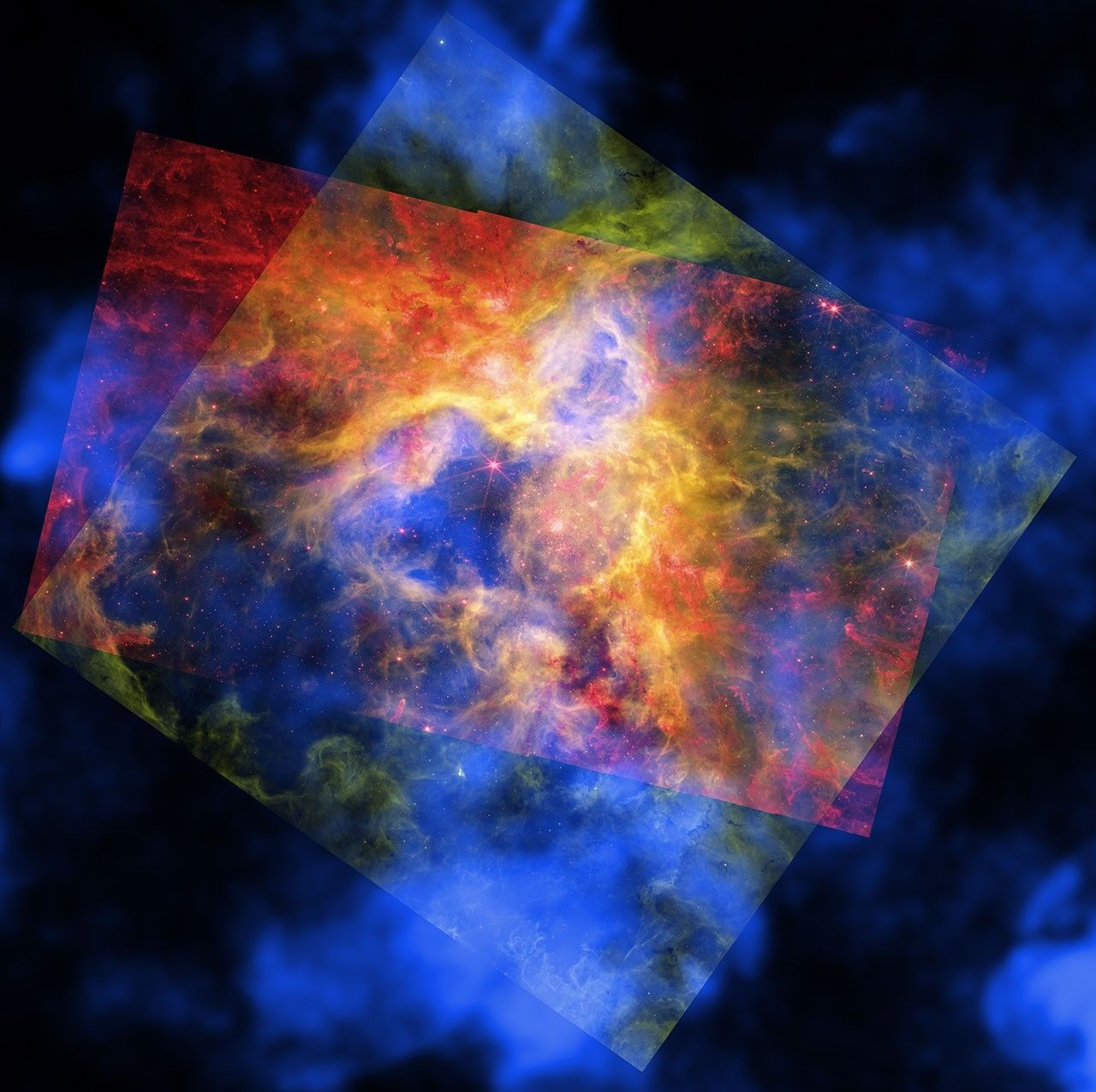
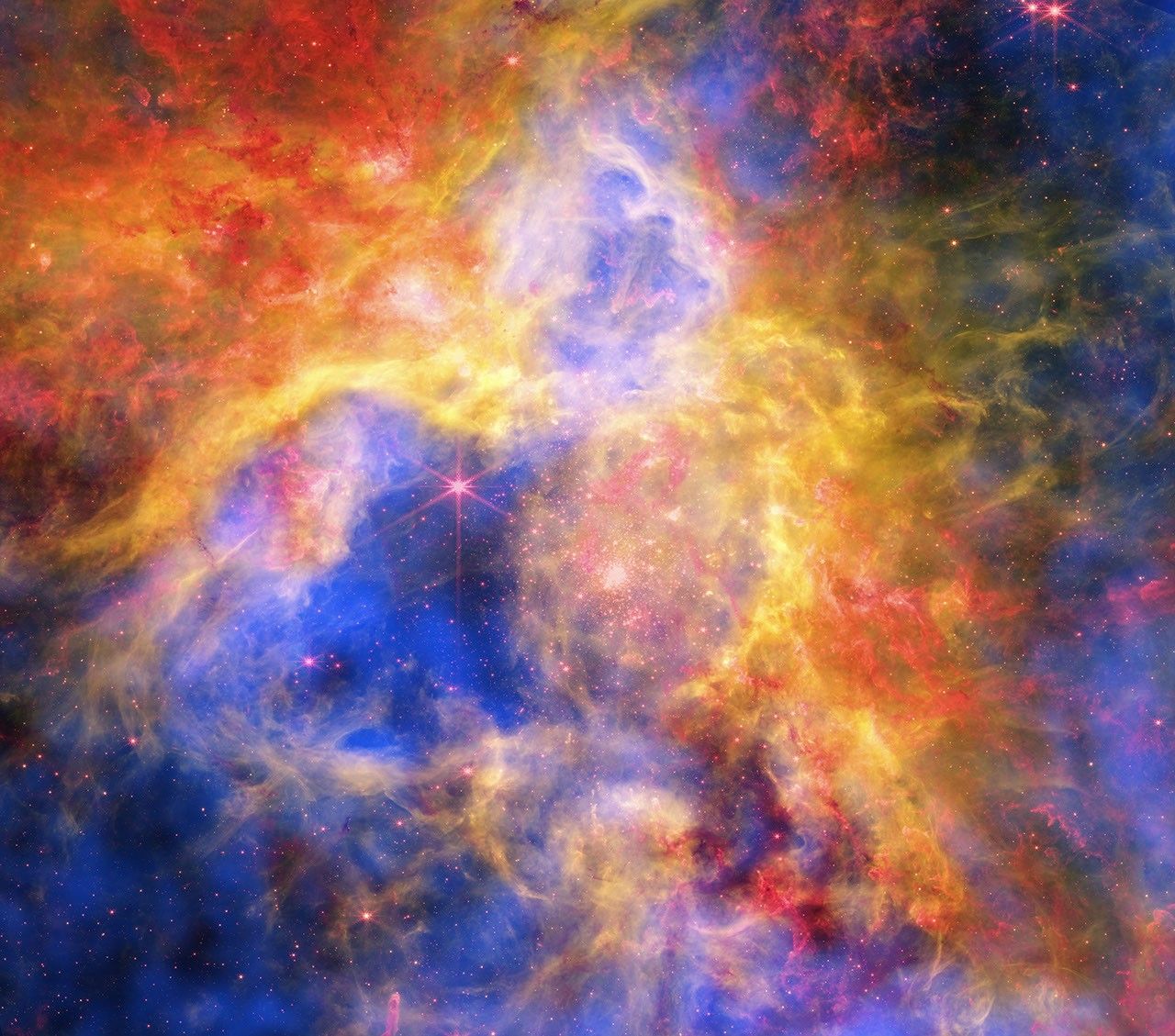
NASA Telescopes Create Colorful ‘Craft’ From Nearby Nebula
Like a collage made of layered sheets of colored cellophane, a vibrant new image layers observations of a famous star-forming nebula from NASA space telescopes. The resulting cosmic “craft” reveals new details about the star formation region known as 30 Doradus, or the Tarantula Nebula.
Located in the Large Magellanic Cloud, a small neighbor galaxy to the Milky Way about 160,000 light-years from Earth, the Tarantula has thousands of young stars embedded in a vibrant honeycomb-like structure of gas and dust.
X-ray: NASA/CXC/Ohio State Univ./J. Rodriguez et al; Infrared: NASA/ESA/CSA/STScI; Optical: NASA/ESA/STScI; Image Processing: NASA/CXC/SAO/P. Edmonds
Like a collage made of layered sheets of colored cellophane, a vibrant new image layers observations of a famous star-forming nebula from NASA space telescopes. The resulting cosmic “craft” reveals new details about the star formation region known as 30 Doradus, or the Tarantula Nebula.
Located in the Large Magellanic Cloud, a small neighbor galaxy to the Milky Way about 160,000 light-years from Earth, the Tarantula has thousands of young stars embedded in a vibrant honeycomb-like structure of gas and dust.
The new composite image contains X-rays from NASA’s Chandra X-ray Observatory, which has repeatedly observed the Tarantula Nebula over the course of its mission, in the layer that appears in blue. The X-ray data reveals gas blown away by winds from the surfaces of young, massive stars and heated to millions of degrees by shock waves, like sonic booms from supersonic jets.
The red represents infrared data from NASA’s James Webb Space Telescope showing thousands of young stars, plus swaths of cool dust that will provide the ingredients to form new stars and planets. Optical data in the green layer from NASA’s Hubble Space Telescope uncovers hydrogen gas that is warmer than seen with Webb, as well as some individual stars through the nebula.
The composite image shows the full Hubble and Webb images of this region, as well as a large section of the Chandra image, all recently published in a research paper in the Astrophysical Journal. In some regions the blue Chandra layer stands alone, and in others it combines with either the red Webb data or the green Hubble data. In the middle region all three images overlap to provide a holistic view in red, orange, yellow, green, and blue.
Previously, astronomers had studied the amount and the impact of energy produced by winds from young, massive stars in the Tarantula Nebula. Scientists expect that much of this energy should heat gas so that it produces X-rays. However, the research paper shows that there is much less X-ray-emitting gas in the nebula than expected. This led researchers to ask: Where has this energy gone and what tamed the Tarantula Nebula?
By studying the data from Chandra, Hubble, and Webb, combined with data from NASA’s retired Spitzer Space Telescope, the team concluded the Tarantula may be losing energy from several sources.
First, up to half of the hot gas is leaking through the shell walls of the gas and dust structures and escaping the nebula. Next, there is stirring and mixing between the cold gas near the shell walls and some of the hot gas, lowering the overall temperature of the gas. Finally, comparisons with computer simulations suggest the Tarantula may be losing energy through conduction. This involves direct physical contact between hot and cooler material, like with a frying pan on a burner, causing the hot and cooler material to equalize in temperature. In the case of the Tarantula Nebula, the hot gas would be conducting heat by being in direct contact with the cooler gas in the shells, especially in the densest regions. This scenario does not necessarily involve mixing the hot and cooler gas.
The combination of these three channels for losing large amounts of energy leads to this colorful and complex display revealed by NASA’s telescopes working together.
Tarantula Nebula / 30 Doradus, cropped version.
X-ray: NASA/CXC/Ohio State Univ./J. Rodriguez et al; Infrared: NASA/ESA/CSA/STScI; Optical: NASA/ESA/STScI; Image Processing: NASA/CXC/SAO/P. Edmonds
The paper describing these results was led by Jennifer Rodriguez of The Ohio State University in Columbus. Additional authors on the paper include Laura Lopez, Ohio State; Lachlan Lancaster, Columbia University in New York City; Anna Rosen, San Diego State University; Omnaraynai Nayak, Space Telescope Science Institute in Baltimore; Sebastian Lopez, Ohio State; Tyler Holland-Ashford, NASA’s Goddard Space Flight Center in Greenbelt, Maryland; and Trinity Webb, Ohio State.
NASA’s Marshall Space Flight Center in Huntsville, Alabama, manages the Chandra program. The Smithsonian Astrophysical Observatory’s Chandra X-ray Center controls science operations from Cambridge, Massachusetts, and flight operations from Burlington, Massachusetts.
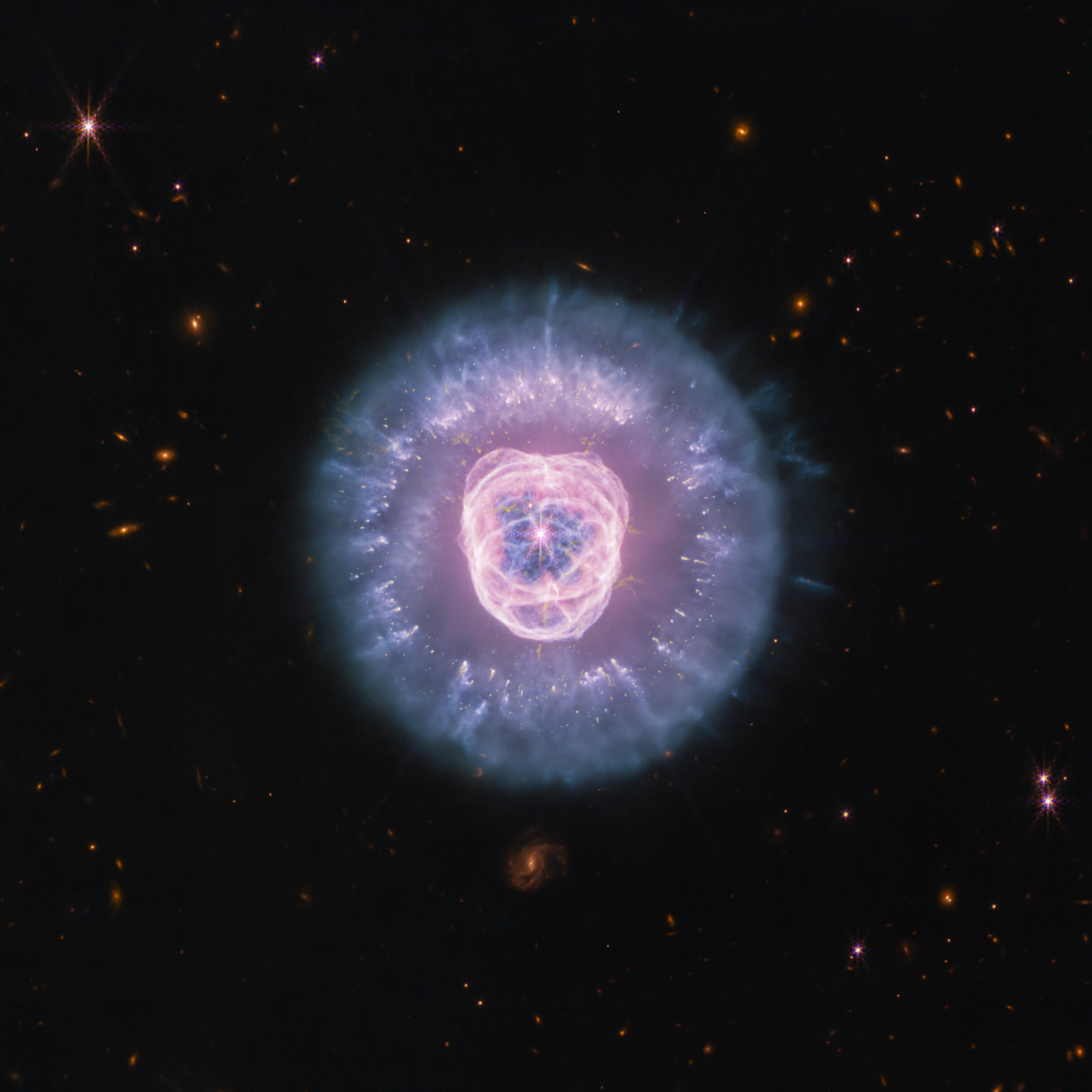
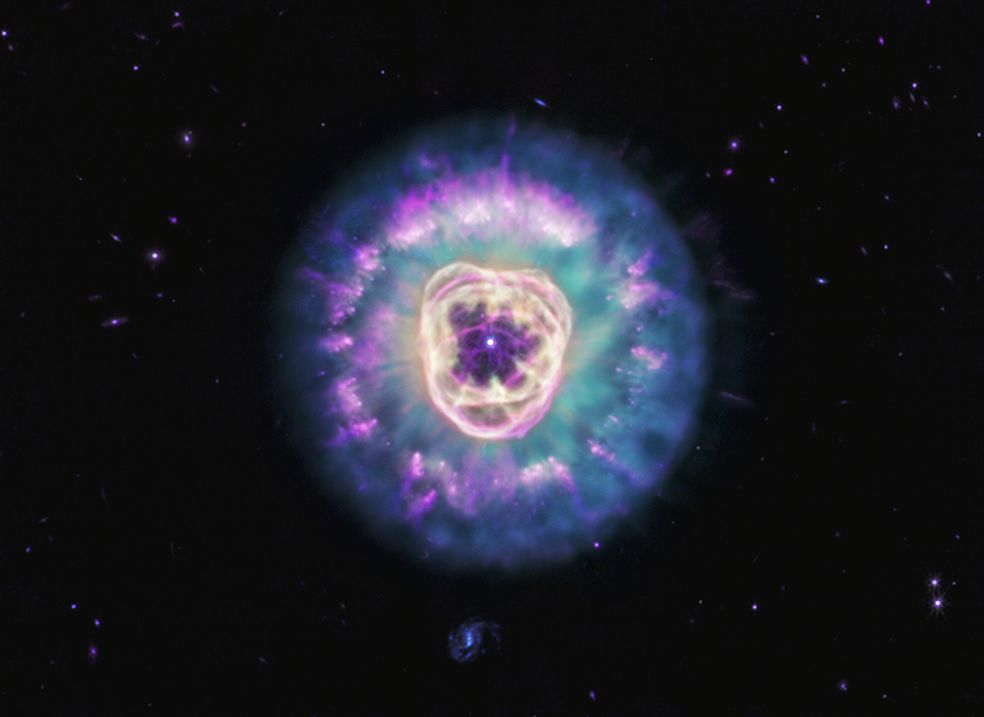
NASA’s James Webb Space Telescope imaged the planetary nebula NGC 2392, the Lion Nebula, using the observatory’s NIRCam and MIRI instruments. The central star’s remains are responsible for the nebula’s structure, including a lion face-shaped bubble of ionized gas and dust “mane.”
Observing across the starry “plains” of space, NASA’s James Webb Space Telescope has taken new images of NGC 2392, nicknamed the Lion Nebula. NASA’s Hubble Space Telescope previously viewed this planetary nebula in 2000, imaging the lion face-shaped target in visible light and revealing features such as the “mane” of hazy, comet-shaped objects. Now Webb has captured a clearer, more detailed view of the Lion Nebula due to its high-resolution imaging.
Lion Nebula (NIRCam and MIRI Image)
NASA’s James Webb Space Telescope imaged the planetary nebula NGC 2392, the Lion Nebula, using the observatory’s NIRCam and MIRI instruments. The central star’s remains are responsible for the nebula’s structure, including a lion face-shaped bubble of ionized gas and dust “mane.”
Image: NASA, ESA, CSA, STScI; Image Processing: Alyssa Pagan (STScI)
At first glance the nebula’s overall structure in Webb’s infrared images, with both the NIRCam (Near Infrared Camera) and MIRI (Mid Infrared Instrument) instruments, may look quite similar to Hubble’s earlier visible-light view. However, Webb’s infrared vision highlights features like compact clumps of dust and a haze of ionized gas. It’s taken several thousand years for this collection of gas and dust to reach its current shape, and the nebula’s components continue to be altered.
The source of these constant changes and the reason for the Lion Nebula’s distinct appearance is located at the center: the remains of a dying star. Though it looks like the button nose of the lion, its energy and radiation are powering the intricate structures seen here.
Lion Nebula (MIRI Image)
NASA’s James Webb Space Telescope’s mid-infrared image of planetary nebula NGC 2392, nicknamed the Lion Nebula, highlights the varying dust structures. Some dust is being destroyed by the dying central star’s radiation, while some dust filaments manage to survive.
Image: NASA, ESA, CSA, STScI; Image Processing: Alyssa Pagan (STScI)
Massive stars undergo supernova explosions at the end of their lives, but these kinds of events are few and far in between. Most of the universe’s stars have lower masses, like the one belonging to NGC 2392. When a lower-mass star can no longer sustain itself with nuclear reactions in its core, the star becomes unstable and pulsates, losing its mass by shedding its outer layers, which then turn into shells of gas and dust called a planetary nebula. (Stars at this life stage are responsible for producing much of the universe’s observable dust.) The star’s radiation drives the ejected material away, leaving behind the very hot stellar core, also known as a white dwarf.
In the Lion Nebula’s case, the death of the oxygen-rich central star has left behind a white dwarf that is “cooking” everything from the inside and producing a bubble of ionized gas as it does. The gas bubble, which forms the lion’s face, is expanding over time and destroying dust that is in its path. Understanding why the swept-up gas has a complex structure of rings and shells, a common feature in planetary nebulae, is an ongoing endeavor.
The mane of the lion is the interior of a dust shell that is being illuminated by the white dwarf at the center. The tufts of hair, which look like cometary tails of material, are compact clumps of dust that have survived the stellar core’s radiation and protect the material that lies behind them.
Webb’s imagery “freezes” this planetary nebula in time, though the star’s death, and its tumultuous effects, go on. NGC 2392 will continue to undergo changes as its gas and dust migrate away from the stellar core. Astronomers estimate the lion will eventually disperse in approximately 10,000 years — a relatively short period in astronomical terms.
The James Webb Space Telescope is the world’s premier space science observatory. Webb is solving mysteries in our solar system, looking beyond to distant worlds around other stars, and probing the mysterious structures and origins of our universe and our place in it. Webb is an international program led by NASA with its partners, ESA (European Space Agency) and CSA (Canadian Space Agency).
The following sections contain links to download this article’s images and videos in all available resolutions followed by related information links, media contacts, and if available, research paper and Spanish translation links.
Related Images & Videos
Lion Nebula (NIRCam and MIRI Image)
NASA’s James Webb Space Telescope imaged the planetary nebula NGC 2392, the Lion Nebula, using the observatory’s NIRCam and MIRI instruments. The central star’s remains are responsible for the nebula’s structure, including a lion face-shaped bubble of ionized gas and dust “mane.”
Lion Nebula (MIRI Image)
NASA’s James Webb Space Telescope’s mid-infrared image of planetary nebula NGC 2392, nicknamed the Lion Nebula, highlights the varying dust structures. Some dust is being destroyed by the dying central star’s radiation, while some dust filaments manage to survive.
But there may be a way for humanity to survive past the Sun’s demise even without having to leave our planet, as independent researcher Gabriel Harry outlines in a paper accepted for publication in the Journal of the British Interplanetary Society.
It’s admittedly extremely far-fetched, but it’s a fun thought experiment that he argues could result in Earth staying habitable for another “9.1 million billion years.” Who could possibly argue against that?
In an accompanying piece for Phys.org, Harry lays out his daring plan. First, he proposes blocking out the Sun to keep the Earth from burning to a crisp by placing a “large sunshade at the Lagrange point 1, which is a “gravitational balancing spot between the Sun and Earth.”
“We’d need to cover a huge 70-degree area of the sky to ensure the red giant would be eclipsed,” he wrote. It would indeed be immense: it’d need to be roughly 434,000 miles in radius, tied to a carbon tether 1.2 million miles in length.
To provide the warming radiation that was now being blocked, Harry suggests sending fusion reactors some 4,000 miles deep into Jupiter’s atmosphere to produce energy, which would then have to be transmitted via laser back to the Earth.
And to move the Earth away from the self-destructing Sun, Harry thinks we could “redirect an asteroid to fly close to Earth’s surface a million times, with the gravitational slingshot effect gradually transferring energy to increase Earth’s orbital distance.”
Moving it that far away would stop the Earth’s tectonics and nutrient cycles, something Henry images could be solved by “sinking [4 pounds] of antimatter” into the Earth’s core per day.
Fast forwarding some four to five billion years, and any surviving humans would need to move the entire solar system out of the way of an incoming Andromeda galaxy, which is currently on a collision course with the Milky Way, Harry argues. To do so, he suggested firing a “beam of hydrogen just above or below the Sun’s north or south pole” to generate a “gravitational slingshot effect.”
In all, Harry’s galaxy-brain proposal would allow humans to stay alive without having to cover interstellar distances — something that would require a “million times” more energy — or terraforming a new planet. Because, after all, what’s better than staying right here, a comfortable place organic life has called home for around four billion years already?
“By building and maintaining the safeguards, for 9.1 million billion years, life on Earth would enjoy comfortable geology, security, seasons, days and starry nights — until, in a hundred trillion years, the last star fades out and the night sky turns dark,” Harry on Phys.org.

 Login