Mac Studio with M5 Max features an 18-core CPU, an up-to-40-core GPU with Neural Accelerators built into each core, and up to 128GB of unified memory, accelerating complex pro and AI workloads. With the powerful M5 Ultra, Mac Studio scales up to a 36-core CPU, up to an 80-core GPU, and a staggering 512GB of unified memory, enabling users to run enormous LLMs entirely on device. Wi-Fi 7 and Bluetooth 6 come to Mac Studio for the first time, while Thunderbolt 5 rounds out its extensive connectivity, so users can take advantage of blazing-fast external storage, PCIe expansion chassis, and powerful hub solutions for the most intense workloads. Thunderbolt 5 also enables multiple Mac Studio systems to be clustered, bringing up to 3x faster performance for distributed AI inference when compared to a single system.
[…]
Mac Studio with M5 Max starts at $2,499 (U.S.) and $2,299 (U.S.) for education.
[…]
Mac Studio with M5 Ultra starts at $5,499 (U.S.) and $5,099 (U.S.) for education.
It’s not shipping until September 22, with the 512 GB configuration in late October.
Here’s my attempt to put all of the RAM/SSD configurations into condensed tables, so you can see which storage and memory options are available for each chip, and how much they cost.
[…]
It kind of stinks that there are no RAM options for the Studio between the 96 GB base and the $4,000 256 GB upgrade.
The Mac Studio is effectively the replacement for the Mac Pro, and it’s alone in offering the Ultra-class chip. Apple has positioned the Mac Studio as ideal for local AI workflows, and the new models will still be able to cluster via Thunderbolt 5 to create even larger collections of memory and performance. Apple representatives pointed out that a four-Mac Studio AI cluster, like the one I saw on display at WWDC earlier this summer, is so efficient that it can be powered from a single standard wall outlet. (They even showed us a picture of four Mac Studios plugged into a power strip that was plugged into the wall.) In an era of data center excesses, Apple is clearly leaning into the possibility of small, efficient Macs being used to do local AI work rather than relying on huge, power-hungry cloud models.
If these numbers hold up and scale linearly, a local Mixture-of-Experts model such as Qwen 3.5-35B-A3B, which would run at ~17 tokens/sec on average on a base M4 Mac mini with 16 GB of RAM, could realistically generate output at over 60 tokens/second with the base model M6 Mac mini.
Based on what we’ve seen so far, the one downside of the M6 Mac mini is that it does not have Thunderbolt 5 ports; those are exclusive to the M5 Pro model, also announced today.
[…]
Speaking from personal experience, I know that my M3 Ultra Mac Studio using oMLX can run DeepSeek-V4-Flash locally with generation averaging 35 tokens/second. Assuming a linear 4x increase, that would put the same model at over 120 tokens/second on an M5 Ultra Mac Studio. To put things in perspective, that kind of performance would be faster than any AI chatbot website, it’d be faster than many providers who offer a “fast” mode for their models, and it’d only be second to either dedicated NVIDIA PC clusters at home or specialized inference providers such as Cerebras or Groq…which are running in full-blown data centers. Sure, you would need a computer that is likely going to cost more than $20,000 to make it happen, but it’d still be possible on a single machine that is small, quiet, and that – in theory – any consumer can buy off the shelf.
That upgrade is labeled “+ $300”, which makes it look as though the starting price for the 18/40-core model is $2,800. That’s the price I put in the original version of my chart.
But if you select that option, you’ll notice that the actual starting price jumps from $2,500 to $3,100 — a $600 difference, not $300. The reason is that the $2500 18/32-core version only comes with one option for RAM: 32 GB. The 18/40-core chip has three tiers for RAM: 48, 64, and 128 GB.
Apple’s press release for the new Mac Studio with M5 Max and M5 Ultra chips last week initially stated that the computer had “next-generation SSD architecture built on PCIe Gen 6.” However, as spotted by the French blog MacGeneration, Apple removed the PCIe 6.0 mention from the announcement shortly after it was published.
With M6, Mac mini now delivers up to 4x faster AI performance, 2x faster storage and graphics, and 40 percent faster CPU performance. Everything on Mac mini with M6 feels incredibly fast, from everyday productivity tasks to agentic AI workflows. Mac mini with M5 Pro delivers even more pro-level performance to breeze through demanding projects, from video production to game development. And this new level of performance takes on business workflows with ease whether Mac mini is being used as a primary desktop or for always-on, deskside agentic computing. Both Mac mini models include Wi-Fi 7 and Bluetooth 6, as well as upgraded 2.5Gb Ethernet, with a 10Gb option available.
[…]
Mac mini with M6 starts at $899 (U.S.) and $799 (U.S.) for education.
[…]
Mac mini with M5 Pro starts at $1,699 (U.S.) and $1,599 (U.S.) for education.
The M6 tops out at 170GB/s and 32GB of unified memory, whereas the M5 Pro offers 307GB/s and up to 64GB–nearly twice the bandwidth, as well as twice the memory ceiling. That is the number to watch for AI inference, not just CPU and GPU benchmark deltas.
Here’s my attempt to put all of the RAM/SSD configurations into condensed tables, so you can see which storage and memory options are available for each chip, and how much they cost.
[…]
If you configure an M6 Mac Mini with 2 TB of storage, the SSD upgrade ($1,000) costs more than the entire base model computer ($900). So too with the 4 TB SSD upgrade for the M5 Pro Mini ($1,800 upgrade for a $1,700 computer).
Why announce (and take pre-orders) today, but not ship for a month? Perhaps Apple is using pre-orders to gauge interest and adjust its product mix. With huge prices for memory and storage, Apple does not want to build high-cost configurations that end up sitting around. Or, perhaps the “Fall iPhone” event will be a “new products” event, and Apple is clearing the decks of interesting-but-hardly-important hardware it doesn’t want distracting us from more exciting Macs (like the expected MacBook Pro “Ultra”).
The Mac mini now starts at $899, $300 over the original starting price of the M4 Mac mini when it launched in October 2024.
[…]
The Mac mini and Mac Studio support genlock over USB-C, so there’s no need for a separate sync box. Genlock is used in multi-camera shoots and virtual production to lock timing to a shared reference signal.
Apple’s newly announced M6 and M5 Pro Mac mini models still support up to three external displays, but there’s now support for higher refresh rates, according to Apple’s published technical specifications.
Now after the price hikes, the Neo starts at £699 and the Mini at £899. So to answer the question, is the best feature of the M6 Mini the price?
I don’t think so, and that’s not because of the increased price to £899 but because of the Macbook Neo. The Mac Mini used to be the computer that everyone bought to get a taste of macOS. A lot of my friends have purchased Mac Minis just because it was the cheapest way to get into a Mac. But now I think the Neo fills that role.
The Mac Mini hasn’t become a bad deal. It’s become a different kind of deal. If you already have a monitor and a keyboard, if you want real desktop performance without paying for an Macbook Pro or a Mac Studio, the M6 Mac Mini is still probably the best price-per-performance computer Apple sells.
M6 is built using cutting-edge 2 nm process technology, packing greater transistor density into a smaller die for a major leap in performance and power efficiency. M6 also introduces a Dual 16-core Neural Engine, providing up to 2x the peak compute over previous generations to make on-device AI workflows run even faster. System frameworks can automatically utilize both engines simultaneously, enabling applications to see faster model execution.
M6 has a brand-new 12-core CPU complex — two more cores than M5 — that consists of 2 super cores, 4 performance cores, and 6 efficiency cores. It delivers the world’s fastest single-threaded performance and up to 1.2x faster multithreaded performance as compared to M5, and up to 2.4x faster than M1.
[…]
M5 Ultra uses UltraFusion to connect two dual-die M5 Max chips to form the quad-die architecture — a first for Apple silicon. UltraFusion increases the inter-die bandwidth to over 4.4TB/s and the connection density by over 6x. Together, these ultra-low-latency, high-bandwidth interconnects allow the four dies to behave as a single unified processor. M5 Ultra also features a large up-to-36-core CPU consisting of 12 super cores and 24 performance cores, delivering up to 1.25x higher single-threaded performance and up to 1.3x higher multithreaded performance than M3 Ultra.
M5 Ultra features a next-generation GPU with up to 80 cores, incorporating a Neural Accelerator in each core to offer up to 4.5x the peak GPU compute for AI compared to M3 Ultra and over 6x more than M1 Ultra.
It was not long ago all the illustrations in an M chip press release were graphs showing it flouncing the competition. Now it’s just random screenshots of desktops. Skimming this I didn’t see a single claim of performance advantages over competitors. The massive thing Apple still needs to solve is making sure customers don’t miss being able to plug the latest greatest GPU into their tower, they should not be resting on their laurels.
The most significant architectural change is in the CPU. The M5 splits its ten cores into performance and efficiency groups, which is an arrangement Apple silicon has used since the M1. The M6 adds a third tier called “super cores,” which handle single-threaded workloads and which Apple says give the chip the world’s fastest single-threaded performance.
[…]
Apple did not publish real-world benchmarks comparing the M6 to the M5 directly, instead framing its Mac mini figures against the M4 and M1 models[…]
[…]
Bloomberg’s Mark Gurmanreported in July that Apple has no plans to release “M6 Pro,” “M6 Max,” or “M6 Ultra” chips, having decided to accelerate development of the AI-optimized M7 generation.
As with previous Ultra generations, the M5 Ultra combines two M5 Max chips, but since they’re dual-die chips, the result is Apple silicon’s first quad-die architecture. (The M3 Ultra connected two single-die M3 Max chips.) There’s no practical benefit to users in a quad-die architecture, but it’s a huge win for Apple. The larger the die, the more difficult and expensive it is to manufacture because a defect can ruin the entire die. Dividing the design into smaller dies can substantially improve manufacturing yield and reduce costs.
[…]
The M5 Ultra dispenses with efficiency cores entirely, devoting all CPU resources to super and performance cores.
If this single Geekbench 7 result is accurate, the M6 chip has up to around 12% faster single-core CPU performance and up to around 27% faster multi-core CPU performance compared to the M5 chip.
Unsurprisingly, the M5 Ultra is Apple’s fastest chip ever. If this Geekbench result is accurate, it has up to around 30% faster single-core CPU performance and up to around 35% faster multi-core performance compared to the M3 Ultra.
Apple’s new version of Safari browser in macOS 27 and iOS 27 can be tasked to monitor a webpage and notify you of any changes, thanks to a new built-in feature.
[…]
In other upcoming feature additions, using the power of AI, Safari tabs that you have open can automatically be organized into topics.
Don’t miss our WWDC26 sessions on web technology, including What’s new in WebKit for Safari 27, to go deeper on our work in this release. Now, let’s dig into this beta, packed with 58 new features, 525 fixes and 4 deprecations that will hopefully make your work as a web developer a little easier.
This year, the WebKit team is here with six sessions covering new CSS layouts, customizable form controls, 3D models, immersive spatial experiences, and browser extensions.
But credit where credit is due. The upcoming version 27 of Safari is looking very good.
That’s not because it’s at the cutting edge of the latest web standards. Quite the opposite. Most of the changes listed for this release are bug fixes. That’s what I want to acknowledge and applaud.
Siri AI is an entirely new version of Siri deeply integrated into iPhone, iPad, Mac, Apple Watch, and Apple Vision Pro. It can draw on personal context understanding to search across messages, emails, photos, and more, and get things done across apps with even more systemwide app actions. Additionally, Siri AI can answer questions related to the content on a user’s screen or go out to the web to get up-to-date information using broad world knowledge and generate a helpful answer. A dedicated Siri app allows users to revisit a past conversation or kick off a new one — all in one place — and uses iCloud to privately sync conversational history across a user’s products.
Powered by the next generation of Apple Intelligence, Siri AI is a completely reimagined version of Siri that is more helpful, more capable, and more intelligent. With detailed, engaging responses and natural back-and-forth conversation, Siri AI helps users get more done than ever.
[…]
Siri has been rebuilt from the ground up with powerful AI at its core. It takes full advantage of the bold new architecture for Apple Intelligence, including the next generation of Apple Foundation Models that run on device and on servers using Private Cloud Compute. When Private Cloud Compute is handling users’ requests, their personal data is not stored nor made accessible to Apple or anyone else. Outside experts can continue to verify this privacy promise at any time. Additionally, Siri AI uses the system orchestrator to tap into core capabilities like the Spotlight index and App Toolbox, which work entirely on device to keep users in control of their data.
[…]
For products that support Apple’s most advanced on-device model ever, Siri AI offers even more expressive voices, as well as a major boost in accuracy with systemwide dictation. Users have the ability to customize the expressiveness and pace of Siri’s voice so it’s just right for them. Dictation now captures what users say as polished text with greater precision, automatically handling capitalization, punctuation, and formatting as they speak. With improved speech understanding, users can speak naturally and trust that their words will appear clearly, accurately, and as intended.
I remain uninterested in these more advanced Siri features. They matter in that Apple needs to show that they’re not “behind” and that they can actually deliver on what they announce and advertise. But I don’t find the use cases compelling and wouldn’t trust the results.
If you really care about a particular concert, would you believe Siri about how the tickets work and that it will auto-create a reminder at the right time? Why should I believe that it can figure out whether a particular irregularly shaped object can fit inside an irregularly shaped container when said shapes are probably not even published on the Web? Can it really dig into my e-mail to find the right flight info? An answer without being able to see the sources is not useful. And I certainly don’t want it to pick for itself which vacation photos to send out.
I just want the basic features—from a decade or so ago, like music controls, reminders, and access to my purchases—to work quickly, reliably, and offline to the extent possible. I did not hear anything to suggest that this was a focus. Instead, everyone is celebrating how slow the demos were because that proves they weren’t fake.
The other interesting thing to note from the keynote: watching the demos, there is ZERO doubt these are real, recorded demonstrations on live devices. There will be no confusion about what is real or fake like there was at WWDC 2024 and the initial attempt at the new Siri.
And, if your standards are the state of the art in AI circa June 2024, when Apple took their first crack at answering the question, they did quite well.
[…]
What’s fascinating about this specific demo is that it also showed just how far behind Apple is.
[…]
Still, the bubble was strong enough to convince OpenAI to make the exact same mistake Dropbox did: the company somehow convinced itself that it could make enough money selling subscriptions to consumers; Anthropic, meanwhile, realized that it was enterprises who were willing to pay for AI’s massive productivity benefits, even as OpenAI failed to capitalize on their consumer market penetration by refusing to build an advertising product.
This is a long-winded way of saying that I don’t think that Apple’s agentic shortcomings are a big deal, at least for now. Agents help you do work and be more productive, and consumers don’t want to work or care about being productive. What they do want to do is watch short-form video, and an iPhone is simply much better at that than any other device ever will be; in that context, Siri being good enough is enough, and it appears that Apple crossed that bar.
They need to execute, they need to prove this can scale, and most of all, they need to get third-party apps on board with App Intents and App Schemas. But it seems like they’re doing all of that. This is not a done deal but it is very realistic.
Siri doesn’t have access to the filesystem or tool-calling, so it’s completely unable to do the kinds of tasks you might easily do with Codex or Claude. It’s a good start, but the state of the art has already dramatically shifted over the past year. The question is will Siri move in this direction, or stick to providing answers from the web?
Will Apple introduce its own distinct Codex-style agentic programming model that can do all this, and work with Xcode? You would hope so…
The revamped version of Siri that is officially named “Siri AI” will be available to test in the iOS 27, iPadOS 27, macOS 27, and visionOS 27 developer betas starting today, and it is coming to the Apple Watch in a future watchOS 27 beta. “Siri AI” will also be included in the public betas of each platform that are launching in July.
“Siri AI” requires a device that is compatible with Apple Intelligence.
Apple senior vice president of software engineering Craig Federighi has explained why the company launched a standalone Siri app in iOS 27, after previously characterizing a dedicated chatbot as contrary to its Apple Intelligence strategy.
[…]
“We see Siri not as a separate chatbot, just an unintegrated place you go and chit-chat, but rather as an integral, conversational tool that you use in the moment, deeply integrated into your experience.”
…And playlists, contacts, settings and preferences. Peel off the agentic slop bandwagon and focus on core performance, smarter caching, and resilience under adverse network conditions.
Though this is a test conducted on the very first version of Siri A.I. from a fixed point in Calgary, it seems to work quite well. So far, it is better than any version of Siri Apple has released yet and, as you can see above, it is almost as good as the original 2010 demo, before Apple acquired the company.
On the one hand, if Siri has indeed become this reliable at understanding queries like those demoed so far, it’s indeed impressive. On the other hand, I can’t help but ask myself, once again, whether people at Apple even know how regular people actually use their phones and devices.
Apple executives downplay and obfuscate the role of Google in Siri AI. The Siri AI announcement didn’t even mention Google or Gemini once! Does anyone actually believe Apple’s BS? The argument seems to be that since Google made a bespoke implementation for Apple, Google is not really involved, and it’s all Apple. Ridiculous.
It’s really odd to me that Apple is getting so much credit for Google’s work. Siri now “works” to the extent it does because Siri is to a very large extent Gemini, and Apple has wrapped that in a bow.
Apple didn’t “nail” anything. Apple failed at its own internal efforts and was forced to outsource.
This is the advantage of being a platform: you can fail and still win.
Apple’s Siri team, led by Craig Federighi, held a post-WWDC keynote tech talk with members of the press this afternoon to talk through iOS 27 and the new Siri AI.
During the talk, Federighi shared more details about Apple’s collaboration with Google.
Apple looks like it will use some combination of Google Gemini models, combined with Google’s Confidential Inference and Apple’s own Private Cloud Compute for private hosting. These systems will process both your queries and evaluate private data from your devices.
[…]
Apple has since “expanded” PCC to encompass Google’s hardware as well. I will confess that I find the details of the new “expanded” PCC just a bit vague. It sounds a lot like Apple is primarily going to rely on Google’s existing confidential compute (running in Google datacenters) to process this data, but they’re bolting on a new layer of technical security to control which models are actually running. In any case: security experts can argue about whether this is good enough to keep Cozy Bear away from your data. What I will grant is that it’s probably good enough to keep Google and Apple from accessing your stuff, which is what most people are worried about in the first place.
So why am I so nervous?
[…]
So far we’ve discussed two adversaries: the misaligned designers of private agents (such as search operators), and the possibility of remote prompt injection attacks. But of course, in any discussion of technical privacy systems we need to talk about the last elephant in the room: your government.
While searching for new Higgs bosons the CMS experiment at the Large Hadron Collider (LHC) may have just found a surprise. They have observed an excess of events that look to be a new particle, and are reporting high statistical evidence for their claim. The only question is what exactly is this new particle?
The search was initially designed to look for new, heavier, versions of the Higgs boson decaying to a top quark and an anti-top quark. Its well known that the Higgs boson of the Standard Model, discovered jointly by ATLAS and CMS in 2012, underlies the mechanism which gives all fundamental particles their masses. The Higgs boson itself interacts with particles in proportion to their mass, preferring heavier particles over lighter ones. It therefore interacts the most strongly with the heaviest known fundamental particle, the top quark, which has a mass of ~173 GeV. The Higgs boson itself only has a bass of 125 GeV, meaning conservation of energy dictates it can’t decay into a top quark-antiquark pair.
However many theories of physics beyond the the Standard Model predict additional Higgs bosons, heavier cousins of the current one. If these new heavy Higgs bosons had a mass larger than 350 GeV, they would likely decay to a top quark-antiquark pair quite often. CMS therefore was analyzed its data searching for this signature, hoping to find signs of a new Higgs boson. To do so, they had scrutinize very carefully the known production of top quark-antiquark pairs, which are produced copiously at the LHC from other processes. If a new particle was being produced and decaying to top quarks, the mass of the new particle would give the top quarks a characteristic energy. One key sign of a new particle would therefore be an excess of top quark-antiquark events at a particular energy, corresponding to the mass of the new particle.
When CMS scrutinized their data looking for such an excess they found one. But curiously right ~350 GeV, the minimum energy required to produce the top quark-antiquark pair. It would be quite the coincidence for a new particle to show up right at this minimum threshold, which made CMS consider alternative possibilities.
A comparison of the observed CMS data and their estimate of backgrounds as a function of the invariant mass of the top quark antiquark system. CMS observes an excess of events at ~350 GeV, which is well fit with a toponium model (red line).
One unorthodox explanation that seems to fit the bill is ‘toponium’, a short lived bound state of the top quark-antiquark pair is being formed. Toponium would be the heaviest version of ‘quarkonia’ we have seen, bound states of quark antiquark pairs that form bound states similar to atoms. We have observed and measured quarkonia states of the other quarks for decades, however it was long thought that the top quark, whose large mass causes it to decay in just 10^(-25) seconds, would decay too quickly to create observable bound state effects at a hadron collider. Toponium production would happen most often if the top quarks were produced just at the energy threshold, such that they don’t any extra energy. These low energy top quarks would spend more time close to each other than normal, rather than immediately flying away, so they could have time to briefly form a toponium state before decaying. However, once small hints of intriguing excesses started appearing in LHC analyses, updated calculations in the last few years suggested that perhaps such an effect could be observable.
These calculations are approximate, and more work is still being done to refine them. But the preliminary predictions they give for the properties of toponium seem to match well with what CMS is seeing, both in terms of the rate of toponium production and the quantum properties of the toponium state (spin and parity).
Still CMS is being cautious before claiming a discovery of toponium. They claim observation of an ‘excess at the top quark pair production threshold’ which is consistent with toponium. However given the limited present data and incomplete theoretical models of toponium, they cannot rule out that the excess they are seeing is coming from a new Higgs-like particle.
CMS measurement tries to disentangle the quantum properties of the observed excess. The x-axis shows the estimated rate of production a ‘pseudoscalar’ particle producing the excess. The y-axis shows a similar estimate for a ‘scalar’ particle. The allowed region for the scalar still includes zero, while the zero pseudoscalar hypothesis is clearly excluded at larger than 5 standard deviations.
Further work will be needed to develop improved theoretical models of toponium, and detailed studies from CMS assessing the properties of their observed excess. The excess will also need confirmation from CMS’s rival LHC experiment, ATLAS, to ensure it has not merely made a mistake in its analysis.
However, the smart money would say this very likely looks like toponium. Which, while not signaling the long sought overthrow of the standard model, would be an unexpected and cool surprise from the LHC. Understanding the properties of this previously-thought-impossible quasiparticle will spawn much fruitful research in the years to come. Physicists love a surprise!
Discloure: The author is a member of the CMS collaboration but did not directly work on this analysis
Erratum 4/15/2025 : The article was updated to clarify that in the theory literature prior to the LHC toponium was thought possible to form, just that it was thought to be too small an effect to be observable. The article previously incorrectly stated it had been previously thought impossible to form
This is the second part of our coverage of the P5 report and its implications for particle physics. To read the first part, click here
One of the thorniest questions in particle physics is ‘What comes after the LHC?’. This was one of the areas people were most uncertain what the P5 report would say. Globally, the field is trying to decide what to do once the LHC winds down in ~2040 While the LHC is scheduled to get an upgrade in the latter half of the decade and run until the end of the 2030’s, the field must start planning now for what comes next. For better or worse, big smash-y things seem to capture a lot of public interest, so the debate over what large collider project to build has gotten heated. Even Elon Musk is tweeting (X-ing?) memes about it.
Famously, the US’s last large accelerator project, the Superconducting Super Collider (SSC), was cancelled in the ’90s partway through its construction. The LHC’s construction itself often faced perilous funding situations, and required a CERN to make the unprecedented move of taking a loan to pay for its construction. So no one takes for granted that future large collider projects will ultimately come to fruition.
Desert or Discovery?
When debating what comes next, dashed hopes of LHC discoveries are top of mind. The LHC experiments were primarily designed to search for the Higgs boson, which they successfully found in 2012. However, many had predicted (perhaps over-confidently) it would also discover a slew of other particles, like those from supersymmetry or those heralding extra-dimensions of spacetime. These predictions stemmed from a favored principle of nature called ‘naturalness’ which argued additional particles nearby in energy to the Higgs were needed to keep its mass at a reasonable value. While there is still much LHC data to analyze, many searches for these particles have been performed so far and no signs of these particles have been seen.
These null results led to some soul-searching within particle physics. The motivations behind the ‘naturalness’ principle that said the Higgs had to be accompanied by other particles has been questioned within the field, and in New York Times op-eds.
No one questions that deep mysteries like the origins of dark matter, matter anti-matter asymmetry, and neutrino masses, remain. But with the Higgs filling in the last piece of the Standard Model, some worry that answers to these questions in the form of new particles may only exist at energy scales entirely out of the reach of human technology. If true, future colliders would have no hope of
A diagram of the particles of the Standard Model laid out as a function of energy. The LHC and other experiments have probed up to around 10^3 GeV, and found all the particles of the Standard Model. Some worry new particles may only exist at the extremely high energies of the Planck or GUT energy scales. This would imply a large large ‘desert’ in energy, many orders of magnitude in which no new particles exist. Figure adapted from here
The situation being faced now is qualitatively different than the pre-LHC era. Prior to the LHC turning on, ‘no lose theorems’, based on the mathematical consistency of the Standard Model, meant that it had to discover the Higgs or some other new particle like it. This made the justification for its construction as bullet-proof as one can get in science; a guaranteed Nobel prize discovery. But now with the last piece of the Standard Model filled in, there are no more free wins; guarantees of the Standard Model’s breakdown don’t occur until energy scales we would need solar-system sized colliders to probe. Now, like all other fields of science, we cannot predict what discoveries we may find with future collider experiments.
Still, optimists hope, and have their reasons to believe, that nature may not be so unkind as to hide its secrets behind walls so far outside our ability to climb. There are compelling models of dark matter that live just outside the energy reach of the LHC, and predict rates too low for direct detection experiments, but would be definitely discovered or ruled out by high energy colliders. The nature of the ‘phase transition’ that occurred in the very early universe, which may explain the prevalence of matter over anti-matter, can also be answered. There are also a slew ofexperimental ‘hints‘, all of which have significant question marks, but could point to new particles within the reach of a future collider.
Many also just advocate for building a future machine to study nature itself, with less emphasis on discovering new particles. They argue that even if we only further confirm the Standard Model, it is a worthwhile endeavor. Though we calculate Standard Model predictions for high energies, unless they are tested in a future collider we will not ‘know’ how if nature actually works like this until we test it in those regimes. They argue this is a fundamental part of the scientific process, and should not be abandoned so easily. Chief among the untested predictions are those surrounding the Higgs boson. The Higgs is a central somewhat mysterious piece of the Standard Model but is difficult to measure precisely in the noisy environment of the LHC. Future colliders would allow us to study it with much better precision, and verify whether it behaves as the Standard Model predicts or not.
Projects
These theoretical debates directly inform what colliders are being proposed and what their scientific case is.
Many are advocating for a “Higgs factory”, a collider of based on clean electron-positron collisions that could be used to study the Higgs in much more detail than the messy proton collisions of the LHC. Such a machine would be sensitive to subtle deviations of Higgs behavior from Standard Model predictions. Such deviations could come from the quantum effects of heavy, yet-undiscovered particles interacting with the Higgs. However, to determine what particles are causing those deviations, its likely one would need a new ‘discovery’ machine which has high enough energy to produce them.
Among the Higgs factory options are the International Linear Collider, a proposed 20km linear machine which would be hosted in Japan. ILC designs have been ‘ready to go’ for the last 10 years but the Japanese government has repeated waffled on whether to approve the project. Sitting in limbo for this long has led to many being pessimistic about the projects future, but certainly many in the global community would be ecstatic to work on such a machine if it was approved.
Designs for the ILC have been ready for nearly a decade, but its unclear if it will receive the greenlight from the Japanese government. Image source
Alternatively, some in the US have proposed building a linear collider based on a ‘cool copper’ cavities (C3) rather than the standard super conducting ones. These copper cavities can achieve more acceleration per meter than the standard super conducting ones, meaning a linear Higgs factory could be constructed with a reduced 8km footprint. A more compact design can significantly cut down on infrastructure costs that governments usually don’t like to use their science funding on. Advocates had proposed it as a cost-effective Higgs factory option, whose small footprint means it could potentially hosted in the US.
The Future-Circular-Collider (FCC), CERN’s successor to the LHC, would kill both birds with one extremely long stone. Similar to the progression from LEP to the LHC, this new proposed 90km collider would run as Higgs factory using electron-positron collisions starting in 2045 before eventually switching to a ~90 TeV proton-proton collider starting in ~2075.
Designs for the massive 90km FCC ring surrounding Geneva
Such a machine would undoubtably answer many of the important questions in particle physics, however many have concerns about the huge infrastructure costs needed to dig such a massive tunnel and the extremely long timescale before direct discoveries could be made. Most of the current field would not be around 50 years from now to see what such a machine finds. The Future-Circular-Collider (FCC), CERN’s successor to the LHC, would kill both birds with one extremely long stone. Similar to the progression from LEP to the LHC, this new proposed 90km collider would run as Higgs factory using electron-positron collisions starting in 2045 before eventually switching to a ~90 TeV proton-proton collider starting in ~2075. Such a machine would undoubtably answer many of the important questions in particle physics, however many have concerns about the extremely long timescale before direct discoveries could be made. Most of the current field would not be around 50 years from now to see what such a machine finds. The FCC is also facing competition as Chinese physicists have proposed a very similar design (CEPC) which could potentially start construction much earlier.
During the snowmass process many in the US starting pushing for an ambitious alternative. They advocated a new type of machine that collides muons, the heavier cousin of electrons. A muon collider could reach the high energies of a discovery machine while also maintaining a clean environment that Higgs measurements can be performed in. However, muons are unstable, and collecting enough of them into formation to form a beam before they decay is a difficult task which has not been done before. The group of dedicated enthusiasts designed t-shirts and Twitter memes to capture the excitement of the community. While everyone agrees such a machine would be amazing, the key technologies necessary for such a collider are less developed than those of electron-positron and proton colliders. However, if the necessary technological hurdles could be overcome, such a machine could turn on decades before the planned proton-proton run of the FCC. It can also presents a much more compact design, at only 10km circumfrence, roughly three times smaller than the LHC. Advocates are particularly excited that this would allow it to be built within the site of Fermilab, the US’s flagship particle physics lab, which would represent a return to collider prominence for the US.
A proposed design for a muon collider. It relies on ambitious new technologies, but could potentially deliver similar physics to the FCC decades sooner and with a ten times smaller footprint. Source
Deliberation & Decision
This plethora of collider options, each coming with a very different vision of the field in 25 years time led to many contentious debates in the community. The extremely long timescales of these projects led to discussions of human lifespans, mortality and legacy being much more being much more prominent than usual scientific discourse.
Ultimately the P5 recommendation walked a fine line through these issues. Their most definitive decision was to recommend against a Higgs factor being hosted in the US, a significant blow to C3 advocates. The panel did recommend US support for any international Higgs factories which come to fruition, at a level ‘commensurate’ with US support for the LHC. What exactly ‘comensurate’ means in this context I’m sure will be debated in the coming years.
However, the big story to many was the panel’s endorsement of the muon collider’s vision. While recognizing the scientific hurdles that would need to be overcome, they called the possibility of muon collider hosted in the US a scientific ‘muon shot‘, that would reap huge gains. They therefore recommended funding for R&D towards they key technological hurdles that need to be addressed.
Because the situation is unclear on both the muon front and international Higgs factory plans, they recommended a follow up panel to convene later this decade when key aspects have clarified. While nothing was decided, many in the muon collider community took the report as a huge positive sign. While just a few years ago many dismissed talk of such a collider as fantastical, now a real path towards its construction has been laid down.
Hitoshi Murayama, chair of the P5 committee, cuts into a ‘Shoot for the Muon’ cake next to a smiling Lia Merminga, the director of Fermilab. Source
While the P5 report is only one step along the path to a future collider, it was an important one. Eyes will now turn towards reports from the different collider advocates. CERN’s FCC ‘feasibility study’, updates around the CEPC and, the International Muon Collider Collaboration detailed design report are all expected in the next few years. These reports will set up the showdown later this decade where concrete funding decisions will be made.
For those interested the full report as well as executive summaries of different areas can be found on the P5 website. Members of the US particle physics community are also encouraged to sign the petition endorsing the recommendations here.
Particle physics is the epitome of ‘big science’. To answer our most fundamental questions out about physics requires world class experiments that push the limits of whats technologically possible. Such incredible sophisticated experiments, like those at the LHC, require bigfacilities to make them possible, bigcollaborations to run them, big project planning to make dreams of new facilities a reality, and committees with big acronyms to decide what to build.
Enter the Particle Physics Project Prioritization Panel (aka P5) which is tasked with assessing the landscape of future projects and laying out a roadmap for the future of the field in the US. And because these large projects are inevitably an international endeavor, the report they released last week has a large impact on the global direction of the field. The report lays out a vision for the next decade of neutrino physics, cosmology, dark matter searches and future colliders.
P5 follows the community-wide brainstorming effort known as the Snowmass Process in which researchers from all areas of particle physics laid out a vision for the future. The Snowmass process led to a particle physics ‘wish list’, consisting of all the projects and research particle physicists would be excited to work on. The P5 process is the hard part, when this incredibly exciting and diverse research program has to be made to fit within realistic budget scenarios. Advocates for different projects and research areas had to make a case of what science their project could achieve and a detailed estimate of the costs. The panel then takes in all this input and makes a set of recommendations of how the budget should be allocated, what should projects be realized and what hopes are dashed. Though the panel only produces a set of recommendations, they are used quite extensively by the Department of Energy which actually allocates funding. If your favorite project is not endorsed by the report, its very unlikely to be funded.
The P5 report also created an awesome graphic that contains symbolism for the different aspects of the plan. The left side depicts oscillating neutrinos and the shape of the Higgs potential. The right side depicts dark matter and the large scale structure of the universe. The central ball of light is supposed to represent discoveries of the unknown. Source
Particle physics is an incredibly diverse field, covering sub-atomic to cosmic scales, so recommendations are divided up into several different areas. In this post I’ll cover the panel’s recommendations for neutrino physics and the cosmic frontier. Future colliders, perhaps the spiciest topic, will be covered in a follow up post.
The Future of Neutrino Physics
For those in the neutrino physics community all eyes were on the panels recommendations regarding the Deep Underground Neutrino Experiment (DUNE). DUNE is the US’s flagship particle physics experiment for the coming decade and aims to be the definitive worldwide neutrino experiment in the years to come. A high powered beam of neutrinos will be produced at Fermilab and sent 800 miles through the earth’s crust towards several large detectors placed in a mine in South Dakota. Its a much bigger project than previous neutrino experiments, unifying essentially the entire US community into a single collaboration.
DUNE is setup to produce world leading measurements of neutrino oscillations, the property by which neutrinos produced in one ‘flavor state’, (eg an electron-neutrino) gradually changes its state with sinusoidal probability (eg into a muon neutrino) as it propagates through space. This oscillation is made possible by a simple quantum mechanical weirdness: neutrino’s flavor state, whether it couples to electrons muons or taus, is not the same as its mass state. Neutrinos of a definite mass are therefore a mixture of the different flavors and visa versa.
Detailed measurements of this oscillation are the best way we know to determine several key neutrino properties. DUNE aims to finally pin down two crucial neutrino properties: their ‘mass ordering’, which will solidify how the different neutrino flavors and measured mass differences all fit together, and their ‘CP-violation’ which specifies whether neutrinos and their anti-matter counterparts behave the same or not. DUNE’s main competitor is the Hyper-Kamiokande experiment in Japan, another next-generation neutrino experiment with similar goals.
A depiction of the DUNE experiment. A high intensity proton beam at Fermilab is used to create a concentrated beam of neutrinos which are then sent through 800 miles of the Earth’s crust towards detectors placed deep underground South Dakota. Source
Construction of the DUNE experiment has been ongoing for several years and unfortunately has not been going quite as well as hoped. It has faced significant schedule delays and cost overruns. DUNE is now not expected to start taking data until 2031, significantly behind Hyper-Kamiokande’s projected 2027 start. These delays may lead to Hyper-K making these definitive neutrino measurements years before DUNE, which would be a significant blow to the experiment’s impact. This left many DUNE collaborators worried about its broad support from the community.
It came as a relief then when P5 report re-affirmed the strong science case for DUNE, calling it the “ultimate long baseline” neutrino experiment. The report strongly endorsed the completion of the first phase of DUNE. However, it recommended a pared-down version of its upgrade, advocating for an earlier beam upgrade in lieu of additional detectors. This re-imagined upgrade will still achieve the core physics goals of the original proposal with a significant cost savings. With this report, and news that the beleaguered underground cavern construction in South Dakota is now 90% complete, was certainly welcome holiday news to the neutrino community. This is also sets up a decade-long race between DUNE and Hyper-K to be the first to measure these key neutrino properties.
Cosmic Implications
While we normally think of particle physics as focused on the behavior of sub-atomic particles, its really about the study of fundamental forces and laws, no matter the method. This means that telescopes to study the oldest light in the universe, the Cosmic Microwave Background (CMB), fall into the same budget category as giant accelerators studying sub-atomic particles. Though the experiments in these two areas look very different, the questions they seek to answer are cross-cutting. Understanding how particles interact at very high energies helps us understand the earliest moments of the universe, when such particles were all interacting in a hot dense plasma. Likewise, by studying the these early moments of the universe and its large-scale evolution can tell us about what kinds of particles and forces are influencing its dynamics. When asking fundamental questions about the universe, one needs both the sharpest microscopes and the grandest panoramas possible.
The most prominent example of this blending of the smallest and largest scales in particle physics is dark matter. Some of our best evidence for dark matter comes analyzing the cosmic microwave background to determine how the primordial plasma behaved. These studies showed that some type of ‘cold’, matter that doesn’t interact with light, aka dark matter, was necessary to form the first clumps that eventually seeded the formation of galaxies. Without it, the universe would be much more soup-y and structureless than what we see to today.
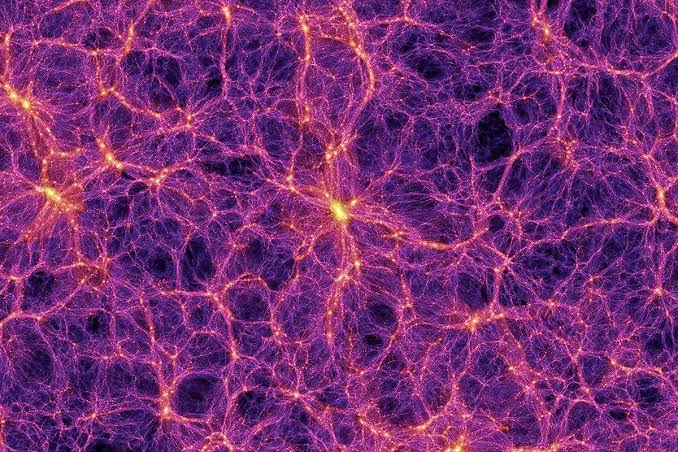
The “cosmic web” galaxy clusters from the Millenium simulation. Measuring and understanding this web can tell us a lot about the fundamental constituents of the universe. Source
To determine what dark matter is then requires an attack from two fronts: design experiments here on earth attempting directly detect it, and further study its cosmic implications to look for more clues as to its properties.
The panel recommended next generation telescopes to study the CMB as a top priority. The so called ‘Stage 4’ CMB experiment would deploy telescopes in both the south pole and Chile’s Atacama desert to better characterize sources of atmospheric noise. The CMB has been studied extensively before, but the increased precision of CMS-S4 could shed light on mysteries like dark energy, dark matter, inflation, and the recent Hubble Tension. Given the past fruitfulness of these efforts, I think few doubted the science case for such a next generation experiment.
A mockup of one of the CMS-S4 telescopes which will be based in the Chilean desert. Note the person for scale on the right (source)
The P5 report recommended a suite of new dark matter experiments in the next decade, including the ‘ultimate’ liquid Xenon based dark matter search. Such an experiment would follow in the footsteps of massive noble gas experiments like LZ and XENONnT which have been hunting for a favored type of dark matter called WIMP’s for the last few decades. These experiments essentially build giant vats of liquid Xenon, carefully shield from any sources of external radiation, and look for signs of dark matter particles bumping into any of the Xenon atoms. The larger the vat of Xenon, the higher chance a dark matter particle will bump into something. Current generation experiments have ~7 tons of Xenon, and the next generation experiment would be even larger. The next generation aims to reach the so called ‘neutrino floor’, the point as which the experiments would be sensitive enough to observe astrophysical neutrinos bumping into the Xenon. Such neutrino interactions would look extremely similar to those of dark matter, and thus represent an unavoidable background which would signal the ultimate sensitivity of this type of experiment. WIMP’s could still be hiding in a basement below this neutrino floor, but finding them would be exceedingly difficult.
A photo of the current XENONnT experiment. This pristine cavity is then filled with liquid Xenon and closely monitored for signs of dark matter particles bumping into one of the Xenon atoms. Credit: XENON Collaboration
WIMP’s are not the only dark matter candidates in town, and recent years have also seen an explosion of interest in the broad range of dark matter possibilities, with axions being a prominent example. Other kinds of dark matter could have very different properties than WIMPs and have had much fewer dedicated experiments to search for them. There is ‘low hanging fruit’ to pluck in the way of relatively cheap experiments which can achieve world-leading sensitivity. Previously, these ‘table top’ sized experiments had a notoriously difficult time obtaining funding, as they were often crowded out of the budgets by the massive flagship projects. However, small experiments can be crucial to ensuring our best chance of dark matter discovery, as they fill in the blinds pots missed by the big projects.
The panel therefore recommended creating a new pool of funding set aside for these smaller scale projects. Allowing these smaller scale projects to flourish is important for the vibrancy and scientific diversity of the field, as the centralization of ‘big science’ projects can sometimes lead to unhealthy side effects. This specific recommendation also mirrors a broader trend of the report: to attempt to rebalance the budget portfolio to be spread more evenly and less dominated by the large projects.
A pie chart comparing the budget porfolio in 2023 (left) versus the projected budget in 2033 (right). Currently most of the budget is being taken up by the accelerator upgrades and cavern construction of DUNE, with some amount for the LHC upgrades. But by 2033 the panel recommends a much more equitable balance between different research area.
What Didn’t Make It
Any report like this comes with some tough choices. Budget realities mean not all projects can be funded. Besides the pairing down of some of DUNE’s upgrades, one of the biggest areas that was recommended against were ‘accessory experiments at the LHC’. In particular, MATHUSULA and the Forward Physics Facility were two experiments that proposed to build additional detectors near already existing LHC collision points to look for particles that may be missed by the current experiments. By building new detectors hundreds of meters away from the collision point, shielded by concrete and the earth, they can obtained unique sensitivity to ‘long lived’ particles capable of traversing such distances. These experiments would follow in the footsteps of the current FASER experiment, which is already producing impressive results.
While FASER found success as a relatively ‘cheap’ experiment, reusing detector components from and situating itself in a beam tunnel, these new proposals were asking for quite a bit more. The scale of these detectors would have required new caverns to be built, significantly increasing the cost. Given the cost and specialized purpose of these detectors, the panel recommended against their construction. These collaborations may now try to find ways to pare down their proposal so they can apply to the new small project portfolio.
Another major decision by the panel was to recommend against hosting a new Higgs factor collider in the US. But that will discussed more in a future post.
Conclusions
The P5 panel was faced with a difficult task, the total cost of all projects they were presented with was three times the budget. But they were able to craft a plan that continues the work of the previous decade, addresses current shortcomings and lays out an inspiring vision for the future. So far the community seems to be strongly rallying behind it. At time of writing, over 2700 community members from undergraduates to senior researchers have signed a petition endorsing the panels recommendations. This strong show of support will be key for turning these recommendations into actual funding, and hopefully lobbying congress to even increase funding so that more of this vision can be realized.
For those interested the full report as well as executive summaries of different areas can be found on the P5 website. Members of the US particle physics community are also encouraged to sign the petition endorsing the recommendations here.
And stayed tuned for part 2 of our coverage which will discuss the implications of the report on future colliders!
Deep underground, on the border between Switzerland and France, the Large Hadron Collider (LHC) is starting back up again after a 4 year hiatus. Today, July 5th, the LHC had its first full energy collisions since 2018. Whenever the LHC is running is exciting enough on its own, but this new run of data taking will also feature several upgrades to the LHC itself as well as the several different experiments that make use of its collisions. The physics world will be watching to see if the data from this new run confirms any of the interesting anomalies seen in previous datasets or reveals any other unexpected discoveries.
New and Improved
During the multi-year shutdown the LHC itself has been upgraded. Noticably the energy of the colliding beams has been increased, from 13 TeV to 13.6 TeV. Besides breaking its own record for the highest energy collisions every produced, this 5% increase to the LHC’s energy will give a boost to searches looking for very rare high energy phenomena. The rate of collisions the LHC produces is also expected to be roughly 50% higher previous maximum achieved in previous runs. At the end of this three year run it is expected that the experiments will have collected twice as much data as the previous two runs combined.
The experiments have also been busy upgrading their detectors to take full advantage of this new round of collisions.
The ALICE experiment had the most substantial upgrade. It features a new silicon inner tracker, an upgraded time projection chamber, a new forward muon detector, a new triggering system and an improved data processing system. These upgrades will help in its study of exotic phase of matter called the quark gluon plasma, a hot dense soup of nuclear material present in the early universe.
A diagram showing the various upgrades to the ALICE detector (source)
ATLAS and CMS, the two ‘general purpose’ experiments at the LHC, had a few upgrades as well. ATLAS replaced their ‘small wheel’ detector used to measure the momentum of muons. CMS replaced the inner most part its inner tracker, and installed a new GEM detector to measure muons close to the beamline. Both experiments also upgraded their software and data collection systems (triggers) in order to be more sensitive to the signatures of potential exotic particles that may have been missed in previous runs.
The new ATLAS ‘small wheel’ being lowered into place. (source)
The LHCb experiment, which specializes in studying the properties of the bottom quark, also had major upgrades during the shutdown. LHCb installed a new Vertex Locator closer to the beam line and upgraded their tracking and particle identification system. It also fully revamped its trigger system to run entirely on GPU’s. These upgrades should allow them to collect 5 times the amount of data over the next two runs as they did over the first two.
One of the main goals in particle physics now is direct experimental evidence of a phenomena unexplained by the Standard Model. While very successful in many respects, the Standard Model leaves several mysteries unexplained such as the nature of dark matter, the imbalance of matter over anti-matter, and the origin of neutrino’s mass. All of these are questions many hope that the LHC can help answer.
Much of the excitement for Run-3 of the LHC will be on whether the additional data can confirm some of the deviations from the Standard Model which have been seen in previous runs.
One very hot topic in particle physics right now are a series of ‘flavor anomalies‘ seen by the LHCb experiment in previous LHC runs. These anomalies are deviations from the Standard Model predictions of how often certain rare decays of the b quarks should occur. With their dataset so far, LHCb has not yet had enough data to pass the high statistical threshold required in particle physics to claim a discovery. But if these anomalies are real, Run-3 should provide enough data to claim a discovery.
A summary of the various measurements making up the ‘flavor anomalies’. The blue lines and error bars indicate the measurements and their uncertainties. The yellow line and error bars indicates the standard model predictions and their uncertainties. Source
There are also a decent number ‘excesses’, potential signals of new particles being produced in LHC collisions, that have been seen by the ATLAS and CMS collaborations. The statistical significance of these excesses are all still quite low, and many such excesses have gone away with more data. But if one or more of these excesses was confirmed in the Run-3 dataset it would be a massive discovery.
While all of these anomalies are gamble, this new dataset will also certainly be used to measure various known entities with better precision, improving our understanding of nature no matter what. Our understanding of the Higgs boson, the top quark, rare decays of the bottom quark, rare standard model processes, the dynamics of the quark gluon plasma and many other areas will no doubt improve from this additional data.
In addition to these ‘known’ anomalies and measurements, whenever an experiment starts up again there is also the possibility of something entirely unexpected showing up. Perhaps one of the upgrades performed will allow the detection of something entirely new, unseen in previous runs. Perhaps FASER will see signals of long-lived particles missed by the other experiments. Or perhaps the data from the main experiments will be analyzed in a new way, revealing evidence of a new particle which had been missed up until now.
No matter what happens, the world of particle physics is a more exciting place when the LHC is running. So lets all cheers to that!

 Login